REVIEW 6 minor 1 cited by
Constraining shear modulus of polycrystalline neutron star crust: Hashin-Shtrikman variational approach
T0 review · 0 major / 6 minor · reviewed 2026-08-06 · deepseek-v4-flash
Pith's one-line read The neutron star crust's effective shear modulus lies in a Hashin-Shtrikman band that excludes the standard Voigt estimate under uncorrelated crystallites.
desk verdict First application of Hashin-Shtrikman bounds to neutron star crust; solid, honest, and with the right caveats. read the letter →
The pith
A machine-rendered reading of the paper's core claim, the machinery that carries it, and where it could break.
The reading
What carries the argument
The load-bearing object is the Hashin-Shtrikman variational principle for polycrystals of cubic crystallites. It supplies explicit algebraic bounds by comparing the actual displacement field with a reference isotropic material and choosing the reference shear modulus equal to the two single-crystal shear stiffnesses, $c_{44}$ and $(c_{11}-c_{12})/2$; because the crust bulk modulus $K$ is much larger than these shear stiffnesses, the simplified forms depend only on shear coefficients. The approach requires no assumption about crystallite shape, only that orientation correlations of any order are absent.
What would settle it
A molecular-dynamics or phase-field simulation of a polycrystalline Coulomb crystal with deliberately correlated crystallite orientations, measuring the effective shear modulus directly, would settle whether the Hashin-Shtrikman interval can be violated; a measured value outside $[0.0712, 0.1028]$ in static bcc Coulomb units would falsify the paper's central claim as stated.
Extended reading notes
Core claim
The central claim is that, under the assumption of uncorrelated crystallite orientations, the effective shear modulus of neutron star crust matter obeys $\mu_{\mathrm{HS}}^{(1)} \le \mu \le \mu_{\mathrm{HS}}^{(2)}$, and these Hashin-Shtrikman bounds are strictly tighter than the Voigt-Reuss bounds. For the static one-component Coulomb crystal with a bcc lattice, $\mu_R = 0.0510$, $\mu_{\mathrm{HS}}^{(1)} = 0.0712$, $\mu_{\mathrm{HS}}^{(2)} = 0.1028$, and $\mu_V = 0.1195$; thus the Voigt estimate, the value most astrophysical models use, overestimates the shear modulus within these assumptions. Electron screening and nuclear motion lower both bounds, and the same bracketing holds for Yukawa and ordered binary crystals; at charge ratio $R_Z \approx 2.29$ the bounds merge because the crystallites become elastically isotropic. The paper does not claim to know the exact effective shear modulus; it claims that the true value must lie in the stated interval unless crystallite orientations are correlated.
Load-bearing premise
The entire tightness of the bounds rests on the assumption that crystallite orientations are completely uncorrelated; if growth processes such as epitaxy align crystallites, the true shear modulus can lie outside the Hashin-Shtrikman interval.
Editorial extensions
If this is right
- Models of torsional crust oscillations, glitches, and crust-breaking events that use the Voigt estimate are stiffer than the Hashin-Shtrikman upper bound permits; within the stated assumptions they should use the Hashin-Shtrikman interval or at least not exceed $\mu_{\mathrm{HS}}^{(2)}$.
- Electron screening and nuclear motion lower both bounds, so the effective stiffness is reduced further in deeper, hotter, or more neutron-rich layers.
- The self-consistent estimate of Kobyakov and Pethick lies inside the Hashin-Shtrikman interval, so it remains a plausible point value but is not guaranteed by the same assumptions.
- At charge ratio $R_Z \approx 2.29$ in ordered binary crystals, all estimates coincide, so in that special composition the effective shear modulus is insensitive to microstructure.
Reading between the lines
- Editorial extension: if epitaxial growth produces correlated crystallite orientations, the effective shear modulus could fall outside the Hashin-Shtrikman interval, so the bounds should be used only as conditional constraints until crust microstructure is known.
- Editorial extension: the same variational machinery could be applied to nuclear pasta phases or amorphous solids, where anisotropy and shape correlations play a role, but this paper does not address those cases.
- Editorial extension: observational inference may help test this claim, since a crustal torsional oscillation frequency that requires shear stiffness above the Hashin-Shtrikman upper bound would indicate either correlated growth or unmodeled physics.
Editorial analysis
A structured set of objections, weighed in public.
Referee Report
Summary. The paper applies the Hashin-Shtrikman (HS) variational bounds to constrain the effective shear modulus of polycrystalline matter in neutron star crusts and white-dwarf cores. Under the stated assumptions of local isotropy and uncorrelated crystallite orientations, the HS formulas for cubic crystallites are specialized and simplified in the crust-appropriate limit K >> c44, c11 - c12. The bounds are then evaluated for static one-component Coulomb crystals, Yukawa crystals, Coulomb crystals with phonon corrections, and ordered binary (sc2) crystals. For the static bcc Coulomb crystal the HS interval is [0.0712, 0.1028] in units of n Z^2 e^2 / a, substantially narrower than the Voigt-Reuss interval [0.0510, 0.1195]; the self-consistent estimate falls inside. Fitting formulae are provided for astrophysical applications, and the paper concludes that, within its stated assumptions, the Voigt estimate typically overestimates the effective shear modulus.
Significance. The central derivation is sound: the HS bounds from Refs. [45,46] are correctly specialized to cubic crystallites, the K-dominated simplification of Eqs. (11)-(12) is justified for crust conditions, and the numerical evaluations are consistent with the known elastic constants. The main contribution is a parameter-free tightening of the Voigt-Reuss interval for the shear modulus, with practical fitting formulae covering electron screening, phonon corrections, and binary crystals. I particularly note the paper's transparency: Section IV explicitly states that the uncorrelated-crystallite assumption 'is not proved for stellar matter,' and the conclusions are framed conditionally. This caveat is the only load-bearing limitation I see; it does not constitute an internal inconsistency. The paper should be a useful reference for glitch, oscillation, and gravitational-wave modeling.
minor comments (6)
- [Eq. (13)] The argument of the square root should be written as sqrt(1 + 12(c11 - c12)/c44); as typeset, the expression is ambiguous and could be misread as sqrt(1 + 12 c11 - c12/c44).
- [Section IV] The phrase 'We straighten constraints' should read 'We tighten constraints'; in the same section, 'the bounds becomes broader' should be 'the bounds become broader.'
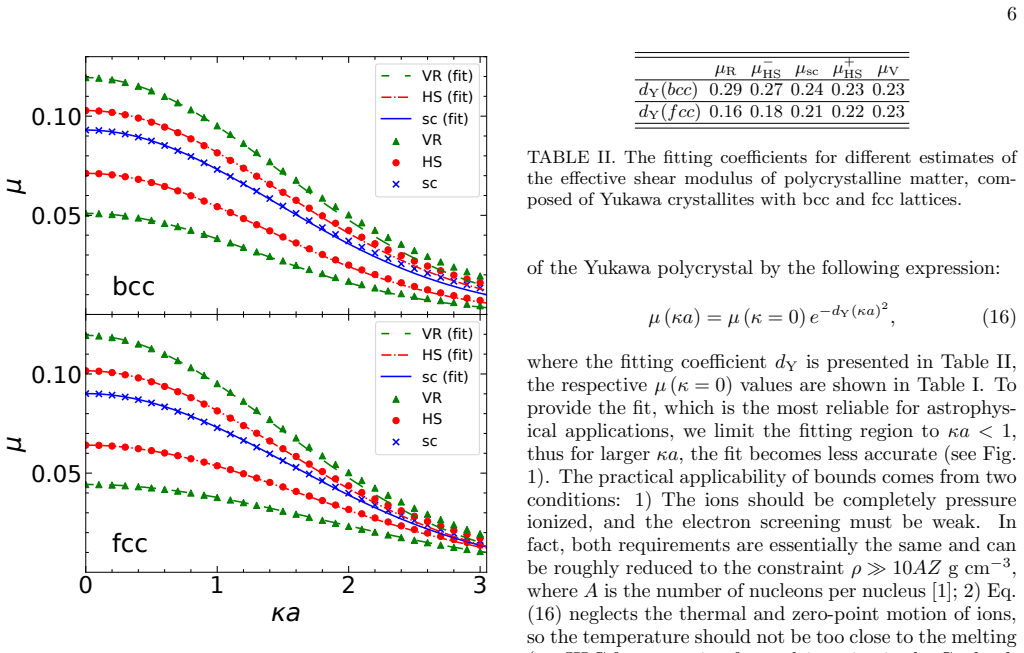
- [Section III.B and Fig. 1] The fitting formula (16) is calibrated for kappa a < 1, but the plotted curves extend to kappa a = 3; the caption or text should state that the curves beyond kappa a = 1 are extrapolations.
- [Section III.C, Eq. (18)] The right-hand side of Eq. (18), denoted mu(T = 0), is the static-lattice value excluding zero-point phonon corrections; this should be stated explicitly, since Eq. (18) at T = 0 still contains the b_q term.
- [Section II.C] The simplified bounds (11) and (12) are derived in the limit K >> c44, c11 - c12; please add a sentence quantifying the small finite-K correction or stating explicitly that it is negligible at crust densities.
- [Section III.C] The statement 'By construction, our approximation for the Voigt estimate coincides with formulae suggested by [24]' is stronger than the preceding description of matching two asymptotic limits; please rephrase or justify.
Circularity Check
No circularity: the Hashin-Shtrikman bounds are an external variational theorem applied to independently calculated monocrystal elastic coefficients; the few self-citations provide analytic Voigt formulations only and are not load-bearing.
full rationale
The paper's derivation chain is self-contained: the Hashin-Shtrikman bounds (Eqs. 9-12) are taken from the external variational theory of Refs. [45, 46, 52]; the monocrystal elastic coefficients (c44, c11 - c12) feeding those formulae come from independent prior calculations, not fitted in this paper. For the static Coulomb crystal, c44 and c11 - c12 are quoted from Ewald-summation calculations [21, 24, 26, 31]; for Yukawa crystals the coefficients use fits from Ref. [21]; phonon corrections use fits from Ref. [24]; binary crystals use Ref. [26]. None of these inputs encodes the target conclusion. The central claim that the effective shear modulus is bounded by mu_HS(1) <= mu <= mu_HS(2) with mu_HS(2) = 0.1028 < mu_V = 0.1195 follows from the external HS theorem applied to those external coefficients; it is not a fit to data that mu_V was intended to predict. The paper's own fitting expressions (Eqs. 16, 18, 20) are presented as interpolation formulas for convenience and are calibrated to the very quantities they describe, so no fitted parameter is renamed as a prediction. The self-citations [33, 34] supply the analytic Voigt expression and screening-correction remarks; the Voigt estimate is also derived by the standard rotational-invariant route [50], so these self-citations are not load-bearing. The no-correlation microstructural premise is stated explicitly and its limitation (epitaxial growth producing correlated crystallites) is honestly acknowledged in Section IV; this is a caveat on applicability to real stellar matter, not a circular step. Overall the derivation is a legitimate first application of an established bound to independent inputs.
Assumptions & free parameters
free parameters (8)
- dY(bcc) =
0.29 (Reuss), 0.27 (HS lower), 0.24 (self-consistent), 0.23 (HS upper), 0.23 (Voigt)
- dY(fcc) =
0.16 (Reuss), 0.18 (HS lower), 0.21 (self-consistent), 0.22 (HS upper), 0.23 (Voigt)
- bq =
0.090 (Reuss), 0.151 (HS lower), 0.258 (self-consistent), 0.305 (HS upper), 0.369 (Voigt)
- bcl =
2.91 (Reuss), 3.79 (HS lower), 4.31 (self-consistent), 4.57 (HS upper), 5.15 (Voigt)
- b0 (binary sc2 fit) =
0.425 (Reuss), 0.593 (HS lower), 0.775 (self-consistent), 0.857 (HS upper)
- b1 (binary sc2 fit) =
0.36 (Reuss), 0.83 (HS lower), 0.38 (self-consistent), 0.11 (HS upper)
- b2 (binary sc2 fit) =
0.001 (Reuss), 0.007 (HS lower), -0.01 (self-consistent), -0.002 (HS upper)
- bV0 =
0.995
assumptions (7)
- standard math Hashin-Shtrikman variational theorem for isotropic and homogeneous polycrystals of cubic crystallites, giving Eqs. (9) and (10).
- domain assumption The neutron star crust is locally isotropic on macroscopic scales.
- domain assumption Crystallite orientations are uncorrelated, with correlation functions of any order isotropic and homogeneous.
- domain assumption The monocrystal elastic coefficients c11, c12, and c44 from Refs. [21, 24, 26] are accurate for the models considered.
- domain assumption The bulk modulus K of the crust greatly exceeds c44 and c11 - c12, allowing Eqs. (11) and (12).
- domain assumption Leading-order Thomas-Fermi screening, represented by the Yukawa potential, is sufficient for the screening corrections discussed in Section III.B.
- domain assumption The harmonic lattice approximation describes nuclear motion, with anharmonic corrections neglected.
Cite this review
Pith. "Pith review of Constraining shear modulus of polycrystalline neutron star crust: Hashin-Shtrikman variational approach." pith.science (2026). https://pith.science/paper/AAIGQZ3D
@misc{pith2026250712266,
  author       = {Pith},
  title        = {Pith review of: Constraining shear modulus of polycrystalline neutron star crust: Hashin-Shtrikman variational approach},
  year         = {2026},
  howpublished = {\url{https://pith.science/paper/AAIGQZ3D}},
  note         = {Machine review of arXiv:2507.12266}
}
read the original abstract
The elastic properties of the neutron star crust are thought to play a crucial role in various phenomena of neutron stars (glitches, oscillations, gravitational wave emission) and should be described quantitatively to model these phenomena. The fundamental problem of this description is associated with the polycrystalline nature of the crust: similar to terrestrial materials, the elastic moduli, strictly speaking, depend on the shape and orientation of crystallites, but for the crust, they are unknown. As a result, some assumptions are generally required to predict the elastic properties or constrain their possible range. In this paper, we follow the commonly believed assumption that the crust is (locally) isotropic, which allows us to describe elastic properties by two (effective) parameters: bulk and shear moduli. The bulk modulus is well determined by the Voigt-Reuss bounds, and we constrain the shear modulus by applying, for the first time in astrophysics of compact stars, the variational Hashin-Shtrikman approach, based on the additional assumption that there are no correlations in the orientation of crystallites. We analyse the Hashin-Shtrikman bounds for the one-component crust taking into account the electron screening and the motion of the nuclei, and for two-component static crystals. In particular, we demonstrate that within applied assumptions the effective shear modulus should be lower than the Voigt estimate, typically applied in the astrophysical literature.
Figures


Figures from the paper (1 more)

Forward citations
Cited by 1 Pith paper
-
Tidal deformation and strain accumulation of solid compact stars
Solid strangeon stars of 1.4 Msun differ by ~40% in tidal deformability from fluid counterparts and release up to 10^46 erg via central-peaking strain fracture at hundreds of Hz.
Reference graph
Works this paper leans on
-
[1]
P. Haensel, A. Potekhin, and D. Yakovlev, Neutron Stars 1: Equation of State and Structure , Astrophysics and Space Science Library (Springer-Verlag, Berlin, 2007)
work page 2007
-
[2]
N. Chamel and P. Haensel, Physics of Neutron Star Crusts, Liv. Rev. Relativ. 11, 10 (2008)
work page 2008
- [3]
-
[4]
M. D. Jones and D. M. Ceperley, Crystallization of the One-Component Plasma at Finite Temperature, Phys. Rev. Lett. 76, 4572 (1996)
work page 1996
-
[5]
A. Y. Potekhin and G. Chabrier, Equation of state of fully ionized electron-ion plasmas. II. Extension to rela- tivistic densities and to the solid phase, Phys. Rev. E 62, 8554 (2000), arXiv:astro-ph/0009261 [astro-ph]
work page Pith review arXiv 2000
-
[6]
Z. Medin and A. Cumming, Crystallization of classi- cal multicomponent plasmas, Phys. Rev. E 81, 036107 (2010), arXiv:1002.3327 [astro-ph.SR]
arXiv 2010
-
[7]
M. E. Caplan and C. J. Horowitz, Colloquium: Astro- material science and nuclear pasta, Rev. Mod. Phys. 89, 041002 (2017)
work page 2017
-
[8]
M. E. Caplan, A. Cumming, D. K. Berry, C. J. Horowitz, and R. Mckinven, Polycrystalline Crusts in Ac- creting Neutron Stars, Astrophys. J. 860, 148 (2018), arXiv:1804.06942 [astro-ph.HE]
arXiv 2018
Show all 76 references
-
[9]
A. F. Fantina, S. De Ridder, N. Chamel, and F. Gul- minelli, Crystallization of the outer crust of a non- accreting neutron star, Astron. Astrophys. 633, A149 (2020), arXiv:1912.02849 [astro-ph.HE]
2020 arXiv
-
[10]
Carreau, F
T. Carreau, F. Gulminelli, N. Chamel, A. F. Fantina, and J. M. Pearson, Crystallization of the inner crust of a neu- tron star and the influence of shell effects, Astron. Astro- phys. 635, A84 (2020), arXiv:1912.01265 [astro-ph.HE]
2020 arXiv
-
[11]
Arnold, J
B. Arnold, J. Daligault, D. Saumon, A. B´ edard, and S. X. Hu, Crystal nucleation rates in one-component Yukawa systems, Phys. Rev. E 111, 025206 (2025), arXiv:2503.05902 [physics.plasm-ph]
2025 arXiv
-
[12]
Hamaguchi, R
S. Hamaguchi, R. T. Farouki, and D. H. E. Dubin, Triple point of Yukawa systems, Phys. Rev. E 56, 4671 (1997)
1997
-
[13]
D. A. Baiko, Effect of the electron gas polarizability on the specific heat of phonons in Coulomb crystals, Phys. Rev. E 66, 056405 (2002)
2002
-
[14]
Kozhberov, Electrostatic energy and phonon proper- ties of Yukawa crystals, Phys
A. Kozhberov, Electrostatic energy and phonon proper- ties of Yukawa crystals, Phys. Rev. E 98, 063205 (2018), arXiv:1901.04427 [cond-mat.mtrl-sci]
2018 arXiv
-
[15]
A. A. Kozhberov and A. Y. Potekhin, Electro- static energy of Coulomb crystals with polarized elec- tron background, Phys. Rev. E 103, 043205 (2021), arXiv:2104.09964 [physics.plasm-ph]
2021 arXiv
-
[16]
Landau, E
L. Landau, E. Lifshitz, A. Kosevich, and L. Pitaevskii, Theory of Elasticity , Course of theoretical physics (Butterworth-Heinemann, 1986)
1986
-
[17]
C. J. Horowitz and J. Hughto, Molecular Dynamics Sim- ulation of Shear Moduli for Coulomb Crystals, arXiv e- prints , arXiv:0812.2650 (2008), arXiv:0812.2650 [astro- ph]
2008 arXiv
-
[18]
Hoffman and J
K. Hoffman and J. Heyl, Mechanical properties of non- accreting neutron star crusts, Mon. Not. R. Astron. Soc. 426, 2404 (2012), arXiv:1208.3258 [astro-ph.SR]
2012 arXiv
-
[19]
D. A. Baiko, Shear Modulus of a Coulomb Crystal of Ions: Effects of Ion Motion and Electron Background Polarization, Contributions to Plasma Physics 52, 157 (2012)
2012
-
[20]
D. A. Baiko, Screening corrections to the Coulomb crys- tal elastic moduli, Mon. Not. R. Astron. Soc. 451, 3055 (2015), arXiv:1603.04227 [astro-ph.SR]
2015 arXiv
-
[21]
A. A. Kozhberov, Elastic properties of Yukawa crystals, Physics of Plasmas 29, 043701 (2022), https://doi.org/10.1063/5.0083168
2022 doi
-
[22]
via another approach (averaging of the shear wave velocity), which leads to the same result as Voigt’s as- sumption (Eq. 4). Within the Coulomb crystal approxi- mation, the Voigt estimate for the effective shear modu- lus can be calculated analytically, leading to a simple ex-...
2024
-
[23]
Ogata and S
S. Ogata and S. Ichimaru, First-principles calculations of shear moduli for Monte Carlo-simulated Coulomb solids, Phys. Rev. A 42, 4867 (1990)
1990
-
[24]
Strohmayer, S
T. Strohmayer, S. Ogata, H. Iyetomi, S. Ichimaru, and H. M. van Horn, The shear modulus of the neutron star crust and nonradial oscillations of neutron stars, Astro- phys. J. 375, 679 (1991)
1991
-
[25]
D. A. Baiko, Shear modulus of neutron star crust, Mon. Not. R. Astron. Soc. 416, 22 (2011), arXiv:1104.0173 [astro-ph.SR]
2011 arXiv
-
[26]
Igarashi and H
T. Igarashi and H. Iyetomi, Phase characteristics and elastic properties of binary Coulomb compounds, Journal of Physics A Mathematical General 36, 6197 (2003)
2003
-
[27]
A. A. Kozhberov, Elastic properties of binary crystals in neutron stars and white dwarfs, Mon. Not. R. Astron. Soc. 486, 4473 (2019), arXiv:1912.11395 [astro-ph.HE]
2019 arXiv
-
[28]
D. A. Baiko, Liquid-phase epitaxy of neutron star crusts and white dwarf cores, Mon. Not. R. Astron. Soc. 528, 408 (2024), arXiv:2312.17544 [astro-ph.SR]
2024 arXiv
-
[29]
D. A. Baiko, Elastic and breaking properties of epi- taxial face-centered crystals in neutron star crusts and white dwarf cores, Contributions to Plasma Physics 64, e202400004 (2024), arXiv:2403.11991 [astro-ph.SR]
2024 arXiv
-
[30]
J. A. Morales and C. J. Horowitz, Anisotropic neu- tron star crust, solar system mountains, and grav- 11 itational waves, Phys. Rev. D 110, 044016 (2024), arXiv:2309.04855 [astro-ph.HE]
2024 arXiv
-
[31]
J. A. Morales and C. J. Horowitz, Limiting Rotation Rate of Neutron Stars from Crust Breaking and Grav- itational Waves, Astrophys. J. Lett. 978, L8 (2025), arXiv:2410.19111 [astro-ph.HE]
2025 arXiv
-
[32]
Fuchs, A quantum mechanical calculation of the elas- tic constants of monovalent metals, Proc
K. Fuchs, A quantum mechanical calculation of the elas- tic constants of monovalent metals, Proc. of the Royal Society of London A: Mathematical, Physical and Engi- neering Sciences 153, 622 (1936)
1936
-
[33]
Voigt, Theoretische Studien uber die Elas- tizit¨ atsverhh¨ altnisse der Kristalle., Abh
W. Voigt, Theoretische Studien uber die Elas- tizit¨ atsverhh¨ altnisse der Kristalle., Abh. Kgl. Ges. Wis. G¨ ottingen34, 1 (1887)
-
[34]
A. I. Chugunov, Neutron star crust in Voigt approxima- tion: general symmetry of the stress-strain tensor and an universal estimate for the effective shear modulus, Mon. Not. R. Astron. Soc. 500, L17 (2021), arXiv:2010.08398 [astro-ph.HE]
2021 arXiv
-
[35]
A. I. Chugunov, Neutron star crust in Voigt approxima- tion II: general formula for electron screening correction for effective shear modulus, Mon. Not. R. Astron. Soc. 517, 4607 (2022), arXiv:2207.14649 [astro-ph.HE]
2022 arXiv
-
[36]
D. G. Yakovlev, Self-similarity relations for torsional os- cillations of neutron stars, Mon. Not. R. Astron. Soc. 518, 1148 (2023), arXiv:2210.02931 [astro-ph.SR]
2023 arXiv
-
[37]
A. A. Kozhberov and D. G. Yakovlev, Deformed crys- tals and torsional oscillations of neutron star crust, Mon. Not. R. Astron. Soc. 10.1093/mnras/staa2715 (2020), arXiv:2009.04952 [astro-ph.HE]
2020 arXiv
-
[38]
Passamonti and J
A. Passamonti and J. A. Pons, Quasi-periodic oscillations in superfluid, relativistic magnetars with nuclear pasta phases, Mon. Not. R. Astron. Soc. 463, 1173 (2016), arXiv:1606.02132 [astro-ph.HE]
2016 arXiv
-
[39]
Kobyakov and C
D. Kobyakov and C. J. Pethick, Elastic properties of polycrystalline dense matter, Mon. Not. R. Astron. Soc. 449, L110 (2015), arXiv:1502.02461 [astro-ph.SR]
2015 arXiv
-
[40]
Reuss, Berechnung der Fließgrenze von Mis- chkristallen auf Grund der Plastizit¨ atsbedingung f¨ ur Einkristalle ., Zeitschrift Angewandte Mathematik und Mechanik 9, 49 (1929)
A. Reuss, Berechnung der Fließgrenze von Mis- chkristallen auf Grund der Plastizit¨ atsbedingung f¨ ur Einkristalle ., Zeitschrift Angewandte Mathematik und Mechanik 9, 49 (1929)
1929
-
[41]
Hill, The Elastic Behaviour of a Crystalline Aggregate, Proceedings of the Physical Society A 65, 349 (1952)
R. Hill, The Elastic Behaviour of a Crystalline Aggregate, Proceedings of the Physical Society A 65, 349 (1952)
1952
-
[42]
Kr¨ oner, Berechnung der elastischen Konstanten des Vielkristalls aus den Konstanten des Einkristalls, Zeitschrift fur Physik 151, 504 (1958)
E. Kr¨ oner, Berechnung der elastischen Konstanten des Vielkristalls aus den Konstanten des Einkristalls, Zeitschrift fur Physik 151, 504 (1958)
1958
-
[43]
J. D. Eshelby, Prog. Solid Mech. 2, 87 (1961)
1961
-
[44]
deWit, Elastic constants and thermal expansion aver- ages of a nontextured polycrystal, Journal of mechanics of materials and structures 3, 195 (2008)
R. deWit, Elastic constants and thermal expansion aver- ages of a nontextured polycrystal, Journal of mechanics of materials and structures 3, 195 (2008)
2008
-
[45]
Y. Wu, M. Jia, X. Gou, and W. Xu, Average eshelby tensor of an arbitrarily shaped inclusion from convexity to non-convexity: Effective elastic properties of compos- ites, International Journal of Solids and Structures 269, 112183 (2023)
2023
-
[46]
Hashin and S
Z. Hashin and S. Shtrikman, On some variational princi- ples in anisotropic and nonhomogeneous elasticity, Jour- nal of Mechanics Physics of Solids 10, 335 (1962)
1962
-
[47]
Hashin and S
Z. Hashin and S. Shtrikman, A variational approach to the theory of the elastic behaviour of polycrystals, Jour- nal of Mechanics Physics of Solids 10, 343 (1962)
1962
-
[48]
C. M. Kube and A. P. Arguelles, Bounds and self- consistent estimates of the elastic constants of polycrys- tals, Computers and Geosciences 95, 118 (2016)
2016
-
[49]
J. M. Brown, Determination of Hashin-Shtrikman bounds on the isotropic effective elastic moduli of poly- crystals of any symmetry, Computers and Geosciences 80, 95 (2015)
2015
-
[50]
D. C. Wallace, Thermoelasticity of Stressed Materials and Comparison of Various Elastic Constants, Physical Review 162, 776 (1967)
1967
-
[51]
D. N. Blaschke, Averaging of elastic constants for poly- crystals, Journal of Applied Physics 122, 145110 (2017), arXiv:1706.07132 [cond-mat.mtrl-sci]
2017 arXiv
-
[52]
Avellaneda and G
M. Avellaneda and G. W. Milton, Optimal bounds on the effective bulk modulus of polycrystals, SIAM Journal on Applied Mathematics 49, 824 (1989)
1989
-
[53]
Kr¨ oner, Bounds for effective elastic moduli of disor- dered materials, Journal of Mechanics Physics of Solids 25, 137 (1977)
E. Kr¨ oner, Bounds for effective elastic moduli of disor- dered materials, Journal of Mechanics Physics of Solids 25, 137 (1977)
1977
-
[54]
Chamel, N
N. Chamel, N. N. Shchechilin, and A. I. Chugunov, Pressure and chemical potentials in the inner crust of a cold neutron star within Hartree-Fock and extended Thomas-Fermi methods, Phys. Rev. C 111, 015805 (2025), arXiv:2501.08075 [nucl-th]
2025 arXiv
-
[55]
N. A. Zemlyakov and A. I. Chugunov, Neutron star in- ner crust: reduction of shear modulus by nuclei finite size effect, Mon. Not. R. Astron. Soc. 518, 3813 (2023), arXiv:2209.05821 [astro-ph.HE]
2023 arXiv
-
[56]
C.-J. Xia, T. Maruyama, N. Yasutake, T. Tatsumi, and Y.-X. Zhang, Elastic properties of nuclear pasta in a fully three-dimensional geometry, Physics Letters B 839, 137769 (2023), arXiv:2209.13310 [nucl-th]
2023 arXiv
-
[57]
J. D. Eshelby, The Determination of the Elastic Field of an Ellipsoidal Inclusion, and Related Problems, Pro- ceedings of the Royal Society of London Series A 241, 376 (1957)
1957
-
[58]
Jancovici, On the relativistic degenerate electron gas, Il Nuovo Cimento 25, 428 (1962)
B. Jancovici, On the relativistic degenerate electron gas, Il Nuovo Cimento 25, 428 (1962)
1962
-
[59]
V. E. Fortov, A. V. Ivlev, S. A. Khrapak, A. G. Khra- pak, and G. E. Morfill, Complex (dusty) plasmas: Cur- rent status, open issues, perspectives, Phys. Rep. 421, 1 (2005)
2005
-
[60]
Donk´ o, G
Z. Donk´ o, G. J. Kalman, and P. Hartmann, Dynamical correlations and collective excitations of Yukawa liquids, Journal of Physics Condensed Matter 20, 413101 (2008), arXiv:0808.1963 [physics.plasm-ph]
2008 arXiv
-
[61]
B. A. Klumov, On melting criteria for complex plasma, Physics Uspekhi 53, 1053 (2010)
2010
-
[62]
S. A. Khrapak, Thermodynamics of Yukawa systems and sound velocity in dusty plasmas, Plasma Physics and Controlled Fusion 58, 014022 (2016)
2016
-
[63]
Khrapak and B
S. Khrapak and B. Klumov, High-frequency elastic moduli of two-dimensional Yukawa fluids and solids, Physics of Plasmas 25, 033706 (2018), arXiv:1803.05295 [physics.plasm-ph]
2018 arXiv
-
[64]
S. Lu, D. Huang, and Y. Feng, Shear softening and hard- ening of a two-dimensional yukawa solid, Phys. Rev. E 105, 035203 (2022)
2022
-
[65]
Beckers, J
J. Beckers, J. Berndt, D. Block, M. Bonitz, P. J. Brugge- man, L. Couedel, G. L. Delzanno, Y. Feng, R. Gopalakr- ishnan, F. Greiner, P. Hartmann, M. Horanyi, H. Ker- sten, C. A. Knapek, U. Konopka, U. Kortshagen, E. G. Kostadinova, E. Kovacevic, S. I. Krasheninnikov, I. Mann, ...
2023
-
[66]
Zhukhovitskii and E
D. Zhukhovitskii and E. Perevoshchikov, Structural Transition in Strongly Coupled Coulomb Clusters, High Temperature 62, 421 (2024)
2024
-
[67]
A. M. Lipaev, V. N. Naumkin, S. A. Khrapak, A. D. Usachev, O. F. Petrov, M. H. Thoma, M. Kretschmer, C.-R. Du, O. D. Kononenko, and A. V. Zobnin, Wave dispersion in a three-dimensional complex plasma solid under microgravity conditions, Phys. Rev. E111, 015209 (2025)
2025
-
[68]
D. A. Baiko and A. I. Chugunov, Ab initio thermodynam- ics of one-component plasma for astrophysics of white dwarfs and neutron stars, Mon. Not. R. Astron. Soc.510, 2628 (2022), arXiv:2112.04822 [astro-ph.HE]
2022 arXiv
-
[69]
Chamel and A
N. Chamel and A. F. Fantina, Binary and ternary ionic compounds in the outer crust of a cold nonaccreting neu- tron star, Phys. Rev. C 94, 065802 (2016)
2016
-
[70]
A. A. Kozhberov and D. A. Baiko, Physical Features of Binary Coulomb Crystals: Madelung Energy, Collec- tive Modes and Phonon Heat Capacity, Contributions to Plasma Physics 52, 153 (2012)
2012
-
[71]
E. E. Salpeter, Electrons Screening and Thermonuclear Reactions, Australian Journal of Physics 7, 373 (1954)
1954
-
[72]
J. P. Hansen and P. Vieillefosse, Equation of state of the classical two-component plasma, Phys. Rev. Lett.37, 391 (1976)
1976
-
[73]
P. H. Dederichs and R. Zeller, Variational treatment of the elastic constants of disordered materials, Zeitschrift fur Physik 259, 103 (1973)
1973
-
[74]
Gairola and E
B. Gairola and E. Kr¨ oner, A simple formula for calcu- lating the bounds and the self-consistent value of the shear modulus of a polycrystalline aggregate of cubic crystals, International Journal of Engineering Science19, 865 (1981)
1981
-
[75]
C. M. Kube and M. de Jong, Elastic constants of poly- crystals with generally anisotropic crystals, Journal of Applied Physics 120, 165105 (2016)
2016
-
[76]
J. G. Berryman, Bounds and self-consistent estimates for elastic constants of random polycrystals with hexagonal, trigonal, and tetragonal symmetries, Journal of Mechan- ics Physics of Solids 53, 2141 (2005)
2005
Reviewed August 6, 2026 · model on record in the stance chip above.
Discussion (0). Continue with ORCID to comment.