REVIEW 3 major objections 5 minor 59 references
Metal-polluted Population III galaxies and How to Find Them
T0 review · 3 major / 5 minor · reviewed 2026-08-15 · deepseek-v4-flash
Pith's one-line read Metal lines betray galaxies that host only first stars
desk verdict The physical idea that metal lines don't rule out PopIII is worth taking seriously, but the candidate pool is model-dependent and the self-polluted phase is a single timestep without an invoked delay. read the letter →
The pith
A machine-rendered reading of the paper's core claim, the machinery that carries it, and where it could break.
The reading
What carries the argument
The argument runs on a semi-analytical galaxy-formation model (NEFERTITI) that follows individual PopIII stars, their supernova yields, and the chemical enrichment of gas within Milky Way–like progenitors, coupled to the Cloudy photoionization code to synthesize emission-line spectra for about 28,000 model galaxies. The load-bearing output is the evolutionary staging of a PopIII galaxy—pristine, self-polluted, hybrid, and PopIII-poor—based on the fraction of stellar mass in metal-free stars. The new candidate-selection tool is the set of four UV metal-line ratio inequalities, valid for log U > −2, which define regions populated only by galaxies with more than 25% of stellar mass in metal-free stars.
What would settle it
Observe a sample of high-redshift galaxies selected to lie inside the proposed UV diagnostic regions with JWST/NIRSpec deep spectroscopy; if the predicted HeII λ1640 emission (or EW(HeII λ4686) ≳ 4 Å for the optical cases) is not detected, the diagnostics are selecting ordinary star-forming galaxies or AGN rather than PopIII-dominated systems. Alternatively, measure CIV/CIII] to infer the ionization parameter: if the candidates cluster at log U ≤ −2, the claimed selection region does not apply to real PopIII galaxies.
Extended reading notes
Core claim
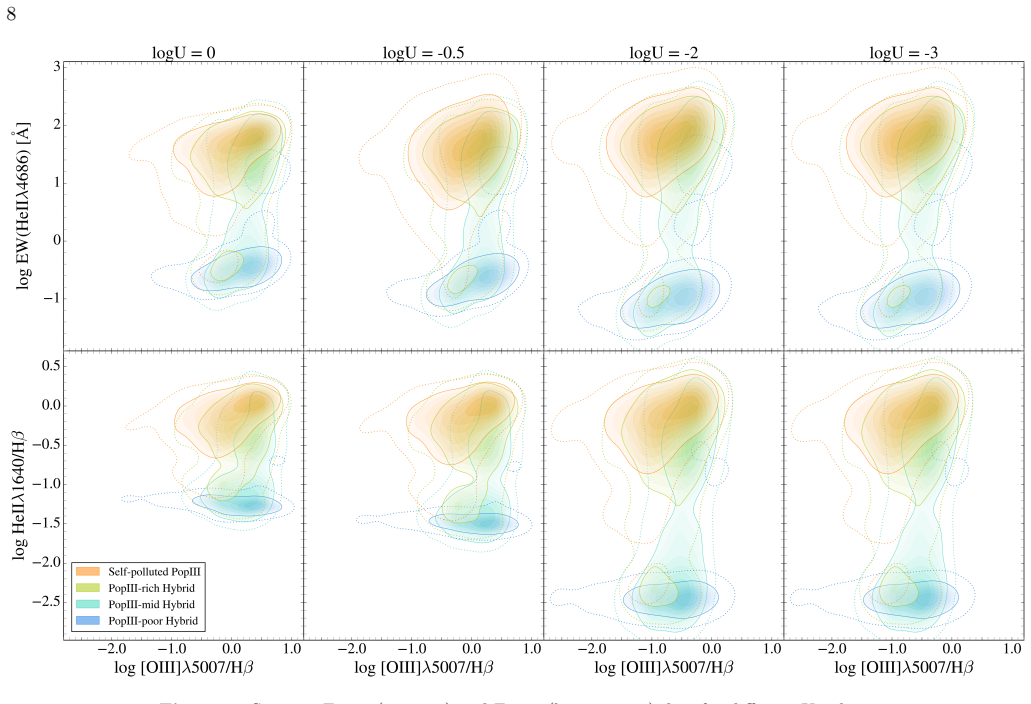
The central claim is that a pure PopIII galaxy—one whose stellar population contains no metals—can display metal emission lines because the interstellar gas has been enriched by supernovae from those same first stars. In this self-polluted phase the oxygen line ratio sits near [OIII]/Hβ ≈ 1, so metal emission does not rule out a PopIII nature. The same models show strong HeII emission (EW(HeII λ4686) ≳ 4 Å) can last up to roughly 20 Myr, part of it in the hybrid phase where PopII stars are already forming. From the modeled line ratios, the paper derives simple inequalities in CIII]/HeII versus CIV/CIII], OIII]/HeII, CIV/HeII, and SiIII]/HeII that select galaxies with M⋆,PopIII > 25% M⋆ while avoiding AGN and normal star-forming contamination. Applying these to the JADES DR3 catalog yields nine PopIII candidates.
Load-bearing premise
The whole search window depends on the assumed ionization parameter (fiducial log U = −1) and on the assumption that the gas stays enriched for at least about a million years before second-generation stars form; if real first-star systems have lower U or form PopII stars immediately, the self-polluted phase and the proposed diagnostics would be far rarer.
Editorial extensions
If this is right
- High-[OIII] galaxies at high redshift should no longer be excluded from PopIII candidacy on the basis of metal lines alone; self-polluted pure PopIII galaxies naturally have [OIII]/Hβ ≈ 1.
- Strong HeII emission remains a viable PopIII indicator for up to ~20 Myr, including the early hybrid phase, extending the observable window well beyond the few-Myr pristine phase.
- The four UV line-ratio diagnostics (Eqs. 1–4) can select PopIII-dominated galaxies with >25% PopIII stellar mass with no AGN or ordinary star-forming contamination for log U > −2.
- Nine galaxies in the JADES DR3 catalog satisfy the new diagnostics; they are the systems most worth deep follow-up to confirm HeII.
- The known candidates LAP1-B and RX J2129–z8HeII are consistent with the models, including pure self-polluted PopIII galaxies, though AGN contamination is not excluded for RX J2129–z8HeII.
Reading between the lines
- Editorial inference: If real PopIII star formation is delayed relative to the first supernovae longer than the single 1-Myr timestep assumed here, the self-polluted phase would last longer and the number of detectable PopIII galaxies could be substantially larger than the nine JADES candidates.
- Editorial inference: The strong dependence of CIV and OIII] on the ionization parameter means the same line ratios may be used to measure U in candidate sources; a target with log U ≤ −2 would fall outside the claimed diagnostic region, so such measurements provide an independent test.
- Editorial inference: The same UV-line selection could be applied to other JWST surveys and to gravitationally lensed fields, where brighter fluxes would allow direct confirmation of the predicted HeII equivalent widths.
- Editorial inference: Because the diagnostics select on stellar-mass fraction rather than pure metal-free stars, some of the nine candidates may turn out to be hybrids with only a minority PopIII component; deep HeII EW measurements will separate those cases.
Signed reviews
Editorial analysis
A structured set of objections, weighed in public.
Referee Report
Summary. This paper uses the NEFERTITI semi-analytical galaxy formation model coupled to Cloudy photoionization calculations to synthesize emission-line spectra of about 1128 PopIII galaxies from z = 17 to z = 6. It identifies a 'self-polluted' phase in which the stellar population is purely metal-free while the gas has been chemically enriched by the first PopIII supernovae, and claims that in this phase [OIII]/Hbeta is approximately 1 at the fiducial logU = -1. The paper further predicts that strong HeII emission can persist up to about 20 Myr, including during the hybrid phase when PopIII and PopII stars coexist, and proposes UV metal-line diagnostic relations (Eqs. 1-4) to select PopIII candidates with more than 25% of stellar mass in metal-free stars. Applying these diagnostics to JADES DR3 data yields nine candidate galaxies. The paper is transparent about some limitations, notably the 1-Myr duration of the self-polluted phase in NEFERTITI.
Significance. If the main claims are robust, the paper would broaden the JWST search for PopIII galaxies beyond the classic criterion of HeII emission without metal lines, by showing that metal lines can actually be present in galaxies hosting only metal-free stars. The modeling chain is a strength: NEFERTITI self-consistently follows chemical enrichment and stochastic IMF sampling, and the synthetic spectra are compared with external AGN and star-forming galaxy models. The proposed diagnostics are falsifiable and the JADES candidate list is a concrete, testable output. However, the quantitative claims are not yet robust: the self-polluted phase is a single 1-Myr timestep in the fiducial model, the ionization parameter is a free parameter, and the candidate selection relies on low-significance detections. These issues affect the central 'pool of candidates' claim and need to be addressed before the results can be considered secure.
major comments (3)
- [Section 3.1 and Discussion] The self-polluted phase, defined as purely PopIII stars with gas already enriched by PopIII SNe, lasts only one 1-Myr timestep in NEFERTITI because the enriched gas immediately reaches the critical metallicity and PopII stars form. The paper's central claim that this phase 'opens the pool of candidates' therefore depends on an unmodeled temporal delay between the PopIII supernovae and the subsequent star formation. The Discussion mentions this delay and cites Katz et al. (2023), but it is not implemented in the fiducial model. Without it, the [OIII]/Hbeta approximately 1 signature is essentially instantaneous, and the predicted candidate rate is not a robust model prediction. Please either implement such a delay in the model or quantify the detection probability implied by a 1-Myr duration.
- [Appendix A and Fig. 5] The ionization parameter U is a free parameter in the modeling, and Appendix A shows that [OIII]/Hbeta decreases with decreasing U. Thus the claimed [OIII]/Hbeta approximately 1 signature, obtained at the fiducial logU = -1, is not robust across the explored range logU = [-3, -0.5, 0]. The paper does not derive a physically motivated value of U for PopIII galaxies; the restriction to logU > -2 in Section 3.2 is an assumption. Because the location of the self-polluted phase and the diagnostic boundaries depend on U, the quantitative predictions should be marginalized over U or justified with a physical argument.
- [Section 3.2 and Fig. 3] The diagnostic boundaries in Eqs. (1)-(4) are defined by the authors' own NEFERTITI+Cloudy model grid; the external AGN and star-forming galaxy models are used only to show that they do not populate the selected regions, not to validate the boundaries independently. In addition, the JADES candidate selection uses tentative detections with S/N > 2, and the caption of Fig. 3 states that all HeII/Hbeta measurements are 5-sigma upper limits. The claim of nine PopIII candidates is therefore not yet a secure observational result. The paper should present the expected completeness and false-positive rate of the selection, or explicitly label the candidate number as an upper limit pending deeper observations.
minor comments (5)
- [Discussion] In the second paragraph of the Discussion, '25% M⋆,PopIIII' contains an extra 'I' in 'PopIIII'; it should read 'PopIII'.
- [Section 2.1] The notation 'Z gas' for the gas metallicity should be made consistent, for example as Z_gas, to avoid confusion with the stellar metallicity and with the critical metallicity Z_cr.
- [Fig. 3] The meaning of 'S/N > 2' should be defined: is it the signal-to-noise ratio of the integrated line flux, and which lines are required to meet this threshold?
- [Appendix B] The quadratic fit for b(U) in Eq. (B5) is presented without a goodness-of-fit statistic or a statement of the range of U over which the fit is valid; please add this information.
- [Fig. 1] The left schematic in Fig. 1 groups phases into pure PopIII and hybrid, but the color coding of the density distributions in the right panel is not described in the caption; please clarify which colors correspond to which evolutionary stage.
Circularity Check
No significant circularity: the claimed emission-line signatures and diagnostics emerge from a forward model (NEFERTITI + Cloudy) and are applied to JADES as selection criteria, not fitted to the JADES data.
full rationale
The central derivation chain is forward and not circular. NEFERTITI is a semi-analytical galaxy-formation model calibrated to present-day Milky Way stellar archeology and other local observations, not to the high-redshift emission-line data used for the candidate search. The synthetic spectra are produced by feeding NEFERTITI outputs (stellar populations, gas metallicities, chemical abundances) into Cloudy, so the claimed results — [OIII]/Hbeta ≈ 1 in the self-polluted phase and HeII emission lasting up to ~20 Myr — emerge from that forward chain rather than being imposed by the input. The diagnostic relations (Eqs. 1-4 and C6) are boundaries drawn on the model distributions and then applied to JADES galaxies; they are not fitted to the JADES objects that are later counted as candidates, so the nine candidates are a model-based classification, not a circular prediction. The paper is also explicit that in NEFERTITI the self-polluted phase lasts only the 1-Myr time resolution and that extending it would require a temporal delay between PopIII supernovae and subsequent star formation as implemented in other works (Katz et al. 2023); this is an acknowledged robustness limitation, not a hidden input masquerading as a prediction. The self-citations to NEFERTITI and related prior modeling are provenance and method description, not a uniqueness theorem, an ansatz smuggled in via citation, or load-bearing authority. No quoted reduction shows a fitted parameter being renamed as a prediction, and no definition ties the target result to the inputs in a circular way. Therefore the appropriate finding is no significant circularity.
Assumptions & free parameters
free parameters (5)
- PopIII IMF characteristic mass =
10 Msun (assumed)
- Ionization parameter U =
logU = -1 fiducial, range -3 to 0
- Neutral hydrogen density =
10^3 cm^-3
- Critical metallicity for PopII formation =
10^-4.5 Zsun
- Metal filling factor Q =
Q(t) from Salvadori et al. 2014
assumptions (6)
- domain assumption PopIII stars form with a Larson IMF of characteristic mass 10 Msun and masses up to 1000 Msun
- domain assumption PopIII supernova yields from Heger and Woosley (2002, 2010) and PopII yields from Limongi and Chieffi (2018) accurately describe the metal production
- domain assumption Gas clouds are plane-parallel, constant density, dust-free, with n_H = 10^3 cm^-3
- domain assumption A Milky Way analog halo simulation calibrated to local stellar archeology data is representative of high-redshift PopIII galaxies
- ad hoc to paper Fiducial logU = -1 is representative of PopIII galaxies
- domain assumption The metal filling factor Q(t) correctly describes inhomogeneous IGM enrichment
Cite this review
Pith. "Pith review of Metal-polluted Population III galaxies and How to Find Them." pith.science (2026). https://pith.science/paper/AATA2JPW
@misc{pith2026250617400,
  author       = {Pith},
  title        = {Pith review of: Metal-polluted Population III galaxies and How to Find Them},
  year         = {2026},
  howpublished = {\url{https://pith.science/paper/AATA2JPW}},
  note         = {Machine review of arXiv:2506.17400}
}
abstract
Observing Population III (hereafter PopIII) galaxies, the hosts of first-generation stars, remains challenging even with the JWST. The current few candidates have been identified through the combination of a prominent HeII emission and the absence of metal lines, a well-known but extremely brief signature of metal-free systems. Here, we accurately model the evolution of the emission from PopIII galaxies to increase the number of candidates in JWST observations. To achieve this, we employ a locally calibrated galaxy-formation model that self-consistently follows the star formation and chemical evolution initiated by the first stars. We find that PopIII galaxies can emit metal lines in their ``self-polluted'' phase, while galaxies host only metal-free stars but the gas has been chemically-enriched by the first supernovae. In this phase, PopIII galaxies have $\rm [OIII]/H\beta \approx 1$, which opens the pool of candidates to more easily detectable sources. We predict that the high HeII emission of PopIII galaxies can last up to $\rm \approx 20 \, Myrs$ and that it is partly maintained in the ``hybrid'' phase, when PopIII and PopII stars co-exist in the host galaxy. We propose novel diagnostics involving UV metal lines to select PopIII candidates in high-z JWST surveys. In JADES, we identify 9 candidate galaxies with $>25\%$ of their stellar mass in metal-free stars, showcasing the effectiveness of our method. Ultimately, the key to discovering PopIII galaxies could be to catch them during their first episodes of chemical enrichment.
Figures


Figures from the paper (3 more)


Reference graph
Works this paper leans on
-
[1]
, " * write output.state after.block = add.period write newline
ENTRY address archivePrefix author booktitle chapter doi edition editor eprint howpublished institution journal key month number organization pages publisher school series title misctitle type volume year version url label extra.label sort.label short.list INTEGERS output.state before.all mid.sentence after.sentence after.block FUNCTION init.state.consts ...
-
[2]
write newline
" write newline "" before.all 'output.state := FUNCTION format.url url empty "" new.block "" url * "" * if FUNCTION format.eprint eprint empty "" archivePrefix empty "" archivePrefix "arXiv" = new.block " " eprint * " " * new.block " " eprint * " " * if if if FUNCTION format.doi doi empty "" " " doi * " " * if FUNCTION format.pid doi empty eprint empty ur...
-
[3]
pynbody: Astrophysics Simulation Analysis for Python
thebibliography [1] 20pt to REFERENCES 6pt =0pt \@twocolumntrue 12pt -12pt 10pt plus 3pt =0pt =0pt =1pt plus 1pt =0pt =0pt -12pt =13pt plus 1pt =20pt =13pt plus 1pt \@M =10000 =-1.0em =0pt =0pt 0pt =0pt =1.0em @enumiv\@empty 10000 10000 `\.\@m \@noitemerr \@latex@warning Empty `thebibliography' environment \@ifnextchar \@reference \@latexerr Missing key o...
arXiv 2017
-
[4]
Bonifacio , P., Monaco , L., Salvadori , S., et al. 2021, title TOPoS. VI. The metal-weak tail of the metallicity distribution functions of the Milky Way and the Gaia-Sausage-Enceladus structure , , 651, A79, 10.1051/0004-6361/202140816
-
[5]
2011, title The First Galaxies , , 49, 373, 10.1146/annurev-astro-081710-102608
Bromm , V., & Yoshida , N. 2011, title The First Galaxies , , 49, 373, 10.1146/annurev-astro-081710-102608
-
[6]
2023, title The 2023 Release of Cloudy , , 59, 327, 10.22201/ia.01851101p.2023.59.02.12
Chatzikos , M., Bianchi , S., Camilloni , F., et al. 2023, title The 2023 Release of Cloudy , , 59, 327, 10.22201/ia.01851101p.2023.59.02.12
-
[7]
de Bennassuti , M., Salvadori , S., Schneider , R., Valiante , R., & Omukai , K. 2017, title Limits on Population III star formation with the most iron-poor stars , , 465, 926, 10.1093/mnras/stw2687
-
[8]
D'Eugenio , F., Cameron , A. J., Scholtz , J., et al. 2025, title JADES Data Release 3: NIRSpec/Microshutter Assembly Spectroscopy for 4000 Galaxies in the GOODS Fields , , 277, 4, 10.3847/1538-4365/ada148
Show all 59 references
- [9]
-
[10]
2016, title Nuclear activity versus star formation: emission-line diagnostics at ultraviolet and optical wavelengths , , 456, 3354, 10.1093/mnras/stv2794
Feltre , A., Charlot , S., & Gutkin , J. 2016, title Nuclear activity versus star formation: emission-line diagnostics at ultraviolet and optical wavelengths , , 456, 3354, 10.1093/mnras/stv2794
2016 doi
-
[11]
J., Korista , K
Ferland , G. J., Korista , K. T., Verner , D. A., et al. 1998, title CLOUDY 90: Numerical Simulation of Plasmas and Their Spectra , , 110, 761, 10.1086/316190
1998 doi
- [12]
-
[13]
2016, title Modelling the nebular emission from primeval to present-day star-forming galaxies , , 462, 1757, 10.1093/mnras/stw1716
Gutkin , J., Charlot , S., & Bruzual , G. 2016, title Modelling the nebular emission from primeval to present-day star-forming galaxies , , 462, 1757, 10.1093/mnras/stw1716
2016 doi
-
[14]
2018, title Descendants of the first stars: the distinct chemical signature of second-generation stars , , 478, 1795, 10.1093/mnras/sty1176
Hartwig , T., Yoshida , N., Magg , M., et al. 2018, title Descendants of the first stars: the distinct chemical signature of second-generation stars , , 478, 1795, 10.1093/mnras/sty1176
2018 doi
-
[15]
2022, title Public Release of A-SLOTH: Ancient Stars and Local Observables by Tracing Halos , , 936, 45, 10.3847/1538-4357/ac7150
Hartwig , T., Magg , M., Chen , L.-H., et al. 2022, title Public Release of A-SLOTH: Ancient Stars and Local Observables by Tracing Halos , , 936, 45, 10.3847/1538-4357/ac7150
2022 doi
-
[16]
Heger , A., & Woosley , S. E. 2002, title The Nucleosynthetic Signature of Population III , , 567, 532, 10.1086/338487
2002 doi
-
[17]
Heger , A., & Woosley , S. E. 2010, title Nucleosynthesis and Evolution of Massive Metal-free Stars , , 724, 341, 10.1088/0004-637X/724/1/341
2010 doi
-
[18]
2014, title One hundred first stars: Protostellar evolution and the final masses, The Astrophysical Journal, 781, 60
Hirano, S., Hosokawa, T., Yoshida, N., et al. 2014, title One hundred first stars: Protostellar evolution and the final masses, The Astrophysical Journal, 781, 60
2014
-
[19]
W., Inayoshi , K., Omukai , K., & Yoshida , N
Hosokawa , T., Yorke , H. W., Inayoshi , K., Omukai , K., & Yoshida , N. 2013, title Formation of Primordial Supermassive Stars by Rapid Mass Accretion , , 778, 178, 10.1088/0004-637X/778/2/178
2013 doi
-
[20]
Inoue , A. K. 2011, title Rest-frame ultraviolet-to-optical spectral characteristics of extremely metal-poor and metal-free galaxies , , 415, 2920, 10.1111/j.1365-2966.2011.18906.x
2011
-
[21]
S., Devriendt , J., & Slyz , A
Katz , H., Kimm , T., Ellis , R. S., Devriendt , J., & Slyz , A. 2023, title The challenges of identifying Population III stars in the early Universe , , 524, 351, 10.1093/mnras/stad1903
2023 doi
-
[22]
S., & Glover , S
Klessen , R. S., & Glover , S. C. O. 2023, title The First Stars: Formation, Properties, and Impact , , 61, 65, 10.1146/annurev-astro-071221-053453
2023 doi
-
[23]
2024, title True Pair-instability Supernova Descendant: Implications for the First Stars' Mass Distribution , , 962, L26, 10.3847/2041-8213/ad2466
Koutsouridou , I., Salvadori , S., & Sk \'u lad \'o ttir , \'A . 2024, title True Pair-instability Supernova Descendant: Implications for the First Stars' Mass Distribution , , 962, L26, 10.3847/2041-8213/ad2466
2024 doi
-
[24]
2023, title The energy distribution of the first supernovae , , 525, 190, 10.1093/mnras/stad2304
Koutsouridou , I., Salvadori , S., Sk \'u lad \'o ttir , \'A ., et al. 2023, title The energy distribution of the first supernovae , , 525, 190, 10.1093/mnras/stad2304
2023 doi
-
[25]
2025, title Large databases of metal-poor stars corrected for three-dimensional and/or non-local thermodynamic equilibrium effects , arXiv e-prints, arXiv:2505.13607
Koutsouridou , I., Sk \'u lad \'o ttir , \'A ., & Salvadori , S. 2025, title Large databases of metal-poor stars corrected for three-dimensional and/or non-local thermodynamic equilibrium effects , arXiv e-prints, arXiv:2505.13607. 2505.13607
2025 arXiv
-
[26]
Larson, R. B. 1998, title Early star formation and the evolution of the stellar initial mass function in galaxies, Monthly Notices of the Royal Astronomical Society, 301, 569
1998
-
[27]
2025, title A new prescription for the spectral properties of population III stellar populations , , 695, A17, 10.1051/0004-6361/202452463
Lecroq , M., Charlot , S., Bressan , A., et al. 2025, title A new prescription for the spectral properties of population III stellar populations , , 695, A17, 10.1051/0004-6361/202452463
2025 doi
-
[28]
2018, title Presupernova Evolution and Explosive Nucleosynthesis of Rotating Massive Stars in the Metallicity Range -3 [Fe/H] 0 , , 237, 13, 10.3847/1538-4365/aacb24
Limongi , M., & Chieffi , A. 2018, title Presupernova Evolution and Explosive Nucleosynthesis of Rotating Massive Stars in the Metallicity Range -3 [Fe/H] 0 , , 237, 13, 10.3847/1538-4365/aacb24
2018 doi
-
[29]
2020, title When did Population III star formation end? , , 497, 2839, 10.1093/mnras/staa2143
Liu , B., & Bromm , V. 2020, title When did Population III star formation end? , , 497, 2839, 10.1093/mnras/staa2143
2020 doi
-
[30]
2013, title Simulating extremely metal-poor gas and DLA metal content at redshift z ≃ 7 , , 435, 1443, 10.1093/mnras/stt1385
Maio , U., Ciardi , B., & M \"u ller , V. 2013, title Simulating extremely metal-poor gas and DLA metal content at redshift z ≃ 7 , , 435, 1443, 10.1093/mnras/stt1385
2013 doi
-
[31]
2019, title De re metallica: the cosmic chemical evolution of galaxies , , 27, 3, 10.1007/s00159-018-0112-2
Maiolino , R., & Mannucci , F. 2019, title De re metallica: the cosmic chemical evolution of galaxies , , 27, 3, 10.1007/s00159-018-0112-2
2019 doi
-
[32]
2024, title JADES
Maiolino , R., \"U bler , H., Perna , M., et al. 2024, title JADES. Possible Population III signatures at z = 10.6 in the halo of GN-z11 , , 687, A67, 10.1051/0004-6361/202347087
2024 doi
-
[33]
Marigo , P., Girardi , L., Chiosi , C., & Wood , P. R. 2001, title Zero-metallicity stars. I. Evolution at constant mass , , 371, 152, 10.1051/0004-6361:20010309
2001 doi
-
[34]
2022, title Diagnostics for PopIII galaxies and direct collapse black holes in the early universe , , 513, 5134, 10.1093/mnras/stac1242
Nakajima , K., & Maiolino , R. 2022, title Diagnostics for PopIII galaxies and direct collapse black holes in the early universe , , 513, 5134, 10.1093/mnras/stac1242
2022 doi
-
[35]
2025, title An Ultra-Faint, Chemically Primitive Galaxy Forming at the Epoch of Reionization , arXiv e-prints, arXiv:2506.11846, 10.48550/arXiv.2506.11846
Nakajima , K., Ouchi , M., Harikane , Y., et al. 2025, title An Ultra-Faint, Chemically Primitive Galaxy Forming at the Epoch of Reionization , arXiv e-prints, arXiv:2506.11846, 10.48550/arXiv.2506.11846
2025 doi
-
[36]
J., Latif , M
Nandal , D., Whalen , D. J., Latif , M. A., & Heger , A. 2025, title 1000-10,000 M _ Primordial Stars Created the Nitrogen Excess in the Galaxy GS 3073 at z = 5.55 , arXiv e-prints, arXiv:2502.04435, 10.48550/arXiv.2502.04435
2025 doi
-
[37]
2023, title On the dearth of C-enhanced metal-poor stars in the galactic bulge , , 521, 5699, 10.1093/mnras/stad912
Pagnini , G., Salvadori , S., Rossi , M., et al. 2023, title On the dearth of C-enhanced metal-poor stars in the galactic bulge , , 521, 5699, 10.1093/mnras/stad912
2023 doi
-
[38]
2014, title Simulating cosmic metal enrichment by the first galaxies, Monthly Notices of the Royal Astronomical Society, 440, 2498
Pallottini, A., Ferrara, A., Gallerani, S., Salvadori, S., & D'Odorico, V. 2014, title Simulating cosmic metal enrichment by the first galaxies, Monthly Notices of the Royal Astronomical Society, 440, 2498
2014
-
[39]
2021, title Ultra-faint dwarf galaxies: unveiling the minimum mass of the first stars, Monthly Notices of the Royal Astronomical Society
Rossi, M., Salvadori, S., & Sk \'u lad \'o ttir, \'A . 2021, title Ultra-faint dwarf galaxies: unveiling the minimum mass of the first stars, Monthly Notices of the Royal Astronomical Society
2021
-
[40]
2024, title Linking High-z and Low-z: Are We Observing the Progenitors of the Milky Way with JWST? , , 974, L35, 10.3847/2041-8213/ad833d
Rusta , E., Salvadori , S., Gelli , V., Koutsouridou , I., & Marconi , A. 2024, title Linking High-z and Low-z: Are We Observing the Progenitors of the Milky Way with JWST? , , 974, L35, 10.3847/2041-8213/ad833d
2024 doi
-
[41]
2023, title Evidence of First Stars-enriched Gas in High-redshift Absorbers , , 948, 35, 10.3847/1538-4357/acc39f
Saccardi , A., Salvadori , S., D'Odorico , V., et al. 2023, title Evidence of First Stars-enriched Gas in High-redshift Absorbers , , 948, 35, 10.3847/1538-4357/acc39f
2023 doi
-
[42]
2009, title Ultra faint dwarfs: probing early cosmic star formation , , 395, L6, 10.1111/j.1745-3933.2009.00627.x
Salvadori , S., & Ferrara , A. 2009, title Ultra faint dwarfs: probing early cosmic star formation , , 395, L6, 10.1111/j.1745-3933.2009.00627.x
2009
-
[43]
2010, title Mining the Galactic halo for very metal-poor stars, Monthly Notices of the Royal Astronomical Society: Letters, 401, L5
Salvadori, S., Ferrara, A., Schneider, R., Scannapieco, E., & Kawata, D. 2010, title Mining the Galactic halo for very metal-poor stars, Monthly Notices of the Royal Astronomical Society: Letters, 401, L5
2010
-
[44]
2015, title Carbon-enhanced metal-poor stars in dwarf galaxies , , 454, 1320, 10.1093/mnras/stv1969
Salvadori , S., Sk \'u lad \'o ttir , \'A ., & Tolstoy , E. 2015, title Carbon-enhanced metal-poor stars in dwarf galaxies , , 454, 1320, 10.1093/mnras/stv1969
2015 doi
-
[45]
2014, title Metals and ionizing photons from dwarf galaxies , , 437, L26, 10.1093/mnrasl/slt132
Salvadori , S., Tolstoy , E., Ferrara , A., & Zaroubi , S. 2014, title Metals and ionizing photons from dwarf galaxies , , 437, L26, 10.1093/mnrasl/slt132
2014 doi
-
[46]
2002, title On the properties of massive Population III stars and metal-free stellar populations , , 382, 28, 10.1051/0004-6361:20011619
Schaerer , D. 2002, title On the properties of massive Population III stars and metal-free stellar populations , , 382, 28, 10.1051/0004-6361:20011619
2002 doi
-
[47]
Schaerer , D. 2003, title The transition from Population III to normal galaxies: Lyalpha and He II emission and the ionising properties of high redshift starburst galaxies , , 397, 527, 10.1051/0004-6361:20021525
2003 doi
-
[48]
2025, title JADES: A large population of obscured, narrow-line active galactic nuclei at high redshift , , 697, A175, 10.1051/0004-6361/202348804
Scholtz , J., Maiolino , R., D'Eugenio , F., et al. 2025, title JADES: A large population of obscured, narrow-line active galactic nuclei at high redshift , , 697, A175, 10.1051/0004-6361/202348804
2025 doi
-
[49]
2014, title The Mass Spectrum of the First Stars , , 792, 32, 10.1088/0004-637X/792/1/32
Susa , H., Hasegawa , K., & Tominaga , N. 2014, title The Mass Spectrum of the First Stars , , 792, 32, 10.1088/0004-637X/792/1/32
2014 doi
-
[50]
C., & McKee , C
Tan , J. C., & McKee , C. F. 2008, title Star Formation at Zero and Very Low Metallicities , in American Institute of Physics Conference Series, Vol. 990, First Stars III, ed. B. W. O'Shea & A. Heger (AIP), 47--62, 10.1063/1.2905668
2008 doi
-
[51]
Trussler , J. A. A., Conselice , C. J., Adams , N. J., et al. 2023, title On the observability and identification of Population III galaxies with JWST , , 525, 5328, 10.1093/mnras/stad2553
2023 doi
-
[52]
Tumlinson , J., & Shull , J. M. 2000, title Zero-Metallicity Stars and the Effects of the First Stars on Reionization , , 528, L65, 10.1086/312432
2000 doi
-
[53]
D., & Cupani , G
Vanni , I., Salvadori , S., D'Odorico , V., Becker , G. D., & Cupani , G. 2024, title Chemical Diagnostics to Unveil Environments Enriched by First Stars , , 967, L22, 10.3847/2041-8213/ad46fa
2024 doi
-
[54]
2023, title Characterizing the true descendants of the first stars , , 526, 2620, 10.1093/mnras/stad2910
Vanni , I., Salvadori , S., Sk \'u lad \'o ttir , \'A ., Rossi , M., & Koutsouridou , I. 2023, title Characterizing the true descendants of the first stars , , 526, 2620, 10.1093/mnras/stad2910
2023 doi
-
[55]
2023, title An extremely metal-poor star complex in the reionization era: Approaching Population III stars with JWST , , 678, A173, 10.1051/0004-6361/202346981
Vanzella , E., Loiacono , F., Bergamini , P., et al. 2023, title An extremely metal-poor star complex in the reionization era: Approaching Population III stars with JWST , , 678, A173, 10.1051/0004-6361/202346981
2023 doi
-
[56]
L., et al
Venditti , A., Bromm , V., Finkelstein , S. L., et al. 2024, title A Hide-and-seek Game: Looking for Population III Stars during the Epoch of Reionization through the He II 1640 Line , , 973, L12, 10.3847/2041-8213/ad7387
2024 doi
-
[57]
2024, title A Strong He II 1640 Emitter with an Extremely Blue UV Spectral Slope at z = 8.16: Presence of Population III Stars? , , 967, L42, 10.3847/2041-8213/ad4ced
Wang , X., Cheng , C., Ge , J., et al. 2024, title A Strong He II 1640 Emitter with an Extremely Blue UV Spectral Slope at z = 8.16: Presence of Population III Stars? , , 967, L42, 10.3847/2041-8213/ad4ced
2024 doi
-
[58]
2011, title The Spectral Evolution of the First Galaxies
Zackrisson , E., Rydberg , C.-E., Schaerer , D., \"O stlin , G., & Tuli , M. 2011, title The Spectral Evolution of the First Galaxies. I. James Webb Space Telescope Detection Limits and Color Criteria for Population III Galaxies , , 740, 13, 10.1088/0004-637X/740/1/13
2011 doi
-
[59]
2025, title The THESAN-ZOOM project: Population III star formation continues until the end of reionization , arXiv e-prints, arXiv:2503.03806, 10.48550/arXiv.2503.03806
Zier , O., Kannan , R., Smith , A., et al. 2025, title The THESAN-ZOOM project: Population III star formation continues until the end of reionization , arXiv e-prints, arXiv:2503.03806, 10.48550/arXiv.2503.03806
2025 doi
Reviewed August 15, 2026 · model on record in the stance chip above.
Discussion (0). Continue with ORCID to comment.