Cepheids with giant companions III. Evolutionary modeling of nine binary double Cepheids from the Milky Way and Magellanic Clouds
Pith reviewed 2026-06-26 01:21 UTC · model grok-4.3
The pith
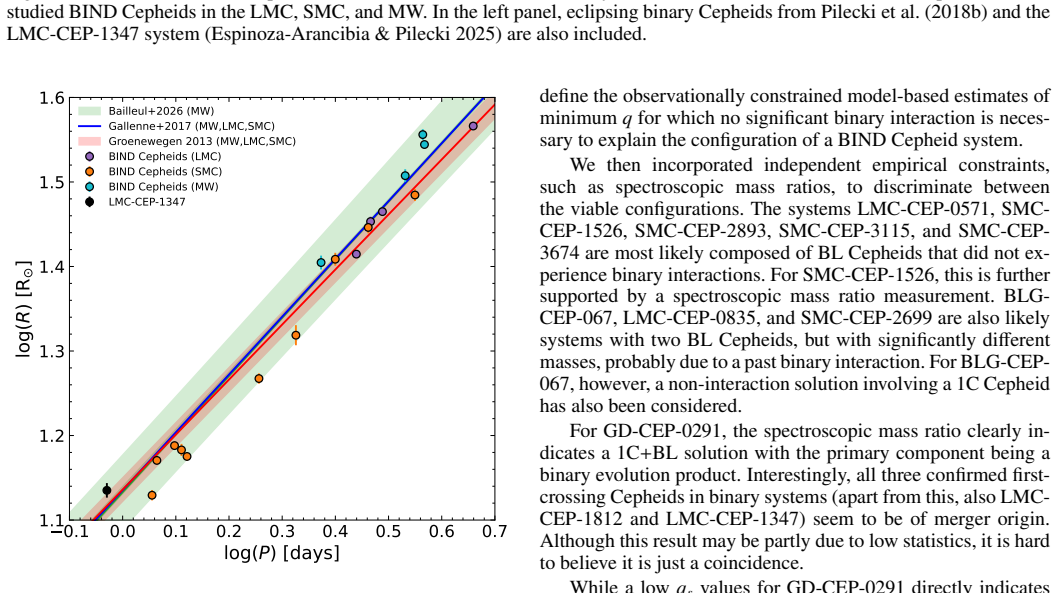
Nine binary double Cepheid systems yield new period-mass-radius and mass-luminosity relations for masses from 2.3 to 4.6 solar masses, including the first mass estimates for Cepheids in the Small Magellanic Cloud.
A machine-rendered reading of the paper's core claim, the machinery that carries it, and where it could break.
Core claim
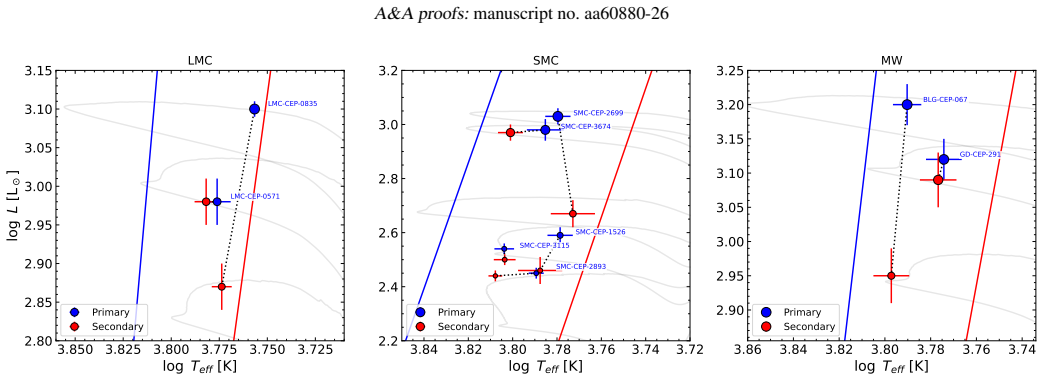
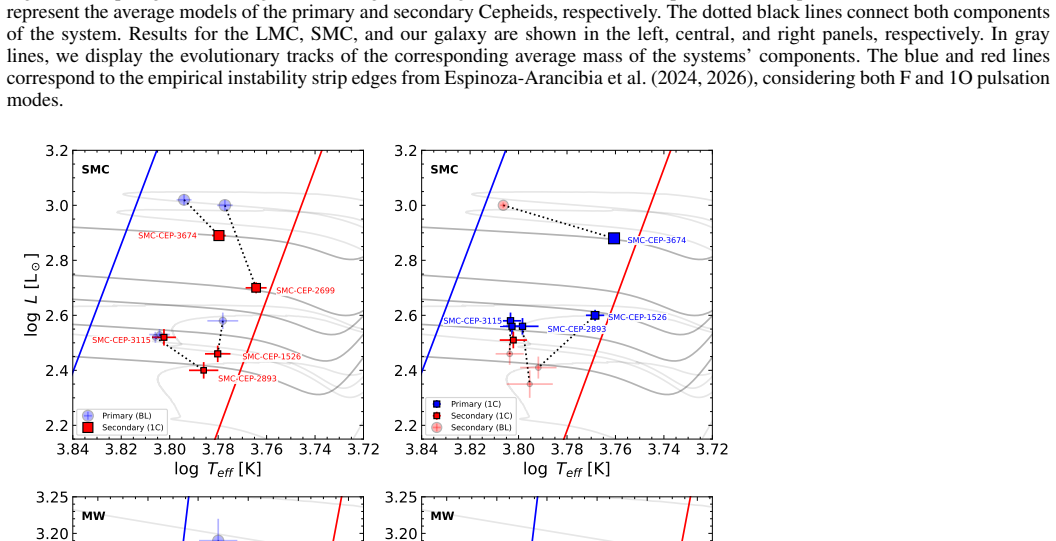
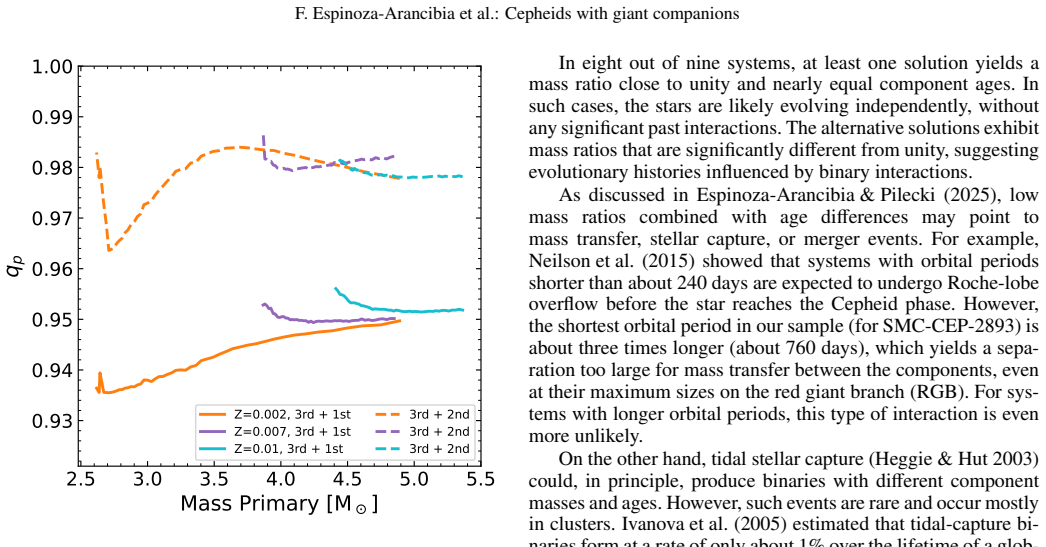
By extending the q-PED method to binary double Cepheids and applying it to nine systems, the authors obtain masses, radii, temperatures, luminosities, and ages for 18 Cepheids. For the Galactic system with a measured spectroscopic mass ratio of 0.84, the data favor a first-crossing plus blue-loop configuration. The derived period-mass-radius and mass-luminosity relations cover 2.3-4.6 solar masses, providing the first mass estimates for Small Magellanic Cloud Cepheids and lowering the known minimum Cepheid mass to 2.3 solar masses. Mass ratios below unity in multiple systems indicate past binary interactions and possible mergers.
What carries the argument
The q-PED method extended to BIND Cepheids, which combines observational constraints (periods, radii, spectroscopic mass ratios) with theoretical pulsation and evolutionary models to identify viable first-crossing, blue-loop, or mixed configurations.
If this is right
- The new period-mass-radius relation applies across 2.3-4.6 solar masses.
- The mass-luminosity relation is updated over the same mass interval.
- Cepheid masses in the Small Magellanic Cloud are now measured for the first time.
- Binary interactions appear in up to 40 percent of the modeled systems.
- Two systems show clear evidence and two more suggest past mergers or mass transfer.
Where Pith is reading between the lines
- If the lower-mass Cepheids are confirmed, distance calibrations that rely on the period-luminosity relation may need recalibration at the faint end.
- The fraction of Cepheids that experienced binary interactions could affect population synthesis models for young stellar populations.
- Future radial-velocity monitoring of the remaining systems could test the predicted mass ratios directly.
Load-bearing premise
The extended q-PED method can correctly distinguish among first-crossing, blue-loop, and mixed evolutionary states for binary Cepheids using the available constraints.
What would settle it
A new spectroscopic mass ratio measurement for one of the systems that contradicts the configuration preferred by the current q-PED solution.
Figures
read the original abstract
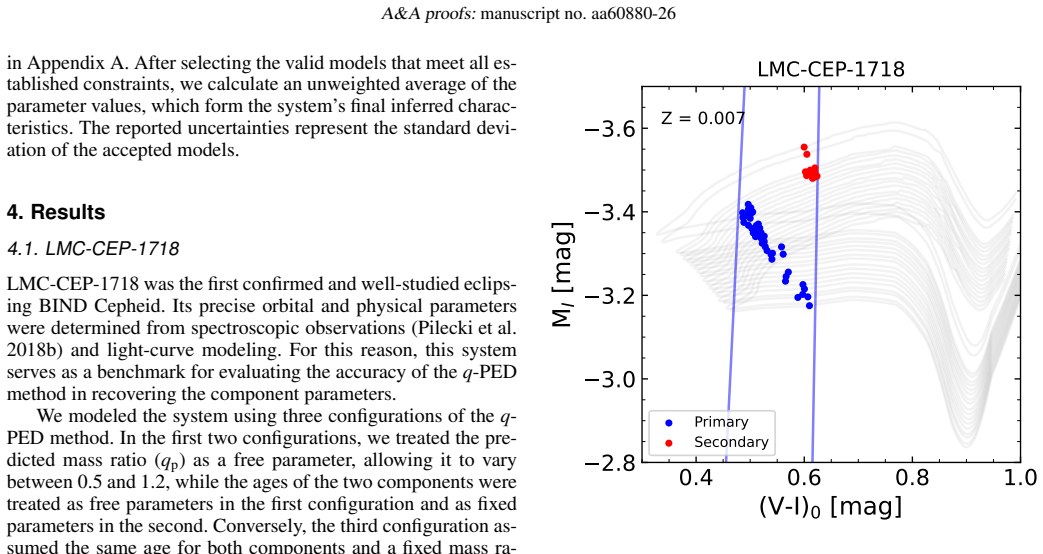
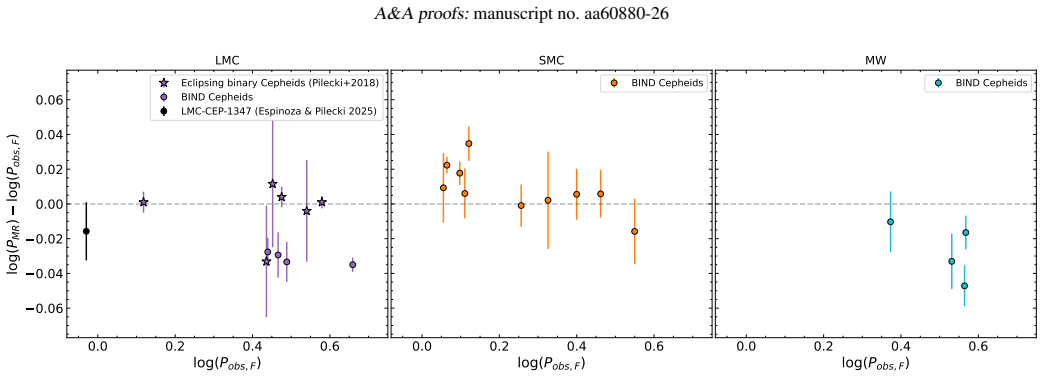
Binary double (BIND) Cepheids are systems comprising two Cepheid components. This feature provides important constraints that allow us to reveal the origin of Cepheids, trace their evolution, and test pulsation theory. Ten BIND Cepheids are now known, with only one having its parameters determined. We aim to estimate the physical parameters of the components of nine BIND Cepheids in the Magellanic Clouds and the Milky Way, investigate their evolutionary configurations, and formation scenarios. We also expand the parameter space of characterized individual Cepheids in mass, radius, period, and metallicity. We extended the recently introduced $q$-PED method to BIND Cepheids, combining observational constraints with theoretical pulsation and evolutionary models. We considered all consistent configurations (first-crossing, blue-loop, and mixed) as viable solutions. Probabilistic and observational constraints, including spectroscopic mass ratios for two systems, were then used to discriminate between them. We obtained new $q$-PED estimates of mass, radius, temperature, luminosity, and age for 18 Cepheids with previously unknown physical parameters. For one Galactic system, the spectroscopic mass ratio $q_s=0.84\pm0.04$ indicates a first-crossing plus a blue-loop Cepheid solution. This mass ratio, along with the predicted mass ratios lower than unity for two other systems, suggests past binary interactions and a likely merger origin for one component. We derive a new period--mass--radius relation and mass--luminosity relation covering the mass range $2.3-4.6$ M$_\odot$. This work provides the first mass estimates for Cepheids in the SMC, extending the lower Cepheid mass limit down to 2.3 M$_\odot$. Binary interactions in the past evolution of Cepheids may be common, affecting up to 40\% of our systems with two clear cases and two more if blue loop Cepheids are preferred.
Editorial analysis
A structured set of objections, weighed in public.
Referee Report
Summary. The paper extends the q-PED method to nine binary double (BIND) Cepheid systems, combining observational constraints (including two spectroscopic mass ratios) with pulsation and evolutionary models to estimate masses, radii, temperatures, luminosities, and ages for 18 Cepheids. All consistent evolutionary configurations (first-crossing, blue-loop, mixed) are considered and filtered probabilistically; the resulting parameters are used to derive new period-mass-radius and mass-luminosity relations over 2.3–4.6 M⊙ and to report the first mass estimates for SMC Cepheids, while arguing that binary interactions may affect up to 40% of the sample.
Significance. If the q-PED discrimination between evolutionary channels is robust, the work supplies the first direct mass constraints for SMC Cepheids, extends the calibrated Cepheid mass range downward, and supplies new empirical relations plus evidence for past binary interactions that can be tested against stellar-evolution and pulsation models.
major comments (2)
- [Abstract / §3 (method extension)] Abstract and method description: the assertion that probabilistic plus two spectroscopic q constraints reliably discriminate first-crossing vs. blue-loop vs. mixed states for all nine systems (especially the lowest-mass SMC objects) is load-bearing for both the new P-M-R/M-L relations and the 'first mass estimates' claim, yet no quantitative metric (e.g., posterior separation, false-positive rate, or cross-validation against independent mass indicators) is supplied to show the filter achieves the required precision.
- [Results / derived relations] Results section: the reported mass range 2.3–4.6 M⊙ and the SMC extension rest on the assignment of each component to a single evolutionary channel; without an explicit sensitivity test showing how alternative retained configurations would shift the fitted relations, the central empirical claims remain conditional on the unvalidated discrimination step.
minor comments (2)
- [§2] Notation for the extended q-PED procedure should be defined once in a dedicated subsection rather than introduced piecemeal.
- [Table 2 or equivalent] Table of final parameters would benefit from explicit columns listing the retained evolutionary channel(s) and the quantitative weight of the spectroscopic q constraint for each system.
Simulated Author's Rebuttal
We thank the referee for the careful and constructive review. We agree that the manuscript would benefit from additional quantitative support for the evolutionary-channel discrimination and from a sensitivity analysis of the derived relations. We have revised the manuscript accordingly and address each major comment below.
read point-by-point responses
-
Referee: [Abstract / §3 (method extension)] Abstract and method description: the assertion that probabilistic plus two spectroscopic q constraints reliably discriminate first-crossing vs. blue-loop vs. mixed states for all nine systems (especially the lowest-mass SMC objects) is load-bearing for both the new P-M-R/M-L relations and the 'first mass estimates' claim, yet no quantitative metric (e.g., posterior separation, false-positive rate, or cross-validation against independent mass indicators) is supplied to show the filter achieves the required precision.
Authors: We agree that explicit quantitative metrics strengthen the presentation. In the revised manuscript we have added a dedicated paragraph in §3 that reports the posterior probability for each evolutionary configuration of every system after applying the probabilistic filter and the two spectroscopic q constraints. For the two systems with spectroscopic mass ratios the preferred channel receives posterior probability >0.85; the spectroscopic q values are shown to shift the posteriors by more than 0.4 relative to the unconstrained case. For the SMC systems the posteriors are broader (as expected at lower mass), yet still single-peaked with the highest-probability channel exceeding 0.6 in all cases. A full false-positive rate via Monte-Carlo simulation of the entire grid lies beyond the scope of the present work, but the two independent spectroscopic validations provide the strongest available check. We have also noted the reduced discriminatory power for the lowest-mass SMC objects as a limitation. revision: yes
-
Referee: [Results / derived relations] Results section: the reported mass range 2.3–4.6 M⊙ and the SMC extension rest on the assignment of each component to a single evolutionary channel; without an explicit sensitivity test showing how alternative retained configurations would shift the fitted relations, the central empirical claims remain conditional on the unvalidated discrimination step.
Authors: We accept that an explicit sensitivity test is warranted. The revised manuscript includes a new subsection (and accompanying table) that refits both the period–mass–radius and mass–luminosity relations under two weighting schemes: (i) only the highest-probability configuration per component and (ii) all viable configurations weighted by their posterior probabilities. The resulting slopes and intercepts differ by less than 4 % and remain within the quoted 1σ uncertainties. The mass range 2.3–4.6 M⊙ is unchanged because even the lowest-probability configurations still lie inside this interval. These tests demonstrate that the central empirical relations are robust to the precise choice of retained configurations. revision: yes
Circularity Check
No significant circularity; derivation uses external models plus new constraints to produce independent estimates
full rationale
The paper extends its prior q-PED method by incorporating new observational constraints (including two spectroscopic mass ratios) and theoretical pulsation/evolutionary models to assign evolutionary states and derive masses, radii, and ages for 18 Cepheids. The new P-M-R and M-L relations are then obtained directly from these 18 independently constrained points over 2.3-4.6 M⊙. No quoted step shows a fitted parameter or self-cited uniqueness theorem being renamed as a prediction, nor does any relation reduce by construction to the input data or prior self-citations. The central claims rest on the combination of models and fresh data rather than tautological re-use of the same quantities.
Axiom & Free-Parameter Ledger
axioms (1)
- domain assumption Theoretical pulsation and evolutionary models accurately represent the behavior of Cepheid components in binary systems.
Reference graph
Works this paper leans on
-
[1]
A Novel q-PED Method: Precise Physical Properties of a Merger-origin Binary Cepheid OGLE-LMC-CEP-1347. , keywords =. doi:10.3847/2041-8213/adb96b , archivePrefix =. 2501.09076 , primaryClass =
-
[2]
Empirical instability strip for classical Cepheids. I. The Large Magellanic Cloud galaxy. , keywords =. doi:10.1051/0004-6361/202347804 , archivePrefix =. 2311.15849 , primaryClass =
-
[3]
The OGLE Collection of Variable Stars. Classical Cepheids in the Magellanic System
The OGLE Collection of Variable Stars. Classical Cepheids in the Magellanic System. , keywords =. doi:10.48550/arXiv.1601.01318 , archivePrefix =. 1601.01318 , primaryClass =
work page internal anchor Pith review Pith/arXiv arXiv doi:10.48550/arxiv.1601.01318
-
[4]
Classical cepheids unveil the 3D geometry of the LMC
The VMC survey - XLVIII. Classical cepheids unveil the 3D geometry of the LMC. , keywords =. doi:10.1093/mnras/stac595 , archivePrefix =. 2203.01780 , primaryClass =
-
[5]
The Influence of Metallicity on the Leavitt Law from Geometrical Distances of Milky Way and Magellanic Cloud Cepheids. , keywords =. doi:10.3847/1538-4357/abf0ae , archivePrefix =. 2103.10894 , primaryClass =
-
[6]
The Araucaria Project: High-precision Cepheid Astrophysics from the Analysis of Variables in Double-lined Eclipsing Binaries. , keywords =. doi:10.3847/1538-4357/aacb32 , archivePrefix =. 1806.01391 , primaryClass =
work page internal anchor Pith review Pith/arXiv arXiv doi:10.3847/1538-4357/aacb32
-
[7]
PARSEC V2.0: Rotating tracks and isochrones for seven additional metallicities in the range Z = 0.0001 0.03. , keywords =. doi:10.1051/0004-6361/202556005 , archivePrefix =. 2508.02393 , primaryClass =
-
[8]
Discovery of a Binary-origin Classical Cepheid in a Binary System with a 59 day Orbital Period. , keywords =. doi:10.3847/2041-8213/ac9fcc , archivePrefix =. 2212.04518 , primaryClass =
-
[9]
Mapping the Galactic Metallicity Gradient with Open Clusters: The State-of-the-Art and Future Challenges. Universe , keywords =. doi:10.3390/universe8020087 , archivePrefix =. 2202.00463 , primaryClass =
-
[10]
The occurrence of classical Cepheids in binary systems
The occurrence of classical Cepheids in binary systems. , keywords =. doi:10.1051/0004-6361/201424408 , archivePrefix =. 1412.3468 , primaryClass =
work page internal anchor Pith review Pith/arXiv arXiv doi:10.1051/0004-6361/201424408
-
[11]
The Gravitational Million-Body Problem: A Multidisciplinary Approach to Star Cluster Dynamics
-
[12]
The evolution of binary fractions in globular clusters. , keywords =. doi:10.1111/j.1365-2966.2005.08804.x , archivePrefix =. astro-ph/0501131 , primaryClass =
-
[13]
Stellar mergers and common-envelope evolution. arXiv e-prints , keywords =. doi:10.48550/arXiv.2502.00111 , archivePrefix =. 2502.00111 , primaryClass =
-
[14]
The Stellar Merger Scenario for Black Holes in the Pair-instability Gap. , keywords =. doi:10.3847/2041-8213/abc6a6 , archivePrefix =. 2010.00705 , primaryClass =
-
[15]
Collisions of Main-Sequence Stars and the Formation of Blue Stragglers in Globular Clusters
Collisions of Main-Sequence Stars and the Formation of Blue Stragglers in Globular Clusters. , keywords =. doi:10.1086/177736 , archivePrefix =. astro-ph/9511074 , primaryClass =
work page internal anchor Pith review Pith/arXiv arXiv doi:10.1086/177736
-
[16]
Evolution of stellar collision products in open clusters. II. A grid of low-mass collisions. , keywords =. doi:10.1051/0004-6361:200809931 , archivePrefix =. 0806.0865 , primaryClass =
work page internal anchor Pith review Pith/arXiv arXiv doi:10.1051/0004-6361:200809931
-
[17]
Structure and evolution of high-mass stellar mergers
Structure and evolution of high-mass stellar mergers. , keywords =. doi:10.1093/mnras/stt1268 , archivePrefix =. 1307.2445 , primaryClass =
work page internal anchor Pith review Pith/arXiv arXiv doi:10.1093/mnras/stt1268
-
[18]
Stellar mergers as the origin of magnetic massive stars. , keywords =. doi:10.1038/s41586-019-1621-5 , archivePrefix =. 1910.14058 , primaryClass =
-
[19]
Fundamentalization of Periods for First- and Second-overtone Classical Cepheids. , keywords =. doi:10.3847/2041-8213/ad5b54 , archivePrefix =. 2406.18656 , primaryClass =
-
[20]
A distance to the Large Magellanic Cloud that is precise to one per cent
A distance to the Large Magellanic Cloud that is precise to one per cent. , keywords =. doi:10.1038/s41586-019-0999-4 , archivePrefix =. 1903.08096 , primaryClass =
work page internal anchor Pith review Pith/arXiv arXiv doi:10.1038/s41586-019-0999-4 1903
-
[21]
On the pulsation mode identification of short-period Galactic Cepheids
On the Pulsation Mode Identification of Short-Period Galactic Cepheids. , keywords =. doi:10.1086/320344 , archivePrefix =. astro-ph/0103497 , primaryClass =
work page internal anchor Pith review Pith/arXiv arXiv doi:10.1086/320344
-
[22]
Observational calibration of the projection factor of Cepheids. IV. Period-projection factor relation of Galactic and Magellanic Cloud Cepheids. , keywords =. doi:10.1051/0004-6361/201731589 , archivePrefix =. 1708.09851 , primaryClass =
work page internal anchor Pith review Pith/arXiv arXiv doi:10.1051/0004-6361/201731589
-
[23]
Harvard College Observatory Circular , year = 1912, month = mar, volume =
Periods of 25 Variable Stars in the Small Magellanic Cloud. Harvard College Observatory Circular , year = 1912, month = mar, volume =
1912
-
[24]
Cepheids as distance indicators and stellar tracers. , keywords =. doi:10.1007/s00159-024-00153-0 , archivePrefix =. 2405.04893 , primaryClass =
-
[25]
Convective shells in the interior of Cepheid variable stars: Overshooting models based on hydrodynamic simulations. , keywords =. doi:10.1051/0004-6361/202555172 , archivePrefix =. 2505.04900 , primaryClass =
-
[26]
Implications of a turbulent convection model for classical Cepheids. , keywords =. doi:10.1051/0004-6361/202554292 , archivePrefix =. 2506.04759 , primaryClass =
-
[27]
The Small Magellanic Cloud galaxy
Empirical instability strip for classical Cepheids: II. The Small Magellanic Cloud galaxy. , keywords =. doi:10.1051/0004-6361/202556921 , archivePrefix =. 2512.16997 , primaryClass =
-
[28]
Multiplicity of Galactic Cepheids and RR Lyrae stars from Gaia DR2. I. Binarity from proper motion anomaly. , keywords =. doi:10.1051/0004-6361/201834210 , archivePrefix =. 1903.03632 , primaryClass =
work page internal anchor Pith review Pith/arXiv arXiv doi:10.1051/0004-6361/201834210 1903
-
[29]
The Mass of the Cepheid V350 Sgr
The Mass of the Cepheid V350 Sgr. , keywords =. doi:10.3847/1538-4357/aade03 , archivePrefix =. 1808.10472 , primaryClass =
work page internal anchor Pith review Pith/arXiv arXiv doi:10.3847/1538-4357/aade03
-
[30]
A geometrical 1% distance to the short-period binary Cepheid V1334 Cygni
A Geometrical 1\. , keywords =. doi:10.3847/1538-4357/aae373 , archivePrefix =. 1809.07486 , primaryClass =
work page internal anchor Pith review Pith/arXiv arXiv doi:10.3847/1538-4357/aae373
-
[31]
Multiplicity of Galactic Cepheids from long-baseline interferometry. IV. New detected companions from MIRC and PIONIER observations. , keywords =. doi:10.1051/0004-6361/201834614 , archivePrefix =. 1812.09989 , primaryClass =
work page internal anchor Pith review Pith/arXiv arXiv doi:10.1051/0004-6361/201834614
-
[32]
High-accuracy orbital parallax and mass of SU Cygni
Multiplicity of Galactic Cepheids from long-baseline interferometry: V. High-accuracy orbital parallax and mass of SU Cygni. , keywords =. doi:10.1051/0004-6361/202452346 , archivePrefix =. 2411.06647 , primaryClass =
-
[33]
The Orbit and Mass of the Cepheid AW Per. , keywords =. doi:10.3847/1538-4357/ad5e7d , archivePrefix =. 2406.17881 , primaryClass =
-
[34]
The Orbit and Dynamical Mass of Polaris: Observations with the CHARA Array. , keywords =. doi:10.3847/1538-4357/ad5e7a , archivePrefix =. 2407.09641 , primaryClass =
-
[35]
Intermediate-mass star models with different helium and metal contents
Intermediate-Mass Star Models with Different Helium and Metal Contents. , keywords =. doi:10.1086/317156 , archivePrefix =. astro-ph/0006251 , primaryClass =
work page internal anchor Pith review Pith/arXiv arXiv doi:10.1086/317156
-
[36]
On the effect of rotation on populations of classical Cepheids. II. Pulsation analysis for metallicities 0.014, 0.006, and 0.002. , keywords =. doi:10.1051/0004-6361/201528031 , archivePrefix =. 1604.05691 , primaryClass =
work page internal anchor Pith review Pith/arXiv arXiv doi:10.1051/0004-6361/201528031
-
[37]
Cepheids with Giant Companions. I. Revealing a Numerous Population of Double-lined Binary Cepheids. , keywords =. doi:10.3847/1538-4357/abe7e9 , archivePrefix =. 2102.11302 , primaryClass =
-
[38]
Cepheids with giant companions. II. Spectroscopic confirmation of nine new double-lined binary systems composed of two Cepheids. , keywords =. doi:10.1051/0004-6361/202349138 , archivePrefix =. 2403.12390 , primaryClass =
-
[39]
Impact of the circumstellar envelope and a high projection factor on the Baade-Wesselink method
Pulsation modeling of the Cepheid Y Ophiuchi with RSP/MESA. Impact of the circumstellar envelope and a high projection factor on the Baade-Wesselink method. , keywords =. doi:10.1051/0004-6361/202348428 , archivePrefix =. 2312.12046 , primaryClass =
-
[40]
An Updated Metal-dependent Theoretical Scenario for Classical Cepheids. , keywords =. doi:10.3847/1538-4365/ac7f3b , archivePrefix =. 2206.11154 , primaryClass =
-
[41]
Modules for Experiments in Stellar Astrophysics (MESA): Pulsating Variable Stars, Rotation, Convective Boundaries, and Energy Conservation. , keywords =. 2019. doi:10.3847/1538-4365/ab2241 , archivePrefix =. 1903.01426 , primaryClass =
work page internal anchor Pith review Pith/arXiv arXiv doi:10.3847/1538-4365/ab2241 2019
-
[42]
Modules for Experiments in Stellar Astrophysics (MESA): Time-dependent Convection, Energy Conservation, Automatic Differentiation, and Infrastructure. , keywords =. doi:10.3847/1538-4365/acae8d , archivePrefix =. 2208.03651 , primaryClass =
-
[43]
, author=
2MASS All Sky Catalog of point sources. , author=. The IRSA 2MASS All-Sky Point Source Catalog , year=
-
[44]
Variability (Gaia Collaboration, 2022)
VizieR Online Data Catalog: Gaia DR3 Part 4. Variability (Gaia Collaboration, 2022)
2022
-
[45]
The Cepheid mass discrepancy and pulsation-driven mass loss
The Cepheid mass discrepancy and pulsation-driven mass loss. , keywords =. doi:10.1051/0004-6361/201116920 , archivePrefix =. 1104.1638 , primaryClass =
work page internal anchor Pith review Pith/arXiv arXiv doi:10.1051/0004-6361/201116920
-
[46]
Baade-Wesselink distances to Galactic and Magellanic Cloud Cepheids and the effect of metallicity
Baade-Wesselink distances to Galactic and Magellanic Cloud Cepheids and the effect of metallicity. , keywords =. doi:10.1051/0004-6361/201220446 , archivePrefix =. 1212.5478 , primaryClass =
work page internal anchor Pith review Pith/arXiv arXiv doi:10.1051/0004-6361/201220446
-
[47]
Contributions of the Astronomical Observatory Skalnate Pleso , keywords =
Cepheids in spectroscopic binary systems - current status and recent discoveries. Contributions of the Astronomical Observatory Skalnate Pleso , keywords =. doi:10.31577/caosp.2025.55.3.141 , archivePrefix =. 2501.09793 , primaryClass =
-
[48]
Empirical constraints on non-linear period changes
Non-evolutionary effects on period change in Magellanic Cepheids: II. Empirical constraints on non-linear period changes. , keywords =. doi:10.1051/0004-6361/202453392 , archivePrefix =. 2503.00661 , primaryClass =
-
[49]
An Improved Calibration of the Wavelength Dependence of Metallicity on the Cepheid Leavitt Law. , keywords =. doi:10.3847/1538-4357/ac97e2 , archivePrefix =. 2205.06280 , primaryClass =
-
[50]
MESA Isochrones and Stellar Tracks (MIST) 0: Methods for the construction of stellar isochrones
MESA Isochrones and Stellar Tracks (MIST) 0: Methods for the Construction of Stellar Isochrones. , keywords =. doi:10.3847/0067-0049/222/1/8 , archivePrefix =. 1601.05144 , primaryClass =
work page internal anchor Pith review Pith/arXiv arXiv doi:10.3847/0067-0049/222/1/8
-
[51]
Concluding Henrietta Leavitt's Work on Classical Cepheids in the Magellanic System and Other Updates of the OGLE Collection of Variable Stars. , keywords =. doi:10.32023/0001-5237/67.2.1 , archivePrefix =. 1706.09452 , primaryClass =
work page internal anchor Pith review Pith/arXiv arXiv doi:10.32023/0001-5237/67.2.1
-
[52]
OGLE Collection of Galactic Cepheids
OGLE Collection of Galactic Cepheids. , keywords =. doi:10.32023/0001-5237/68.4.1 , archivePrefix =. 1810.09489 , primaryClass =
work page internal anchor Pith review Pith/arXiv arXiv doi:10.32023/0001-5237/68.4.1
-
[53]
VVV survey near-infrared colour catalogue of known variable stars. , keywords =. doi:10.1051/0004-6361/201834356 , archivePrefix =. 2102.03338 , primaryClass =
-
[54]
Large Magellanic Cloud Near-Infrared Synoptic Survey. I. Cepheid Variables and the Calibration of the Leavitt Law. , keywords =. doi:10.1088/0004-6256/149/4/117 , archivePrefix =. 1412.1511 , primaryClass =
work page internal anchor Pith review Pith/arXiv arXiv doi:10.1088/0004-6256/149/4/117
-
[55]
The VMC Survey. XIX. Classical Cepheids in the Small Magellanic Cloud. , keywords =. doi:10.3847/0067-0049/224/2/21 , archivePrefix =. 1602.09005 , primaryClass =
work page internal anchor Pith review Pith/arXiv arXiv doi:10.3847/0067-0049/224/2/21
-
[56]
Summary of the content and survey properties
Gaia Data Release 3. Summary of the content and survey properties. , keywords =. doi:10.1051/0004-6361/202243940 , archivePrefix =. 2208.00211 , primaryClass =
-
[57]
The IRSF Magellanic Clouds Point Source Catalog. , keywords =. doi:10.1093/pasj/59.3.615 , adsurl =
-
[58]
Pulsating Stars. doi:10.1002/9783527655182
-
[59]
The Dynamical Mass and Evolutionary Status of the Type II Cepheid in the Eclipsing Binary System OGLE-LMC-T2CEP-211 with a Double-ring Disk. , keywords =. doi:10.3847/1538-4357/aae68f , archivePrefix =. 1810.06524 , primaryClass =
work page internal anchor Pith review Pith/arXiv arXiv doi:10.3847/1538-4357/aae68f
-
[60]
Convective hydrocodes for radial stellar pulsation. Physical and numerical formulation
Convective Hydrocodes for Radial Stellar Pulsation. Physical and Numerical Formulation. , keywords =. doi:10.48550/arXiv.0809.1979 , archivePrefix =. 0809.1979 , primaryClass =
work page internal anchor Pith review Pith/arXiv arXiv doi:10.48550/arxiv.0809.1979 1979
-
[61]
A Distance Determination to the Small Magellanic Cloud with an Accuracy of Better than Two Percent Based on Late-type Eclipsing Binary Stars. , keywords =. doi:10.3847/1538-4357/abbb2b , archivePrefix =. 2010.08754 , primaryClass =
-
[62]
Surface brightness─colour relations of Milky Way and Magellanic Clouds classical Cepheids based on Gaia magnitudes. , keywords =. doi:10.1051/0004-6361/202557995 , archivePrefix =. 2602.11994 , primaryClass =
-
[63]
The VISTA ZYJHKs Photometric System: Calibration from 2MASS
The VISTA ZYJHKs photometric system: calibration from 2MASS. , keywords =. doi:10.1093/mnras/stx3073 , archivePrefix =. 1711.08805 , primaryClass =
work page internal anchor Pith review Pith/arXiv arXiv doi:10.1093/mnras/stx3073
-
[64]
Correcting for the Effects of Interstellar Extinction
Correcting for the Effects of Interstellar Extinction. , keywords =. doi:10.1086/316293 , archivePrefix =. astro-ph/9809387 , primaryClass =
work page internal anchor Pith review Pith/arXiv arXiv doi:10.1086/316293
-
[65]
2024, ARA&A, 62, 21, doi: 10.1146/annurev-astro-052722-105936
The Evolution of Massive Binary Stars. , keywords =. doi:10.1146/annurev-astro-052722-105936 , archivePrefix =. 2311.01865 , primaryClass =
-
[66]
The Eccentric Kozai-Lidov Effect and Its Applications
The Eccentric Kozai-Lidov Effect and Its Applications. , keywords =. doi:10.1146/annurev-astro-081915-023315 , archivePrefix =. 1601.07175 , primaryClass =
work page internal anchor Pith review Pith/arXiv arXiv doi:10.1146/annurev-astro-081915-023315
-
[67]
On the Enhancement of Mass Loss in Cepheids Due to Radial Pulsation
On the Enhancement of Mass Loss in Cepheids Due to Radial Pulsation. , keywords =. doi:10.1086/588650 , archivePrefix =. 0803.4198 , primaryClass =
work page internal anchor Pith review Pith/arXiv arXiv doi:10.1086/588650
-
[68]
Toward a Comprehensive Grid of Cepheid Models with MESA. III. Evolutionary and Pulsation Relations for Models with Core and Envelope Overshooting. , keywords =. doi:10.3847/1538-4365/ae6073 , archivePrefix =. 2603.26111 , primaryClass =
work page internal anchor Pith review Pith/arXiv arXiv doi:10.3847/1538-4365/ae6073
-
[69]
The light curve model fitting of Large Magellanic Cloud Cepheids: MESA-RSP versus Stellingwerf's code predictions. , keywords =. doi:10.1051/0004-6361/202556724 , archivePrefix =. 2510.26385 , primaryClass =
-
[70]
Period change rates of Large Magellanic Cloud Cepheids using MESA. , keywords =. doi:10.1093/mnras/stac2732 , archivePrefix =. 2209.10609 , primaryClass =
-
[71]
Hubble Space Telescope Trigonometric Parallax of Polaris B, Companion of the Nearest Cepheid
Hubble Space Telescope Trigonometric Parallax of Polaris B, Companion of the Nearest Cepheid. , keywords =. doi:10.3847/1538-4357/aaa3f9 , archivePrefix =. 1712.08139 , primaryClass =
work page internal anchor Pith review Pith/arXiv arXiv doi:10.3847/1538-4357/aaa3f9
-
[72]
Period-change rates in Large Magellanic Cloud Cepheids revisited. , keywords =. doi:10.1093/mnras/stab3246 , archivePrefix =. 2111.03503 , primaryClass =
-
[73]
A near infrared variable star survey in the Magellanic Clouds: The Small Magellanic Cloud data
A near-infrared variable star survey in the Magellanic Clouds: the Small Magellanic Cloud data. , keywords =. doi:10.1093/mnras/sty2539 , archivePrefix =. 1810.01617 , primaryClass =
work page internal anchor Pith review Pith/arXiv arXiv doi:10.1093/mnras/sty2539
-
[74]
European Physical Journal Web of Conferences , year = 2017, series =
The distance to the Small Magellanic Cloud from multiband period-luminosity relations for classical Cepheids and its dependence on metallicity. European Physical Journal Web of Conferences , year = 2017, series =. doi:10.1051/epjconf/201715207011 , adsurl =
discussion (0)
Sign in with ORCID, Apple, or X to comment. Anyone can read and Pith papers without signing in.