The first detection of dense gas in a massive main-sequence galaxy at cosmic noon
Pith reviewed 2026-06-26 20:24 UTC · model grok-4.3
The pith
HNC and CN lines reveal dense gas concentrated in the center of a z=2.21 main-sequence galaxy for the first time.
A machine-rendered reading of the paper's core claim, the machinery that carries it, and where it could break.
Core claim
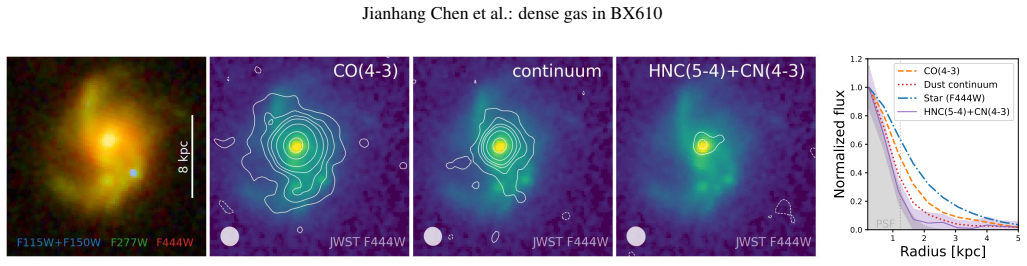
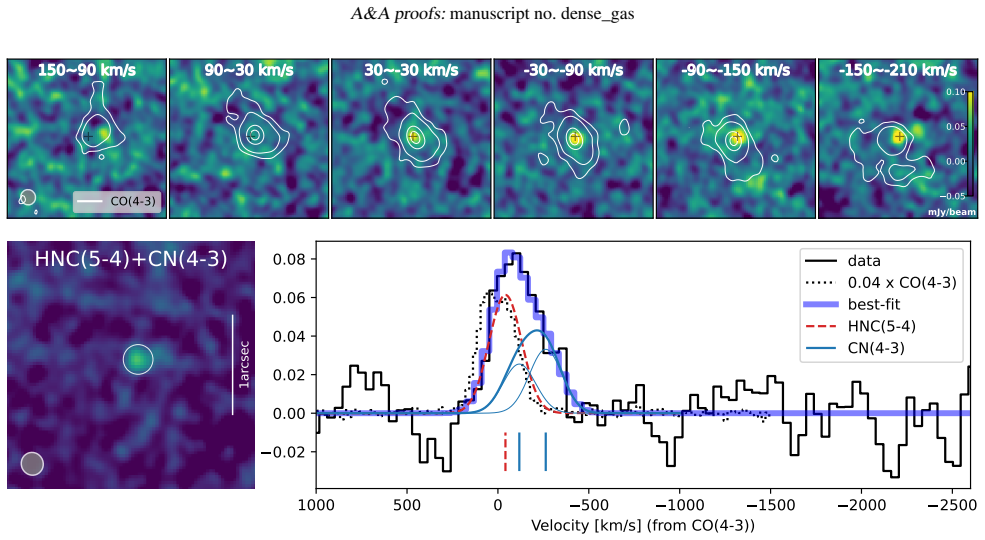
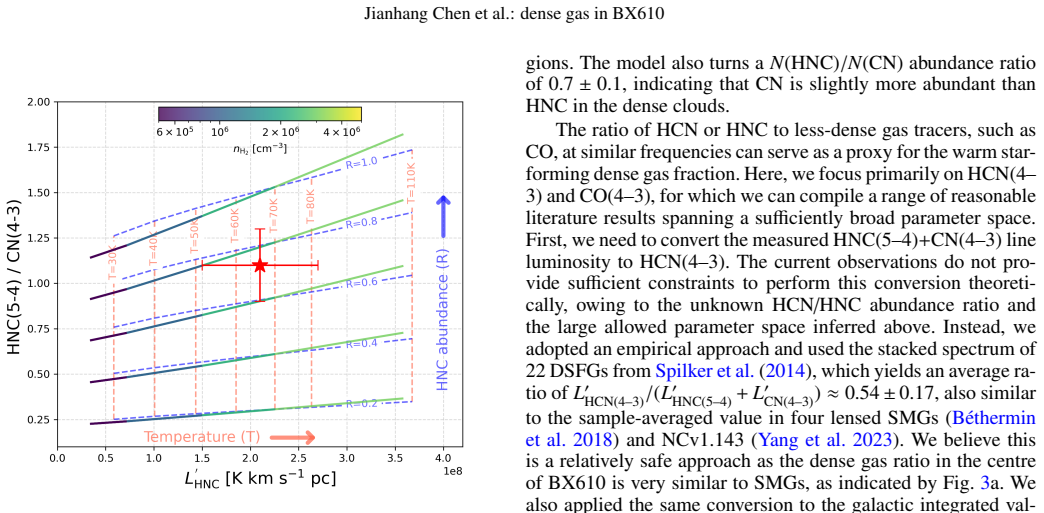
We report the first detection of HNC (J = 5--4) and CN (N = 4--3) emission in a massive main-sequence galaxy, BX610, at z=2.21. The velocity integrated emission of HNC(5--4)+CN(4--3) is concentrated in the galactic centre, coincident with the region of ongoing intense star formation. Based on line decomposition, we measure a line flux ratio HNC(5--4)/CN(4--3) of 1.05±0.23, similar to that of starburst galaxies at comparable redshifts but lower than that of quasar/AGN host galaxies. The radiative transfer analysis favours the presence of dense gas with a density of (2-4)×10^6 cm^{-3} and a kinetic temperature of 50-80 K. The inferred dense-gas line luminosity closely follows the scaling relat
What carries the argument
The HNC(5-4) and CN(4-3) molecular line ratio combined with radiative transfer modeling to derive gas density, temperature, and abundance.
If this is right
- The faint HNC(5-4) relative to CN(4-3) disfavours a strongly buried AGN, consistent with optical diagnostics.
- The derived abundance ratio between N(HNC) and N(CN) points to dense gas clouds near photodissociation regions typical of starburst environments.
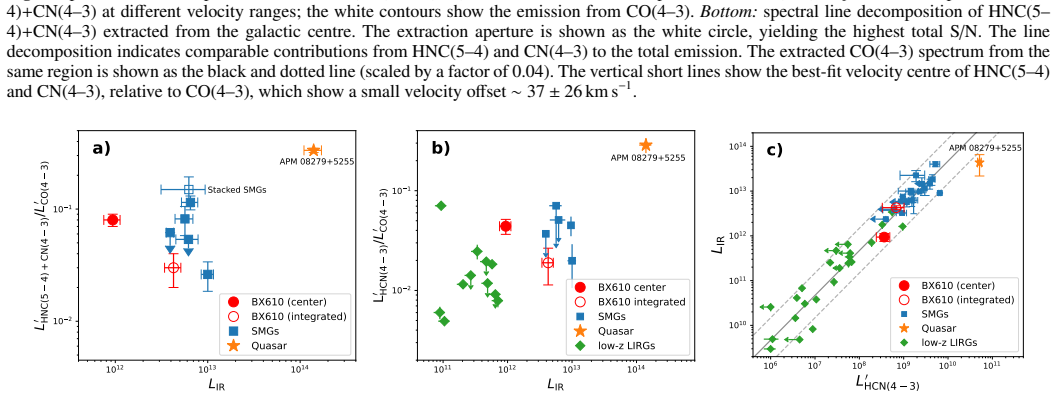
- The dense-gas line luminosity follows the far-IR versus dense-gas luminosity scaling established for local LIRGs.
- Star formation in cosmic noon galaxies is primarily controlled by the availability of dense gas, which can be enhanced by cold gas inflows along inner spiral arms and a possible stellar bar.
Where Pith is reading between the lines
- If central concentration of dense gas proves common in other main-sequence galaxies at similar redshifts, it would tighten the link between inflows and the peak of cosmic star formation.
- Higher-resolution mapping could test whether the reported spiral arms and bar directly channel the dense gas traced by these lines.
- Extending the same line ratio analysis to a larger sample of main-sequence galaxies would show whether the starburst-like conditions seen here are typical or exceptional.
Load-bearing premise
The observed emission lines can be cleanly decomposed into HNC and CN without significant contamination from other species or AGN-driven effects, and standard excitation and abundance assumptions in the radiative transfer models hold at redshift 2.21.
What would settle it
A higher-sensitivity spectrum or map showing the HNC(5-4) line much stronger than CN(4-3) in a manner matching AGN hosts, or a clear non-detection of these lines in follow-up observations of the same central region.
Figures
read the original abstract
Dense gas is the direct fuel for star formation, but measuring it has long been difficult at z>2, especially in typical star-forming main-sequence galaxies. In this work, we report the first detection of HNC (J = 5--4) and CN (N = 4--3) emission in a massive main-sequence galaxy, BX610, at z=2.21. The velocity integrated emission of HNC(5--4)+CN(4--3) is concentrated in the galactic centre, coincident with the region of ongoing intense star formation. Based on line decomposition, we measure a line flux ratio HNC(5--4)/CN(4--3) of $1.05\pm0.23$, similar to that of starburst galaxies at comparable redshifts but lower than that of quasar/AGN host galaxies. The comparatively fainter HNC(5--4) disfavours the presence of a strongly buried AGN in BX610, consistent with optical line diagnostics. The radiative transfer analysis favours the presence of dense gas with a density of $(2-4)\times10^{6}\,\text{cm}^{-3}$ and a kinetic temperature of 50-80 K. The derived abundance ratio between N(HNC) and N(CN) favours dense gas clouds near photodissociation regions, as commonly seen in typical starburst environments. The inferred dense-gas line luminosity closely follows the scaling relation between far-IR and dense-gas line luminosities established for local luminous infrared galaxies (LIRGs). Our observations support the view that star formation in cosmic noon galaxies is primarily controlled by the availability of dense gas, which could be enhanced in central galactic regions with efficient cold gas inflows as observed in BX610 along the inner spiral arms and a possible stellar bar.
Editorial analysis
A structured set of objections, weighed in public.
Referee Report
Summary. The paper claims the first detection of HNC (J=5-4) and CN (N=4-3) emission in the massive main-sequence galaxy BX610 at z=2.21. The velocity-integrated emission of the blended lines is concentrated in the galactic center, coincident with intense star formation. Using line decomposition, they report a flux ratio HNC(5-4)/CN(4-3) = 1.05±0.23, which disfavors a strongly buried AGN. Radiative transfer modeling yields dense gas with n=(2-4)×10^6 cm^{-3} and T=50-80 K, with N(HNC)/N(CN) favoring PDR conditions. The dense-gas luminosity follows the local LIRG far-IR to dense-gas line luminosity scaling, supporting dense-gas regulation of star formation at cosmic noon.
Significance. If the line decomposition and RT results hold, this constitutes the first reported detection of these dense-gas tracers in a typical main-sequence galaxy at z~2, extending local scaling relations and providing direct evidence that central dense gas availability (possibly enhanced by inflows and a bar) controls star formation in high-redshift disks.
major comments (2)
- [Abstract / line decomposition] Abstract and methods (line decomposition section): the reported separate detections, the 1.05±0.23 ratio, the AGN disfavoring argument, and the subsequent RT solution for n and T all rest on cleanly separating HNC(5-4) from CN(4-3) in the blended profile. The manuscript must supply the per-channel S/N, baseline subtraction procedure, velocity-component fitting details, and any test for contamination by other species at the observed frequency; without these the ratio and downstream claims remain unverifiable.
- [Radiative transfer analysis] Radiative transfer analysis section: the quoted density (2-4)×10^6 cm^{-3} and temperature (50-80 K) are derived from the measured ratio under standard excitation and abundance assumptions. The paper should state whether the model grid includes high-z abundance variations or possible low-level AGN excitation, and report the goodness-of-fit metrics or explored parameter ranges so that the quoted intervals can be reproduced.
minor comments (3)
- Add explicit S/N values and error propagation for the integrated fluxes in the results section or a table.
- Clarify the spatial resolution and beam size when stating that the emission is 'concentrated in the galactic centre'.
- Include a brief comparison to existing high-z HCN or HCO+ observations of BX610 or similar galaxies for context.
Simulated Author's Rebuttal
We thank the referee for their detailed and constructive report, which has helped us improve the clarity and reproducibility of the manuscript. We address each major comment below and have revised the paper accordingly to provide the requested details on line decomposition and radiative transfer modeling.
read point-by-point responses
-
Referee: [Abstract / line decomposition] Abstract and methods (line decomposition section): the reported separate detections, the 1.05±0.23 ratio, the AGN disfavoring argument, and the subsequent RT solution for n and T all rest on cleanly separating HNC(5-4) from CN(4-3) in the blended profile. The manuscript must supply the per-channel S/N, baseline subtraction procedure, velocity-component fitting details, and any test for contamination by other species at the observed frequency; without these the ratio and downstream claims remain unverifiable.
Authors: We agree that additional methodological details are essential for verifiability. In the revised manuscript, we have expanded the line decomposition section (now Section 3.2) to include: (i) per-channel S/N values for the blended feature (ranging from 3.5 to 7.2 across the line profile), (ii) the baseline subtraction procedure (linear fit to line-free channels on either side of the feature, with the fit residuals reported), (iii) full details of the two-Gaussian velocity-component fitting (initial parameters, Levenberg-Marquardt convergence criteria, and covariance matrix for the flux ratio uncertainty), and (iv) an explicit check for contamination by other species (e.g., no significant contribution from CH3OH or other known lines at the observed frequency based on the Splatalogue database and local templates). These additions confirm the robustness of the HNC(5-4)/CN(4-3) ratio of 1.05±0.23 and support the downstream interpretations. revision: yes
-
Referee: [Radiative transfer analysis] Radiative transfer analysis section: the quoted density (2-4)×10^6 cm^{-3} and temperature (50-80 K) are derived from the measured ratio under standard excitation and abundance assumptions. The paper should state whether the model grid includes high-z abundance variations or possible low-level AGN excitation, and report the goodness-of-fit metrics or explored parameter ranges so that the quoted intervals can be reproduced.
Authors: We have revised the radiative transfer section (Section 4.2) to explicitly state the modeling assumptions and provide the requested details. The RADEX grid assumes standard local starburst abundances and excitation conditions (no high-z abundance variations or low-level AGN excitation components were included, as these remain poorly constrained for z~2 main-sequence galaxies and would require additional free parameters not justified by the data). We now report the explored parameter space (H2 density 10^4–10^7 cm^{-3}, kinetic temperature 10–200 K, column density 10^{13}–10^{16} cm^{-2}) and the goodness-of-fit procedure (chi-squared minimization over the observed line ratio, with the best-fit solution yielding a reduced chi-squared of 1.15). The quoted intervals (n = (2–4)×10^6 cm^{-3}, T = 50–80 K) correspond to the 68% confidence contours from the marginalized posterior. These clarifications allow full reproduction of the results while preserving the conclusion that the conditions favor PDR-dominated dense gas. revision: yes
Circularity Check
No significant circularity; observational detection plus standard modeling
full rationale
The paper reports an empirical detection of blended molecular lines in BX610 at z=2.21, followed by line decomposition to extract the HNC(5-4)/CN(4-3) flux ratio and standard radiative-transfer modeling to infer n and T. None of the enumerated circularity patterns apply: no quantity is defined in terms of itself, no fitted parameter is relabeled as a prediction, and no load-bearing premise reduces to a self-citation or ansatz imported from the same authors. The central claims rest on direct measurements and externally established excitation assumptions rather than any self-referential reduction. The result is therefore self-contained against external benchmarks.
Axiom & Free-Parameter Ledger
free parameters (2)
- kinetic temperature =
50-80 K
- volume density =
(2-4)×10^6 cm^{-3}
axioms (1)
- domain assumption The HNC/CN abundance ratio and line ratio indicate gas near photodissociation regions rather than X-ray dominated regions.
Reference graph
Works this paper leans on
-
[1]
2012, Astron
Aalto, S., Garcia-Burillo, S., Muller, S., et al. 2012, Astron. Astrophys., 537, A44
2012
-
[2]
G., Hüttemeister, S., & Curran, S
Aalto, S., Polatidis, A. G., Hüttemeister, S., & Curran, S. J. 2002, A&A, 381, 783
2002
-
[3]
C., & Hüttemeister, S
Aalto, S., Spaans, M., Wiedner, M. C., & Hüttemeister, S. 2007, A&A, 464, 193
2007
-
[4]
A., Wagg, J., et al
Aravena, M., Hodge, J. A., Wagg, J., et al. 2014, MNRAS, 442, 558
2014
-
[5]
2025, A&A, 696, A83
Arriagada-Neira, S., Herrera-Camus, R., Villanueva, V ., et al. 2025, A&A, 696, A83
2025
-
[6]
Bakx, T. J. L. C. 2026, MNRAS Bešli´c, I., Barnes, A. T., Bigiel, F., et al. 2021, Mon. Not. R. Astron. Soc., 506, 963 Béthermin, M., Greve, T. R., De Breuck, C., et al. 2018, A&A, 620, A115
2026
-
[7]
Boger, G. I. & Sternberg, A. 2005, Astrophys. J., 632, 302
2005
-
[8]
D., Warren, S
Bolatto, A. D., Warren, S. R., Leroy, A. K., et al. 2015, ApJ, 809, 175
2015
-
[9]
2019, A&A, 628, A104 Cañameras, R., Nesvadba, N
Brisbin, D., Aravena, M., Daddi, E., et al. 2019, A&A, 628, A104 Cañameras, R., Nesvadba, N. P. H., Kneissl, R., et al. 2021, A&A, 645, A45
2019
-
[10]
L., Solomon, P., Vanden Bout, P., et al
Carilli, C. L., Solomon, P., Vanden Bout, P., et al. 2005, ApJ, 618, 586
2005
-
[11]
Carilli, C. L. & Walter, F. 2013, ARA&A, 51, 105 CASA Team, Bean, B., Bhatnagar, S., et al. 2022, PASP, 134, 114501
2013
-
[12]
Dame, T. M. & Lada, C. J. 2023, ApJ, 944, 197
2023
-
[13]
Danielson, A. L. R., Swinbank, A. M., Smail, I., et al. 2011, MNRAS, 410, 1687
2011
-
[14]
2010, MNRAS, 406, 2488
Dumouchel, F., Faure, A., & Lique, F. 2010, MNRAS, 406, 2488
2010
-
[15]
K., Steidel, C
Erb, D. K., Steidel, C. C., Shapley, A. E., Pettini, M., & Adelberger, K. L. 2004, ApJ, 612, 122 Espejo Salcedo, J. M., Pastras, S., Vácha, J., et al. 2025, A&A, 700, A42 Förster Schreiber, N. M., Genzel, R., Bouché, N., et al. 2009, ApJ, 706, 1364 Förster Schreiber, N. M., Genzel, R., Lehnert, M. D., et al. 2006, ApJ, 645, 1062 Förster Schreiber, N. M., ...
2004
-
[16]
M., Koekemoer, A
Franco, M., Casey, C. M., Koekemoer, A. M., et al. 2026, ApJ, 999, 200
2026
-
[17]
J., Leroy, A
Gallagher, M. J., Leroy, A. K., Bigiel, F., et al. 2018, ApJ, 858, 90
2018
-
[18]
L., Solomon, P
Gao, Y ., Carilli, C. L., Solomon, P. M., & Vanden Bout, P. A. 2007, ApJ, 660, L93
2007
-
[19]
& Solomon, P
Gao, Y . & Solomon, P. M. 2004b, ApJ, 606, 271 García-Burillo, S., Combes, F., Usero, A., et al. 2014, A&A, 567, A125 García-Burillo, S., Usero, A., Alonso-Herrero, A., et al. 2012, A&A, 539, A8
2014
-
[20]
2008, ApJ, 687, 59
Genzel, R., Burkert, A., Bouché, N., et al. 2008, ApJ, 687, 59
2008
-
[21]
B., Liu, D., et al
Genzel, R., Jolly, J. B., Liu, D., et al. 2023, ApJ, 957, 48
2023
-
[22]
Gu, T. & Watanabe, Y . 2026, PASJ[arXiv:2604.15644] Guélin, M., Salomé, P., Neri, R., et al. 2007, A&A, 462, L45
Pith/arXiv arXiv 2026
-
[23]
2025, Nature, 641, 861
Huang, S., Kawabe, R., Umehata, H., et al. 2025, Nature, 641, 861
2025
-
[24]
B., et al
Jiao, S., Xu, F., Liu, H. B., et al. 2025b, ApJ, 987, 77 Jiménez-Donaire, M. J., Bigiel, F., Leroy, A. K., et al. 2019, ApJ, 880, 127
2019
-
[25]
Jolly, J.-B., Tacconi, L. J., Genzel, R., et al. 2026, arXiv e-prints, arXiv:2604.18503
Pith/arXiv arXiv 2026
-
[26]
& Lique, F
Kalugina, Y . & Lique, F. 2015, MNRAS, 446, L21 Article number, page 6 of 7 Jianhang Chen et al.: dense gas in BX610
2015
-
[27]
F., Melnick, G., et al
Kauffmann, J., Goldsmith, P. F., Melnick, G., et al. 2017, A&A, 605, L5
2017
-
[28]
J., Forbrich, J., Lombardi, M., & Alves, J
Lada, C. J., Forbrich, J., Lombardi, M., & Alves, J. F. 2012, ApJ, 745, 190
2012
-
[29]
M., Steidel, C
Lee, M. M., Steidel, C. C., Brammer, G., et al. 2024, MNRAS, 527, 9529
2024
-
[30]
& Dickinson, M
Madau, P. & Dickinson, M. 2014, ARA&A, 52, 415
2014
-
[31]
Meijerink, R., Spaans, M., & Israel, F. P. 2007, A&A, 461, 793
2007
-
[32]
J., Bigiel, F., et al
Neumann, L., Gallagher, M. J., Bigiel, F., et al. 2023, MNRAS, 521, 3348
2023
-
[33]
J., Leroy, A
Neumann, L., Jiménez-Donaire, M. J., Leroy, A. K., et al. 2025, A&A, 693, L13
2025
-
[34]
F., Buschkamp, P., Genzel, R., et al
Newman, S. F., Buschkamp, P., Genzel, R., et al. 2014, ApJ, 781, 21
2014
-
[35]
D., et al
Nishimura, Y ., Aalto, S., Gorski, M. D., et al. 2024, A&A, 686, A48
2024
-
[36]
2017, ApJ, 850, 170
Oteo, I., Zhang, Z.-Y ., Yang, C., et al. 2017, ApJ, 850, 170
2017
-
[37]
J., et al
Pastras, S., Genzel, R., Tacconi, L. J., et al. 2025, A&A, 704, A329
2025
-
[38]
2019, A&A, 625, A19
Querejeta, M., Schinnerer, E., Schruba, A., et al. 2019, A&A, 625, A19
2019
-
[39]
A., Greve, T
Rybak, M., Hodge, J. A., Greve, T. R., et al. 2022, A&A, 667, A70
2022
-
[40]
A., et al
Rybak, M., Sallaberry, G., Hodge, J. A., et al. 2026, A&A, 706, A69
2026
-
[41]
& Catinella, B
Saintonge, A. & Catinella, B. 2022, ARA&A, 60, 319 Sánchez-García, M., García-Burillo, S., Pereira-Santaella, M., et al. 2022, A&A, 660, A83
2022
-
[42]
& Leroy, A
Schinnerer, E. & Leroy, A. K. 2024, ARA&A, 62, 369 Schöier, F. L., van der Tak, F. F. S., van Dishoeck, E. F., & Black, J. H. 2005, A&A, 432, 369
2024
-
[43]
Shirley, Y . L. 2015, PASP, 127, 299
2015
-
[44]
& Vanden Bout, P
Solomon, P. & Vanden Bout, P. 2005, ARA&A, 43, 677
2005
-
[45]
S., Marrone, D
Spilker, J. S., Marrone, D. P., Aguirre, J. E., et al. 2014, ApJ, 785, 149
2014
-
[46]
C., Shapley, A
Steidel, C. C., Shapley, A. E., Pettini, M., et al. 2004, ApJ, 604, 534
2004
-
[47]
J., Genzel, R., & Sternberg, A
Tacconi, L. J., Genzel, R., & Sternberg, A. 2020, ARA&A, 58, 157
2020
-
[48]
J., Neri, R., Genzel, R., et al
Tacconi, L. J., Neri, R., Genzel, R., et al. 2013, ApJ, 768, 74
2013
-
[49]
2018, ApJ, 860, 165 Übler, H., D’Eugenio, F., Perna, M., et al
Tan, Q.-H., Gao, Y ., Zhang, Z.-Y ., et al. 2018, ApJ, 860, 165 Übler, H., D’Eugenio, F., Perna, M., et al. 2024, MNRAS, 533, 4287
2018
-
[50]
K., Walter, F., et al
Usero, A., Leroy, A. K., Walter, F., et al. 2015, ApJ, 150, 115 van der Tak, F. F. S., Black, J. H., Schöier, F. L., Jansen, D. J., & van Dishoeck, E. F. 2007, A&A, 468, 627
2015
-
[51]
2011, MNRAS, 416, L21
Wang, J., Zhang, Z., & Shi, Y . 2011, MNRAS, 416, L21
2011
-
[52]
J., Gao, Y ., et al
Wu, J., Evans, II, N. J., Gao, Y ., et al. 2005, ApJ, 635, L173
2005
-
[53]
C., Balakrishnan, N., & Forrey, R
Yang, B., Stancil, P. C., Balakrishnan, N., & Forrey, R. C. 2010, ApJ, 718, 1062
2010
-
[54]
2023, A&A, 680, A95
Yang, C., Omont, A., Martín, S., et al. 2023, A&A, 680, A95
2023
-
[55]
2014, ApJ, 784, L31 Article number, page 7 of 7
Zhang, Z.-Y ., Gao, Y ., Henkel, C., et al. 2014, ApJ, 784, L31 Article number, page 7 of 7
2014
discussion (0)
Sign in with ORCID, Apple, or X to comment. Anyone can read and Pith papers without signing in.