REVIEW 3 major objections 6 minor 25 references
$A_1^{(1)}$-Grounded partitions at levels $1$ and $2$, Part I: bijections
T0 review · 3 major / 6 minor · reviewed 2026-08-15 · deepseek-v4-flash
Pith's one-line read Explicit bijections prove that level-2 grounded partitions are counted by odd overpartitions and by partitions with distinct even parts.
desk verdict The two bijections are new and the generating-function refinements are right, but the inverse map in Section 2 has a concrete off-by-one error in its gap-selection rule, and Section 3 inherits it. read the letter →
The pith
A machine-rendered reading of the paper's core claim, the machinery that carries it, and where it could break.
The reading
What carries the argument
The load-bearing object is the loose-part decomposition coupled with an array of $2$s. A grounded partition is a coloured partition whose parts increase weakly and whose consecutive part sizes differ exactly by the matrix entry $|2-i-j|$ when the colours are $i$ and $j$; at level $2$ the colours are $a,b,c$. The forward map removes every removable even part to form the minimal odd skeleton $\pi_{\min}$, collects the removed parts as loose parts $\pi_e$, then uses each remaining even part $2i$ to increase the $i$ odd parts to its left by $2$, and each loose part $2i$ to increase the $i$ largest odd parts by $2$. The inverse map places the odd-part colour sequence, represents the total increase of each part as a column of $2$s, and recursively inserts an even part $2i$ into the unique gap between consecutive odd parts of colours $a$ and $c$ where the top-row count of $2$s up to that column equals $i$. This array is what makes the bijection constructive rather than existence-based.
What would settle it
Run the inverse algorithm on every overpartition into odd parts of size at most, say, $40$, checking that at each iteration with more columns than the largest odd index exactly one gap satisfies the count condition; any input where the condition selects zero or more than one gap falsifies the claimed bijection. A sharper search is to enumerate colour sequences of odd parts together with array row sums and look for a top row whose cumulative $2$-count skips the value $i$ between the two relevant colour classes.
Extended reading notes
Core claim
The central discovery is a pair of reversible maps that transfer the colour data of grounded partitions into overline data. In $P_{2,b}$, every grounded partition splits into a minimal grounded partition and a multiset of loose even parts; the minimal part gives the odd skeleton, the loose parts record how many of the largest odd parts must be increased by $2$, and the colours $a/c$ of the first occurrences of each odd value translate into overlines. The result is an overpartition into odd parts with the same size and the same number of parts. In $P_{2,a}$, a notational step marks certain even parts with overlines, after which the same loose-part and array-of-$2$s procedure produces a partition whose even parts are distinct. The inverse maps recover the grounded partition by writing the required increases as columns of $2$s beneath the part sequence and inserting even parts one by one into uniquely specified gaps.
Load-bearing premise
The inverse map rests on an assertion of uniqueness and existence: at every recursive step, among the odd parts of the current partition there is exactly one gap between parts of colours $a$ and $c$ at which the running count of $2$s equals $i$. The paper justifies this claim in a short paragraph rather than a full proof, and if it failed for some input the inverse construction would be ill-defined.
Editorial extensions
If this is right
- The generating function for $P_{2,b}$ is $(-q;q^2)_\infty/(q;q^2)_\infty$ with a bijective proof, not only a character-theoretic one.
- The generating function for $P_{2,a}$ is $(-q^2;q^2)_\infty/(q;q^2)_\infty$ with a bijective proof.
- The same bijections prove the refined identities (1.7) and (1.8), which track the number of odd parts through the parameter $t$.
- The construction preserves both size and number of odd parts, so the refined counts of grounded partitions match those of overpartitions into odd parts and of partitions with distinct even parts, respectively.
Reading between the lines
- The loose-part decomposition may extend to level 3, where the target products are shifted versions of classical product-side identities; a testable step is whether a unique-gap insertion rule still exists once three colours and more alternating colour sequences are involved.
- Because the paper notes an alternative route through cylindric partitions, the present bijection may be a specialization of a level-independent cylindric-partition bijection; comparing the two maps on small examples would make this precise.
- A full proof of the gap-uniqueness assertion would make the inverse map obviously algorithmic, turning the bijection into a fast size-preserving transformation suitable for computation and for experimental testing at higher levels.
Signed reviews
Editorial analysis
A structured set of objections, weighed in public.
Referee Report
Summary. The paper gives two bijections for level-2 A_1^(1)-grounded partitions: Theorem 1.11 between P_{2,b}(n,k) and odd overpartitions PO(n,k), and Theorem 1.12 between P_{2,a}(n,k) and partitions E(n,k) with distinct even parts. The forward directions are algorithmic (minimal grounded partition, loose parts, shift-by-2 operations) and are illustrated in detail. From these bijections the authors derive the product formulas (1.3) and (1.4) and the refined bivariate identities (1.7) and (1.8). The main technical content is the recursive inverse map in Section 2 and its asserted analogue in Section 3.
Significance. If correct, the paper would provide the first direct bijective proofs of the product formulas for level-2 grounded partitions of type A_1^(1), refining them with length statistics and connecting them to classical partition models such as odd overpartitions and partitions with distinct even parts. The construction is explicit, the examples are carefully chosen, and the paper honestly distinguishes between what is proved and what remains conjectural at higher levels. The q-series identities (1.7) and (1.8) are natural refinements and would follow from the bijections together with standard generating functions. However, the current proof has a concrete defect in the load-bearing inverse Step 3, so the bijections are not yet established as written.
major comments (3)
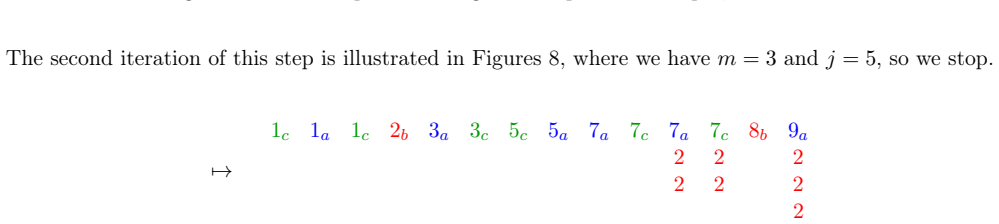
- [Section 2, inverse map Step 3 (Figures 6–8)] The selection rule for the gap is off by one on the paper's own example. In the state of Figure 6, the first iteration is supposed to insert (2)_b with i=1 into the gap between 1_c and 1_a. The top row of the array has 2s in columns 3 through 12, so the number of 2s read from the left up to and including the column below the 1_a at the right end of the chosen gap is 2, not 1; the count through the preceding 1_c is 1. The second iteration from Figure 7 shows the same discrepancy: the count through the 7_a is 5 while i=4, and the count through the preceding 7_c is 4. Under the literal reading, no gap satisfies the condition for i=1 in the first iteration, and for i=2 there are two gaps (the (c,a) gap at columns 3–4 and the (a,c) gap at columns 4–5) with count 2, so the asserted uniqueness also fails. This is a load-bearing step: the inverse map is ill-defined without a correct and unique gap-selection rule. The rule appears repairable (for example, by counting through the left part of the gap rather than through the a-coloured part, or by counting up to but not including the a-part), but as written it is incorrect.
- [Section 2, inverse map Step 3, justification paragraph] The sentence beginning 'Indeed, the number of 2s up to and including the largest odd part...' does not prove the asserted existence and uniqueness. It states that moving from right to left the count of 2s decreases by one at each step, but it does not specify whether the count is taken through the left or the right part of a gap, and it does not show that the resulting values at the relevant alternating-colour gaps are exactly 1,2,...,j without repetition. Since this step determines which even part is inserted at each recursive stage, a complete and precise proof is required.
- [Section 3, inverse map Step 3] The sentence 'We omit the detailed description of this recursive construction, as it is completely analogous to the map in Step 3 of the inverse map in the proof of Theorem 1.11' is not acceptable in its current form, because the analogous step in Section 2 is defective. Theorem 1.12 inherits the same load-bearing gap-selection mechanism, and the omission leaves no way to verify that the inverse map is well-defined. Please provide the corrected step and its proof, or give an explicit reduction to a corrected Section 2 argument.
minor comments (6)
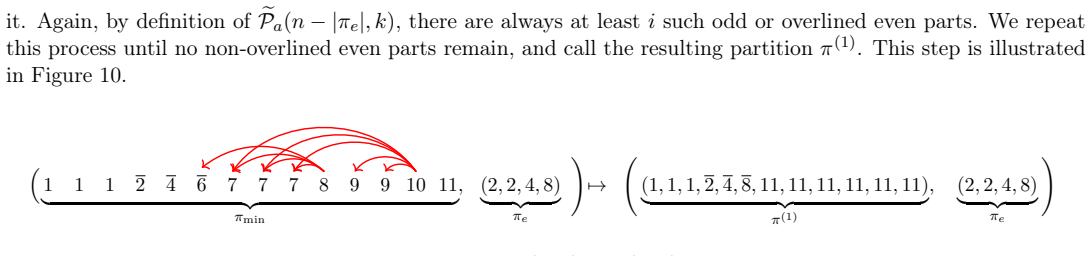
- [Section 2, forward Step 3] The order in which the parts of π_e are processed is not specified. Section 3 explicitly says 'starting from the largest,' and the example in Figure 3 appears to process (2,6,6) in decreasing order, but the text of Section 2 does not state this. Please clarify whether the order is prescribed or whether the final overpartition is independent of it.
- [Section 2, inverse Step 3] The sentences 'The first iteration of this step is illustrated in Figures 7, where we have m=5 and j=4' and the analogous sentence for Figure 8 give the parameters after the insertion, not at the start of the iteration. State the values of m and j at the beginning of each iteration to avoid confusion.
- [Page 4, Example 1.9 (i) and Section 2, Example 2.1] 'Theorem 1.9' should read 'Example 1.9' in both places.
- [Page 5, after (1.6) and before Theorem 1.11] 'Their produce sides' should be 'Their product sides' in both occurrences.
- [Corollary 3.4] The corollary cites 'Theorem 3.3', but the statement being cited is Lemma 3.3.
- [Figures 6–8] The rows of 2s in the array are right-justified under the partition, but this is not stated in the text. Stating this explicitly would make the column sums and the off-by-one analysis unambiguous.
Circularity Check
No circularity: the bijections are constructed directly and the product formulas are used as target identities, not as inputs.
full rationale
The bijective proofs in Sections 2 and 3 are self-contained. Theorem 1.11 constructs maps between P_b(n,k) and PO(n,k) directly from the difference-condition definition of grounded partitions and the definition of overpartitions; the inverse map is defined on the same combinatorial objects. The target product formula (1.3) is used only after the bijection, by equating the generating function of grounded partitions with the standard overpartition generating function (2.1). Similarly, Theorem 1.12 and identity (1.4) use (3.1) after the bijection. Lemma 2.2 and Lemma 3.3 derive the bivariate generating functions of grounded partitions from the colour and difference conditions themselves, not from the desired products. Corollaries 2.3 and 3.4 then combine these derivations with the independent overpartition/partition generating functions and the proved bijections, which is the normal structure of a bijective proof. The paper cites [9] for the original representation-theoretic product formulas, but Theorem 1.6 is not used inside the bijection proofs. The only flagged weakness is the asserted uniqueness/existence of the gap in inverse Step 3 of Section 2 and the omitted analogous Step 3 in Section 3; this is a correctness and completeness concern, not a circular reduction, so it does not affect the circularity score.
Assumptions & free parameters
Cite this review
Pith. "Pith review of $A_1^{(1)}$-Grounded partitions at levels $1$ and $2$, Part I: bijections." pith.science (2026). https://pith.science/paper/ABOCIDLN
@misc{pith2026250802664,
  author       = {Pith},
  title        = {Pith review of: $A_1^(1)$-Grounded partitions at levels $1$ and $2$, Part I: bijections},
  year         = {2026},
  howpublished = {\url{https://pith.science/paper/ABOCIDLN}},
  note         = {Machine review of arXiv:2508.02664}
}
abstract
Grounded partitions, introduced by Dousse and Konan, are coloured partitions satisfying difference conditions encoded by a matrix. For suitable choices of this matrix, their generating functions are known to coincide with characters of affine Lie algebras. In this paper, we study, from a combinatorial point of view, the grounded partitions introduced by Dousse, Hardiman and Konan and related to the Lie algebra $A_1^{(1)}$. Using the connection with characters, they showed that the generating function for these grounded partitions is an infinite product. We give direct combinatorial proofs of the corresponding product formulas. In particular, we construct two explicit bijections from grounded partitions to odd overpartitions, and to partitions in which the even parts are distinct.
Figures


Figures from the paper (12 more)





Reference graph
Works this paper leans on
-
[1]
Eight-vertexSOSmodelandgeneralizedRogers–Ramanujan- type identities
G.E.Andrews,R.J.Baxter,andP.J.Forrester.“Eight-vertexSOSmodelandgeneralizedRogers–Ramanujan- type identities”. In:Journal of Statistical Physics35.3–4 (1984), pp. 193–266.doi:10.1007/BF01014383
-
[2]
Rogers–Ramanujan identities in the hard hexagon model
R. J. Baxter. “Rogers–Ramanujan identities in the hard hexagon model”. In:Journal of Statistical Physics 26 (1981), pp. 427–452.doi:10.1007/BF01011427
-
[3]
Periodic Schur process and cylindric partitions
A. Borodin. “Periodic Schur process and cylindric partitions”. In:Duke Mathematical Journal140.3 (2007), pp. 391–468.doi:10.1215/S0012-7094-07-14031-6. arXiv:math/0601019
work page Pith review arXiv 2007
-
[4]
On partitions, orthogonal polynomials and the expansion of certain infinite products
D. M. Bressoud. “On partitions, orthogonal polynomials and the expansion of certain infinite products”. In: Proceedings of the London Mathematical Society. 3rd ser. 42 (1981), pp. 478–500.doi:10.1112/plms/s3- 42.3.478
doi:10.1112/plms/s3- 1981
-
[5]
Eulerian series as modular forms
K. Bringmann, K. Ono, and R. C. Rhoades. “Eulerian series as modular forms”. In:Journal of the American Mathematical Society21.4 (2008), pp. 1085–1104.doi:10.1090/S0894-0347-07-00587-5
-
[6]
Rogers-Ramanujan type identities and Nil-DAHA
I. Cherednik and B. Feigin. “Rogers–Ramanujan type identities and Nil-DAHA”. In:Advances in Mathematics 248 (2013), pp. 1050–1088.doi:10.1016/j.aim.2013.08.025. arXiv:1209.1978
work page Pith review arXiv 2013
-
[7]
S. Corteel and J. Lovejoy. “Overpartitions”. In:Trans. Amer. Math. Soc.356.4 (2004), pp. 1623–1635.issn: 0002-9947,1088-6850.doi:10.1090/S0002-9947-03-03328-2
-
[8]
B. Dombos and J. Jang.A (1) 1 -grounded partitions at levels1and2. Part II: Affine crystal structure. In preparation
Show all 25 references
-
[9]
Partition identities from higher level crystals ofA(1) 1
J. Dousse, L. Hardiman, and I. Konan. “Partition identities from higher level crystals ofA(1) 1 ”. In:Proceedings of the American Mathematical Society153.4 (Feb. 2025), pp. 1363–1382.doi:10.1090/proc/16417.url: https://hal.science/hal-03448464. 13
2025 doi
-
[10]
Dousse and I
J. Dousse and I. Konan.Generalisations of Capparelli’s and Primc’s identities, II: perfectA(1) n−1 crystals and explicit character formulas. 2020. arXiv:1911.13189 [math.QA].url:https://arxiv.org/abs/1911.13189
2020 arXiv
-
[11]
Multi-grounded partitions and character formulas
J. Dousse and I. Konan. “Multi-grounded partitions and character formulas”. In:Advances in Mathematics 400 (2022), p. 108275.issn: 0001-8708.doi:https : / / doi . org / 10 . 1016 / j . aim . 2022 . 108275.url: https://www.sciencedirect.com/science/article/pii/S0001870822000913
2022
-
[12]
Variants of the Rogers–Ramanujan identities
K. Garrett, M. E. H. Ismail, and D. Stanton. “Variants of the Rogers–Ramanujan identities”. In:Advances in Applied Mathematics23.3 (1999), pp. 274–299.doi:10.1006/aama.1999.0658
1999
-
[13]
Gasper and M
G. Gasper and M. Rahman.Basic hypergeometric series. Second. Vol. 96. Encyclopedia of Mathematics and its Applications. With a foreword by Richard Askey. Cambridge University Press, Cambridge, 2004, pp. xxvi+428.isbn: 0-521-83357-4.doi:10.1017/CBO9780511526251.url:https://doi....
2004 doi
-
[14]
Hong and S.-J
J. Hong and S.-J. Kang.Introduction to Quantum Groups and Crystal Bases. Vol. 42. Graduate Studies in Mathematics. Amer. Math. Soc., 2002
2002
-
[15]
Kac.Infinite Dimensional Lie Algebras
V. Kac.Infinite Dimensional Lie Algebras. 3rd. Cambridge Univ. Press, 1990
1990
- [16]
-
[17]
Perfect crystals of quantum affine Lie algebras
S. Kang, M. Kashiwara, K. Misra, T. Miwa, T. Nakashima, and A. Nakayashiki. “Perfect crystals of quantum affine Lie algebras”. In:Duke Mathematical Journal68.3 (1992), pp. 499–607.doi:10.1215/S0012-7094- 92-06821-9
1992 doi
-
[18]
Lepowsky.Lectures on Kac–Moody Lie Algebras
J. Lepowsky.Lectures on Kac–Moody Lie Algebras. Spring 1978. Paris: Université Paris VI, 1978
1978
-
[19]
Lie Algebraic Approaches to Classical Partition Identities
J. Lepowsky and S. Milne. “Lie Algebraic Approaches to Classical Partition Identities”. In:Advances in Mathematics29.1 (1978), pp. 15–59.issn: 0001-8708.doi:https://doi.org/10.1016/0001- 8708(78) 90004-X.url:https://www.sciencedirect.com/science/article/pii/000187087890004X
1978
-
[20]
The structure of standard modules, I: Universal algebras and the Rogers- Ramanujan identities
J. Lepowsky and R. L. Wilson. “The structure of standard modules, I: Universal algebras and the Rogers- Ramanujan identities”. In:Invent. Math.77 (1984), pp. 199–290.doi:https : / / doi . org / 10 . 1007 / BF01388447
1984
-
[21]
The structure of standard modules, II: The caseA(1) 1 , principal gradation
J. Lepowsky and R. L. Wilson. “The structure of standard modules, II: The caseA(1) 1 , principal gradation”. In:Invent. Math.79 (1985), pp. 417–442.doi:https://doi.org/10.1007/BF01388515
1985 doi
-
[22]
P. A. MacMahon.Combinatory Analysis. Vol. 2. New York, NY, USA: Cambridge Univ. Press, 1916
1916
-
[23]
Proof of certain identities in combinatory analysis
L. J. Rogers and S. Ramanujan. “Proof of certain identities in combinatory analysis”. In:Math. Proc. Cam- bridge Philos. Soc.19 (1919), pp. 211–216
1919
-
[24]
Ein Beitrag zur Additiven Zahlentheorie und zur Theorie der Kettenbrüche
I. Schur. “Ein Beitrag zur Additiven Zahlentheorie und zur Theorie der Kettenbrüche”. In:S.-B. Preuss. Akad. Wiss. Phys. Math. Klasse(1917), pp. 302–321
1917
-
[25]
Combinatorial proofs of Ramanujan’s1ψ1 summation and theq-Gauss summation
A. J. Yee. “Combinatorial proofs of Ramanujan’s1ψ1 summation and theq-Gauss summation”. In:J. Combin. Theory Ser. A105.1 (2004), pp. 63–77.issn: 0097-3165,1096-0899.doi:10.1016/j.jcta.2003.10.002.url: https://doi.org/10.1016/j.jcta.2003.10.002. 14
2004 doi
Reviewed August 15, 2026 · model on record in the stance chip above.
Discussion (0). Continue with ORCID to comment.