REVIEW 3 major objections 5 minor 61 references
Prevalence of neutral gas in centres of merging galaxies-II: nuclear HI and multi-wavelength properties
T0 review · 3 major / 5 minor · reviewed 2026-08-14 · deepseek-v4-flash
Pith's one-line read Galaxy mergers with radio-loud cores show neutral hydrogen absorption in about 84% of cases, roughly four times the rate in non-mergers.
desk verdict Solid confirmation that radio-loud mergers show ~4x higher HI 21-cm absorption than non-mergers, but the post-merger gas-survival claim is overinterpreted relative to the statistics. read the letter →
The pith
A machine-rendered reading of the paper's core claim, the machinery that carries it, and where it could break.
The reading
What carries the argument
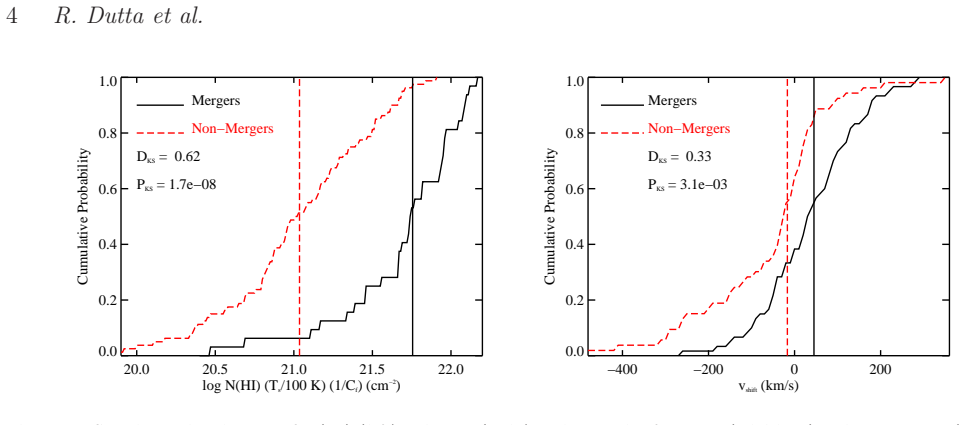
The load-bearing probe is the HI 21-cm absorption line: the spin-flip transition of neutral hydrogen seen in absorption against a compact background radio continuum source, which traces cold gas along the line of sight through the central kiloparsecs. The argument compares this absorption in 38 radio-loud mergers with 229 non-merger radio galaxies, using two-sided Kolmogorov-Smirnov tests on column density, line width, and velocity shift, and a stellar-mass/redshift-matched control to rule out galaxy-mass effects. Conversion of optical depth to column density assumes a spin temperature of 100 K and unity covering factor. Merger stages are assigned with a six-stage classification scheme compressed into pre-merger, ongoing, and post-merger phases, and the evolution along that sequence is the third quantitative axis of the paper.
What would settle it
HI 21-cm observations of the seven unobserved radio-loud mergers in the parent sample at comparable sensitivity: if most of those seven turn out to be non-detections, the quoted 84% detection rate falls (for example, if four of seven are non-detections, the rate drops to roughly 71%) and the contrast with the 23% non-merger rate weakens.
Extended reading notes
Core claim
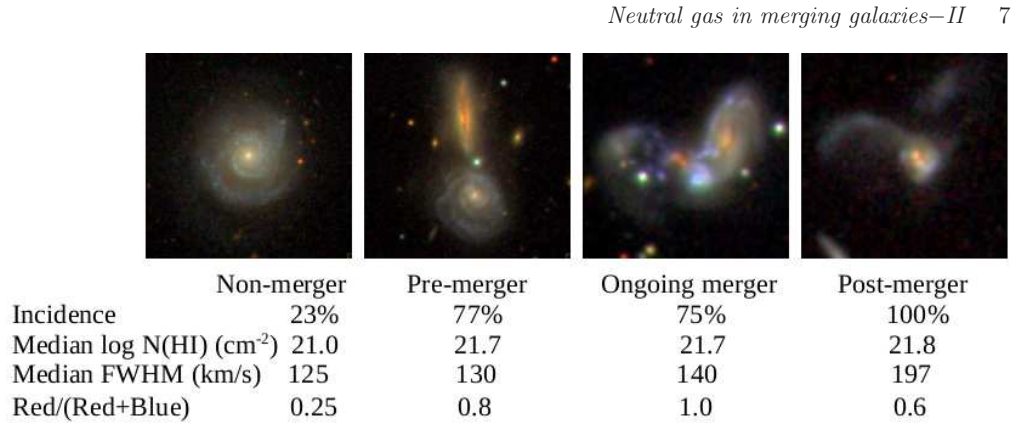
The central discovery is that the nuclear neutral hydrogen content of radio-loud galaxies depends strongly on merger state. Among 38 mergers, 32 are detected in HI 21-cm absorption, a detection rate of 84 ± 15%, against 23 ± 3% in a reference sample of 229 non-mergers. A two-sided Kolmogorov-Smirnov test gives $P_{\mathrm{KS}} = 2\times10^{-8}$ for the column-density distributions and $P_{\mathrm{KS}} = 3\times10^{-3}$ for the absorption velocity shifts; the median $N(\mathrm{H\,I})$ is roughly five times higher in mergers, and the fraction of components with $v_{\mathrm{shift}} \ge 100$ km s$^{-1}$ is 30 ± 7%, versus 9 ± 4% in non-mergers. Matching the samples in stellar mass and redshift leaves the differences intact. The detection rate climbs from pre-merger through ongoing to post-merger stages and reaches 100% in post-mergers, which the paper reads as evidence that circumnuclear neutral gas persists through coalescence and is not yet quenched by the radio-loud nucleus.
Load-bearing premise
The claim rests on the assumption that the 38 mergers with HI measurements fairly represent all 45 radio-loud mergers in the parent sample; in particular, the seven systems without HI data must not be mostly non-detections.
Editorial extensions
If this is right
- The mass-matched comparison implies that the high column densities and infall signatures are caused by the merging process itself, not by the stellar mass of the galaxies involved.
- Because 100% of the post-mergers show absorption, the neutral gas reservoir that feeds or accompanies nuclear activity survives for roughly a gigayear after coalescence; radio-loud feedback has not yet expelled it.
- The incidence of HI absorption rises from pre-merger to post-merger stages, implying that tidal interactions progressively concentrate neutral gas into the nuclear regions.
- The absence of strong correlations between HI gas properties and infrared luminosity or star formation rate means that current starburst intensity does not determine how much neutral gas sits at the nucleus.
- The higher fraction of redshifted absorption lines in mergers indicates that a substantial part of the nuclear neutral gas is infalling rather than outflowing, which is relevant to black hole feeding.
Reading between the lines
- The tentative anti-correlation of $N(\mathrm{H\,I})$ with stellar mass likely tracks gas-rich blue mergers; a sample extending to fainter radio powers and higher redshifts could test whether the mass trend is purely a selection effect.
- If the post-merger gas reservoir survives coalescence, the next evolutionary step should be a drop in HI absorption once quasar-driven winds clear the nucleus; searching for HI in radio-loud post-mergers with quasar-like optical spectra would test this sequence.
- The fixed spin-temperature and covering-factor values ($T_s=100$ K, $C_f=1$) mean the reported column densities are lower limits if the gas is warm or patchy; resolved 21-cm excitation measurements or comparison with other cold-gas tracers would calibrate the actual column.
Signed reviews
Editorial analysis
A structured set of objections, weighed in public.
Referee Report
Summary. This paper presents H I 21-cm absorption observations of nine galaxy mergers obtained with the GMRT and combines them with literature data to build a sample of 38 radio-loud mergers at z <= 0.2. The authors report an H I absorption detection rate of 84 +/- 15% (32/38), about four times the 23 +/- 3% rate found in a 229-object non-merger sample from Maccagni et al. (2017). Two-sided KS tests show significantly different distributions of H I column density (P = 2e-8) and velocity shift (P = 3e-3) between mergers and non-mergers, and these differences persist in a stellar-mass/redshift-matched subsample. The paper also examines correlations with multi-wavelength properties and merger stage, finding tentative trends and a 100% detection rate among 13 post-mergers, which it interprets as evidence that neutral gas survives the coalescence period.
Significance. If the central result holds, the paper makes a strong case that the merger process itself, rather than galaxy stellar mass or AGN radio power, drives elevated cold neutral gas in the nuclear regions of radio-loud galaxies. The statistical treatment is careful in several respects: KS tests are applied to full and matched samples, upper limits on N(H I) are treated as censored data via survival analysis, and the incidence comparison is repeated at different N(H I) sensitivity limits. The new GMRT observations are presented in detail in the appendix. The main caveats concern the completeness of the parent sample and the strength of the evolutionary interpretation drawn from the post-merger subsample.
major comments (3)
- [Section 2.1, Table A1] The statistical sample comprises 38 of the 45 radio-loud mergers; the 7 without H I measurements are excluded without discussion. If all 7 were non-detections, the incidence would be 32/45 = 71%, still well above the non-merger rate but lower than the quoted 84%, and the '~4 times' excess would become '~3 times'. Please either provide the H I limits for these 7 systems or compare their z, P1.4, M*, and merger-stage distributions with the 38 included systems, and state the resulting range of detection rates.
- [Section 3.1, Table 1] The quoted factor-of-four excess relative to non-mergers rests on the comparability of the Maccagni et al. (2017) reference sample, but the paper does not demonstrate that this sample satisfies the same selection (for example, S1.4 > 20 mJy and z <= 0.2) or that its P1.4 and redshift distributions match the merger sample. The later mass/redshift matching is performed for only 24 mergers and only for the distribution comparison, not for the incidence comparison. Please report the radio-power and redshift distributions of the full non-merger sample and repeat the incidence comparison for a P1.4- and z-matched control, or state explicitly why this is unnecessary.
- [Section 3.3, Fig. 4, Abstract] The claim that the 100% detection rate in post-mergers indicates that neutral gas survives the coalescence period and is not yet quenched is not statistically supported as stated. The paper itself notes that differences among merger stages are not significant in KS tests; moreover, the 13 post-mergers lack a comparison control matched in P1.4 and redshift, and the sample is selected on S1.4 > 20 mJy. A Fisher exact test or bootstrap comparison of 13/13 with the ongoing/pre-merger rates and with a matched non-merger control should be reported. Until then, the abstract and conclusions should present the post-merger survival as a tentative interpretation rather than a firm result.
minor comments (5)
- [Section 1] The word 'untill' in the first paragraph should be 'until'.
- [Section 3.1] The uncertainty quoted on the 84% detection rate (15%) is not defined; please specify whether it is a binomial or Wilson confidence interval.
- [Section 3.3, Fig. 4] The median N(H I) and FWHM values for each merger stage are shown in Fig. 4 but are not given numerically in the text; adding them to the text or a small table would improve reproducibility.
- [Table A1] The spectral-index column header uses alpha_{0.15}^{1.4}, but the definition is given only in Section 2.1; please restate it in the table note for clarity.
- [Throughout] Several LaTeX artifacts such as 'greaterorequalslant' appear in the text; these should be rendered as proper symbols in the final version.
Circularity Check
No circularity: direct observational HI 21-cm absorption statistics compared with an external non-merger control sample.
full rationale
The paper's central claims are observational statistics: an 84±15% (32/38) HI 21-cm absorption detection rate in radio-loud mergers, compared with 23±3% in 229 non-mergers from Maccagni et al. (2017), plus KS-test comparisons of N(HI), FWHM, and vshift distributions. The N(HI) values are converted from measured optical depths using the standard assumed values T_s = 100 K and C_f = 1; these are not fitted to the data and do not encode the merger/non-merger distinction. The sensitivity-limit comparisons in Table 1 are re-binnings of the same measured detections and upper limits, not predictions derived from the comparison. The self-citations (D18 and Dutta et al. 2016, 2017) provide previously published observational data and standard data-reduction procedures; they are not invoked as an unverified authority that defines the result, and the 9 new GMRT observations (8 detections) independently contribute to the sample. The stronger interpretive claim that the 100% post-merger detection rate implies survival of circumnuclear neutral gas is based on 13 objects and the paper itself notes that differences among merger stages are not statistically significant in two-sided KS tests; that is an over-interpretation or statistical-power concern, not circular reasoning. No equation in the paper is defined in terms of the claimed result, and no fitted parameter is renamed as a prediction. The analysis is therefore self-contained as a measurement paper, with any weaknesses lying in sample representativeness and statistical power rather than circularity.
Assumptions & free parameters
free parameters (6)
- Projected separation threshold for incidence split =
6 kpc
- Stellar mass threshold for incidence split =
6 x 10^10 M_sun
- Redshift threshold for incidence split =
0.04
- Spectral index threshold for incidence split =
-0.48
- Spin temperature (T_s) =
100 K
- Covering factor (C_f) =
1
assumptions (4)
- standard math Flat Lambda-CDM cosmology with H0 = 70 km/s/Mpc and Omega_M = 0.30
- domain assumption Spin temperature T_s = 100 K and covering factor C_f = 1 for all sources
- domain assumption Visual classification of mergers and merger stages from SDSS images is reliable
- domain assumption The non-merger reference sample from Maccagni et al. (2017) is comparable in sensitivity and selection to the merger observations
Cite this review
Pith. "Pith review of Prevalence of neutral gas in centres of merging galaxies-II: nuclear HI and multi-wavelength properties." pith.science (2026). https://pith.science/paper/ACMI7357
@misc{pith2026190802291,
  author       = {Pith},
  title        = {Pith review of: Prevalence of neutral gas in centres of merging galaxies-II: nuclear HI and multi-wavelength properties},
  year         = {2026},
  howpublished = {\url{https://pith.science/paper/ACMI7357}},
  note         = {Machine review of arXiv:1908.02291}
}
read the original abstract
Using a sample of 38 radio-loud galaxy mergers at z<=0.2, we confirm the high detection rate (~84%) of HI 21-cm absorption in mergers, which is significantly higher (~4 times) than in non-mergers. The distributions of the HI column density [N(HI)] and velocity shift of the absorption with respect to the systemic redshift of the galaxy hosting the radio source in mergers are significantly different from that in non-mergers. We investigate the connection of the nuclear HI gas with various multi-wavelength properties of the mergers. While the inferred N(HI) and gas kinematics do not show strong (i.e. >=3-sigma level) correlation with galaxy properties, we find that the incidence and N(HI) of absorption tend to be slightly higher at smaller projected separations between the galaxy pairs and among the lower stellar mass-radio galaxies. The incidence, N(HI) and line width of HI absorption increase from the pre-merger to the post-merger stages. The 100% detection rate in post-mergers indicates that the neutral gas in the circumnuclear regions survives the coalescence period and is not yet quenched by the nuclear radio activity.
Figures


Figures from the paper (1 more)
Reference graph
Works this paper leans on
-
[1]
Baan W. A., Hagiwara Y., Hofner P., 2007, @doi [ ] 10.1086/513593 , http://adsabs.harvard.edu/abs/2007ApJ...661..173B 661, 173
-
[2]
Baldwin J. A., Phillips M. M., Terlevich R., 1981, @doi [ ] 10.1086/130766 , http://adsabs.harvard.edu/abs/1981PASP...93....5B 93, 5
doi:10.1086/130766 1981
-
[3]
Barcos-Mu \ n oz L., et al., 2017, @doi [ ] 10.3847/1538-4357/aa789a , https://ui.adsabs.harvard.edu/abs/2017ApJ...843..117B 843, 117
-
[4]
Blanton M. R., Roweis S., 2007, @doi [ ] 10.1086/510127 , http://adsabs.harvard.edu/abs/2007AJ....133..734B 133, 734
doi:10.1086/510127 2007
-
[5]
Blumenthal K. A., Barnes J. E., 2018, @doi [ ] 10.1093/mnras/sty1605 , https://ui.adsabs.harvard.edu/abs/2018MNRAS.479.3952B 479, 3952
-
[6]
Brinchmann J., Charlot S., White S. D. M., Tremonti C., Kauffmann G., Heckman T., Brinkmann J., 2004, @doi [ ] 10.1111/j.1365-2966.2004.07881.x , http://cdsads.u-strasbg.fr/abs/2004MNRAS.351.1151B 351, 1151
arXiv 2004
-
[7]
Bustamante S., Sparre M., Springel V., Grand R. J. J., 2018, @doi [ ] 10.1093/mnras/sty1692 , http://adsabs.harvard.edu/abs/2018MNRAS.479.3381B 479, 3381
-
[8]
Carilli C. L., Wrobel J. M., Ulvestad J. S., 1998, @doi [ ] 10.1086/300253 , http://adsabs.harvard.edu/abs/1998AJ....115..928C 115, 928
doi:10.1086/300253 1998
Show all 61 references
-
[9]
Catinella B., et al., 2018, @doi [ ] 10.1093/mnras/sty089 , http://adsabs.harvard.edu/abs/2018MNRAS.476..875C 476, 875
2018 doi
-
[11]
K., Saikia D
Chandola Y., Sirothia S. K., Saikia D. J., Gupta N., 2012, Bulletin of the Astronomical Society of India, http://adsabs.harvard.edu/abs/2012BASI...40..139C 40, 139
2012
-
[12]
J., Cotton W
Condon J. J., Cotton W. D., Greisen E. W., Yin Q. F., Perley R. A., Taylor G. B., Broderick J. J., 1998, @doi [ ] 10.1086/300337 , http://adsabs.harvard.edu/abs/1998AJ....115.1693C 115, 1693
1998 doi
-
[13]
J., Jonsson P., Somerville R
Cox T. J., Jonsson P., Somerville R. S., Primack J. R., Dekel A., 2008, @doi [ ] 10.1111/j.1365-2966.2007.12730.x , http://adsabs.harvard.edu/abs/2008MNRAS.384..386C 384, 386
2008
-
[14]
W., Kaviraj S., Lintott C
Darg D. W., Kaviraj S., Lintott C. J., Schawinski K., Silk J., Lynn S., Bamford S., Nichol R. C., 2011, @doi [ ] 10.1111/j.1365-2966.2011.18964.x , https://ui.adsabs.harvard.edu/abs/2011MNRAS.416.1745D 416, 1745
2011
-
[15]
Di Matteo T., Springel V., Hernquist L., 2005, @doi [ ] 10.1038/nature03335 , http://adsabs.harvard.edu/abs/2005Natur.433..604D 433, 604
2005 doi
-
[16]
Di Matteo P., Combes F., Melchior A.-L., Semelin B., 2007, @doi [ ] 10.1051/0004-6361:20066959 , http://adsabs.harvard.edu/abs/2007A
2007 doi
-
[17]
M., 1986, @doi [ ] 10.1086/163793 , http://adsabs.harvard.edu/abs/1986ApJ...300..190D 300, 190
Dickey J. M., 1986, @doi [ ] 10.1086/163793 , http://adsabs.harvard.edu/abs/1986ApJ...300..190D 300, 190
1986 doi
-
[18]
M., 2016, @doi [ ] 10.1093/mnras/stv2980 , http://adsabs.harvard.edu/abs/2016MNRAS.456.4209D 456, 4209
Dutta R., Gupta N., Srianand R., O'Meara J. M., 2016, @doi [ ] 10.1093/mnras/stv2980 , http://adsabs.harvard.edu/abs/2016MNRAS.456.4209D 456, 4209
2016 doi
-
[19]
Dutta R., Srianand R., Gupta N., Momjian E., Noterdaeme P., Petitjean P., Rahmani H., 2017, @doi [ ] 10.1093/mnras/stw2689 , http://adsabs.harvard.edu/abs/2017MNRAS.465..588D 465, 588
2017 doi
-
[20]
Dutta R., Srianand R., Gupta N., 2018, @doi [ ] 10.1093/mnras/sty1872 , http://adsabs.harvard.edu/abs/2018MNRAS.480..947D 480, 947
2018 doi
-
[21]
L., Patton D
Ellison S. L., Patton D. R., Simard L., McConnachie A. W., 2008, @doi [ ] 10.1088/0004-6256/135/5/1877 , http://adsabs.harvard.edu/abs/2008AJ....135.1877E 135, 1877
2008 doi
-
[22]
L., Fertig D., Rosenberg J
Ellison S. L., Fertig D., Rosenberg J. L., Nair P., Simard L., Torrey P., Patton D. R., 2015, @doi [ ] 10.1093/mnras/stu2744 , http://adsabs.harvard.edu/abs/2015MNRAS.448..221E 448, 221
2015 doi
-
[23]
L., Catinella B., Cortese L., 2018, @doi [ ] 10.1093/mnras/sty1247 , http://adsabs.harvard.edu/abs/2018MNRAS.478.3447E 478, 3447
Ellison S. L., Catinella B., Cortese L., 2018, @doi [ ] 10.1093/mnras/sty1247 , http://adsabs.harvard.edu/abs/2018MNRAS.478.3447E 478, 3447
2018 doi
-
[24]
L., Viswanathan A., Patton D
Ellison S. L., Viswanathan A., Patton D. R., Bottrell C., McConnachie A. W., Gwyn S., Cuillandre J.-C., 2019, @doi [ ] 10.1093/mnras/stz1431 , https://ui.adsabs.harvard.edu/abs/2019MNRAS.tmp.1374E p. 1374
2019 doi
-
[25]
Fu H., et al., 2018, @doi [ ] 10.3847/1538-4357/aab364 , https://ui.adsabs.harvard.edu/abs/2018ApJ...856...93F 856, 93
2018 doi
-
[26]
F., Baum S
Gallimore J. F., Baum S. A., O'Dea C. P., Pedlar A., Brinks E., 1999, @doi [ ] 10.1086/307853 , http://adsabs.harvard.edu/abs/1999ApJ...524..684G 524, 684
1999 doi
-
[27]
M., Morganti R., Oosterloo T
Ger \'e b K., Maccagni F. M., Morganti R., Oosterloo T. A., 2015, @doi [ ] 10.1051/0004-6361/201424655 , http://adsabs.harvard.edu/abs/2015A
2015 doi
-
[28]
J., Saikia D
Gupta N., Salter C. J., Saikia D. J., Ghosh T., Jeyakumar S., 2006, @doi [ ] 10.1111/j.1365-2966.2006.11064.x , http://adsabs.harvard.edu/abs/2006MNRAS.373..972G 373, 972
2006
-
[29]
Haan S., et al., 2011, @doi [ ] 10.1088/0004-6256/141/3/100 , http://adsabs.harvard.edu/abs/2011AJ....141..100H 141, 100
2011 doi
-
[30]
E., van Gorkom J
Hibbard J. E., van Gorkom J. H., 1996, @doi [ ] 10.1086/117815 , http://adsabs.harvard.edu/abs/1996AJ....111..655H 111, 655
1996 doi
-
[31]
F., Hernquist L., Cox T
Hopkins P. F., Hernquist L., Cox T. J., Kere s D., 2008, @doi [ ] 10.1086/524362 , http://adsabs.harvard.edu/abs/2008ApJS..175..356H 175, 356
2008 doi
-
[32]
Kawada M., et al., 2007, @doi [ ] 10.1093/pasj/59.sp2.S389 , http://adsabs.harvard.edu/abs/2007PASJ...59S.389K 59, S389
2007 doi
-
[33]
J., Geller M
Kewley L. J., Geller M. J., Barton E. J., 2006, @doi [ ] 10.1086/500295 , http://adsabs.harvard.edu/abs/2006AJ....131.2004K 131, 2004
2006 doi
-
[34]
M., Jonsson P., Cox T
Lotz J. M., Jonsson P., Cox T. J., Primack J. R., 2008, @doi [ ] 10.1111/j.1365-2966.2008.14004.x , http://adsabs.harvard.edu/abs/2008MNRAS.391.1137L 391, 1137
2008
-
[35]
M., Morganti R., Oosterloo T
Maccagni F. M., Morganti R., Oosterloo T. A., Ger \'e b K., Maddox N., 2017, @doi [ ] 10.1051/0004-6361/201730563 , http://adsabs.harvard.edu/abs/2017A
2017 doi
-
[36]
C., Hernquist L., 1996, @doi [ ] 10.1086/177353 , http://adsabs.harvard.edu/abs/1996ApJ...464..641M 464, 641
Mihos J. C., Hernquist L., 1996, @doi [ ] 10.1086/177353 , http://adsabs.harvard.edu/abs/1996ApJ...464..641M 464, 641
1996 doi
-
[37]
F., Sanders D
Mirabel I. F., Sanders D. B., 1988, @doi [ ] 10.1086/166909 , https://ui.adsabs.harvard.edu/abs/1988ApJ...335..104M 335, 104
1988 doi
-
[38]
L., Patton D
Moreno J., Torrey P., Ellison S. L., Patton D. R., Bluck A. F. L., Bansal G., Hernquist L., 2015, @doi [ ] 10.1093/mnras/stv094 , http://adsabs.harvard.edu/abs/2015MNRAS.448.1107M 448, 1107
2015 doi
-
[39]
Moreno J., et al., 2019, @doi [ ] 10.1093/mnras/stz417 , http://adsabs.harvard.edu/abs/2019MNRAS.485.1320M 485, 1320
2019 doi
-
[40]
B., Oosterloo T
Morganti R., Peck A. B., Oosterloo T. A., van Moorsel G., Capetti A., Fanti R., Parma P., de Ruiter H. R., 2009, @doi [ ] 10.1051/0004-6361/200912605 , http://adsabs.harvard.edu/abs/2009A
2009 doi
-
[41]
Moshir M., et al., 1990, in Bulletin of the American Astronomical Society. p. 1325
1990
-
[42]
G., Ferruit P., Pedlar A., 2001, @doi [ ] 10.1086/322508 , http://adsabs.harvard.edu/abs/2001ApJ...560..168M 560, 168
Mundell C. G., Ferruit P., Pedlar A., 2001, @doi [ ] 10.1086/322508 , http://adsabs.harvard.edu/abs/2001ApJ...560..168M 560, 168
2001 doi
-
[43]
Pan H.-A., et al., 2018, @doi [ ] 10.3847/1538-4357/aaeb92 , http://adsabs.harvard.edu/abs/2018ApJ...868..132P 868, 132
2018 doi
-
[44]
Salim S., et al., 2007, @doi [ ] 10.1086/519218 , http://cdsads.u-strasbg.fr/abs/2007ApJS..173..267S 173, 267
2007 doi
-
[45]
B., Mirabel I
Sanders D. B., Mirabel I. F., 1996, @doi [ ] 10.1146/annurev.astro.34.1.749 , http://adsabs.harvard.edu/abs/1996ARA
1996 doi
-
[46]
L., McAlpine W., Hickox R
Satyapal S., Ellison S. L., McAlpine W., Hickox R. C., Patton D. R., Mendel J. T., 2014, @doi [ ] 10.1093/mnras/stu650 , http://adsabs.harvard.edu/abs/2014MNRAS.441.1297S 441, 1297
2014 doi
-
[47]
Satyapal S., et al., 2017, @doi [ ] 10.3847/1538-4357/aa88ca , https://ui.adsabs.harvard.edu/abs/2017ApJ...848..126S 848, 126
2017 doi
-
[48]
K., Oosterloo T., 2018, @doi [ ] 10.1051/0004-6361/201833108 , https://ui.adsabs.harvard.edu/abs/2018A&A...617A..38S 617, A38
Schulz R., Morganti R., Nyland K., Paragi Z., Mahony E. K., Oosterloo T., 2018, @doi [ ] 10.1051/0004-6361/201833108 , https://ui.adsabs.harvard.edu/abs/2018A&A...617A..38S 617, A38
2018 doi
-
[49]
M., Ellison S
Scudder J. M., Ellison S. L., Torrey P., Patton D. R., Mendel J. T., 2012, @doi [ ] 10.1111/j.1365-2966.2012.21749.x , http://adsabs.harvard.edu/abs/2012MNRAS.426..549S 426, 549
2012
-
[50]
Srianand R., Gupta N., Momjian E., Vivek M., 2015, @doi [ ] 10.1093/mnras/stv1004 , http://adsabs.harvard.edu/abs/2015MNRAS.451..917S 451, 917
2015 doi
-
[51]
J., Genzel R., Tecza M., Gallimore J
Tacconi L. J., Genzel R., Tecza M., Gallimore J. F., Downes D., Scoville N. Z., 1999, @doi [ ] 10.1086/307839 , http://adsabs.harvard.edu/abs/1999ApJ...524..732T 524, 732
1999 doi
-
[52]
T., Buat V., Heinis S., Giovannoli E., Yuan F.-T., Iglesias-P \'a ramo J., Murata K
Takeuchi T. T., Buat V., Heinis S., Giovannoli E., Yuan F.-T., Iglesias-P \'a ramo J., Murata K. L., Burgarella D., 2010, @doi [ ] 10.1051/0004-6361/200913476 , http://adsabs.harvard.edu/abs/2010A
2010 doi
-
[53]
H., Veilleux S., Baker A
Teng S. H., Veilleux S., Baker A. J., 2013, @doi [ ] 10.1088/0004-637X/765/2/95 , http://adsabs.harvard.edu/abs/2013ApJ...765...95T 765, 95
2013 doi
-
[54]
J., Kewley L., Hernquist L., 2012, @doi [ ] 10.1088/0004-637X/746/1/108 , http://adsabs.harvard.edu/abs/2012ApJ...746..108T 746, 108
Torrey P., Cox T. J., Kewley L., Hernquist L., 2012, @doi [ ] 10.1088/0004-637X/746/1/108 , http://adsabs.harvard.edu/abs/2012ApJ...746..108T 746, 108
2012 doi
-
[55]
C., et al., 2003, @doi [ ] 10.1051/0004-6361:20030468 , http://adsabs.harvard.edu/abs/2003A
Vermeulen R. C., et al., 2003, @doi [ ] 10.1051/0004-6361:20030468 , http://adsabs.harvard.edu/abs/2003A
2003 doi
-
[56]
L., Sargent M., Coppin K
Violino G., Ellison S. L., Sargent M., Coppin K. E. K., Scudder J. M., Mendel T. J., Saintonge A., 2018, @doi [ ] 10.1093/mnras/sty345 , http://adsabs.harvard.edu/abs/2018MNRAS.476.2591V 476, 2591
2018 doi
-
[57]
M., van den Bosch F
Weinmann S. M., van den Bosch F. C., Yang X., Mo H. J., 2006, @doi [ ] 10.1111/j.1365-2966.2005.09865.x , http://adsabs.harvard.edu/abs/2006MNRAS.366....2W 366, 2
2006
-
[58]
E., McIntosh D
Weston M. E., McIntosh D. H., Brodwin M., Mann J., Cooper A., McConnell A., Nielsen J. L., 2017, @doi [ ] 10.1093/mnras/stw2620 , http://adsabs.harvard.edu/abs/2017MNRAS.464.3882W 464, 3882
2017 doi
-
[59]
L., Becker R
White R. L., Becker R. H., Helfand D. J., Gregg M. D., 1997, , http://adsabs.harvard.edu/abs/1997ApJ...475..479W 475, 479
1997
-
[60]
G., et al., 2000, @doi [ ] 10.1086/301513 , http://adsabs.harvard.edu/abs/2000AJ....120.1579Y 120, 1579
York D. G., et al., 2000, @doi [ ] 10.1086/301513 , http://adsabs.harvard.edu/abs/2000AJ....120.1579Y 120, 1579
2000 doi
-
[61]
T., Frail D
de Gasperin F., Intema H. T., Frail D. A., 2018, @doi [ ] 10.1093/mnras/stx3125 , http://adsabs.harvard.edu/abs/2018MNRAS.474.5008D 474, 5008
2018 doi
-
[62]
H., Knapp G
van Gorkom J. H., Knapp G. R., Ekers R. D., Ekers D. D., Laing R. A., Polk K. S., 1989, @doi [ ] 10.1086/115016 , http://adsabs.harvard.edu/abs/1989AJ.....97..708V 97, 708
1989 doi
Reviewed August 14, 2026 · model on record in the stance chip above.
Discussion (0). Continue with ORCID to comment.