REVIEW 4 major objections 7 minor 34 references
Feasibility study of single top-quark and top-quark pair production in association with a Higgs Boson and a Photon at the LHC
T0 review · 4 major / 7 minor · reviewed 2026-08-07 · deepseek-v4-flash
Pith's one-line read A simulation study projects that top-Higgs-photon events will be visible at the LHC with 350 inverse femtobarns of data.
desk verdict The abstract's cross sections contradict the paper's own tables, but the BDT work is thorough and the final states are underexplored; send to peer review expecting major revision. read the letter →
The pith
A machine-rendered reading of the paper's core claim, the machinery that carries it, and where it could break.
The reading
What carries the argument
The object that carries the argument is a Boosted Decision Tree (BDT), a multivariate classifier that combines many simple threshold rules on event variables. The discriminants with the largest separation power are sums of transverse momenta of photons, leptons, b-jets, and missing transverse energy, the invariant mass and pseudorapidity separation of the two b-jets assigned to the Higgs candidate, and the multiplicities of photons and leptons. The BDT output is cut at a threshold that maximizes $S/\sqrt{S+B}$, the same formula used to quote the 7.5$\sigma$ and 6.6$\sigma$ significances.
What would settle it
Apply the same event selection and trained classifier to real 13.6 TeV collision data with 350 fb$^{-1}$, first in a control region enriched in $t\bar{t}\gamma$ events; if the measured yields or the classifier's signal-to-background separation do not match the simulation, the quoted significances will not materialize. A direct search in that data that sees no excess at the expected level would falsify the study's central claim.
Extended reading notes
Core claim
The central claim is that $tH\gamma$ and $t\bar{t}H\gamma$ production are not just calculable but observable in the near term. In final states with leptons, b-jets, missing transverse energy, and a photon, a boosted-decision-tree discriminant trained on kinematic sums, jet angles, and object multiplicities yields expected significances of 7.5$\sigma$ for $tH\gamma$ and 6.6$\sigma$ for $t\bar{t}H\gamma$ with 350 fb$^{-1}$ at $\sqrt{s}=13.6$ TeV, with expected signal cross sections of 1.31 fb and $2.94^{+0.196}_{-0.276}$ fb respectively. Because the top-Higgs coupling is directly accessible only through such associated-production channels, a measured rate that disagrees with the standard-model prediction in either channel would indicate new physics in the top-Higgs sector.
Load-bearing premise
The projection rests on the assumption that the fast detector simulation reproduces real photon identification, lepton efficiency, b-tagging, and missing-energy resolution closely enough that the simulated event yields and the BDT separation carry over to actual data.
Editorial extensions
If this is right
- Both $tH\gamma$ and $t\bar{t}H\gamma$ should be observable above the background-only hypothesis at more than 5$\sigma$ with 350 fb$^{-1}$ of 13.6 TeV data.
- The single-top channel is projected to be the more sensitive, reaching about 7.5$\sigma$ with an expected signal cross section of 1.31 fb.
- These channels provide a direct probe of the top-Higgs Yukawa coupling, and a measured rate in disagreement with the standard model would signal new physics.
- The paper concludes that both processes are already within reach of the current Run 3 dataset, so an early measurement attempt is justified.
Reading between the lines
- Because the study relies entirely on fast simulation, a natural next step is a data-driven closure test in a control region dominated by $t\bar{t}\gamma$ events, checking that the simulated photon efficiencies and BDT separation match real data.
- If the projection holds, the same event topology could be used to constrain anomalous $tH\gamma$ and $t\bar{t}H\gamma$ couplings, since any new physics would shift the measured cross sections.
- The analysis strategy is transferable to other rare photon-associated production processes, such as $tZ\gamma$ or $tW\gamma$, where the prompt photon similarly suppresses backgrounds.
Editorial analysis
A structured set of objections, weighed in public.
Referee Report
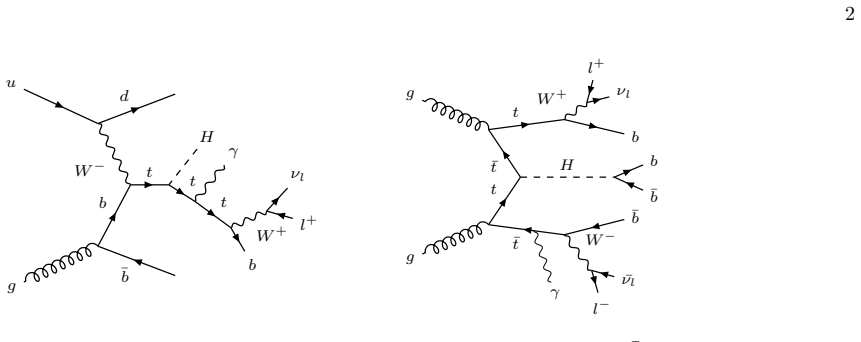
Summary. The paper reports a fast-simulation feasibility study of tHγ and ttHγ production at the LHC, using MadGraph-generated events with Delphes for a CMS-like detector response. The analysis targets final states with leptonic W decays, H→bb, and a photon, and uses BDT classifiers (XGBoost and TMVA) to separate signal from background. At an integrated luminosity of 350 fb^-1 at 13.6 TeV, the authors quote expected significances of 7.5σ and 6.6σ for tHγ and ttHγ, respectively, and report 'measured' cross sections of 1.31 fb and 2.94 fb, concluding that both processes are already feasible with the current Run 3 dataset.
Significance. If the projected significances were robust, this study would be a useful contribution to the case for early LHC measurements of the top-Higgs Yukawa coupling through rare tHγ and ttHγ final states. The paper includes some careful technical steps, notably BDT hyperparameter tuning, KS overtraining checks, and monitoring of training/test AUC. However, the central numerical claims as written are not reproducible from the paper's own tables, and the significance calculation omits systematic uncertainties. The claimed Run 3 feasibility is not derived from the presented 350 fb^-1 analysis. The underlying simulation study may be salvageable, but the current presentation overstates the results.
major comments (4)
- [Abstract and Section V] The quoted 'measured' cross sections of 1.31 fb for tHγ and 2.94 fb for ttHγ are not derivable from the paper's own yields. For L=350 fb^-1, the expected signal yields of 96 and 48 events in Tables I and II correspond to cross sections of 0.274 fb and 0.137 fb, which match the total 'decay-level' cross sections of 0.277 fb and 0.139 fb in Table V. No efficiency, acceptance correction, unfolding, or fitting procedure is described in Section IV that would convert these yields into 1.31 fb and 2.94 fb; the latter value is close to the ttHγ background cross section of 3.082 fb in Table I, suggesting an inclusive generator-level cross section was quoted rather than the decay-level cross section actually used. This internal inconsistency affects the central numerical claim and must be resolved.
- [Section IV, Table VI, Figures 9 and 11] All quoted significances are computed as S/sqrt(S+B) after applying the BDT cut, with no systematic uncertainties and no background uncertainty term. The abstract and Section V present 7.5σ and 6.6σ as the measurement significances. Given the very large backgrounds in Tables I and II and the absence of any data/MC scale-factor uncertainties, these values are optimistic. For a robust feasibility claim, the authors should either include a systematic-uncertainty model or state prominently and consistently that the quoted significances are statistical-only projections.
- [Abstract and Section V] The claim that 'both the tHγ and ttHγ processes are already feasible with the currently accumulated Run 3 dataset' is not supported by the analysis, which is performed at 350 fb^-1. No scaling to a lower Run 3 luminosity is shown, and a simple luminosity rescaling of the Table VI yields would not trivially preserve the 5σ threshold. This claim should be removed or substantiated with a dedicated lower-luminosity projection.
- [Section III] The entire event-yield model, and hence every significance in the paper, relies on the Delphes fast simulation of the CMS detector, but no comparison is made between the Delphes-tuned identification efficiencies, b-tagging rates, or MET resolution and CMS public performance results. Because the BDT achieves near-perfect AUC values (0.998 for tHγ, Table IV), the authors should demonstrate that this separation is not an artifact of the parametrized detector simulation, or at least discuss the associated uncertainty in the conclusions.
minor comments (7)
- [Abstract vs Section V] The ttHγ significance is quoted as 6.6σ in the abstract but 6.5σ in Section V; the values in Table VI and Figures 9–12 should be used consistently.
- [Section IV] The sentence 'Boosted Decision Trees (BDTs [29] are utilized' is missing a closing parenthesis and should read '(BDTs) [29]'.
- [Section II] The phrase 'Each variable is normalized to the total integrated luminosity of 350 fb^-1' is unclear: variables are not normalized to luminosity; event yields are. Please rephrase.
- [Table V] The assumed branching ratios (W→ℓν and H→bb) that define the 'decay-level cross sections' are not stated. Without these values, the table cannot be used to reproduce the expected event yields in Tables I and II.
- [Section IV, Figures 9 and 11] The text states that for 96 signal and 248,000,000 background events the maximum S/sqrt(S+B) is 7.4598, but with those numbers the value is approximately 0.006. The caption must refer to post-cut yields rather than pre-selection event counts, and this should be clarified.
- [Throughout] The word 'measured' should be replaced by 'expected' or 'projected' throughout the abstract and conclusions, since no real data are used and no cross-section extraction or unfolding procedure is described.
- [Introduction] The introduction should compare the projected sensitivity with existing ATLAS/CMS searches and projections for ttH and tH production, in order to place the claimed feasibility in context.
Circularity Check
The abstract's 'measured' cross sections are not derived from the analysis yields; they reproduce the generator-level input cross sections by construction.
-
fitted input called prediction
[Abstract; Tables I, II, V; Section V]
"The expected cross section for single top-quark production in association with a Higgs boson and a photon, σ(tHγ), was measured to be 1.31 fb at 13.6 TeV, with a significance of 7.5 standard deviations from the background-only hypothesis for a luminosity of 350 fb−1 at 13.6 TeV. The expected cross section for σ(t¯tHγ) was measured to be 2.94+0.196−0.276 fb at 13.6 TeV ... Expected Signal 0.2767 96 ... Expected Signal 0.139 48"
The analysis normalizes its signal samples to the decay-level generator cross sections listed in Tables I, II, and V: 0.2767 fb (tHγ → 96 events at 350 fb−1) and 0.139 fb (t¯tHγ → 48 events). The BDT yields in Table VI (94.1 and 43.1 events) lead to the quoted significances, but converting those yields back to a cross section would give ~0.27 fb and ~0.14 fb, not the 1.31 fb and 2.94 fb quoted in the abstract. No fitting formula or signal-strength extraction is presented that connects the event counts to the quoted cross sections. The only numbers in the paper that are near the abstract values are generator-level inputs, e.g. t¯tHγ = 3.082 fb appears as a background in Table I and is close to the quoted 2.94 fb.
full rationale
The paper is a Monte Carlo feasibility study: signal and background are generated with MadGraph/Delphes, normalized to assumed SM cross sections, and a BDT separates the two. The significance claims (7.46 for tHγ and 6.51 for t¯tHγ with XGBoost) follow legitimately from the expected yields in Table VI and are a standard sensitivity projection, not circular by themselves. The circular step is in the headline cross sections: the abstract and conclusion claim that the cross sections were 'measured to be' 1.31 fb and 2.94 fb, but the analysis described in the paper produces neither number. The only cross sections defined in the analysis are the input generator cross sections (0.2767 fb and 0.139 fb decay-level; 3.082 fb for inclusive t¯tHγ in the background table). Since there is no fitted signal strength, no unfolding, and no formula relating the event yields to the quoted sigmas, the abstract's 'measured' values must be the generator inputs (or near variants) presented as measurements. That is equivalent to asserting the input as the output by construction. The BDT performance, ROC curves, and expected significance calculations remain independent, non-circular content, so the paper is only partially circular; the central cross-section claims, however, do reduce to the simulation inputs.
Assumptions & free parameters
free parameters (4)
- BDT optimal cut values =
tHgamma 0.98 (XGBoost) and 0.27 (TMVA); ttHgamma 0.65 (XGBoost) and 0.59 (TMVA)
- BDT hyperparameters =
165 and 290 trees after AUC plateau; max depth 14 for XGBoost and 3 for TMVA
- Object selection thresholds =
pT > 10 GeV for leptons and photons, pT > 20 GeV for jets, |eta| < 2.4, anti-kT R = 0.4
- b-tagging efficiency and mistag parametrizations =
CMS-like efficiency and mistag maps, not quoted numerically
assumptions (4)
- domain assumption The Delphes CMS fast simulation accurately approximates CMS detector response, including photon isolation, lepton efficiencies, b-tagging, and missing transverse momentum.
- domain assumption The background process list in Tables I and II is complete and the generator cross sections need no additional k-factors or normalization corrections.
- ad hoc to paper S/sqrt(S+B) with B = 0 is a valid significance estimator and no systematic terms are needed for the feasibility claim.
- domain assumption The signal cross sections in Tables I and II (0.277 fb and 0.139 fb) are the appropriate decay-level cross sections for the simulated final states.
Cite this review
Pith. "Pith review of Feasibility study of single top-quark and top-quark pair production in association with a Higgs Boson and a Photon at the LHC." pith.science (2026). https://pith.science/paper/AD5ZUGW6
@misc{pith2026250523919,
  author       = {Pith},
  title        = {Pith review of: Feasibility study of single top-quark and top-quark pair production in association with a Higgs Boson and a Photon at the LHC},
  year         = {2026},
  howpublished = {\url{https://pith.science/paper/AD5ZUGW6}},
  note         = {Machine review of arXiv:2505.23919}
}
abstract
A feasibility study for the Standard Model Higgs boson produced in association with a single top-quark or a top-quark pair and a photon (\tHa\, and \ttHa) is presented, using simulated pp collision data corresponding to an integrated luminosity of 350 fb$^{-1}$ at $\sqrt{s}=13.6$ TeV. This study was conducted using simulated data generated with MadGraph. The study was performed in the context of the CMS experiment, where detector effects were incorporated using Delphes. Final states are selected through the leptonic decay of W boson, and the Higgs boson decays to two b-quarks. Signal events are separated from background events using multivariate techniques such as Boosted Decision Trees (BDT). The expected cross section for single top-quark production in association with a Higgs boson and a photon, $\sigma$(\tHa), was measured to be 1.31 fb at 13.6 TeV, with a significance of 7.5 standard deviations from the background-only hypothesis for a luminosity of 350 fb$^{-1}$ at 13.6 TeV. The expected cross section for $\sigma$(\ttHa) was measured to be $2.94^{+0.196}_{-0.276}$ fb at 13.6 TeV, with a significance of 6.6 standard deviations from the background-only hypothesis for a luminosity of 350\,fb$^{-1}$ at 13.6 TeV. Importantly, both the \tHa\, and \ttHa\, processes are already feasible with the currently accumulated Run 3 dataset, demonstrating strong potential for early measurements.
Figures


Figures from the paper (9 more)


Reference graph
Works this paper leans on
-
[1]
S. Chatrchyan et al. (CMS), Observation of a New Bo- son at a Mass of 125 GeV with the CMS Experiment at the LHC, Phys. Lett. B 716, 30 (2012), arXiv:1207.7235 [hep-ex]
arXiv 2012
- [2]
-
[3]
Englert and R
F. Englert and R. Brout, Broken Symmetry and the Mass of Gauge Vector Mesons, Phys. Rev. Lett.13, 321 (1964)
1964
-
[4]
P. W. Higgs, Broken symmetries, massless particles and gauge fields, Phys. Lett. 12, 132 (1964)
work page 1964
-
[5]
P. W. Higgs, Broken Symmetries and the Masses of Gauge Bosons, Phys. Rev. Lett. 13, 508 (1964)
1964
-
[6]
G. S. Guralnik, C. R. Hagen, and T. W. B. Kibble, Global Conservation Laws and Massless Particles, Phys. Rev. Lett. 13, 585 (1964)
work page 1964
-
[7]
P. W. Higgs, Spontaneous Symmetry Breakdown without Massless Bosons, Phys. Rev. 145, 1156 (1966)
work page 1966
-
[8]
T. W. B. Kibble, Symmetry breaking in nonAbelian gauge theories, Phys. Rev. 155, 1554 (1967)
work page 1967
Show all 34 references
-
[9]
Chatrchyan et al
S. Chatrchyan et al. (CMS), Observation of a New Boson with Mass Near 125 GeV in pp Collisions at √s = 7 and 8 TeV, JHEP 06, 081, arXiv:1303.4571 [hep-ex]
-
[10]
Chatrchyan et al
S. Chatrchyan et al. (CMS), Study of the Mass and Spin- Parity of the Higgs Boson Candidate Via Its Decays to Z Boson Pairs, Phys. Rev. Lett. 110, 081803 (2013), arXiv:1212.6639 [hep-ex]
2013 arXiv
-
[11]
Aad et al
G. Aad et al. (ATLAS), Evidence for the spin-0 nature of the Higgs boson using ATLAS data, Phys. Lett. B 726, 120 (2013), arXiv:1307.1432 [hep-ex]
2013 arXiv
-
[12]
Aaltonen et al
T. Aaltonen et al. (CDF, D0), Higgs Boson Stud- ies at the Tevatron, Phys. Rev. D 88, 052014 (2013), arXiv:1303.6346 [hep-ex]
2013 arXiv
-
[13]
Cepeda et al
M. Cepeda et al. , Report from Working Group 2: Higgs Physics at the HL-LHC and HE-LHC, CERN Yellow Rep. Monogr. 7, 221 (2019), arXiv:1902.00134 [hep-ph]
2019 arXiv
-
[14]
Eichhorn, H
A. Eichhorn, H. Gies, J. Jaeckel, T. Plehn, M. M. Scherer, and R. Sondenheimer, The Higgs Mass and the Scale of New Physics, JHEP 04, 022, arXiv:1501.02812 [hep-ph]
-
[15]
Alwall, R
J. Alwall, R. Frederix, S. Frixione, V. Hirschi, F. Maltoni, O. Mattelaer, H.-S. Shao, T. Stelzer, P. Torrielli, and M. Zaro, The automated computation of tree-level and next-to-leading order differential cross sections, and their matching to parton shower simulations, Journal...
2014 doi
-
[16]
Arkani-Hamed, A
N. Arkani-Hamed, A. G. Cohen, E. Katz, and A. E. Nelson, The littlest higgs, Journal of High En- ergy Physics 2002, 034–034 (2002), doi:10.1088/1126- 6708/2002/07/034
2002 doi
-
[17]
Contino, L
R. Contino, L. Da Rold, and A. Pomarol, Light custodians in natural composite higgs models, Physi- cal Review D 75, 10.1103/physrevd.75.055014 (2007), doi10.1103/physrevd.75.055014
2007 doi
-
[18]
de Favereau, C
J. de Favereau, C. Delaere, P. Demin, A. Gi- ammanco, V. Lema ˆ ıtre, A. Mertens, and M. Selvaggi, Delphes 3: a modular framework for fast simulation of a generic collider experiment, Journal of High En- ergy Physics 2014, 10.1007/jhep02(2014)057 (2014), doi:10.1007/jhep02(2014)057
2014 doi
-
[19]
Bierlich, S
C. Bierlich, S. Chakraborty, N. Desai, L. Gellersen, I. He- lenius, P. Ilten, L. L¨ onnblad, S. Mrenna, S. Prestel, C. T. Preuss, T. Sj¨ ostrand, P. Skands, M. Utheim, and R. Ver- heyen, A comprehensive guide to the physics and usage of pythia 8.3 (2022), arXiv:2203.11601 [hep-ph]
2022 arXiv
-
[20]
Buckley, J
A. Buckley, J. Ferrando, S. Lloyd, K. Nord- str¨ om, B. Page, M. R¨ ufenacht, M. Sch¨ onherr, and G. Watt, Lhapdf6: parton density access in the lhc precision era, The European Physical Jour- nal C 75, 10.1140/epjc/s10052-015-3318-8 (2015), doi:10.1140/epjc/s10052-015-3318-8
2015 doi
-
[21]
A. M. Sirunyan et al. (CMS), Particle-flow recon- struction and global event description with the CMS detector, JINST 12 (10), P10003, doi:10.1088/1748- 0221/12/10/P10003, arXiv:1706.04965 [physics.ins-det]
-
[22]
Beaudette, The cms particle flow algorithm (2014), arXiv:1401.8155 [hep-ex]
F. Beaudette, The cms particle flow algorithm (2014), arXiv:1401.8155 [hep-ex]. 9
2014 arXiv
-
[23]
Commissioning of the Particle-flow Event Reconstruction with the first LHC collisions recorded in the CMS detec- tor, https://cds.cern.ch/record/1247373 (2010)
2010
-
[24]
Khachatryan et al
V. Khachatryan et al. (CMS), Observation of the Diphoton Decay of the Higgs Boson and Measurement of Its Properties, Eur. Phys. J. C 74, 3076 (2014), doi:10.1140/epjc/s10052-014-3076-z, arXiv:1407.0558 [hep-ex]
2014 arXiv
-
[25]
W. Adam, R. Fr¨ uhwirth, A. Strandlie, and T. Todorov, Reconstruction of electrons with the gaussian-sum fil- ter in the cms tracker at the lhc, Journal of Physics G: Nuclear and Particle Physics 31, N9–N20 (2005), doi:10.1088/0954-3899/31/9/n01
2005 doi
-
[26]
T. C. Collaboration, Electron and photon reconstruc- tion and identification with the cms experiment at the cern lhc, Journal of Instrumentation 16 (05), P05014, doi:10.1088/1748-0221/16/05/p05014
-
[27]
Rembser, Cms electron and photon performance at 13 tev, Journal of Physics: Conference Series 1162, 012008 (2019), doi:10.1088/1742-6596/1162/1/012008
J. Rembser, Cms electron and photon performance at 13 tev, Journal of Physics: Conference Series 1162, 012008 (2019), doi:10.1088/1742-6596/1162/1/012008
2019 doi
-
[28]
A. M. Sirunyan et al. (CMS), Performance of the CMS muon detector and muon reconstruction with proton-proton collisions at √s = 13 TeV, JINST 13 (06), P06015, doi:10.1088/1748-0221/13/06/P06015, arXiv:1804.04528 [physics.ins-det]
-
[29]
Coadou, Boosted decision trees, in Artificial Intelli- gence for High Energy Physics (WORLD SCIENTIFIC,
Y. Coadou, Boosted decision trees, in Artificial Intelli- gence for High Energy Physics (WORLD SCIENTIFIC,
-
[30]
Chen and C
T. Chen and C. Guestrin, Xgboost: A scalable tree boost- ing system, in Proceedings of the 22nd ACM SIGKDD International Conference on Knowledge Discovery and Data Mining , KDD ’16 (Association for Computing Ma- chinery, New York, NY, USA, 2016) p. 785–794
2016
-
[31]
Hocker et al
A. Hocker et al. (TMV A), TMV A - Toolkit for Multivari- ate Data Analysis, (2007), arXiv:physics/0703039
2007 arXiv
-
[32]
Pedregosa et al
F. Pedregosa et al. , Scikit-learn: Machine Learning in Python, J. Machine Learning Res. 12, 2825 (2011), arXiv:1201.0490 [cs.LG]
2011 arXiv
-
[33]
Demortier and L
L. Demortier and L. Lyons, Testing hypotheses in particle physics: Plots of p0 versus p1, (2014), arXiv:1408.6123. APPENDIX 0 200 400 600 800 1000 Number of Trees 0.995 0.996 0.997 0.998 0.999 1.000AUC auc_test auc_train 0 200 400 600 800 1000 Number of Trees 0.970 0.975 0.980...
2014 arXiv
-
[2022]
Chapter 2, p
Chap. Chapter 2, p. 9–58
Reviewed August 7, 2026 · model on record in the stance chip above.
Discussion (0). Sign in to comment.