REVIEW 4 major objections 6 minor 60 references
Reprocessing of X-rays emission in Ultra-Luminous X-ray sources
T0 review · 4 major / 6 minor · reviewed 2026-08-04 · deepseek-v4-flash
Pith's one-line read Reprocessed X-ray emission is suppressed in ultraluminous X-ray sources
desk verdict The combined Fe Kα EW limit is a real improvement, but the headline number excludes the only ULX epoch with a detected line, and the environmental interpretation leans on a NH comparison that ignores interstellar absorption. read the letter →
The pith
A machine-rendered reading of the paper's core claim, the machinery that carries it, and where it could break.
The reading
What carries the argument
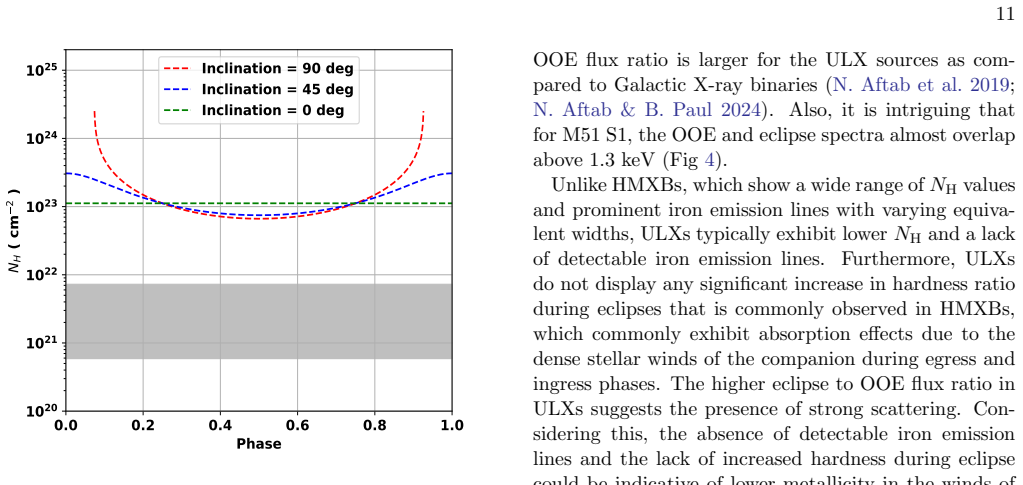
Three diagnostics carry the argument. First, a stacked spectral analysis with an absorbed power-law plus a Gaussian line, fixed at 6.4 keV, converts non-detections into equivalent-width upper limits. Second, a hardness ratio HR=(H-S)/(H+S) is tracked across eclipse transitions and compared with known Galactic eclipsing HMXBs. Third, spectral fits in and out of eclipse give the eclipse-to-out-of-eclipse flux ratio. A curve of growth comparing ULXs against Galactic source classes, together with a radiation-driven wind model that predicts much larger column densities than observed, supplies the interpretive step: the column is there but the iron fluorescence is missing, implying low metallicity
What would settle it
A stacked ULX spectrum with sensitivity below 10 eV that recovers an iron K-alpha line above 20 eV equivalent width, or an eclipse transition in any ULX showing a hardness-ratio increase like those in Galactic HMXBs, would break the central claim. The authors' own simulations show that their method can recover injected lines, so a future detection at the few-tens-of-eV level would be decisive.
Extended reading notes
Core claim
The paper's central claim is that the material around ULXs re-emits far less of the incident X-ray flux than standard binary wind reprocessing predicts. In eleven ULX and ultraluminous X-ray pulsar systems, no iron K-alpha line is detected, and stacking all spectra gives a 90% confidence upper limit of 11-20 eV on its equivalent width—several times tighter than earlier limits. In five eclipsing ULXs, the hardness ratio does not rise during ingress or egress, whereas Galactic eclipsing high-mass X-ray binaries show clear hardening from wind absorption. The eclipse-to-out-of-eclipse flux ratios are also smaller (3-23 times) than typical Galactic values, meaning the residual eclipse light is re
Load-bearing premise
The literature column densities used as the intrinsic ULX line-of-sight absorption really do trace the ULX donor wind rather than being dominated by interstellar gas in the Milky Way or the host galaxy.
Editorial extensions
If this is right
- The tight iron-line upper limits (11-20 eV) mean that a ULX sample stacked from many observations still shows no fluorescence, so the absence is an environmental property, not a data limitation.
- Eclipsing ULXs do not harden during ingress/egress like Galactic HMXBs, indicating their donor winds absorb soft X-rays far less.
- Residual eclipse flux is a larger fraction of the out-of-eclipse flux in ULXs than in Galactic binaries, so scattering or reprocessing by an extended ionized medium contributes more.
- If the interpretation holds, the gas around most ULXs is either metal-poor or highly ionized, with consequences for how super-Eddington outflows are diagnosed in other galaxies.
Reading between the lines
- If the environment is highly ionized rather than simply metal-poor, the reprocessed flux may emerge as recombination lines of hydrogen and helium instead of iron K-alpha; future ULX spectra could search for those lines as a discriminant.
- The wind-model comparison assumes the literature column densities are intrinsic to the ULX binary. If much of that column is interstellar, the predicted-vs-observed deficit shrinks, and the metal-poor conclusion would need host-galaxy absorption maps to separate components.
- A testable corollary is that ULXs in higher-metallicity host regions, like NGC 925 ULX-3, should show stronger iron lines or eclipse hardening if metallicity is the controlling variable; existing data could be re-examined for such source-by-source differences.
- The same suppression logic could apply to other super-Eddington accretors, such as tidal disruption events or hyperluminous pulsars, suggesting that reprocessing diagnostics may systematically underestimate the gas content of extreme accretion flows.
Editorial analysis
A structured set of objections, weighed in public.
Referee Report
Summary. This paper investigates reprocessed X-ray emission in ULXs/ULXPs using three diagnostics: (i) a search for Fe Kα lines in combined XMM-Newton EPIC-pn spectra of six bright ULXs and five ULXPs, (ii) hardness-ratio evolution across eclipses in five eclipsing ULXs compared with the Galactic HMXBs LMC X-4 and SMC X-1, and (iii) the eclipse-to-out-of-eclipse flux ratio in the same eclipsing systems. The authors report 90% upper limits of 11–20 eV on the equivalent width of a narrow 6.4 keV line in the combined spectrum, no significant hardness-ratio changes during ingress/egress, and higher reprocessed flux fractions than in most Galactic HMXBs. They interpret the combined results as evidence that ULX environments are either metal-poor or highly ionized, supported by a curve-of-growth comparison and a CAK radiation-driven wind model.
Significance. If the claims hold, the paper would establish that ULX environments are not simply scaled-up HMXB winds, a relevant constraint for understanding super-Eddington accretion and donor-wind reprocessing. The main strengths are the large archival sample, the clean narrow-band spectral fitting, the injection tests calibrating the combined upper limit, and the explicit comparison with Galactic eclipsing systems. However, the headline upper limit is obtained after deleting the only ULX epoch with a detected Fe Kα line, and the environmental interpretation depends on comparing literature line-of-sight N_H values with a wind model without subtracting foreground interstellar absorption. The result is a useful observational constraint, but the universal, population-level conclusion is not yet robust.
major comments (4)
- [§2, §4.1, Table 4] The combined upper limit of 11–20 eV is computed after excluding the 2010 XMM-Newton observation of NGC 300 ULX1, the only ULX epoch in the sample with a detected Fe Kα line (EW = 343 ± 93 eV; Carpano et al. 2018). The stated justification—'remarkably different spectrum' and no detected pulsations—does not remove the epoch from the ULX/ULXP population; it is a selection on the very signal being measured. Please report a stacking test that includes the 2010 spectrum, or explicitly state that the constraint applies only to the non-detection epochs. If the limit degrades above ~20 eV when the detection is included, the 'most stringent constraint' and the inference of universal suppression require revision.
- [§5, Table 1, Fig. 6] The curve-of-growth comparison (Fig. 5) and the wind-model comparison (Fig. 6) treat the literature N_H values in Table 1 as the intrinsic line-of-sight column density of the ULX binary environment. These values are total absorption columns from spectral fits and almost certainly contain significant Milky Way and host-galaxy interstellar foreground. Without subtracting that foreground, the fact that typical ULX N_H is 0.06–0.7×10^22 cm^-2 does not imply that the donor-wind column is small; the apparent deficit against the CAK model predictions (10^22–10^25 cm^-2) could disappear. Please propagate foreground-subtracted intrinsic columns with uncertainties, or substantially downgrade the environmental claim. The wind-model calculation also adopts M82 X-2 binary parameters as representative of all ULX donors without exploring parameter dependence.
- [§4.2, Fig. 3] The non-detection of hardness-ratio changes during eclipse ingress/egress in the ULX sources is reported without any sensitivity estimate. The ULX light curves are binned at 1200–3000 s with low count rates, so the lack of a visible hardness-ratio variation may be a photon-statistics effect. Please quantify, via simulations, the smallest hardness-ratio change excluded at 90% confidence for each source, and compare that threshold with the excursions seen in LMC X-4 and SMC X-1. Without this, the qualitative contrast with Galactic HMXBs is not strongly supported.
- [§4.3, Table 5] The OOE-to-eclipse flux ratios for the ULXs (e.g., 4.5–5.2 for M51 S1, 3.0–4.4 for M51 S2, 23.4 for CG X-1, and the wide ranges for M51 ULX1/2) overlap substantially with the LMXB range (6–54) and the lower end of the HMXB range (8–237) quoted in the introduction. The statement that 'the reprocessing efficiency is larger in ULXs compared to Galactic HMXBs' requires a formal statistical comparison of the distributions; as presented it appears to invert the OOE/eclipse ratio without testing significance. Please provide such a comparison or soften the claim.
minor comments (6)
- [Abstract / §4.3] The abstract says 'reprocessing efficiency (eclipse to OOE flux ratio)' while §4.3 defines the OOE-to-eclipse ratio; please make the reciprocal relationship explicit to avoid confusion.
- [§2, Table A1] The 2010 NGC 300 ULX1 observation is not listed in Table A1. Please add the ObsID/MJD and state the exact exclusion criterion, including the reason why 'no pulsations' removes a ULXP from the sample.
- [§4.1] The Gaussian line is fixed at 6.4 keV with σ = 0.1 keV. Many ULX spectra show ionized lines at 6.7–6.9 keV; please either search with a free centroid or at 6.7 keV, or clearly state that the quoted limits apply only to a narrow neutral Fe Kα line.
- [§4.1, Fig. 2] The injection tests only inject lines at 6.4 keV with a fixed width; they do not validate recovery of broad or ionized lines. This limitation should be stated.
- [Table 1] The adopted N_H values are quoted without uncertainties or a specification of whether they include Galactic foreground absorption. Adding both would improve the transparency of Fig. 5.
- [Eq. (3), Fig. 6] In Eq. (3), κ is not defined; please define the conversion factor and the integration geometry. In Fig. 6, the gray 'measured' band appears to represent the full range of Table 1 values; overlaying the per-source measurements would be more informative.
Circularity Check
Partial circularity in the Fe Kα upper limit: the combined stack is defined by excluding the only ULX epoch with a detected iron line; the hardness-ratio and flux-ratio diagnostics are independent.
-
self definitional
[Section 2 (source selection) and Section 4.1 / Table 4 (combined EW upper limit)]
"The source NGC 300 ULX1 was also observed in 2010 and showed a prominent iron line feature near 6.4 keV (S. Carpano et al. 2018). The spectrum obtained from this data is remarkably different from that of other ULXs, and no pulsations were observed for that source. Therefore, this dataset is excluded from the present analysis."
The headline constraint 'upper limit on EW ... 11.1–20 eV' (Table 4) is derived from a combined spectrum that is, by construction, the sum of all ULX/ULXP observations except the only epoch with a prominent Fe Kα line (EW=343±93 eV). NGC 300 ULX1 remains a ULX/ULXP in the other epochs; the stated reasons (spectrum 'remarkably different', no pulsations) are not independent of the measured line. No stacking test including the 2010 spectrum is reported, so the 'most stringent upper limit' is partly an artifact of sample selection on the dependent variable rather than a measured absence of iron lines.
full rationale
The iron-line upper limit is the one place where the result is shaped by sample definition: after removing the sole 2010 NGC 300 ULX1 observation that shows a 343±93 eV Fe Kα line, the combined spectrum (Table 4) yields EW<11-20 eV. Because the exclusion is justified partly by the spectrum being 'remarkably different' (the very feature being searched for) and no robustness test with that epoch included is given, the headline constraint is not fully independent of the selection rule. This is a self-definitional/selection circularity for that diagnostic. The other two diagnostics are direct count-rate and flux measurements: hardness ratios show no ingress/egress change in ULXs while LMC X-4 and SMC X-1 do, and OOE/eclipse flux ratios are measured from spectral fits in Table 5. These are compared to external Galactic samples (Aftab et al. 2019; Pradhan et al. 2018; Torrejon et al. 2010) and do not reduce to an assumption. The CAK wind model (Eqs. 1-3) is a forward calculation using standard Castor et al. (1975) physics and Bachetti et al. (2022) binary parameters; it is not fitted to the EW upper limits, so the metal-poor/highly-ionized interpretation is a model-data comparison rather than a fitted prediction. Same-group references (Kumar et al. 2025 for NH; Balu/Tamang for wind code; Aftab/Paul for Galactic flux ratios) supply inputs/benchmarks and are not used as unverified uniqueness theorems. The literature-NH and ISM-subtraction issue (Table 1 vs Fig. 6) is a correctness caveat, not circularity.
Assumptions & free parameters
free parameters (4)
- NH fixed at 0.15e22 cm^-2 =
0.15e22 cm^-2
- Gaussian line centroid and width =
6.4 keV, sigma=0.1 keV
- Wind model parameters =
Mdot=4.7e-6 Msun/yr, v_inf=1500 km/s, R*=8 Rsun, beta=0.8
- Hardness ratio band boundaries =
per-source values (e.g., 0.3-0.57/0.57-2.0 keV for M51 S1)
assumptions (5)
- domain assumption A powerlaw (or diskbb for M51 S1/S2) plus fixed narrow Gaussian is an adequate spectral model for the 5-8 keV band of all selected ULXs.
- domain assumption The empirical EW-NH relation EW = 0.00329 N22_H keV from Torrejon et al. (2010), calibrated on Galactic HMXBs, holds for ULX environments.
- ad hoc to paper The companion wind of ULXs follows the CAK beta-velocity law with beta=0.8 and the binary/wind parameters of M82 X-2 are representative of all ULX donors.
- domain assumption Literature NH values (Table 1) measure the intrinsic column in the ULX binary environment, not predominantly interstellar absorption.
- domain assumption Eclipse-phase photons in the selected ULXs are reprocessed/scattered emission from the ULX system rather than contamination from nearby sources or incomplete occultation.
Cite this review
Pith. "Pith review of Reprocessing of X-rays emission in Ultra-Luminous X-ray sources." pith.science (2026). https://pith.science/paper/ADCZ43ZD
@misc{pith2026250909133,
  author       = {Pith},
  title        = {Pith review of: Reprocessing of X-rays emission in Ultra-Luminous X-ray sources},
  year         = {2026},
  howpublished = {\url{https://pith.science/paper/ADCZ43ZD}},
  note         = {Machine review of arXiv:2509.09133}
}
abstract
With the discovery of pulsations in some of the ultra-luminous X-ray sources (ULXs), it is quite clear that most of the ULXs harbor either a neutron star or a stellar mass black hole as a compact object accreting at super-Eddington rates. In spite of having such a high accretion rate, the reprocessed emission in the ULX sources is quite meagre compared to that observed in Galactic X-ray binaries, except for some absorption lines in the winds. In this work, we investigate the extent of reprocessed emission in ULXs using three diagnostics: (i) searches for Fe $\rm K\alpha$ lines in bright well-known ULXs and Ultra luminous X-ray Pulsars (ULXPs), (ii) evolution of hardness ratio around the eclipse transitions in the eclipsing ULXs, and (iii) the flux ratio between eclipse and out-of-eclipse (OOE) phases in eclipsing ULXs. We placed the most stringent constraints to date on the upper limits on EW of the iron line, 11--20 eV. Furthermore, we have not observed any significant changes in the hardness ratio during the ingress or egress, while in Galactic eclipsing X-ray binaries, an increase in the hardness ratio is observed during the transitions. Finally, the reprocessing efficiency (eclipse to OOE flux ratio) is found to be larger in ULXs compared to Galactic eclipsing X-ray binaries. Based on these results, we discuss the possibility of a metal-poor or highly ionized environment surrounding the ULXs, which suppresses reprocessed emission features.
Figures


Figures from the paper (3 more)


Reference graph
Works this paper leans on
-
[1]
2024, NewA, 106, 102109, doi: 10.1016/j.newast.2023.102109
Aftab, N., & Paul, B. 2024, NewA, 106, 102109, doi: 10.1016/j.newast.2023.102109
arXiv 2024
-
[2]
2019, ApJS, 243, 29, doi: 10.3847/1538-4365/ab2a77
Aftab, N., Paul, B., & Kretschmar, P. 2019, ApJS, 243, 29, doi: 10.3847/1538-4365/ab2a77
-
[3]
Arnaud, K. A. 1996, in Astronomical Society of the Pacific Conference Series, Vol. 101, Astronomical Data Analysis Software and Systems V, ed. G. H. Jacoby & J. Barnes, 17
1996
-
[4]
Bachetti, M., Harrison, F. A., Walton, D. J., et al. 2014, Nature, 514, 202, doi: 10.1038/nature13791
-
[5]
2022, ApJ, 937, 125, doi: 10.3847/1538-4357/ac8d67
Bachetti, M., Heida, M., Maccarone, T., et al. 2022, ApJ, 937, 125, doi: 10.3847/1538-4357/ac8d67
-
[6]
2024, A&A, 692, A47, doi: 10.1051/0004-6361/202451922
Balu, A., Roy, K., Manikantan, H., Tamang, A., & Paul, B. 2024, A&A, 692, A47, doi: 10.1051/0004-6361/202451922
-
[7]
2024, A&A, 682, A94, doi: 10.1051/0004-6361/202348471
Barra, F., Pinto, C., Middleton, M., et al. 2024, A&A, 682, A94, doi: 10.1051/0004-6361/202348471
-
[8]
2024, ApJ, 965, 78, doi: 10.3847/1538-4357/ad320a
Belfiore, A., Salvaterra, R., Sidoli, L., et al. 2024, ApJ, 965, 78, doi: 10.3847/1538-4357/ad320a
Show all 60 references
-
[9]
2022, The Astrophysical Journal, 925, 18, doi: 10.3847/1538-4357/ac3829 Caballero-Garc ´ ıa, M
Brightman, M., Bachetti, M., Earnshaw, H., et al. 2022, The Astrophysical Journal, 925, 18, doi: 10.3847/1538-4357/ac3829 Caballero-Garc ´ ıa, M. D. 2011, Monthly Notices of the Royal Astronomical Society, 418, 1973, doi: 10.1111/j.1365-2966.2011.19615.x
2022
-
[10]
2018, MNRAS, 476, L45, doi: 10.1093/mnrasl/sly030
Carpano, S., Haberl, F., Maitra, C., & Vasilopoulos, G. 2018, MNRAS, 476, L45, doi: 10.1093/mnrasl/sly030
2018 doi
-
[11]
Castillo, G. A. R., Israel, G. L., Belfiore, A., et al. 2020, The Astrophysical Journal, 895, 60, doi: 10.3847/1538-4357/ab8a44
2020 doi
-
[12]
I., Abbott, D
Castor, J. I., Abbott, D. C., & Klein, R. I. 1975, ApJ, 195, 157, doi: 10.1086/153315
1975 doi
-
[13]
1989, ARA&A, 27, 87, doi: 10.1146/annurev.aa.27.090189.000511
Fabbiano, G. 1989, ARA&A, 27, 87, doi: 10.1146/annurev.aa.27.090189.000511
1989
-
[14]
Sholukhova, O. N. 2021, Astrophysical Bulletin, 76, 6, doi: 10.1134/S1990341321010077
2021 doi
- [15]
-
[16]
C., Allen, G
Fruscione, A., McDowell, J. C., Allen, G. E., et al. 2006, in Observatory Operations: Strategies, Processes, and Systems, ed. D. R. Silva & R. E. Doxsey, Vol. 6270, International Society for Optics and Photonics (SPIE), 62701V, doi: 10.1117/12.671760 F¨ urst, F., Walton, D. J....
2006 doi
-
[17]
P., Bautz, M
Garmire, G. P., Bautz, M. W., Ford, P. G., Nousek, J. A., & Jr., G. R. R. 2003, in X-Ray and Gamma-Ray Telescopes and Instruments for Astronomy, ed. J. E. Truemper & H. D. Tananbaum, Vol. 4851, International Society for Optics and Photonics (SPIE), 28 – 44, doi: 10.1117/12.461...
2003 doi
-
[18]
2002, A&A, 382, 130, doi: 10.1051/0004-6361:20011581
Mukai, K. 2002, A&A, 382, 130, doi: 10.1051/0004-6361:20011581
2002 doi
-
[19]
L., Belfiore, A., Stella, L., et al
Israel, G. L., Belfiore, A., Stella, L., et al. 2017a, Science, 355, 817, doi: 10.1126/science.aai8635
-
[20]
L., Papitto, A., Esposito, P., et al
Israel, G. L., Papitto, A., Esposito, P., et al. 2017b, MNRAS, 466, L48, doi: 10.1093/mnrasl/slw218
-
[21]
2001, A&A, 365, L1, doi: 10.1051/0004-6361:20000036
Jansen, F., Lumb, D., Altieri, B., et al. 2001, A&A, 365, L1, doi: 10.1051/0004-6361:20000036
2001 doi
-
[22]
2023, NewAR, 96, 101672, doi: 10.1016/j.newar.2022.101672
King, A., Lasota, J.-P., & Middleton, M. 2023, NewAR, 96, 101672, doi: 10.1016/j.newar.2022.101672
2023
-
[23]
C., & Walton, D
Kosec, P., Pinto, C., Fabian, A. C., & Walton, D. J. 2017, Monthly Notices of the Royal Astronomical Society, 473, 5680, doi: 10.1093/mnras/stx2695
2017 doi
-
[24]
S., et al
Kosec, P., Pinto, C., Reynolds, C. S., et al. 2021, MNRAS, 508, 3569, doi: 10.1093/mnras/stab2856
2021 doi
-
[25]
2025, Monthly Notices of the Royal Astronomical Society, 536, 340, doi: 10.1093/mnras/stae2558 Lara-L´ opez, M
Kumar, M., Sharma, R., Paul, B., & Rana, V. 2025, Monthly Notices of the Royal Astronomical Society, 536, 340, doi: 10.1093/mnras/stae2558 Lara-L´ opez, M. A., Zinchenko, I. A., Pilyugin, L. S., et al. 2021, ApJ, 906, 42, doi: 10.3847/1538-4357/abc892 13
2025 doi
-
[26]
2000, The Astrophysical Journal, 535, 632, doi: 10.1086/308868
Makishima, K., Kubota, A., Mizuno, T., et al. 2000, The Astrophysical Journal, 535, 632, doi: 10.1086/308868
2000 doi
-
[27]
2009, Monthly Notices of the Royal Astronomical Society: Letters, 395, L71, doi: 10.1111/j.1745-3933.2009.00645.x
Mapelli, M., Colpi, M., & Zampieri, L. 2009, Monthly Notices of the Royal Astronomical Society: Letters, 395, L71, doi: 10.1111/j.1745-3933.2009.00645.x
2009
-
[28]
2010, Monthly Notices of the Royal Astronomical Society, 408, 234, doi: 10.1111/j.1365-2966.2010.17048.x
Bressan, A. 2010, Monthly Notices of the Royal Astronomical Society, 408, 234, doi: 10.1111/j.1365-2966.2010.17048.x
2010
-
[29]
2021, A&A, 651, A54, doi: 10.1051/0004-6361/202140459
Mondal, S., R´ o˙ za´ nska, A., Bagi´ nska, P., Markowitz, A., & De Marco, B. 2021, A&A, 651, A54, doi: 10.1051/0004-6361/202140459
2021 doi
-
[30]
2021, Monthly Notices of the Royal Astronomical Society: Letters, 505, L106, doi: 10.1093/mnrasl/slab061
Mondal, S., R´ o˙ za´ nska, A., De Marco, B., & Markowitz, A. 2021, Monthly Notices of the Royal Astronomical Society: Letters, 505, L106, doi: 10.1093/mnrasl/slab061
2021 doi
-
[31]
2003, A&A, 401, 265, doi: 10.1051/0004-6361:20030111
Naik, S., & Paul, B. 2003, A&A, 401, 265, doi: 10.1051/0004-6361:20030111
2003 doi
-
[32]
2010, A&A, 522, A96, doi: 10.1051/0004-6361/200913575
Ng, C., D ´ ıaz Trigo, M., Cadolle Bel, M., & Migliari, S. 2010, A&A, 522, A96, doi: 10.1051/0004-6361/200913575
2010 doi
-
[33]
W., & Mirioni, L
Pakull, M. W., & Mirioni, L. 2002, Optical Counterparts of Ultraluminous X-Ray Sources, https://arxiv.org/abs/astro-ph/0202488
2002 arXiv
-
[34]
2002, ApJ, 579, 411, doi: 10.1086/342701
Paul, B., Nagase, F., Endo, T., et al. 2002, ApJ, 579, 411, doi: 10.1086/342701
2002 doi
-
[35]
J., & Fabian, A
Pinto, C., Middleton, M. J., & Fabian, A. C. 2016, Nature, 533, 64, doi: 10.1038/nature17417
2016 doi
-
[36]
2014, MNRAS, 439, 3461, doi: 10.1093/mnras/stu195
Pintore, F., Zampieri, L., Wolter, A., & Belloni, T. 2014, MNRAS, 439, 3461, doi: 10.1093/mnras/stu195
2014 doi
-
[37]
2021, Monthly Notices of the Royal Astronomical Society, 504, 551, doi: 10.1093/mnras/stab913
Pintore, F., Motta, S., Pinto, C., et al. 2021, Monthly Notices of the Royal Astronomical Society, 504, 551, doi: 10.1093/mnras/stab913
2021 doi
-
[38]
2018, A&A, 610, A50, doi: 10.1051/0004-6361/201731487
Pradhan, P., Bozzo, E., & Paul, B. 2018, A&A, 610, A50, doi: 10.1051/0004-6361/201731487
2018 doi
-
[39]
2021, ApJ, 906, 36, doi: 10.3847/1538-4357/abc959
Qiu, Y., & Feng, H. 2021, ApJ, 906, 36, doi: 10.3847/1538-4357/abc959
2021 doi
-
[40]
2019, The Astrophysical Journal, 877, 57, doi: 10.3847/1538-4357/ab16e7
Qiu, Y., Soria, R., Wang, S., et al. 2019, The Astrophysical Journal, 877, 57, doi: 10.3847/1538-4357/ab16e7
2019 doi
-
[41]
2018, Monthly Notices of the Royal Astronomical Society, 477, 5358, doi: 10.1093/mnras/sty918
Raman, G., Maitra, C., & Paul, B. 2018, Monthly Notices of the Royal Astronomical Society, 477, 5358, doi: 10.1093/mnras/sty918
2018 doi
-
[42]
Rikame, K., Paul, B., Sharma, R., Jithesh, V., & Paul, K. T. 2024, MNRAS, 529, 3360, doi: 10.1093/mnras/stae739
2024 doi
-
[43]
J., et al
Robba, A., Pinto, C., Walton, D. J., et al. 2021, A&A, 652, A118, doi: 10.1051/0004-6361/202140884
2021 doi
-
[44]
P., Walton, D
Sathyaprakash, R., Roberts, T. P., Walton, D. J., et al. 2019, Monthly Notices of the Royal Astronomical Society: Letters, 488, L35, doi: 10.1093/mnrasl/slz086
2019 doi
-
[45]
2023, MNRAS, 526, L35, doi: 10.1093/mnrasl/slad110
Sharma, R., Jain, C., & Paul, B. 2023, MNRAS, 526, L35, doi: 10.1093/mnrasl/slad110
2023 doi
-
[46]
2005, Monthly Notices of the Royal Astronomical Society, 356, 12, doi: 10.1111/j.1365-2966.2004.08438.x Str¨ uder, L., Briel, U., Dennerl, K., et al
Soria, R., Cropper, M., Pakull, M., Mushotzky, R., & Wu, K. 2005, Monthly Notices of the Royal Astronomical Society, 356, 12, doi: 10.1111/j.1365-2966.2004.08438.x Str¨ uder, L., Briel, U., Dennerl, K., et al. 2001, A&A, 365, L18, doi: 10.1051/0004-6361:20000066
2005
-
[47]
2025, A&A, 698, A122, doi: 10.1051/0004-6361/202451923 Torrej´ on, J
Tamang, A., Roy, K., Manikantan, H., Balu, A., & Paul, B. 2025, A&A, 698, A122, doi: 10.1051/0004-6361/202451923 Torrej´ on, J. M., Schulz, N. S., Nowak, M. A., & Kallman, T. R. 2010, ApJ, 715, 947, doi: 10.1088/0004-637X/715/2/947
2025 doi
-
[48]
Turner, M. J. L., Abbey, A., Arnaud, M., et al. 2001, A&A, 365, L27, doi: 10.1051/0004-6361:20000087
2001 doi
-
[49]
2016, ApJ, 831, 56, doi: 10.3847/0004-637X/831/1/56
Urquhart, R., & Soria, R. 2016, ApJ, 831, 56, doi: 10.3847/0004-637X/831/1/56
2016 doi
-
[50]
A., Ferland, G
Verner, D. A., Ferland, G. J., Korista, K. T., & Yakovlev, D. G. 1996, ApJ, 465, 487, doi: 10.1086/177435
1996 doi
-
[51]
J., Mackenzie, A
Walton, D. J., Mackenzie, A. D. A., Gully, H., et al. 2021, Monthly Notices of the Royal Astronomical Society, 509, 1587, doi: 10.1093/mnras/stab3001
2021 doi
-
[53]
Miller, J. M. 2012, Monthly Notices of the Royal Astronomical Society, 422, 2510, doi: 10.1111/j.1365-2966.2012.20809.x
2012
-
[54]
J., F¨ urst, F., Bachetti, M., et al
Walton, D. J., F¨ urst, F., Bachetti, M., et al. 2016, ApJL, 827, L13, doi: 10.3847/2041-8205/827/1/L13
2016 doi
-
[55]
J., F¨ urst, F., Harrison, F
Walton, D. J., F¨ urst, F., Harrison, F. A., et al. 2017, The Astrophysical Journal, 839, 105, doi: 10.3847/1538-4357/aa683e
2017 doi
-
[56]
J., Pinto, C., Nowak, M., et al
Walton, D. J., Pinto, C., Nowak, M., et al. 2020, Monthly Notices of the Royal Astronomical Society, 494, 6012, doi: 10.1093/mnras/staa1129
2020 doi
-
[57]
2018, Monthly Notices of the Royal Astronomical Society, 477, 3623, doi: 10.1093/mnras/sty872
Wang, S., Soria, R., Urquhart, R., & Liu, J. 2018, Monthly Notices of the Royal Astronomical Society, 477, 3623, doi: 10.1093/mnras/sty872
2018 doi
-
[58]
C., Brinkman, B., Canizares, C., et al
Weisskopf, M. C., Brinkman, B., Canizares, C., et al. 2002, Publications of the Astronomical Society of the Pacific, 114, 1, doi: 10.1086/338108
2002 doi
-
[59]
A., Lehmer, B
West, L. A., Lehmer, B. D., Wik, D., et al. 2018, The Astrophysical Journal, 869, 111, doi: 10.3847/1538-4357/aaec6b
2018 doi
-
[60]
2000, ApJ, 542, 914, doi: 10.1086/317016 XMM-Newton Science Operations Centre
Wilms, J., Allen, A., & McCray, R. 2000, ApJ, 542, 914, doi: 10.1086/317016 XMM-Newton Science Operations Centre. 2025, Users Guide to the XMM-Newton Science Analysis System, issue 19.0 edn., ESA: XMM-Newton SOC 14
2000 doi
-
[61]
2004, The Astrophysical Journal, 603, 523, doi: 10.1086/381541 15 APPENDIX A
Zampieri, L., Mucciarelli, P., Falomo, R., et al. 2004, The Astrophysical Journal, 603, 523, doi: 10.1086/381541 15 APPENDIX A. SUPPLEMENTARY INFORMATION 16 T able A1.Detailed list of XMM-Newton observations used in this work for the selected bright well-known ULX Sources and ...
2004 doi
Reviewed August 4, 2026 · model on record in the stance chip above.
Discussion (0). Continue with ORCID to comment.