REVIEW 3 major objections 7 minor 41 references
Electron heating in bulk overdense plasma aided by time dependent external magnetic field
T0 review · 3 major / 7 minor · reviewed 2026-08-06 · deepseek-v4-flash
Pith's one-line read A time-dependent external magnetic field lets a low-frequency laser propagate into an overdense plasma and then, as the field decays through the electron cyclotron resonance, converts its energy directly into localized electron heating.
desk verdict Temporal magnetic field sweep is a genuinely new idea for bulk overdense heating, but the 1D model omits the Faraday field that a time-varying uniform B demands, so the quantitative claims are on shaky ground. read the letter →
The pith
A machine-rendered reading of the paper's core claim, the machinery that carries it, and where it could break.
The reading
What carries the argument
The load-bearing mechanism is the crossing of the electron cyclotron resonance within the R-mode passband of a magnetized plasma dispersion relation. In the geometry with the external field along the laser propagation direction, the R mode (the right-hand circularly polarized wave) has a passband that admits the laser at $\omega_L = 0.2\,\omega_{pe}$ when $B_0 = 1$; as the field decays toward $B_0 = 0.2$, the laser frequency coincides with $\omega_{ce} = eB_0/m_e$, the group velocity goes to zero, and the electromagnetic energy is transferred to electron gyro-motion. The temporal profile of $B_0$ is therefore the control knob that sets both the spatial location of the resonance layer and the efficiency of energy transfer.
What would settle it
A simulation that includes the Faraday electric field from the collapsing magnetic field—or a laboratory attempt with the strongest available pulsed magnet and a CO$_2$ laser—would settle the central claim: if the field profile cannot be produced or the resonance layer does not form, the predicted 9% localized absorption and the heated spot at the expected depth would not appear.
Extended reading notes
Core claim
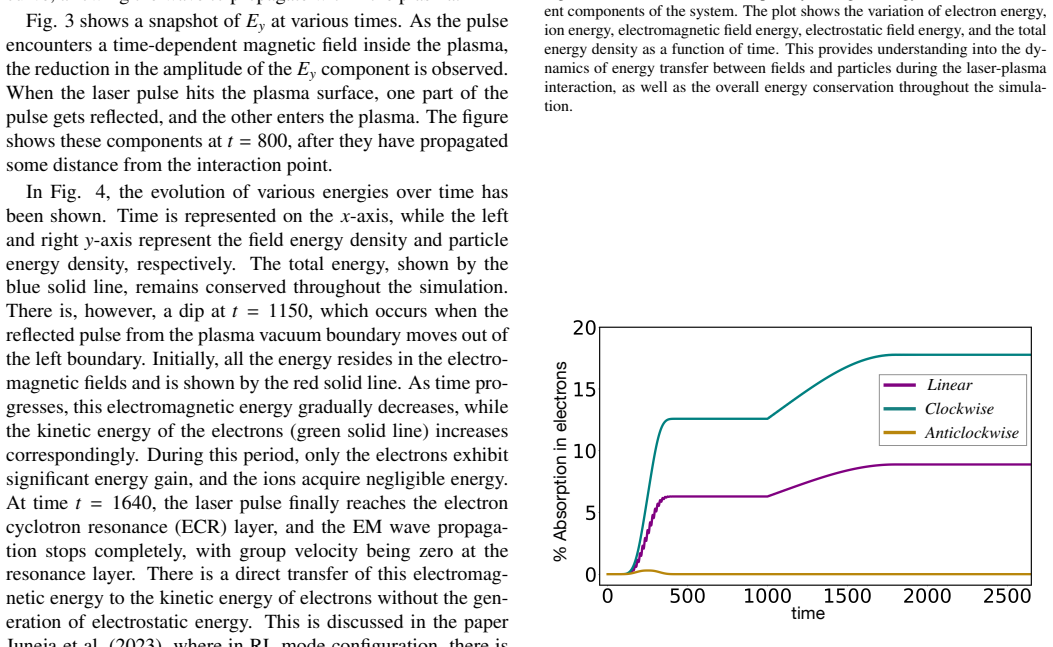
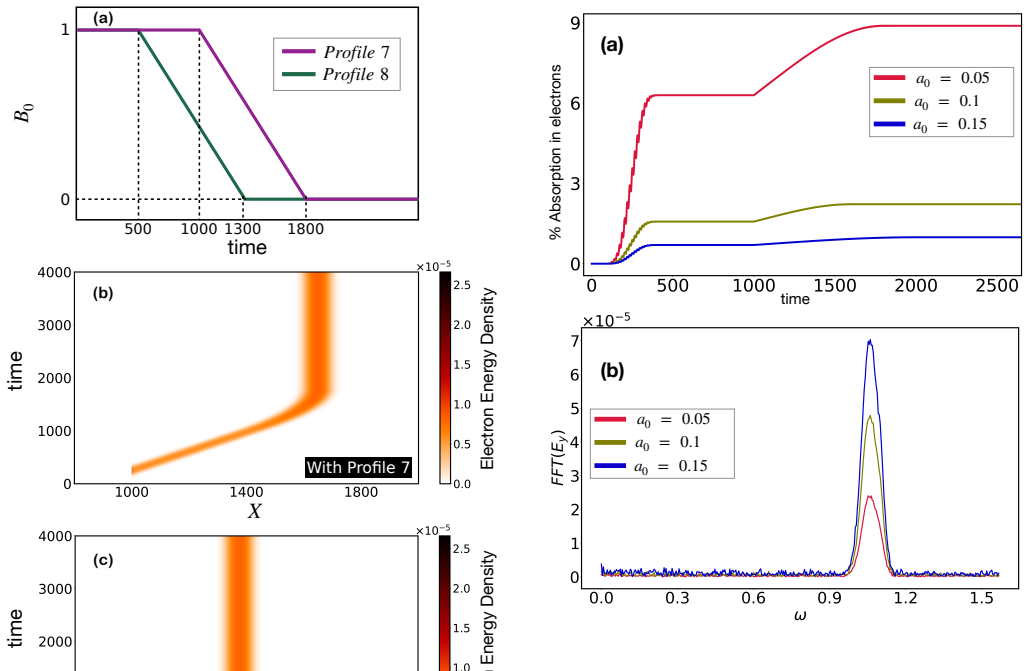
The central claim is that a temporally decaying external magnetic field lets a low-frequency laser enter an overdense plasma through the R-mode passband and then transfer its energy to electrons at the point where the instantaneous electron cyclotron frequency matches the laser frequency. In 1D particle-in-cell simulations with $\omega_L = 0.2\,\omega_{pe}$, the wave propagates when the normalized field is $B_0 = 1$, and as $B_0$ falls linearly to zero the resonance condition $\omega = \omega_{ce}$ is met inside the plasma at $B_0 = 0.2$. At that layer the field energy goes directly into electron kinetic energy, with no electrostatic energy generated, giving roughly 9% absorption of the incident laser energy in the reference case. The paper also shows that right-hand circular polarization couples most strongly, that the total absorbed fraction tracks the total change in magnetic field while the decay rate sets the timing, and that shifting the decay interval moves the heated spot to a different depth. Higher laser intensities reduce the absorption percentage because more energy leaves the target as higher harmonics.
Load-bearing premise
The external magnetic field is modeled as spatially uniform and decaying globally from $B_0=1$ to zero in about $0.8$ picoseconds, with no account of the inductive electric field that such a rapid global change would generate or of a real magnet capable of producing the field.
Editorial extensions
If this is right
- A laser at $0.2\,\omega_{pe}$ can deposit energy in the bulk of an overdense plasma, not merely at the vacuum-plasma boundary, when the magnetic field is swept through electron cyclotron resonance.
- Changing when the magnetic field starts to decay moves the heated layer to a different depth, so the same laser and plasma parameters can heat different spots by reprogramming the field profile.
- Right-hand circular polarization yields the strongest coupling because it rotates with the electron gyro-motion; left-hand circular polarization does not enter the R-mode passband.
- The total drop in magnetic field sets the final absorbed energy, while the slope of the drop sets how quickly the absorption saturates.
- At higher laser intensities the resonant absorption fraction falls, with the missing energy appearing as higher-harmonic emission.
Reading between the lines
- The same resonance-crossing idea could be realized with a static, spatially decreasing magnetic field instead of a time-varying one, giving a fixed-depth ECR layer at the cost of the dynamic control demonstrated here.
- The simulated geometry is one-dimensional; in a multi-dimensional target, refraction and oblique incidence near the resonance layer could spread the heated region and change the absorption fraction from the 9% reference value.
- If kilo-tesla magnet technology continues to improve toward the tens of kilo-tesla needed for a CO$_2$ laser, the scheme becomes testable in the near term; an intermediate step would be to pair a lower-frequency source with a lower density target to match currently available field strengths.
- The assumed field is prescribed and spatially uniform; a self-consistent treatment of how such a fast global field collapse is generated and diffused into the plasma would reveal whether the scheme survives in a realistic experimental setting.
Editorial analysis
A structured set of objections, weighed in public.
Referee Report
Summary. The manuscript proposes a scheme for localized electron heating in an overdense plasma using a laser that propagates through the R-mode passband of a strongly magnetized plasma and then undergoes electron cyclotron resonance (ECR) as a time-dependent axial magnetic field decays to the resonance value. The authors use 1D OSIRIS PIC simulations with B0(t) prescribed as a spatially uniform background. They report about 9% electron absorption in the base case, higher absorption for right-hand circular polarization than for linear or left-hand polarization, increased absorption with larger magnetic-field drop, rate-dependent deposition timing, profile-controlled heating location, and reduced absorption at higher laser intensities due to harmonic emission. They emphasize that no electrostatic energy is generated and that total energy is conserved.
Significance. If the proposed mechanism is physically realizable, it offers a novel and controllable route to bulk overdense plasma heating with no fitted parameters and with a falsifiable prediction that the B-field waveform sets both the amount and location of absorption. The polarization dependence is consistent with the R/L-mode dispersion picture, and the energy-conservation check in Fig. 4 is a useful internal consistency test. However, the significance is currently limited by the idealized treatment of the time-dependent magnetic field and by the absence of any convergence or uncertainty assessment; the quantitative absorption values should be treated as provisional.
major comments (3)
- [Section 2, Fig. 1(b)] A spatially uniform, time-dependent B0(t) along the laser propagation direction cannot be generated self-consistently in a 1D simulation. In 1D, all fields depend only on x, so the x-component of Faraday's law, (∇×E)_x = -∂B_x/∂t, has a zero left-hand side; the induction electric field that would accompany any physical ramp of Bx is therefore omitted from the model. For the parameters in Table 1, with B0 dropping from 1 to 0.2 over about 800 ω_pe^{-1}, the induced field E_ind ≈ (r/2)|dB/dt| is about 0.06 E_n at r = 100 c/ω_pe, i.e., comparable to the laser amplitude a0 = 0.05. This omitted field can itself heat electrons and can shift the resonance or the localization shown in Figs. 7 and 11, so the reported 9% absorption and the location control cannot be attributed to ECR alone unless a Faraday-consistent simulation (e.g., 2D/3D with a realistic source field) reproduces them.
- [Section 2, Figs. 5, 7-12] The paper contains no convergence study. Only a single resolution (dx = 0.05 c/ω_pe, dt = 0.02 ω_pe^{-1}) and 8 particles per cell are used, and the absorption percentages are quoted to two significant figures (9%, 3%, 2.6%, 3.0%, 3.2%) without error bars or run-to-run variation. At least one higher-resolution/higher-particle-number run, and ideally a short ensemble, is needed to establish that the central quantitative comparisons are not numerical artifacts.
- [Section 3, Fig. 4] The claim that 'there is no generation of electrostatic energy' is presented as evidence for direct electromagnetic (ECR) heating. This null result is a consequence of the 1D geometry with a uniform axial B0(t): a physically realized time-dependent axial field necessarily has a non-conservative electric field whose components can drive transverse currents and fields, so the zero electrostatic energy may not survive in a Faraday-consistent model. The conclusion that heating is purely electromagnetic is therefore not established by the present simulation.
minor comments (7)
- [Table 1] The standard-unit column lists ω_L as 0.2×10^15 Hz. Since ω_pe = 10^15 rad/s, ω_L = 0.2ω_pe = 2×10^14 rad/s, corresponding to f_L ≈ 3.18×10^13 Hz and λ_L ≈ 9.42 µm; please correct the units or the numerical value.
- [Figures 5 and 6] The terms 'clockwise' and 'anticlockwise' are used without defining the sense with respect to the +x propagation direction and the B-field direction; please state the convention explicitly.
- [Section 3, first paragraph] The text says the plasma is 'overdense' but immediately adds that the frequency lies in the magnetized passband; please clarify that 'overdense' refers to the unmagnetized cutoff so readers do not infer a contradiction.
- [Section 3, Fig. 6(c) discussion] The statement that there is 'no component present' for the anticlockwise case is imprecise; the LCP wave is evanescent in the R-mode stopband, so it is the propagating component that is absent, not the field itself.
- [Abstract and Introduction] The abstract and introduction quote the record magnetic field as 1.4 kT, while the cited Nakamura et al. (2018) reference reports 1200 T; please reconcile the value.
- [Section 3, Fig. 12(b)] The subplot is described as 'leakage of higher harmonics' but no spectrum is shown; please define what quantity is plotted (e.g., harmonic amplitude at the boundary) and how it is computed.
- [Section 4, Conclusion] The conclusion states that 'the rate of change of the magnetic field determines the energy transfer process,' which conflicts with Fig. 10 where the final absorption is rate-independent; please align the wording to say that the rate controls the deposition timing, not the total absorbed energy.
Circularity Check
No circularity: absorption values and trends are simulation outputs, not fitted inputs; the only self-citation is corroborated by in-paper diagnostics.
full rationale
The paper does not fit any parameter to the quantities it reports. The B0(t) profiles are prescribed inputs, and the 9% absorption, polarization ordering, Delta-B scaling, intensity dependence, and localized heating positions are outputs of the OSIRIS 4.0 PIC simulations. The R-mode passband and the electron cyclotron resonance condition are standard dispersion-relation inputs, but using a standard mechanism as the design premise is not circular: the amplitude and location of heating are not encoded in the input field profile beyond the intended resonance crossing. The self-citation to Juneja et al. (2023) for the claim that energy goes directly to electrons without electrostatic energy generation is not load-bearing because Fig. 4 independently shows the electrostatic energy density remains zero throughout the simulation. The spatial-localization demonstration in Fig. 11 is by design, since profiles 7 and 8 are chosen so that B0 crosses the resonance value at different times, but the resulting absorption near x=1700 and x=1400 are simulation outputs, and the paper presents this as a controlled demonstration rather than as a fitted prediction. The Faraday-law inconsistency from a spatially uniform, time-varying B0 is a physical modeling gap and a correctness risk, not an input-output equivalence or a self-citation loop. No step in the derivation chain reduces to its own input.
Assumptions & free parameters
assumptions (3)
- domain assumption Cold magnetized plasma dispersion relation for R and L modes governs wave propagation in the passband/stopband picture.
- domain assumption The applied magnetic field is spatially uniform and changes simultaneously everywhere in the target according to the prescribed temporal profile.
- domain assumption One-dimensional PIC geometry captures the essential absorption physics.
Cite this review
Pith. "Pith review of Electron heating in bulk overdense plasma aided by time dependent external magnetic field." pith.science (2026). https://pith.science/paper/ADEICA5T
@misc{pith2026250702543,
  author       = {Pith},
  title        = {Pith review of: Electron heating in bulk overdense plasma aided by time dependent external magnetic field},
  year         = {2026},
  howpublished = {\url{https://pith.science/paper/ADEICA5T}},
  note         = {Machine review of arXiv:2507.02543}
}
abstract
This study investigates the localized electron heating in a bulk overdense plasma. The method relies on using a time dependent magnetic field. An initially high external magnetic field imposed on the overdense plasma target enables the propagation of a laser pulse inside it through the pass bands that occur in the magnetized dispersion relation. The choice of decaying external magnetic field is then tailored appropriately to achieve Electron Cyclotron Resonance (ECR) with the frequency of the laser electromagnetic field. At the resonance location, the field energy of the laser gets transferred to the electrons. These studies have been carried out with the help of the Particle-In-Cell (PIC) simulation technique on the OSIRIS4.0 platform. A detailed study has been carried out to illustrate the energy gain by electrons for a variety of temporal profiles of the magnetic field, laser intensities, and polarizations. The experiments in this regime may be within reach in the near future. For instance, the choice of long-wavelength CO$_2$ laser requires a magnetic field of about 10s of kilo Tesla to comfortably elicit a magnetized response from electrons. Recent technological advancements have shown the generation of about 1.4 kilo Tesla of magnetic field.
Figures


Figures from the paper (5 more)


Reference graph
Works this paper leans on
-
[1]
The physics of inertial fusion: beam plasma interaction, hydrodynamics, hot dense matter
Atzeni, S., Meyer-ter Vehn, J., 2004. The physics of inertial fusion: beam plasma interaction, hydrodynamics, hot dense matter. volume 125. OUP Oxford
work page 2004
-
[2]
Electron cy- clotron emission and absorption in fusion plasmas
Bornatici, M., Cano, R., De Barbieri, O., Engelmann, F., 1983. Electron cy- clotron emission and absorption in fusion plasmas. Nuclear Fusion 23, 1153
work page 1983
-
[3]
Brueckner, K.A., Jorna, S., 1974. Laser-driven fusion. Reviews of modern physics 46, 325. Brunel, 1987. Not-so-resonant, resonant absorption. Physical review letters 59 1, 52–55
work page 1974
-
[4]
Identification of coupling mechanisms between ultraintense laser light and dense plasmas
Bonnaud, G., Martin, P., Vincenti, H., Qu ´er´e, F., 2019. Identification of coupling mechanisms between ultraintense laser light and dense plasmas. Physical Review X 9, 011050
work page 2019
-
[5]
Gamma-rays from harmonically resonant betatron oscillations in a plasma wake
Yang, X., Issac, R.C., Wiggins, S.M., Welsh, G.H., et al., 2011. Gamma-rays from harmonically resonant betatron oscillations in a plasma wake. Nature Physics 7, 867–871
work page 2011
-
[6]
Femtosecond x rays from laser-plasma accelerators
Corde, S., Ta Phuoc, K., Lambert, G., Fitour, R., Malka, V ., Rousse, A., Beck, A., Lefebvre, E., 2013. Femtosecond x rays from laser-plasma accelerators. Reviews of Modern Physics 85, 1–48
work page 2013
-
[7]
Laser plasma session: Aapps-dpp conference, 12–17 nov 2018, kanazawa
Das, A., 2020. Laser plasma session: Aapps-dpp conference, 12–17 nov 2018, kanazawa. Reviews of Modern Plasma Physics 4, 10
work page 2020
-
[8]
Dhalia, T., Juneja, R., Das, A., 2024. Absorption of electromagnetic waves at oblique resonance in plasmas threaded by inhomogenous magnetic fields. Physical Review E 110, 065213
work page 2024
Show all 41 references
-
[9]
Harmonic gen- eration in magnetized plasma for electromagnetic wave propagating parallel to external magnetic field
Dhalia, T., Juneja, R., Goswami, L.P., Maity, S., Das, A., 2023. Harmonic gen- eration in magnetized plasma for electromagnetic wave propagating parallel to external magnetic field. Journal of Physics D: Applied Physics
2023
-
[10]
Electron cyclotron resonance heating and current drive in toroidal fusion plasmas
Erckmann, V ., Gasparino, U., 1994. Electron cyclotron resonance heating and current drive in toroidal fusion plasmas. Plasma physics and controlled fu- sion 36, 1869
1994
-
[11]
Properties of resonantly heated electron distributions
Estabrook, K., Kruer, W.L., 1978. Properties of resonantly heated electron distributions. Physical Review Letters 40, 42
1978
-
[12]
One- to-one direct modeling of experiments and astrophysical scenarios: pushing the envelope on kinetic plasma simulations
Fonseca, R., Martins, S., Silva, L., Tonge, J., Tsung, F., Mori, W., 2008. One- to-one direct modeling of experiments and astrophysical scenarios: pushing the envelope on kinetic plasma simulations. Plasma Physics and Controlled Fusion 50, 124034
2008
-
[13]
Osiris: A three- dimensional, fully relativistic particle in cell code for modeling plasma based accelerators, in: International Conference on Computational Science, Springer
Fonseca, R.A., Silva, L.O., Tsung, F.S., Decyk, V .K., Lu, W., Ren, C., Mori, W.B., Deng, S., Lee, S., Katsouleas, T., et al., 2002. Osiris: A three- dimensional, fully relativistic particle in cell code for modeling plasma based accelerators, in: International Conference on C...
2002
-
[14]
Resonant absorp- tion of laser light by plasma targets
Freidberg, J., Mitchell, R., Morse, R.L., Rudsinski, L., 1972. Resonant absorp- tion of laser light by plasma targets. Physical Review Letters 28, 795
1972
-
[15]
Evaluation of compact ecr plasma source for thruster applications
Ganguli, A., Tarey, R., Narayanan, R., Verma, A., 2019. Evaluation of compact ecr plasma source for thruster applications. Plasma Sources Science and Technology 28, 035014
2019
-
[16]
Electron cyclotron resonance ion sources and ECR plasmas
Geller, R., 2018. Electron cyclotron resonance ion sources and ECR plasmas. Routledge
2018
-
[17]
Collisionless absorption in sharp-edged plasmas
Gibbon, P., Bell, A., 1992. Collisionless absorption in sharp-edged plasmas. Physical review letters 68, 1535
1992
-
[18]
Ob- servations of brillouin scattering process in particle-in-cell simulations for laser pulse interacting with magnetized overdense plasma
Goswami, L.P., Dhalia, T., Juneja, R., Maity, S., Das, S., Das, A., 2022. Ob- servations of brillouin scattering process in particle-in-cell simulations for laser pulse interacting with magnetized overdense plasma. Physica Scripta 98, 015602
2022
-
[19]
Particle-in-cell modeling of plasma-based accelerators in two and three dimensions
Hemker, R.G., 2000. Particle-in-cell modeling of plasma-based accelerators in two and three dimensions. University of California, Los Angeles
2000
-
[20]
Ultrahigh gradient particle acceleration by intense laser-driven plasma den- sity waves
Joshi, C., Mori, W., Katsouleas, T., Dawson, J., Kindel, J., Forslund, D., 1984. Ultrahigh gradient particle acceleration by intense laser-driven plasma den- sity waves. Nature 311, 525–529
1984
-
[21]
Enhanced plasma ion heating by lasers in inhomogeneous external magnetic field
Juneja, R., Dhalia, T., Das, A., 2024. Enhanced plasma ion heating by lasers in inhomogeneous external magnetic field. Physics Letters A 519, 129696
2024
-
[22]
Ion heating in laser interacting with magnetized plasma
Juneja, R., Dhalia, T., Goswami, L.P., Maity, S., Mandal, D., Das, A., 2023. Ion heating in laser interacting with magnetized plasma. Plasma Physics and Controlled Fusion 65, 095005
2023
-
[23]
Nonlinear laser–plasma interactions
Kaw, P., 2017. Nonlinear laser–plasma interactions. Reviews of Modern Plasma Physics 1, 1–42
2017
-
[24]
Laser-induced anomalous heating of a plasma
Kaw, P.K., Dawson, J., 1969. Laser-induced anomalous heating of a plasma. The Physics of Fluids 12, 2586–2591
1969
-
[25]
Gigagauss-scale quasistatic magnetic field generation in a snail-shaped target
Korneev, P., d’Humi`eres, E., Tikhonchuk, V ., 2015. Gigagauss-scale quasistatic magnetic field generation in a snail-shaped target. Physical Review E 91, 043107
2015
-
[26]
J ×b heating by very intense laser light
Kruer, W.L., Estabrook, K.G., 1985. J ×b heating by very intense laser light. Physics of Fluids 28, 430–432
1985
-
[27]
Resonant and nonresonant electron cyclotron heating at densities above the plasma cuto ff by oxb mode conversion at the w7-as stellarator
Laqua, H., Erckmann, V ., Hartfuß, H., Laqua, H., et al., 1997. Resonant and nonresonant electron cyclotron heating at densities above the plasma cuto ff by oxb mode conversion at the w7-as stellarator. Physical review letters 78, 3467
1997
-
[28]
Ion acceleration by superintense laser-plasma interaction
Macchi, A., Borghesi, M., Passoni, M., 2013. Ion acceleration by superintense laser-plasma interaction. Reviews of Modern Physics 85, 751
2013
-
[29]
Mode conversion and laser energy absorption by plasma under an inhomogeneous external magnetic field
Maity, S., Goswami, L.P., Vashistha, A., Mandal, D., Das, A., 2022. Mode conversion and laser energy absorption by plasma under an inhomogeneous external magnetic field. Physical Review E 105, 055209
2022
-
[30]
Electromagnetic wave transparency of x-mode in strongly magnetized plasma
Mandal, D., Vashistha, A., Das, A., 2021. Electromagnetic wave transparency of x-mode in strongly magnetized plasma. Scientific Reports 11, 1–11
2021
-
[31]
Electron acceler- ation from the breaking of relativistic plasma waves
Malka, V ., Darrow, C., Danson, C., Neely, D., et al., 1995. Electron acceler- ation from the breaking of relativistic plasma waves. nature 377, 606–608
1995
-
[32]
Record indoor magnetic field of 1200 t generated by electromagnetic flux- compression
Nakamura, D., Ikeda, A., Sawabe, H., Matsuda, Y ., Takeyama, S., 2018. Record indoor magnetic field of 1200 t generated by electromagnetic flux- compression. Review of Scientific Instruments 89, 095106
2018
-
[33]
Absorption of short laser 8 pulses on solid targets in the ultrarelativistic regime
Ping, Y ., Shepherd, R., Lasinski, B., Tabak, M., Chen, H., Chung, H., Fournier, K., Hansen, S., Kemp, A., Liedahl, D., et al., 2008. Absorption of short laser 8 pulses on solid targets in the ultrarelativistic regime. Physical review letters 100, 085004
2008
-
[34]
A review of astro- physics experiments on intense lasers
Remington, B.A., Drake, R.P., Takabe, H., Arnett, D., 2000. A review of astro- physics experiments on intense lasers. Physics of Plasmas 7, 1641–1652
2000
-
[35]
Production of a kev x-ray beam from synchrotron radiation in¡? format?¿ relativistic laser- plasma interaction
Rousse, A., Phuoc, K.T., Shah, R., Pukhov, A., Lefebvre, E., Malka, V ., Kiselev, S., Burgy, F., Rousseau, J.P., Umstadter, D., et al., 2004. Production of a kev x-ray beam from synchrotron radiation in¡? format?¿ relativistic laser- plasma interaction. Physical review letters...
2004
-
[36]
Radiation and absorption via mode conversion in an inhomo- geneous collision-free plasma
Stix, T.H., 1965. Radiation and absorption via mode conversion in an inhomo- geneous collision-free plasma. Physical Review Letters 15, 878
1965
-
[37]
Laser electron accelerator
Tajima, T., Dawson, J.M., 1979. Laser electron accelerator. Physical review letters 43, 267
1979
-
[38]
A new mech- anism of direct coupling of laser energy to ions
Vashistha, A., Mandal, D., Kumar, A., Shukla, C., Das, A., 2020. A new mech- anism of direct coupling of laser energy to ions. New Journal of Physics 22, 063023
2020
-
[39]
Absorption of ultra-intense laser pulses
Wilks, S., Kruer, W., Tabak, M., Langdon, A., 1992. Absorption of ultra-intense laser pulses. Physical review letters 69, 1383
1992
-
[40]
Evidence of anomalous resistivity for hot electron propagation through a dense fusion core in fast ignition experiments
Yabuuchi, T., Das, A., Kumar, G., Habara, H., Kaw, P., Kodama, R., Mima, K., Norreys, P., Sengupta, S., Tanaka, K., 2009. Evidence of anomalous resistivity for hot electron propagation through a dense fusion core in fast ignition experiments. New Journal of Physics 11, 093031
2009
-
[41]
Inertial confinement fusion driven thermonuclear energy
Zohuri, B., 2017. Inertial confinement fusion driven thermonuclear energy. Springer. 9
2017
Reviewed August 6, 2026 · model on record in the stance chip above.
Discussion (0). Continue with ORCID to comment.