REVIEW 5 major objections 5 minor 15 references
EvoRIC: Reinforcement Learning Fine-Tuned LLM-empowered RAN Intelligent Control Toward Autonomous O-RAN
T0 review · 5 major / 5 minor · reviewed 2026-08-10 · deepseek-v4-flash
Pith's one-line read A fine-tuned 3B LLM can outperform optimization solvers and far larger models for RAN power allocation.
desk verdict EvoRIC is a well-structured framework paper whose headline generalization claim is unverified because the paper never specifies the PPO training topologies; the quantitative results are conditional. read the letter →
The pith
A machine-rendered reading of the paper's core claim, the machinery that carries it, and where it could break.
The reading
What carries the argument
The machinery is an LLM as the actor inside a PPO reinforcement-learning agent, regularized by a frozen reference model through a KL-divergence penalty. The non-RT RIC aggregates interaction tuples (state prompt, generated action, reward) via the O1 interface, runs PPO updates on the last L transformer blocks, and redeploys via A1. The near-RT RIC serializes network state into a prompt with explicit output-format directives, parses the LLM's text into a power vector, verifies it against the power budget, and falls back to equal power allocation if validation fails. A composite reward adds a format penalty to the throughput objective, which keeps the model from producing unexecutable outputs.
What would settle it
Train EvoRIC-L2 on a held-out topology set that excludes the three reported scenarios, then evaluate on those scenarios: if the throughput advantage over EPA disappears or drops to in-distribution levels, the generalization claim is unsupported.
Extended reading notes
Core claim
On its own terms, the paper's central discovery is that a 3B-parameter Llama-3.2-Instruct model, fine-tuned with PPO using only environmental reward, becomes a better power-allocation policy for IAB networks than the equal-power heuristic, the successive convex approximation solver, the un-fine-tuned Llama, and the much larger DeepSeek-V3 and Gemini 1.5 Flash models. EvoRIC-L2, the version with two final transformer blocks trained, achieves these results across three network topologies, adapts to a changed objective through prompt modification alone, and loses almost nothing when one telemetry stream is corrupted. The paper also reports that the KL-regularized PPO update is necessary for stable training, since without it the policy drifts and training becomes numerically unstable.
Load-bearing premise
The cross-topology generalization claim assumes the test scenarios were not seen during fine-tuning, but the paper does not specify which topologies were in the training rollout buffer.
Editorial extensions
If this is right
- A single fine-tuned compact LLM could replace topology-specific RL models, cutting the retraining burden in heterogeneous RAN deployments.
- Sub-second inference (0.56 s) falls inside the near-RT RIC control window, so LLM-based control is not limited to non-real-time planning.
- KL regularization keeps the fine-tuned model close to its pretrained knowledge, which should reduce catastrophic forgetting during continued learning.
- Prompt-level intent changes let the same model switch objectives, such as priority-weighted throughput, without parameter updates.
- The safety-verification and fallback layer ensures that even hallucinated outputs degrade to a valid baseline, a necessary condition for deployment in critical infrastructure.
Reading between the lines
- The paper never states whether the three evaluation topologies were part of the PPO rollout buffer; if they were, the reported cross-topology generalization is in-distribution and a held-out topology evaluation is needed.
- The 0.56 s inference figure is measured on an RTX 4090 workstation; real edge hardware will likely be slower, so the sub-second claim should be re-verified on target COTS edge servers.
- The comparison against DeepSeek and Gemini is zero-shot with prompt engineering; fine-tuning those large models might narrow the gap, though their size would still make near-RT deployment impractical.
- The composite reward's format penalty and fail-safe fallback mean part of the measured gain comes from suppressing parse failures; ablating the fallback would quantify how much.
Editorial analysis
A structured set of objections, weighed in public.
Referee Report
Summary. The paper introduces EvoRIC, a hierarchical O-RAN control framework in which a compact LLM (Llama-3.2-3B) is fine-tuned via proximal policy optimization (PPO) in the non-RT RIC and then deployed in the near-RT RIC for power allocation in IAB networks. The framework serializes network state into structured prompts, uses a composite reward with format penalty and KL regularization, and closes the loop through O1/A1/E2 interfaces. Experiments compare EvoRIC-L2 against EPA, Llama3B-NoFT, DeepSeek-V3, Gemini, and an SCA baseline, reporting throughput gains across three topologies, intent adaptation, and robustness to telemetry corruption.
Significance. If the results hold, the paper demonstrates a practically attractive combination: a 3B-parameter LLM fine-tuned with reinforcement learning can outperform both a conventional heuristic and a model-based solver for IAB power allocation while keeping inference latency below one second, and it can transfer to varying topology sizes without retraining. The closed-loop collect-update-deploy design and the explicit handling of format compliance and safety fallback are well motivated. The paper also includes a limitation statement for the telemetry robustness experiments, which is commendable. However, the empirical claims rest on an under-specified evaluation protocol, and the central generalization claim is not yet demonstrated.
major comments (5)
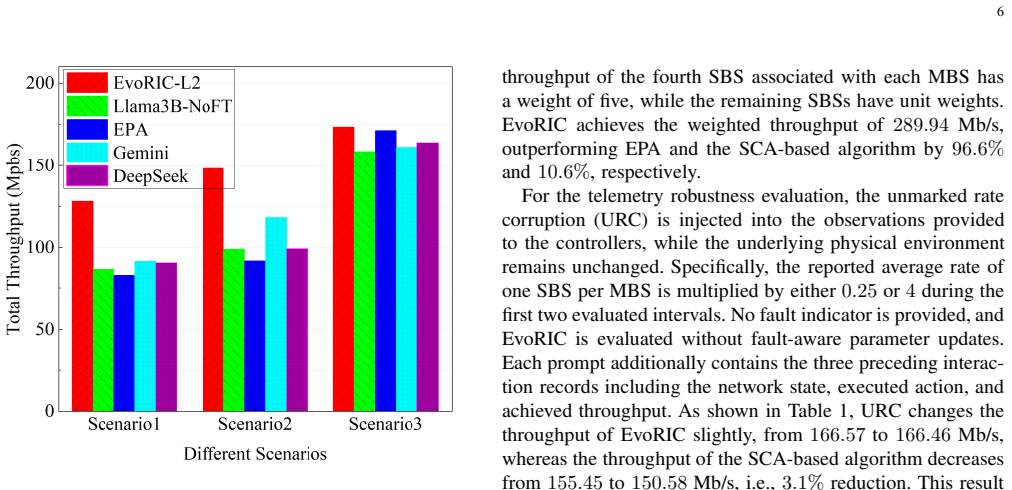
- [Section III-C, Figure 3] The paper's central generalization claim is not verifiable because the training topology distribution is never specified. The training curve in Figure 2 is reported for M=3, N=5, and the evaluation scenarios in Figure 3 include M=3,N=6; M=3,N=5; and M=2,N=3. If the PPO rollouts used any of these scenarios, the corresponding result is in-distribution. Please state exactly which topologies were used for training, whether any evaluation scenarios were held out, and how the reported averages were computed.
- [Section III-C, Figure 3 and Table 1] All numerical results are averages over 500 episodes with no confidence intervals, standard deviations, or number of random seeds. The claimed margin in Scenario 3 (16.6% over EPA) may be within sampling noise; without variance bars it is impossible to judge statistical significance. Please report per-scenario confidence intervals or box plots and repeat with at least three seeds.
- [Section III-B-4 and Section III-C] The safety verification module falls back to EPA whenever the LLM output is invalid, so the throughput averages in Figure 3 and Table 1 mix successful LLM actions with EPA fallback actions. The paper does not report the fraction of fallback episodes or the throughput conditional on a valid generation. This confound should be disentangled to assess the true contribution of the learned policy.
- [Section III-C, Table 1] The SCA-based baseline is under-specified; no details are given on the convex approximation scheme, initialization, iteration count, or convergence tolerance. Given that EvoRIC reportedly outperforms SCA by 10.6% on the weighted-throughput intent, please document the SCA implementation and verify that both methods use the same information and solve the same optimization problem.
- [Section III-C and Section IV] The simulator setup is not described sufficiently for reproduction. The paper omits the simulation platform, path-loss exponents, LoS probability parameters, Nakagami-m parameter, number of users per SBS, mobility parameters, episode length, and initial-state distribution. Please provide these details or release the simulator code.
minor comments (5)
- [Figure 2 caption] The caption contains an apparent text-encoding artifact (e.g., '/s48/s49/s48/s48/s48 /s50/...'); please repair the caption and ensure the figure is legible.
- [Section III-B-4] The phrase 'an fail-safe protocol' should read 'a fail-safe protocol'.
- [Section III-C] The notation 'top p' should be made consistent with 'top-p sampling' at first use; also define the PPO hyperparameters (clip ratio, GAE lambda, number of epochs) for reproducibility.
- [Section III-C, Scenario 3 discussion] The sentence 'the solver improves upon EPA by only 16.6%' is ambiguous; specify which solver (SCA or EvoRIC) is referred to.
- [Section III-C] The inference latency of 0.56 s is reported without specifying the inference hardware, quantization, batch size, or whether prompt parsing is included; please state the test conditions or add a caveat.
Circularity Check
No significant circularity: EvoRIC's empirical comparisons are self-contained; the only self-citation is non-load-bearing, and the generalization claim is under-specified but not circular.
full rationale
The paper's derivation chain is empirical rather than analytic: EvoRIC uses PPO to fine-tune Llama-3.2-3B as the actor, with rewards computed from a simulator, and then compares throughput against EPA, Llama3B-NoFT, DeepSeek, Gemini, and an SCA/CVXPY solver. No equation or fitted constant is reused as a prediction: the architecture is not defined in terms of the reported metrics, the reward is not the evaluation metric by construction, and the baselines are externally implemented. The only self-citation, [5] (LLM-hRIC), appears in the introduction as related work describing a prior hierarchical architecture and is not used to justify EvoRIC's central claims; the KL-regularized PPO update is supported by external references [10], [11]. The main weakness adjacent to circularity is that the cross-topology generalization claim in Section III-C (Figure 3) is not verifiable because the paper never states which topology/topologies were used for PPO training: the training curve in Figure 2 is for M=3, N=5 (Scenario 2), so the reader cannot tell whether Scenarios 1-3 are in-distribution or out-of-distribution. This is a missing train/test specification, not a reduction of the claim to its inputs; it should be weighed as a rigor/correctness concern, and the paper itself acknowledges limited scope when it notes that telemetry robustness 'does not establish general robustness to all telemetry faults.' Overall, no load-bearing step is circular.
Assumptions & free parameters
free parameters (6)
- Number of fine-tuned transformer blocks L =
2 (EvoRIC-L2)
- RL temperature schedule =
1.5 to 0.6 linear decay
- Top-p sampling =
0.95
- Format penalty r_format =
-5
- Learning rate and batch size =
1e-5 and 16
- KL penalty coefficient =
not reported
assumptions (5)
- domain assumption The IAB network model with LoS/NLoS path loss, Nakagami-m fading, Gaussian-Markov mobility, and bottleneck-limited throughput is a faithful proxy for real IAB deployment performance.
- domain assumption PPO with KL regularization to a frozen reference model can fine-tune an LLM's control policy without catastrophic forgetting.
- domain assumption Throughput is the correct scalar reward for the power allocation objective, with only a format penalty attached.
- standard math KL divergence penalizes large policy updates and stabilizes RL fine-tuning.
- domain assumption A common model fine-tuned in the non-RT RIC can be deployed across multiple near-RT RICs with different topologies.
Cite this review
Pith. "Pith review of EvoRIC: Reinforcement Learning Fine-Tuned LLM-empowered RAN Intelligent Control Toward Autonomous O-RAN." pith.science (2026). https://pith.science/paper/AE2FJZOF
@misc{pith2026260806789,
  author       = {Pith},
  title        = {Pith review of: EvoRIC: Reinforcement Learning Fine-Tuned LLM-empowered RAN Intelligent Control Toward Autonomous O-RAN},
  year         = {2026},
  howpublished = {\url{https://pith.science/paper/AE2FJZOF}},
  note         = {Machine review of arXiv:2608.06789}
}
read the original abstract
Despite recent advances in applying artificial intelligence (AI) techniques to radio access network (RAN), critical challenges remain: traditional machine learning (ML) algorithms suffer from limited generalization across varying network topologies, whereas general-purpose large language models (LLMs) face high computational demands and lack domain-specific knowledge. To address these gaps, this article introduces the evolving RAN intelligent controller (RIC) (EvoRIC) framework, a hierarchical architecture that enables continuous evolution by leveraging a non-real-time RIC (non-RT RIC) for global model updates and a near-real-time RIC (near-RT RIC) for local execution, dynamically empowering LLMs with domain-specific decision-making capabilities. Within this framework, we employ a reinforcement learning-based fine-tuning (RLFT) mechanism where an LLM operates as an actor within a proximal policy optimization (PPO) agent. By leveraging the interaction tuples collected from the wireless environment, the LLM's parameters are iteratively updated to align semantic reasoning with rigorous network performance objectives. We evaluate the generalization and efficacy of the proposed EvoRIC framework within integrated access and backhaul (IAB) networks, and finally, discuss the open challenges and future directions of the EvoRIC framework toward realizing autonomous O-RAN.
Figures


Reference graph
Works this paper leans on
-
[1]
Un- derstanding O-RAN: Architecture, interfaces, algorithms , security, and research challenges,
M. Polese, L. Bonati, S. D’oro, S. Basagni, and T. Melodia , “Un- derstanding O-RAN: Architecture, interfaces, algorithms , security, and research challenges,” IEEE Commun. Surv. Tutor . , vol. 25, no. 2, pp. 1376–1411, Jan. 2023
work page 2023
-
[2]
Resource allocation for network slicing in open RAN: A hier archical learning approach,
K. Qiao, H. Wang, W. Zhang, D. Y ang, Y . Zhang, and N. Zhang, “Resource allocation for network slicing in open RAN: A hier archical learning approach,” IEEE Trans. Cogn. Commun. Netw. , vol. 11, no. 4, pp. 2584–2600, 2025
work page 2025
-
[3]
LLM-empowered resource allocation i n wireless communications systems,
W. Lee and J. Park, “LLM-empowered resource allocation i n wireless communications systems,” IEEE Access , vol. 14, pp. 15 260–15 272, 2026
work page 2026
-
[4]
Prompting Wireless Networks: Reinforced In-Context Learning for Power Control
H. Zhou, C. Hu, D. Y uan, Y . Y uan, D. Wu, X. Liu et al. , “Prompting wireless networks: Reinforced in-context learning for pow er control,” arXiv preprint arXiv:2506.06526 , 2025
work page Pith review arXiv 2025
-
[5]
LLM- hRIC: LLM-empowered hierarchical RAN intelligent control for O-RAN,
L. Bao, S. Y un, J. Lee, and T. Q. Quek, “LLM- hRIC: LLM-empowered hierarchical RAN intelligent control for O-RAN,” IEEE Commun. Mag. , pp. 1–7, 2026, early access
work page 2026
-
[6]
LLM4WM: Adap ting LLM for wireless multi-tasking,
X. Liu, S. Gao, B. Liu, X. Cheng, and L. Y ang, “LLM4WM: Adap ting LLM for wireless multi-tasking,” IEEE Trans. Mach. Learn. Commun. Netw., pp. 1–1, 2025
work page 2025
-
[7]
Y . Lin, R. Zhang, W. Huang, K. Wang, Z. Ding, D. K. C. So, and D. Niy- ato, “Empowering large language models in wireless communi cation: A novel dataset and fine-tuning framework,” IEEE Trans. on Commun. , vol. 73, no. 12, pp. 14 260–14 274, 2025
work page 2025
-
[8]
Mobile-LLaMA: Instr uction fine-tuning open-source LLM for network analysis in 5G netwo rks,
K. B. Kan, H. Mun, G. Cao, and Y . Lee, “Mobile-LLaMA: Instr uction fine-tuning open-source LLM for network analysis in 5G netwo rks,” IEEE Netw., vol. 38, no. 5, pp. 76–83, Sep. 2024
work page 2024
Show all 15 references
-
[9]
ORAN-Bench-13K: An open source bench- mark for assessing LLMs in open radio access networks,
P . Gajjar and V . K. Shah, “ORAN-Bench-13K: An open source bench- mark for assessing LLMs in open radio access networks,” in Proc. - IEEE Consum. Commun. Netw. Conf. (CCNC) , Las V egas, NV , USA, Jan. 2025, pp. 1–4
2025
-
[10]
LLMs are greedy agents: Effects of RL fine-tuning on de cision- making abilities,
T. Schmied, J. Bornschein, J. Grau-Moya, M. Wulfmeier, and R. Pas- canu, “LLMs are greedy agents: Effects of RL fine-tuning on de cision- making abilities,” arXiv preprint arXiv:2504.16078 , 2025
2025 arXiv
-
[11]
Rethinking KL regu larization in RLHF: From value estimation to gradient optimization,
K. Liu, J. K. Liu, M. Chen, and Y . Liu, “Rethinking KL regu larization in RLHF: From value estimation to gradient optimization,” arXiv preprint arXiv:2510.01555, 2025
2025
-
[12]
The Llama 3 herd of models,
A. Grattafiori, A. Dubey, A. Jauhri, A. Pandey, A. Kadian , A. Al-Dahle, A. Letman, A. Mathur, A. Schelten, A. V aughan et al. , “The Llama 3 herd of models,” arXiv preprint arXiv:2407.21783 , 2024
2024 arXiv
-
[13]
Deepseek-v3 technical report,
A. Liu, B. Feng, B. Xue, B. Wang, B. Wu, C. Lu, C. Zhao, C. De ng, C. Zhang, C. Ruan et al., “Deepseek-v3 technical report,” arXiv preprint arXiv:2412.19437, 2024
2024 arXiv
-
[14]
Gemini 1.5: Unlocking multimodal understanding across millions of tokens of context,
G. Team, P . Georgiev, V . I. Lei, R. Burnell, L. Bai, A. Gul ati, G. Tanzer, D. Vincent, Z. Pan, S. Wang et al., “Gemini 1.5: Unlocking multimodal understanding across millions of tokens of context,” arXiv preprint arXiv:2403.05530, 2024
2024 arXiv
-
[15]
CVXPY: A Python-embedded model ing lan- guage for convex optimization,
S. Diamond and S. Boyd, “CVXPY: A Python-embedded model ing lan- guage for convex optimization,” Journal of Machine Learning Research , vol. 17, no. 83, pp. 1–5, 2016
2016
Reviewed August 10, 2026 · model on record in the stance chip above.
Discussion (0). Continue with ORCID to comment.