REVIEW 6 minor 1 cited by
Search for very-high-energy gamma-ray counterparts of gravitational waves with HAWC
T0 review · 0 major / 6 minor · reviewed 2026-08-14 · deepseek-v4-flash
Pith's one-line read HAWC searched for TeV gamma-ray flashes tied to LIGO/Virgo events and found none, a result consistent with background.
desk verdict A robust first null-result search for VHE gamma-ray counterparts of LIGO/Virgo events; the non-detection stands even if the background calibration is off, but the constraints are limited by small sky coverage and missing systematics. read the letter →
The pith
A machine-rendered reading of the paper's core claim, the machinery that carries it, and where it could break.
The reading
What carries the argument
The load-bearing instrument is HAWC itself plus the internal analysis chain called ZEBRA: a binned likelihood search over a HEALPix grid at Nside = 512, with events binned by the fraction of detector channels hit ($f_{\mathrm{hit}}$), background estimated by 'direct integration' (convolving a stable local arrival direction probability with the total event rate), and eight logarithmically spaced time windows sliding from $t_0 - 5\Delta t$ to $t_0 + 10\Delta t$. The null-hypothesis test-statistic distribution is produced by randomly fluctuating the expected background through the same analysis, which accounts for pixel and time-window correlations; per-timescale false-alarm rates are then combined to yield the trials-corrected p-value. This machinery is what lets a wide-field survey claim either detection or meaningful constraints on prompt TeV emission.
What would settle it
Take archived HAWC data for the analyzed gravitational-wave events, inject artificial VHE bursts of known flux into the same time windows, and rerun ZEBRA: if the injection recovery fraction differs substantially from the claimed sensitivity at the same test-statistic threshold, the null calibration is wrong. Alternatively, a future binary neutron star merger fully inside HAWC's field of view that is seen in TeV by an independent instrument would directly settle whether the search misses real counterparts.
Extended reading notes
Core claim
For every LIGO/Virgo gravitational-wave event with at least partial HAWC sky coverage during O1, O2, and O3, a search over time windows from 0.3 to 1000 seconds and over the sky region containing 95% of the localization probability found no excess above background. The largest test statistic at any location, time, event, or timescale was $TS = 26.0$, corresponding to a p-value of 1.0 after trial correction. For GW170817, whose merger time fell outside HAWC's field of view, HAWC observed the later transit 8.20 to 10.23 hours after coalescence and set an upper limit of $1.5 \times 10^{-8}\,\mathrm{erg\,cm^{-2}\,s^{-1}}$ between 100 GeV and 1 TeV. The conclusion is that no very-high-energy gamma-ray counterpart above HAWC's sensitivity was emitted by the analyzed events.
Load-bearing premise
The background estimate and the simulated null-hypothesis test-statistic distribution are correctly calibrated, including all correlations between nearby pixels and overlapping time windows; if those simulations miss a systematic effect, the reported p-value and upper limit would shift.
Editorial extensions
If this is right
- For nearby binary neutron star and neutron star-black hole mergers inside HAWC's field of view, the search will either detect a VHE counterpart or place an upper limit that constrains prompt-emission models.
- Starting in O3, HAWC's automatic follow-up of gravitational-wave alerts can provide a localization to about 0.5 degrees within minutes to an hour, helping other telescopes target the counterpart.
- The non-detection across O1-O3 sets a benchmark: any model predicting bright TeV prompt emission for typical LIGO/Virgo events is disfavoured at HAWC's sensitivity.
- Continued running increases exposure, so the same pipeline naturally tightens these limits as more gravitational-wave events accumulate.
Reading between the lines
- One extension the paper leaves implicit: apply the same pipeline to short gamma-ray bursts without gravitational-wave triggers, where larger samples could calibrate the VHE detection rate even if the GW association is absent.
- The GW170817 upper limit covers only the later transit, not the prompt phase; interpreting it as a constraint on prompt emission would require an afterglow model, since the prompt emission was outside the field of view.
- A sub-second time window below 0.3 seconds could be tried, since Fermi-LAT shows a fraction of short GRB emission concentrated in much shorter intervals than the search's shortest window.
- An obvious test, not discussed in the paper: run the same search on fake GW alerts placed at random times and locations; the distribution of maximum test statistics should match the claimed null distribution, validating the false-alarm-rate formula.
Signed reviews
Editorial analysis
A structured set of objections, weighed in public.
Referee Report
Summary. The paper reports a search for very-high-energy (VHE) gamma-ray emission coincident with gravitational-wave (GW) events detected by LIGO/Virgo during O1, O2, and part of O3, using the HAWC observatory. The search is performed on a HEALPix grid over the 95% localization region, with eight time-window widths from 0.3 s to 1000 s, and uses a binned likelihood test statistic. All analyzed events are consistent with background; the maximum test statistic anywhere is TS = 26.0, which corresponds to a post-trial p-value of 1.0. For GW170817, the source was outside the field of view at merger, and an upper limit of 1.5 x 10^-8 erg cm^-2 s^-1 (100 GeV - 1 TeV) is set using the later transit. The paper concludes that no significant VHE counterpart was observed and that HAWC can provide competitive constraints for events in its field of view.
Significance. The result is a null search with no significant excess, which is valuable for constraining VHE emission from compact binary mergers. The paper's strengths are the wide field of view and continuous operation of HAWC, and the explicit post-trial p-value of 1.0 after a large trials correction. However, the quantitative constraints are limited by the small sky coverage for O3 events (25%, 28%, and 4% of localization probability) and the degraded sensitivity for GW170817. The paper does not include systematic uncertainties on the upper limit or full event-by-event results, but these do not affect the central null result, which is robust to plausible errors in the trials factor and background estimation.
minor comments (6)
- [Section 2, Eq. (2.3)] The formula for the expected number of false positives should explicitly include the number of gravitational-wave events searched, and the conversion from <n> to a p-value should be stated for the case <n> >= 1 (e.g., p = 1 - exp(-<n>)).
- [Section 4] A table listing all analyzed GW events with the observed maximum TS, location, time window, and searched sky fraction would improve reproducibility and is standard for such searches.
- [Section 4] The GW170817 upper limit should be accompanied by an estimate of systematic uncertainties from the background normalization and the assumed spectral index (alpha = -2).
- [Section 2] The text contains the typo 'precense' (for 'presence'), and the expansion of ZEBRA should read 'Zenith' instead of 'ZEnith.'
- [Section 2] The statement that the search is only weakly dependent on the assumed spectral index is not supported with a reference or figure; a brief justification or citation would help.
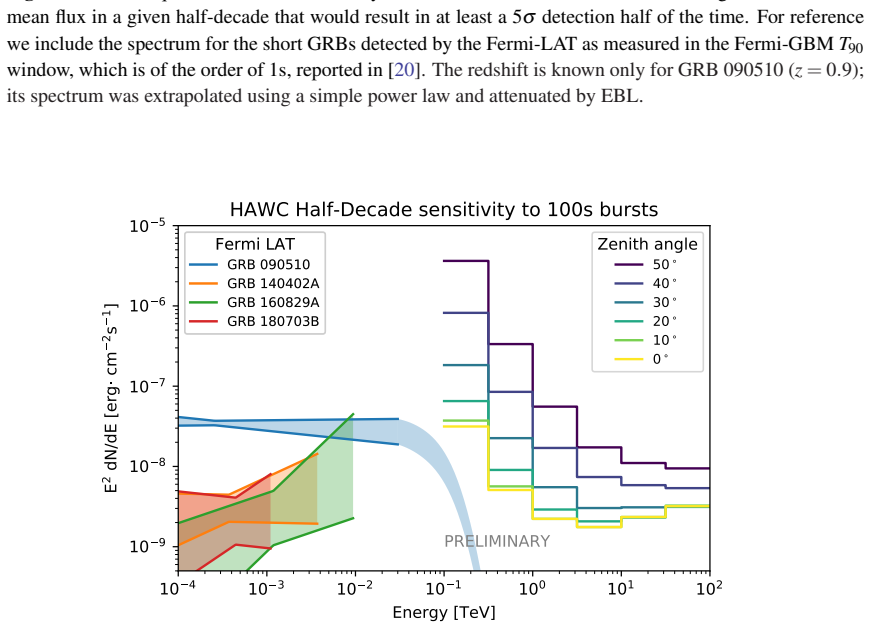
- [Section 3, Figures 1 and 2] The sensitivity curves are compared to Fermi-LAT spectra, but the caption does not state which energy range of the HAWC sensitivity is shown; restating the energy range in the caption would improve clarity.
Circularity Check
No circularity: the search is a direct experimental analysis whose null result is derived from HAWC data and independent background simulation, not from the quantities it reports.
full rationale
This paper reports a targeted search for very-high-energy gamma-ray counterparts of gravitational-wave events. The central result is a null observation: the maximum test statistic over all pixels, events, time windows, and timescales is TS = 26.0 with a post-trials p-value of 1.0. There is no fitted parameter that is then renamed as a prediction, and no theoretical claim is derived from an input that already contains the answer. The assumed spectral index alpha = -2 is a search sensitivity input, not an output of the analysis, and the upper limit on GW170817 is obtained from observed counts and a background estimate, not from the assumed spectrum. The background estimate and null-hypothesis TS distribution are standard statistical calibrations for the search itself; even if imperfect, they do not make the non-detection circular because the conclusion is that no significant excess was found under the stated background model. The comparisons with Fermi-LAT short GRB spectra are illustrative sensitivity references, not predictions derived from HAWC inputs. Citations to prior HAWC analyses describe the likelihood implementation and are not used as a substitute for the data analysis or as justification of the claimed null result. No step in the paper reduces by construction to its own inputs, and no self-citation is load-bearing. The honest finding is therefore no significant circularity.
Assumptions & free parameters
free parameters (3)
- Spectral index alpha =
-2 (assumed)
- Zenith angle cutoff =
45 degrees
- Time window widths =
8 values from 0.3 s to 1000 s
assumptions (4)
- domain assumption Direct integration background estimation accurately models cosmic-ray background to 1e-3
- domain assumption The source spectrum is a simple power law and EBL attenuation follows Gilmore et al. (2012)
- domain assumption The TS distribution under the null is correctly calibrated by fluctuating the expected background
- domain assumption HAWC was in normal operation during all analyzed GW events
Cite this review
Pith. "Pith review of Search for very-high-energy gamma-ray counterparts of gravitational waves with HAWC." pith.science (2026). https://pith.science/paper/AEYMIP6G
@misc{pith2026190806122,
  author       = {Pith},
  title        = {Pith review of: Search for very-high-energy gamma-ray counterparts of gravitational waves with HAWC},
  year         = {2026},
  howpublished = {\url{https://pith.science/paper/AEYMIP6G}},
  note         = {Machine review of arXiv:1908.06122}
}
read the original abstract
The High-Altitude Water Cherenkov Observatory (HAWC) is a large field of view (~2 sr) continuously operating experiment sensitive to very-high energy (VHE) gamma rays (~0.3-100 TeV). These characteristics make it well suited for observing or constraining the VHE emission of rapid transients such as some gravitational waves progenitors. Of special interest are the events at low redshift where the attenuation due to the extragalactic background light is minimal. This is the case for binary neutron star mergers in the horizon of the LIGO and Virgo experiments, for which HAWC can either detect or place constraining limits on events occurring in our field of view. We report on our search for counterparts of the gravitational waves detected by LIGO and Virgo.
Figures


Forward citations
Cited by 1 Pith paper
-
Study of long-term spectral evolution and X-ray and Gamma-ray correlation of blazars seen by HAWC
A 2143-day HAWC/Swift-XRT campaign finds a linear X-ray/TeV correlation for Mrk 421, tentative correlation evidence for Mrk 501, and confirms harder-when-brighter gamma-ray behavior in Mrk 421.
Reference graph
Works this paper leans on
-
[1]
LIGO Collaboration. Advanced LIGO. Classical and Quantum Gravity , 32(7):074001, mar 2015. 5 Search for counterparts of gravitational waves with HA WC Israel Martinez-Castellanos 10 1 100 101 102 103 104 105 t [s] 10 10 10 9 10 8 10 7 10 6 10 5 10 4 Flux [erg cm 2 s 1] PRELIMINARY Fermi-LAT (0.1-100 GeV) GW170817 UL GRB090510 Other SGRBs HAWC (0.1-1 TeV) ...
work page 2015
-
[2]
B. P. Abbott, R. Abbott, T. D. Abbott, M. R. Abernathy, F. Acernese, K. Ackley, C. Adams, T. Adams, P. Addesso, R. X. Adhikari, and et al. Observation of Gravitational Waves from a Binary Black Hole Merger. Physical Review Letters, 116(6):061102, February 2016
work page 2016
-
[3]
B. Zhang. Mergers of Charged Black Holes: Gravitational-wave Events, Short Gamma-Ray Bursts, and Fast Radio Bursts. The Astrophysical Journal Letters, 827:L31, August 2016
work page 2016
-
[4]
A. Loeb. Electromagnetic Counterparts to Black Hole Mergers Detected by LIGO. The Astrophysical Journal Letters, 819:L21, March 2016
work page 2016
-
[5]
E. Berger. Short-Duration Gamma-Ray Bursts. Annual Review of Astronomy and Astrophysics , 52:43–105, August 2014
work page 2014
-
[6]
W. Fong, E. Berger, R. Margutti, and B. A. Zauderer. A Decade of Short-duration Gamma-Ray Burst Broadband Afterglows: Energetics, Circumburst Densities, and Jet Opening Angles. The Astrophysical Journal Letters, 815:102, December 2015
work page 2015
-
[7]
B. P. Abbott and et al. Multi-messenger observations of a binary neutron star merger. The Astrophysical Journal, 848(2):L12, oct 2017
work page 2017
-
[8]
Hjorth Jens. Gamma-ray Bursts. The Gamma-Ray Burst - Supernova Connection . Cambridge Astrophysics. Cambridge University Press, 2012
work page 2012
Show all 23 references
-
[9]
A. S. Fruchter and et al. Long γ-ray bursts and core-collapse supernovae have different environments. Nature, 441:463–468, May 2006. 6 Search for counterparts of gravitational waves with HA WC Israel Martinez-Castellanos
2006
-
[10]
Veitch, V
J. Veitch, V . Raymond, B. Farr, W. Farr, P. Graff, S. Vitale, B. Aylott, K. Blackburn, N. Christensen, M. Coughlin, W. Del Pozzo, F. Feroz, J. Gair, C.-J. Haster, V . Kalogera, T. Littenberg, I. Mandel, R. O’Shaughnessy, M. Pitkin, C. Rodriguez, C. Röver, T. Sidery, R. Smith,...
2015
-
[11]
Kumar and B
P. Kumar and B. Zhang. The physics of gamma-ray bursts and relativistic jets. Physics Reports, 561:1–109, February 2015
2015
-
[12]
T. Totani. TEV Burst of Gamma-Ray Bursts and Ultra-High-Energy Cosmic Rays. The Astrophysical Journal Letters, 509:L81–L84, December 1998
1998
-
[13]
P. C. Fragile, G. J. Mathews, J. Poirier, and T. Totani. Constraints on models for TeV gamma rays from gamma-ray bursts. Astroparticle Physics, 20:591–607, February 2004
2004
-
[14]
B. P. Abbott, R. Abbott, T. D. Abbott, M. R. Abernathy, F. Acernese, K. Ackley, C. Adams, T. Adams, P. Addesso, R. X. Adhikari, and et al. Prospects for observing and localizing gravitational-wave transients with Advanced LIGO, Advanced Virgo and KAGRA. Living Reviews in Relat...
2018
-
[15]
R. C. Gilmore and et al. Semi-analytic modelling of the extragalactic background light and consequences for extragalactic gamma-ray spectra. Monthly Notices of the Royal Astronomical Society, 422:3189–3207, June 2012
2012
-
[16]
A. U. Abeysekara and et al. Observation of the crab nebula with the HAWC gamma-ray observatory. The Astrophysical Journal, 843(1):39, jun 2017
2017
-
[17]
Atkins and et al
R. Atkins and et al. Observation of TeV gamma rays from the crab nebula with milagro using a new background rejection technique. The Astrophysical Journal, 595(2):803–811, oct 2003
2003
-
[18]
Alfaro and et al
R. Alfaro and et al. Search for very-high-energy emission from gamma-ray bursts using the first 18 months of data from the HAWC gamma-ray observatory. The Astrophysical Journal, 843(2):88, jul 2017
2017
-
[19]
K. M. Gorski and et al. HEALPix: A framework for high-resolution discretization and fast analysis of data distributed on the sphere. The Astrophysical Journal, 622(2):759–771, apr 2005
2005
-
[20]
Ajello and et al
M. Ajello and et al. A decade of gamma-ray bursts observed by fermi-LAT: The second GRB catalog. The Astrophysical Journal, 878(1):52, jun 2019
2019
-
[21]
Abadie, B
J. Abadie, B. P. Abbott, R. Abbott, M. Abernathy, T. Accadia, F. Acernese, C. Adams, R. Adhikari, P. Ajith, B. Allen, and et al. TOPICAL REVIEW: Predictions for the rates of compact binary coalescences observable by ground-based gravitational-wave detectors. Classical and Quan...
2010
-
[22]
Goldstein, P
A. Goldstein, P. Veres, E. Burns, M. S. Briggs, R. Hamburg, D. Kocevski, C. A. Wilson-Hodge, R. D. Preece, S. Poolakkil, O. J. Roberts, C. M. Hui, V . Connaughton, J. Racusin, A. von Kienlin, T. Dal Canton, N. Christensen, T. Littenberg, K. Siellez, L. Blackburn, J. Broida, E....
2017
-
[23]
Fermi-LAT observations of the LIGO/Virgo event GW170817
Fermi-LAT Collaboration. Fermi-LAT observations of the LIGO/Virgo event GW170817. arXiv e-prints, October 2017. 7
2017
Reviewed August 14, 2026 · model on record in the stance chip above.
Discussion (0). Continue with ORCID to comment.