REVIEW 2 major objections 6 minor 48 references
Gas injection and leakage in layered aquifers
T0 review · 2 major / 6 minor · reviewed 2026-08-14 · deepseek-v4-flash
Pith's one-line read CO2 injected into layered aquifers can build enough capillary pressure to leak through thin seals without a fault or fracture conduit, and this may explain the stratified leakage at Sleipner.
desk verdict A well-derived upscaled model showing that water-film relative permeability can control seal leakage, but the Sleipner claim is an end-member scenario that needs better parameter constraints. read the letter →
The pith
A machine-rendered reading of the paper's core claim, the machinery that carries it, and where it could break.
The reading
What carries the argument
The machinery is the dimensionless ratio $\Lambda^s_w h_n/k^\star_{rw}$, which compares the vertical resistance to water flow through the gas-saturated region with that through the seal. It controls the hydraulic connectivity of the water column across the plume: when the ratio is small the capillary pressure follows the buoyant-overpressure limit, and when it is large the water pressure is disconnected and the capillary pressure is instead set by the water pressure in the aquifer above. The model also couples the layers through a smoothed capillary entry threshold for gas flow across seals, with dimensionless groups $\Lambda^s_w$, $M^s_z$, and $\tilde{p}^E_c$ governing the strength and extent of leakage.
What would settle it
Measure the relative permeability of water in CO2-brine systems at residual water saturation under reservoir conditions, for example with core floods at $s_{wr}\approx0.2$: if $k^\star_{rw}$ is of order $10^{-2}$ or larger, then $\Lambda^s_w h_n/k^\star_{rw}\ll 1$ in the Sleipner scenario, the capillary pressure falls to the roughly 11 kPa buoyant-overpressure value, and the predicted distributed leakage across the mudstone seals does not occur.
Extended reading notes
Core claim
The paper's central claim is that distributed gas leakage in layered aquifers can be switched on, or dramatically amplified, by a single material property: the relative permeability of water inside the gas plume, $k^\star_{rw}$. In the conventional limit where $k^\star_{rw}$ is large, the water pressure remains nearly hydrostatic across the plume and the capillary pressure on the underside of the seal equals the buoyant overpressure $(\rho_w-\rho_g)gh_n$; at the reference parameter set this is about 11 kPa. If $k^\star_{rw}$ is small enough that $\Lambda^s_w h_n/k^\star_{rw}\gg 1$, the plume blocks vertical water flow, the water pressure is set by the overlying aquifer, and the capillary pressure rises to about 3.2 MPa. The latter exceeds the estimated entry pressure of the intermediate mudstone seals at Sleipner, so the authors conclude that CO2 may be able to leak across those seals by distributed flow even with no fault or fracture conduit.
Load-bearing premise
The load-bearing premise is that water is nearly immobile inside the CO2 plume ($k^\star_{rw}$ very small); the paper says the value is very poorly constrained and likely small, but no direct measurement is given, and if water can flow through the plume easily the capillary pressure reverts to the buoyant-overpressure limit and the Sleipner conclusion fails.
Editorial extensions
If this is right
- If $k^\star_{rw}$ is small, the maximum capillary pressure beneath a seal can exceed the buoyant overpressure by two to three orders of magnitude, making gas leakage possible where a buoyancy-only estimate would rule it out.
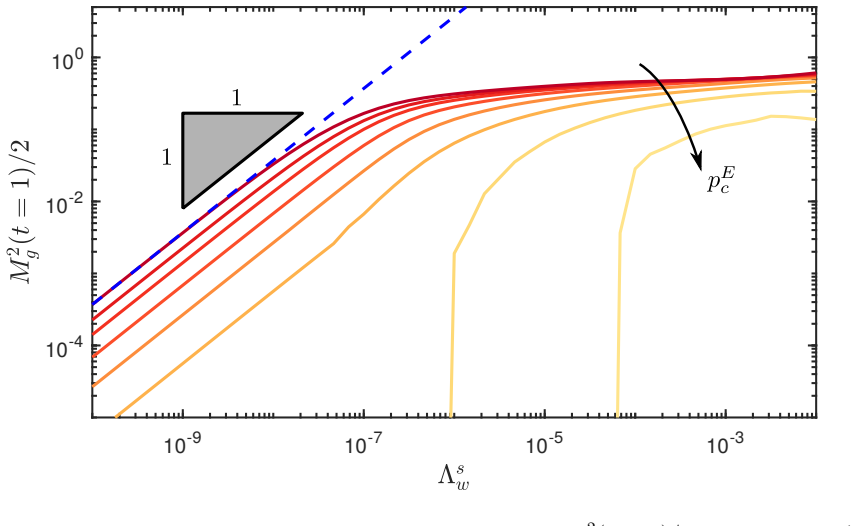
- Decreasing $k^\star_{rw}$ by one to two orders of magnitude can initiate gas leakage or substantially increase the leaked mass, so uncertainty in this parameter translates directly into uncertainty in storage security.
- At Sleipner parameter values, the disconnected-water limit gives a capillary pressure near 3.2 MPa, exceeding entry-pressure estimates of 0.5-5 MPa and implying that distributed leakage across the intermediate mudstone seals is plausible without a focused conduit.
- The amount of gas that leaks grows roughly linearly with the seal-to-aquifer conductance ratio $\Lambda^s_w$ and the seal gas-to-water mobility ratio $M^s_z$ when leakage is weak, and this growth saturates once leakage itself modifies the pressure field.
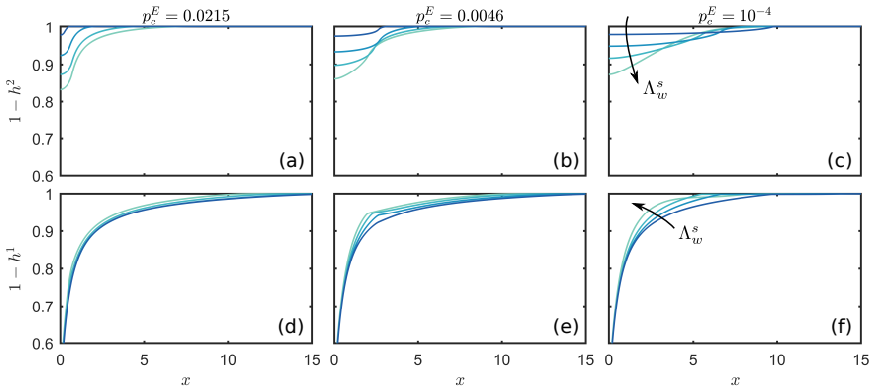
- Distributed gas leakage can also alter plume geometry, narrowing the plume in the injection aquifer by up to about 25 percent relative to pressure dissipation alone.
Reading between the lines
- If this mechanism operates, seismic images showing multiple stratified CO2 plumes at Sleipner may be reinterpreted as evidence of distributed seal breakthrough rather than hidden faults; a testable check is whether the predicted leakage onset matches the timing of plume appearance in each layer.
- The same ratio-based mechanism should apply to other buoyant gases stored underground, such as methane or hydrogen, and to hydrocarbon migration, so containment assessments for any layered storage system should include water-relative-permeability effects in the gas-saturated zone.
- Because $k^\star_{rw}$ depends on the conductivity and connectivity of residual water films, direct core-flood measurements of CO2-brine relative permeability at representative saturations could calibrate the model and narrow the factor-of-300 uncertainty in predicted capillary pressure.
- If film connectivity changes with geochemistry over time, for example through drying or mineral reactions near the injection well, leakage risk could evolve during a storage project, a coupling the present model does not include.
Signed reviews
Editorial analysis
A structured set of objections, weighed in public.
Referee Report
Summary. This paper extends the vertically integrated two-phase model of Jenkins et al. (2019) to include vertical gas leakage across thin seals with a capillary entry threshold. The authors derive coupled PDEs for water and gas in layered aquifers, coupled through vertical water fluxes and through gas fluxes controlled by a smoothed step function of capillary pressure. They analyze a two-aquifer reference case and show that the maximum capillary pressure at the base of the seal is extremely sensitive to the relative permeability of water in the gas region, k*_rw. Two limiting approximations are derived: buoyant overpressure (Eq. 46) and hydraulically disconnected water column (Eq. 47). They then apply the model to Sleipner and argue that if k*_rw is small, capillary pressures may reach ~3.2 MPa and invade interbedded mudstone seals without a focused conduit.
Significance. If the model and its Sleipner interpretation hold, the paper provides a physically plausible mechanism for distributed CO2 leakage across thin intermediate seals, which would challenge the widespread inference of a focused conduit at Sleipner. The derivation is internally consistent, and the two limiting closures (Eqs. 46 and 47) are tested against the full numerical model in Figs. 2 and 3. The paper also gives a clear, falsifiable prediction: the leakage fraction should be strongly controlled by k*_rw. Its main limitation is that the field-scale conclusion is conditioned on a parameter, k*_rw, that the authors admit is very poorly constrained, and the model closures have not been validated against higher-fidelity simulations or experimental data.
major comments (2)
- [Section IV, Eq. (47), Fig. 3] The Sleipner estimate pc ≈ 3.2 MPa is computed in the k*_rw ≈ 0 end-member. The high-capillary limit in Eq. (47) requires k*_rw << Λ_s_w h_n, which with the reference values (Λ_s_w = 10^-4 and h_n ~ O(1)) means k*_rw << 10^-4. The paper provides no measurement, core-flood data, pore-network calculation, or field calibration to support values below this threshold. If k*_rw is near the high end of plausibility, say 10^-2, Fig. 3 shows that the maximum capillary pressure drops by two to three orders of magnitude, returning to the buoyant-overpressure limit of Eq. (46), which would not exceed the ~2 MPa seal entry pressure. The statement in the Abstract and Section IV that CO2 at Sleipner 'may be able to leak across the intermediate seals in the absence of a focused conduit' is therefore a conditional scenario rather than a robust prediction; the required constraint on k*_rw should be stated explicitly and the conclusions reframed accordingly.
- [Section II.A, Eqs. (5), (10), (15)] The vertical-flux ansatz (piecewise-linear q_w,z and vertically uniform q_g,z) and the assumption that leaked gas appears instantaneously in the overlying aquifer are central to the model, but they are not validated against full 2D two-phase simulations or laboratory experiments. Since the paper uses the model to make quantitative leakage predictions (e.g., M2_g fractions in Figs. 4–9), a comparison with a high-resolution numerical model for a few representative parameter sets would materially strengthen the central claims. At present, the predictive accuracy of the upscaled closure is an assumption rather than a demonstrated property.
minor comments (6)
- [Section II.D/E] The dimensionless notation is inconsistent: Eq. (34) defines tilde quantities, but the tildes are dropped immediately afterward, and some source terms in Eqs. (36)–(37) still appear with tildes. Please make the notation uniform throughout.
- [Section III.B] The sentence 'M 1 g (t = 1) = 2−M 1 g (t = 1)< 2' appears to contain an indexing error; the second term should presumably refer to M 2 g (t = 1).
- [Section IV] The text 'see §33' when referring to the characteristic pressure should refer to the appropriate section or equation (§II.D or Eq. (33)).
- [Section II.B.2] The entry-pressure transition function R in Eq. (23) depends on the smoothing parameter ϑ, but no numerical test of independence with respect to ϑ is reported. Please include such a test or state the range of ϑ for which the results are verified.
- [Figure 3] The curve labels in Fig. 3 are difficult to distinguish at printed size; using distinct line styles or markers in addition to color would improve readability.
- [Section II.A.2] The neglect of gas transit time through the seals is a reasonable approximation for thin seals, but its effect on the time at which gas arrives in the upper aquifer should be mentioned in the Sleipner discussion, where the seismic images show vertically stacked plumes.
Circularity Check
No circularity found: the gas-leakage model is derived within the paper from Darcy's law and mass conservation, and the Sleipner estimate is explicitly conditional on the unconstrained parameter k*_rw.
full rationale
The derivation is self-contained. The governing equations for gas flow (Eqs. 36–44) are obtained by vertical integration of the two-phase Darcy equations, with a capillary-threshold closure (Eqs. 21–23) that is not imported from the authors' prior work. The water-flow framework is taken from Jenkins et al. [25], but that is an extension, not a reduction: the paper states, 'Unlike in Jenkins et al. [25], we now also allow for gas flow across the seals, subject to an appropriate capillary entry threshold,' and [25] itself assumed no gas leakage. The Sleipner estimate pc ≈ 3.2 MPa is presented as an end-member calculation: 'Assuming that the gas region completely obstructs vertical water flow, k*_rw ≈ 0... this capillary pressure... is sufficiently high to suggest that gas leakage through the sealing layers at Sleipner is entirely plausible.' No parameter is fitted to the target leakage outcome, and the entry-pressure range 0.5–5 MPa is taken from external measurements (Chiquet et al.; Kuila and Prasad; Chadwick et al.). The paper explicitly flags the weak constraint on k*_rw: 'the appropriate value of k*_rw [is] very poorly constrained. The most likely scenario is that k*_rw << 1.' This is an uncertainty/robustness limitation, not circular reasoning. There is minor self-citation to [25], but the central gas-leakage claim has independent content and would stand or fall with the unconstrained input, not with the citation.
Assumptions & free parameters
free parameters (3)
- k*_rw =
reference 10^-3; varied from 10^-10 to 1
- pE_c =
varied logarithmically; Sleipner estimate 0.5 to 5 MPa from Chiquet et al. and Kuila and Prasad
- theta (smoothing sharpness) =
300
assumptions (6)
- domain assumption Weakly compressible fluids with linear density-pressure relation, Eq. (1).
- domain assumption Strong gravity segregation: a coherent gas plume overlying water, with no gas in the water regions or seals, and no gas storage in seals.
- domain assumption Closure for vertical water flux: piecewise-linear profile through the aquifer, Eq. (5), and uniform vertical gas flux, Eq. (10).
- domain assumption Seals have no horizontal flow and no storage, so vertical fluxes through each seal are uniform.
- domain assumption Gas leakage is controlled by a capillary entry threshold, represented by a smoothed step function R, Eq. (23).
- domain assumption Leaked gas immediately appears in the overlying aquifer plume, neglecting transit time through the seal and water region.
Cite this review
Pith. "Pith review of Gas injection and leakage in layered aquifers." pith.science (2026). https://pith.science/paper/AFXVIUBU
@misc{pith2026190808137,
  author       = {Pith},
  title        = {Pith review of: Gas injection and leakage in layered aquifers},
  year         = {2026},
  howpublished = {\url{https://pith.science/paper/AFXVIUBU}},
  note         = {Machine review of arXiv:1908.08137}
}
read the original abstract
Carbon dioxide (CO2) injection into saline aquifers is one method of mitigating anthropogenic climate change. To ensure secure storage of this CO2, it is important to understand the interaction of CO2 injection and migration with geological layering. For example, seismic monitoring at the Sleipner pilot project suggests that the injected CO2 is ponding against, and leaking across, a series of thin, intermediate seals. Here, we develop a gravity-current model for weakly compressible, two-phase fluid migration in a system of layered aquifers. Our model includes vertical leakage of both water and gas across seals, where the latter is subject to a capillary entry threshold. We demonstrate that the buildup of capillary pressure is very sensitive to the conductivity and connectivity of water films in the gas region. We identify two associated limiting cases, where gas obstructs water flow either completely or not at all. We then explore the parameters that govern gas leakage and the resulting fluid distributions---demonstrating that this problem involves a complex interplay between pressure dissipation, capillary pressure buildup, and fluid migration. We show that decreasing the relative permeability of water in the gas region can initiate gas leakage or significantly increase the amount of gas leakage. Finally, we apply our model to rock properties expected for Sleipner and show that CO2 injection may build up sufficient capillary pressure to invade the seals---suggesting that, contrary to conventional wisdom, CO2 may be able to leak across the intermediate seals at Sleipner in the absence of a focused conduit.
Figures


Figures from the paper (6 more)


Reference graph
Works this paper leans on
-
[25]
Here, we extend the work of Jenkins et al
showed that vertical pressure dissipation is also coupled to the motion of the gas plume, leading to a more compact plume shape by suppressing the formation of the advancing gas tongue. Here, we extend the work of Jenkins et al. [25] to account for distributed gas leakage. A key aspect of the present study is that, as in Jenkinset al. [25], we focus on a ...
-
[1]
We do not make this assumption for gas since we expect thatcg≫cw
We therefore assume that ρw≈ ρ0 w, which simplifies our analysis below. We do not make this assumption for gas since we expect thatcg≫cw. As in Jenkins et al. [25], we allow for vertical and lateral pressure dissipation via brine flow through the aquifers and across the seals. Unlike in Jenkins et al. [25], we now also allow for gas flow across the seals, su...
-
[2]
Gas in aquifer n Conservation of mass for gas in aquifern is given by ∂ ∂t (ρgφsg) + ∇· (ρgqg) =Ig, (7) 7 wheresg is the saturation of gas, qg is the Darcy flux of gas, and Ig is the local mass rate of gas injection per unit volume. The Darcy flux of gas is given by Darcy’s law, qg =−kkrg µg (∇pg +ρggˆez), (8) wherekrg is the relative permeability of gas,µg...
-
[3]
Water in aquifer n We now outline the derivation of the governing partial differential equation (PDE) for water in aquifern, which is identical to that in Jenkins et al. [25]. Conservation of mass for the water in aquifern is given by ∂ ∂t (ρwφsw) + ∇· (ρwqw) =Iw, (2) wheresw is the water saturation, qw is the Darcy flux of water, and Iw is the local mass ...
-
[4]
Gravity-driven flows in porous layers,
H. E. Huppert and A. W. Woods, “Gravity-driven flows in porous layers,” Journal of Fluid Mechanics 292, 55–69 (1995)
work page 1995
-
[5]
Similarity solutions for fluid injection into confined aquifers,
J. M. Nordbotten and M. A. Celia, “Similarity solutions for fluid injection into confined aquifers,” Journal of Fluid Mechanics 561, 307–327 (2006)
work page 2006
-
[6]
Vertical water fluxes For the vertical fluxes of water across the seals, our approach and results are identical to those of Jenkins et al. [25]. We assume that there is horizontal flow and no storage within the seals, such that the mass flux of water entering seal s from aquifer n− 1 must equal the mass flux of water exiting seals into aquifern: ρn−1 w qn−1,T ...
-
[7]
Vertical gas fluxes For the vertical fluxes of gas across the seals, we follow a similar procedure to that for water. With no horizontal flow and no storage within the seals, the mass flux of gas entering seal s from aquifern− 1 must equal the mass flux of gas exiting seals into aquifern: ρn−1 g qn−1,T g,z =ρn gqn,B g,z =ρs gqs g,z, (19) whereρs g is the densi...
Show all 48 references
-
[8]
To do so, we consider the total mass of gas in aquifer 2 at the end of injection
Varying Λs w and pE c for fixedMs z We first fixMs z = 20 (the reference value) and study the roles of Λs w and pE c . To do so, we consider the total mass of gas in aquifer 2 at the end of injection. Note that the total mass of gas in aquifern at timet is given by Mn g (t) = ∫ +...
-
[9]
Effect of Ms z We now briefly consider the impact of varyingMs z at fixed Λs w = 10−4 (the reference value). Recall thatMs z≡ (ks rg/µg)/(ks rw/µw) is the ratio of the mobility of gas in the seal to the mobility 26 10-9 10-7 10-5 10-3 102 104 106 10-9 10-7 10-5 10-3 10-1 100 101...
1996
-
[10]
IPCC, Carbon Dioxide Capture and Storage , Special Report Prepared by Working Group III of the Intergovernmental Panel on Climate Change (Cambridge, UK, 2005)
2005
-
[11]
Issue profile: environmental issues and the geolog- 32 ical storage of CO2,
J. M. West, J. Pearce, M. Bentham, and P. Maul, “Issue profile: environmental issues and the geolog- 32 ical storage of CO2,” European Environment15, 250–259 (2005)
2005
-
[12]
Potential impacts of leakage from deep CO 2 geosequestration on overlying freshwater aquifers,
M. G. Little and R. B. Jackson, “Potential impacts of leakage from deep CO 2 geosequestration on overlying freshwater aquifers,” Environmental science & technology44, 9225–9232 (2010)
2010
-
[13]
Gravity currents over fractured substrates in a porous medium,
D. Pritchard, “Gravity currents over fractured substrates in a porous medium,” Journal of Fluid Me- chanics 584, 415–431 (2007)
2007
-
[14]
The effect of a fissure on storage in a porous medium,
J. A. Neufeld, D. Vella, and H. E. Huppert, “The effect of a fissure on storage in a porous medium,” Journal of Fluid Mechanics 639, 239–259 (2009)
2009
-
[15]
Gravity currents in horizontal porous layers: transition from early to late self-similarity,
M. A. Hesse, H. A. Tchelepi, B. J. Cantwell, and F. M. Orr Jr., “Gravity currents in horizontal porous layers: transition from early to late self-similarity,” Journal of Fluid Mechanics577, 363–383 (2007)
2007
-
[16]
Vertical equilibrium with sub-scale analytical methods for geological CO2 sequestration,
S. E. Gasda, J. M. Nordbotten, and M. A. Celia, “Vertical equilibrium with sub-scale analytical methods for geological CO2 sequestration,” Computational Geosciences79, 15–27 (2009)
2009
-
[17]
The footprint of the CO 2 plume during car- bon dioxide storage in saline aquifers: Storage efficiency for capillary trapping at the basin scale,
R. Juanes, C. W. MacMinn, and M. L. Szulczewski, “The footprint of the CO 2 plume during car- bon dioxide storage in saline aquifers: Storage efficiency for capillary trapping at the basin scale,” Transport in Porous Media 82, 19–30 (2010)
2010
-
[18]
Reservoir geology of the utsira formation at the first industrial-scale underground CO 2 storage site (sleipner area, north sea),
P. Zweigel, R. Arts, A. E. Lothe, and E. Lindeberg, “Reservoir geology of the utsira formation at the first industrial-scale underground CO 2 storage site (sleipner area, north sea),” Geological Society, London, Special Publications 233, 165–180 (2004)
2004
-
[19]
Spatial and temporal evolution of injected CO2 at the Sleipner Field, North Sea,
F. C. Boait, N. J. White, M. J. Bickle, R. A. Chadwick, J. A. Neufeld, and H. E. Huppert, “Spatial and temporal evolution of injected CO2 at the Sleipner Field, North Sea,” Journal of Geophysical Research 117, B03309 (2012)
2012
-
[20]
Buoyant dispersal of CO 2 during geological storage,
M. A. Hesse and A. W. Woods, “Buoyant dispersal of CO 2 during geological storage,” Geophysical Research Letters 37, L01403 (2010)
2010
-
[21]
Sequential vertical gas charge into multilayered sequences controlled by central conduits,
M. Foschi, J. A. Cartwright, and C. W. MacMinn, “Sequential vertical gas charge into multilayered sequences controlled by central conduits,” AAPG Bulletin102, 855–883 (2018)
2018
-
[22]
Analytical solutions for two-phase subsurface flow to a leaky fault considering vertical flow effects and fault properties,
M. Kang, J. M. Nordbotten, F. Doster, and M. A. Celia, “Analytical solutions for two-phase subsurface flow to a leaky fault considering vertical flow effects and fault properties,” Water Resources Research 50, 3536–3552 (2014)
2014
-
[23]
Fluid migration between confined aquifers,
S. S. Pegler, H. E. Huppert, and J. A. Neufeld, “Fluid migration between confined aquifers,” Journal of Fluid Mechanics 757, 330–353 (2014)
2014
-
[24]
Leakage from gravity currents in a porous medium. part 1. a localized sink,
J. A. Neufeld, D. Vella, H. E. Huppert, and J. R. Lister, “Leakage from gravity currents in a porous medium. part 1. a localized sink,” Journal of Fluid Mechanics666, 391–413 (2011)
2011
-
[26]
Leakage from gravity currents in a porous 33 medium. part 2. a line sink,
D. Vella, J. A. Neufeld, H. E. Huppert, and J. R. Lister, “Leakage from gravity currents in a porous 33 medium. part 2. a line sink,” Journal of Fluid Mechanics666, 414–427 (2011)
2011
-
[27]
On the slow draining of a gravity current moving through a layered permeable medium,
D. Pritchard, A. W. Woods, and A. J. Hogg, “On the slow draining of a gravity current moving through a layered permeable medium,” Journal of Fluid Mechanics444, 23–47 (2001)
2001
-
[28]
Two-dimensional viscous gravity cur- rents flowing over a deep porous medium,
James M. Acton, Herbert E. Huppert, and M. Grae Worster, “Two-dimensional viscous gravity cur- rents flowing over a deep porous medium,” Journal of Fluid Mechanics440, 359–380 (2001)
2001
-
[29]
The effect of drainage on the capillary retention of CO 2 in a layered permeable rock,
A. Farcas and A. W. Woods, “The effect of drainage on the capillary retention of CO 2 in a layered permeable rock,” Journal of Fluid Mechanics618, 349–359 (2009)
2009
-
[30]
for flow near a well. The expression is qw,z(x,z,t )≈ qn,B w,z + ( z−zn,B zn,I−zn,B ) (qn,T w,z−qn,B w,z ) zn,B≤z <zn,I, qn,T w,z zn,I≤z≤zn,T, (5) whereqn,B w,z (x,t ) andqn,T w,z (x,t ) are the vertical fluxes of water through the lower and upper seals of aquifern, ...
-
[31]
Capillary entry pressure and the leakage of gravity currents through a sloping layered permeable rock,
A. W. Woods and A. Farcas, “Capillary entry pressure and the leakage of gravity currents through a sloping layered permeable rock,” Journal of Fluid Mechanics618, 361–379 (2009)
2009
-
[32]
On the flow of buoyant fluid injected into a confined, inclined aquifer,
I. Gunn and A. W. Woods, “On the flow of buoyant fluid injected into a confined, inclined aquifer,” Journal of Fluid Mechanics 672, 109–129 (2011)
2011
-
[33]
Fluid invasion of an unsaturated leaky porous layer,
S. S. Pegler, E. L. Bain, H. E. Huppert, and J. A. Neufeld, “Fluid invasion of an unsaturated leaky porous layer,” Journal of Fluid Mechanics777, 97–121 (2015)
2015
-
[34]
Impact of pressure dissipation on fluid injection into layered aquifers,
L. T. Jenkins, M. Foschi, and C. W. MacMinn, “Impact of pressure dissipation on fluid injection into layered aquifers,” Journal of Fluid Mechanics877, 214–238 (2019)
2019
-
[35]
Large-scale impact of CO2 storage in deep saline aquifers: A sensitivity study on pressure response in stratified systems,
J. T. Birkholzer, Q. Zhou, and C.-F. Tsang, “Large-scale impact of CO2 storage in deep saline aquifers: A sensitivity study on pressure response in stratified systems,” International Journal of Greenhouse Gas Control 3, 181–194 (2009)
2009
-
[36]
Evaluation of large-scale CO 2 storage on fresh-water sections of aquifers: An exam- ple from the Texas Gulf Coast Basin,
J.-P. Nicot, “Evaluation of large-scale CO 2 storage on fresh-water sections of aquifers: An exam- ple from the Texas Gulf Coast Basin,” International Journal of Greenhouse Gas Control 2, 582–593 (2008)
2008
-
[37]
Reduction of lateral pressure prop- agation due to dissipation into ambient mudrocks during geological carbon dioxide storage,
Kyung Won Chang, Marc A. Hesse, and JeanPhilippe Nicot, “Reduction of lateral pressure prop- agation due to dissipation into ambient mudrocks during geological carbon dioxide storage,” Water Resources Research 49, 2573–2588 (2013)
2013
-
[38]
Jacob Bear, Dynamics of fluids in porous media (Courier Corporation, 1972)
1972
-
[39]
An improved analytical solution for interface upconing around a 34 well,
J. M. Nordbotten and M. A. Celia, “An improved analytical solution for interface upconing around a 34 well,” Water Resources Research42 (2006)
2006
-
[40]
The matlab ode suite,
L. F. Shampine and M. W. Reichelt, “The matlab ode suite,” SIAM journal on scientific computing 18, 1–22 (1997)
1997
-
[41]
Approximate solutions for pressure buildup during co 2 injection in brine aquifers,
Simon A Mathias, Paul E Hardisty, Mark R Trudell, and Robert W Zimmerman, “Approximate solutions for pressure buildup during co 2 injection in brine aquifers,” Transport in Porous Media 79, 265–284 (2009)
2009
-
[42]
Effects of co 2 compressibility on co 2 storage in deep saline aquifers,
V . Vilarrasa, D. Bolster, M. Dentz, S. Olivella, and J. Carrera, “Effects of co 2 compressibility on co 2 storage in deep saline aquifers,” Transport in porous media85, 619–639 (2010)
2010
-
[43]
CO 2/water interfacial tensions under pressure and temperature conditions of CO2 geological storage,
P. Chiquet, J.-L. Daridon, D. Broseta, and S. Thibeau, “CO 2/water interfacial tensions under pressure and temperature conditions of CO2 geological storage,” Energy Conversion and Management48, 736– 744 (2007)
2007
-
[44]
Specific surface area and pore-size distribution in clays and shales,
U. Kuila and M. Prasad, “Specific surface area and pore-size distribution in clays and shales,” Geo- physical Prospecting 61, 341–362 (2013)
2013
-
[45]
- geological characterization of co 2 storage sites: Lessons from sleipner, northern north sea,
R. A. Chadwick, P. Zweigel, U. Gregersen, G. A. Kirby, S. Holloway, and P. N. Johannessen, “- geological characterization of co 2 storage sites: Lessons from sleipner, northern north sea,” inGreen- house Gas Control Technologies-6th International Conference(Elsevier, 2003) pp. 321–326
2003
-
[46]
4d seismic quantification of a growing CO 2 plume at Sleipner, North Sea,
R. A. Chadwick, R. Arts, and O. Eiken, “4d seismic quantification of a growing CO 2 plume at Sleipner, North Sea,” in Geological Society, London, Petroleum Geology Conference series , V ol. 6 (Geological Society of London, 2005) pp. 1385–1399
2005
-
[47]
Modelling carbon dioxide accumulation at sleipner: Implications for underground carbon storage,
M. Bickle, A. Chadwick, H. E. Huppert, M. Hallworth, and S. Lyle, “Modelling carbon dioxide accumulation at sleipner: Implications for underground carbon storage,” Earth and Planetary Science Letters 255, 164–176 (2007)
2007
-
[48]
Flow to a well in a multiaquifer system,
B. Hunt, “Flow to a well in a multiaquifer system,” Water Resources Research21, 1637–1641 (1985). 35
1985
Reviewed August 14, 2026 · model on record in the stance chip above.
Discussion (0). Continue with ORCID to comment.