Lagrangian evaluation of polymeric stress in viscoelastic fluids
Pith reviewed 2026-07-03 18:25 UTC · model grok-4.3
The pith
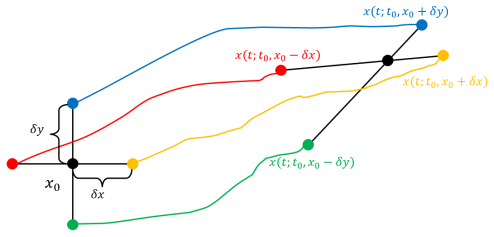
A Lagrangian scheme reconstructs polymeric stress fields from deformation-gradient history along fluid trajectories in a known steady velocity field.
A machine-rendered reading of the paper's core claim, the machinery that carries it, and where it could break.
Core claim
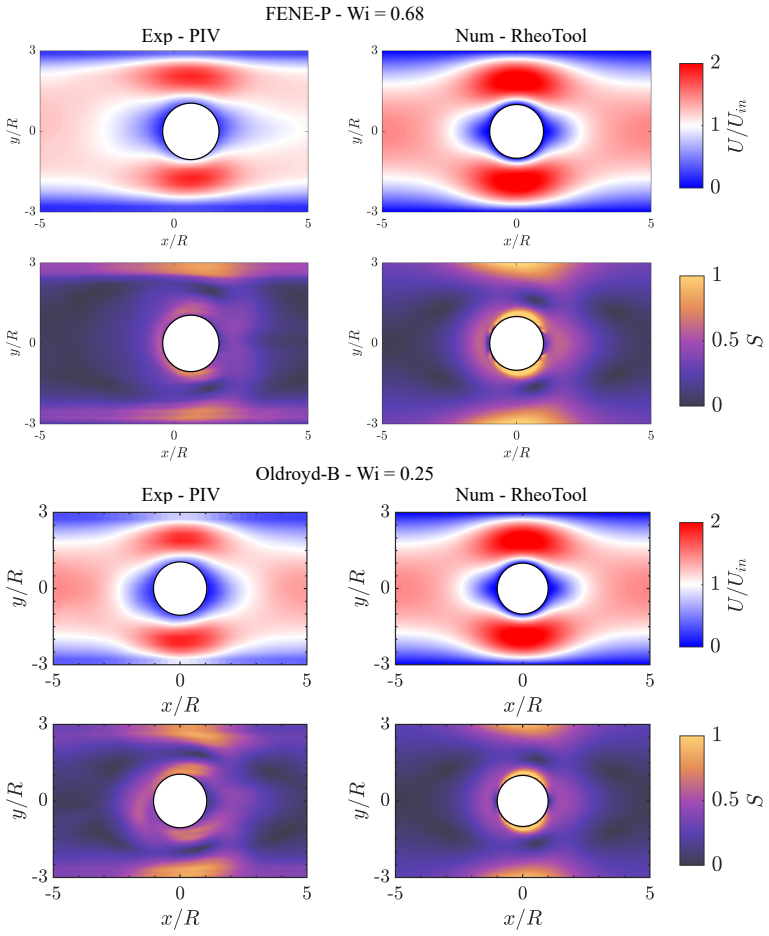
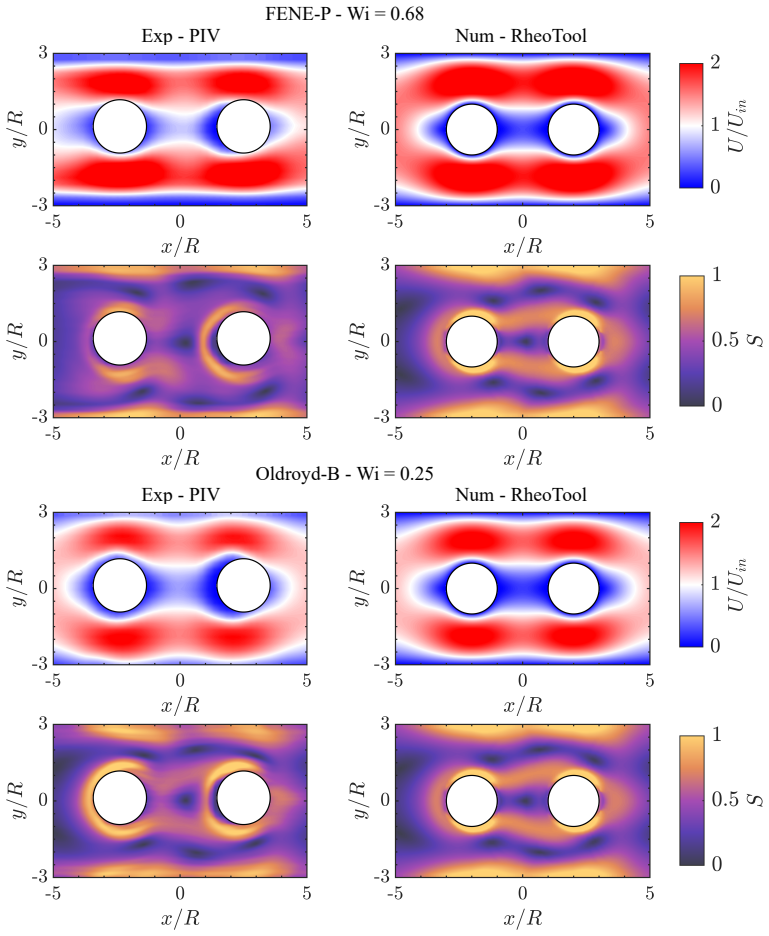
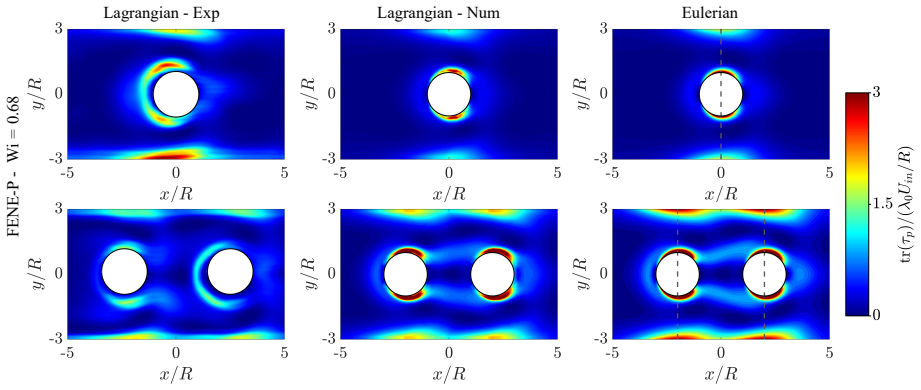
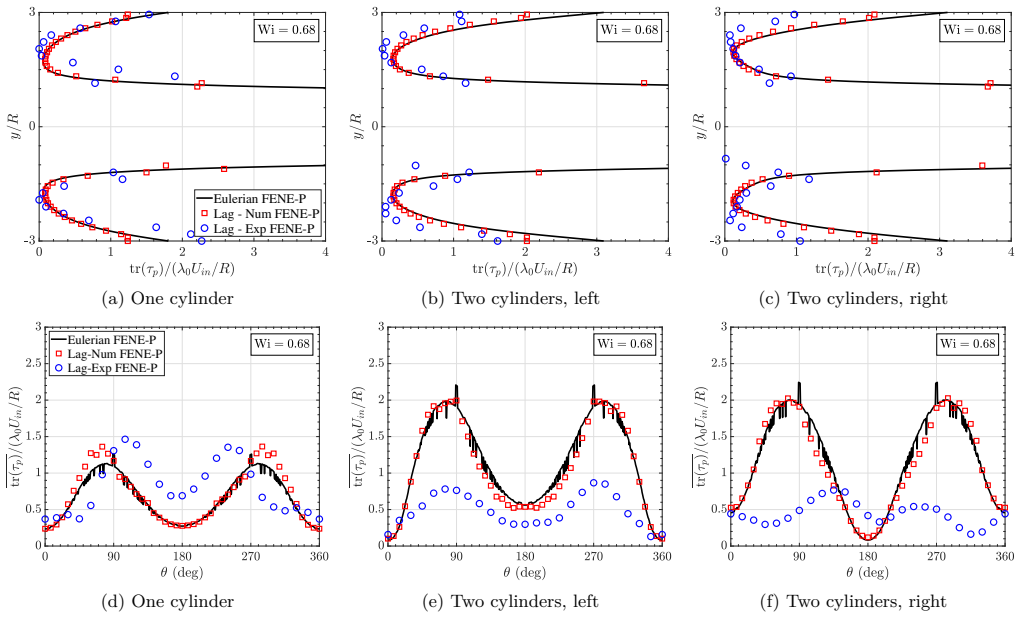
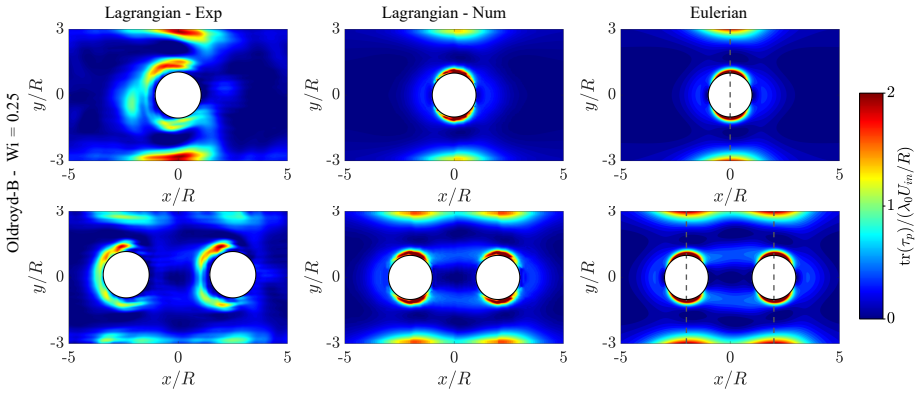
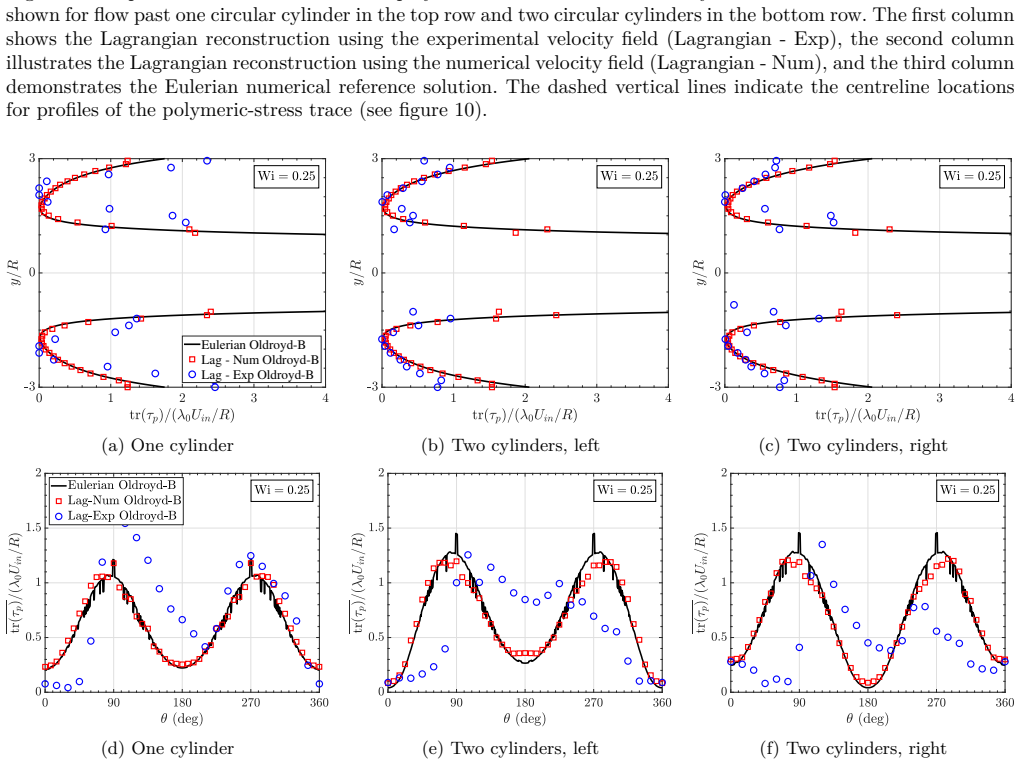
Polymeric stresses can be obtained by integrating the evolution equation for the conformation tensor along particle trajectories using only the history of the deformation gradient in a prescribed steady velocity field, and the resulting stress distributions agree with those produced by standard Eulerian constitutive solvers for both the Oldroyd-B and FENE-P models in channel flows containing circular obstacles.
What carries the argument
Lagrangian integration of the conformation tensor along fluid-element trajectories using the deformation-gradient tensor in a known steady velocity field.
If this is right
- Stress fields can be mapped directly from experimentally measured velocity data without solving any constitutive transport equation.
- The computational cost of obtaining stresses is reduced because only individual trajectories need to be integrated instead of a domain-wide Eulerian field.
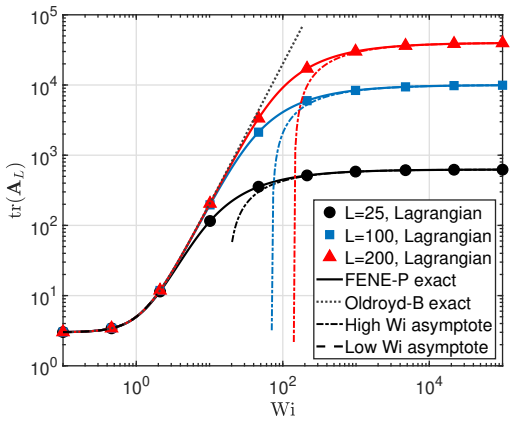
- The same procedure applies without modification to both the linear Oldroyd-B model and the nonlinear FENE-P model.
- The method remains valid in flows past obstacles where the velocity field is taken from either simulation or experiment.
Where Pith is reading between the lines
- If time-resolved velocity fields were available the scheme could be applied to unsteady flows by integrating along space-time trajectories.
- The Lagrangian stresses could be fed back into an iterative solver to relax the assumption of a prescribed velocity field.
- Particle-tracking velocimetry data could be post-processed to produce whole-field stress maps in microfluidic devices without additional constitutive modeling.
Load-bearing premise
The velocity field is known in advance, is steady, and remains smooth enough for accurate numerical integration of particle paths without any back-coupling from the computed stresses.
What would settle it
A side-by-side comparison in an unsteady flow in which the Lagrangian stresses deviate measurably from a fully coupled Eulerian solution would show that the scheme does not extend beyond its stated assumptions.
Figures


read the original abstract
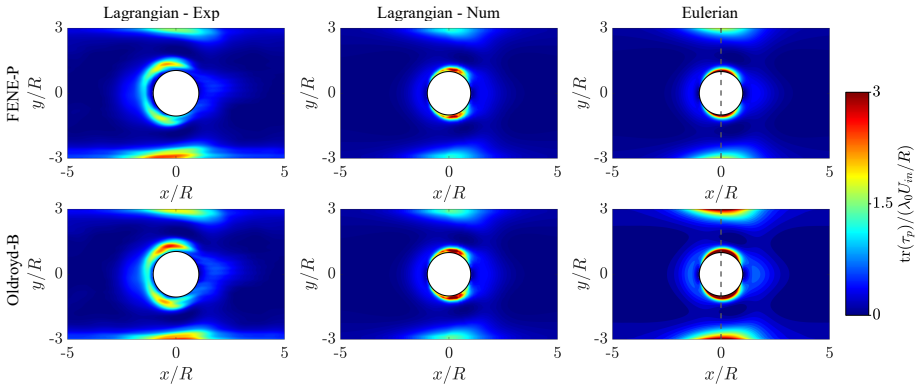
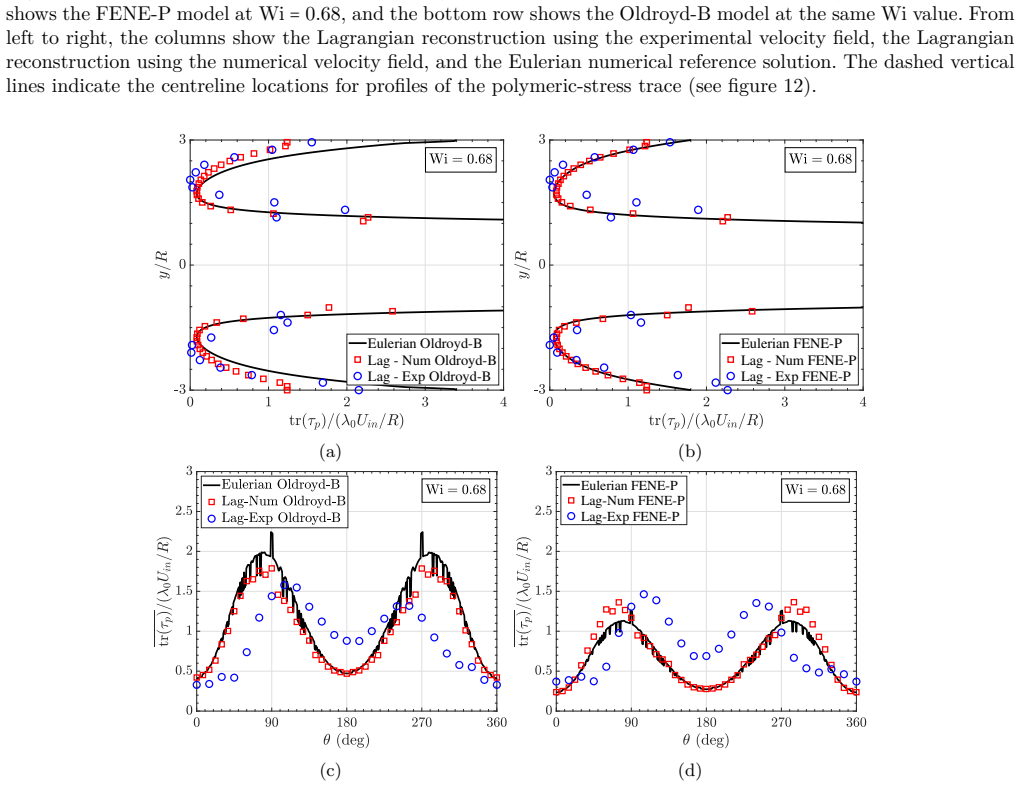
Polymeric stresses in viscoelastic flows arise from the deformation of polymer chains and are commonly computed using Eulerian constitutive models, in which the conformation tensor is evolved as a transported field over the entire domain. This approach is computationally intensive, prone to numerical instabilities, and not directly applicable to experimentally measured velocity fields. In this work, we develop a Lagrangian integration scheme that reconstructs the polymeric stress field from the deformation-gradient history along fluid element trajectories in a known, steady velocity field. This approach avoids solving the full Eulerian constitutive transport equation, which we develop for the nonlinear FENE-P model as well as the Oldroyd-B model as a reference case. After validation on unidirectional, canonical flows, the scheme is applied to non-trivial channel flows past circular obstacles using velocity fields quantified from both numerical simulations and microfluidic experiments. The reconstructed stress fields across both experiments and simulations are in agreement with traditional Eulerian reference solutions. Not only does this new Lagrangian scheme enable the quantification of stress fields directly from experimental velocity field data, but it also enables partial or whole-field mapping of stresses without solving fully-coupled viscoelastic constitutive equations.
Editorial analysis
A structured set of objections, weighed in public.
Referee Report
Summary. The manuscript develops a Lagrangian integration scheme to reconstruct polymeric stress fields from the deformation-gradient history along fluid-element trajectories in a prescribed steady velocity field. The scheme is derived for the Oldroyd-B model and extended to the nonlinear FENE-P model. After validation on unidirectional canonical flows, it is applied to channel flows past circular obstacles using velocity fields from both numerical simulations and microfluidic experiments; the reconstructed stresses agree with traditional Eulerian reference solutions on the same fields.
Significance. If the central claim holds, the method enables direct post-processing of experimental velocity data to obtain polymeric stress fields without solving the full Eulerian constitutive transport equations. This is useful for flows where the velocity is measured or prescribed, and the internal validation against Eulerian solutions on identical velocity fields provides a clean test of the integration scheme itself.
minor comments (2)
- [Abstract] Abstract: the quantitative agreement claims would be strengthened by reporting error bars or sensitivity to trajectory integration tolerances, as noted in the validation sections.
- [Methods] §3 (or equivalent methods section): clarify the precise numerical tolerances used for trajectory integration and deformation-gradient evolution to allow reproducibility of the reported agreement levels.
Simulated Author's Rebuttal
We thank the referee for the positive assessment of our manuscript and the recommendation to accept. The provided summary accurately reflects the scope and contributions of the work.
Circularity Check
No significant circularity
full rationale
The paper presents a direct numerical integration scheme that computes the deformation gradient (and thus conformation tensor and polymeric stress) along fluid-element trajectories from a prescribed steady velocity field. This is validated by explicit comparison to independent Eulerian solutions on identical velocity fields for both Oldroyd-B and FENE-P models. No parameters are fitted to the target stress data, no self-citation chain is load-bearing for the central claim, and the method is scoped as post-processing on known flows. The derivation is therefore self-contained and externally falsifiable via the reported Eulerian benchmarks.
Axiom & Free-Parameter Ledger
axioms (2)
- domain assumption The velocity field is steady and known a priori.
- standard math Fluid-element trajectories can be integrated accurately from the velocity field.
Reference graph
Works this paper leans on
-
[1]
D. T. Chen, Q. Wen, P. A. Janmey, J. C. Crocker, and A. G. Yodh, “Rheology of soft materials,” Annu. Rev. Condens. Matter Phys. , vol. 1, no. 1, pp. 301–322, 2010
work page 2010
-
[2]
K. S. Sorbie, Polymer-improved oil recovery. Springer Science & Business Media, 2013
work page 2013
-
[3]
Efficient mixing at low reynolds numbers using polymer additives,
A. Groisman and V. Steinberg, “Efficient mixing at low reynolds numbers using polymer additives,” Nature, vol. 410, no. 6831, pp. 905–908, 2001
work page 2001
-
[4]
Prediction of anomalous blood viscosity in confined shear flow,
M. Thiébaud, Z. Shen, J. Harting, and C. Misbah, “Prediction of anomalous blood viscosity in confined shear flow,” Physical Review Letters , vol. 112, p. 238304, 2014
work page 2014
-
[5]
Transport of complex and active fluids in porous media,
M. Kumar, J. S. Guasto, and A. M. Ardekani, “Transport of complex and active fluids in porous media,” Journal of Rheology, vol. 66, no. 2, pp. 375–397, 2022
work page 2022
-
[6]
Elastic turbulence in a polymer solution flow,
A. Groisman and V. Steinberg, “Elastic turbulence in a polymer solution flow,” Nature, vol. 405, no. 6782, pp. 53–55, 2000
work page 2000
-
[7]
P. S. Virk, “Drag reduction fundamentals,” AIChE Journal , vol. 21, no. 4, pp. 625–656, 1975
work page 1975
-
[8]
Mechanics and prediction of turbulent drag reduction with polymer additives,
C. M. White and M. G. Mungal, “Mechanics and prediction of turbulent drag reduction with polymer additives,” Annual Review of Fluid Mechanics , vol. 40, pp. 235–256, 2008
work page 2008
-
[9]
Instabilities in viscoelastic flows,
R. G. Larson, “Instabilities in viscoelastic flows,” Rheologica Acta, vol. 31, pp. 213–263, 1992
work page 1992
-
[10]
Elastic instabilities between two cylinders confined in a channel,
M. Kumar and A. M. Ardekani, “Elastic instabilities between two cylinders confined in a channel,” Physics of Fluids, vol. 33, p. 074107, 07 2021
work page 2021
-
[11]
R. B. Bird, C. F. Curtiss, R. C. Armstrong, and O. Hassager, Dynamics of polymeric liquids, volume 2: Kinetic theory. Wiley, 1987
work page 1987
-
[12]
H. C. Öttinger, Stochastic processes in polymeric fluids: tools and examples for developing simulation algorithms . Springer Science & Business Media, 2012
work page 2012
-
[13]
R. G. Larson, Constitutive equations for polymer melts and solutions: Butterworths series in chemical engineering . Butterworth-Heinemann, 2013
work page 2013
-
[14]
The relationship between viscoelasticity and elasticity,
J. Snoeijer, A. Pandey, M. Herrada, and J. Eggers, “The relationship between viscoelasticity and elasticity,” Proceedings of the Royal Society A: Mathematical, Physical and Engineering Sciences , vol. 476, no. 2243, 2020
work page 2020
-
[15]
Lagrangian stretching reveals stress topology in viscoelastic flows,
M. Kumar, J. S. Guasto, and A. M. Ardekani, “Lagrangian stretching reveals stress topology in viscoelastic flows,” Proceedings of the National Academy of Sciences , vol. 120, no. 5, p. e2211347120, 2023
work page 2023
-
[16]
Stress and stretching regulate dispersion in viscoelastic porous media flows,
M. Kumar, D. M. Walkama, A. M. Ardekani, and J. S. Guasto, “Stress and stretching regulate dispersion in viscoelastic porous media flows,” Soft Matter , vol. 19, no. 35, pp. 6761–6770, 2023
work page 2023
-
[17]
Distinguished material surfaces and coherent structures in three-dimensional fluid flows,
G. Haller, “Distinguished material surfaces and coherent structures in three-dimensional fluid flows,” Physica D: Nonlinear Phenomena , vol. 149, no. 4, pp. 248–277, 2001
work page 2001
-
[18]
Experimental measurements of stretching fields in fluid mixing,
G. A. Voth, G. Haller, and J. P. Gollub, “Experimental measurements of stretching fields in fluid mixing,” Physical review letters , vol. 88, no. 25, p. 254501, 2002
work page 2002
-
[19]
Haller, Transport Barriers and Coherent Structures in Flow Data
G. Haller, Transport Barriers and Coherent Structures in Flow Data . Cambridge University Press, 2023
work page 2023
-
[20]
A note about convected time derivatives for flows of complex fluids,
H. A. Stone, M. J. Shelley, and E. Boyko, “A note about convected time derivatives for flows of complex fluids,” Soft Matter , vol. 19, no. 28, pp. 5353–5359, 2023
work page 2023
-
[21]
Perspective on the description of viscoelastic flows via continuum elastic dumbbell models,
E. Boyko and H. A. Stone, “Perspective on the description of viscoelastic flows via continuum elastic dumbbell models,” Journal of Engineering Mathematics , vol. 147, no. 1, p. 5, 2024
work page 2024
-
[22]
G. G. Fuller, Optical rheometry of complex fluids . Oxford University Press, 1995
work page 1995
-
[23]
D. B. Murphy and M. W. Davidson, Fundamentals of Light Microscopy and electronic imaging . Wiley-Blackwell, 2013. 21
work page 2013
-
[24]
Spatially resolved quantitative rheo-optics of complex fluids in a microfluidic device,
T. J. Ober, J. Soulages, and G. H. McKinley, “Spatially resolved quantitative rheo-optics of complex fluids in a microfluidic device,” Journal of Rheology , vol. 55, no. 5, pp. 1127–1159, 2011
work page 2011
-
[25]
Measurements of flow-induced birefringence in microfluidics,
C.-l. Sun and H.-Y. Huang, “Measurements of flow-induced birefringence in microfluidics,” Biomicrofluidics, vol. 10, no. 1, 2016
work page 2016
-
[26]
Single polymer dynamics in an elongational flow,
T. T. Perkins, D. E. Smith, and S. Chu, “Single polymer dynamics in an elongational flow,” Science, vol. 276, p. 2016–2021, June 1997
work page 2016
-
[27]
Single-polymer dynamics in steady shear flow,
D. E. Smith, H. P. Babcock, and S. Chu, “Single-polymer dynamics in steady shear flow,” Science, vol. 283, p. 1724–1727, Mar. 1999
work page 1999
-
[28]
Polymer conformation during flow in porous media,
D. Kawale, G. Bouwman, S. Sachdev, P. L. Zitha, M. T. Kreutzer, W. R. Rossen, and P. E. Boukany, “Polymer conformation during flow in porous media,” Soft matter , vol. 13, no. 46, pp. 8745–8755, 2017
work page 2017
-
[29]
Particle tracking techniques for electrokinetic microchannel flows,
S. Devasenathipathy, J. G. Santiago, and K. Takehara, “Particle tracking techniques for electrokinetic microchannel flows,” Analytical Chemistry, vol. 74, p. 3704–3713, June 2002
work page 2002
-
[30]
R. Sureshkumar and A. N. Beris, “Linear stability analysis of viscoelastic poiseuille flow using an arnoldi-based orthogonalization algorithm,” Journal of non-newtonian fluid mechanics , vol. 56, no. 2, pp. 151–182, 1995
work page 1995
-
[31]
Master curves for fene-p fluids in steady shear flow,
S. Yamani and G. H. McKinley, “Master curves for fene-p fluids in steady shear flow,” Journal of Non-Newtonian Fluid Mechanics , vol. 313, p. 104944, 2023
work page 2023
-
[32]
Polymer solution rheology based on a finitely extensible bead—spring chain model,
R. B. Bird, P. J. Dotson, and N. Johnson, “Polymer solution rheology based on a finitely extensible bead—spring chain model,” Journal of Non-Newtonian Fluid Mechanics , vol. 7, no. 2-3, pp. 213–235, 1980
work page 1980
-
[33]
R. P. Brent, Algorithms for Minimization Without Derivatives . Englewood Cliffs, New Jersey: Prentice-Hall, 1973
work page 1973
-
[34]
Lagrangian Coherent Structures,
G. Haller, “Lagrangian Coherent Structures,” Annual Review of Fluid Mechanics , vol. 47, no. 1, pp. 137–162, 2015
work page 2015
-
[35]
Lcs tool: A computational platform for lagrangian coherent structures,
K. Onu, F. Huhn, and G. Haller, “Lcs tool: A computational platform for lagrangian coherent structures,” Journal of Computational Science , vol. 7, pp. 26–36, 2015
work page 2015
-
[36]
OpenFOAM: A C++ library for complex physics simulations,
H. Jasak, A. Jemcov, and Z. Tukovic, “OpenFOAM: A C++ library for complex physics simulations,” in International Workshop on Coupled Methods in Numerical Dynamics , 2007
work page 2007
-
[37]
Stabilization of an open-source finite-volume solver for viscoelastic fluid flows,
F. Pimenta and M. Alves, “Stabilization of an open-source finite-volume solver for viscoelastic fluid flows,” Journal of Non-Newtonian Fluid Mechanics , vol. 239, pp. 85–104, 2017
work page 2017
-
[38]
Flow of low viscosity Boger fluids through a microfluidic hyperbolic contraction,
L. Campo-Deaño, F. J. Galindo-Rosales, F. T. Pinho, M. A. Alves, and M. S. Oliveira, “Flow of low viscosity Boger fluids through a microfluidic hyperbolic contraction,” Journal of Non-Newtonian Fluid Mechanics , vol. 166, pp. 1286–1296, Nov. 2011
work page 2011
-
[39]
Bistability in the Unstable Flow of Polymer Solutions Through Porous Media,
C. A. Browne, A. Shih, and S. S. Datta, “Bistability in the Unstable Flow of Polymer Solutions Through Porous Media,” Journal of Fluid Mechanics , vol. 890, p. A2, May 2020. arXiv:2002.01898 [cond-mat.soft]
-
[40]
A. Gaillard, M. A. Herrada, A. Deblais, J. Eggers, and D. Bonn, “Beware of CaBER: Filament thinning rheometry does not always give ‘the’ relaxation time of polymer solutions,” Physical Review Fluids , vol. 9, p. 073302, July 2024
work page 2024
-
[41]
Y. Xia and G. M. Whitesides, “Soft Lithography,” Annual Review of Materials Science , vol. 28, no. 1, pp. 153– 184, 1998. ISBN: 0084660000846600
work page 1998
-
[42]
W. Thielicke and E. J. Stamhuis, “PIVlab – Towards User-friendly , Affordable and Accurate Digital Particle Image Velocimetry in MATLAB,” Journal of open research software , vol. 2, no. e2, pp. 1–10, 2014
work page 2014
-
[43]
Direct numerical simulation of the turbulent channel flow of a polymer solution,
R. Sureshkumar, A. N. Beris, and R. A. Handler, “Direct numerical simulation of the turbulent channel flow of a polymer solution,” Physics of Fluids , vol. 9, no. 3, pp. 743–755, 1997
work page 1997
-
[44]
Effect of a spectrum of relaxation times on the capillary thinning of a filament of elastic liquid,
V. Entov and E. Hinch, “Effect of a spectrum of relaxation times on the capillary thinning of a filament of elastic liquid,” Journal of Non-Newtonian Fluid Mechanics , vol. 72, no. 1, pp. 31–53, 1997
work page 1997
-
[45]
M. Bajaj, M. Pasquali, and J. R. Prakash, “Coil-stretch transition and the breakdown of computations for viscoelastic fluid flow around a confined cylinder,” Journal of Rheology , vol. 52, no. 1, pp. 197–223, 2008. 22
work page 2008
discussion (0)
Sign in with ORCID, Apple, or X to comment. Anyone can read and Pith papers without signing in.