REVIEW 4 major objections 5 minor 66 references
LLM-Driven Dual-Level Multi-Interest Modeling for Recommendation
T0 review · 4 major / 5 minor · reviewed 2026-08-06 · deepseek-v4-flash
Pith's one-line read LDMI shows that aligning LLM semantic clusters with collaborative interest capsules, plus synthetic-user contrastive learning, makes multi-interest recommendation the top performer on three Amazon datasets.
desk verdict A credible and novel dual-level LLM multi-interest recommender, but the missing control on LLM cluster quality and underreported significance stats keep the attribution claim from being fully trusted. read the letter →
The pith
A machine-rendered reading of the paper's core claim, the machinery that carries it, and where it could break.
The reading
What carries the argument
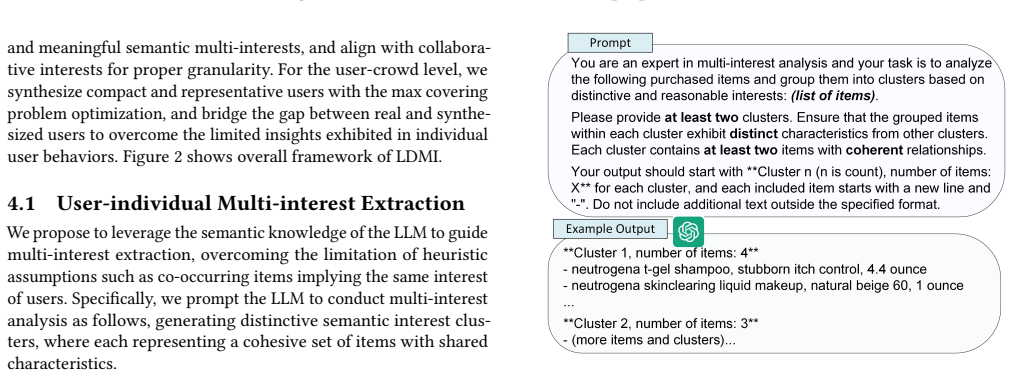
The load-bearing mechanism is a two-level pipeline around a frozen LLM used as an extractor. At the user-individual level, a prompt asks the LLM to divide the user's interacted items into semantic clusters $\mathcal{C}^i_1,\dots,\mathcal{C}^i_F$; each cluster is summarized by attention-weighted item embeddings $\boldsymbol{h}^i_f$, and an attention projection layer assigns these clusters to the $K$ collaborative interest capsules $\boldsymbol{m}^i_k$ produced by a capsule network over global user-item interactions, yielding hybrid interest vectors $\boldsymbol{o}^i_k = \boldsymbol{m}^i_k + \boldsymbol{z}^i_k$. This alignment is what adjusts the LLM's agnostic granularity. At the user-crowd level, users with overlapping behavior are merged into cliques to form synthesized users, a max covering problem selects the most representative of these, the LLM analyzes the selected synthesized users' item sets, and a contrastive loss treats items in the same LLM cluster as positives and other items as hard negatives to disentangle item representations globally.
What would settle it
Run the same user sequences through the LLM prompt several times and compute cluster stability (for example, adjusted Rand index), then replace the real clusters in LDMI with one unstable run and with a random partition of items; if random partitions close the gap to the full model, or if accuracy is flat across cluster stability, the semantic-supervision mechanism is not the cause of the reported gains.
Extended reading notes
Core claim
On the paper's own terms, the central discovery is that LDMI consistently outperforms existing single-interest, multi-interest, and LLM-based baselines on all three Amazon datasets (Beauty, Book, Game) across Recall@20/50, Hit@20/50, and NDCG@20/50, with t-test significance at $p \le 0.01$. The ablation study supports the author's causal story: removing the LLM semantic clusters hurts most, removing the collaborative interest branch also degrades performance, and dropping either the compactness or representativeness rule for synthesized users weakens the crowd-level benefit. A case-study heatmap shows the learned interests are more balanced and less collapsed than those of the MIND baseline, which the paper presents as qualitative evidence that the LLM guidance produces discriminated, item-balanced interest facets.
Load-bearing premise
The claim stands on the assumption that GPT-4o's groupings of item titles are semantically accurate and stable enough to supervise interest learning; the paper does not measure the raw LLM clusters' quality or consistency, only the final model's outputs.
Editorial extensions
If this is right
- A recommender can use a commercial LLM as a zero-parameter semantic extractor, prompting it once offline while the learned recommender handles serving with no online LLM latency.
- The alignment module makes the number of interest facets a user-level parameter: over-fine LLM clusters get merged and over-coarse clusters get sharpened, so a single fixed $K$ works across datasets.
- Aggregating users into synthesized users with a max-covering selection gives the LLM denser behavior sequences, which should help in cold-start and sparse-history settings where individual sequences are too short.
- Contrastive learning on synthesized users' clusters provides a global view of item relationships that co-occurrence-based item partitioning alone cannot see.
Reading between the lines
- We infer that the paper's untested dependence is the quality of the raw LLM clusters: only the final model, not the GPT-4o groupings, is evaluated, so the ceiling of LDMI is set by how consistently the LLM clusters item titles; repeated runs of the prompt and a stability metric would make that clear.
- We infer that because the max-covering objective weights popular items more heavily, the method likely biases coverage toward head items; re-weighting by inverse frequency would reveal how much of the gain comes from niche-interest coverage.
- We infer that the dual-level recipe (LLM semantics on sparse instances plus max-covering aggregation into dense pseudo-instances) transfers to other tasks that use an LLM as a per-instance annotator or feature extractor.
Editorial analysis
A structured set of objections, weighed in public.
Referee Report
Summary. The paper proposes LDMI, a dual-level framework for multi-interest sequential recommendation. At the user-individual level, GPT-4o is prompted to group each user's engaged items into semantic clusters (Eq. 4); these clusters are then aligned with collaborative interest capsules learned by a capsule network (Eqs. 5-7), producing hybrid interest representations. At the user-crowd level, similar users are aggregated into cliques, a max covering problem is solved to select a small set of representative synthesized users with rich behaviors (Eqs. 8-11), GPT-4o re-clusters those synthesized behaviors (Eq. 12), and a contrastive loss (Eq. 13) encourages intra-cluster concentration and inter-cluster dispersion. The final objective combines a recommendation loss with the contrastive loss (Eqs. 14-16). Experiments on three Amazon datasets (Beauty, Book, Game) compare LDMI against single-interest, multi-interest, and LLM-based baselines, with ablations, hyperparameter analysis, and a qualitative case study.
Significance. If the empirical claims hold, LDMI is a credible state-of-the-art method for multi-interest sequential recommendation: it shows consistent gains over a broad set of baselines on three public datasets, the ablations align with the proposed design, and the crowd-level synthesis plus alignment mechanism is a genuine extension beyond prior LLM-as-extractor and multi-interest work. The paper also provides a useful complexity analysis and a qualitative case study. No code or data is released, so reproducibility depends on the completeness of the experimental description, which is currently incomplete on two load-bearing points: the exact negative-sampling protocol in the recommendation loss and the statistical evidence for the claimed significance. The strongest structural weakness is the lack of any direct validation of the GPT-4o cluster assignments themselves, which are the semantic supervision for both levels of the framework.
major comments (4)
- [§4.3, Eq. (15), and Table 2] The InfoNCE objective in Eq. (15) sums the denominator over the full item vocabulary V, but with |V| ranging from 27,456 to 361,002 and batch size 128 no implementation can compute this exactly; the paper does not state whether in-batch negatives, sampled softmax, or a fixed negative pool is used, nor how many negatives are drawn. This is not merely a reproducibility detail: the choice of negative distribution changes the learned representations and can affect the relative ranking of methods. In addition, Section 5.1.2 says results are averages of five runs for a significance test, but Table 2 reports neither standard deviations nor p-values, so the claimed t-test significance at p ≤ 0.01 cannot be verified. Please report variances or confidence intervals, the exact test procedure, and the negative-sampling protocol.
- [§4.1 Eq. (4), §4.2 Eq. (12), §5.2.4] The LLM cluster assignments C_i^f and C'^i_f are used as semantic supervision for the alignment module (Eqs. 5-7) and for the positive/negative partitions in the crowd contrastive loss (Eq. 13), but the paper offers no quantitative evidence that these GPT-4o clusters are accurate or stable. The w/o-sem ablation removes all semantic modeling and therefore only shows that some semantic signal helps; it cannot distinguish well-formed LLM clusters from noisy or title-superficial groupings. The only qualitative evidence, Fig. 5, visualizes the final learned interest-item similarities, not the raw LLM clusters. I ask for a direct control: permute the LLM cluster assignments randomly while preserving cluster sizes and re-run LDMI; if performance degrades substantially, the LLM-specific assignments are load-bearing. Also report agreement of LLM clusters with co-purchase or co-occurrence statistics, or a small human evaluation of cluster quality, and run the LLM at least a few times to assess stability.
- [§4.2, Eqs. (9)-(13)] There is a mismatch in the treatment of overlapping clusters. Section 4.2 states 'We allow items to belong to multiple interest clusters,' but Eq. (13) defines C'(v_j) as the cluster that contains item v_j and partitions the synthesized user's items into positives (same cluster) and negatives (all other items outside C'(v_j)). If an item belongs to several clusters, C'(v_j) is ambiguous and the positive/negative sets are not well-defined. Please either enforce disjoint clusters for the contrastive objective or define the positive and negative sets explicitly under overlapping assignments, for instance by treating all co-clustered items as positives and all items sharing no cluster as negatives.
- [§4.2, Fig. 4(c), §5.1.4] The MCP component relies on the neural solver of [45], but the paper does not say whether this solver is retrained on the synthesized-user/item matrices or applied as a pretrained one-shot model, and no validation of solution quality is given. The matrices here are large and sparse (up to 99,101 synthesized users and 361,002 items), while [45] was evaluated on synthetic instances; distribution shift could make the selected set B unrepresentative. Please state the training status of the solver and report at least the achieved coverage relative to a greedy or LP upper bound, in addition to the end-task comparison with L-gre. Relatedly, the w/o-com ablation is underspecified: it 'removes the compactness rule' but does not say what replaces clique construction from similar users, so the reader cannot tell exactly what is being removed.
minor comments (5)
- [§5.2.4] In the case study text, 'LMDI' should be 'LDMI' (two occurrences).
- [Table 2 and §5.1.3] The baseline is called 'LB4Rec' in Section 5.1.3 but 'LLMBRec' in Table 2; please use one consistent name.
- [§3, Eq. (2)] The phrase 'the the routing weight' contains a duplicated article; also, in Section 1, 'their multi-interests' should be 'their multi-interests' without the misplaced apostrophe in the full text.
- [Table 3] The ablation study is reported only on Beauty; a sentence explaining why Book and Game are omitted, or the corresponding tables in an appendix, would make the ablation claim easier to assess.
- [§4.2, Eq. (8)] The construction of N(u_i), the set of users with the most overlapped behaviors, is not defined precisely (how many users, which overlap measure, and what happens with ties); this also affects the claimed O(M^2) complexity for the MCP stage.
Circularity Check
No circular derivation: LDMI's recommendation and contrastive losses are supervised by external next-item labels; the sole self-citation (DisMIR) is a baseline, not a load-bearing premise.
full rationale
The paper's claimed derivation chain is not circular. The method trains a supervised multi-task model: LLM semantic cluster assignments are produced from item titles in Eq. (4) and Eq. (12); Eq. (5)-(7) align these clusters with capsule-network collaborative interests; Eq. (14)-(15) define a standard InfoNCE ranking loss against held-out next-item labels; Eq. (13) and Eq. (16) add contrastive learning on synthesized users. No fitted parameter is defined in terms of the evaluation target, and no equation reduces to its own fitted constants: the LLM clusters are input features, not quantities fitted to the recommendation labels. The ablation w/o-sem removes semantic modeling rather than fitting a semantic parameter, so it does not create a circular prediction. The only self-citation is the authors' DisMIR [11], used as a related method and as a baseline in Table 2; it is not the premise of LDMI's design, its alignment module, its crowd-level synthesis, or its evaluation. The empirical claim is benchmarked on public Amazon datasets against external baselines, so by hard rule 4 the citation is not load-bearing. A score of 1 reflects the presence of a minor self-citation without any circular dependency; the central derivation is self-contained against external benchmarks.
Assumptions & free parameters
free parameters (4)
- number of interest capsules K =
4 (validated over {2,4,6,8})
- crowd loss weight lambda =
0.01 with update interval floor(1/lambda)=100
- contrastive temperature tau =
0.1
- MCP cardinality Z =
not reported
assumptions (5)
- domain assumption GPT-4o returns meaningfully correct and stable semantic clusters from item titles alone.
- domain assumption Users with the most overlapped behavior have compact, interest-coherent cliques.
- domain assumption Item popularity is a valid value function for coverage in the MCP.
- ad hoc to paper The pretrained neural MCP solver from [45] transfers to this item-coverage instance without retraining.
- standard math Standard deep learning assumptions for capsule routing, attention, and InfoNCE losses hold.
Cite this review
Pith. "Pith review of LLM-Driven Dual-Level Multi-Interest Modeling for Recommendation." pith.science (2026). https://pith.science/paper/AG4DKXZF
@misc{pith2026250710917,
  author       = {Pith},
  title        = {Pith review of: LLM-Driven Dual-Level Multi-Interest Modeling for Recommendation},
  year         = {2026},
  howpublished = {\url{https://pith.science/paper/AG4DKXZF}},
  note         = {Machine review of arXiv:2507.10917}
}
read the original abstract
Recently, much effort has been devoted to modeling users' multi-interests based on their behaviors or auxiliary signals. However, existing methods often rely on heuristic assumptions, e.g., co-occurring items indicate the same interest of users, failing to capture user multi-interests aligning with real-world scenarios. While large language models (LLMs) show significant potential for multi-interest analysis due to their extensive knowledge and powerful reasoning capabilities, two key challenges remain. First, the granularity of LLM-driven multi-interests is agnostic, possibly leading to overly fine or coarse interest grouping. Second, individual user analysis provides limited insights due to the data sparsity issue. In this paper, we propose an LLM-driven dual-level multi-interest modeling framework for more effective recommendation. At the user-individual level, we exploit LLMs to flexibly allocate items engaged by users into different semantic clusters, indicating their diverse and distinct interests. To alleviate the agnostic generation of LLMs, we adaptively assign these semantic clusters to users' collaborative multi-interests learned from global user-item interactions, allowing the granularity to be automatically adjusted according to the user's behaviors using an alignment module. To alleviate the limited insights derived from individual users' behaviors, at the user-crowd level, we propose aggregating user cliques into synthesized users with rich behaviors for more comprehensive LLM-driven multi-interest analysis. We formulate a max covering problem to ensure the compactness and representativeness of synthesized users' behaviors, and then conduct contrastive learning based on their LLM-driven multi-interests to disentangle item representations among different interests. Experiments on real-world datasets show the superiority of our approach against state-of-the-art methods.
Figures


Figures from the paper (2 more)


Reference graph
Works this paper leans on
-
[45]
Xubin Ren, Wei Wei, Lianghao Xia, Lixin Su, Suqi Cheng, Junfeng Wang, Dawei Yin, and Chao Huang. 2024. RLMRec: Representation Learning with Large Lan- guage Models for Recommendation. In Proceedings of the ACM on Web Conference 2024 (TheWebConf). 3464–3475
work page 2024
-
[1]
Ting Bai, Jian-Yun Nie, Wayne Xin Zhao, Yutao Zhu, Pan Du, and Ji-Rong Wen
-
[2]
Keqin Bao, Jizhi Zhang, Yang Zhang, Wenjie Wang, Fuli Feng, and Xiangnan He
-
[3]
Yukuo Cen, Jianwei Zhang, Xu Zou, Chang Zhou, Hongxia Yang, and Jie Tang
-
[4]
Zheng Chai, Zhihong Chen, Chenliang Li, Rong Xiao, Houyi Li, Jiawei Wu, Jingxu Chen, and Haihong Tang. 2022. User-Aware Multi-Interest Learning for Candidate Matching in Recommenders. In Proceedings of the 45th International ACM SIGIR Conference on Research and Development in Information Retrieval (SIGIR). 1326–1335
work page 2022
-
[5]
Gaode Chen, Xinghua Zhang, Yanyan Zhao, Cong Xue, and Ji Xiang. 2021. Ex- ploring Periodicity and Interactivity in Multi-Interest Framework for Sequential Recommendation.. In Proceedings of the 30th International Joint Conference on Artificial Intelligence (IJCAI). 1426–1433
work page 2021
-
[6]
Hong Chen, Yudong Chen, Xin Wang, Ruobing Xie, Rui Wang, Feng Xia, and Wenwu Zhu. 2021. Curriculum disentangled recommendation with noisy multi- feedback. Advances in Neural Information Processing Systems (NeurIPS) 34 (2021), 26924–26936
work page 2021
-
[7]
Sunhao Dai, Ninglu Shao, Haiyuan Zhao, Weijie Yu, Zihua Si, Chen Xu, Zhongx- iang Sun, Xiao Zhang, and Jun Xu. 2023. Uncovering ChatGPT’s Capabilities in Recommender Systems. In Proceedings of the 17th ACM Conference on Recom- mender Systems (RecSys). 1126–1132
work page 2023
Show all 66 references
-
[8]
Sunhao Dai, Ninglu Shao, Jieming Zhu, Xiao Zhang, Zhenhua Dong, Jun Xu, Quanyu Dai, and Ji-Rong Wen. 2024. Modeling User Attention in Music Rec- ommendation. In 2024 IEEE 40th International Conference on Data Engineering (ICDE). 761–774
2024
-
[9]
Yingpeng Du, Hongzhi Liu, and Zhonghai Wu. 2021. Modeling multi-factor and multi-faceted preferences over sequential networks for next item recommenda- tion. In Machine Learning and Knowledge Discovery in Databases. Research Track: European Conference, ECML PKDD 2021, Spain, 2...
2021
-
[10]
Yingpeng Du, Di Luo, Rui Yan, Xiaopei Wang, Hongzhi Liu, Hengshu Zhu, Yang Song, and Jie Zhang. 2024. Enhancing Job Recommendation through LLM-Based Generative Adversarial Networks.Proceedings of the AAAI Conference on Artificial Intelligence (AAAI) (2024), 8363–8371
2024
-
[11]
Yingpeng Du, Ziyan Wang, Zhu Sun, Yining Ma, Hongzhi Liu, and Jie Zhang
-
[12]
Shijie Geng, Shuchang Liu, Zuohui Fu, Yingqiang Ge, and Yongfeng Zhang. 2022. Recommendation as Language Processing (RLP): A Unified Pretrain, Personalized Prompt & Predict Paradigm (P5). In Proceedings of the 16th ACM Conference on Recommender Systems (RecSys). 299–315
2022
-
[13]
Shijie Geng, Shuchang Liu, Zuohui Fu, Yingqiang Ge, and Yongfeng Zhang. 2022. Recommendation as Language Processing (RLP): A Unified Pretrain, Personalized Prompt & Predict Paradigm (p5). In Proceedings of the 16th ACM Conference on Recommender Systems (RecSys). 299–315
2022
-
[14]
Will Hamilton, Zhitao Ying, and Jure Leskovec. 2017. Inductive representation learning on large graphs. Advances in Neural Information Processing Systems (NeurIPS) 30 (2017)
2017
-
[15]
Jesse Harte, Wouter Zorgdrager, Panos Louridas, Asterios Katsifodimos, Diet- mar Jannach, and Marios Fragkoulis. 2023. Leveraging Large Language Models for Sequential Recommendation. In Proceedings of the 17th ACM Conference on Recommender Systems (RecSys)
2023
-
[16]
Xiangnan He, Kuan Deng, Xiang Wang, Yan Li, Yongdong Zhang, and Meng Wang. 2020. Lightgcn: Simplifying and powering graph convolution network for recommendation. In Proceedings of the 43rd International ACM SIGIR conference on research and development in Information Retrieval ...
2020
-
[17]
Xiangnan He, Lizi Liao, Hanwang Zhang, Liqiang Nie, Xia Hu, and Tat-Seng Chua. 2017. Neural Collaborative Filtering. InProceedings of the 26th International Conference on World Wide Web (WWW) . 173–182
2017
-
[18]
Balazs Hidasi, Alexandros Karatzoglou, Linas Baltrunas, and Domonkos Tikk
-
[19]
Yupeng Hou, Shanlei Mu, Wayne Xin Zhao, Yaliang Li, Bolin Ding, and Ji-Rong Wen. 2022. Towards Universal Sequence Representation Learning for Recom- mender Systems. InProceedings of the 28th ACM SIGKDD Conference on Knowledge Discovery and Data Mining (KDD) . 585–593
2022
-
[20]
Yupeng Hou, Junjie Zhang, Zihan Lin, Hongyu Lu, Ruobing Xie, Julian McAuley, and Wayne Xin Zhao. 2024. Large Language Models are Zero-Shot Rankers for Recommender Systems. In European Conference on Information Retrieval (ECIR) . 364–381
2024
-
[21]
Edward J Hu, Yelong Shen, Phillip Wallis, Zeyuan Allen-Zhu, Yuanzhi Li, Shean Wang, Lu Wang, and Weizhu Chen. 2022. LoRA: Low-Rank Adaptation of Large Language Models. In International Conference on Learning Representations (ICLR)
2022
-
[22]
Lee Jaeri, Yun Jeongin, and Kang U. 2024. BAM: Enhancing Recommendation with Backward-Aware Mechanisms. In Proceedings of the 30th ACM SIGKDD Conference on Knowledge Discovery and Data Mining (KDD)
2024
-
[23]
Jianchao Ji, Zelong Li, Shuyuan Xu, Wenyue Hua, Yingqiang Ge, Juntao Tan, and Yongfeng Zhang. 2024. GenRec: Large Language Model for Generative Recommendation. In European Conference on Information Retrieval (ECIR) . 494– 502
2024
-
[24]
Wang-Cheng Kang and Julian McAuley. 2018. Self-Attentive Sequential Rec- ommendation. In 2018 IEEE International Conference on Data Mining (ICDM) . 197–206
2018
-
[25]
Samir Khuller, Anna Moss, and Joseph Seffi Naor. 1999. The budgeted maximum coverage problem. Information processing letters 70, 1 (1999), 39–45
1999
-
[26]
Chao Li, Zhiyuan Liu, Mengmeng Wu, Yuchi Xu, Huan Zhao, Pipei Huang, Guoliang Kang, Qiwei Chen, Wei Li, and Dik Lun Lee. 2019. Multi-Interest Network with Dynamic Routing for Recommendation at Tmall. In Proceedings of the 28th ACM International Conference on Information and Kn...
2019
-
[27]
Jing Li, Pengjie Ren, Zhumin Chen, Zhaochun Ren, Tao Lian, and Jun Ma. 2017. Neural Attentive Session-based Recommendation. In Proceedings of the 26th ACM International Conference on Information and Knowledge Management (CIKM) . 1419–1428
2017
-
[28]
Xinyu Lin, Wenjie Wang, Yongqi Li, Fuli Feng, See-Kiong Ng, and Tat-Seng Chua. 2024. Bridging Items and Language: A Transition Paradigm for Large Language Model-Based Recommendation. InProceedings of the 30th ACM SIGKDD Conference on Knowledge Discovery and Data Mining (KDD) ....
2024
-
[29]
Danyang Liu, Yuji Yang, Mengdi Zhang, Wei Wu, Xing Xie, and Guangzhong Sun. 2022. Knowledge Enhanced Multi-Interest Network for the Generation of Recommendation Candidates. In Proceedings of the 31st ACM International Conference on Information & Knowledge Management (CIKM) . 3322–3331
2022
-
[30]
Qijiong Liu, Nuo Chen, Tetsuya Sakai, and Xiao-Ming Wu. 2024. ONCE: Boosting Content-based Recommendation with Both Open- and Closed-source Large Language Models. In Proceedings of the 17th ACM International Conference on Web Search and Data Mining (WSDM) . 452–461
2024
-
[31]
Qijiong Liu, Nuo Chen, Tetsuya Sakai, and Xiao-Ming Wu. 2024. Once: Boosting Content-based Recommendation with Both Open-and Closed-source Large Lan- guage Models. In Proceedings of the 17th ACM International Conference on Web Search and Data Mining (WSDM) . 452–461
2024
-
[32]
Yaokun Liu, Xiaowang Zhang, Minghui Zou, and Zhiyong Feng. 2024. Attribute Simulation for Item Embedding Enhancement in Multi-interest Recommendation. In Proceedings of the 17th ACM International Conference on Web Search and Data Mining (WSDM). 482–491
2024
-
[33]
Jianxin Ma, Chang Zhou, Hongxia Yang, Peng Cui, Xin Wang, and Wenwu Zhu
-
[34]
Chang Meng, Ziqi Zhao, Wei Guo, Yingxue Zhang, Haolun Wu, Chen Gao, Dong Li, Xiu Li, and Ruiming Tang. 2023. Coarse-to-fine knowledge-enhanced multi-interest learning framework for multi-behavior recommendation. ACM Transactions on Information Systems (TIS) 42, 1 (2023), 1–27
2023
-
[35]
Jianmo Ni, Jiacheng Li, and Julian McAuley. 2019. Justifying Recommendations using Distantly-Labeled Reviews and Fine-Grained Aspects. In Proceedings of the 2019 Conference on Empirical Methods in Natural Language Processing and the 9th International Joint Conference on Natura...
2019
-
[36]
Shutong Qiao, Chen Gao, Yong Li, and Hongzhi Yin. 2024. LLM-assisted Explicit and Implicit Multi-interest Learning Framework for Sequential Recommendation. arXiv preprint arXiv:2411.09410 (2024)
2024 arXiv
-
[37]
Zhaopeng Qiu, Xian Wu, Jingyue Gao, and Wei Fan. 2021. U-BERT: Pre-training user representations for improved recommendation. In Proceedings of the AAAI Conference on Artificial Intelligence (AAAI), Vol. 35. 4320–4327
2021
-
[38]
Zekai Qu, Ruobing Xie, Chaojun Xiao, Zhanhui Kang, and Xingwu Sun. 2024. The Elephant in the Room: Rethinking the Usage of Pre-trained Language Model in Sequential Recommendation. In Proceedings of the 18th ACM Conference on Recommender Systems (RecSys). 53–62
2024
-
[39]
In Proceedings of the 26th ACM SIGKDD International Conference on Knowledge Discovery & Data Mining (KDD)
Disentangled Self-Supervision in Sequential Recommenders. In Proceedings of the 26th ACM SIGKDD International Conference on Knowledge Discovery & Data Mining (KDD). 483–491
-
[40]
Sara Sabour, Nicholas Frosst, and Geoffrey E. Hinton. 2017. Dynamic routing between capsules. In Proceedings of the 31st International Conference on Neural Information Processing Systems (NeurIPS) . 3859–3869
2017
-
[41]
Scott Sanner, Krisztian Balog, Filip Radlinski, Ben Wedin, and Lucas Dixon. 2023. Large Language Models are Competitive Near Cold-start Recommenders for Language- and Item-based Preferences. InProceedings of the 17th ACM Conference on Recommender Systems (RecSys) . 890–896
2023
-
[42]
Fei Sun, Jun Liu, Jian Wu, Changhua Pei, Xiao Lin, Wenwu Ou, and Peng Jiang
-
[43]
Youchen Sun, Zhu Sun, Xiao Sha, Jie Zhang, and Yew Soon Ong. 2023. Disentan- gling Motives behind Item Consumption and Social Connection for Mutually- enhanced Joint Prediction. In Proceedings of the 17th ACM Conference on Recom- mender Systems (RecSys). 613–624
2023
-
[44]
Yu Tian, Jianxin Chang, Yanan Niu, Yang Song, and Chenliang Li. 2022. When Multi-Level Meets Multi-Interest: A Multi-Grained Neural Model for Sequential Recommendation. In Proceedings of the 45th International ACM SIGIR Conference on Research and Development in Information Ret...
2022
-
[46]
Xin Wang, Hong Chen, Yuwei Zhou, Jianxin Ma, and Wenwu Zhu. 2022. Dis- entangled representation learning for recommendation. IEEE Transactions on Pattern Analysis and Machine Intelligence (TPAMI) 45, 1 (2022), 408–424
2022
-
[47]
Xin Wang, Hong Chen, and Wenwu Zhu. 2021. Multimodal disentangled represen- tation for recommendation. In 2021 IEEE International Conference on Multimedia and Expo (ICME). IEEE, 1–6
2021
-
[48]
Yancheng Wang, Ziyan Jiang, Zheng Chen, Fan Yang, Yingxue Zhou, Eunah Cho, Xing Fan, Yanbin Lu, Xiaojiang Huang, and Yingzhen Yang. 2024. RecMind: Large Language Model Powered Agent For Recommendation. In Findings of the Association for Computational Linguistics: NAACL 2024
2024
-
[49]
Yuling Wang, Xiao Wang, Xiangzhou Huang, Yanhua Yu, Haoyang Li, Mengdi Zhang, Zirui Guo, and Wei Wu. 2023. Intent-aware recommendation via disen- tangled graph contrastive learning. In Proceedings of the 32nd International Joint Conference on Artificial Intelligence (IJCAI) . ...
2023
-
[50]
Wei Wei, Xubin Ren, Jiabin Tang, Qinyong Wang, Lixin Su, Suqi Cheng, Junfeng Wang, Dawei Yin, and Chao Huang. 2024. LLMRec: Large Language Models with Graph Augmentation for Recommendation. In Proceedings of the 17th ACM International Conference on Web Search and Data Mining (...
2024
-
[51]
Likang Wu, Zhi Zheng, Zhaopeng Qiu, Hao Wang, Hongchao Gu, Tingjia Shen, Chuan Qin, Chen Zhu, Hengshu Zhu, Qi Liu, Hui Xiong, and Enhong Chen. 2024. A survey on large language models for recommendation. World Wide Web 27 (2024), 60
2024
-
[52]
Runzhong Wang, Li Shen, Yiting Chen, Xiaokang Yang, Dacheng Tao, and Junchi Yan. 2022. Towards one-shot neural combinatorial solvers: Theoretical and empirical notes on the cardinality-constrained case. In The 11th International Conference on Learning Representations (ICLR)
2022
-
[53]
Xu Xie, Fei Sun, Zhaoyang Liu, Shiwen Wu, Jinyang Gao, Jiandong Zhang, Bolin Ding, and Bin Cui. 2022. Contrastive Learning for Sequential Recommendation. In IEEE 38th International Conference on Data Engineering (ICDE) . 1259–1273
2022
-
[54]
Yueqi Xie, Jingqi Gao, Peilin Zhou, Qichen Ye, Yining Hua, Jae Boum Kim, Fangzhao Wu, and Sunghun Kim. 2023. Rethinking Multi-Interest Learning for Candidate Matching in Recommender Systems. In Proceedings of the 17th ACM Conference on Recommender Systems (RecSys) . 283–293
2023
-
[55]
Qianru Zhang, Lianghao Xia, Xuheng Cai, Siu-Ming Yiu, Chao Huang, and Christian S. Jensen. 2024. Graph Augmentation for Recommendation. In IEEE 40th International Conference on Data Engineering (ICDE) . 557–569
2024
-
[56]
Shengyu Zhang, Lingxiao Yang, Dong Yao, Yujie Lu, Fuli Feng, Zhou Zhao, Tat-Seng Chua, and Fei Wu. 2022. Re4: Learning to Re-contrast, Re-attend, Re-construct for Multi-interest Recommendation. In The ACM Web Conference (TheWebConf). 2216–2226
2022
-
[57]
Sheng, and Xiaofang Zhou
Jing Zhao, Pengpeng Zhao, Lei Zhao, Yanchi Liu, Victor S. Sheng, and Xiaofang Zhou. 2021. Variational Self-attention Network for Sequential Recommendation. In IEEE 37th International Conference on Data Engineering (ICDE) . 1559–1570
2021
-
[58]
Zhi Zheng, Zhaopeng Qiu, Xiao Hu, Likang Wu, Hengshu Zhu, and Hui Xiong
-
[59]
Zhibo Xiao, Luwei Yang, Wen Jiang, Yi Wei, Yi Hu, and Hao Wang. 2020. Deep Multi-Interest Network for Click-through Rate Prediction. In Proceedings of the 29th ACM International Conference on Information & Knowledge Management (CIKM). 2265–2268
2020
-
[66]
arXiv preprint arXiv:2307.02157 (2023)
Generative Job Recommendations with Large Language Model. arXiv preprint arXiv:2307.02157 (2023)
2023 arXiv
-
[2016]
In Inter- national Conference on Learning Representations (ICLR)
Session-based recommendations with recurrent neural networks. In Inter- national Conference on Learning Representations (ICLR)
-
[2018]
In The 41st International ACM SIGIR Conference on Research & Development in Information Retrieval (SIGIR)
An Attribute-aware Neural Attentive Model for Next Basket Recommenda- tion. In The 41st International ACM SIGIR Conference on Research & Development in Information Retrieval (SIGIR) . 1201–1204
-
[2019]
In Proceedings of the 28th ACM International Conference on Information and Knowledge Management (CIKM)
BERT4Rec: Sequential Recommendation with Bidirectional Encoder Rep- resentations from Transformer. In Proceedings of the 28th ACM International Conference on Information and Knowledge Management (CIKM) . 1441–1450
-
[2020]
InProceedings of the 26th ACM SIGKDD International Conference on Knowledge Discovery & Data Mining (KDD)
Controllable Multi-Interest Framework for Recommendation. InProceedings of the 26th ACM SIGKDD International Conference on Knowledge Discovery & Data Mining (KDD). 2942–2951
-
[2023]
In Proceedings of the 17th ACM Conference on Recommender Systems (RecSys)
TALLRec:An Effective and Efficient Tuning Framework to Align Large Lan- guage Model with Recommendation. In Proceedings of the 17th ACM Conference on Recommender Systems (RecSys) . 1007–1014
-
[2024]
In Proceedings of the 30th ACM SIGKDD Conference on Knowledge Discovery and Data Mining (KDD)
Disentangled Multi-interest Representation Learning for Sequential Rec- ommendation. In Proceedings of the 30th ACM SIGKDD Conference on Knowledge Discovery and Data Mining (KDD) . 677–688
Reviewed August 6, 2026 · model on record in the stance chip above.
Discussion (0). Continue with ORCID to comment.