Stable Positive Integral Deferred Correction Methods for Positive Dynamical Systems
Pith reviewed 2026-06-30 01:58 UTC · model grok-4.3
The pith
SPIDeC methods embed deferred correction inside an exponential Volterra reformulation to preserve positivity and equilibria unconditionally.
A machine-rendered reading of the paper's core claim, the machinery that carries it, and where it could break.
Core claim
The SPIDeC methods achieve unconditional preservation of positivity and equilibria through a multiplicative structure that arises when an exponential-type Volterra reformulation of the differential problem is combined with deferred correction sweeps; this structure is maintained at every correction stage and holds independently of the integration stepsize while still permitting arbitrarily high-order accuracy.
What carries the argument
The exponential-type Volterra reformulation of the ODE, which produces a multiplicative positivity-preserving structure that deferred corrections can exploit without breaking invariance.
If this is right
- Arbitrarily high-order accuracy follows from repeated explicit-in-sweep corrections applied to the base approximation.
- The integrators are L-stable and exactly reproduce the continuous semigroup generated by any diagonal linear operator.
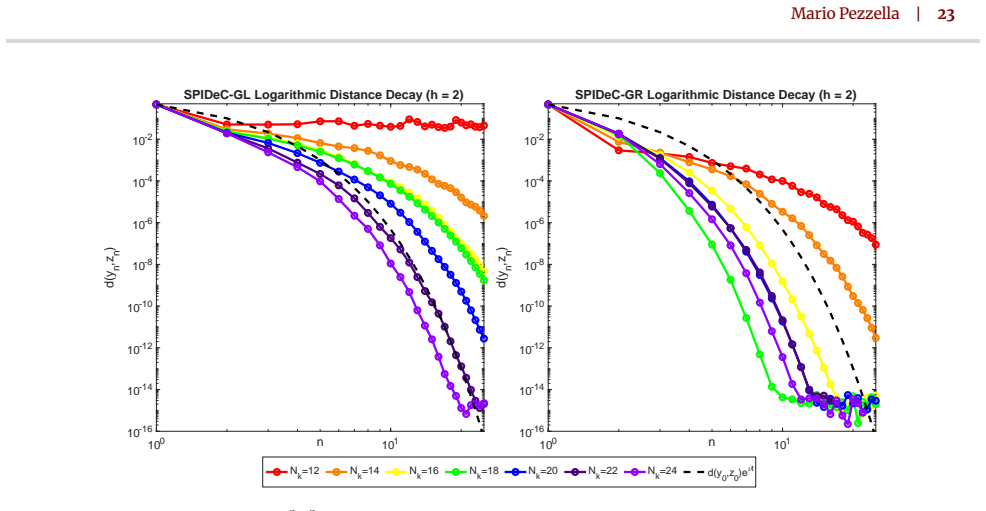
- When Gauss-Radau quadrature nodes are used, the discrete flow approaches a logarithmically contractive map as the number of sweeps grows.
Where Pith is reading between the lines
- The same reformulation-plus-correction pattern may extend directly to nonlinear positive systems provided the Volterra step remains valid.
- In applications such as chemical kinetics or population models, these methods could remove the need for stepsize restrictions that current positivity-preserving schemes often impose.
- A direct comparison on stiff positive test problems would reveal whether the logarithmic contractivity property improves long-time behavior over standard implicit Runge-Kutta methods.
Load-bearing premise
The differential problem must admit an exponential-type Volterra reformulation whose multiplicative structure survives the deferred correction process.
What would settle it
Apply any SPIDeC method with a large stepsize to a known positive linear system whose exact solution stays positive and check whether the numerical solution ever becomes negative or moves the equilibrium.
Figures
read the original abstract
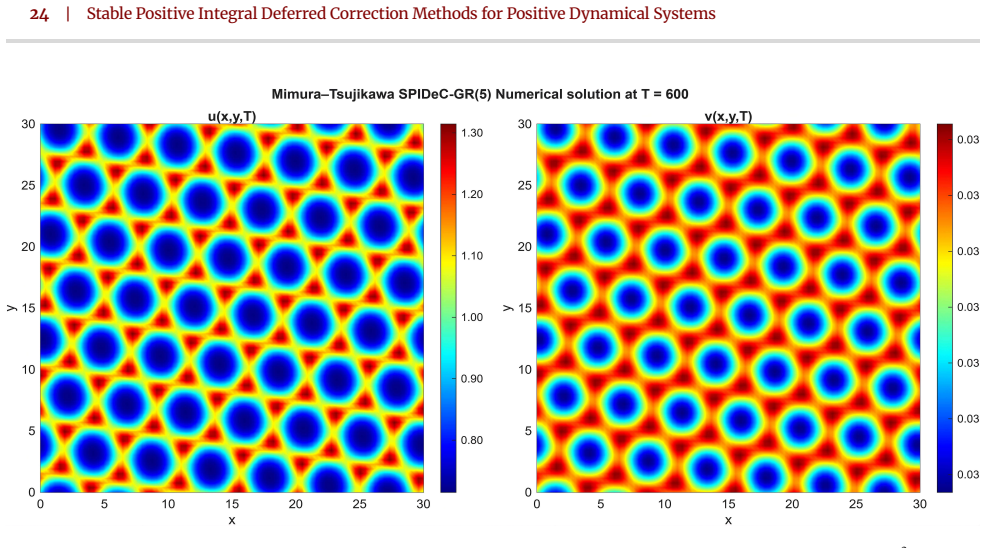
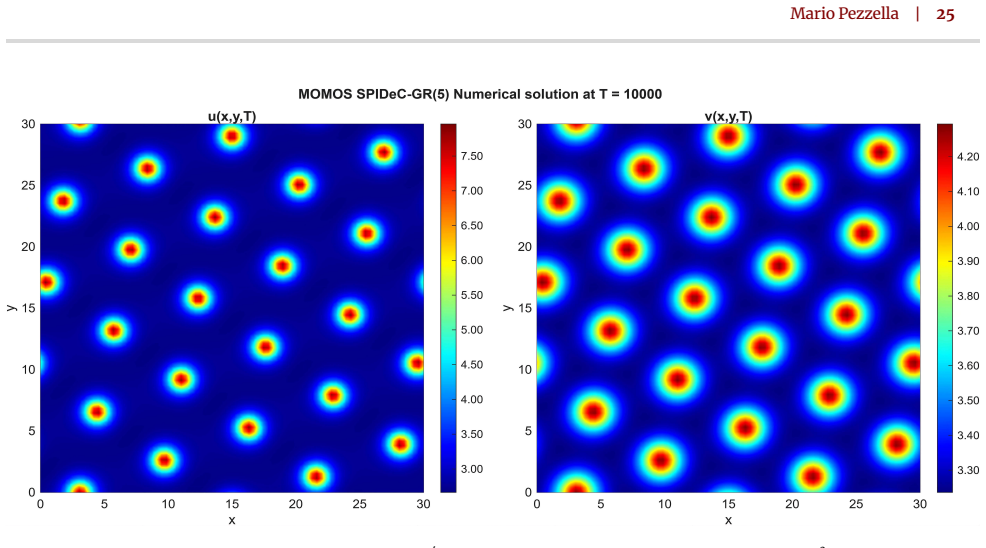
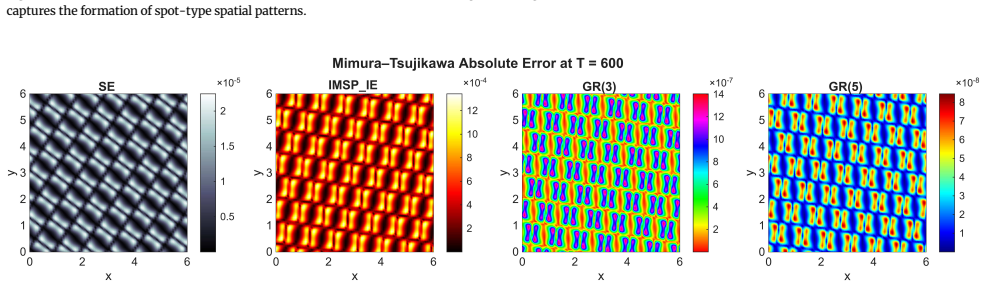
In this paper, we introduce the class of Stable Positive Integral Deferred Correction (SPIDeC) methods for the numerical integration of positive dynamical systems. The proposed framework embeds a deferred correction mechanism within an exponential-type Volterra reformulation of the underlying differential problem. The resulting multiplicative structure guarantees the unconditional preservation of both positivity and equilibria, independently of the integration stepsize. Arbitrarily high-order accuracy is systematically achieved through successive explicit-in-sweep corrections applied to a low-order base approximation. From a stability viewpoint, the SPIDeC integrators are L-stable and exactly reproduce the continuous semigroup generated by diagonal linear operators. Furthermore, when Gauss--Radau quadrature nodes are employed, the associated discrete flow asymptotically approaches a logarithmically contractive map as the number of sweeps increases, ensuring stability. Numerical experiments are provided to validate the theoretical analysis and illustrate the practical performance of the proposed methods.
Editorial analysis
A structured set of objections, weighed in public.
Referee Report
Summary. The paper introduces Stable Positive Integral Deferred Correction (SPIDeC) methods for positive dynamical systems. It embeds deferred correction into an exponential-type Volterra reformulation of the ODE, yielding a multiplicative structure (y = y0 .* exp(∫g)) that preserves positivity and equilibria unconditionally for any stepsize. Arbitrarily high order is obtained via successive explicit-in-sweep corrections from a low-order base scheme. The methods are L-stable, exactly reproduce the continuous semigroup for diagonal linear operators, and become asymptotically logarithmically contractive under Gauss–Radau nodes as the number of sweeps grows. Numerical experiments are presented to support the theoretical claims.
Significance. If the central construction holds, the work offers a systematic way to enforce positivity and equilibrium preservation by design while retaining high-order accuracy and strong stability, which is valuable for stiff positive systems arising in chemical kinetics, epidemiology, and population dynamics. The exact reproduction of equilibria and the multiplicative preservation independent of stepsize are notable strengths; the deferred-correction framework allows order elevation without sacrificing these properties.
minor comments (2)
- [Introduction] The introduction could include a brief forward reference to the specific base integrator (e.g., the low-order method before corrections) to orient readers before the Volterra reformulation is introduced.
- [Stability analysis] In the stability analysis section, the transition from the continuous semigroup reproduction to the discrete logarithmic contractivity could be cross-referenced more explicitly to the quadrature-node choice.
Simulated Author's Rebuttal
We thank the referee for their positive assessment of the manuscript and for recommending acceptance. There are no major comments requiring a point-by-point response.
Circularity Check
No significant circularity detected
full rationale
The derivation introduces a new SPIDeC framework by embedding deferred corrections inside an exponential Volterra reformulation, yielding a multiplicative structure that preserves positivity and equilibria by direct construction of the integrator. No load-bearing step reduces to a fitted parameter renamed as prediction, a self-citation chain, or an ansatz smuggled from prior work; the L-stability and contractivity claims follow from the same explicit multiplicative form without external uniqueness theorems or renamings. The central result is therefore self-contained against the stated assumptions.
Axiom & Free-Parameter Ledger
axioms (1)
- domain assumption The differential problem admits an exponential-type Volterra reformulation whose multiplicative structure supports positivity preservation under deferred corrections.
invented entities (1)
-
SPIDeC integrators
no independent evidence
Reference graph
Works this paper leans on
-
[1]
R. Abgrall. “High Order Schemes for Hyperbolic Problems Using Globally Continuous Approximation and Avoiding Mass Matrices”. In:Journal of Scientific Computing73.2–3 (July 2017), pp. 461–494.issn: 1573-7691. doi:10.1007/s10915-017-0498-4
-
[2]
F. K. Alalhareth, M. Gupta, H. V. Kojouharov, and S. Roy. “Second-Order Modified Nonstandard Explicit Euler and Explicit Runge–Kutta Methods for n-Dimensional Autonomous Differential Equations”. In:Computation 12.9 (2024).doi:10.3390/computation12090183
-
[3]
A second-order nonstandard finite difference scheme for an eco-epidemiological predator-prey model
A. J. Arenas, J. Barajas-Calonge, G. González-Parra, and L. M. Villada. “A second-order nonstandard finite difference scheme for an eco-epidemiological predator-prey model”. In:Journal of Difference Equations and Applications32.6 (2026), pp. 925–959.doi:10.1080/10236198.2026.2638517
-
[4]
Block Operators and Spectral Discretizations
J. L. Aurentz and L. N. Trefethen. “Block Operators and Spectral Discretizations”. In:SIAM Review59.2 (2017), pp. 423–446.doi:10.1137/16M1065975
-
[5]
A. I. Ávila, G. J. González, S. Kopecz, and A. Meister. “Extension of modified Patankar–Runge–Kutta schemes to nonautonomous production–destruction systems based on Oliver’s approach”. In:Journal of Computational and Applied Mathematics389 (2021), p. 113350.issn: 0377-0427.doi: https://doi.org/10.1016/j.cam.2020. 113350
-
[6]
Barycentric Lagrange Interpolation
J.-P . Berrut and L. N. Trefethen. “Barycentric Lagrange Interpolation”. In:SIAM Review46.3 (2004), pp. 501– 517.doi:10.1137/S0036144502417715
-
[7]
Positivity-preserving methods for ordinary differential equations
S. Blanes, A. Iserles, and S. Macnamara. “Positivity-preserving methods for ordinary differential equations”. In:ESAIM: Mathematical Modelling and Numerical Analysis56.6 (Aug. 2022), pp. 1843–1870.issn: 2804-7214. doi:10.1051/m2an/2022042
-
[8]
Conservation de la positivité lors de la discrétisation des problèmes d’évolution paraboliques
C. Bolley and M. Crouzeix. “Conservation de la positivité lors de la discrétisation des problèmes d’évolution paraboliques”. In:RAIRO. Analyse numérique12.3 (1978), pp. 237–245.issn: 0399-0516.doi: 10.1051/m2an/ 1978120302371
-
[9]
H. Burchard, E. Deleersnijder, and A. Meister. “A high-order conservative Patankar-type discretisation for stiff systems of production–destruction equations”. In:Applied Numerical Mathematics47.1 (2003), pp. 1–30. issn: 0168-9274.doi:https://doi.org/10.1016/S0168-9274(03)00101-6
-
[10]
J. C. Butcher.Numerical Methods for Ordinary Differential Equations. Wiley, 2016.isbn: 9781119121534.doi: 10.1002/9781119121534
-
[11]
Modified Patankar Semi-Lagrangian Scheme for the Optimal Control of Production-Destruction Systems
S. Cacace, A. Oliviero, and M. Pezzella. “Modified Patankar Semi-Lagrangian Scheme for the Optimal Control of Production-Destruction Systems”. In:Journal of Scientific Computing106.2 (Jan. 2026).issn: 1573-7691. doi:10.1007/s10915-025-03167-7
-
[12]
An Integro-Differential Model of Cadmium Yellow Photodegradation
M. Ceseri, R. Natalini, and M. Pezzella. “An Integro-Differential Model of Cadmium Yellow Photodegradation”. In:SIAM Journal on Applied Mathematics85.6 (2025), pp. 2591–2610.doi:10.1137/24M1709704
-
[13]
High order nonstandard finite-difference methods
D. Conte, G. Pagano, and T. Roldán. “High order nonstandard finite-difference methods”. In:Applied Mathe- matics and Computation510 (2026), p. 129681.issn: 0096-3003.doi:10.1016/j.amc.2025.129681
-
[14]
Geometric Numerical Integration in Ecological Modelling
F. Diele and C. Marangi. “Geometric Numerical Integration in Ecological Modelling”. In:Mathematics8.1 (2020).issn: 2227-7390.doi:10.3390/math8010025
-
[15]
doi:https://doi.org/10.1016/0771-050X(80)90013-3
J. Dormand and P . Prince. “A family of embedded Runge-Kutta formulae”. In:Journal of Computational and Applied Mathematics6.1 (Mar. 1980), pp. 19–26.issn: 0377-0427.doi:10.1016/0771-050x(80)90013-3
-
[16]
T. A. Driscoll, N. Hale, and L. N. Trefethen, eds.Chebfun Guide. Oxford, UK, 2014. Mario Pezzella | 27
2014
-
[17]
A. Dutt, L. Greengard, and V. Rokhlin. “Spectral Deferred Correction Methods for Ordinary Differential Equations”. In:BIT Numerical Mathematics40.2 (June 2000), pp. 241–266.issn: 1572-9125.doi:10.1023/a: 1022338906936
work page doi:10.1023/a: 2000
-
[18]
Fehlberg.Low-order classical Runge–Kutta formulas with step size control and their application to some heat transfer problems
E. Fehlberg.Low-order classical Runge–Kutta formulas with step size control and their application to some heat transfer problems. Tech. rep. TR R-315. NASA, 1969
1969
-
[19]
Positivity and Conservation Properties of Some Integration Schemes for Mass Action Kinetics
L. Formaggia and A. Scotti. “Positivity and Conservation Properties of Some Integration Schemes for Mass Action Kinetics”. In:SIAM Journal on Numerical Analysis49.3 (Jan. 2011), pp. 1267–1288.issn: 1095-7170.doi: 10.1137/100789592
-
[20]
Equilibria of Runge-Kutta methods
E. Hairer, A. Iserles, and J. M. Sanz-Serna. “Equilibria of Runge-Kutta methods”. In:Numerische Mathematik 58.1 (Dec. 1990), pp. 243–254.issn: 0945-3245.doi:10.1007/bf01385623
-
[21]
E. Hairer, C. Lubich, and G. Wanner.Geometric Numerical Integration: Structure-Preserving Algorithms for Ordi- nary Differential Equations. 2nd ed. Vol. 31. Springer Series in Computational Mathematics. Berlin, Heidelberg: Springer-Verlag, 2006.isbn: 978-3-540-30663-4.doi:10.1007/3-540-30666-8
-
[22]
E. Hairer, S. P . Nørsett, and G. Wanner.Solving Ordinary Differential Equations I. Springer Berlin Heidelberg, 1993.doi:10.1007/978-3-540-78862-1
-
[23]
E. Hairer and G. Wanner.Solving Ordinary Differential Equations II. Springer Berlin Heidelberg, 1996.isbn: 9783642052217.doi:10.1007/978-3-642-05221-7
-
[24]
Mathematical Analysis of a Chemotaxis-Type Model of Soil Carbon Dynamic
A. Hammoudi and O. Iosifescu. “Mathematical Analysis of a Chemotaxis-Type Model of Soil Carbon Dynamic”. In:Chinese Annals of Mathematics, Series B39.2 (Feb. 2018), pp. 253–280.issn: 1860-6261.doi: 10.1007/s11401- 018-1063-7
-
[25]
Weakly coupled systems of quasilinear hyperbolic equations
B. Hanouzet and R. Natalini. “Weakly coupled systems of quasilinear hyperbolic equations”. In:Differential and Integral Equations9.6 (Jan. 1996).issn: 0893-4983.doi:10.57262/die/1367846901
-
[26]
M. T. Hoang. “High-order nonstandard finite difference methods preserving dynamical properties of one- dimensional dynamical systems”. In:Numerical Algorithms98.1 (Mar. 2024), pp. 219–249.issn: 1572-9265. doi:10.1007/s11075-024-01792-1
-
[27]
M. T. Hoang and M. Ehrhardt. “A generalized second-order positivity-preserving numerical method for non-autonomous dynamical systems with applications”. In:Applied Mathematics and Computation524 (2026), p. 130029.issn: 0096-3003.doi:10.1016/j.amc.2026.130029
-
[28]
C. S. Holling. “The Components of Predation as Revealed by a Study of Small-Mammal Predation of the European Pine Sawfly”. In:The Canadian Entomologist91.5 (1959), pp. 293–320.doi:10.4039/Ent91293-5
-
[29]
On the stability of strong-stability-preserving modified Patankar–Runge–Kutta schemes
J. Huang, T. Izgin, S. Kopecz, A. Meister, and C. -W. Shu. “On the stability of strong-stability-preserving modified Patankar–Runge–Kutta schemes”. In:ESAIM: Mathematical Modelling and Numerical Analysis57.2 (Mar. 2023), pp. 1063–1086.issn: 2804-7214.doi:10.1051/m2an/2023005
-
[30]
Spurious solutions of numerical methods for initial value problems
A. R. Humphries. “Spurious solutions of numerical methods for initial value problems”. In:IMA Journal of Numerical Analysis13.2 (Apr. 1993), pp. 263–290.issn: 0272-4979.doi:10.1093/imanum/13.2.263
-
[31]
Iserles.A First Course in the Numerical Analysis of Differential Equations
A. Iserles.A First Course in the Numerical Analysis of Differential Equations. 2nd ed. Cambridge University Press, 2009.doi:10.1017/CBO9780511995569
-
[32]
T. Izgin. “A Boot-Strapping Technique to Design Unconditionally Positive Dense Output Formulae for Modified Patankar-Runge-Kutta Methods”. In:Communications on Applied Mathematics and Computation8.3 (May 2025), pp. 868–892.issn: 2661-8893.doi:10.1007/s42967-025-00480-8
-
[33]
Modified Patankar Linear Multistep Methods for Production- Destruction Systems
G. Izzo, E. Messina, M. Pezzella, and A. Vecchio. “Modified Patankar Linear Multistep Methods for Production- Destruction Systems”. In:Journal of Scientific Computing102.3 (Feb. 2025).issn: 1573-7691.doi: 10.1007/ s10915-025-02804-5
2025
-
[34]
An explicit sixth-order Runge–Kutta formula
H. A. Luther. “An explicit sixth-order Runge–Kutta formula”. In:Mathematics of Computation22.102 (1968), pp. 434–436
1968
-
[35]
E. Messina, M. Pezzella, and A. Vecchio. “A long-time behavior preserving numerical scheme for age-of- infection epidemic models with heterogeneous mixing”. In:Applied Numerical Mathematics200 (2024). New Trends in Approximation Methods and Numerical Analysis (FAATNA20>22), pp. 344–357.issn: 0168-9274. doi:10.1016/j.apnum.2023.04.009
-
[36]
E. Messina, M. Pezzella, and A. Vecchio.A non-standard numerical scheme for an age-of-infection epidemic model. 2022.doi:10.3934/jcd.2021029
-
[37]
Nonlocal finite difference discretization of a class of renewal equation models for epidemics
E. Messina, M. Pezzella, and A. Vecchio. “Nonlocal finite difference discretization of a class of renewal equation models for epidemics”. In:Mathematical Biosciences and Engineering20.7 (2023), pp. 11656–11675.issn: 1551- 0018.doi:10.3934/mbe.2023518. 28 | Stable Positive Integral Deferred Correction Methods for Positive Dynamical Systems
-
[38]
Positive Numerical Approximation of Integro-Differential Epidemic Model
E. Messina, M. Pezzella, and A. Vecchio. “Positive Numerical Approximation of Integro-Differential Epidemic Model”. In:Axioms11.2 (2022).doi:10.3390/axioms11020069
-
[39]
R. E. Mickens.Applications of Nonstandard Finite Difference Schemes. WORLD SCIENTIFIC, Mar. 2000.isbn: 9789812813251.doi:10.1142/4272
-
[40]
Aggregating pattern dynamics in a chemotaxis model including growth
M. Mimura and T. Tsujikawa. “Aggregating pattern dynamics in a chemotaxis model including growth”. In: Physica A: Statistical Mechanics and its Applications230.3 (1996), pp. 499–543.issn: 0378-4371.doi: 10.1016/ 0378-4371(96)00051-9
1996
-
[41]
A. Monti, F. Diele, D. Lacitignola, and C. Marangi. “Patterns in soil organic carbon dynamics: Integrating microbial activity , chemotaxis and data-driven approaches”. In:Mathematics and Computers in Simulation234 (2025), pp. 86–101.issn: 0378-4754.doi:10.1016/j.matcom.2025.02.019
-
[42]
Positivity-preserving adaptive Runge–Kutta methods
S. Nüßlein, H. Ranocha, and D. I. Ketcheson. “Positivity-preserving adaptive Runge–Kutta methods”. In: Communications in Applied Mathematics and Computational Science16.2 (Nov. 2021), pp. 155–179.issn: 1559- 3940.doi:10.2140/camcos.2021.16.155
-
[43]
Arbitrary high-order, conservative and positivity preserving Patankar-type deferred correction schemes
P . Öffner and D. Torlo. “Arbitrary high-order, conservative and positivity preserving Patankar-type deferred correction schemes”. In:Applied Numerical Mathematics153 (2020), pp. 15–34.issn: 0168-9274.doi: 10. 1016/j.apnum.2020.01.025
2020
-
[44]
Deferred Correction Methods for Ordinary Differential Equations
B. W. Ong and R. J. Spiteri. “Deferred Correction Methods for Ordinary Differential Equations”. In:Journal of Scientific Computing83.3 (June 2020).issn: 1573-7691.doi:10.1007/s10915-020-01235-8
-
[45]
A Structure-preserving rational integrator for the replicator dynamics on the probability simplex
M. Pezzella. “A Structure-preserving rational integrator for the replicator dynamics on the probability simplex”. In:Communications in Nonlinear Science and Numerical Simulation152 (2026), p. 109425.issn: 1007-5704.doi:10.1016/j.cnsns.2025.109425
-
[46]
High order positivity-preserving numerical methods for a non-local photochemical model
M. Pezzella. “High order positivity-preserving numerical methods for a non-local photochemical model”. In: ESAIM: Mathematical Modelling and Numerical Analysis59.3 (May 2025), pp. 1763–1790.issn: 2804-7214.doi: 10.1051/m2an/2025041
-
[47]
A. Quarteroni, R. Sacco, and F. Saleri.Numerical Mathematics. Springer New York, 2007.isbn: 9780387227504. doi:10.1007/b98885
-
[48]
Runge-Kutta methods with minimum error bounds
A. Ralston. “Runge-Kutta methods with minimum error bounds”. In:Mathematics of Computation16.80 (1962), pp. 431–437.issn: 0025-5718.doi:10.1090/s0025-5718-1962-0150954-0
-
[49]
Devising efficient numerical methods for oscillating patterns in reaction–diffusion systems
G. Settanni and I. Sgura. “Devising efficient numerical methods for oscillating patterns in reaction–diffusion systems”. In:Journal of Computational and Applied Mathematics292 (2016), pp. 674–693.issn: 0377-0427. doi:10.1016/j.cam.2015.04.044
-
[50]
Efficient implementation of essentially non-oscillatory shock-capturing schemes
C.-W. Shu and S. Osher. “Efficient implementation of essentially non-oscillatory shock-capturing schemes”. In:Journal of Computational Physics77.2 (1988), pp. 439–471.issn: 0021-9991.doi: 10.1016/0021-9991(88) 90177-5
-
[51]
H. L. Smith. “Systems of Ordinary Differential Equations Which Generate an Order Preserving Flow. A Survey of Results”. In:SIAM Review30.1 (1988), pp. 87–113.doi:10.1137/1030003
-
[52]
Parallelizing spectral deferred corrections across the method
R. Speck. “Parallelizing spectral deferred corrections across the method”. In:Computing and Visualization in Science19.3–4 (July 2018), pp. 75–83.issn: 1433-0369.doi:10.1007/s00791-018-0298-x
-
[53]
Uniform approximation on [−1, 1] via discrete de la Vallée Poussin means
W. Themistoclakis. “Uniform approximation on [−1, 1] via discrete de la Vallée Poussin means”. In:Numerical Algorithms60.4 (May 2012), pp. 593–612.issn: 1572-9265.doi:10.1007/s11075-012-9588-4
-
[54]
A new kernel method for the uniform approximation in reproducing kernel Hilbert spaces
W. Themistoclakis and M. V. Barel. “A new kernel method for the uniform approximation in reproducing kernel Hilbert spaces”. In:Applied Mathematics Letters153 (2024), p. 109052.issn: 0893-9659.doi: 10.1016/ j.aml.2024.109052
-
[55]
Issues with positivity-preserving Patankar-type schemes
D. Torlo, P . Öffner, and H. Ranocha. “Issues with positivity-preserving Patankar-type schemes”. In:Applied Numerical Mathematics182 (2022), pp. 117–147.issn: 0168-9274.doi:10.1016/j.apnum.2022.07.014
discussion (0)
Sign in with ORCID, Apple, or X to comment. Anyone can read and Pith papers without signing in.