Spectral reconstruction from Euclidean lattice correlators through singular value decomposition
Pith reviewed 2026-05-19 19:13 UTC · model grok-4.3
The pith
Truncating the singular value decomposition of the kernel function reconstructs smeared spectral densities from Euclidean lattice correlators with controlled uncertainties.
A machine-rendered reading of the paper's core claim, the machinery that carries it, and where it could break.
Core claim
By retaining only the components associated with the largest singular values, for which the correlator data remain statistically significant, one can reconstruct smeared spectral functions with controlled uncertainties. The systematic error arising from the truncation can also be bounded under reasonable assumptions. In the limit where the ranges of t and ω become infinitely large and continuous, the SVD basis approaches the Mellin transform, allowing a representation of the smeared spectrum that is independent of the details of the lattice parameters.
What carries the argument
Singular value decomposition of the kernel function exp(-ω t) on discrete imaginary-time t and energy ω sets, which supplies orthogonal bases in both spaces and ranks their contributions by singular-value magnitude.
If this is right
- Smeared spectra can be extracted without performing a full ill-conditioned inversion.
- Statistical significance of each SVD mode directly limits the number of retained terms.
- The method supplies an explicit bound on truncation systematics once positivity or smoothness of the spectrum is assumed.
- In the continuum limit the reconstruction becomes independent of lattice spacing and volume through the Mellin-transform connection.
Where Pith is reading between the lines
- The same SVD truncation strategy could be tested on other ill-posed inverse problems that share an exponential kernel, such as certain imaging or relaxation-spectrum inversions.
- Combining the SVD basis with positivity constraints might further reduce the required number of retained modes while preserving the error bound.
- The Mellin-transform limit suggests that the method could be formulated directly in momentum space for continuum theories, bypassing lattice discretization details.
Load-bearing premise
The systematic error from SVD truncation can be bounded under reasonable assumptions about the form or positivity properties of the underlying spectral function.
What would settle it
A numerical test in which a known positive spectral function is used to generate exact correlators, noise is added at realistic levels, and the SVD-truncated reconstruction deviates from the true smeared spectrum by more than the claimed bounded systematic error.
Figures


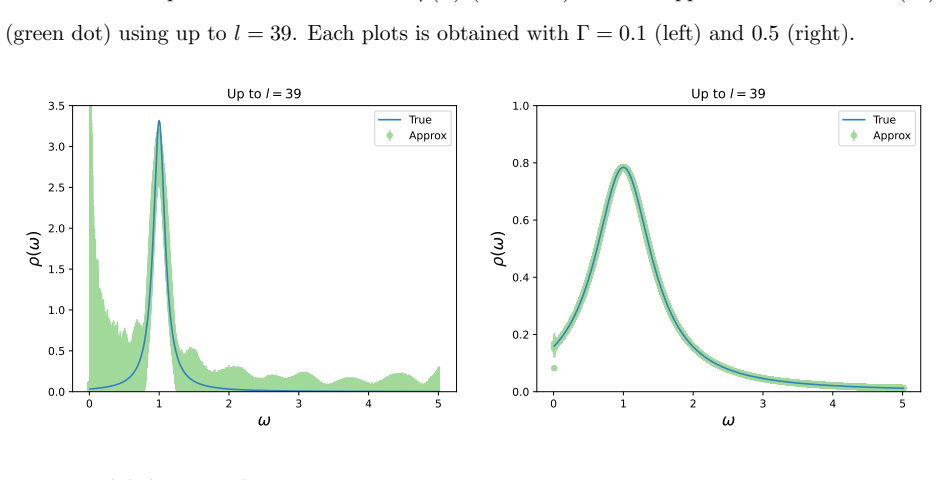

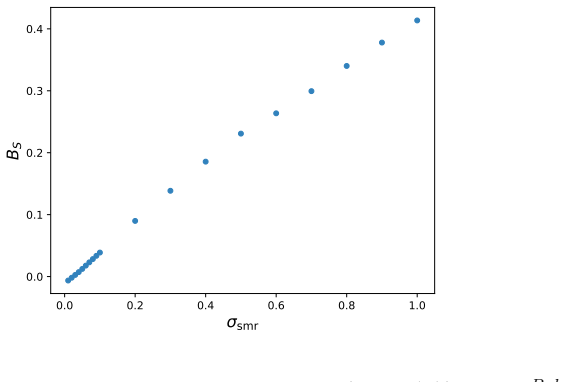
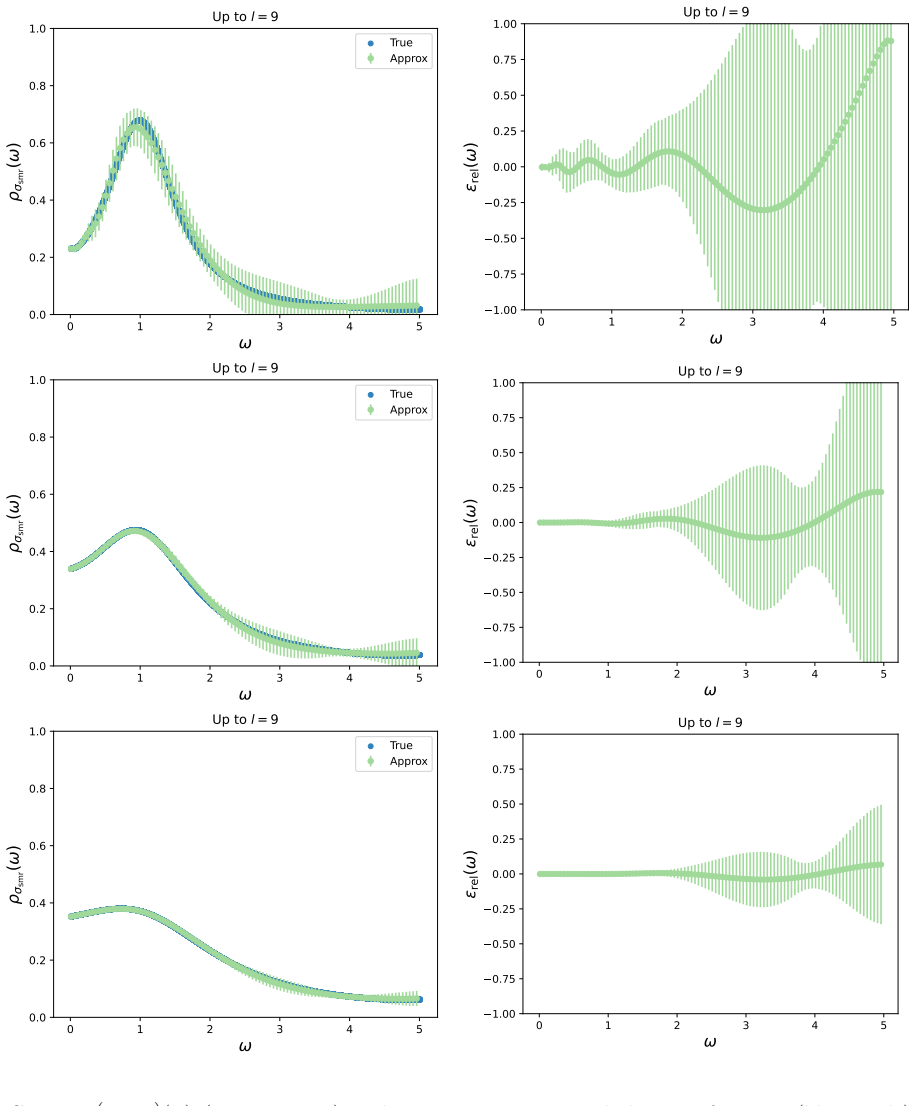


read the original abstract
Reconstructing spectral densities from Euclidean lattice correlators requires an inverse Laplace transform, which is inherently ill-conditioned when applied to numerical data with statistical uncertainties. The maximum amount of information that can be extracted from the imaginary-time dependence of correlators can be characterized by the singular value decomposition (SVD) of the kernel function $\exp(-\omega t)$ defined on discrete sets of imaginary times $t$ and energies $\omega$. The SVD provides orthogonal basis functions in both the $t$- and $\omega$-spaces, while the singular values determine the magnitude of their contributions to the correlators. By retaining only the components associated with the largest singular values, for which the correlator data remain statistically significant, one can reconstruct smeared spectral functions with controlled uncertainties. The systematic error arising from the truncation can also be bounded under reasonable assumptions. In the limit where the ranges of $t$ and $\omega$ become infinitely large and continuous, the SVD basis approaches the Mellin transform, allowing a representation of the smeared spectrum that is independent of the details of the lattice parameters.
Editorial analysis
A structured set of objections, weighed in public.
Referee Report
Summary. The manuscript proposes reconstructing smeared spectral functions from Euclidean lattice correlators via singular value decomposition (SVD) of the kernel exp(−ωt) on discrete t and ω grids. By retaining only the largest singular-value components for which the correlator data remain statistically significant, the method claims to yield smeared spectra with controlled uncertainties; the truncation systematic error is asserted to be boundable under reasonable assumptions on the spectral function. In the infinite-range continuous limit the SVD basis approaches the Mellin transform, furnishing a representation independent of lattice details.
Significance. If the truncation-error bound can be placed on a rigorous, assumption-light footing and validated numerically on realistic QCD spectra, the approach would supply a linear-algebraic, largely parameter-free route to controlled spectral information from noisy Euclidean data, complementing existing inversion techniques. The explicit link to the Mellin transform in the continuum limit is a conceptual strength that could aid analytic understanding.
major comments (2)
- [Abstract] Abstract: the statement that 'the systematic error arising from the truncation can also be bounded under reasonable assumptions' is load-bearing for the central claim of 'controlled uncertainties,' yet the manuscript supplies neither an explicit error formula nor numerical tests against known spectra (resonances plus continuum) that would demonstrate the bound holds for typical lattice correlators.
- [Method / truncation analysis] The SVD truncation procedure retains a free parameter (the singular-value cutoff threshold). The manuscript does not show how this cutoff is chosen in a manner that keeps the omitted contributions small in the relevant norm without additional assumptions on ρ(ω) whose validity for general lattice data is not demonstrated.
minor comments (2)
- [Notation] Clarify the precise definition of the smeared spectral function that is reconstructed and how the retained SVD components map onto it.
- [Results] Provide at least one concrete numerical example (even a toy model) showing the reconstructed spectrum, the retained singular values, and a quantitative estimate of the truncation error.
Simulated Author's Rebuttal
We thank the referee for the careful reading of our manuscript and the constructive comments. We address each major point below and have revised the manuscript to incorporate additional derivations, explanations, and numerical tests where appropriate.
read point-by-point responses
-
Referee: [Abstract] Abstract: the statement that 'the systematic error arising from the truncation can also be bounded under reasonable assumptions' is load-bearing for the central claim of 'controlled uncertainties,' yet the manuscript supplies neither an explicit error formula nor numerical tests against known spectra (resonances plus continuum) that would demonstrate the bound holds for typical lattice correlators.
Authors: We agree that the truncation error bound is central to the claim of controlled uncertainties and that the original manuscript would be strengthened by an explicit formula and validation. In the revised version we derive the bound explicitly: the truncation error in the L2 norm is at most the sum of the neglected singular values multiplied by an a priori bound on ||ρ||_2, under the standard assumptions that ρ(ω) ≥ 0 and is normalized. We have added this derivation in a new subsection and included numerical tests on synthetic correlators generated from Breit-Wigner resonances plus a continuum threshold, demonstrating that the observed reconstruction error remains within the derived bound at noise levels representative of lattice data. These additions appear in the updated Sections 3.2 and 4. revision: yes
-
Referee: [Method / truncation analysis] The SVD truncation procedure retains a free parameter (the singular-value cutoff threshold). The manuscript does not show how this cutoff is chosen in a manner that keeps the omitted contributions small in the relevant norm without additional assumptions on ρ(ω) whose validity for general lattice data is not demonstrated.
Authors: The cutoff is chosen by retaining only those singular values for which the corresponding projection of the correlator exceeds the statistical uncertainty by a factor of three or more; this ensures that omitted terms lie below the noise floor. In the revision we have added a quantitative analysis showing that, when ||ρ||_2 is bounded (a mild assumption satisfied by normalized spectral functions), the contribution of the tail is controlled by the decay of the singular-value spectrum. We discuss the validity of this assumption for QCD spectra and note that it is comparable to assumptions used in other reconstruction methods; we also describe a posteriori consistency checks. While the procedure is not entirely assumption-free, the added material clarifies the rationale and the regime of applicability. revision: partial
Circularity Check
SVD truncation is a direct linear-algebra regularization with no self-referential reduction
full rationale
The derivation applies the singular value decomposition to the kernel matrix K(t,ω) = exp(−ω t) on the discrete lattice grids, retains the dominant singular components where the correlator data exceed statistical noise, and reconstructs a smeared spectral function. This procedure is a standard, assumption-light regularization of the ill-posed inverse Laplace transform; the retained coefficients are fixed by the data and the kernel itself rather than by any fitted parameter or redefinition of the target spectrum. The statement that truncation error “can also be bounded under reasonable assumptions” invokes external positivity or smoothness properties of ρ(ω) and does not close a loop back onto the SVD coefficients or the lattice correlators. The continuous Mellin-transform limit is a separate mathematical observation about the infinite-range case and does not alter the finite-data construction. No equation or claim reduces to its own input by construction, and no load-bearing step relies on a self-citation whose content is unverified outside the present work.
Axiom & Free-Parameter Ledger
free parameters (1)
- singular-value cutoff threshold
axioms (1)
- domain assumption Reasonable assumptions on the spectral function allow the truncation systematic error to be bounded.
Lean theorems connected to this paper
-
IndisputableMonolith/Cost/FunctionalEquation.leanwashburn_uniqueness_aczel unclear?
unclearRelation between the paper passage and the cited Recognition theorem.
The SVD of ˜L is written as ˜Lij = ∑ ˜Ul(ti) σl ˜Vl(ωj) … singular values decrease exponentially … truncation error … bounded under reasonable assumptions about the form or positivity properties of the underlying spectral function.
-
IndisputableMonolith/Foundation/AlphaCoordinateFixation.leancostAlphaLog_fourth_deriv_at_zero echoes?
echoesECHOES: this paper passage has the same mathematical shape or conceptual pattern as the Recognition theorem, but is not a direct formal dependency.
In the limit … the SVD basis approaches the Mellin transform … |λs| = √(π / cosh(π s)) … u±(θ)s(x) = cos/sin(s ln x − θ(s)/2) / √(π x)
What do these tags mean?
- matches
- The paper's claim is directly supported by a theorem in the formal canon.
- supports
- The theorem supports part of the paper's argument, but the paper may add assumptions or extra steps.
- extends
- The paper goes beyond the formal theorem; the theorem is a base layer rather than the whole result.
- uses
- The paper appears to rely on the theorem as machinery.
- contradicts
- The paper's claim conflicts with a theorem or certificate in the canon.
- unclear
- Pith found a possible connection, but the passage is too broad, indirect, or ambiguous to say the theorem truly supports the claim.
Reference graph
Works this paper leans on
-
[1]
M. Bertero, C. D. Mol, and E. R. Pike, Inverse Problems1, 301 (1985), URLhttps://doi. org/10.1088/0266-5611/1/4/004
-
[2]
M. Bertero, C. D. Mol, and E. R. Pike, Inverse Problems4, 573 (1988), URLhttps://doi. org/10.1088/0266-5611/4/3/004
-
[3]
Hadronic Spectral Functions in Lattice QCD
Y. Nakahara, M. Asakawa, and T. Hatsuda, Phys. Rev. D60, 091503 (1999), hep-lat/9905034
work page internal anchor Pith review Pith/arXiv arXiv 1999
-
[4]
M. Asakawa, T. Hatsuda, and Y. Nakahara, Prog. Part. Nucl. Phys.46, 459 (2001), hep- lat/0011040
-
[5]
J. Otsuki, M. Ohzeki, H. Shinaoka, and K. Yoshimi, Journal of the Physical Society of Japan 24 10 1 100 101 102 t 0.0 0.2 0.4 0.6 0.8 1.0 1.2 1.4U0(t) tmax = max = 50.1 tmax = max = 75.1 tmax = max = 100.1 10 1 100 101 102 0.0 0.2 0.4 0.6 0.8 1.0 1.2 1.4V0( ) tmax = max = 50.1 tmax = max = 75.1 tmax = max = 100.1 10 1 100 101 102 t 2.0 1.5 1.0 0.5 0.0 U1(...
- [6]
-
[7]
A novel Bayesian approach to spectral function reconstruction
Y. Burnier and A. Rothkopf, Phys. Rev. Lett.111, 182003 (2013), 1307.6106
work page internal anchor Pith review Pith/arXiv arXiv 2013
-
[8]
L. Del Debbio, A. Lupo, M. Panero, and N. Tantalo, Eur. Phys. J. C85, 185 (2025), 25 10 1 100 101 102 t 1.5 1.0 0.5 0.0 0.5 1.0 U8(t) tmax = max = 50.1 tmax = max = 75.1 tmax = max = 100.1 10 1 100 101 102 1.5 1.0 0.5 0.0 0.5 1.0 V8( ) tmax = max = 50.1 tmax = max = 75.1 tmax = max = 100.1 10 1 100 101 102 t 1.0 0.5 0.0 0.5 1.0 1.5 U9(t) tmax = max = 50.1...
-
[9]
T. Bergamaschi, W. I. Jay, and P. R. Oare, Phys. Rev. D108, 074516 (2023), 2305.16190
-
[10]
Nevanlinna-Pick interpolation from uncertain data
S. Fields and N. Christ, Phys. Rev. D113, 054502 (2026), 2510.12136
work page internal anchor Pith review arXiv 2026
-
[11]
L. Kades, J. M. Pawlowski, A. Rothkopf, M. Scherzer, J. M. Urban, S. J. Wetzel, N. Wink, and F. P. G. Ziegler, Phys. Rev. D102, 096001 (2020), 1905.04305. 26 10 1 100 101 102 t 1.0 0.5 0.0 0.5 1.0 U19(t) tmax = max = 50.1 tmax = max = 75.1 tmax = max = 100.1 10 1 100 101 102 1.0 0.5 0.0 0.5 1.0 V19( ) tmax = max = 50.1 tmax = max = 75.1 tmax = max = 100.1...
- [12]
-
[13]
M. Buzzicotti, A. De Santis, and N. Tantalo, Eur. Phys. J. C84, 32 (2024), 2307.00808
- [14]
-
[15]
On the extraction of spectral densities from lattice correlators
M. Hansen, A. Lupo, and N. Tantalo, Phys. Rev. D99, 094508 (2019), 1903.06476
work page internal anchor Pith review Pith/arXiv arXiv 2019
- [16]
-
[17]
C. Alexandrou et al. (Extended Twisted Mass Collaboration (ETMC)), Phys. Rev. Lett.130, 241901 (2023), 2212.08467
- [18]
-
[19]
C. E. Creffield, E. G. Klepfish, E. R. Pike, and S. Sarkar, Phys. Rev. Lett.75, 517 (1995), URLhttps://link.aps.org/doi/10.1103/PhysRevLett.75.517
-
[20]
H. Shinaoka, J. Otsuki, M. Ohzeki, and K. Yoshimi, Phys. Rev. B96, 035147 (2017), URL https://link.aps.org/doi/10.1103/PhysRevB.96.035147
-
[21]
N. Chikano, J. Otsuki, and H. Shinaoka, Phys. Rev. B98, 035104 (2018), URLhttps: //link.aps.org/doi/10.1103/PhysRevB.98.035104
- [22]
- [23]
-
[24]
R. Bellman and R. Roth, The Laplace Transform, Modern Applied Mathematics Series (World Scientific, 1984), ISBN 9789971966737, URLhttps://books.google.co.jp/books? id=roFjH53691wC
work page 1984
-
[25]
J. G. McWhirter and E. R. Pike, Journal of Physics A: Mathematical and General11, 1729 (1978), URLhttps://doi.org/10.1088/0305-4470/11/9/007
-
[26]
C. L. Epstein and J. Schotland, SIAM Review50, 504 (2008), https://doi.org/10.1137/060657273, URLhttps://doi.org/10.1137/060657273
-
[27]
R. Kellermann, Z. Hu, A. Barone, A. Elgaziari, S. Hashimoto, T. Kaneko, and A. J¨ uttner, Phys. Rev. D112, 014501 (2025), 2504.03358
-
[28]
R. Kellermann, A. Barone, A. Elgaziari, S. Hashimoto, Z. Hu, A. J¨ uttner, and T. Kaneko (2026), 2604.22201
work page internal anchor Pith review Pith/arXiv arXiv 2026
-
[29]
P. Gambino and S. Hashimoto, Phys. Rev. Lett.125, 032001 (2020), 2005.13730
- [30]
-
[31]
J. Bulava and M. T. Hansen, Phys. Rev. D100, 034521 (2019), 1903.11735
-
[32]
R. Frezzotti, N. Tantalo, G. Gagliardi, F. Sanfilippo, S. Simula, and V. Lubicz, Phys. Rev. D 28 108, 074510 (2023), 2306.07228
- [33]
-
[34]
E.-k. Wang, U. W. Heinz, and X.-f. Zhang, Phys. Rev. D53, 5978 (1996), hep-ph/9509331
work page internal anchor Pith review Pith/arXiv arXiv 1996
-
[35]
H. B. Meyer, Phys. Rev. D76, 101701 (2007), 0704.1801. 29
work page internal anchor Pith review Pith/arXiv arXiv 2007
discussion (0)
Sign in with ORCID, Apple, or X to comment. Anyone can read and Pith papers without signing in.