REVIEW 2 major objections 2 minor 23 references
XOR Bidding and Knapsack Formulations for HPC Network Resource Allocation
T0 review · 2 major / 2 minor · reviewed 2026-06-28 · grok-4.3
Pith's one-line read Two auction mechanisms allocate HPC bandwidth using bids on scientific value and outperform FCFS by cutting delays over 80 percent in high-load simulations.
desk verdict The paper applies VCG knapsack and greedy value-density auctions with XOR bids to HPC bandwidth allocation under network and processing constraints, reporting large simulated gains over FCFS, but the gains rest on unvalidated synthetic workloads. read the letter →
The pith
A machine-rendered reading of the paper's core claim, the machinery that carries it, and where it could break.
The reading
What carries the argument
The Greedy Value Density Auction and VCG Knapsack Auction, which select bids via XOR bidding and knapsack optimization to maximize social welfare while respecting network and processing constraints.
What would settle it
A real HPC deployment in which the auction mechanisms produce no measurable reduction in average or tail completion delays relative to FCFS or in which submitted bids show no correlation with actual scientific outcomes.
Extended reading notes
Core claim
The paper claims that XOR bidding combined with knapsack formulations enables two auction mechanisms—the Greedy Value Density Auction and the VCG Knapsack Auction—to allocate bandwidth in HPC networks by maximizing the total scientific value of completed transfers, leading to over 80 percent reduction in average and tail completion delays under high-load conditions in simulations.
Load-bearing premise
User bids accurately encode the true scientific value of their data transfers and the simulated network and processing constraints match real HPC workloads.
Editorial extensions
If this is right
- Reduces average and tail completion delays by more than 80 percent under high-load conditions.
- Decreases the coefficient of variation of delay by 75-85 percent.
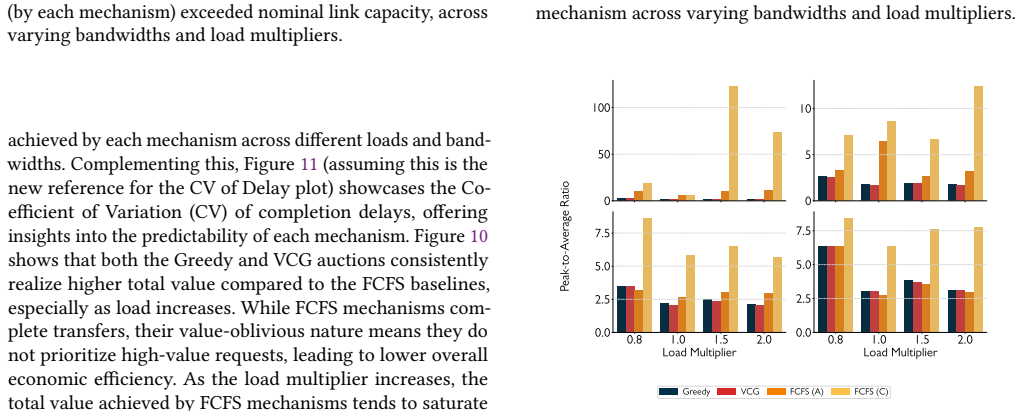
- Decreases load volatility measured by peak-to-average ratio by 60-70 percent.
- Increases predictability and network stability while providing fairer access based on reported scientific value.
Reading between the lines
- The bidding model could be tested against real user behavior in live HPC systems to check whether reported values align with measured outcomes.
- If the approach scales, similar knapsack auctions might apply to other constrained scientific resources such as storage or compute time.
- The mechanisms might require integration with existing job schedulers, which could alter the observed performance gains.
Signed reviews
Editorial analysis
A structured set of objections, weighed in public.
Referee Report
Summary. The paper formalizes bandwidth allocation in HPC centers as a knapsack-like problem with network and processing constraints, proposing two mechanisms: a computationally efficient Greedy Value Density Auction and a VCG Knapsack Auction that uses XOR bids encoding data volume and scientific value to maximize social welfare. Simulations under high-load conditions report >80% reductions in average and tail completion delays, 75-85% lower delay coefficient of variation, and 60-70% lower load volatility relative to FCFS baselines.
Significance. If the simulation results hold under realistic conditions, the work could advance value-based resource allocation in data-intensive HPC environments by providing both efficient heuristics and incentive-compatible mechanisms. However, the absence of external validation against production traces or elicited user valuations limits the strength of the claimed improvements in social welfare and stability.
major comments (2)
- [Simulation results] Simulation results section: The headline claim of >80% reduction in average and tail delays (and the associated stability metrics) is obtained exclusively from simulations whose workload generator, bid synthesis procedure, and network/processing constraint models are not described with sufficient detail to allow reproduction or sensitivity analysis; this is load-bearing because the performance gap is attributed to the mechanisms rather than to the choice of synthetic inputs.
- [§3] §3 (mechanism definitions): The assumption that user bids accurately encode true scientific value is used without qualification to justify the social-welfare objective, yet no section provides a mapping from real scientific priorities to bid values or tests robustness when bids are strategic or noisy; this directly affects whether the VCG guarantees translate to the claimed welfare gains.
minor comments (2)
- [Introduction] The abstract and introduction use 'XOR bidding' in the title but do not explicitly define the XOR semantics or contrast it with additive bids in the mechanism sections.
- No table or figure caption supplies the exact parameter settings (e.g., arrival rates, capacity values, bid distributions) used to generate the reported 80% figures.
Simulated Author's Rebuttal
We thank the referee for the detailed and constructive comments. We address each major comment below and indicate the revisions we will make to improve reproducibility and clarify assumptions.
read point-by-point responses
-
Referee: [Simulation results] Simulation results section: The headline claim of >80% reduction in average and tail delays (and the associated stability metrics) is obtained exclusively from simulations whose workload generator, bid synthesis procedure, and network/processing constraint models are not described with sufficient detail to allow reproduction or sensitivity analysis; this is load-bearing because the performance gap is attributed to the mechanisms rather than to the choice of synthetic inputs.
Authors: We agree that the current description of the simulation setup is insufficient for full reproducibility. In the revised manuscript we will expand the simulation section to provide complete specifications of the workload generator (including arrival processes and data-volume distributions), the exact bid-synthesis procedure (how data volumes and scientific values are sampled and encoded as XOR bids), and the precise network and processing constraint models together with all numerical parameters used in the reported experiments. This will enable independent reproduction and sensitivity analysis. revision: yes
-
Referee: [§3] §3 (mechanism definitions): The assumption that user bids accurately encode true scientific value is used without qualification to justify the social-welfare objective, yet no section provides a mapping from real scientific priorities to bid values or tests robustness when bids are strategic or noisy; this directly affects whether the VCG guarantees translate to the claimed welfare gains.
Authors: The mechanisms are defined under the standard mechanism-design assumption that reported bids equal true valuations; the VCG auction therefore maximizes welfare with respect to the reported values and is strategy-proof. The manuscript does not contain an empirical mapping from actual scientific priorities to bid values nor robustness experiments under noisy or strategic bidding, because the focus is on the formal problem formulation and synthetic evaluation. We will add a dedicated discussion subsection that explicitly states this modeling assumption, notes the practical difficulty of valuation elicitation, and outlines future work on robustness to misreported or noisy bids. revision: partial
Circularity Check
No circularity; performance claims rest on independent simulation outputs
full rationale
The paper formalizes an allocation problem, proposes two auction mechanisms (Greedy Value Density Auction and VCG Knapsack Auction) that take user bids as inputs to maximize social welfare, and reports simulation results showing improvements over FCFS. No derivation chain, equation, or claim reduces a result to its own inputs by construction, renames a fitted quantity as a prediction, or relies on a load-bearing self-citation. The >80% delay reductions are simulation outputs, not tautological consequences of the model definition.
Assumptions & free parameters
Cite this review
Pith. "Pith review of XOR Bidding and Knapsack Formulations for HPC Network Resource Allocation." pith.science (2026). https://pith.science/paper/AHZIJYNC
@misc{pith2026260600490,
  author       = {Pith},
  title        = {Pith review of: XOR Bidding and Knapsack Formulations for HPC Network Resource Allocation},
  year         = {2026},
  howpublished = {\url{https://pith.science/paper/AHZIJYNC}},
  note         = {Machine review of arXiv:2606.00490}
}
read the original abstract
Modern High Performance Computing (HPC) centers face growing challenges in ingesting large and diverse data streams. These issues often create bottlenecks that limit bandwidth utilization and delay scientific progress. Traditional static allocation and simple queuing methods are often insufficient. This paper presents a dynamic, value-based approach to bandwidth allocation. We formalize the problem by incorporating both network and processing constraints. To address it, we introduce two auction-based mechanisms: the Greedy Value Density Auction, which is computationally efficient, and the Vickrey--Clarke--Groves (VCG) Knapsack Auction, which provides strong theoretical guarantees. Both mechanisms rely on user bids that specify data requirements and scientific value. The objective is to maximize the total value of successful transfers, commonly referred to as social welfare. Simulation results demonstrate that the proposed mechanisms significantly outperform First Come First Served (FCFS) baselines. Under high-load conditions, they reduce average and tail completion delays by more than 80%. Predictability also improves, with the coefficient of variation of delay decreasing by 75--85%. Network stability increases as well, with load volatility, measured by the peak-to-average ratio, decreasing by 60--70%. These results indicate that value-driven, adaptive bandwidth allocation can reduce congestion, improve resource utilization, and provide fairer access based on scientific importance.
Figures


Figures from the paper (10 more)


Reference graph
Works this paper leans on
-
[1]
The Petascale DTN Project: High Performance Data Transfer for HPC Facilities,
E. Dart, W. Allcock, W. Bhimji, T. Boerner, R. Cheema, A. Cherry, B. Draney, S. Habib, D. Hazen, J. Hill, M. Kollross, S. Parete-Koon, D. Pelfrey, A. Pope, J. Porter, and D. Wheeler, “The Petascale DTN Project: High Performance Data Transfer for HPC Facilities, ”arXiv e-print 2105.12880, 2021. XOR Bidding and Knapsack Formulations for HPC Network Resource...
-
[2]
Globus: Recent Enhancements and Future Plans,
K. Chard, S. Tuecke, and I. Foster, “Globus: Recent Enhancements and Future Plans, ” inProceedings of the XSEDE16 Conference on Diversity, Big Data, and Science at Scale, pp. 24:1–24:8, 2016
2016
-
[3]
CATCH: A Cloud-based Adaptive Data Transfer Service for HPC,
H. M. Monti, A. R. Butt, and S. S. Vazhkudai, “CATCH: A Cloud-based Adaptive Data Transfer Service for HPC, ” inProceedings of the 2011 IEEE International Parallel & Distributed Processing Symposium (IPDPS), pp. 126–137, 2011
2011
-
[4]
Frontiers in Scientific Workflows: Pervasive Integration with High-Performance Computing,
B. Enders, L. Ramakrishnan, W. Bhimji, E. Dart, and K. Wu, “Frontiers in Scientific Workflows: Pervasive Integration with High-Performance Computing, ”IEEE Computer, vol. 57, no. 8, pp. 46–55, 2024
2024
-
[5]
Understanding Data Movement Patterns at HPC: A NERSC Case Study,
A. Giannakou, D. Hazen, B. Enders, L. Ramakrishnan, and N. Wright, “Understanding Data Movement Patterns at HPC: A NERSC Case Study, ” inProceedings of the International Conference for High Performance Computing, Networking, Storage and Analysis (SC), 2024 (to appear)
2024
-
[6]
Revisiting I/O Bandwidth-Sharing Strategies for HPC Applications,
A. Benoit, T. Herault, L. Perotin, Y. Robert, and F. Vivien, “Revisiting I/O Bandwidth-Sharing Strategies for HPC Applications, ”Journal of Parallel and Distributed Computing, vol. 188, p. 104863, 2024
2024
-
[7]
A Workflow Roofline Model for End- to-End Workflow Performance Analysis,
N. Ding, B. Austin, Y. Liu, N. Mehta, J. P. Blaschke, L. Oliker, H. Ah Nam, N. J. Wright, and S. Williams, “A Workflow Roofline Model for End- to-End Workflow Performance Analysis, ” Tech. Rep. LBNL-2001423, Lawrence Berkeley National Laboratory (LBNL) Technical Report, 2023
2023
-
[8]
Streaming Large-Scale Microscopy Data to a Supercom- puting Facility,
S. S. Welborn, C. Harris, S. M. Ribet, G. Varnavides, C. Ophus, B. Enders, and P. Ercius, “Streaming Large-Scale Microscopy Data to a Supercom- puting Facility, ”Microscopy and Microanalysis, vol. 31, no. S1, pp. 17–20, 2025
2025
Show all 23 references
-
[9]
Automatically encapsulating hpc best practices into data transfers,
P. Z. Kolano, “Automatically encapsulating hpc best practices into data transfers, ” inProceedings of the Second International Workshop on HPC User Support Tools, pp. 1–12, 2015
2015
-
[10]
Rsync for data transfers
University of Arizona Research Computing, “Rsync for data transfers. ”https://hpcdocs.hpc.arizona.edu/storage_and_transfers/ transfers/rsync/, 2024. Accessed: 2025-05-05
2024
-
[11]
Gridftp: High-performance data transfer pro- tocol
Grid Community Forum, “Gridftp: High-performance data transfer pro- tocol. ”https://gridcf.org/gct-docs/latest/gridftp/key/index.html, 2024. Accessed: 2025-05-05
2024
-
[12]
Ibm aspera: High-speed data transfer software
IBM Corporation, “Ibm aspera: High-speed data transfer software. ” https://www.ibm.com/products/aspera, 2024. Accessed: 2025-05-05
2024
-
[13]
Gridftp usage and performance at alcf
A. L. C. Facility, “Gridftp usage and performance at alcf. ”https://reports. alcf.anl.gov/data/GRIDFTP.html, 2024. Accessed: 2025-05-05
2024
-
[14]
Big Data Transfer Optimiza- tion Through Adaptive Parameter Tuning,
E. Arslan, B. A. Pehlivan, and T. Kosar, “Big Data Transfer Optimiza- tion Through Adaptive Parameter Tuning, ”Journal of Parallel and Distributed Computing, vol. 120, pp. 89–100, 2018
2018
-
[15]
Coordinating an operational data distribution network for cmip6 data,
R. Petrie, S. Denvil, S. Ames, G. Levavasseur, S. Fiore, C. Allen, F. An- tonio, K. Berger, P.-A. Bretonnière, L. Cinquini,et al., “Coordinating an operational data distribution network for cmip6 data, ”Geoscientific Model Development Discussions, vol. 2020, pp. 1–22, 2020
2020
-
[16]
Krishna,Auction theory
V. Krishna,Auction theory. Academic press, 2009
2009
-
[17]
Vickrey-clarke- groves (vcg) auctions,
M. Caminati, M. Kerber, C. Lange, and C. Rowat, “Vickrey-clarke- groves (vcg) auctions, ”College Inf. Sci. Technol., Pennsylvania State Univ., State College, PA, USA, 2015
2015
-
[18]
Cs6840: Algo- rithmic game theory – december 4 lecture
Cornell University Department of Computer Science, “Cs6840: Algo- rithmic game theory – december 4 lecture. ”https://www.cs.cornell.edu/ courses/cs6840/2024fa/lectures/December04, 2024. Accessed: 2025-05- 05
2024
-
[19]
Computing Just What You Need: Online Data Analysis and Reduction at Extreme Scales,
I. Foster, M. Ainsworth, and et al., “Computing Just What You Need: Online Data Analysis and Reduction at Extreme Scales, ” inProceed- ings of the 23rd International Conference on Parallel and Distributed Computing (Euro-Par), pp. 3–19, 2017
2017
-
[20]
Resilient Error- Bounded Lossy Compressor for Data Transfer,
S. Li, S. Di, K. Zhao, X. Liang, Z. Chen, and F. Cappello, “Resilient Error- Bounded Lossy Compressor for Data Transfer, ” inProceedings of the International Conference for High Performance Computing, Networking, Storage and Analysis (SC), pp. 32:1–32:14, 2021
2021
-
[21]
Gladier: Automation toolkit for scientific workflows
G. G. Team, “Gladier: Automation toolkit for scientific workflows. ” https://github.com/globus-gladier/gladier, 2024. Accessed: 2025-05-05
2024
-
[22]
Cross-facility science with the superfacility project at lbnl,
B. Enders, D. Bard, C. Snavely, L. Gerhardt, J. Lee, B. Totzke, K. Antypas, S. Byna, R. Cheema, S. Cholia,et al., “Cross-facility science with the superfacility project at lbnl, ” in2020 IEEE/ACM 2nd Annual Workshop on Extreme-scale Experiment-in-the-Loop Computing (XLOOP), pp...
2020
-
[23]
Value- Based Scheduling for Oversubscribed Power-Constrained Homoge- neous HPC Systems,
N. Kumbhare, H. Casanova, M. K. Nilsen, and H. J. Siegel, “Value- Based Scheduling for Oversubscribed Power-Constrained Homoge- neous HPC Systems, ”Proceedings of the IEEE International Conference on Cloud and Autonomic Computing (ICCAC), pp. 120–130, 2017
2017
Reviewed June 28, 2026 · model on record in the stance chip above.
Discussion (0). Continue with ORCID to comment.