REVIEW 2 major objections 6 minor 27 references
Local Gaussian Correlation in the Tails: A Scarcity Diagnostic, an Optimal Local Bandwidth, and the Limits of Adaptivity
T0 review · 2 major / 6 minor · reviewed 2026-07-13 · grok-4.5
Pith's one-line read Tail dependence measured by local Gaussian correlation is limited by data scarcity, not by bandwidth placement; adaptivity helps only at moderate dependence.
desk verdict Solid, usable paper: first location-specific AMISE bandwidth for LGC plus a clean regime map that finally explains why global bandwidths win outside a narrow band. read the letter →
The pith
A machine-rendered reading of the paper's core claim, the machinery that carries it, and where it could break.
The reading
What carries the argument
The local AMISE that balances the Fisher variance floor Var(rho-hat) approximately (1 - rho squared) squared over (n b squared f) against the O(b squared) bias expansion whose leading functional is beta = Laplacian of rho plus density-drift term. Minimizing that AMISE produces the location-specific bandwidth of Theorem 1, which is then plug-in estimated under a budget-neutral normalization.
What would settle it
On strongly dependent curved copulas (Kendall tau near 0.8) recompute integrated squared error for the adaptive rule versus global plug-in at increasing n; if the adaptive deficit shrinks rather than grows, or if an oracle-scale version of the same shape beats global, the regime-map claim fails.
Extended reading notes
Core claim
The first AMISE-optimal location-specific bandwidth for local Gaussian correlation is b-star of x proportional to [(1 - rho squared) squared over (f beta squared)] to the one-sixth times n to the minus one-sixth. A Monte Carlo regime map demonstrates that this adaptive rule improves on the global plug-in only at moderate dependence with curved surfaces; outside that band, and especially at strong dependence, adaptivity is substantially worse and its integrated error grows with sample size because the pointwise-optimal shape missmooths.
Load-bearing premise
The leading bias is taken to be proportional to b squared times a curvature functional beta whose exact closed-form constant is not derived; the bandwidth formula is claimed invariant to that constant, yet the numerical validation still relies on a finite-difference pilot estimate of the same beta.
Editorial analysis
A structured set of objections, weighed in public.
Referee Report
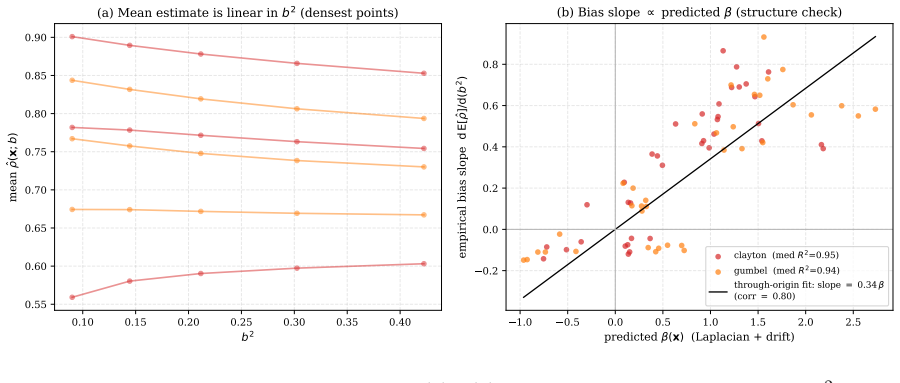
Summary. The paper studies why local Gaussian correlation (LGC) degrades in the joint tails and when location-adaptive bandwidths help. It shows that a parametric marginal pre-transform is essentially inert for integrated error, while tail error is organised by local effective sample size and tracks a Fisher variance floor sd ≈ (1-ρ²)/√eff_n. Specialising Hjort–Jones local-likelihood asymptotics to the bivariate Gaussian family, it derives the first location-specific AMISE-optimal LGC bandwidth b⋆(x) ∝ [(1-ρ²)²/(f β²)]^{1/6} n^{-1/6}, validates the O(b²) bias expansion empirically, and maps regimes via Monte Carlo: the adaptive rule beats a global plug-in only at moderate dependence with curved surfaces; at strong dependence the pointwise-optimal shape missmooths and the deficit grows with n. On volatility-filtered equity returns the adaptive surface is more stable under resampling. The cautionary message is that data scarcity, not bandwidth placement, is the binding constraint.
Significance. If the results hold, the paper supplies a usable scarcity diagnostic, the first AMISE-derived local bandwidth for LGC, and a clear regime map that explains the field’s experience that global selectors are hard to beat. Strengths include: (i) assembling published local-likelihood bias and Gaussian-correlation MLE variance into an explicit local AMSE balance (Theorem 1); (ii) direct validation of the bias expansion (median R² ≈ 0.9, slope-to-β correlation 0.80); (iii) a paired Monte Carlo with an oracle-scale check that isolates shape failure from normalisation; (iv) a carefully scoped real-data claim (stability, not accuracy); and (v) open, seeded code. These make the contribution falsifiable and reproducible rather than purely heuristic.
major comments (2)
- §5.1, Eq. (5): the bias functional is written β(x)=Δρ+2∇log f⊤∇ρ+r with the exact Hjort–Jones projection constant deferred. Budget-neutral normalisation makes b⋆ invariant to a global scale factor in β, but not necessarily to a spatially varying projection that would reshape relative β(x). The empirical structure check (Fig. 3b, corr 0.80) supports the form used in the plug-in, yet a short statement of what is and is not invariant—and whether the deferred constant is expected to be spatially constant under the Gaussian family—would close the only remaining gap between the asymptotic claim and the operational rule.
- §7.2 / oracle-scale experiment: the strong-dependence failure is attributed to the pointwise-optimal shape of (7). The region-by-region decomposition and pilot-resolution check are persuasive, but the main text reports the oracle-scale ISE ratios only for Clayton and t4 at n=2500. Adding the corresponding numbers for Gumbel (and, if space, Gaussian) in the text or a small table would make the “intrinsic to shape” claim fully checkable without consulting the repository.
minor comments (6)
- Eqs. (3)–(6): typesetting of kernel constants is hard to parse (e.g. “R(K) 2”, “nb 2”). Write R(K)² and nb² explicitly throughout.
- §2, Monte Carlo design: state the product kernel and the precise definition of density-weighted ISE (weights and grid measure) so that the ISE percentages in §7 are fully reproducible from the text alone.
- Table 2 and Fig. 4b: clarify whether “cells improved” counts are over replications×quantile points or over unique (copula, quantile) locations; the denominator matters for interpreting 93%.
- §8.1: the AR(1)–GARCH(1,1)-t filter is standard; a one-line note that results are qualitatively unchanged under EGARCH or a pure GARCH(1,1) would reassure readers worried about filter dependence.
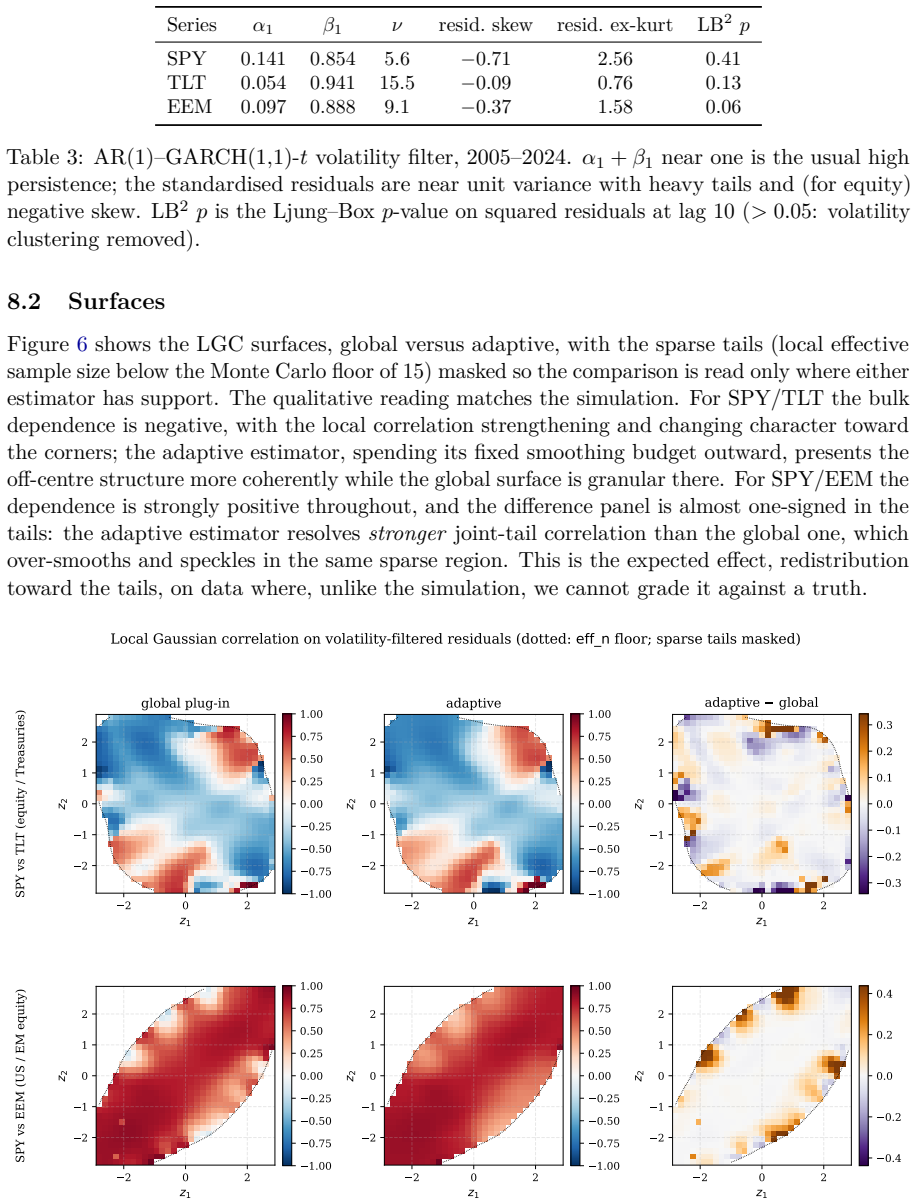
- Fig. 6: the colour scale for the difference panels is small relative to the surfaces; a shared, annotated scale bar would help.
- References: Otneim et al. (2013) and Otneim & Tjøstheim (2022) are load-bearing for (3)–(4); ensure page or equation pointers if the journal style allows.
Circularity Check
No significant circularity: AMISE formula, Fisher-floor diagnostic, and regime map are derived from external asymptotics and independent Monte Carlo, not from self-referential fits or load-bearing self-citations.
full rationale
The paper's central derivation (Theorem 1) assembles the known O(b^{2}) bias of the local Gaussian likelihood estimator (Otneim et al. 2013) with the asymptotic variance of the Gaussian-correlation MLE (Otneim & Tjøstheim 2022) under the Hjort–Jones local-likelihood framework; the resulting AMSE balance yields b⋆(x) ∝ [(1−ρ^{2})^{2}/(f β^{2})]^{1/6} n^{-1/6} by ordinary calculus, with the location-specific constant new but the rate classical. The Fisher variance floor sd ≈ (1−ρ^{2})/√eff_n is recovered as the special case of that same asymptotic variance when m = eff_n, then confirmed empirically rather than assumed. Bias expansion (4) is validated by an independent ladder-of-bandwidths regression (median R^{2} ≈ 0.9, slope-to-β correlation 0.80) that does not feed back into the formula. The adaptive estimator uses a standard pilot plug-in of ρ̂, f̂, β̂, budget-neutralized so that any gain is attributable only to placement; this is ordinary nonparametric practice, not a prediction forced by a fitted constant. The regime map is a paired Monte Carlo across τ that isolates the strong-dependence failure as intrinsic to the pointwise shape (oracle-scale check still loses). No uniqueness theorem, ansatz, or self-citation is load-bearing; citations to Tjøstheim, Otneim, Hjort–Jones et al. are external. The derivation chain is therefore self-contained against published asymptotics and independent simulation.
Assumptions & free parameters
free parameters (4)
- global plug-in constant 1.75 =
1.75
- bandwidth cap interval [0.5, 3]×global =
[0.5, 3]
- β floor and coarse-scale smoother
- eff_n floor of 15 for masking =
15
assumptions (4)
- standard math Hjort–Jones local-likelihood asymptotics supply the leading O(b²) bias and O(1/(n b²)) variance for the five-parameter Gaussian family.
- domain assumption Local effective sample size eff_n(x) ≈ 2π b² n f(x) for a Gaussian product kernel.
- ad hoc to paper The bias functional β(x) = Δρ + 2 ∇log f · ∇ρ + r, with r vanishing under local Gaussianity, is sufficient for bandwidth selection even though its exact closed-form constant is deferred.
- ad hoc to paper Budget-neutral normalization (density-weighted geometric mean of local constants equals the global plug-in constant) isolates placement gains from overall smoothing level.
Cite this review
Pith. "Pith review of Local Gaussian Correlation in the Tails: A Scarcity Diagnostic, an Optimal Local Bandwidth, and the Limits of Adaptivity." pith.science (2026). https://pith.science/paper/AICXSYHB
@misc{pith2026260703888,
  author       = {Pith},
  title        = {Pith review of: Local Gaussian Correlation in the Tails: A Scarcity Diagnostic, an Optimal Local Bandwidth, and the Limits of Adaptivity},
  year         = {2026},
  howpublished = {\url{https://pith.science/paper/AICXSYHB}},
  note         = {Machine review of arXiv:2607.03888}
}
read the original abstract
Local Gaussian correlation (LGC) measures dependence locally, making it a natural tool for tail dependence and financial contagion, but its estimates degrade in the joint tails, where they are most needed. Location-adaptive bandwidths have been tried for LGC and found inferior to a single global bandwidth; we explain why, and map the regime in which adaptivity does help. First, a diagnostic: across heavy-tailed data-generating processes the parametric marginal pre-transform is inert (it changes the integrated error only in the fourth decimal), while the binding constraint is the local effective sample size, with the replication dispersion following a Fisher variance floor sd ~ (1 - rho^2)/sqrt(eff_n). Second, theory: specializing the Hjort-Jones local-likelihood asymptotics to the bivariate Gaussian family that LGC fits, we derive the first location-specific AMISE-optimal bandwidth for LGC, b*(x) proportional to [(1 - rho^2)^2 / (f beta^2)]^(1/6) n^(-1/6), and validate its bias expansion directly (bias proportional to b^2 beta, R^2 approximately 0.9, slope-to-beta correlation 0.80). Third, a regime map: a Monte Carlo across dependence strengths shows the adaptive rule beats the global plug-in only at moderate dependence with curved surfaces. At weak dependence there is no curvature to exploit; at strong dependence finite-sample bias from the steep surface dominates, and adaptivity performs substantially worse, with an error that grows in the sample size. This explains the field's experience that global bandwidths are hard to beat, and locates the exception. Fourth, application: on volatility-filtered equity returns the adaptive estimator yields more stable tail-dependence surfaces under resampling. The message is cautionary: the binding constraint on tail LGC is data scarcity, not bandwidth placement, and no bandwidth, however optimal, can recover information the data do not contain.
Figures


Figures from the paper (4 more)



Reference graph
Works this paper leans on
-
[1]
Tj. Local. Journal of Econometrics , volume =. 2013 , publisher =
2013
-
[2]
The Annals of Statistics , volume =
Locally parametric nonparametric density estimation , author =. The Annals of Statistics , volume =
-
[3]
Recognizing and visualizing copulas: an approach using local
Berentsen, Geir Drage and St. Recognizing and visualizing copulas: an approach using local. Insurance: Mathematics and Economics , volume =. 2014 , publisher =
2014
-
[4]
Using local
St. Using local. Journal of Empirical Finance , volume =. 2014 , publisher =
2014
-
[5]
Sleire, Anders D. and St. Portfolio allocation under asymmetric dependence using local. Finance Research Letters , volume =. 2022 , publisher =
2022
-
[6]
Gundersen, Kristian and Bacri, Thibault and Bulla, Jan and H. Local. Scandinavian Journal of Statistics , year =
-
[7]
Regime-dependent tail risk for insurance claims via local
Afazali, Hossein and Gundersen, Kristian and Kasozi, Juma and Omala, Peter and St. Regime-dependent tail risk for insurance claims via local. Dependence Modeling , year =
-
[8]
and Bianchi, Michele Leonardo and Fabozzi, Frank J
Kim, Young Shin and Rachev, Svetlozar T. and Bianchi, Michele Leonardo and Fabozzi, Frank J. , journal =. Computing
Show all 27 references
-
[9]
Journal of Banking & Finance , volume =
Time series analysis for financial market meltdowns , author =. Journal of Banking & Finance , volume =
-
[10]
and Kim, Young Shin and Bianchi, Michele Leonardo and Fabozzi, Frank J
Rachev, Svetlozar T. and Kim, Young Shin and Bianchi, Michele Leonardo and Fabozzi, Frank J. , year =. Financial Models with
-
[11]
, journal =
Barndorff-Nielsen, Ole E. , journal =. Normal inverse
-
[12]
2004 , publisher =
Financial Modelling with Jump Processes , author =. 2004 , publisher =
2004
-
[13]
Journal of the American Statistical Association , volume =
Locally adaptive bandwidth choice for kernel regression estimators , author =. Journal of the American Statistical Association , volume =. 1993 , publisher =
1993
-
[14]
1996 , publisher =
Local Polynomial Modelling and Its Applications , author =. 1996 , publisher =
1996
-
[15]
The locally
Otneim, H. The locally. Statistics and Computing , volume =. 2017 , publisher =
2017
-
[16]
Statistical Modeling Using Local
Tj. Statistical Modeling Using Local. 2022 , publisher =
2022
-
[17]
Statistics & Probability Letters , volume =
Bias and bandwidth for local likelihood density estimation , author =. Statistics & Probability Letters , volume =. 2013 , publisher =
2013
-
[18]
The locally
Otneim, H. The locally. Journal of Business & Economic Statistics , volume =. 2022 , publisher =
2022
-
[19]
Nonlinear spectral analysis: A local
Jordanger, Lars Arne and Tj. Nonlinear spectral analysis: A local. Journal of the American Statistical Association , volume =. 2022 , publisher =
2022
-
[20]
Recognizing and visualizing departures from independence in bivariate data using local
Berentsen, Geir Drage and Tj. Recognizing and visualizing departures from independence in bivariate data using local. Statistics and Computing , volume =. 2014 , publisher =
2014
-
[21]
Introducing localgauss, an
Berentsen, Geir Drage and Kleppe, Tore Selland and Tj. Introducing localgauss, an. Journal of Statistical Software , volume =
-
[22]
Conditional density estimation using the local
Otneim, H. Conditional density estimation using the local. Statistics and Computing , volume =. 2018 , publisher =
2018
-
[23]
Statistical dependence: Beyond
Tj. Statistical dependence: Beyond. Statistical Science , volume =
-
[24]
The Annals of Statistics , volume =
Local likelihood density estimation , author =. The Annals of Statistics , volume =
-
[25]
The Annals of Statistics , volume =
On bandwidth variation in kernel estimates---a square root law , author =. The Annals of Statistics , volume =
-
[26]
arXiv preprint arXiv:2511.16563 , year =
Probability weighting meets heavy tails: An econometric framework for behavioral asset pricing , author =. arXiv preprint arXiv:2511.16563 , year =
-
[27]
Technometrics , volume =
Variable kernel estimates of multivariate densities , author =. Technometrics , volume =. 1977 , publisher =
1977
Reviewed July 13, 2026 · model on record in the stance chip above.
Discussion (0). Continue with ORCID to comment.