REVIEW 3 major objections 4 minor 42 references
Delay engineered solitary states in complex networks
T0 review · 3 major / 4 minor · reviewed 2026-08-14 · deepseek-v4-flash
Pith's one-line read This paper claims that installing time delays on selected links in a synchronized network creates solitary states at exactly the delayed nodes, and that the delay values control how far each solitary node is displaced from the…
desk verdict A useful engineering-style demonstration that placing delays on selected nodes' links induces solitary states in FHN rings and logistic maps, but the 'complete control' claim outruns the evidence. read the letter →
The pith
A machine-rendered reading of the paper's core claim, the machinery that carries it, and where it could break.
The reading
What carries the argument
The central object is the delayed node: a network node whose links to its neighbors all carry a time delay, either a common value (homogeneous) or randomly distributed values (heterogeneous). The delay acts as a perturbation that shifts the node's phase relative to the synchronized cluster, and the selective placement of these delayed nodes is what carves the solitary pattern out of a synchronized state. In FitzHugh-Nagumo networks the delay changes the limit cycle of the delayed node; in logistic maps it displaces the delayed node's state from the cluster. The paper uses the delay matrix to encode which links are delayed and by how much.
What would settle it
Run the protocol for many random choices of delayed nodes and delay values in the FitzHugh-Nagumo network, and count how often the nodes that actually leave the synchronized cluster (identified by a deviation in mean phase velocity) coincide with the delayed nodes. A single realization in which a non-delayed node leaves the cluster, or a delayed node stays synchronized, would disprove the claim of complete control.
Extended reading notes
Core claim
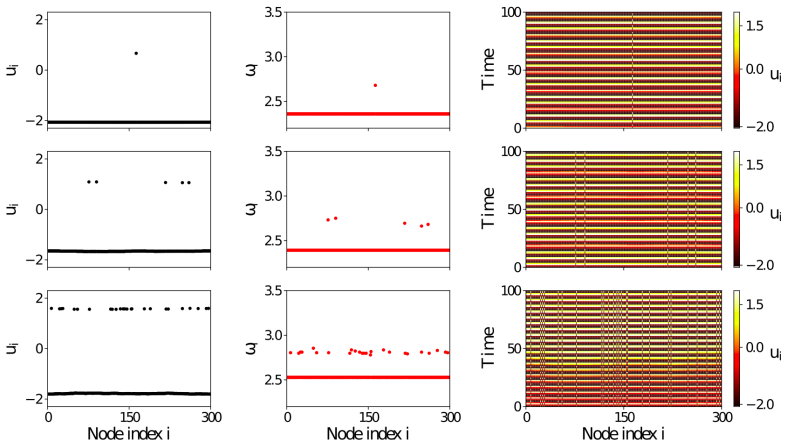
The authors induce solitary states in networks that were originally fully synchronized. Delaying every ingoing and outgoing link of a chosen node perturbs that node out of the coherent cluster, producing the characteristic solitary state: a synchronized cluster coexists with individual nodes displaced in phase and mean velocity. With homogeneous delays, all solitary nodes are displaced by roughly the same amount; with heterogeneous delays, displacements differ. The same technique works in reverse, starting from an all-delayed synchronized network and changing the delay on a few nodes. The authors conclude that the number, position, and displacement of solitary states can be fully controlled by the positions and values of the delays.
Load-bearing premise
The load-bearing premise is that every node whose links are delayed becomes a solitary node and every non-delayed node remains in the synchronized cluster, so the delay pattern exactly marks the solitary-state pattern.
Editorial extensions
If this is right
- A desired number of solitary nodes can be placed at desired locations by installing delays on that many selected nodes at those locations.
- Homogeneous delays give equally displaced solitary states; heterogeneous delays give unequally displaced ones, allowing tailored spatial patterns.
- Starting from an all-delayed synchronized network, changing the delay on a few nodes (or removing it) creates solitary states in the same way, so the control works in both directions.
- The same delay-engineering scheme produces solitary states in both continuous FitzHugh-Nagumo oscillators and discrete chaotic maps, suggesting a mechanism that does not depend on the specific node dynamics.
Reading between the lines
- A stronger, quantitatively testable version of the claim would be that the set of delayed nodes exactly equals the set of solitary nodes; the paper demonstrates this in examples but does not measure the match over many random delay placements, so a follow-up could check this one-to-one correspondence statistically.
- If the one-to-one mapping holds, the method becomes a design primitive for network control: any prescribed solitary-state pattern can be written as a delay pattern, with implications for targeted desynchronization in power grids or neural stimulation protocols.
- Since the delay value appears to set displacement, mapping displacement versus delay across a range (rather than the few values shown) would yield a calibration curve for how far a node can be pushed out of the cluster.
- The reverse scheme suggests that delay patterns can be edited incrementally, so a network's solitary-state pattern can be trimmed or extended without resetting the whole system.
Signed reviews
Editorial analysis
A structured set of objections, weighed in public.
Referee Report
Summary. The manuscript proposes a technique for engineering solitary states in networks of identical oscillators by introducing time delays on all links of selected nodes. The authors study two systems: a ring of FitzHugh-Nagumo oscillators described by Eq. (1) and a ring of coupled logistic maps described by Eq. (3). They show, through phase portraits, time series, snapshots, mean-phase-velocity profiles, and spatial profiles, that placing homogeneous or heterogeneous delays on a subset of nodes can make those nodes leave the synchronized cluster while the rest remain synchronized. They further demonstrate a reverse scheme in which a fully delayed network is perturbed by altering delays on a few nodes. Based on these examples, the abstract and Section 6 claim that the position and displacement extent of solitary elements can be completely controlled by the positions and values of the incorporated delays.
Significance. If the central claim were quantitatively established, this would be a useful contribution to the control of partial synchronization patterns, particularly because the technique is demonstrated in two very different dynamical systems (FHN oscillators and chaotic maps), suggesting a potentially general mechanism. The paper also connects delay engineering of chimera states to the less studied solitary states. However, the current evidence is largely qualitative and illustrative: no quantitative definition of solitary state is given, no systematic parameter scans are provided, and no statistical verification over random realizations is reported. The claimed "complete control" therefore goes beyond what the presented data support.
major comments (3)
- [Section 3, Figs. 2-4, Eq. (1)] The central positional-control claim requires demonstrating that, for arbitrary selections and parameter values, exactly the delayed nodes become solitary nodes and all non-delayed nodes remain in the synchronized cluster. The manuscript provides no quantitative definition of a solitary node, no measure of displacement from the cluster, and no statistics over random selections. Fig. 2 shows only 1, 5, and 25 delayed nodes, while Fig. 4 already shows a 125-delayed-node case where the solitary node exhibits irregular spiking and a smeared limit cycle, suggesting that the correspondence between delayed nodes and solitary nodes may break down as the delayed fraction grows. Please define a threshold-based measure (e.g., time-averaged deviation from the synchronized manifold or a phase-velocity difference), and report, over many random realizations and a range of delay values and delayed-node counts, the fraction of delayed nodes that are solitary and the fraction of non-delayed nodes that leave the cluster.
- [Section 6 and Figs. 9-10] The claim that the extent of displacement is completely controlled by the delay value is not supported by the data. Figs. 9 and 10 show only a few selected delay values, with no quantitative measure of displacement on the vertical axis and no error bars or repeated realizations. No functional relationship between the delay time and the solitary-node displacement is derived, fitted, or systematically scanned. Please provide quantitative displacement-versus-delay curves for both homogeneous and heterogeneous delays, with multiple random realizations and statistical measures, and state whether the displacement is a single-valued and monotone function of the delay in the studied regime.
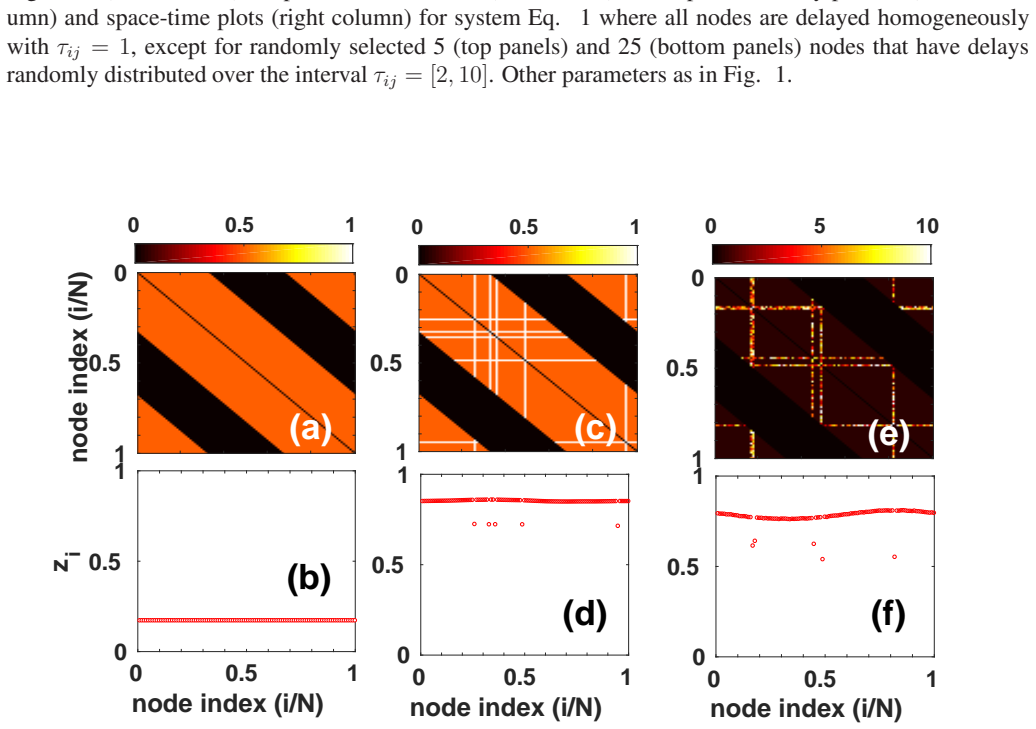
- [Sections 2 and 4] Eq. (1) delays both the incoming and outgoing links of a selected node, so non-delayed neighbors also receive delayed signals and could in principle leave the synchronized cluster; conversely, a delayed node could remain effectively synchronized for small delay values or strong coupling. The manuscript does not analyze the parameter window in which exactly the delayed nodes become solitary nodes. The reverse scheme in Section 4 concludes that "the mechanism works in both directions" based only on qualitative snapshots in Fig. 6, without testing whether the number of solitary nodes equals the number of modified nodes. Please provide a regime analysis that identifies where the delayed-node-to-solitary-node correspondence holds, including boundary cases such as small delays and large numbers of delayed nodes.
minor comments (4)
- [Section 3] In the sentence "we choose the delay times randomly in the interval τij. ∈ [1, 10]" there is an extra period after τij; it should read τij ∈ [1, 10].
- [Section 5] In the model description for the maps, "takes vale 1" should be "takes value 1".
- [Sections 2 and 5] The notation for the coupling range is inconsistent: Section 2 uses P/N with N=300 and r=0.35, while Section 5 uses K/N with r=0.32. Please unify the notation.
- [Throughout] The paper does not report the numerical integration scheme, time step, or transient length used for the FHN simulations, nor the number of iterations and transient for the maps, which makes reproduction difficult. Please add these details.
Circularity Check
No circularity: delays are inputs, solitary-state displacement is emergent simulation output, and self-citations are contextual rather than load-bearing.
full rationale
The paper contains no fitted parameters, no equation derived from the data it claims to predict, and no uniqueness theorem imported from prior work. The delay values and positions are inputs to the dynamical systems in Eqs. (1) and (3), and the solitary states are reported as emergent simulation results. The central claim that the number, position, and displacement of solitary nodes can be controlled by choosing delayed nodes and delay values is an empirical demonstration based on numerical integration and maps, not a reduction of the output to the input by construction. The self-citations, notably to Ghosh and Jalan (2018), are used explicitly to motivate the delay-engineering scheme, but the present paper's results are new simulations and are not derived from that citation. The absence of quantitative measures or exhaustive validation is a correctness/robustness concern, not a circularity concern. Under the stated criteria, there is no circular step to report.
Assumptions & free parameters
free parameters (7)
- Homogeneous delay value (FHN) =
1
- Heterogeneous delay range (FHN, forward scheme) =
1 to 10
- Heterogeneous delay range (FHN, reverse scheme) =
2 to 10
- Coupling phase phi =
pi/2 - 0.35
- Coupling radius r (FHN) and K/N (maps) =
0.35 and 0.32
- Number of delayed nodes =
1, 5, 25, 75, 125 (FHN); 5, 10, 20 (maps)
- Coupling strength (maps) =
0.9
assumptions (5)
- domain assumption FitzHugh-Nagumo equations with rotational coupling adequately model neural oscillators in the oscillatory regime.
- domain assumption The logistic map with mu = 4 is chaotic and is a valid local dynamics for coupled map networks.
- domain assumption Nonlocal ring topology with 2R neighbors per node is the network structure.
- domain assumption For phi = pi/2 - 0.35, the undelayed FHN network is completely synchronized.
- domain assumption Random initial conditions on the circle u^2 + v^2 = 4 for FHN and uniform [0,1] for maps do not affect the asymptotic state.
Cite this review
Pith. "Pith review of Delay engineered solitary states in complex networks." pith.science (2026). https://pith.science/paper/AJ3GNJ4Z
@misc{pith2026190801295,
  author       = {Pith},
  title        = {Pith review of: Delay engineered solitary states in complex networks},
  year         = {2026},
  howpublished = {\url{https://pith.science/paper/AJ3GNJ4Z}},
  note         = {Machine review of arXiv:1908.01295}
}
read the original abstract
We present a technique to engineer solitary states by means of delayed links in a network of neural oscillators and in coupled chaotic maps. Solitary states are intriguing partial synchronization patterns, where a synchronized cluster coexists with solitary nodes displaced from this cluster and distributed randomly over the network. We induce solitary states in the originally synchronized network of identical nodes by introducing delays in the links for a certain number of selected network elements. It is shown that the extent of displacement and the position of solitary elements can be completely controlled by the choice (values) and positions (locations) of the incorporated delays, reshaping the delay engineered solitary states in the network.
Figures


Figures from the paper (7 more)




Reference graph
Works this paper leans on
-
[1]
author A. Pikovsky , author M. G. Rosenblum , and author J. Kurths , title Synchronization: a universal concept in nonlinear sciences ( publisher Cambridge University Press , address Cambridge , year 2001 )
work page 2001
-
[2]
author S. Boccaletti , author A. N. Pisarchik , author C. I. del Genio , and author A. Amann , title Synchronization: F rom Coupled Systems to Complex Networks ( publisher Cambridge University Press , address Cambridge , year 2018 ), ISBN isbn 9781107056268
work page 2018
-
[3]
author A. Rothkegel and author K. Lehnertz , journal New J. Phys. volume 16 , pages 055006 ( year 2014 )
work page 2014
-
[4]
author R. G. Andrzejak , author C. Rummel , author F. Mormann , and author K. Schindler , journal Sci. Rep. volume 6 , pages 23000 ( year 2016 )
work page 2016
-
[5]
author P. Tass , author M. G. Rosenblum , author J. Weule , author J. Kurths , author A. Pikovsky , author J. Volkmann , author A. Schnitzler , and author H. J. Freund , journal Phys. Rev. Lett. volume 81 , pages 3291 ( year 1998 )
work page 1998
-
[6]
author Y. Kuramoto and author D. Battogtokh , journal Nonlin. Phen. in Complex Sys. volume 5 , pages 380 ( year 2002 )
work page 2002
-
[7]
author D. M. Abrams and author S. H. Strogatz , journal Phys. Rev. Lett. volume 93 , pages 174102 ( year 2004 )
work page 2004
-
[8]
author Y. Maistrenko , author B. Penkovsky , and author M. Rosenblum , journal Phys. Rev. E volume 89 , pages 060901 ( year 2014 )
work page 2014
Show all 42 references
-
[9]
Jaros , author Y
author P. Jaros , author Y. Maistrenko , and author T. Kapitaniak , journal Phys. Rev. E volume 91 , pages 022907 ( year 2015 )
2015
-
[10]
Mikhaylenko , author L
author M. Mikhaylenko , author L. Ramlow , author S. Jalan , and author A. Zakharova , journal C haos volume 29 , pages 023122 ( year 2019 )
2019
-
[11]
Hellmann , author P
author F. Hellmann , author P. Schultz , author P. Jaros , author R. Levchenko , author T. Kapitaniak , author J. Kurths , and author Y. Maistrenko , journal arXiv ( year 2018 )
2018
-
[12]
Jaros , author S
author P. Jaros , author S. Brezetsky , author R. Levchenko , author D. Dudkowski , author T. Kapitaniak , and author Y. Maistrenko , journal Chaos volume 28 , pages 011103 ( year 2018 )
2018
-
[13]
Rybalova , author N
author E. Rybalova , author N. Semenova , author G. Strelkova , and author V. Anishchenko , journal Eur. Phys. J. Spec. Top. volume 226 , pages 1857 ( year 2017 )
2017
-
[14]
Rybalova , author G
author E. Rybalova , author G. I. Strelkova , and author V. S. Anishchenko , journal Chaos Solitons Fractals volume 115 , pages 300 ( year 2018 )
2018
-
[15]
Semenova , author T
author N. Semenova , author T. Vadivasova , and author V. Anishchenko , journal Eur. Phys. J. Spec. Top. volume 227 , pages 1173 ( year 2018 )
2018
-
[16]
Poel , author A
author W. Poel , author A. Zakharova , and author E. Sch \"o ll , journal Phys. Rev. E volume 91 , pages 022915 ( year 2015 )
2015
-
[17]
Krishnagopal , author J
author S. Krishnagopal , author J. Lehnert , author W. Poel , author A. Zakharova , and author E. Sch \"o ll , journal Phil. Trans. R. Soc. A volume 375 , pages 20160216 ( year 2017 )
2017
-
[18]
author A. L. Do , author J. M. H\"ofener , and author T. Gross , journal New J. Phys. volume 14 , pages 115022 ( year 2012 )
2012
-
[19]
Haken , title Brain Dynamics: Synchronization and Activity Patterns in Pulse-Coupled Neural Nets with Delays and Noise ( publisher Springer , address Berlin , year 2007 )
author H. Haken , title Brain Dynamics: Synchronization and Activity Patterns in Pulse-Coupled Neural Nets with Delays and Noise ( publisher Springer , address Berlin , year 2007 )
2007
-
[20]
Zakharova , author I
author A. Zakharova , author I. Schneider , author Y. N. Kyrychko , author K. B. Blyuss , author A. Koseska , author B. Fiedler , and author E. Sch \"o ll , journal Europhys. Lett. volume 104 , pages 50004 ( year 2013 )
2013
-
[21]
Gjurchinovski , author A
author A. Gjurchinovski , author A. Zakharova , and author E. Sch \"o ll , journal Phys. Rev. E volume 89 , pages 032915 ( year 2014 )
2014
-
[22]
Gjurchinovski , author E
author A. Gjurchinovski , author E. Sch \"o ll , and author A. Zakharova , journal Phys. Rev. E volume 95 , pages 042218 ( year 2017 )
2017
-
[23]
Sawicki , author I
author J. Sawicki , author I. Omelchenko , author A. Zakharova , and author E. Sch \"o ll , journal Eur. Phys. J. Spec. Top. volume 226 , pages 1883 ( year 2017 )
2017
-
[24]
Semenov , author A
author V. Semenov , author A. Zakharova , author Y. Maistrenko , and author E. Sch \"o ll , journal Europhys. Lett. volume 115 , pages 10005 ( year 2016 )
2016
-
[25]
Zakharova , author N
author A. Zakharova , author N. Semenova , author V. S. Anishchenko , and author E. Sch \"o ll , journal Chaos volume 27 , pages 114320 ( year 2017 )
2017
-
[26]
editor F. M. Atay , ed., title Complex Time-Delay Systems , Understanding Complex Systems ( publisher Springer , address Berlin Heidelberg , year 2010 )
2010
-
[27]
author A. D. Kachhvah and author S. Jalan , journal New J. Phys. volume 21 , pages 015006 ( year 2019 )
2019
-
[28]
Popovych , author S
author O. Popovych , author S. Yanchuk , and author P. Tass , journal Phys. Rev. Lett. volume 107 , pages 228102 ( year 2011 )
2011
-
[29]
Yanchuk , author P
author S. Yanchuk , author P. Perlikowski , author O. Popovych , and author P. Tass , journal Chaos volume 21 , eid 047511 (pages numpages 11 ) ( year 2011 )
2011
-
[30]
Kantner , author E
author M. Kantner , author E. Sch \"o ll , and author S. Yanchuk , journal Sci. Rep. volume 5 , pages 8522 ( year 2015 )
2015
-
[31]
Ghosh and author S
author S. Ghosh and author S. Jalan , journal Chaos volume 28 , pages 071103 ( year 2018 )
2018
-
[32]
Masoliver , author N
author M. Masoliver , author N. Malik , author E. Sch \"o ll , and author A. Zakharova , journal Chaos volume 27 , pages 101102 ( year 2017 )
2017
-
[33]
o vel , and author E. Sch \
author I. Omelchenko , author O. E. Omel'chenko , author P. H\" o vel , and author E. Sch \"o ll , journal Phys. Rev. Lett. volume 110 , pages 224101 ( year 2013 )
2013
-
[34]
Chouzouris , author I
author T. Chouzouris , author I. Omelchenko , author A. Zakharova , author J. Hlinka , author P. Jiruska , and author E. Sch \"o ll , journal Chaos volume 28 , pages 045112 ( year 2018 )
2018
-
[35]
Semenova , author A
author N. Semenova , author A. Zakharova , author V. S. Anishchenko , and author E. Sch \"o ll , journal Phys. Rev. Lett. volume 117 , pages 014102 ( year 2016 )
2016
-
[36]
Semenova and author A
author N. Semenova and author A. Zakharova , journal Chaos volume 28 , pages 051104 ( year 2018 )
2018
-
[37]
Sawicki , author I
author J. Sawicki , author I. Omelchenko , author A. Zakharova , and author E. Sch \"o ll , journal Eur. Phys. J. B volume 92 , pages 54 ( year 2019 a )
2019
-
[38]
Nikitin , author I
author D. Nikitin , author I. Omelchenko , author A. Zakharova , author M. Avetyan , author A. L. Fradkov , and author E. Sch \"o ll , journal Phil. Trans. R. Soc. A ( year 2019 )
2019
-
[39]
Sawicki , author S
author J. Sawicki , author S. Ghosh , author S. Jalan , and author A. Zakharova , journal Front. Appl. Math. Stat. volume 5 , pages 19 ( year 2019 b )
2019
-
[40]
Ghosh and author S
author S. Ghosh and author S. Jalan , journal Int. J. Bifurc. Chaos volume 26 , pages 1650120 ( year 2016 )
2016
-
[41]
Ghosh , author A
author S. Ghosh , author A. Kumar , author A. Zakharova , and author S. Jalan , journal Europhys. Lett. volume 115 , pages 60005 ( year 2016 )
2016
-
[42]
Ghosh , author A
author S. Ghosh , author A. Zakharova , and author S. Jalan , journal Chaos Solitons Fractals volume 106 , pages 56 ( year 2018 )
2018
Reviewed August 14, 2026 · model on record in the stance chip above.
Discussion (0). Continue with ORCID to comment.