REVIEW 3 major objections 4 minor 1 cited by
Very badly ordered cycles of interval maps
T0 review · 3 major / 4 minor · reviewed 2026-08-14 · deepseek-v4-flash
Pith's one-line read A convergent pattern with coprime over-rotation pair is an over-twist exactly when its forced over-rotation interval starts at its own over-rotation number; non-coprime pairs break this equivalence and yield 'very badly ordered' patterns.
desk verdict The coprime characterization is solid and new; the non-coprime existence result for very badly ordered patterns is missing the key no-block-structure verification. read the letter →
The pith
A machine-rendered reading of the paper's core claim, the machinery that carries it, and where it could break.
The reading
What carries the argument
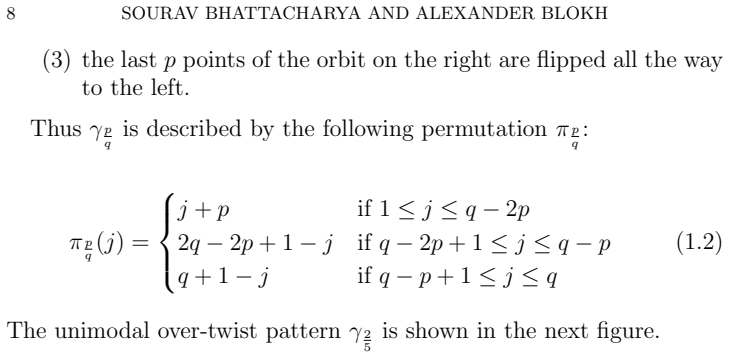
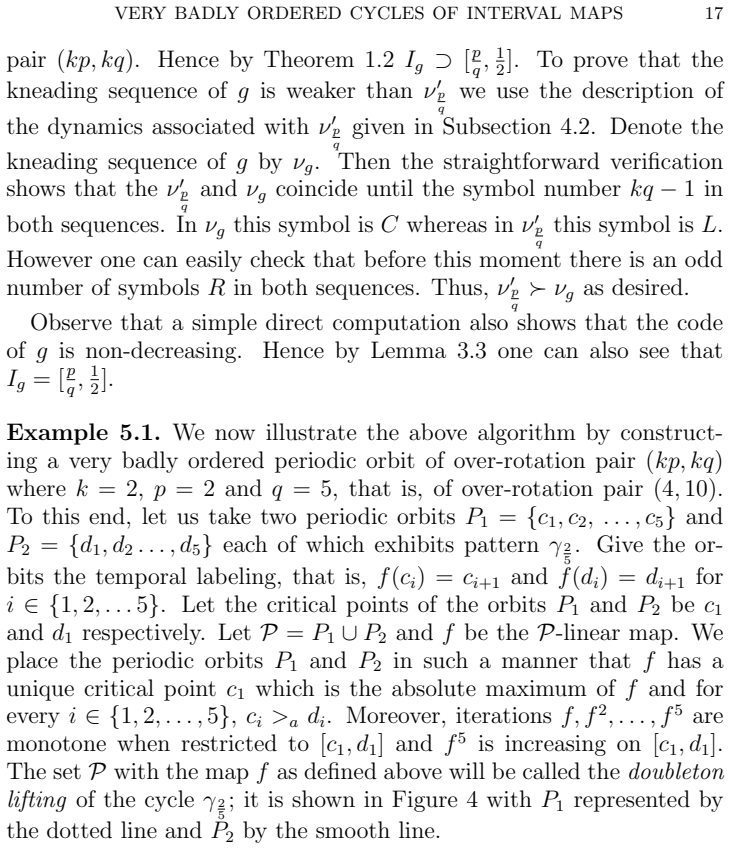
The code of a periodic orbit is a real-valued function $L$ defined by $L(f(y))=L(y)+\rho-\phi_a(y)$, where $\rho$ is the over-rotation number and $\phi_a$ records which side of the unique fixed point $a$ a point lies on; monotonicity of this code characterizes over-twists. The paper also uses the P-linear map, whose cycles are exactly the patterns forced by the original pattern, and kneading sequences of unimodal maps, through which it identifies the strongest unimodal pattern with a given over-rotation interval. The construction of very badly ordered patterns merges $k$ copies of the unimodal over-twist $\gamma_{p/q}$ into one orbit, then compares the resulting kneading sequence with the strongest kneading sequence for the interval $[p/q,1/2]$.
What would settle it
For the constructed orbit with over-rotation pair $(kp,kq)$, compute whether its points can be partitioned into blocks that collapse to an over-twist of over-rotation number $p/q$; exhibiting such a block structure would disprove the 'very badly ordered' claim. A more direct check is to compute $r_\pi$ by iterating the P-linear map and testing whether it is strictly less than $\rho(\pi)$, which would also falsify the construction.
Extended reading notes
Core claim
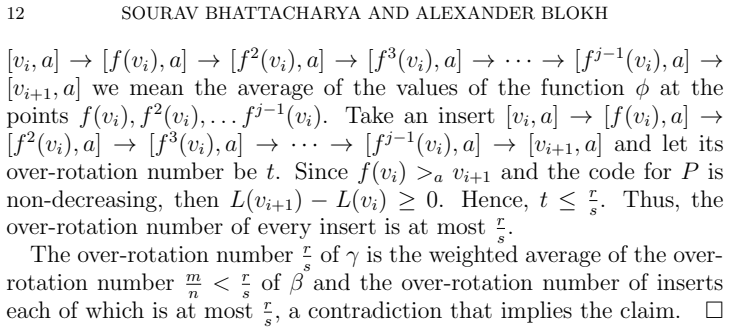
The central claim is Theorem 2.4: for a convergent pattern with coprime over-rotation pair $(p,q)$, having $r_\pi = \rho(\pi)$ — equivalently, having the P-linear map's over-rotation interval equal to $[p/q,1/2]$ — forces the pattern to be an over-twist. The proof runs through the code function: with a coprime pair, the code cannot have equal values on distinct points on the same side of the fixed point, and if the code ever decreased, Lemma 2.1 would produce a forced periodic orbit of smaller over-rotation number, contradicting $r_\pi=\rho(\pi)$. Hence the code is strictly monotone, and by the known over-twist criterion the pattern is an over-twist. The paper then shows this theorem is sharp: for every non-coprime pair $(kp,kq)$ with $2p<q$, Section 5 constructs a unimodal pattern whose over-rotation number equals the left endpoint of its forced over-rotation interval, yet which has no block structure over an over-twist of the same over-rotation number — a 'very badly ordered' pattern.
Load-bearing premise
The Section 5 construction proves that the merged orbit has over-rotation interval $[p/q,1/2]$, but it never proves the second defining condition of 'very badly ordered': that the orbit has no block structure over an over-twist of the same over-rotation number.
Editorial extensions
If this is right
- For a pattern with coprime over-rotation pair, the equality $r_\pi=\rho(\pi)$ completely characterizes over-twist patterns.
- Any pattern with $r_\pi=\rho(\pi)$ that is not an over-twist must have a non-coprime over-rotation pair.
- Very badly ordered patterns show that over-rotation forcing on the interval is not fully analogous to rotation-number forcing for circle maps of degree one.
- For every non-coprime over-rotation pair $(kp,kq)$ with $2p<q$, there exists a unimodal very badly ordered pattern with that pair.
- The strongest unimodal pattern forcing the over-rotation interval $[p/q,1/2]$ has an explicit kneading sequence, obtained from the over-twist kneading sequence by replacing each occurrence of the fragment $CRL$ with $LRR$.
Reading between the lines
- The existence of very badly ordered patterns suggests that the forcing relation among non-coprime patterns is not determined by the over-rotation interval alone, even though the interval is the same as for an over-twist pattern.
- A testable numerical signature of the constructed patterns is a kneading sequence that matches the strongest kneading sequence for $[p/q,1/2]$ up to position $kq-1$ and then shows a $C$ where the strongest sequence has an $L$; this could be checked for larger $k$.
- One might expect similar 'very badly ordered' phenomena in multimodal interval maps, since the construction relies only on unimodal kneading theory, although the paper does not address that case.
Signed reviews
Editorial analysis
A structured set of objections, weighed in public.
Referee Report
Summary. The paper studies over-rotation numbers of interval maps. It proves that for a convergent periodic orbit pattern with coprime over-rotation pair, equality between the left endpoint of the forced over-rotation interval and the over-rotation number forces the pattern to be an over-twist (Theorem 2.4). It then introduces 'very badly ordered' patterns, develops a criterion via non-decreasing code, constructs the strongest unimodal pattern associated with a rational over-rotation interval in Section 4, and in Section 5 claims to construct, for every non-coprime over-rotation pair (kp,kq) with 2p<q, a unimodal very badly ordered pattern by merging k copies of the over-twist gamma_{p/q}. The announced conclusion is that interval dynamics differ from the circle-map case: a non-coprime pattern can have r_pi = rho(pi) without a block structure over an over-twist.
Significance. Theorem 2.4 and the code criterion are clean and potentially useful, and the proof of Theorem 2.4 is transparent. The explicit description of the strongest kneading sequence nu'_rho and the algorithmic construction in Section 5 are concrete and would provide a family of examples not previously in the literature. The paper builds on established results and offers a falsifiable construction rather than a parameter fit. However, the central existence claim for very badly ordered patterns is not fully verified as written: Section 5 proves the equality of the left endpoint of the forced interval but not the absence of block structure required by Definition 3.2. If that gap can be filled, the paper would establish a genuine and interesting contrast with the circle-map theory.
major comments (3)
- [Section 5, paragraphs after the construction of g|P] The verification of the main claim checks only part of Definition 3.2. It shows that g|P is unimodal, has over-rotation pair (kp,kq), satisfies nu'_{p/q} ≻ nu_g ≻ nu_{p/q}, and has non-decreasing code, from which the authors infer I_g = [p/q,1/2]. It never checks the second defining condition of 'very badly ordered': that g|P has no block structure over an over-twist of over-rotation number p/q. This condition is not a consequence of I_g = [p/q,1/2] or of non-decreasing code; indeed, a pattern with a block structure over the over-twist gamma_{p/q} would also have those properties. Since the construction begins with k disjoint copies of gamma_{p/q} and then glues them into one orbit, a block structure over gamma_{p/q} is a natural candidate, and no argument in the paper rules it out. The proof of the main existence theorem is therefore incomplete.
- [Example 3.5] The example asserts, without computation or proof, that the displayed pattern pi 'does not have a block structure over an over-twist periodic orbit'. The only evidence given is a statement about the code being non-decreasing, which by Corollary 3.4 is equivalent to r_pi = rho(pi) but does not preclude a block structure over an over-twist. Since this is the first proposed example of a very badly ordered pattern, the missing verification is a substantive gap.
- [Section 4.2, construction of gamma'_rho and proof of Theorem 4.1] The identification of nu'_rho as the kneading sequence of the constructed map is asserted through phrases such as 'straightforward verification', 'it easily follows from the dynamics', and 'because of periodicity'. The proof of Theorem 4.1 and the comparisons in Section 5 depend on this identification. In particular, the claim that the point c3 under g has itinerary equal to nu'_rho and the assertion that any orbit of over-rotation number less than p/q would force a kneading sequence stronger than nu'_rho are not demonstrated. A rigorous proof should be supplied.
minor comments (4)
- [Section 5, notation] The notation c13 and c2(l-1) is ambiguous; it should be c_{1,3} or explained explicitly, otherwise the reader cannot distinguish c13 from c_{13} in the temporal labelling.
- [Section 5, reference to Lemma 1.2] The sentence 'Hence by Theorem 1.2 I_g ⊃ [p/q, 1/2]' refers to a 'Theorem 1.2' that does not exist; the intended reference is likely Lemma 1.2 or a result from [BM97].
- [Example 5.1, verification of code non-decreasing] The listed code values are not sufficient for the reader to check non-decreasingness without reconstructing the full spatial order and the map g|P; a table or explicit permutation for the example would help.
- [References] There are several typographical errors in the bibliography: 'Corrollary' in the text, 'mappimg' in [Sha64], 'aplications' in [BS13], and the citation label [MN90] does not match the listed authors Bobok and Kuchta.
Circularity Check
No circularity found: the left-endpoint equality is verified by direct kneading/code computations; the unproved no-block-structure clause is a correctness gap, not a circularity.
full rationale
Walking the derivation chain, Theorem 2.4 is a genuine characterization: given r_P=rho(P) and a coprime over-rotation pair, the proof rules out L(x)=L(y) by Lemma 2.2 and L(x)>L(y) by Lemma 2.1, so the code is strictly monotone and Theorem 1.3 ([BM99]) gives over-twist. Lemma 3.3 and Corollary 3.4 similarly derive r_pi=rho(pi) from a non-decreasing code; they are used as proof criteria, not as definitions of the target property. In Section 5 the constructed g|P is checked directly: the kneading sequence is compared term-by-term with nu'_{p/q}, and the code is computed to be non-decreasing, so the conclusion I_g=[p/q,1/2] follows from those computations plus Lemma 3.3 rather than being assumed. All imported results ([BM97], [BM99], [BS13]) are prior published theorems with assumptions independent of the present construction, so self-citation does not carry the argument in a circular way. The one caveat, visible in Section 5, is that the 'no block structure over an over-twist' clause of Definition 3.2 is asserted but never proved for g|P; that is an omitted structural verification (a correctness risk), not a reduction of the conclusion to its own input, so it does not affect the circularity score.
Assumptions & free parameters
assumptions (4)
- standard math Sharkovsky theorem and the forcing partial order for interval-map patterns.
- domain assumption Lemma 1.2 from [BM97]: an admissible loop of intervals generates a periodic point with the same over-rotation number.
- domain assumption Theorem 1.3 from [BM99]: a pattern is an over-twist if and only if it is convergent and has monotone code.
- domain assumption Theorem 1.4 from [BS13]: the only unimodal over-twist pattern of over-rotation number rho is gamma_rho, and I_f=[r_f,1/2] contains rho iff f has gamma_rho.
Cite this review
Pith. "Pith review of Very badly ordered cycles of interval maps." pith.science (2026). https://pith.science/paper/AJJYSKA7
@misc{pith2026190806145,
  author       = {Pith},
  title        = {Pith review of: Very badly ordered cycles of interval maps},
  year         = {2026},
  howpublished = {\url{https://pith.science/paper/AJJYSKA7}},
  note         = {Machine review of arXiv:1908.06145}
}
abstract
We prove that a periodic orbit $P$ with coprime over-rotation pair is an over-twist periodic orbit iff the $P$-linear map has the over-rotation interval with left endpoint equal to the over-rotation number of $P$. We then show that this result fails if the over-rotation pair of $P$ is not coprime. Examples of patterns with non-coprime over-rotation pairs are given so that these patterns have no block structure over over-twists but have over-rotation number equal to the left endpoint of the forced over-rotation interval (such patterns are called \emph{very badly ordered}). This presents a situation in which the results about over-rotation numbers on the interval and those about classical rotation numbers for circle degree one maps are different. In the end we elucidate a rigorous description of the strongest unimodal pattern that corresponds to a given over-rotation interval and use it to construct unimodal very badly ordered patterns with arbitrary non-coprime over-rotation pair.
Figures

Figures from the paper (2 more)

Forward citations
Cited by 1 Pith paper
-
Over-rotation intervals of bimodal interval maps
For N-bimodal interval maps, the paper explicitly describes all over-twist patterns and gives a lifting construction that computes the left endpoint of the over-rotation interval.
Reference graph
Works this paper leans on
-
[1]
Alseda, J
L. Alseda, J. Llibre, and M. Misiurewicz, Badly ordered cycles of circle maps, Pacific J. Math. 184 (1998), 23--41
1998
-
[2]
Alsed\` a , J
Ll. Alsed\` a , J. Llibre and M. Misiurewicz, Combinatorial Dynamics and Entropy in Dimension One, Advanced Series in Nonlinear Dynamics (2nd edition) 5 (2000), World Scientific Singapore (2000)
2000
-
[3]
67 (1987), 111--127
S.Baldwin, Generalisation of a theorem of Sharkovsky on prbits of continous real valued functions, Discrete Math. 67 (1987), 111--127
1987
-
[4]
Blokh, M
A. Blokh, M. Misiurewicz, A new order for periodic orbits of interval maps, Ergodic Theory and Dynamical Sys. 17(1997), 565-574
1997
- [5]
-
[6]
Blokh, K
A. Blokh, K. Snider, Over-rotation numbers for unimodal maps, Journal of Difference Equations and Aplications 19(2013), 1108--1132
2013
-
[7]
J. Bobok and M. Kuchta, X-minimal orbits for maps on the interval, Fund. Math. 156(1998), 33--66
work page 1998
-
[8]
J. Bobok and M. Kuchta, Combinatorial Patterns for maps of the interval, Mem. Amer. Math. Soc. 456(1990)
work page 1990
Show all 9 references
-
[9]
A. N. Sharkovsky, Coexistence of the cycles of a continuous mappimg of the line into itself, Ukraine Mat. Zh. 16(1964), 61--71 (Russian)
1964
Reviewed August 14, 2026 · model on record in the stance chip above.
Discussion (0). Continue with ORCID to comment.