REVIEW 3 major objections 4 minor 26 references
From Simulation to Real Scans: Anomaly Detection in Maritime Cargo with Muon Scattering Tomography
T0 review · 3 major / 4 minor · reviewed 2026-08-16 · deepseek-v4-flash
Pith's one-line read An anomaly detector trained only on simulated benign cargo can localize contraband in real one-hour muon scans of shipping containers.
desk verdict A promising first sim-to-real demo with a genuinely useful scoring function, but the missing real benign baseline keeps the operational claim from being proven. read the letter →
The pith
A machine-rendered reading of the paper's core claim, the machinery that carries it, and where it could break.
The reading
What carries the argument
The load-bearing components are (i) the attention U-Net denoiser $f_\theta$, trained exclusively on benign synthetic axial scattering maps with a composite MSE–SSIM–TV loss, so that benign structure is reproduced and out-of-distribution structure survives in the residual map $E=|x-f_\theta(x)|$; and (ii) the Homogeneity Index, a cell-based score that partitions the residual into non-overlapping cells, builds intensity histograms per cell and for the full map, and sums the per-bin standard deviation across cells: $HI = \sum_i \sqrt{\frac{1}{n}\sum_j (p_{ij}-p_i)^2}$. The HI is what transfers: by measuring spatial structure rather than error magnitude, it suppresses the uniform cosmic-ray noise floor that varies between cargo configurations and between simulation and measurement. The synthetic side is carried by a pipeline that renders randomized intermediate bulk container scenes into a detector simulation with a cosmic-ray muon generator, and reconstructs them with the same algorithm used for real volumes, so the network only ever sees reconstruction products of benign simulated scenes.
What would settle it
Acquire real benign scans of the same single- and dual-IBC configurations under the same one-hour protocol, run the Cold-start model, and measure the slice-level false positive rate at 95% true positive rate using thresholds calibrated on synthetic data; if localized reconstruction artifacts or non-uniform real noise produce HI scores comparable to a submerged weapon, the claimed sim-to-real transfer fails at the operational operating point.
Extended reading notes
Core claim
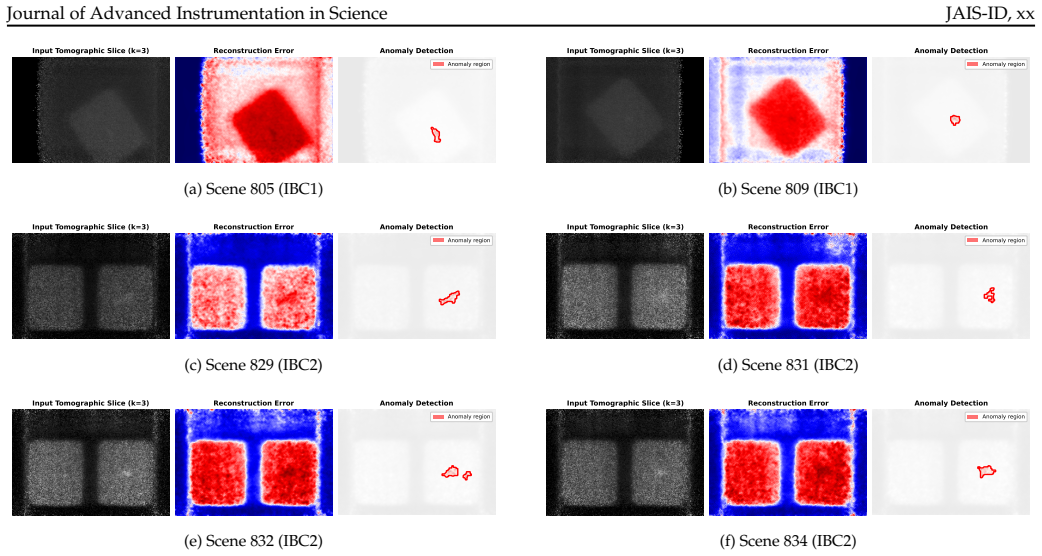
The central claim is that unsupervised out-of-distribution detection works end-to-end for maritime muon tomography: an attention U-Net trained only on physically consistent synthetic benign cargo maps reconstructs the benign background, and anything it cannot reproduce, such as submerged handguns, persists in the pixel-wise residual. The Homogeneity Index converts that residual into an anomaly score by comparing local cell histograms against the global histogram, so uniform cosmic-ray noise contributes little while a localized object produces a distributional shift. The paper reports that pixel-level MAE scoring collapses under domain shift (AUROC drops to 0.379 on IBC2 for the IBC1-only model), whereas HI-32 and HI-16 retain AUROC above 0.74 across configurations, and that the Cold-start model, fine-tuned on a small set of synthetic IBC2 scenes, transfers to real scans of both configurations without any real measurement in training. The real-data evidence is limited to scenes that all contain contraband; detection and correct localization are shown on real scans, while quantitative false-alarm behavior is evaluated on synthetic data only.
Load-bearing premise
The framework assumes that real benign cargo scans, which were never acquired, produce reconstruction-error maps whose noise is spatially uniform enough that the Homogeneity Index's distributional test separates genuine hidden objects from reconstruction artifacts and dead-pixel spikes without an unacceptable false-alarm rate.
Editorial extensions
If this is right
- No labeled contraband is needed: because the network is trained only on benign scenes and the score is thresholded, any object whose scattering signature is absent from normality is flagged, regardless of weapon type or geometry.
- A single model can cover multiple cargo configurations: the IBC1-trained model retains useful discriminative power on IBC2, and a small synthetic fine-tuning set (Cold-start) keeps in-domain sensitivity while matching the best cross-domain score.
- Spatial scoring, not pixel-by-pixel error, is the transferable signal: HI keeps AUROC above 0.74 in every cross-configuration scene-level test while MAE falls to or below chance.
- One-hour scans are adequate for detection: under the operational scan time the framework resolves submerged handgun signatures in both single- and dual-container real scans, even with geometric misalignment.
Reading between the lines
- The framework's own evidence stops at detection on real contraband-bearing scenes; the first decisive test is to acquire real benign scans and measure the false-positive rate at the synthetic-calibrated threshold, because the assumption of uniform real noise is untested.
- Encoding known scene structure, such as the gap between two IBCs, into the model or the scoring stage should reduce spurious contours; this follows directly from the paper's observation that the gap generates elevated reconstruction error.
- An adaptive or multi-scale variant of HI, combining HI-16 and HI-32, is a natural next step since the two grid sizes are not uniformly ordered across configurations, suggesting cell size interacts with object size and background structure.
- The residual-distribution scoring idea should transfer to other imaging domains with rare localized targets on a uniform noise floor; each domain would need its own benign training set.
Signed reviews
Editorial analysis
A structured set of objections, weighed in public.
Referee Report
Summary. The paper presents an unsupervised anomaly detection framework for muon scattering tomography (MST) of maritime cargo. Synthetic IBC scenes are generated with a Geant4-based pipeline (B2G4, EcoMug) for single- and dual-container configurations; an attention U-Net is trained exclusively on benign synthetic slices to reconstruct scattering-density maps; the pixel-wise reconstruction error is scored by a new Homogeneity Index (HI) that suppresses spatially uniform noise while preserving localized anomalies. Three training strategies are compared on synthetic data, and the Cold-start model is applied to six real SilentBorder container scans, all containing contraband. The central claim, stated in Section 5.3, is that a model trained only on simulated benign cargo transfers to real one-hour muon scans across two cargo configurations.
Significance. If the central claim holds, this would be a valuable first demonstration that an anomaly detector for MST can be trained entirely on physically consistent synthetic data and still localize contraband in real scans, with HI providing robustness to cargo-configuration shift. The paper has clear strengths: the synthetic pipeline is physically motivated; the authors make an explicit, testable claim that no real measurement entered training; both scene- and slice-level metrics are reported on synthetic data; and the IBC1-to-IBC2 transition is a sensible controlled proxy for operational variability. The significance is conditional, however, because the real-data evidence is qualitative only, no real benign scan was acquired, and the measured scenes deliberately replicate the simulated configurations. The absence of a real benign baseline leaves the operational false-alarm rate unbounded, so the headline sim-to-real claim is not yet quantitatively established.
major comments (3)
- [Section 3 and Section 5.3] The absence of any real benign acquisition is the load-bearing gap. Section 3 states that "all measured scenes contain contraband, as no benign real acquisition was available," and Section 5.2 acknowledges that dead-pixel artifacts, high-magnitude noise spikes, and reconstruction artifacts produce spurious contours, while Section 5.3 notes that the IBC2 central gap generates elevated reconstruction error along the boundary. Under these conditions, a real benign scan could plausibly produce spatially structured residuals that HI would score as anomalous. Because every real scene contains a handgun bundle, successful localization does not discriminate between a true anomaly signal and a generally elevated or nonuniform residual baseline. The claim in Section 5.3 that "the framework transfers from physically consistent synthetic data to real container scans across two distinct cargo configurations" is therefore stronger than the evidence supports. The authors should either add real benign scans with a false-alarm analysis at a specified operational threshold, or explicitly reframe the real-data result as a proof-of-detection study with false-alarm metrics limited to synthetic data.
- [Section 5.3 and Figure 5] The real-data evaluation is purely qualitative. No AUROC, FPR@95%, recall, or numerical HI/MAE scores are reported for the six real scenes, and no threshold tau for the decision rule s(x)>tau is specified for real deployment. With all six scenes containing contraband, the paper cannot quantify the sim-to-real transfer in a way that another group could reproduce or benchmark. A quantitative real-data report, even with a small number of scenes, is needed to support the statement that "the sim-to-real gap can be bridged."
- [Section 3 and Section 5.3] The transfer test is conducted under best-case conditions. The measured scenes replicate the synthetic configurations described in Section 3, and the same proprietary reconstruction algorithm processes both synthetic and real volumes. The real scenes are therefore the same two IBC layouts used in simulation, so the evaluation measures robustness to sensor and reconstruction statistics but not to unseen cargo geometries or arrangements. The conclusions in Section 6 acknowledge that the scope is bounded to the SilentBorder demonstration, but the abstract and Section 5.3 should carry the same qualification when claiming transfer "across two distinct cargo configurations," otherwise the generality of the claim exceeds the evidence.
minor comments (4)
- [Tables 2 and 3] The IBC2 test set contains 7 benign and 20 anomalous scenes, making anomalies the majority class, contrary to the statement in Section 4.3 that anomalous scenes are a minority of operational traffic. The reported AUPRC values should be interpreted with this reversed imbalance in mind.
- [Figure 5] The caption states that each panel shows "scoring metrics," but no numerical MAE or HI values are visible or described in the text. Either include the values in the figure or remove the claim from the caption.
- [Section 2, Equation (2)] The symbols in the composite loss are mostly clear, but the SSIM term is not defined in the text; citing reference [14] is sufficient for informed readers, yet a one-line definition would improve readability.
- [Section 3] The text says the real scenes contain "a single bundle of three tightly packed handguns," while the synthetic anomalous scenes contain handgun replicas. The difference in threat size and composition between simulation and real data is not discussed; a brief note on how this affects the sim-to-real comparison would be useful.
Circularity Check
No circular derivation: training, scoring, and validation are separable; the missing real benign baseline is an external-validity limitation, not a circular reduction.
full rationale
The central claim is not equivalent to its inputs by construction. The U-Net is trained only on synthetic benign slices (Section 3: 'the anomalous partition serves exclusively to validate the anomaly scores and never enters training'), the HI cell sizes, histogram bins, and preprocessing gains are fixed design choices or are selected on benign synthetic scenes only, and the real scans are passed through the fixed checkpoint without retraining (Section 5.3: 'No real measurement entered the training at any point'). The observed localization on real anomalous scenes is therefore an out-of-sample observation rather than a restatement of the training objective. The B2G4 pipeline [15] and GScan reconstruction patents [20,21] involve overlapping authors, but they function as tools and the real measurement campaign provides an independent, falsifiable check; no uniqueness theorem or same-author result is invoked to forbid alternative scoring rules. The genuine weakness is explicitly acknowledged in Section 3: 'All measured scenes contain contraband, as no benign real acquisition was available; the real-data evidence therefore establishes detection and correct localization under operational conditions, while the metrics are quantified on synthetic data only.' This absence of a real benign baseline means the operational false-alarm rate is not bounded, and the deliberate replication of the simulated IBC configurations makes the transfer test easier. Those are external-validity gaps, not circular reductions: the real-data evidence is weak but not self-referential. Score 2 reflects only the presence of non-load-bearing self-citations in the simulation and reconstruction infrastructure chain.
Assumptions & free parameters
free parameters (5)
- Wavelet subband gains and soft threshold =
coarse gain 1.8, fine gain 2.5, threshold 0.05
- Reconstruction loss weights =
alpha = 0.9, lambda_TV = 1e-3
- Homogeneity Index grid parameters =
k = 16 intensity bins; cell sizes c = 16 and c = 32
- Preprocessing slice range and crop =
Z in [71,328]; crop 195 by 290 pixels
- Gaussian blur and slice averaging window =
3x3 kernel, sigma = 0.25; 3-slice moving average
assumptions (6)
- domain assumption EcoMug and Geant4 v11.0.3 generate physically consistent cosmic-muon flux and scattering for cargo scenes.
- domain assumption The proprietary GScan reconstruction is a fixed black box that maps simulated and real detector data into comparable scattering-density volumes at 1 cm resolution.
- domain assumption Real benign cargo scans have a spatially uniform reconstruction-error floor that the Homogeneity Index can separate from localized anomaly signatures.
- domain assumption Submerged handgun replicas are a representative concealed threat for validating threat-agnostic anomaly detection.
- standard math The multiple Coulomb scattering formula (Equation 1) correctly captures the material-dependent scattering used for reconstruction.
- standard math Averaging slice-level anomaly scores into a scene-level score preserves discriminative information.
Cite this review
Pith. "Pith review of From Simulation to Real Scans: Anomaly Detection in Maritime Cargo with Muon Scattering Tomography." pith.science (2026). https://pith.science/paper/AJMOHX3X
@misc{pith2026260812068,
  author       = {Pith},
  title        = {Pith review of: From Simulation to Real Scans: Anomaly Detection in Maritime Cargo with Muon Scattering Tomography},
  year         = {2026},
  howpublished = {\url{https://pith.science/paper/AJMOHX3X}},
  note         = {Machine review of arXiv:2608.12068}
}
read the original abstract
Maritime cargo inspection requires imaging technologies capable of detecting concealed threats within dense, sealed containers, a role for which Muon Scattering Tomography (MST) is well suited: it images their interior through the density-dependent deflection of naturally occurring cosmic muons. However, MST remains constrained by the scarcity of labeled scans and by a cosmic muon flux that is both low and stochastic. Anomaly detection algorithms must therefore be trained on simulations, yet operate on measured scans acquired under different conditions, a sim-to-real gap that remains a central obstacle to operational deployment. We present the first end-to-end anomaly detection framework for maritime MST, from physically consistent simulations to validation on real container scans from the SilentBorder demonstration campaign. The task is cast as an out-of-distribution problem: the framework learns the spatial configurations of benign cargo and flags threats as deviations in the reconstruction error space, remaining agnostic to threat type and geometry. An attention U-Net, trained exclusively on benign synthetic scenes, preserves small-scale scattering signatures through its skip connections, and contraband consequently persists in the pixel-wise reconstruction error instead of being absorbed into the reconstructed background. A scoring function, the Homogeneity Index (HI), suppresses spatially uniform cosmic-ray statistical noise while amplifying coherent anomaly signatures: where pixel-level metrics collapse under a change of cargo configuration, HI retains its discriminative power. We evaluate three training strategies across two distinct cargo configurations under operational one-hour scan times, and test the best model on real muon cargo scans. The results for the studied scenarios indicate that the sim-to-real gap can be bridged.
Figures


Figures from the paper (3 more)


Reference graph
Works this paper leans on
-
[1]
H. Tagawa and Q. Meng, Network evolution of major shipping routes: perspectives from dominant ports and shipping lines, J. Transp. Geogr.128(2025) 104376
work page 2025
-
[2]
S. Barnes et al., Cosmic-ray tomography for border secu- rity, Instruments7(2023) 13 9 Journal of Advanced Instrumentation in Science JAIS-ID, xx Input Tomographic Slice (k=3) Reconstruction Error Anomaly Detection Anomaly region (a) Scene 805 (IBC1) Input Tomographic Slice (k=3) Reconstruction Error Anomaly Detection Anomaly region (b) Scene 809 (IBC1) I...
work page 2023
-
[3]
Bonechi et al., Atmospheric muons as an imaging tool, Rev
L. Bonechi et al., Atmospheric muons as an imaging tool, Rev. Phys.5(2020) 100038
work page 2020
-
[4]
Borozdin et al., Radiographic imaging with cosmic- ray muons, Nature422(2003) 277
K.N. Borozdin et al., Radiographic imaging with cosmic- ray muons, Nature422(2003) 277
work page 2003
-
[5]
K. Borozdin et al., Muon imaging methods and applica- tions, Optica Imaging Congress, Technical Digest Series (2023) paper HTu5D.2
work page 2023
-
[6]
W. O’Donnell, D. Mahon, G. Yang and S. Gardner, Muo- graphic image upsampling with machine learning for built infrastructure applications, Particles8(2025) 33
work page 2025
-
[7]
S. Riggi et al., Muon tomography imaging algorithms for nuclear threat detection inside large volume containers with the Muon Portal detector, Nucl. Instrum. Methods Phys. Res. A728(2013) 59–68
work page 2013
-
[8]
Georgadze, Muon imaging for illicit cargo detection: a simulation-based study, J
A. Georgadze, Muon imaging for illicit cargo detection: a simulation-based study, J. Instrum.20(2025) P06053
work page 2025
Show all 26 references
-
[9]
Sattler et al., A comprehensive framework toward the seamless integration of muon reconstruction algorithms with machine learning, J
F.A. Sattler et al., A comprehensive framework toward the seamless integration of muon reconstruction algorithms with machine learning, J. Appl. Phys.138(2025) 144904
2025
-
[10]
Bueno Rodriguez et al., Pillar embedding visualization for muon-scattering tomography, J
A. Bueno Rodriguez et al., Pillar embedding visualization for muon-scattering tomography, J. Appl. Phys.138(2025) 14
2025
-
[11]
Bury and M
F. Bury and M. Lagrange, Scattering-based machine learn- ing algorithms for momentum estimation in muon tomog- raphy, Particles8(2025) 43
2025
-
[12]
Bao et al., BMAD: benchmarks for medical anomaly de- tection, arXiv:2306.11876 (2023)
J. Bao et al., BMAD: benchmarks for medical anomaly de- tection, arXiv:2306.11876 (2023)
2023 arXiv
-
[13]
Ronneberger, P
O. Ronneberger, P . Fischer and T. Brox, U-Net: convolu- tional networks for biomedical image segmentation, MIC- CAI (2015) 234–241
2015
-
[14]
Wang et al., Image quality assessment: from error vis- ibility to structural similarity, IEEE Trans
Z. Wang et al., Image quality assessment: from error vis- ibility to structural similarity, IEEE Trans. Image Process. 13(2004) 600–612
2004
-
[15]
Bueno Rodriguez et al., B2G4: a synthetic data pipeline for the integration of Blender models in Geant4 simulation toolkit, J
A. Bueno Rodriguez et al., B2G4: a synthetic data pipeline for the integration of Blender models in Geant4 simulation toolkit, J. Adv. Instrum. Sci. (2024) 476
2024
-
[16]
Western Global, Intermediate bulk containers — IBC com- pliance & regulations, Support Insights Guide (2021)
2021
-
[17]
Pagano et al., EcoMug: an efficient cosmic muon gen- erator for cosmic-ray muon applications, Nucl
D. Pagano et al., EcoMug: an efficient cosmic muon gen- erator for cosmic-ray muon applications, Nucl. Instrum. Methods Phys. Res. A1014(2021) 165732
2021
-
[18]
Agostinelli et al., GEANT4—a simulation toolkit, Nucl
S. Agostinelli et al., GEANT4—a simulation toolkit, Nucl. Instrum. Methods Phys. Res. A506(2003) 250–303
2003
-
[19]
Zaher et al., Optimization of a cosmic muon tomogra- phy scanner for cargo border control inspection, J
Z. Zaher et al., Optimization of a cosmic muon tomogra- phy scanner for cargo border control inspection, J. Appl. Phys.138(2025) 19
2025
-
[20]
Kiisk et al., U.S
M. Kiisk et al., U.S. Patent 12,529,808 (2026)
2026
-
[21]
Georgadze et al., U.S
A. Georgadze et al., U.S. Patent 11,774,626 (2023)
2023
-
[22]
Donoho, De-noising by soft-thresholding, IEEE Trans
D.L. Donoho, De-noising by soft-thresholding, IEEE Trans. Inf. Theory41(1995) 613–627
1995
-
[23]
Zong, A.F
X. Zong, A.F. Laine and E.A. Geiser, Speckle reduction and contrast enhancement of echocardiograms via multiscale nonlinear processing, IEEE Trans. Med. Imaging17(1998) 532–540
1998
-
[24]
Hanley and B.J
J.A. Hanley and B.J. McNeil, The meaning and use of the area under a receiver operating characteristic (ROC) curve, Radiology143(1982) 29–36
1982
-
[25]
Saito and M
T. Saito and M. Rehmsmeier, The precision-recall plot is more informative than the ROC plot when evaluating bi- nary classifiers on imbalanced datasets, PLOS ONE10 (2015) e0118432
2015
-
[26]
McDermott et al., A closer look at AUROC and AUPRC under class imbalance, Adv
M.B.A. McDermott et al., A closer look at AUROC and AUPRC under class imbalance, Adv. Neural Inf. Process. Syst.37(2024) 10
2024
Reviewed August 16, 2026 · model on record in the stance chip above.
Discussion (0). Continue with ORCID to comment.