Stellar mass loading drives dissipation and reacceleration in AGN jets: Explaining VLBI-Gaia offsets and constraining jet power
Pith reviewed 2026-06-27 08:37 UTC · model grok-4.3
The pith
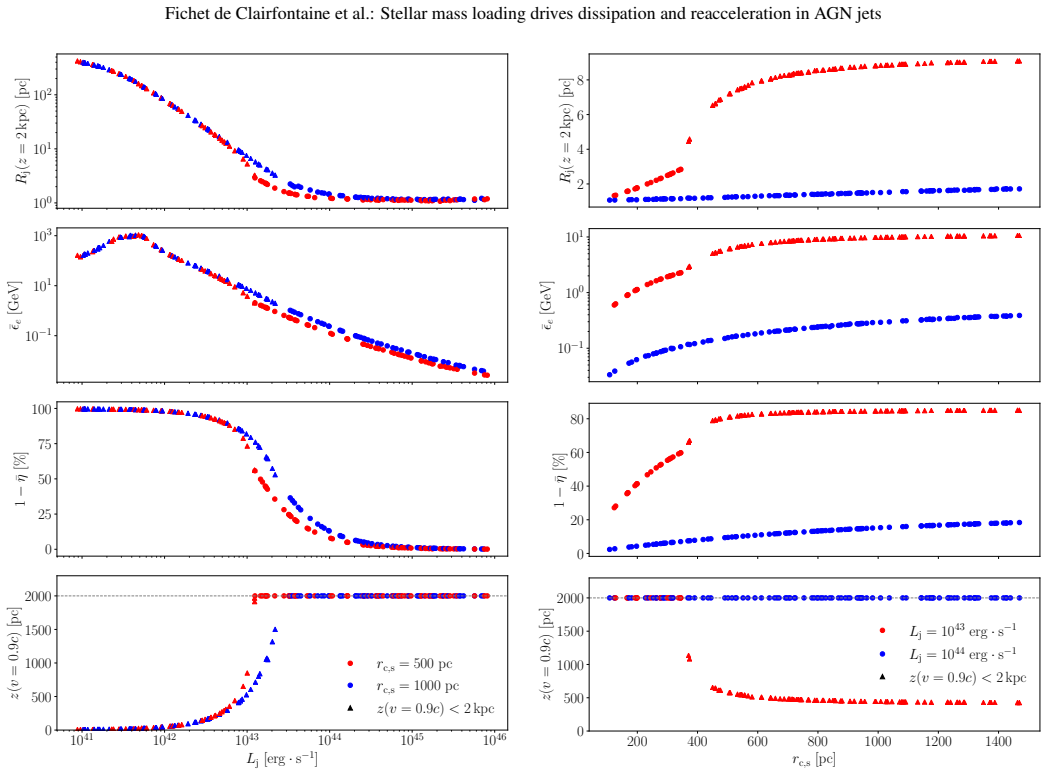
Stellar winds load mass into AGN jets and produce radio-optical centroid offsets only for jet powers between 10^{42.5} and 10^{44} erg s^{-1}.
A machine-rendered reading of the paper's core claim, the machinery that carries it, and where it could break.
Core claim
In steady-state axisymmetric RMHD simulations that include baryonic mass loading from stellar winds, parsec-scale radio-optical offsets appear exclusively for jet powers L_j ∼ 10^{42.5}–10^{44} erg s^{-1}. Within this range the winds decelerate the flow at intrinsic distances of a few 10^2–10^3 pc, shifting the optical synchrotron centroid downstream and generating projected offsets of ∼0.1–4 mas. Offsets depend on stellar core radius, viewing angle and the degree of optical jet dominance; they vanish outside the stated power interval. The same models recover the redshift trend of offset frequency through the evolution of thermally pulsing asymptotic giant branch mass loss.
What carries the argument
Axisymmetric relativistic magnetohydrodynamic simulations of jets that incorporate stellar-wind mass loading, followed by radiative-transfer post-processing to produce synthetic radio and optical synchrotron maps and to measure their centroids.
If this is right
- Offsets of 0.1–4 mas appear at z=1 only inside the quoted power window.
- Offset size and presence vary with stellar distribution, viewing angle and optical jet dominance.
- Offsets are absent for jet powers outside 10^{42.5}–10^{44} erg s^{-1}.
- The redshift dependence of offset incidence matches observations through TP-AGB mass-loss evolution.
- Radio-optical offsets supply a constraint on jet power and jet-host coupling independent of lobe-based methods.
Where Pith is reading between the lines
- Stellar mass loading sets a minimum dissipation floor that any additional mechanism must surpass in jets outside the quoted power range.
- Offset statistics could be used to infer the radial distribution of evolved stars in AGN host galaxies at cosmological distances.
- The mechanism supplies a baseline interaction term that cosmological simulations of jet feedback must include when modelling energy deposition on hundred-parsec scales.
Load-bearing premise
Stellar mass loading from winds dominates the dissipation and reacceleration beyond the radio core rather than other mechanisms.
What would settle it
Detection of statistically significant radio-optical offsets in AGN whose jet kinetic power has been independently measured to lie below 10^{42.5} erg s^{-1} or above 10^{44} erg s^{-1}.
Figures




read the original abstract
Recent Very Long Baseline Interferometry (VLBI) and Gaia astrometry reveal systematic milliarcsecond-scale offsets between the radio and optical centroids of active galactic nuclei (AGN). These "radio-optical offsets" do not alter the standard opacity-driven interpretation of radio core shifts. Instead, they indicate that the optical emission centroid is frequently displaced downstream of the radio synchrotron optical depth $\tau = 1$ surface, implying that additional dissipation and particle reacceleration occur beyond the opacity radio core within relativistic jets. We perform steady-state, axisymmetric relativistic magnetohydrodynamic (RMHD) simulations of AGN jets, including baryonic mass-load from stellar winds, varying jet kinetic power, and stellar core radius. Synthetic synchrotron emission maps in radio and optical bands are generated via a radiative transfer code, and centroid offsets are extracted for comparison with observations. Parsec-scale radio-optical offsets arise only for jet powers $L_{\rm j} \sim 10^{42.5} - 10^{44}\,\rm{erg}\,\rm{s}^{-1}$. In this regime, stellar winds trigger jet deceleration at intrinsic distances of a few $10^2-10^3\,\rm{pc}$, shifting the optical centroid downstream and producing offsets of $\sim 0.1 - 4\,\rm{mas}$ (a few tens of parsecs at $z=1$). Offsets depend on stellar distribution, viewing angle, and optical jet dominance, and vanish outside this power range. We reproduce the observed redshift evolution of offset incidence, linking it to the cosmic evolution of thermally pulsing asymptotic giant branch (TP-AGB) mass loss. Although stellar mass loading is unlikely to be the sole dissipation mechanism, its unavoidable presence in galactic nuclei makes it a natural baseline for energy dissipation. Radio-optical offsets therefore offer a constraint on AGN jet power and jet-host coupling, independent of traditional lobe-based methods.
Editorial analysis
A structured set of objections, weighed in public.
Referee Report
Summary. The manuscript uses steady-state axisymmetric RMHD simulations of AGN jets that incorporate baryonic mass loading from stellar winds. Varying jet kinetic power L_j and stellar core radius, the authors generate synthetic radio and optical synchrotron maps via radiative transfer and extract centroid offsets. They report that parsec-scale radio-optical offsets (0.1-4 mas) occur exclusively for L_j in 10^{42.5}-10^{44} erg s^{-1}, where stellar winds cause jet deceleration at intrinsic distances of a few 10^2-10^3 pc, shifting the optical centroid downstream of the radio au=1 surface. The model reproduces the observed redshift evolution of offset incidence via the cosmic evolution of TP-AGB mass loss. Offsets depend on stellar distribution, viewing angle, and optical dominance; the mechanism is presented as a natural baseline rather than the sole dissipation process.
Significance. If the central result holds under the adopted stellar profiles and mass-loss rates, the work supplies an independent observational constraint on jet power in the intermediate-luminosity regime where lobe-based methods are difficult. The forward simulation approach (rather than parameter fitting) and the explicit link to redshift-dependent stellar evolution are strengths that allow falsifiable predictions for offset incidence and magnitude.
major comments (2)
- [Abstract] Abstract: the statement that offsets 'arise only' for L_j ∼ 10^{42.5}-10^{44} erg s^{-1} is the central claim. This range is produced by the specific stellar mass-loading rate set by the chosen core radius and TP-AGB mass-loss prescription; without an explicit sensitivity study showing how the window shifts when the loading rate is varied by a factor of a few (while keeping other inputs fixed), the exclusivity of the reported power interval cannot be assessed as robust.
- [Abstract] Abstract: the model assumes optical emission is jet synchrotron whose centroid is shifted solely by the deceleration profile. The manuscript should quantify how the reported offsets change if a non-negligible fraction of the optical flux arises from a different component or if additional dissipation (internal shocks, reconnection) is included at comparable levels; otherwise the claim that stellar loading sets the observed offsets in this power window remains conditional on that dominance assumption.
minor comments (1)
- The abstract states that offsets 'vanish outside this power range'; a concise table or figure summarizing the simulated offset magnitudes and incidence for the full grid of L_j and core radii would make this statement immediately verifiable.
Simulated Author's Rebuttal
We thank the referee for the constructive review. We address each major comment below and will revise the manuscript to strengthen the robustness claims.
read point-by-point responses
-
Referee: [Abstract] Abstract: the statement that offsets 'arise only' for L_j ∼ 10^{42.5}-10^{44} erg s^{-1} is the central claim. This range is produced by the specific stellar mass-loading rate set by the chosen core radius and TP-AGB mass-loss prescription; without an explicit sensitivity study showing how the window shifts when the loading rate is varied by a factor of a few (while keeping other inputs fixed), the exclusivity of the reported power interval cannot be assessed as robust.
Authors: We agree that an explicit sensitivity study on the mass-loading rate (independent of core radius) is needed to fully substantiate the exclusivity of the reported power window. Although varying the stellar core radius already modulates the effective loading rate through changes in stellar density, this does not isolate the normalization of the TP-AGB mass-loss rate while holding all other inputs fixed. We will add a dedicated sensitivity analysis varying the mass-loss rate by factors of 2 and 0.5 in the revised manuscript. revision: yes
-
Referee: [Abstract] Abstract: the model assumes optical emission is jet synchrotron whose centroid is shifted solely by the deceleration profile. The manuscript should quantify how the reported offsets change if a non-negligible fraction of the optical flux arises from a different component or if additional dissipation (internal shocks, reconnection) is included at comparable levels; otherwise the claim that stellar loading sets the observed offsets in this power window remains conditional on that dominance assumption.
Authors: The manuscript already notes that offsets depend on optical jet dominance and states that stellar loading is unlikely to be the sole dissipation mechanism. However, we acknowledge that explicit quantification of how offsets change under partial contributions from other components or additional dissipation processes would strengthen the conditional nature of the results. We will add test calculations and a brief discussion in the revised manuscript showing the reduction in offsets when 20-50% of the optical flux originates from a non-jet component or when extra dissipation is superimposed. revision: yes
Circularity Check
No significant circularity; forward simulations yield reported power range
full rationale
The paper runs steady-state RMHD simulations varying jet power L_j and stellar core radius, then computes synthetic radio/optical maps and extracts centroid offsets as simulation outputs. The claim that offsets appear only for L_j ~10^{42.5}-10^{44} erg/s is presented as the direct numerical result of those runs (stellar winds decelerate the jet at 100-1000 pc scales only inside that window). No parameter is fitted to the observed offsets and then relabeled a prediction; no self-citation chain or uniqueness theorem is invoked to force the outcome; the stellar mass-loading profile is an explicit input, not derived from the target offsets. The derivation therefore remains independent of the final reported range.
Axiom & Free-Parameter Ledger
free parameters (2)
- jet kinetic power
- stellar core radius
axioms (1)
- domain assumption Steady-state axisymmetric relativistic magnetohydrodynamic flow
Reference graph
Works this paper leans on
-
[1]
M., & Laing, R
Anglés-Castillo, A., Perucho, M., Martí, J. M., & Laing, R. A. 2021, MNRAS, 500, 1512
2021
-
[2]
J., Smith, L
Barlow, M. J., Smith, L. J., & Willis, A. J. 1981, MNRAS, 196, 101
1981
-
[3]
A., Naidu, R
Berg, D. A., Naidu, R. P., Chisholm, J., et al. 2026, ApJ, 1003, 112
2026
-
[4]
Bicknell, G. V . 1984, ApJ, 286, 68
1984
-
[5]
Bicknell, G. V . 1995, ApJS, 101, 29
1995
-
[6]
Bicknell, G. V . 2002, NewAR, 46, 365
2002
-
[7]
2019, ARA&A, 57, 467
Blandford, R., Meier, D., & Readhead, A. 2019, ARA&A, 57, 467
2019
-
[8]
Blandford, R. D. & Konigl, A. 1979, ApJ, 232, 34
1979
-
[9]
Bosch-Ramon, V ., Perucho, M., & Barkov, M. V . 2012, A&A, 539, A69
2012
-
[10]
p., & Komissarov, S
Bowman, M., Leahy, J. p., & Komissarov, S. S. 1996, MNRAS, 279, 899
1996
-
[11]
Bridle, A. H. & Perley, R. A. 1984, ARA&A, 22, 319
1984
-
[12]
2017, A&A, 606, A98
Brienza, M., Godfrey, L., Morganti, R., et al. 2017, A&A, 606, A98
2017
-
[13]
Brown, A. G. A., Vallenari, A., Prusti, T., et al. 2021, A&A, 649, A1
2021
-
[14]
& Charlot, S
Bruzual, G. & Charlot, S. 2003, MNRAS, 344, 1000
2003
-
[15]
W., McNamara, B
Cavagnolo, K. W., McNamara, B. R., Nulsen, P. E. J., et al. 2010, ApJ, 720, 1066
2010
-
[16]
Chatterjee, K., Liska, M., Tchekhovskoy, A., & Markoff, S. B. 2019, MNRAS, 490, 2200
2019
-
[17]
S., Ritchie, B
Clark, J. S., Ritchie, B. W., Najarro, F., Langer, N., & Negueruela, I. 2014, A&A, 565, A90
2014
-
[18]
H., Ineson, J., & Hardcastle, M
Croston, J. H., Ineson, J., & Hardcastle, M. J. 2018, MNRAS, 476, 1614
2018
-
[19]
2026, A&A, 710, A18 Article number, page 12 of 14 Fichet de Clairfontaine et al.: Stellar mass loading drives dissipation and reacceleration in AGN jets
Curti, M., Cataldi, E., Belfiore, F., et al. 2026, A&A, 710, A18 Article number, page 12 of 14 Fichet de Clairfontaine et al.: Stellar mass loading drives dissipation and reacceleration in AGN jets
2026
-
[20]
2012, ARA&A, 50, 455
Fabian, A. 2012, ARA&A, 50, 455
2012
-
[21]
Fanaroff, B. L. & Riley, J. M. 1974, MNRAS, 167, 31P Fichet de Clairfontaine, G., Meliani, Z., & Zech, A. 2022, A&A, 661, A54 Fichet de Clairfontaine, G., Meliani, Z., Zech, A., & Hervet, O. 2021, A&A, 647, A77 Fichet de Clairfontaine, G., Perucho, M., & Martí, J. M. 2025a, MNRAS, 544, 4217 Fichet de Clairfontaine, G., Perucho, M., Martí, J. M., & Kovalev...
1974
-
[22]
M., Perucho, M., Mimica, P., & Ros, E
Fromm, C. M., Perucho, M., Mimica, P., & Ros, E. 2016, A&A, 588, A101
2016
-
[23]
1993, ApJ, 407, 65
Ghisellini, G., Padovani, P., Celotti, A., & Maraschi, L. 1993, ApJ, 407, 65
1993
-
[24]
2014, Na- ture, 515, 376
Ghisellini, G., Tavecchio, F., Maraschi, L., Celotti, A., & Sbarrato, T. 2014, Na- ture, 515, 376
2014
-
[25]
Godfrey, L. E. H. & Shabala, S. S. 2013, ApJ, 767, 12
2013
-
[26]
Godfrey, L. E. H. & Shabala, S. S. 2015, MNRAS, 456, 1172
2015
-
[27]
Gourgouliatos, K. N. & Komissarov, S. S. 2018, NatAs, 2, 167 Gómez, J. L., Martí, J. M. A., Marscher, A. P., Ibánez, J. M. A., & Marcaide, J. M. 1995, ApJL, 449, L19
2018
-
[28]
& Croston, J
Hardcastle, M. & Croston, J. 2020, NewAR, 88, 101539
2020
-
[29]
Heckman, T. M. & Best, P. N. 2014, ARA&A, 52, 589
2014
-
[30]
2005, ARA&A, 43, 435
Herwig, F. 2005, ARA&A, 43, 435
2005
-
[31]
& Blackman, E
Hubbard, A. & Blackman, E. G. 2006, MNRAS, 371, 1717 Höfner, S. & Olofsson, H. 2018, A&ARv, 26
2006
-
[32]
H., Hardcastle, M
Ineson, J., Croston, J. H., Hardcastle, M. J., & Mingo, B. 2017, MNRAS, 467, stx189
2017
-
[33]
Kaiser, C. R. 2006, MNRAS, 367, 1083 Katarzy´nski, K., Sol, H., & Kus, A. 2001, A&A, 367, 809
2006
-
[34]
Komissarov, S. S. 1994, MNRAS, 269, 394
1994
-
[35]
S., Barkov, M
Komissarov, S. S., Barkov, M. V ., Vlahakis, N., & Königl, A. 2007, MNRAS, 380, 51
2007
-
[36]
S., Porth, O., & Lyutikov, M
Komissarov, S. S., Porth, O., & Lyutikov, M. 2015, ComAC, 2, 9
2015
-
[37]
Y ., Petrov, L., & Plavin, A
Kovalev, Y . Y ., Petrov, L., & Plavin, A. V . 2017, A&A, 598, L1
2017
-
[38]
Y ., Pushkarev, A
Kovalev, Y . Y ., Pushkarev, A. B., Nokhrina, E. E., et al. 2020, MNRAS, 495, 3576
2020
-
[39]
Y ., Zobnina, D
Kovalev, Y . Y ., Zobnina, D. I., Plavin, A. V ., & Blinov, D. 2020, MNRASL, 493, L54
2020
-
[40]
Laing, R. A. & Bridle, A. H. 2014, MNRAS, 437, 3405
2014
-
[41]
R., Gebhardt, K., Faber, S
Lauer, T. R., Gebhardt, K., Faber, S. M., et al. 2007, ApJ, 664, 226
2007
-
[42]
Leitner, S. N. & Kravtsov, A. V . 2011, ApJ, 734, 48
2011
-
[43]
& Pelletier, G
Lemoine, M. & Pelletier, G. 2003, ApJ, 589, L73
2003
-
[44]
2020, ApJ, 896, 121
Liang, F.-H., Li, C., Li, N., et al. 2020, ApJ, 896, 121
2020
-
[45]
L., Homan, D
Lister, M. L., Homan, D. C., Kellermann, K. I., et al. 2021, ApJ, 923, 30, [Erra- tum: Astrophys.J. 949, 34 (2023)]
2021
-
[46]
Lobanov, A. P. 1997, A&A, 330, 79
1997
-
[47]
M., & Fichet de Clair- fontaine, G
Longo, B., Perucho, M., Bosch-Ramon, V ., Martí, J. M., & Fichet de Clair- fontaine, G. 2025, A&A, 704, A172
2025
-
[48]
1993, A&A, 269, 67 Martí, J.-M
Mannheim, K. 1993, A&A, 269, 67 Martí, J.-M. 2015, MNRAS, 452, 3106 Martí, J. M., Perucho, M., & Gómez, J. L. 2016, ApJ, 831, 163
1993
-
[49]
A., & Perucho, M
Matsumoto, J., Aloy, M. A., & Perucho, M. 2017, MNRAS, 472, 1421
2017
-
[50]
& Nulsen, P
McNamara, B. & Nulsen, P. 2007, ARA&A, 45, 117
2007
-
[51]
McNamara, B. R. & Nulsen, P. E. J. 2012, NJPh, 14, 055023
2012
-
[52]
2020, ApJ, 896, 7
Medeiros, L., Psaltis, D., & Özel, F. 2020, ApJ, 896, 7
2020
-
[53]
& Tacconi-Garman, L
Mengel, S. & Tacconi-Garman, L. E. 2007, A&A, 466, 151
2007
-
[54]
& Aloy, M
Mimica, P. & Aloy, M. A. 2012, MNRAS, 421, 2635
2012
-
[55]
H., Best, P
Mingo, B., Croston, J. H., Best, P. N., et al. 2022, MNRAS, 511, 3250
2022
-
[56]
Murase, K., Inoue, Y ., & Dermer, C. D. 2014, PhRvD, 90, 023007
2014
-
[57]
& Stecker, F
Murase, K. & Stecker, F. W. 2023, High-Energy Neutrinos from Active Galactic Nuclei (World Scientific), 483–540
2023
-
[58]
& Bednarz, J
Ostrowski, M. & Bednarz, J. 2002, A&A, 394, 1141 O’Shea, T. M., Heinz, S., Soares-Furtado, M., Igo, Z., & Merloni, A. 2025, ApJ, 995, 106
2002
-
[59]
2021, ApJ, 911, 66
Pasini, T., Gitti, M., Brighenti, F., et al. 2021, ApJ, 911, 66
2021
-
[60]
2019, Galaxies, 7, 70
Perucho, M. 2019, Galaxies, 7, 70
2019
-
[61]
2020, MNRASL, 494, L22
Perucho, M. 2020, MNRASL, 494, L22
2020
-
[62]
Perucho, M., Bosch-Ramon, V ., & Barkov, M. V . 2017, A&A, 606, A40
2017
-
[63]
M., & Hanasz, M
Perucho, M., Marti, J. M., & Hanasz, M. 2005, A&A, 443, 863
2005
-
[64]
M., Cela, J
Perucho, M., Martí, J. M., Cela, J. M., et al. 2010, A&A, 519, A41
2010
-
[65]
M., Laing, R
Perucho, M., Martí, J. M., Laing, R. A., & Hardee, P. E. 2014, MNRAS, 441, 1488
2014
-
[66]
Y ., & Plavin, A
Petrov, L., Kovalev, Y . Y ., & Plavin, A. V . 2018, MNRAS, 482, 3023
2018
-
[67]
2026, arXiv e-prints, arXiv:2603.26662
Plavin, A. 2026, arXiv e-prints, arXiv:2603.26662
-
[68]
V ., Kovalev, Y
Plavin, A. V ., Kovalev, Y . Y ., & Petrov, L. Y . 2019, ApJ, 871, 143
2019
-
[69]
& Komissarov, S
Porth, O. & Komissarov, S. S. 2015, MNRAS, 452, 1089
2015
-
[70]
B., Kovalev, Y
Pushkarev, A. B., Kovalev, Y . Y ., Lister, M. L., & Savolainen, T. 2017, MNRAS, 468, 4992
2017
-
[71]
Rybicki, G. B. & Lightman, A. P. 1979, Radiative processes in astrophysics
1979
-
[72]
A., Martí, J
Scheck, L., Aloy, M. A., Martí, J. M., Gómez, J. L., & Müller, E. 2002, MNRAS, 331, 615
2002
-
[73]
J., Murphy, E
Selina, R. J., Murphy, E. J., McKinnon, M., et al. 2018, in ASPC, V ol. 517, Science with a Next Generation Very Large Array, ed. E. Murphy, 15
2018
-
[74]
S., Jurlin, N., Morganti, R., et al
Shabala, S. S., Jurlin, N., Morganti, R., et al. 2020, MNRAS, 496, 1706
2020
-
[75]
2009, NewAR, 53, 57
Shankar, F. 2009, NewAR, 53, 57
2009
-
[76]
Snios, B., Nulsen, P. E. J., Wise, M. W., et al. 2018, ApJ, 855, 71
2018
-
[77]
& Bromberg, O
Tchekhovskoy, A. & Bromberg, O. 2016, MNRASL, 461, L46
2016
-
[78]
Thomas, D., Maraston, C., Bender, R., & de Oliveira, C. M. 2005, ApJ, 621, 673
2005
-
[79]
Urry, C. M. & Padovani, P. 1995, PASP, 107, 803 van der Wel, A., Franx, M., van Dokkum, P. G., et al. 2014, ApJ, 788, 28
1995
-
[80]
L., Torres-Albà, N., & Bosch-Ramon, V
Vieyro, F. L., Torres-Albà, N., & Bosch-Ramon, V . 2017, A&A, 604, A57
2017
discussion (0)
Sign in with ORCID, Apple, or X to comment. Anyone can read and Pith papers without signing in.