REVIEW 3 major objections 4 minor 168 references
A Review on Multisensor Data Fusion for Wearable Health Monitoring
T0 review · 3 major / 4 minor · reviewed 2026-08-11 · deepseek-v4-flash
Pith's one-line read This review argues that multisensor fusion algorithms for wearable health monitoring fall into five broad families — state estimation, rule-based, signal-quality-index-based, machine-learning feature fusion, and CNN-based fusion — and…
desk verdict A useful but internally inconsistent review; the taxonomy holds up, but the inclusion criteria need reconciliation. read the letter →
The pith
A machine-rendered reading of the paper's core claim, the machinery that carries it, and where it could break.
The reading
What carries the argument
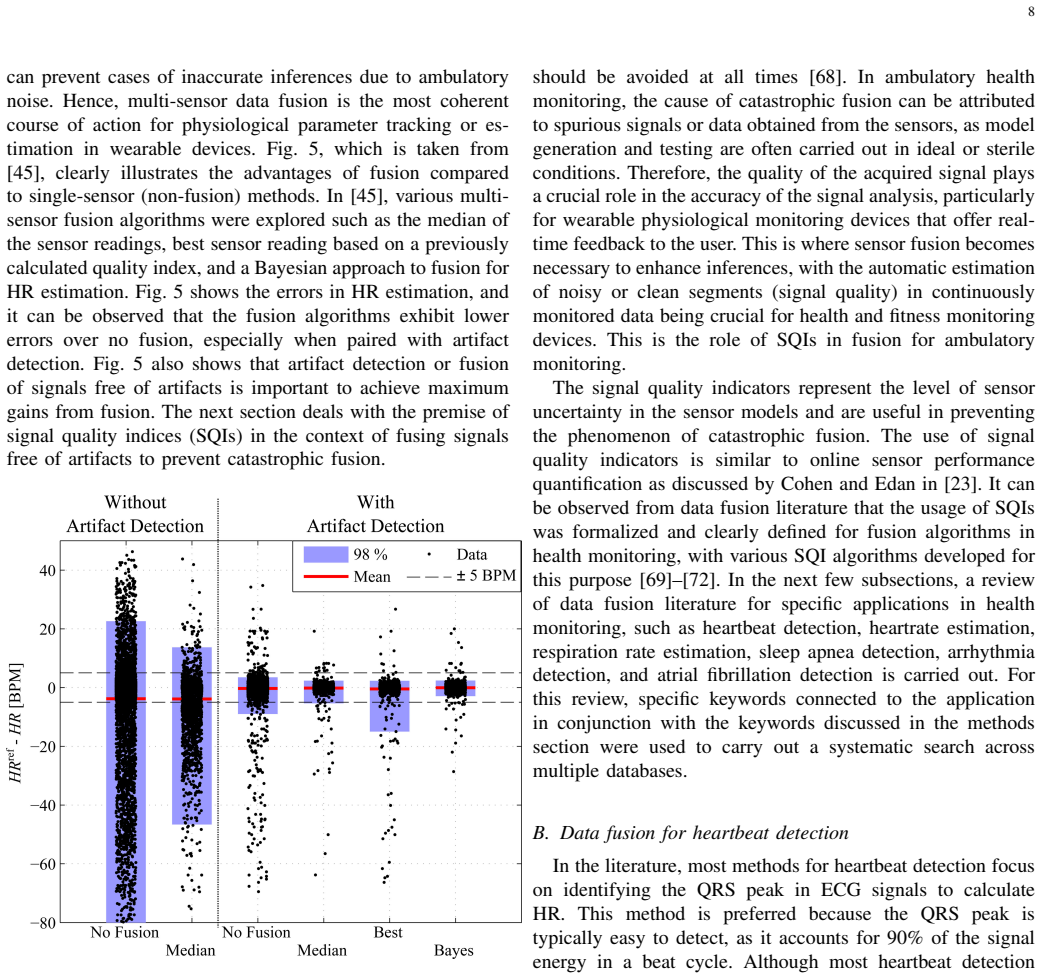
The load-bearing machinery is a stack of three classification schemes: Durrant-Whyte's relationship-based split into complementary, redundant, and cooperative fusion; Luo and Kay's abstraction-level split into data-level, feature-level, and decision-level fusion; and Dasarathy's five input/output modes from data-in/data-out to decision-in/decision-out. The review uses these three schemes, together with temporal fusion as an orthogonal dimension, to label every surveyed algorithm, and then groups the algorithms into the five method families above. Signal quality indices (SQIs) act as the practical mechanism that prevents catastrophic fusion: they estimate how clean a sensor segment is and are used to weight, select, or switch among sensor contributions before fusion.
What would settle it
A systematic literature search that finds a published wearable multisensor fusion algorithm not assignable to any of the five families — state estimation, rule-based, SQI-based, machine-learning feature fusion, or CNN fusion — would falsify the taxonomy's exhaustiveness. A quicker check is internal: verifying whether the two single-sensor, multi-algorithm heart-rate fusion papers in the review's own table violate its stated inclusion rule, which would show the taxonomy rests on an inconsistent corpus.
Extended reading notes
Core claim
This review's core claim is that the scattered field of multisensor data fusion for wearable health monitoring can be organized into five algorithm families: state-estimation methods (Kalman filtering, Bayesian inference, particle filtering), rule-based fusion, signal-quality-index-based fusion, machine-learning and deep-learning feature fusion, and CNN-based fusion where the network learns the fusion itself. Surveying heartbeat detection, heart-rate estimation, respiration-rate estimation, sleep apnea detection, arrhythmia detection, and atrial fibrillation detection, the authors assign each reviewed algorithm to one or more of these families and to the established Durrant-Whyte, Luo-Kay, and Dasarathy categories. They further argue that the established fusion architectures do not explicitly account for the quality of the signals being fused, and that for body-worn devices — where motion artifacts and non-ideal sensor placement corrupt signals — signal-quality-index-based fusion is therefore particularly significant, since fusing corrupted signals can produce catastrophic fusion that is worse than using a single sensor.
Load-bearing premise
The map holds only if "fusion" always means combining signals, features, or decisions from multiple sensors; if single-sensor combinations of multiple algorithms or features also count as fusion, as two heart-rate entries in the review's own table appear to do, then the surveyed set is not consistent and the taxonomy's coverage claim weakens.
Editorial extensions
If this is right
- If the taxonomy is right, a designer of a wearable monitor can treat the five families as a checklist and choose SQI-based gating or weighting whenever signal corruption is expected.
- It follows that a fusion algorithm evaluated on clean, clinical data cannot be assumed safe on ambulatory data; adding SQI awareness is the review's proposed defense.
- For arrhythmia and atrial fibrillation monitoring, the survey shows rule-based and machine-learning methods dominate, with CNN-based learned fusion emerging for multi-lead ECG.
- The review's own conclusion is that fusion algorithms remain application-dependent, so general-purpose fusion frameworks are not yet realistic for wearables.
- Explainable AI, missing-data handling, and federated learning are identified as needed directions before clinicians can rely on fused remote-monitoring outputs.
Reading between the lines
- A natural extension the paper leaves implicit: a standardized, openly benchmarked signal quality index per vital sign would allow fair cross-comparison of fusion algorithms, since surveyed works each define their own quality measures.
- The five-family taxonomy is fitted to 1-D time-series physiological signals; applying it to image-based or multimodal fusion would likely require adding categories such as multiscale fusion, which the review discusses only in the non-biomedical context.
- The review's finding that atrial fibrillation fusion literature is sparse suggests the fusion strategies developed for arrhythmia false-alarm reduction could be transplanted to wearable AF detection.
- The inclusion rule excludes single-sensor multi-feature fusion, yet two surveyed heart-rate papers fuse multiple heartbeat annotators on one ECG; reconciling that boundary is an editorial challenge the review itself does not resolve.
Signed reviews
Editorial analysis
A structured set of objections, weighed in public.
Referee Report
Summary. The manuscript is a review of multisensor data fusion methods for wearable health monitoring. It surveys classical fusion frameworks (JDL, Durrant-Whyte, Luo-Kay, Dasarathy, etc.), reviews fusion applications outside and inside healthcare, and then organizes the wearable-health fusion literature into six application areas: heartbeat detection, heart rate estimation, respiratory rate estimation, sleep apnea detection, arrhythmia detection, and atrial fibrillation detection. The paper proposes a five-part taxonomy of fusion algorithms (state estimation, rule-based, signal-quality-index-based, ML/deep-learning feature fusion, and CNN-based fusion) and argues that signal-quality-index-based fusion is especially important for wearable devices because existing fusion architectures do not explicitly account for signal quality.
Significance. If the survey's boundary and taxonomy hold, the paper provides a useful organizational map of a fragmented literature. Its strengths include the structured presentation of classical fusion frameworks, the systematic application-area summaries in Tables II–VII, clear flow diagrams for common fusion architectures, and the explicit discussion of catastrophic fusion and signal quality indices. The paper also candidly acknowledges variability in performance metrics across studies. These features make the review potentially valuable for researchers entering the field and for practitioners selecting fusion approaches. However, the value of the central taxonomy depends on the surveyed set respecting the paper's own definition of multisensor fusion, and that boundary is currently not consistently enforced.
major comments (3)
- [Section II, Section III.C, Table III, Section V.C] The stated inclusion criterion is that works must fuse signals, features, or decisions from multiple sensor sources, with fusion of different features from a single sensor source excluded. This criterion is violated by Table III entries [88] and [89], which fuse multiple QRS/heartbeat annotation algorithms applied to a single ECG signal and list only 'ECG' as the input signal. The text in Section V.C even states that 'similar approaches can be used for multisensor fusion,' implicitly acknowledging that these works are not yet multisensor. Entry [103] is also included despite the text noting that it fuses modulations from a single sensor source. Because the Section VII taxonomy is induced from the survey tables, this porous boundary makes the central organizational claim less precise than advertised. The authors should either remove or explicitly mark such single-sensor algorithm-fusion works as related but out of scope, or broaden the stated definition of fusion and adjust the conclusions accordingly.
- [Section V.B, Table II] The classification labels are internally inconsistent for the CNN-based heartbeat detection works. The text says that the methods in [32] and [86] 'are examples of feature-level fusion algorithms' and 'can also be considered as examples of FEI-DEO fusion,' but Table II classifies both [32] and [86] as 'signal-level, FEI-DEO.' Since the paper's contribution is a reliable classification of fusion architectures, such direct contradictions between the text and the summary tables undermine the accuracy of the proposed taxonomy and need to be resolved.
- [Section V.A and Section VII] The conclusion that 'the fusion architectures outlined in Section III do not explicitly account for the quality of the signals being fused' is overbroad given the paper's own earlier discussion. Section III describes Cohen and Edan [23] as a framework that incorporates measures to assess sensor performance online, and Section V.A explicitly likens SQI use to that online sensor performance quantification. The claim should be qualified to distinguish between general sensor-reliability assessment and the more specific use of physiologically meaningful signal quality indices; otherwise the central argument for the novelty and significance of SQI-based fusion is overstated.
minor comments (4)
- [References] References [39] and [90] are the same paper (Nathan and Jafari) but are listed as separate entries; one should be removed and the corresponding citation points updated.
- [Section V.D] There are several typographical errors, including 'PPG-derivd respiration' instead of 'PPG-derived respiration,' 'daa fusion' in Section VI.A, and 'linar regression' in the Table III footnote.
- [Section IV.A] The subsection titled 'Applications in military and defense' includes autonomous driving material under the military heading; consider retitling or splitting this subsection for clarity.
- [Tables II–VII] The performance columns are not directly comparable because the metric definitions and data sets differ; this is acknowledged in the text, but a brief note in each table caption reminding readers of this limitation would improve usability.
Circularity Check
No circular derivation; self-citations are not load-bearing. The survey's own inclusion-criteria violations are a consistency issue, not circularity.
full rationale
This is a literature review with no fitted parameters, predictive claims, or uniqueness theorems, so there is no derivation chain that could reduce to its own inputs. The central taxonomy in Section VII (state estimation, rule-based, SQI-based, ML/deep feature fusion, CNN-based fusion) is induced from a broad set of external works and stands independently of the authors' own contributions. The authors' self-citations ([37], [70]-[72], [95], [129], [166]) appear as surveyed examples or background and are not used to justify the review's classification choices; removing them would not alter the categories. The one notable internal inconsistency is the inclusion-criteria violation: Section II excludes 'fusion of different features obtained from a single sensor source,' yet Table III lists [88] and [89] with 'ECG' as the only signal, fusing multiple QRS detection algorithms, and Section V.C concedes 'Similar approaches can be used for multisensor fusion for heartrate estimation,' implicitly acknowledging these are single-sensor works. The same applies to [95] and to [103], which the text admits was 'employed for fusion of modulation signals obtained from a single sensor source, but the popularity of the algorithm in subsequent multi-sensor fusion literature merits mention in this review' (Section V.D). This weakens the precision of the survey's boundary and should be weighed as a correctness/consistency concern, but it is not a circular self-reference: the taxonomy does not presuppose the inclusion of these entries, and the review's organizational map remains externally grounded in the cited literature.
Assumptions & free parameters
assumptions (3)
- domain assumption The reviewed papers are accurately and consistently classified into the Durrant-Whyte, Luo-Kay, and Dasarathy fusion frameworks.
- domain assumption The selected literature is representative of multisensor fusion for wearable health monitoring, and the reported performance metrics are faithfully transcribed.
- domain assumption Signal quality indices can mitigate catastrophic fusion and are therefore a meaningful design axis for wearable fusion.
Cite this review
Pith. "Pith review of A Review on Multisensor Data Fusion for Wearable Health Monitoring." pith.science (2026). https://pith.science/paper/ALI4V7T3
@misc{pith2026241205895,
  author       = {Pith},
  title        = {Pith review of: A Review on Multisensor Data Fusion for Wearable Health Monitoring},
  year         = {2026},
  howpublished = {\url{https://pith.science/paper/ALI4V7T3}},
  note         = {Machine review of arXiv:2412.05895}
}
read the original abstract
The growing demand for accurate, continuous, and non-invasive health monitoring has propelled multi-sensor data fusion to the forefront of healthcare technology. This review aims to provide an overview of the development of fusion frameworks in the literature and common terminology used in fusion literature. The review introduces the fusion classification standards and methods that are most relevant from an algorithm development perspective. Applications of the reviewed fusion frameworks in fields such as defense, autonomous driving, robotics, and image fusion are also discussed to provide contextual information on the various fusion methodologies that have been developed in this field. This review provides a comprehensive analysis of multi-sensor data fusion methods applied to health monitoring systems, focusing on key algorithms, applications, challenges, and future directions. We examine commonly used fusion techniques, including Kalman filters, Bayesian networks, and machine learning models. By integrating data from various sources, these fusion approaches enhance the reliability, accuracy, and resilience of health monitoring systems. However, challenges such as data quality and differences in acquisition systems exist, calling for intelligent fusion algorithms in recent years. The review finally converges on applications of fusion algorithms in biomedical inference tasks like heartbeat detection, respiration rate estimation, sleep apnea detection, arrhythmia detection, and atrial fibrillation detection.
Figures


Figures from the paper (14 more)



Reference graph
Works this paper leans on
-
[88]
Continuous-valued annotations aggregation for heart rate detection,
Y . Xie, J. Li, T. Zhu, and C. Liu, “Continuous-valued annotations aggregation for heart rate detection,” IEEE Access, vol. 7, pp. 37 664– 37 671, Mar 2019
2019
-
[89]
A bayesian fusion model for heart rate an- notations,
J. Di, J. Li, and C. Liu, “A bayesian fusion model for heart rate an- notations,” in 2020 International Conference on Sensing, Measurement Data Analytics in the era of Artificial Intelligence (ICSMD) , Oct 2020, pp. 307–312
2020
-
[103]
Multi- parameter respiratory rate estimation from the photoplethysmogram,
W. Karlen, S. Raman, J. M. Ansermino, and G. A. Dumont, “Multi- parameter respiratory rate estimation from the photoplethysmogram,” IEEE Transactions on Biomedical Engineering , vol. 60, no. 7, pp. 1946–1953, Jul 2013
work page 1946
-
[32]
Robust heartbeat detection from multimodal data via CNN-based generalizable information fu- sion,
B. S. Chandra, C. S. Sastry, and S. Jana, “Robust heartbeat detection from multimodal data via CNN-based generalizable information fu- sion,” IEEE Transactions on Biomedical Engineering , vol. 66, no. 3, pp. 710–717, Jul. 2018
2018
-
[86]
Signal-Level Fusion with Convolutional Neural Networks for Capacitively Coupled ECG in the Car,
C. H. Antink, E. Breuer, D. U. Uguz, and S. Leonhardt, “Signal-Level Fusion with Convolutional Neural Networks for Capacitively Coupled ECG in the Car,” in 2018 Computing in Cardiology Conference (CinC), vol. 45, Sep 2018, pp. 1–4. 21
2018
-
[23]
A sensor fusion framework for online sensor and algorithm selection,
O. Cohen and Y . Edan, “A sensor fusion framework for online sensor and algorithm selection,” Robotics and Autonomous Systems , vol. 56, no. 9, pp. 762–776, Sep 2008
2008
-
[1]
Alarms in the intensive care unit: how can the number of false alarms be reduced?
M.-C. Chambrin, “Alarms in the intensive care unit: how can the number of false alarms be reduced?” Critical Care, vol. 5, no. 4, pp. 184–188, Aug 2001
2001
-
[2]
RS slope detection algorithm for extraction of heart rate from noisy, multimodal recordings,
J. Gierałtowski, K. Ciuchci ´nski, I. Grzegorczyk, K. Ko´sna, M. Soli´nski, and P. Podziemski, “RS slope detection algorithm for extraction of heart rate from noisy, multimodal recordings,” Physiological Measurement, vol. 36, no. 8, pp. 1743–1761, Jul 2015
2015
Show all 168 references
-
[3]
Improvement of force-sensor-based heart rate estimation using multichannel data fusion,
C. Br ¨user, J. M. Kortelainen, S. Winter, M. Tenhunen, J. P ¨arkk¨a, and S. Leonhardt, “Improvement of force-sensor-based heart rate estimation using multichannel data fusion,” IEEE Journal of Biomedical and Health Informatics, vol. 19, no. 1, pp. 227–235, Jan 2015
2015
-
[4]
Data fusion lexicon. tech. rep., joint directors of laboratories, technical panel for c3
F. White, “Data fusion lexicon. tech. rep., joint directors of laboratories, technical panel for c3.” Data Fusion Sub-Panel, Naval Ocean Systems Center, San Diego, CA, 1987
1987
-
[5]
Sensor data fusion,
L.-F. Pau, “Sensor data fusion,” Journal of Intelligent and Robotic Systems, vol. 1, pp. 103–116, Jun 1988
1988
-
[6]
A Distributed Sensor Architecture For Advanced Aerospace Systems,
J. Schoess and G. Castore, “A Distributed Sensor Architecture For Advanced Aerospace Systems,” in Sensor Fusion, C. B. Weaver, Ed., vol. 0931, International Society for Optics and Photonics. SPIE, 1988, pp. 74 – 87
1988
-
[7]
Sensor models and multisensor integration,
H. F. Durrant-Whyte, “Sensor models and multisensor integration,” The International Journal of Robotics Research , vol. 7, no. 6, pp. 97–113, Dec 1988
1988
-
[8]
Multisensor integration and fusion in intelli- gent systems,
R. Luo and M. Kay, “Multisensor integration and fusion in intelli- gent systems,” IEEE Transactions on Systems, Man, and Cybernetics , vol. 19, no. 5, pp. 901–931, Aug 1989
1989
-
[9]
Sensor Integration And Data Fusion,
S. C. A. Thomopoulos, “Sensor Integration And Data Fusion,” in Sensor Fusion II: Human and Machine Strategies , ser. Society of Photo-Optical Instrumentation Engineers (SPIE) Conference Series, vol. 1198, Mar 1990, pp. 178–191
1990
-
[10]
Interpretation of remotely sensed images in a context of multisensor fusion using a multispecialist architecture,
V . Clement, G. Giraudon, S. Houzelle, and F. Sandakly, “Interpretation of remotely sensed images in a context of multisensor fusion using a multispecialist architecture,” IEEE Transactions on Geoscience and Remote Sensing, vol. 31, no. 4, pp. 779–791, Aug 1993
1993
-
[11]
Sensor fusion potential exploitation-innovative archi- tectures and illustrative applications,
B. V . Dasarathy, “Sensor fusion potential exploitation-innovative archi- tectures and illustrative applications,” Proceedings of the IEEE, vol. 85, no. 1, pp. 24–38, Jan. 1997
1997
-
[12]
Multi-sensor data fusion in defence and aerospace,
C. J. Harris, A. Bailey, and T. Dodd, “Multi-sensor data fusion in defence and aerospace,” The Aeronautical Journal (1968) , vol. 102, no. 1015, p. 229–244, May 1998
1968
-
[13]
Multisensor image fusion in remote sensing: Concepts, methods and applications,
C. Pohl and J. L. V . Genderen, “Multisensor image fusion in remote sensing: Concepts, methods and applications,” International Journal of Remote Sensing, vol. 19, no. 5, pp. 823–854, 1998
1998
-
[14]
The omnibus model: a new model of data fusion?
M. Bedworth and J. O’Brien, “The omnibus model: a new model of data fusion?” IEEE Aerospace and Electronic Systems Magazine , vol. 15, no. 4, pp. 30–36, Apr 2000
2000
-
[15]
An evaluation methodology for fusion processes based on information needs,
H. Keithley, “An evaluation methodology for fusion processes based on information needs,” in Handbook of multisensor data fusion 1st ed. , D. Hall and J. Llinas, Eds. Boca Raton, FL: CRC press, Jun 2001, ch. 26, pp. 527–539
2001
-
[16]
Knowledge and data fusion in probabilistic networks,
K. B. Laskey and S. M. Mahoney, “Knowledge and data fusion in probabilistic networks,” in submitted to Machine Learning special issue on knowledge and data fusion, A paraıtre . Citeseer, 2003
2003
-
[17]
Performance modeling for multisensor data fusion,
K. C. Chang, Y . Song, and M. E. L. II, “Performance modeling for multisensor data fusion,” in Signal Processing, Sensor Fusion, and Target Recognition XII, I. Kadar, Ed., vol. 5096, International Society for Optics and Photonics. SPIE, Aug 2003, pp. 354 – 363
2003
-
[18]
A general data fusion architecture,
H. Carvalho, W. Heinzelman, A. Murphy, and C. Coelho, “A general data fusion architecture,” in Sixth International Conference of Informa- tion Fusion, 2003. Proceedings of the, vol. 2, Jul 2003, pp. 1465–1472
2003
-
[19]
Soft computing techniques,
R. Brooks, “Soft computing techniques,” in Distributed sensor net- works, R. Brooks and S. S. Iyengar, Eds. Boca Raton, FL: Chapman and Hall/CRC, Dec 2004, ch. 17, pp. 321–333
2004
-
[20]
Fusion in the context of information theory,
M. Ahmed and G. Pottie, “Fusion in the context of information theory,” in Distributed sensor networks, R. Brooks and S. S. Iyengar, Eds. Boca Raton, FL: Chapman and Hall/CRC, Dec 2004, ch. 22, pp. 419–435
2004
-
[21]
Fusion metrics for dynamic situation analysis,
E. P. Blasch, M. Pribilski, B. Daughtery, B. Roscoe, and J. Gunsett, “Fusion metrics for dynamic situation analysis,” in Signal Processing, Sensor Fusion, and Target Recognition XIII , I. Kadar, Ed., vol. 5429, International Society for Optics and Photonics. SPIE, Aug 2004, pp...
2004
-
[22]
A review of data fusion models and architectures: towards engineering guidelines,
J. Esteban, A. Starr, R. Willetts, P. Hannah, and P. Bryanston-cross, “A review of data fusion models and architectures: towards engineering guidelines,” Neural Computing and Applications, vol. 14, pp. 273–281, Dec 2005
2005
-
[24]
Systems engineering approach for imple- menting data fusion systems,
C. Bowman and S. A.N., “Systems engineering approach for imple- menting data fusion systems,” in Handbook of multisensor data fusion: theory and practice 2nd ed., M. L. II, D. Hall, and J. Llinas, Eds. Boca Raton, FL: Chapman and Hall/CRC, 2009, ch. 21, pp. 561–596
2009
-
[25]
Assessing the performance of multisensor fusion processes,
J. Llinas, “Assessing the performance of multisensor fusion processes,” in Handbook of multisensor data fusion: theory and practice 2nd ed. , M. L. II, D. Hall, and J. Llinas, Eds. Boca Raton, FL: Chapman and Hall/CRC, 2009, ch. 25, pp. 655–675
2009
-
[26]
Advances in multi-sensor data fusion: Algorithms and applications,
J. Dong, D. Zhuang, Y . Huang, and J. Fu, “Advances in multi-sensor data fusion: Algorithms and applications,” Sensors, vol. 9, no. 10, pp. 7771–7784, Sep 2009
2009
-
[27]
Research on fusion performance model for multisensor data fusion,
J. Chen, “Research on fusion performance model for multisensor data fusion,” in 2010 International Conference on E-Product E-Service and E-Entertainment, Nov 2010, pp. 1–4
2010
-
[28]
A review of data fusion techniques,
F. Castanedo, “A review of data fusion techniques,” The Scientific World Journal, p. 704504, Oct 2013
2013
-
[29]
Sensor fusion: A review of methods and applications,
M. L. Fung, M. Z. Q. Chen, and Y . H. Chen, “Sensor fusion: A review of methods and applications,” in 2017 29th Chinese Control And Decision Conference (CCDC) , May 2017, pp. 3853–3860
2017
-
[30]
An introduction to sensor fusion,
W. Elmenreich, “An introduction to sensor fusion,” Technische Univer- sit¨at Wien, Institut f ¨ur Technische Informatik, Technical Report , May 2001
2001
-
[31]
A discourse on winning and losing [briefing slides],
J. Boyd, “A discourse on winning and losing [briefing slides],” Maxwell Air Force Base, AL: Air University Library (Document No. MU 43947), 1987
1987
-
[33]
A deep learning approach to monitoring and detecting atrial fibrilla- tion using wearable technology,
S. P. Shashikumar, A. J. Shah, Q. Li, G. D. Clifford, and S. Nemati, “A deep learning approach to monitoring and detecting atrial fibrilla- tion using wearable technology,” in 2017 IEEE EMBS International Conference on Biomedical & Health Informatics (BHI) , Apr 2017, pp. 141–144
2017
-
[34]
Atrial fibrillation detection using photo-plethysmography and acceleration data at the wrist,
A. G. Bonomi, F. Schipper, L. M. Eerik ¨ainen, J. Margarito, R. M. Aarts, S. Babaeizadeh, H. M. de Morree, and L. Dekker, “Atrial fibrillation detection using photo-plethysmography and acceleration data at the wrist,” in 2016 Computing in Cardiology Conference (CinC), Sep 2016...
2016
-
[35]
A survey on machine learning for data fusion,
T. Meng, X. Jing, Z. Yan, and W. Pedrycz, “A survey on machine learning for data fusion,” Information Fusion , vol. 57, pp. 115–129, May 2020
2020
-
[36]
Multi-camera multi-object tracking,
W. Liu, O. Camps, and M. Sznaier, “Multi-camera multi-object tracking,” 2017. [Online]. Available: https://arxiv.org/abs/1709.07065
2017 arXiv
-
[37]
A multimodal data fusion technique for heartbeat detection in wearable IoT sensors,
A. John, S. J. Redmond, B. Cardiff, and D. John, “A multimodal data fusion technique for heartbeat detection in wearable IoT sensors,” IEEE Internet of Things Journal , vol. 9, no. 3, pp. 2071–2082, 2022
2022
-
[38]
Robust heart rate estimation from multimodal physiological signals using beat signal quality index based majority voting fusion method,
S. A. Rankawat and R. Dubey, “Robust heart rate estimation from multimodal physiological signals using beat signal quality index based majority voting fusion method,” Biomedical Signal Processing and Control, vol. 33, pp. 201 – 212, Mar 2017
2017
-
[40]
Robust detection of heartbeats using association models from blood pressure and EEG signals,
T. Jeon, J. Yu, W. Pedrycz, M. Jeon, B. Lee, and B. Lee, “Robust detection of heartbeats using association models from blood pressure and EEG signals,” BioMedical Engineering OnLine, vol. 15, no. 7, Jan 2016
2016
-
[41]
Respiratory rate assessments using a dual- accelerometer device,
S. Lapi, F. Lavorini, G. Borgioli, M. Calzolai, L. Masotti, M. Pistolesi, and G. A. Fontana, “Respiratory rate assessments using a dual- accelerometer device,” Respiratory Physiology & Neurobiology , vol. 191, pp. 60–66, Jan 2014. 20
2014
-
[42]
A robust fusion model for estimating respiratory rate from photoplethys- mography and electrocardiography,
D. A. Birrenkott, M. A. Pimentel, P. J. Watkinson, and D. A. Clifton, “A robust fusion model for estimating respiratory rate from photoplethys- mography and electrocardiography,” IEEE Transactions on Biomedical Engineering, vol. 65, no. 9, pp. 2033–2041, Dec 2018
2018
-
[43]
Data fusion of multimodal cardiovascular signals,
E. Kenneth, A. Rajendra, N. Kannathal, and C. M. Lim, “Data fusion of multimodal cardiovascular signals,” in 2005 IEEE Engineering in Medicine and Biology 27th Annual Conference , Jan 2005, pp. 4689– 4692
2005
-
[44]
A new hierarchical method for inter-patient heartbeat classification using random projec- tions and RR intervals,
H. Huang, J. Liu, Q. Zhu, R. Wang, and G. Hu, “A new hierarchical method for inter-patient heartbeat classification using random projec- tions and RR intervals,” Biomedical engineering online, vol. 13, p. 90, Jun 2014
2014
-
[45]
Ro- bust sensor fusion of unobtrusively measured heart rate,
T. Wartzek, Christoph Br ¨user, Marian Walter, and S. Leonhardt, “Ro- bust sensor fusion of unobtrusively measured heart rate,” IEEE Journal of Biomedical and Health Informatics, vol. 18, no. 2, pp. 654–660, Mar 2014
2014
-
[46]
A systematic review on fusion techniques and approaches used in applications,
S. Jusoh and S. Almajali, “A systematic review on fusion techniques and approaches used in applications,” IEEE Access, vol. 8, pp. 14 424– 14 439, Jan 2020
2020
-
[47]
Towards Raw Sensor Fusion in 3D Object Detection,
A. R ¨ovid and V . Remeli, “Towards Raw Sensor Fusion in 3D Object Detection,” in 2019 IEEE 17th World Symposium on Applied Machine Intelligence and Informatics (SAMI) , Jan 2019, pp. 293–298
2019
-
[48]
Real-time hybrid multi-sensor fusion framework for perception in autonomous vehicles,
B. Shahian Jahromi, T. Tulabandhula, and S. Cetin, “Real-time hybrid multi-sensor fusion framework for perception in autonomous vehicles,” Sensors, vol. 19, no. 20, Oct 2019
2019
-
[49]
Deep learning sensor fusion for autonomous vehicle perception and localization: A review,
J. Fayyad, M. A. Jaradat, D. Gruyer, and H. Najjaran, “Deep learning sensor fusion for autonomous vehicle perception and localization: A review,” Sensors, vol. 20, no. 15, Jul 2020
2020
-
[50]
Multiple sensor fusion and clas- sification for moving object detection and tracking,
R. O. Chavez-Garcia and O. Aycard, “Multiple sensor fusion and clas- sification for moving object detection and tracking,” IEEE Transactions on Intelligent Transportation Systems, vol. 17, no. 2, pp. 525–534, Sep 2016
2016
-
[51]
RVNet: Deep Sensor Fusion of Monocular Camera and Radar for Image-Based Obstacle Detection in Challenging Environments,
V . John and S. Mita, “RVNet: Deep Sensor Fusion of Monocular Camera and Radar for Image-Based Obstacle Detection in Challenging Environments,” in Image and Video Technology . Cham: Springer International Publishing, Nov 2019, pp. 351–364
2019
-
[52]
Rich feature hierarchies for accurate object detection and semantic segmentation,
R. Girshick, J. Donahue, T. Darrell, and J. Malik, “Rich feature hierarchies for accurate object detection and semantic segmentation,”
-
[53]
Pose estimation of a mobile robot based on fusion of imu data and vision data using an extended kalman filter,
M. B. Alatise and G. P. Hancke, “Pose estimation of a mobile robot based on fusion of imu data and vision data using an extended kalman filter,” Sensors, vol. 17, no. 10, Sep 2017
2017
-
[54]
Multi-sensor fusion based robot self-activity recognition,
D. Luo, Y . Ma, X. Zhang, and X. Wu, “Multi-sensor fusion based robot self-activity recognition,” in 2018 IEEE-RAS 18th International Conference on Humanoid Robots (Humanoids) , Nov 2018, pp. 1–9
2018
-
[55]
A review of sensor fusion techniques for underwater vehicle navigation,
T. Nicosevici, R. Garcia, M. Carreras, and M. Villanueva, “A review of sensor fusion techniques for underwater vehicle navigation,” in Oceans ’04 MTS/IEEE Techno-Ocean ’04 (IEEE Cat. No.04CH37600) , vol. 3, Nov 2004, pp. 1600–1605 V ol.3
2004
-
[56]
A survey of sensor fusion methods in wearable robotics,
D. Novak and R. Riener, “A survey of sensor fusion methods in wearable robotics,” Robotics and Autonomous Systems , vol. 73, pp. 155–170, Nov 2015
2015
-
[57]
Data fusion and multiple classifier systems for human activity detection and health monitoring: Review and open research directions,
H. F. Nweke, Y . W. Teh, G. Mujtaba, and M. A. Al-garadi, “Data fusion and multiple classifier systems for human activity detection and health monitoring: Review and open research directions,” Information Fusion, vol. 46, pp. 147–170, Mar 2019
2019
-
[58]
Multi- sensor fusion in body sensor networks: State-of-the-art and research challenges,
R. Gravina, P. Alinia, H. Ghasemzadeh, and G. Fortino, “Multi- sensor fusion in body sensor networks: State-of-the-art and research challenges,” Information Fusion, vol. 35, pp. 68–80, May 2017
2017
-
[59]
Feature-level fusion of surface elec- tromyography for activity monitoring,
X. Xi, M. Tang, and Z. Luo, “Feature-level fusion of surface elec- tromyography for activity monitoring,” Sensors, vol. 18, no. 2, Feb 2018
2018
-
[60]
Multimodal medical image sensor fusion framework using cascade of wavelet and contourlet transform domains,
V . Bhateja, H. Patel, A. Krishn, A. Sahu, and A. Lay-Ekuakille, “Multimodal medical image sensor fusion framework using cascade of wavelet and contourlet transform domains,” IEEE Sensors Journal , vol. 15, no. 12, pp. 6783–6790, Aug 2015
2015
-
[61]
Review of pixel-level image fusion,
B. Yang, Z. Jing, and H.-t. Zhao, “Review of pixel-level image fusion,” Journal of Shanghai Jiaotong University (Science) , vol. 15, pp. 6–12, Feb 2010
2010
-
[62]
Tomography defined as sensor fusion,
K. B. Ozanyan, “Tomography defined as sensor fusion,” in 2015 IEEE SENSORS, Nov 2015, pp. 1–4
2015
-
[63]
Sensor-level fusion to enhance health and usage monitoring systems,
C. Byington, M. Watson, H. Lee, and M. Hollins, “Sensor-level fusion to enhance health and usage monitoring systems,” Annual Forum Proceedings - AHS International , vol. 2, pp. 1476–1485, Jan 2008
2008
-
[64]
An integrated multi-sensor fusion-based deep feature learning approach for rotating machinery diagnosis,
J. Liu, Y . Hu, Y . Wang, B. Wu, J. Fan, and Z. Hu, “An integrated multi-sensor fusion-based deep feature learning approach for rotating machinery diagnosis,” Measurement Science and Technology , vol. 29, no. 5, p. 055103, Mar 2018
2018
-
[65]
Deep learning sensor fusion in plant water stress assessment: A comprehensive review,
M. H. Kamarudin, Z. H. Ismail, and N. B. Saidi, “Deep learning sensor fusion in plant water stress assessment: A comprehensive review,” Applied Sciences, vol. 11, no. 4, Feb 2021
2021
-
[66]
Gas detection and identification using multimodal artificial intelligence based sensor fusion,
P. Narkhede, R. Walambe, S. Mandaokar, P. Chandel, K. Kotecha, and G. Ghinea, “Gas detection and identification using multimodal artificial intelligence based sensor fusion,” Applied System Innovation , vol. 4, no. 1, Jan 2021
2021
-
[67]
Detecting pulse from head motions in video,
G. Balakrishnan, F. Durand, and J. Guttag, “Detecting pulse from head motions in video,” in 2013 IEEE Conference on Computer Vision and Pattern Recognition, Jun 2013, pp. 3430–3437
2013
-
[68]
H. B. Mitchell, Data fusion: concepts and ideas. Heidelberg: Springer Berlin, 2012
2012
-
[69]
Signal-quality indices for the electrocardiogram and photoplethysmogram: Derivation and applications to wireless monitor- ing,
C. Orphanidou, T. Bonnici, P. Charlton, D. Clifton, D. Vallance, and L. Tarassenko, “Signal-quality indices for the electrocardiogram and photoplethysmogram: Derivation and applications to wireless monitor- ing,” IEEE Journal of Biomedical and Health Informatics , vol. 19, no....
2015
-
[70]
Binary classifiers for data integrity detection in wearable IoT edge devices,
A. John, R. C. Panicker, B. Cardiff, Y . Lian, and D. John, “Binary classifiers for data integrity detection in wearable IoT edge devices,” IEEE Open Journal of Circuits and Systems , vol. 1, pp. 88–99, Aug 2020
2020
-
[71]
A generalized signal quality estima- tion method for IoT sensors,
A. John, B. Cardiff, and D. John, “A generalized signal quality estima- tion method for IoT sensors,” in 2020 IEEE International Symposium on Circuits and Systems (ISCAS) , Oct 2020, pp. 1–5
2020
-
[72]
An approximate binary classifier for data integrity assessment in IoT sensors,
A. John, S. Ullah, A. Kumar, B. Cardiff, and D. John, “An approximate binary classifier for data integrity assessment in IoT sensors,” in 2020 27th IEEE International Conference on Electronics, Circuits and Systems (ICECS), Nov 2020, pp. 1–4
2020
-
[73]
Robust detection of heart beats in multimodal data,
I. Silva, B. Moody, J. Behar, A. Johnson, J. Oster, G. D. Clifford, and G. B. Moody, “Robust detection of heart beats in multimodal data,” Physiological measurement, vol. 36, no. 8, pp. 549–552, Aug 2015
2015
-
[74]
Data fusion of multivariate time series: Application to noisy 12-lead ECG signals,
C. Diao, B. Wang, and N. Cai, “Data fusion of multivariate time series: Application to noisy 12-lead ECG signals,” Applied Sciences , vol. 9, no. 1, Dec 2019
2019
-
[75]
A real-time QRS detection algorithm,
J. Pan and W. J. Tompkins, “A real-time QRS detection algorithm,” IEEE Transactions on Biomedical Engineering , vol. BME-32, no. 3, pp. 230–236, Mar. 1985
1985
-
[76]
A single scan algorithm for QRS- detection and feature extraction,
W. A. H. Engelse and C. Zeelenberg, “A single scan algorithm for QRS- detection and feature extraction,” Computers in Cardiology, vol. 6, pp. 37–42, Nov. 1979
1979
-
[77]
A robust open-source algorithm to detect onset and duration of QRS complexes,
W. Zong, G. Moody, and D. Jiang, “A robust open-source algorithm to detect onset and duration of QRS complexes,” in Computers in Cardiology, 2003, Sep 2003, pp. 737–740
2003
-
[78]
A multilead fusion based QRS complex detection method on 12-lead electrocardio- gram signals,
W. Zhao, Y . Xu, C. Yan, J. Hu, D. Jia, X. Sun, and T. You, “A multilead fusion based QRS complex detection method on 12-lead electrocardio- gram signals,” in 2018 Computing in Cardiology Conference (CinC) , vol. 45, Sep 2018, pp. 1–4
2018
-
[79]
Robust algorithm to locate heart beats from multiple physiological waveforms by individual signal detector voting,
L. Galeotti, C. G. Scully, J. Vicente, L. Johannesen, and D. G. Strauss, “Robust algorithm to locate heart beats from multiple physiological waveforms by individual signal detector voting,” Physiological Mea- surement, vol. 36, no. 8, pp. 1705–1716, Aug 2015
2015
-
[80]
Multimodal sensor fusion of cardiac signals via blind deconvolution: A source-filter approach,
C. H. Antink, C. Br ¨user, and S. Leonhardt, “Multimodal sensor fusion of cardiac signals via blind deconvolution: A source-filter approach,” in Computing in Cardiology , Sep 2014, pp. 805–808
2014
-
[81]
R-peak estimation using multimodal lead switching,
A. E. Johnson, J. Behar, F. Andreotti, G. D. Clifford, and J. Oster, “R-peak estimation using multimodal lead switching,” in Computing in Cardiology 2014 , Sep 2014, pp. 281–284
2014
-
[82]
Robust detection of heart beats using dynamic thresholds and moving windows,
M. V ollmer, “Robust detection of heart beats using dynamic thresholds and moving windows,” in Computing in Cardiology 2014 , Sep 2014, pp. 569–572
2014
-
[83]
Applying quality index criterion for flexible multi-detection of heartbeat using features of multimodal data,
M. J. Mollakazemi, F. Asadi, S. Ghiasi, and S. H. Sadati, “Applying quality index criterion for flexible multi-detection of heartbeat using features of multimodal data,” in 2016 Computing in Cardiology Con- ference (CinC), Sep 2016, pp. 1065–1068
2016
-
[84]
Heart rate estimation from non-cardiovascular signals using slope sum function and teager energy,
S. A. Rankawat, M. Rankawat, and R. Dubey, “Heart rate estimation from non-cardiovascular signals using slope sum function and teager energy,” in 2015 International Conference on Industrial Instrumenta- tion and Control (ICIC) , May 2015, pp. 1534–1539
2015
-
[85]
Multimodal information fusion for robust heart beat detection,
Q. Ding, Y . Bai, Y . B. Erol, R. Salas-Boni, X. Zhang, L. Li, and X. Hu, “Multimodal information fusion for robust heart beat detection,” in Computing in Cardiology 2014 , Sep 2014, pp. 261–264
2014
-
[87]
Sensor fusion for robust heartbeat detection during driving,
J. M. Warnecke, N. Boeker, N. Spicher, J. Wang, M. Flormann, and T. M. Deserno, “Sensor fusion for robust heartbeat detection during driving,” in 2021 43rd Annual International Conference of the IEEE Engineering in Medicine Biology Society (EMBC), Nov 2021, pp. 447– 450
2021
-
[90]
Particle filtering and sensor fusion for robust heart rate monitoring using wearable sensors,
V . Nathan and R. Jafari, “Particle filtering and sensor fusion for robust heart rate monitoring using wearable sensors,” IEEE Journal of Biomedical and Health Informatics , vol. 22, no. 6, pp. 1834–1846, Dec 2018
2018
-
[91]
Bayesian fusion of multi- ple sensors for reliable heart rate detection,
G. De Morais Borges and V . Brusamarello, “Bayesian fusion of multi- ple sensors for reliable heart rate detection,” in2014 IEEE International Instrumentation and Measurement Technology Conference (I2MTC) Proceedings, May 2014, pp. 1310–1313
2014
-
[92]
Robust interbeat interval and heart rate variability estimation method from various morphologi- cal features using wearable sensors,
A. Aygun, H. Ghasemzadeh, and R. Jafari, “Robust interbeat interval and heart rate variability estimation method from various morphologi- cal features using wearable sensors,” IEEE Journal of Biomedical and Health Informatics, vol. 24, no. 8, pp. 2238–2250, Aug 2020
2020
-
[93]
A fault-tolerant hardware architecture for robust wearable heart rate monitoring,
Q. Li, H. Alemzadeh, Z. Kalbarczyk, and R. K. Iyer, “A fault-tolerant hardware architecture for robust wearable heart rate monitoring,” in 2015 9th International Conference on Pervasive Computing Technolo- gies for Healthcare (PervasiveHealth) , May 2015, pp. 185–192
2015
-
[94]
Unobtrusive inter- beat interval estimation from multichannel ballistocardiogram signal using kalman filter,
Y . Huang, C. Sun, T. Jin, S. Yang, and Z. Zhang, “Unobtrusive inter- beat interval estimation from multichannel ballistocardiogram signal using kalman filter,” in 2020 42nd Annual International Conference of the IEEE Engineering in Medicine Biology Society (EMBC) , Jul 2020, ...
2020
-
[95]
An evaluation of ECG data fusion algorithms for wearable IoT sensors,
A. John, A. Padinjarathala, E. Doheny, B. Cardiff, and D. John, “An evaluation of ECG data fusion algorithms for wearable IoT sensors,” Information Fusion, vol. 96, pp. 237–251, Aug 2023
2023
-
[96]
Respiratory rate variability as a prognostic factor in hospitalized patients transferred to the intensive care unit,
D. Garrido, J. J. Assioun, A. Keshishyan, M. A. Sanchez-Gonzalez, and B. Goubran, “Respiratory rate variability as a prognostic factor in hospitalized patients transferred to the intensive care unit,” Cureus, vol. 10(1), p. e2100, Jan 2018
2018
-
[97]
Detecting early signs of deterioration and preventing hospitalizations in skilled nursing facilities using remote respiratory monitoring,
T. Lauteslager, V . Dishakjian, L. Watson, J. Savarese, A. J. Williams, and G. D. Leschziner, “Detecting early signs of deterioration and preventing hospitalizations in skilled nursing facilities using remote respiratory monitoring,” Respiratory Medicine Case Reports , vol. 50...
2024
-
[98]
A new framework to estimate breathing rate from electrocardiogram, photoplethysmogram, and blood pressure signals,
A. Adami, R. Boostani, F. Marzbanrad, and P. H. Charlton, “A new framework to estimate breathing rate from electrocardiogram, photoplethysmogram, and blood pressure signals,” IEEE Access, vol. 9, pp. 45 832–45 844, Mar 2021
2021
-
[99]
A pulse transit time based fusion method for the noninvasive and continuous monitoring of respiratory rate,
X.-R. Ding, Y .-T. Zhang, H. K. Tsang, and W. Karlen, “A pulse transit time based fusion method for the noninvasive and continuous monitoring of respiratory rate,” in 2016 38th Annual International Conference of the IEEE Engineering in Medicine and Biology Society (EMBC), Aug ...
2016
-
[100]
Data fusion for improved respiration rate estimation,
S. Nemati, A. Malhotra, and G. D. Clifford, “Data fusion for improved respiration rate estimation,” EURASIP journal on advances in signal processing, vol. 2010, pp. 1–10, 2010
2010
-
[101]
P. H. Charlton, M. Villarroel, and F. Salguiero, Waveform Analysis to Estimate Respiratory Rate . Cham: Springer, 2016, ch. 26, pp. 377– 390
2016
-
[102]
Determining respiratory rate from photoplethysmogram and electrocardiogram signals using respiratory quality indices and neural networks,
S. Baker, W. Xiang, and I. Atkinson, “Determining respiratory rate from photoplethysmogram and electrocardiogram signals using respiratory quality indices and neural networks,” Plos one , vol. 16, no. 4, p. e0249843, Apr 2021
2021
-
[104]
Fusion estimation of respiration rate from ECG and PPG signal based on android platform and wearable watch,
Z. He, X. Chen, Z. Fang, T. Sheng, and S. Xia, “Fusion estimation of respiration rate from ECG and PPG signal based on android platform and wearable watch,” in 2nd IET International Conference on Biomedical Image and Signal Processing (ICBISP 2017) , May 2017, pp. 1–6
2017
-
[105]
Derivation of respiration rate from ambulatory ecg and ppg using ensemble empirical mode decomposition: Comparison and fusion,
C. Orphanidou, “Derivation of respiration rate from ambulatory ecg and ppg using ensemble empirical mode decomposition: Comparison and fusion,” Computers in biology and medicine , vol. 81, pp. 45–54, 2017
2017
-
[106]
A respiration monitor based on electrocardiographic and photoplethysmographic sensor fusion,
C. Ahlstrom, A. Johansson, T. Lanne, and P. Ask, “A respiration monitor based on electrocardiographic and photoplethysmographic sensor fusion,” in The 26th Annual International Conference of the IEEE Engineering in Medicine and Biology Society , vol. 1, Sep 2004, pp. 2311–2314
2004
-
[107]
U-net: Convolutional net- works for biomedical image segmentation,
O. Ronneberger, P. Fischer, and T. Brox, “U-net: Convolutional net- works for biomedical image segmentation,” in Medical Image Com- puting and Computer-Assisted Intervention – MICCAI 2015 . Cham: Springer International Publishing, Nov 2015, pp. 234–241
2015
-
[108]
Respiratory Rate Estimation us- ing U-Net-Based Cascaded Framework from Electrocardiogram and Seismocardiogram Signals,
M. Chan, V . Ganti, and O. Inan, “Respiratory Rate Estimation us- ing U-Net-Based Cascaded Framework from Electrocardiogram and Seismocardiogram Signals,” IEEE Journal of Biomedical and Health Informatics, vol. 26, no. 6, pp. 2481–2492, Jan 2022
2022
-
[109]
Increased prevalence of sleep-disordered breathing in adults,
P. E. Peppard, T. Young, J. H. Barnet, M. Palta, E. W. Hagen, and K. M. Hla, “Increased prevalence of sleep-disordered breathing in adults,” American journal of epidemiology , vol. 177, no. 9, pp. 1006–1014, May 2013
2013
-
[110]
Real-Time Sleep Apnea Detection by Classi- fier Combination,
B. Xie and H. Minn, “Real-Time Sleep Apnea Detection by Classi- fier Combination,” IEEE Transactions on Information Technology in Biomedicine, vol. 16, no. 3, pp. 469–477, Feb 2012
2012
-
[111]
Obstructive sleep apnea detection using spectrum and bispectrum analysis of single-lead ECG signal,
R. Atri and M. Mohebbi, “Obstructive sleep apnea detection using spectrum and bispectrum analysis of single-lead ECG signal,” Physio- logical Measurements, vol. 36, no. 9, pp. 1963–1980, Sep 2015
1963
-
[112]
Sleep apnea identification us- ing HRV features of ECG signals,
B. Sulistyo, N. Surantha, and S. M. Isa, “Sleep apnea identification us- ing HRV features of ECG signals,” International Journal of Electrical and Computer Engineering (IJECE) , vol. 8, p. 3940, Oct 2018
2018
-
[113]
Deep learning approaches for automatic detection of sleep apnea events from an electrocardiogram,
E. Urtnasan, Y .-J. Kim, J.-U. Park, E.-Y . Joo, and K.-J. Lee, “Deep learning approaches for automatic detection of sleep apnea events from an electrocardiogram,” Computer Methods and Programs in Biomedicine, vol. 180, p. 105001, Jul 2019
2019
-
[114]
Detection of obstruc- tive sleep apnea through ECG signal features,
L. Almazaydeh, K. Elleithy, and M. Faezipour, “Detection of obstruc- tive sleep apnea through ECG signal features,” in 2012 IEEE Interna- tional Conference on Electro/Information Technology , May 2012, pp. 1–6
2012
-
[115]
A Novel Algorithm for the Automatic Detection of Sleep Apnea From Single-Lead ECG,
C. Varon, A. Caicedo, D. Testelmans, B. Buyse, and S. Van Huffel, “A Novel Algorithm for the Automatic Detection of Sleep Apnea From Single-Lead ECG,” IEEE Transactions on Biomedical Engineering , vol. 62, no. 9, pp. 2269–2278, Sep 2015
2015
-
[116]
An online sleep apnea detection method based on recurrence quantification analysis,
H. D. Nguyen, B. A. Wilkins, Q. Cheng, and B. A. Benjamin, “An online sleep apnea detection method based on recurrence quantification analysis,” IEEE Journal of Biomedical and Health Informatics, vol. 18, no. 4, pp. 1285–1293, Jul 2014
2014
-
[117]
Obstructive sleep apnea detection using combination of CNN and LSTM techniques,
X. Liang, X. Qiao, and Y . Li, “Obstructive sleep apnea detection using combination of CNN and LSTM techniques,” in 2019 IEEE 8th Joint International Information Technology and Artificial Intelligence Conference (ITAIC), May 2019, pp. 1733–1736
2019
-
[118]
AIOSA: An approach to the automatic identification of obstructive sleep apnea events based on deep learning,
A. Bernardini, A. Brunello, G. L. Gigli, A. Montanari, and N. Sac- comanno, “AIOSA: An approach to the automatic identification of obstructive sleep apnea events based on deep learning,” Artificial Intelligence in Medicine , vol. 118, p. 102133, Aug 2021
2021
-
[119]
SpO2 based sleep apnea detection using deep learning,
S. S. Mostafa, F. Mendonc ¸a, F. Morgado-Dias, and A. Ravelo-Garc ´ıa, “SpO2 based sleep apnea detection using deep learning,” in 2017 IEEE 21st International Conference on Intelligent Engineering Systems (INES), Oct 2017, pp. 91–96
2017
-
[120]
A Systematic Review of Detecting Sleep Apnea Using Deep Learning,
S. S. Mostafa, F. Mendonc ¸a, A. G. Ravelo-Garc ´ıa, and F. Morgado- Dias, “A Systematic Review of Detecting Sleep Apnea Using Deep Learning,” Sensors, vol. 19, no. 22, p. 4934, Nov 2019
2019
-
[121]
Automatic System for Obstructive Sleep Apnea Events Detection Using Convolutional Neural Network,
L. Cen, Z. L. Yu, T. Kluge, and W. Ser, “Automatic System for Obstructive Sleep Apnea Events Detection Using Convolutional Neural Network,” in 2018 40th Annual International Conference of the IEEE Engineering in Medicine and Biology Society (EMBC) , Jul 2018, pp. 3975–3978
2018
-
[122]
Sleep Apnea Detection Based on Thoracic and Abdominal Movement Signals of Wearable Piezoelectric Bands,
Y . Lin, H. Wu, C. Hsu, P. Huang, Y . Huang, and Y . Lo, “Sleep Apnea Detection Based on Thoracic and Abdominal Movement Signals of Wearable Piezoelectric Bands,”IEEE Journal of Biomedical and Health Informatics, vol. 21, no. 6, pp. 1533–1545, Nov 2017
2017
-
[123]
Sleep apnea classification based on respiration signals by using ensemble methods,
C. Avcı and A. Akbas ¸, “Sleep apnea classification based on respiration signals by using ensemble methods,” Biomed Mater Eng , vol. 26, no. s1, p. S1703 – S1710, 2015
2015
-
[124]
Portable sleep apnea syndrome screening and event detection using long short-term memory recurrent neural network,
H.-C. Chang, H.-T. Wu, P.-C. Huang, H.-P. Ma, Y .-L. Lo, and Y .-H. Huang, “Portable sleep apnea syndrome screening and event detection using long short-term memory recurrent neural network,” Sensors, vol. 20, no. 21, p. 6067, Oct 2020
2020
-
[125]
Fuzzy structural algorithms to identify and characterize apnea and hypopnea episodes,
A. Otero, P. Felix, M. R. Alvarez, and C. Zamarron, “Fuzzy structural algorithms to identify and characterize apnea and hypopnea episodes,” in 2008 30th Annual International Conference of the IEEE Engineering in Medicine and Biology Society , Aug 2008, pp. 5242–5245. 22
2008
-
[126]
Cardiorespira- tory Model-Based Data-Driven Approach for Sleep Apnea Detection,
S. Gutta, Q. Cheng, H. D. Nguyen, and B. A. Benjamin, “Cardiorespira- tory Model-Based Data-Driven Approach for Sleep Apnea Detection,” IEEE Journal of Biomedical and Health Informatics , vol. 22, no. 4, pp. 1036–1045, Jul 2018
2018
-
[127]
Multimodal classification of obstructive sleep apnea using feature level fusion,
G. Memis and M. Sert, “Multimodal classification of obstructive sleep apnea using feature level fusion,” in 2017 IEEE 11th International Conference on Semantic Computing (ICSC) , Jan 2017, pp. 85–88
2017
-
[128]
Convolutional neural networks on multiple respiratory channels to detect hypopnea and obstructive apnea events,
R. Haidar, S. McCloskey, I. Koprinska, and B. Jeffries, “Convolutional neural networks on multiple respiratory channels to detect hypopnea and obstructive apnea events,” in 2018 International Joint Conference on Neural Networks (IJCNN) , Jul 2018, pp. 1–7
2018
-
[129]
Multimodal mul- tiresolution data fusion using convolutional neural networks for iot wearable sensing,
A. John, K. K. Nundy, B. Cardiff, and D. John, “Multimodal mul- tiresolution data fusion using convolutional neural networks for iot wearable sensing,” IEEE Transactions on Biomedical Circuits and Systems, vol. 15, no. 6, pp. 1161–1173, Dec 2021
2021
-
[130]
Sensor fusion using backward shortcut connections for sleep apnea detection in multi-modal data,
T. V . Steenkiste, D. Deschrijver, and T. Dhaene, “Sensor fusion using backward shortcut connections for sleep apnea detection in multi-modal data,” 2020. [Online]. Available: https://arxiv.org/abs/1912.06879
2020 arXiv
-
[131]
A multi-level features fusion network for detect- ing obstructive sleep apnea hypopnea syndrome,
X. Lv and J. Li, “A multi-level features fusion network for detect- ing obstructive sleep apnea hypopnea syndrome,” in Algorithms and Architectures for Parallel Processing . Cham: Springer International Publishing, Sep 2020, pp. 509–519
2020
-
[132]
Arrhythmia detection using deep convolutional neural network with long duration ECG signals,
¨Ozal Yıldırım, P. Pławiak, R.-S. Tan, and U. R. Acharya, “Arrhythmia detection using deep convolutional neural network with long duration ECG signals,” Computers in Biology and Medicine , vol. 102, pp. 411– 420, Nov 2018
2018
-
[133]
The physionet/computing in cardiology challenge 2015: Reducing false arrhythmia alarms in the ICU,
G. D. Clifford, I. Silva, B. Moody, Q. Li, D. Kella, A. Shahin, T. Kooistra, D. Perry, and R. G. Mark, “The physionet/computing in cardiology challenge 2015: Reducing false arrhythmia alarms in the ICU,” in 2015 Computing in Cardiology Conference (CinC), Sep 2015, pp. 273–276
2015
-
[134]
Reducing false arrhythmia alarms in the ICU using novel signal quality indices assessment method,
R. He, H. Zhang, K. Wang, Y . Yuan, Q. Li, J. Pan, Z. Sheng, and N. Zhao, “Reducing false arrhythmia alarms in the ICU using novel signal quality indices assessment method,” in 2015 Computing in Cardiology Conference (CinC), vol. 42, Sep 2015, pp. 1189–1192
2015
-
[135]
Reducing false arrhythmia alarms in the ICU by Hilbert QRS detection,
N. Sadr, J. Huvanandana, D. T. Nguyen, C. Kalra, A. McEwan, and P. De Chazal, “Reducing false arrhythmia alarms in the ICU by Hilbert QRS detection,” in 2015 Computing in Cardiology Conference (CinC) , Sep 2015, pp. 1173–1176
2015
-
[136]
Real-time Fusion of ECG and SpO2 Signals to Reduce False Alarms,
J. Su, S. Liu, Z. Sun, B. Sun, W. Ye, C. Rajagopalan, and H. Xianliang, “Real-time Fusion of ECG and SpO2 Signals to Reduce False Alarms,” in 2018 Computing in Cardiology Conference (CinC) , vol. 45, Sep 2018, pp. 1–4
2018
-
[137]
A multimodal approach to reduce false arrhythmia alarms in the intensive care unit,
S. Fallet, S. Yazdani, and J.-M. Vesin, “A multimodal approach to reduce false arrhythmia alarms in the intensive care unit,” in 2015 Computing in Cardiology Conference (CinC) , Sep 2015, pp. 277–280
2015
-
[138]
Suppression of false arrhyth- mia alarms using ECG and pulsatile waveforms,
P. Couto, R. Ramalho, and R. Rodrigues, “Suppression of false arrhyth- mia alarms using ECG and pulsatile waveforms,” in 2015 Computing in Cardiology Conference (CinC) , Sep 2015, pp. 749–752
2015
-
[139]
Reducing false arrhythmia alarms in the ICU,
S.-K. Teo, J. C. Wong, B. Yang, F. Yang, L. Feng, T. W. Lim, and Y . Su, “Reducing false arrhythmia alarms in the ICU,” in 2015 Computing in Cardiology Conference (CinC), Sep 2015, pp. 1177–1180
2015
-
[140]
Optimization strategies to reduce alarm fatigue in patient monitors,
M. Liu, Z. Sun, W. Ye, X. He, H. Jiang, Y . Li, and Y . Zhuang, “Optimization strategies to reduce alarm fatigue in patient monitors,” in 2020 Computing in Cardiology , Sep 2020, pp. 1–4
2020
-
[141]
Reduction of false alarms in intensive care unit using multi-feature fusion method,
C. Liu, L. Zhao, and H. Tang, “Reduction of false alarms in intensive care unit using multi-feature fusion method,” in 2015 Computing in Cardiology Conference (CinC), Sep 2015, pp. 741–744
2015
-
[142]
False alarms in intensive care unit monitors: Detection of life-threatening arrhythmias using elementary algebra, descriptive statistics and fuzzy logic,
F. Plesinger, P. Klimes, J. Halamek, and P. Jurak, “False alarms in intensive care unit monitors: Detection of life-threatening arrhythmias using elementary algebra, descriptive statistics and fuzzy logic,” in 2015 Computing in Cardiology Conference (CinC), Sep 2015, pp. 281– 284
2015
-
[143]
Reduction of false critical ECG alarms using waveform features of arterial blood pressure and/or photoplethysmogram signals,
W. Zong, “Reduction of false critical ECG alarms using waveform features of arterial blood pressure and/or photoplethysmogram signals,” in 2015 Computing in Cardiology Conference (CinC) , Sep 2015, pp. 289–292
2015
-
[144]
Algorithm for life-threatening ar- rhythmias detection with reduced false alarms,
J. J. Gierałtowski, I. Grzegorczyk, K. Ciuchci ´nski, K. Ko ´sna, M. Soli ´nski, and P. Podziemski, “Algorithm for life-threatening ar- rhythmias detection with reduced false alarms,” in 2015 Computing in Cardiology Conference (CinC) , Sep 2015, pp. 1201–1204
2015
-
[145]
False arrhythmia alarm reduction in the intensive care unit using data fusion and machine learning,
Q. Zhang, X. Chen, Z. Fang, and S. Xia, “False arrhythmia alarm reduction in the intensive care unit using data fusion and machine learning,” in 2016 IEEE-EMBS International Conference on Biomedi- cal and Health Informatics (BHI) , Feb 2016, pp. 232–235
2016
-
[146]
Reduction of false cardiac arrhythmia alarms through the use of machine learning techniques,
M. Caballero and G. M. Mirsky, “Reduction of false cardiac arrhythmia alarms through the use of machine learning techniques,” in 2015 Computing in Cardiology Conference (CinC) , Sep 2015, pp. 1169– 1172
2015
-
[147]
Automatic classification of heartbeats using ECG morphology and heartbeat interval features,
P. De Chazal, M. O’Dwyer, and R. B. Reilly, “Automatic classification of heartbeats using ECG morphology and heartbeat interval features,” IEEE Transactions on Biomedical Engineering , vol. 51, no. 7, pp. 1196–1206, Jul 2004
2004
-
[148]
Decreasing the false alarm rate of arrhythmias in intensive care using a machine learning approach,
L. M. Eerik ¨ainen, J. Vanschoren, M. J. Rooijakkers, R. Vullings, and R. M. Aarts, “Decreasing the false alarm rate of arrhythmias in intensive care using a machine learning approach,” in 2015 Computing in Cardiology Conference (CinC) , Sep 2015, pp. 293–296
2015
-
[149]
A novel algorithm for reducing false arrhythmia alarms in intensive care units,
C. Srivastava, S. Sharma, and A. Jalali, “A novel algorithm for reducing false arrhythmia alarms in intensive care units,” in 2016 38th Annual International Conference of the IEEE Engineering in Medicine and Biology Society (EMBC) , Aug 2016, pp. 2525–2528
2016
-
[150]
Reducing false arrhythmia alarms using robust interval estimation and machine learning,
C. Hoog Antink and S. Leonhardt, “Reducing false arrhythmia alarms using robust interval estimation and machine learning,” in 2015 Com- puting in Cardiology Conference (CinC) , Sep 2015, pp. 285–288
2015
-
[151]
Enhancing accuracy of arrhythmia classification by combining logical and machine learning techniques,
V . Kalidas and L. S. Tamil, “Enhancing accuracy of arrhythmia classification by combining logical and machine learning techniques,” in 2015 Computing in Cardiology Conference (CinC) , Sep 2015, pp. 733–736
2015
-
[152]
Multimodal data classification using signal quality indices and empirical similarity-based reasoning,
M. Xu, J. Shen, and H. Yu, “Multimodal data classification using signal quality indices and empirical similarity-based reasoning,” in 2015 Computing in Cardiology Conference (CinC) , Sep 2015, pp. 1197–1200
2015
-
[153]
An improved method for detecting false alarm in arrhythmia ICU patients,
T. Manna and A. Swetapadma, “An improved method for detecting false alarm in arrhythmia ICU patients,” in Proceedings - 2018 4th IEEE International Conference on Research in Computational Intel- ligence and Communication Networks, ICRCICN 2018 , Jul 2018, pp. 66–69
2018
-
[154]
Heartbeat fusion algorithm to reduce false alarms for arrhythmias,
C. Daluwatte, L. Johannesen, J. Vicente, C. G. Scully, L. Galeotti, and D. G. Strauss, “Heartbeat fusion algorithm to reduce false alarms for arrhythmias,” in 2015 Computing in Cardiology Conference (CinC) , Sep 2015, pp. 745–748
2015
-
[155]
Automated heartbeat classification exploiting convolutional neural network with channel- wise attention,
F. Li, J. Wu, M. Jia, Z. Chen, and Y . Pu, “Automated heartbeat classification exploiting convolutional neural network with channel- wise attention,” IEEE Access, vol. 7, pp. 122 955–122 963, Aug 2019
2019
-
[156]
MLBF-Net: A Multi-Lead-Branch Fusion Network for Multi-Class Arrhythmia Classification Using 12-Lead ECG,
J. Zhang, D. Liang, A. Liu, M. Gao, X. Chen, X. Zhang, and X. Chen, “MLBF-Net: A Multi-Lead-Branch Fusion Network for Multi-Class Arrhythmia Classification Using 12-Lead ECG,” IEEE Journal of Translational Engineering in Health and Medicine , vol. 9, pp. 1–11, Mar 2021
2021
-
[157]
Multi-class arrhythmia detection based on neural network with multi-stage features fusion,
R. Wang, Q. Yao, X. Fan, and Y . Li, “Multi-class arrhythmia detection based on neural network with multi-stage features fusion,” in 2019 IEEE International Conference on Systems, Man and Cybernetics (SMC), Oct 2019, pp. 4082–4087
2019
-
[158]
Automatic Classification of 12-lead ECG Based on Model Fusion,
X. Ye and Q. Lu, “Automatic Classification of 12-lead ECG Based on Model Fusion,” in 2020 13th International Congress on Image and Signal Processing, BioMedical Engineering and Informatics (CISP- BMEI), Oct 2020, pp. 733–738
2020
-
[159]
Multi-Leads ECG Premature Ventricular Contraction Detection using Tensor Decomposition and Convolutional Neural Network,
T. Hoang, N. Fahier, and W.-C. Fang, “Multi-Leads ECG Premature Ventricular Contraction Detection using Tensor Decomposition and Convolutional Neural Network,” in2019 IEEE Biomedical Circuits and Systems Conference (BioCAS) , Oct 2019, pp. 1–4
2019
-
[160]
Atrial fibrillation: Mechanisms, therapeutics, and future directions,
J. Pellman and F. Sheikh, “Atrial fibrillation: Mechanisms, therapeutics, and future directions,” Comprehensive Physiology, vol. 5, pp. 649–665, Apr 2015
2015
-
[161]
Multiscaled Fusion of Deep Convolutional Neural Networks for Screening Atrial Fibrillation from Single Lead Short ECG Recordings,
X. Fan, Q. Yao, Y . Cai, F. Miao, F. Sun, and Y . Li, “Multiscaled Fusion of Deep Convolutional Neural Networks for Screening Atrial Fibrillation from Single Lead Short ECG Recordings,” IEEE Journal of Biomedical and Health Informatics , vol. 22, pp. 1744–1753, Nov 2018
2018
-
[162]
Mobile health solutions for atrial fibrillation detection and management: A systematic review,
A. N. Hermans, M. Gawalko, L. Dohmen, R. M. van der Velden, K. Betz, D. Duncker, D. V . Verhaert, H. Heidbuchel, E. Svennberg, L. Neubeck, J. Eckstein, D. A. Lane, G. Y . H. Lip, H. J. G. M. Crijns, P. Sanders, J. M. Hendriks, N. A. H. A. Pluymaekers, and D. Linz, “Mobile heal...
2021
-
[163]
Atrial fibrillation detection and atrial fibrillation burden estimation via wearables,
L. Zhu, V . Nathan, J. Kuang, J. Kim, R. Avram, J. Olgin, and J. Gao, “Atrial fibrillation detection and atrial fibrillation burden estimation via wearables,” IEEE Journal of Biomedical and Health Informatics , vol. 26, no. 5, pp. 2063–2074, Dec 2022
2022
-
[164]
Detecting atrial fibrillation and atrial flutter in daily life using photoplethysmography data,
L. M. Eerik ¨ainen, A. G. Bonomi, F. Schipper, L. R. C. Dekker, H. M. de Morree, R. Vullings, and R. M. Aarts, “Detecting atrial fibrillation and atrial flutter in daily life using photoplethysmography data,” IEEE 23 Journal of Biomedical and Health Informatics, vol. 24, no. 6...
2020
-
[165]
The role of explainability in AI-supported medical decision-making,
A. Gerdes, “The role of explainability in AI-supported medical decision-making,” Discover Artificial Intelligence , vol. 4, no. 29, Apr 2024
2024
-
[166]
Adaptive savitzky- golay filtering in non-gaussian noise,
A. John, J. Sadasivan, and C. S. Seelamantula, “Adaptive savitzky- golay filtering in non-gaussian noise,” IEEE Transactions on Signal Processing, vol. 69, pp. 5021–5036, Aug 2021
2021
-
[167]
Applications of federated learning in mobile health: Scoping review,
T. Wang, Y . Du, Y . Gong, K.-K. R. Choo, and Y . Guo, “Applications of federated learning in mobile health: Scoping review,” Journal of Medical Internet Research , vol. 25, p. e43006, May 2023
2023
-
[168]
Clarifying responsibility: professional digital health in the doctor-patient relationship, recommendations for physicians based on a multi-stakeholder dialogue in the Netherlands,
A. V . Silven, P. G. van Peet, S. N. Boers, M. Tabak, A. de Groot, D. Hendriks, H. J. A. van Os, T. N. Bonten, D. E. Atsma, T. J. de Graaf, M. P. Sombroek, N. H. Chavannes, and M. Villalobos- Quesada, “Clarifying responsibility: professional digital health in the doctor-patien...
2022
-
[2014]
Available: https://arxiv.org/abs/1311.2524
[Online]. Available: https://arxiv.org/abs/1311.2524
Reviewed August 11, 2026 · model on record in the stance chip above.
Discussion (0). Continue with ORCID to comment.