REVIEW 3 major objections 5 minor 72 references
Downscaling with AI reveals the large role of internal variability in fine-scale projections of climate extremes
T0 review · 3 major / 5 minor · reviewed 2026-08-06 · deepseek-v4-flash
Pith's one-line read At fine scales, internal variability — not emissions scenario — dominates uncertainty in future precipitation extremes over New Zealand.
desk verdict A credible, large-ensemble emulator study showing internal variability dominates fine-scale precipitation extremes over New Zealand; the headline ratios rest on emulator-generated variance that deserves one more validation step before it is quoted. read the letter →
The pith
A machine-rendered reading of the paper's core claim, the machinery that carries it, and where it could break.
The reading
What carries the argument
The central object is a residual generative adversarial network that emulates a regional climate model. A deterministic U-Net first predicts the large-scale, circulation-driven component of daily precipitation and temperature; a GAN is then trained on the residuals between that prediction and the RCM truth, with an adversarial loss and a regional intensity constraint, so the emulator captures the distribution and extremes of the fine-scale fields. Because the emulator runs orders of magnitude faster than the RCM, the authors can generate an ensemble of more than 15,000 simulation years, and the spread within the two SMILEs is used to separate internal variability from model and scenario uncertainty using the variance-decomposition framework of earlier work.
What would settle it
Run the same 40-member ACCESS-ESM1-5 (or CanESM5) initial-condition ensemble through a conventional regional climate model at comparable resolution, compute the spread of RX10y and RX1Day change signals across members, and compare its magnitude and its trend with warming to the emulator's reported 72% and 59% variance increases; a substantially smaller or non-growing RCM spread would falsify the claim that fine-scale internal variability dominates and grows.
Extended reading notes
Core claim
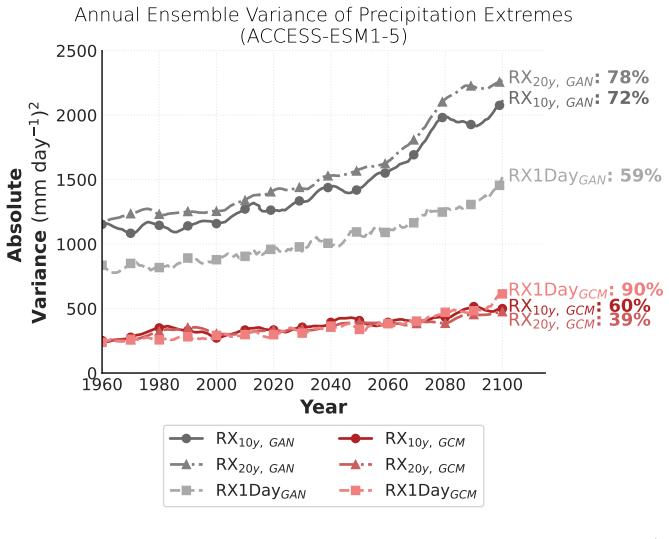
On the paper's own terms, the central discovery is that fine-scale projections of precipitation extremes are dominated by irreducible internal variability. At New Zealand's resolved downscaling scales, the signal-to-noise ratio for 10-year precipitation extremes is 0.77 in the emulator versus 1.12 in the driving global model, meaning internal precipitation variability exceeds the climate-change signal at fine scales but not quite at coarse scales. For annual and decadal extremes, internal variability contributes over 50% of total projection variance by 2080–2099, while for temperature extremes it contributes about 11% (annual) and 27% (decadal). The paper also reports that internal-variability variance for precipitation extremes increases by 59% (annual), 72% (10-year) and 78% (20-year) from the historical period to 2080–2099, and that this growth is missed by the common static-variability assumption, which underestimates end-of-century internal variability by more than a factor of two.
Load-bearing premise
The load-bearing premise is that the emulator's fine-scale internal variability — the spread among its ensemble members — faithfully represents the internal variability a real regional climate model would produce, since the paper's headline variance numbers are generated by the emulator itself rather than verified against a full RCM large ensemble.
Editorial extensions
If this is right
- If correct, individual downscaled projections of future precipitation extremes should not be read as the expected change; the ensemble-mean forced response is smoother and locally smaller than any single member.
- Detecting forced change in fine-scale precipitation extremes over New Zealand will require ensembles far larger than the three-member RCM set used previously, because internal variability can exceed the signal.
- Rare 10- and 20-year precipitation extremes will be both more severe and more uncertain than annual extremes, with internal-variability spread growing as the climate warms.
- Uncertainty assessments that assume internal variability is constant in time will understate end-of-century uncertainty in fine-scale precipitation by more than a factor of two.
- Temperature extremes remain comparatively more predictable at fine scales, with scenario spread dominating by late century, though internal variability is not negligible.
Reading between the lines
- The emulator's stochastic layer draws a single random noise vector per day; testing whether multiple draws change the variance statistics would directly probe whether the reported internal-variability growth is a property of the climate or of the generator.
- The fourfold and tenfold ratios are domain-specific; the same decomposition applied to other mid-latitude, orographically influenced regions would show whether New Zealand is a best-case or worst-case baseline for fine-scale predictability.
- The finding that downscaling itself can alter the forced signal by an amount comparable to internal variability suggests that emulator (or RCM) structural uncertainty should be included alongside model, scenario, and internal variability in future decomposition studies.
- If the variance-growth result generalizes, adaptation planning for local rainfall extremes should be framed around risk-based ensemble ranges rather than single-model 'most likely' projections.
Editorial analysis
A structured set of objections, weighed in public.
Referee Report
Summary. The paper presents a generative-AI (residual GAN) emulator for dynamical downscaling of daily precipitation and temperature over New Zealand, trained on a single CCAM RCM simulation driven by ACCESS-CM2. The emulator is applied to 20 CMIP6 GCMs, four SSPs, and two SMILEs (ACCESS-ESM1-5, CanESM5), generating more than 15,000 simulation years. The authors evaluate the emulator's historical climatology against observations and out-of-sample RCM simulations, and its climate-change signals against two unseen RCMs. They then use the emulator-downscaled ensembles to decompose uncertainty in annual and decadal extremes into model, scenario, and internal-variability components. The headline findings are that internal variability dominates model and scenario uncertainty for fine-scale precipitation extremes, that its variance grows with warming (59-78% increases for ACCESS-ESM1-5 by 2080-2099), and that it exceeds scenario variance by fourfold for annual and tenfold for decadal extremes. The paper also reports that internal-variability spread is larger at fine scales than at GCM scales and that individual ensemble members are poor guides to the forced response.
Significance. If the findings hold, they have substantial significance for regional climate risk assessment and for the design of downscaling ensembles. The paper demonstrates a promising and computationally efficient approach to generating very large downscaled ensembles, and it quantifies, at fine scales, the irreducible uncertainty from internal variability that is often underestimated in coarse-resolution studies. The evaluation against out-of-sample RCMs and observations, the use of two SMILEs, and the public availability of code and data are notable strengths. The central claim, however, rests on the emulator's ability to reproduce not only mean and extreme-change signals but also the magnitude, spatial pattern, and future scaling of fine-scale internal variability. That aspect is not directly validated against a dynamical RCM large ensemble, which is the key risk to the headline quantitative results.
major comments (3)
- [Methods, 'Generating a Large Ensemble of Climate Projections'] The statement that 'For each day, a single GAN prediction is generated from a randomized noise vector, rather than using an ensemble as in previous studies, since variability was found to be minimal for the statistics explored here' is load-bearing for the paper's central claims, but the supporting analysis is not shown. The internal-variability variance, the fourfold/tenfold ratios, and the 59-78% variance increases (Figure 5) are all computed from ensemble spread that includes the stochastic GAN output. If the single-draw approximation suppresses or inflates the stochastic component, those numbers could be emulator artifacts. Please provide the evidence that variability across multiple GAN noise draws is negligible for the variance and rare-extreme statistics used (e.g., RX1Day, RX10y, TXx, TX10y), for both historical and future periods. If the sensitivity is not negligible, the ensemble should be constructed with multiple stochastic draws per day, or the uncertainty in the variance estimates should be quantified and propagated into the decomposition.
- [Results, 'Emulator Performance in Historical and Future Climates' and 'Internal Variability in Future Climate…] The headline results concern the magnitude, spatial pattern, and future growth of fine-scale internal variability, yet these are never directly validated against a dynamical RCM SMILE. The emulator is evaluated against observations and RCMs for historical climatology and mean/extreme change signals (Figure 1; Supplementary S32-S35), and against historical interannual variability or two SMILEs only qualitatively (Supplementary S25-S27). The comparison with raw GCM spread (Figures 2 and 5) is suggestive but cannot rule out that the emulator generates structurally plausible but quantitatively wrong fine-scale variance, especially for rare decadal extremes. Please provide a quantitative validation of emulator-generated internal variability against a dynamical RCM ensemble with multiple initial conditions. If no RCM SMILE is available, a direct comparison using the CCAM n=6 ensemble (Figure 3) or another multi-member RCM dataset for the historical period, including the variance of RX10y/TX10y statistics, would materially address this concern. Absent this, the paper overstates the confidence that can be placed in the central claim.
- [Methods, 'Fractional Uncertainty in Climate Projections'] The model uncertainty component is 'defined as the variance across GCM-specific forced response fits, averaged over scenarios,' where each GCM is represented by a single realization (except for the two SMILEs). The forced-response fit is a second-degree polynomial to smoothed decadal means, which reduces but does not eliminate the influence of internal variability in each GCM's trajectory. As a result, the 'model' variance likely contains a substantial contribution from sampling noise due to internal variability, and the decomposition may double-count internal variability when the SMILE-based internal-variance estimate is added separately. The authors acknowledge this issue for the static method but not for their default decomposition. Please quantify the sensitivity: for the two SMILEs, compute model variance both from single fits of individual members and from fits of the ensemble mean, and report how the fractional contributions change. If the double-counting is material, the interpretation of 'model uncertainty dominates' versus 'internal variability dominates' could shift.
minor comments (5)
- [Abstract] The phrase 'Internal variability spread is larger at fine scales that at the coarser scales simulated in climate models' contains a typo: 'that' should be 'than'.
- [Methods, 'Fractional Uncertainty in Climate Projections'] The sentence 'We use absolute precipitation anomalies as a pose to previous studies using percentage changes' contains a typo: 'as a pose to' should be 'as opposed to'.
- [Figure 3 caption] The symbol 'A indicates the percentage of the area with sign agreement' is unclear; define the symbol explicitly in the caption or label it 'Area agreement' in the figure.
- [Results, 'Uncertainty decomposition at fine scales'] In Figure 4 and its description, 'land-averaged' and 'land average' are used interchangeably; please standardize the terminology to avoid confusion between averaging over land points before versus after computing extreme statistics.
- [References] The Harrington et al. reference has malformed author formatting ('Harrington, L. J., , Peter B., G., , Nicolas, F., , Hamish, L., , Dave, F., , and Rosier, S. M.'). Please correct.
Circularity Check
No significant circularity: the central internal-variability findings emerge from an emulator independently benchmarked against observations and out-of-sample RCMs, and the self-citations are not load-bearing.
full rationale
I walked the derivation chain from GCM inputs through the residual-GAN emulator to the uncertainty decomposition. The headline quantities, such as the fourfold/tenfold variance ratios and the 59-78% increases in precipitation variance, are computed as ensemble statistics of emulator-downscaled SMILE outputs; they are not fitted parameters and are not defined in terms of the conclusions. The emulator itself is validated in this paper against the VCSN observational dataset (Figure 1a,b) and against two RCMs not used in training (EC-Earth3 and NorESM2-MM) for mean and extreme climate-change signals (Figure 1c-e; Supplementary S32-S35), so the central claim does not reduce to a self-citation chain. The methodological statement in the Methods that one GAN noise draw per day suffices because 'variability was found to be minimal for the statistics explored here' is an unsupported assertion and a validation gap, but it is not a case where a predicted quantity is defined in terms of the input or where a fitted parameter is renamed as a prediction. Similarly, the absence of a large dynamical RCM SMILE for directly validating the future magnitude of fine-scale internal variability is a correctness and robustness concern, not a circularity. The Hawkins-Sutton style variance decomposition is standard and externally established, and the internal-variability estimate is taken from SMILE member spread rather than from the emulator's own loss function. No step was found where Eq. X = Eq. Y by construction, and the self-citations to Rampal et al. (2024a, 2025) describe architecture and training choices that are re-evaluated here rather than invoked as an unexamined uniqueness theorem. Overall, the paper's central claims have independent empirical content and are not forced by definition or by self-citation.
Assumptions & free parameters
free parameters (5)
- Residual GAN and U-Net weights =
3.5 million trainable parameters
- GAN adversarial loss weight lambda_adv =
0.01
- Intensity constraint pooling window =
20 pixels (about 350 km)
- Polynomial fit degree for forced response =
second degree, 1950-2100
- Training hyperparameters =
learning rates 2e-4 (GAN) and 7e-4 (CNN), batch 32, 200 epochs
assumptions (6)
- domain assumption Model, scenario, and internal variability uncertainties are independent and their covariance is negligible at fine scales.
- domain assumption The emulator, trained in the perfect framework on CCAM forced by ACCESS-CM2, generalizes to other GCMs, including rare 10-year extremes.
- ad hoc to paper A single stochastic GAN draw per day is representative for the variance and extreme statistics studied.
- domain assumption The two SMILEs (ACCESS-ESM1-5, CanESM5) represent the range of internal variability across models.
- domain assumption No bias correction of GCM inputs is appropriate for change-signal analysis.
- standard math Second-degree polynomial fits capture the forced response of extremes.
Cite this review
Pith. "Pith review of Downscaling with AI reveals the large role of internal variability in fine-scale projections of climate extremes." pith.science (2026). https://pith.science/paper/ALSHS5PK
@misc{pith2026250706527,
  author       = {Pith},
  title        = {Pith review of: Downscaling with AI reveals the large role of internal variability in fine-scale projections of climate extremes},
  year         = {2026},
  howpublished = {\url{https://pith.science/paper/ALSHS5PK}},
  note         = {Machine review of arXiv:2507.06527}
}
read the original abstract
The computational cost of dynamical downscaling limits ensemble sizes in regional downscaling efforts. We present a newly developed generative-AI approach to greatly expand the scope of such downscaling, enabling fine-scale future changes to be characterised including rare extremes that cannot be addressed by traditional approaches. We test this approach for New Zealand, where strong regional effects are anticipated. At fine scales, the forced (predictable) component of precipitation and temperature extremes for future periods (2080--2099) is spatially smoother than changes in individual simulations, and locally smaller. Future changes in rarer (10-year and 20-year) precipitation extremes are more severe and have larger internal variability spread than annual extremes. Internal variability spread is larger at fine scales that at the coarser scales simulated in climate models. Unpredictability from internal variability dominates model uncertainty and, for precipitation, its variance increases with warming, exceeding the variance across emission scenarios by fourfold for annual and tenfold for decadal extremes. These results indicate that fine-scale changes in future precipitation are less predictable than widely assumed and require much larger ensembles to assess reliably than changes at coarser scales.
Figures


Figures from the paper (2 more)

Reference graph
Works this paper leans on
-
[1]
E., Lenderink, G., van Meijgaard, E., and van den Hurk, B
Aalbers, E. E., Lenderink, G., van Meijgaard, E., and van den Hurk, B. J. J. M. (2018). Local-scale changes in mean and heavy precipitation in Western Europe , climate change or internal variability? Climate Dynamics , 50(11):4745--4766
work page 2018
-
[2]
Addison, H., Kendon, E., Ravuri, S., Aitchison, L., and Watson, P. A. (2024). Machine learning emulation of precipitation from km-scale regional climate simulations using a diffusion model. arXiv:2407.14158 [physics]
arXiv 2024
-
[3]
Annau, N. J., Cannon, A. J., and Monahan, A. H. (2023). Algorithmic Hallucinations of Near - Surface Winds : Statistical Downscaling with Generative Adversarial Networks to Convection - Permitting Scales . arXiv:2302.08720 [physics]
arXiv 2023
-
[4]
Bailie, T., Koh, Y. S., Rampal, N., and Gibson, P. B. (2024). Quantile- Regression - Ensemble : A Deep Learning Algorithm for Downscaling Extreme Precipitation . Proceedings of the AAAI Conference on Artificial Intelligence , 38(20):21914--21922. Number: 20
work page 2024
-
[5]
Bartók, B., Wild, M., Folini, D., Lüthi, D., Kotlarski, S., Schär, C., Vautard, R., Jerez, S., and Imecs, Z. (2017). Projected changes in surface solar radiation in CMIP5 global climate models and in EURO - CORDEX regional climate models for Europe . Climate Dynamics , 49(7):2665--2683
work page 2017
-
[6]
Baño-Medina, J., Iturbide, M., Fernández, J., and Gutiérrez, J. M. (2024). Transferability and explainability of deep learning emulators for regional climate model projections: Perspectives for future applications. Artificial Intelligence for the Earth Systems . Section: Artificial Intelligence for the Earth Systems
work page 2024
-
[7]
Bengtsson, L. and Hodges, K. I. (2019). Can an ensemble climate simulation be used to separate climate change signals from internal unforced variability? Climate Dynamics , 52(5):3553--3573
work page 2019
-
[8]
Blanusa, M. L., López-Zurita, C. J., and Rasp, S. (2023). Internal variability plays a dominant role in global climate projections of temperature and precipitation extremes. Climate Dynamics , 61(3):1931--1945
work page 2023
Show all 72 references
-
[9]
Boé, J., Mass, A., and Deman, J. (2023). A simple hybrid statistical–dynamical downscaling method for emulating regional climate models over Western Europe . Evaluation , application, and role of added value? Climate Dynamics , 61(1):271--294
2023
-
[10]
B., Stuart, S., Broadbent, A
Campbell, I., Gibson, P. B., Stuart, S., Broadbent, A. M., Sood, A., Pirooz, A. A. S., and Rampal, N. (2024). Comparison of three reanalysis-driven regional climate models over New Zealand : Climatology and extreme events. International Journal of Climatology , n/a(n/a). \_epr...
2024 doi
-
[11]
Chadwick, R., Coppola, E., and Giorgi, F. (2011). An artificial neural network technique for downscaling GCM outputs to RCM spatial scale. Nonlinear Processes in Geophysics , 18(6):1013--1028. Publisher: Copernicus GmbH
2011
-
[12]
K.-H., and Takbash, A
Chapman, S., Syktus, J., Trancoso, R., Thatcher, M., Toombs, N., Wong, K. K.-H., and Takbash, A. (2023). Evaluation of Dynamically Downscaled CMIP6 - CCAM Models Over Australia . Earth's Future , 11(11):e2023EF003548. \_eprint: https://agupubs.onlinelibrary.wiley.com/doi/pdf/1...
2023 doi
-
[13]
C., Xie, S.-P., and Dai, X
Dai, A., Fyfe, J. C., Xie, S.-P., and Dai, X. (2015). Decadal modulation of global surface temperature by internal climate variability. Nature Climate Change , 5(6):555--559. Publisher: Nature Publishing Group
2015
-
[14]
de Vries, I., Sippel, S., Zeder, J., Fischer, E., and Knutti, R. (2024). Increasing extreme precipitation variability plays a key role in future record-shattering event probability. Communications Earth & Environment , 5(1):1--15. Publisher: Nature Publishing Group
2024
-
[15]
B., Ault, T., Delworth, T
Deser, C., Lehner, F., Rodgers, K. B., Ault, T., Delworth, T. L., DiNezio, P. N., Fiore, A., Frankignoul, C., Fyfe, J. C., Horton, D. E., Kay, J. E., Knutti, R., Lovenduski, N. S., Marotzke, J., McKinnon, K. A., Minobe, S., Randerson, J., Screen, J. A., Simpson, I. R., and Tin...
2020
-
[16]
Deser, C., Phillips, A., Bourdette, V., and Teng, H. (2012). Uncertainty in climate change projections: the role of internal variability. Climate Dynamics , 38(3):527--546
2012
-
[17]
S., Alexander, M
Deser, C., Phillips, A. S., Alexander, M. A., and Smoliak, B. V. (2014). Projecting North American Climate over the Next 50 Years : Uncertainty due to Internal Variability . Journal of Climate . Section: Journal of Climate
2014
-
[18]
Di Luca, A., de Elía, R., and Laprise, R. (2013). Potential for added value in temperature simulated by high-resolution nested RCMs in present climate and in the climate change signal. Climate Dynamics , 40(1):443--464
2013
-
[19]
P., Di Luca, A., Grose, M
Di Virgilio, G., Evans, J. P., Di Luca, A., Grose, M. R., Round, V., and Thatcher, M. (2020). Realised added value in dynamical downscaling of Australian climate change. Climate Dynamics , 54(11-12):4675--4692
2020
-
[20]
Doury, A., Somot, S., and Gadat, S. (2024). On the suitability of a convolutional neural network based RCM -emulator for fine spatio-temporal precipitation. Climate Dynamics
2024
-
[21]
Doury, A., Somot, S., Gadat, S., Ribes, A., and Corre, L. (2022). Regional climate model emulator based on deep learning: concept and first evaluation of a novel hybrid downscaling approach. Climate Dynamics , 60(5):1751--1779
2022
-
[22]
Fischer, E. M. and Knutti, R. (2016). Observed heavy precipitation increase confirms theory and early models. Nature Climate Change , 6(11):986--991. Publisher: Nature Publishing Group
2016
-
[23]
B., Broadbent, A
Gibson, P. B., Broadbent, A. M., Stuart, S. J., Lewis, H., Campbell, I., Rampal, N., Harrington, L. J., and Williams, J. (2025). Downscaled CMIP6 future climate projections for New Zealand : climatology and extremes. Weather and Climate Extremes , page 100784
2025
-
[24]
B., Rampal, N., Dean, S
Gibson, P. B., Rampal, N., Dean, S. M., and Morgenstern, O. (2024a). Storylines for Future Projections of Precipitation Over New Zealand in CMIP6 Models . Journal of Geophysical Research: Atmospheres , 129(5):e2023JD039664. \_eprint: https://agupubs.onlinelibrary.wiley.com/doi...
2024 doi
-
[25]
B., Stuart, S., Sood, A., Stone, D., Rampal, N., Lewis, H., Broadbent, A., Thatcher, M., and Morgenstern, O
Gibson, P. B., Stuart, S., Sood, A., Stone, D., Rampal, N., Lewis, H., Broadbent, A., Thatcher, M., and Morgenstern, O. (2024b). Dynamical downscaling CMIP6 models over New Zealand : added value of climatology and extremes. Climate Dynamics
2024
-
[26]
S., and Bates, G
Giorgi, F., Brodeur, C. S., and Bates, G. T. (1994). Regional Climate Change Scenarios over the United States Produced with a Nested Regional Climate Model . Journal of Climate , 7(3):375--399. Publisher: American Meteorological Society Section: Journal of Climate
1994
-
[27]
Glawion, L., Polz, J., Kunstmann, H., Fersch, B., and Chwala, C. (2023). spateGAN : Spatio - Temporal Downscaling of Rainfall Fields Using a cGAN Approach . Earth and Space Science , 10(10):e2023EA002906. \_eprint: https://agupubs.onlinelibrary.wiley.com/doi/pdf/10.1029/2023EA002906
2023 doi
-
[28]
Goodfellow, I., Pouget-Abadie, J., Mirza, M., Xu, B., Warde-Farley, D., Ozair, S., Courville, A., and Bengio, Y. (2014). Generative Adversarial Nets . In Advances in Neural Information Processing Systems , volume 27. Curran Associates, Inc
2014
-
[29]
Gulrajani, I., Ahmed, F., Arjovsky, M., Dumoulin, V., and Courville, A. C. (2017). Improved Training of Wasserstein GANs . In Advances in Neural Information Processing Systems , volume 30. Curran Associates, Inc
2017
-
[30]
J., , Peter B., G., , Nicolas, F., , Hamish, L., , Dave, F., , and Rosier, S
Harrington, L. J., , Peter B., G., , Nicolas, F., , Hamish, L., , Dave, F., , and Rosier, S. M. (2025). On the procurement of physical risk assessments for climate-related disclosures: guidance from a climate science perspective. Journal of the Royal Society of New Zealand , 0...
2025
-
[31]
S., Gregory, J
Hawkins, E., Smith, R. S., Gregory, J. M., and Stainforth, D. A. (2016). Irreducible uncertainty in near-term climate projections. Climate Dynamics , 46(11):3807--3819
2016
-
[32]
and Sutton, R
Hawkins, E. and Sutton, R. (2009). The Potential to Narrow Uncertainty in Regional Climate Predictions . Bulletin of the American Meteorological Society , 90(8):1095--1108
2009
-
[33]
and Sutton, R
Hawkins, E. and Sutton, R. (2011). The potential to narrow uncertainty in projections of regional precipitation change. Climate Dynamics , 37(1-2):407--418
2011
-
[34]
A., Domínguez, M., and Rodríguez-Camino, E
Hernanz, A., García-Valero, J. A., Domínguez, M., and Rodríguez-Camino, E. (2022). A critical view on the suitability of machine learning techniques to downscale climate change projections: Illustration for temperature with a toy experiment. Atmospheric Science Letters , 23(6)...
2022 doi
-
[35]
B., Edwards, N
Holden, P. B., Edwards, N. R., Garthwaite, P. H., and Wilkinson, R. D. (2015). Emulation and interpretation of high-dimensional climate model outputs. Journal of Applied Statistics , 42(9):2038--2055
2015
-
[36]
J., Addison, H., Doury, A., Somot, S., Watson, P
Kendon, E. J., Addison, H., Doury, A., Somot, S., Watson, P. A. G., Booth, B. B. B., Coppola, E., Gutiérrez, J. M., Murphy, J., and Scullion, C. (2025). Potential for machine learning emulators to augment regional climate simulations in provision of local climate change inform...
2025
-
[37]
J., Fischer, E
Kendon, E. J., Fischer, E. M., and Short, C. J. (2023). Variability conceals emerging trend in 100yr projections of UK local hourly rainfall extremes. Nature Communications , 14(1):1133. Number: 1 Publisher: Nature Publishing Group
2023
-
[38]
Lafferty, D. C. and Sriver, R. L. (2023). Downscaling and bias-correction contribute considerable uncertainty to local climate projections in CMIP6 . npj Climate and Atmospheric Science , 6(1):1--13. Publisher: Nature Publishing Group
2023
-
[39]
B., Giguère, M., Brissette, F., Turcotte, R., Braun, M., and Scinocca, J
Leduc, M., Mailhot, A., Frigon, A., Martel, J.-L., Ludwig, R., Brietzke, G. B., Giguère, M., Brissette, F., Turcotte, R., Braun, M., and Scinocca, J. (2019). The ClimEx Project : A 50- Member Ensemble of Climate Change Projections at 12-km Resolution over Europe and Northeaste...
2019
-
[40]
and Deser, C
Lehner, F. and Deser, C. (2023). Origin, importance, and predictive limits of internal climate variability. Environmental Research: Climate , 2(2):023001. Publisher: IOP Publishing
2023
-
[41]
M., Brunner, L., Knutti, R., and Hawkins, E
Lehner, F., Deser, C., Maher, N., Marotzke, J., Fischer, E. M., Brunner, L., Knutti, R., and Hawkins, E. (2020). Partitioning climate projection uncertainty with multiple large ensembles and CMIP5 /6. Earth System Dynamics , 11(2):491--508. Publisher: Copernicus GmbH
2020
-
[42]
Leinonen, J., Nerini, D., and Berne, A. (2021). Stochastic Super - Resolution for Downscaling Time - Evolving Atmospheric Fields With a Generative Adversarial Network . IEEE Transactions on Geoscience and Remote Sensing , 59(9):7211--7223. Conference Name: IEEE Transactions on...
2021
-
[43]
Y., Zepeda-Núñez, L., Schneider, T., Anderson, J., and Sha, F
Lopez-Gomez, I., Wan, Z. Y., Zepeda-Núñez, L., Schneider, T., Anderson, J., and Sha, F. (2025). Dynamical-generative downscaling of climate model ensembles. Proceedings of the National Academy of Sciences , 122(17):e2420288122. Publisher: Proceedings of the National Academy of...
2025
-
[44]
L., , and Smith, L
Machete, R. L., , and Smith, L. A. (2016). Demonstrating the value of larger ensembles in forecasting physical systems. Tellus A: Dynamic Meteorology and Oceanography , 68(1):28393. Publisher: Taylor & Francis \_eprint: https://doi.org/10.3402/tellusa.v68.28393
2016 doi
-
[45]
Maher, N., Lehner, F., and Marotzke, J. (2020). Quantifying the role of internal variability in the temperature we expect to observe in the coming decades. Environmental Research Letters , 15(5):054014. Publisher: IOP Publishing
2020
-
[46]
Maher, N., Milinski, S., and Ludwig, R. (2021). Large ensemble climate model simulations: introduction, overview, and future prospects for utilising multiple types of large ensemble. Earth System Dynamics , 12(2):401--418. Publisher: Copernicus GmbH
2021
-
[47]
M., Chandler, R
Maraun, D., Wetterhall, F., Ireson, A. M., Chandler, R. E., Kendon, E. J., Widmann, M., Brienen, S., Rust, H. W., Sauter, T., Themeßl, M., Venema, V. K. C., Chun, K. P., Goodess, C. M., Jones, R. G., Onof, C., Vrac, M., and Thiele-Eich, I. (2010). Precipitation downscaling und...
2010 doi
-
[48]
Martel, J.-L., Mailhot, A., Brissette, F., and Caya, D. (2018). Role of Natural Climate Variability in the Detection of Anthropogenic Climate Change Signal for Mean and Extreme Precipitation at Local and Regional Scales . Journal of Climate . Section: Journal of Climate
2018
-
[49]
A., Arblaster, J
Meehl, G. A., Arblaster, J. M., and Branstator, G. (2012). Mechanisms Contributing to the Warming Hole and the Consequent U . S . East – West Differential of Heat Extremes . Journal of Climate . Section: Journal of Climate
2012
-
[50]
Miralles, O., Steinfeld, D., Martius, O., and Davison, A. C. (2022). Downscaling of Historical Wind Fields over Switzerland Using Generative Adversarial Networks . Artificial Intelligence for the Earth Systems , 1(4). Publisher: American Meteorological Society Section: Artific...
2022
-
[51]
and Osindero, S
Mirza, M. and Osindero, S. (2014). Conditional Generative Adversarial Nets . arXiv:1411.1784 [cs, stat]
2014 arXiv
-
[52]
G., Knutti, R., Lehner, F., Deser, C., and Sanderson, B
Pendergrass, A. G., Knutti, R., Lehner, F., Deser, C., and Sanderson, B. M. (2017). Precipitation variability increases in a warmer climate. Scientific Reports , 7(1):17966. Publisher: Nature Publishing Group
2017
-
[53]
and Ludwig, R
Poschlod, B. and Ludwig, R. (2021). Internal variability and temperature scaling of future sub-daily rainfall return levels over Europe . Environmental Research Letters , 16(6):064097. Publisher: IOP Publishing
2021
-
[54]
B., Sherwood, S., and Abramowitz, G
Rampal, N., Gibson, P. B., Sherwood, S., and Abramowitz, G. (2024a). On the Extrapolation of Generative Adversarial Networks for downscaling precipitation extremes in warmer climates. Geophysical Research Letters , 51(e2024GL112492). arXiv:2409.13934
2024 arXiv
-
[55]
B., Sherwood, S., Abramowitz, G., and Hobeichi, S
Rampal, N., Gibson, P. B., Sherwood, S., Abramowitz, G., and Hobeichi, S. (2025). A Reliable Generative Adversarial Network Approach for Climate Downscaling and Weather Generation . Journal of Advances in Modeling Earth Systems , 17(1):e2024MS004668. \_eprint: https://onlineli...
2025 doi
-
[56]
B., Sood, A., Stuart, S., Fauchereau, N
Rampal, N., Gibson, P. B., Sood, A., Stuart, S., Fauchereau, N. C., Brandolino, C., Noll, B., and Meyers, T. (2022). High-resolution downscaling with interpretable deep learning: Rainfall extremes over New Zealand . Weather and Climate Extremes , 38:100525
2022
-
[57]
B., Baño-Medina, J., Abramowitz, G., Beucler, T., González-Abad, J., Chapman, W., Harder, P., and Gutiérrez, J
Rampal, N., Hobeichi, S., Gibson, P. B., Baño-Medina, J., Abramowitz, G., Beucler, T., González-Abad, J., Chapman, W., Harder, P., and Gutiérrez, J. M. (2024b). Enhancing Regional Climate Downscaling through Advances in Machine Learning . Artificial Intelligence for the Earth ...
2024
-
[58]
and Braun, M
Rondeau-Genesse, G. and Braun, M. (2019). Impact of internal variability on climate change for the upcoming decades: analysis of the CanESM2 - LE and CESM - LE large ensembles. Climatic Change , 156(3):299--314
2019
-
[59]
Rummukainen, M. (2016). Added value in regional climate modeling. WIREs Climate Change , 7(1):145--159. \_eprint: https://onlinelibrary.wiley.com/doi/pdf/10.1002/wcc.378
2016 doi
-
[60]
Schwarzwald, K., Poppick, A., Rugenstein, M., Bloch-Johnson, J., Wang, J., McInerney, D., and Moyer, E. J. (2021). Changes in Future Precipitation Mean and Variability across Scales . Journal of Climate . Section: Journal of Climate
2021
-
[61]
C., Cole, J
Swart, N. C., Cole, J. N. S., Kharin, V. V., Lazare, M., Scinocca, J. F., Gillett, N. P., Anstey, J., Arora, V., Christian, J. R., Hanna, S., Jiao, Y., Lee, W. G., Majaess, F., Saenko, O. A., Seiler, C., Seinen, C., Shao, A., Sigmond, M., Solheim, L., von Salzen, K., Yang, D.,...
2019
-
[62]
L., Schär, C., Lüthi, D., and Kjellström, E
Sørland, S. L., Schär, C., Lüthi, D., and Kjellström, E. (2018). Bias patterns and climate change signals in GCM - RCM model chains. Environmental Research Letters , 13(7):074017. Publisher: IOP Publishing
2018
-
[63]
Tait, A., Henderson, R., Turner, R., and Zheng, X. (2006). Thin plate smoothing spline interpolation of daily rainfall for New Zealand using a climatological rainfall surface. International Journal of Climatology , 26(14):2097--2115. \_eprint: https://rmets.onlinelibrary.wiley...
2006 doi
-
[64]
Tait, A., Sturman, J., and Clark, M. (2012). An assessment of the accuracy of interpolated daily rainfall for New Zealand . Weather and Climate
2012
-
[65]
and McGregor, J
Thatcher, M. and McGregor, J. L. (2009). Using a Scale - Selective Filter for Dynamical Downscaling with the Conformal Cubic Atmospheric Model . Monthly Weather Review , 137(6):1742--1752. Publisher: American Meteorological Society Section: Monthly Weather Review
2009
-
[66]
von Trentini, F., Leduc, M., and Ludwig, R. (2019). Assessing natural variability in RCM signals: comparison of a multi model EURO - CORDEX ensemble with a 50-member single model large ensemble. Climate Dynamics , 53(3):1963--1979
2019
-
[67]
R., Lehner, F., Pendergrass, A
Wood, R. R., Lehner, F., Pendergrass, A. G., and Schlunegger, S. (2021). Changes in precipitation variability across time scales in multiple global climate model large ensembles. Environmental Research Letters , 16(8):084022. Publisher: IOP Publishing
2021
-
[68]
Yip, S., Ferro, C. A. T., Stephenson, D. B., and Hawkins, E. (2011). A Simple , Coherent Framework for Partitioning Uncertainty in Climate Predictions . Journal of Climate , 24(17):4634--4643
2011
-
[69]
L., and Held, I
Zhang, R., Delworth, T. L., and Held, I. M. (2007). Can the Atlantic Ocean drive the observed multidecadal variability in Northern Hemisphere mean temperature? Geophysical Research Letters , 34(2):2006GL028683
2007
-
[70]
Zhang, W., Furtado, K., Zhou, T., Wu, P., and Chen, X. (2022). Constraining extreme precipitation projections using past precipitation variability. Nature Communications , 13(1):6319. Publisher: Nature Publishing Group
2022
-
[71]
Zhang, W., Zhou, T., and Wu, P. (2024). Anthropogenic amplification of precipitation variability over the past century. Science , 385(6707):427--432. Publisher: American Association for the Advancement of Science
2024
-
[72]
A., Law, R
Ziehn, T., Chamberlain, M. A., Law, R. M., Lenton, A., Bodman, R. W., Dix, M., Stevens, L., Wang, Y.-P., and Srbinovsky, J. (2020). The Australian Earth System Model : ACCESS - ESM1 .5. Journal of Southern Hemisphere Earth Systems Science , 70(1):193--214. Publisher: CSIRO PUBLISHING
2020
Reviewed August 6, 2026 · model on record in the stance chip above.
Discussion (0). Sign in to comment.