Spatially Coherent and Intermittent Alfv\'enic Fluctuations in Solar Polar Spicules
Pith reviewed 2026-06-30 03:53 UTC · model grok-4.3
The pith
Polar spicules contain multiscale Alfvénic velocity fluctuations whose spectra and statistics match a developing turbulent cascade.
A machine-rendered reading of the paper's core claim, the machinery that carries it, and where it could break.
Core claim
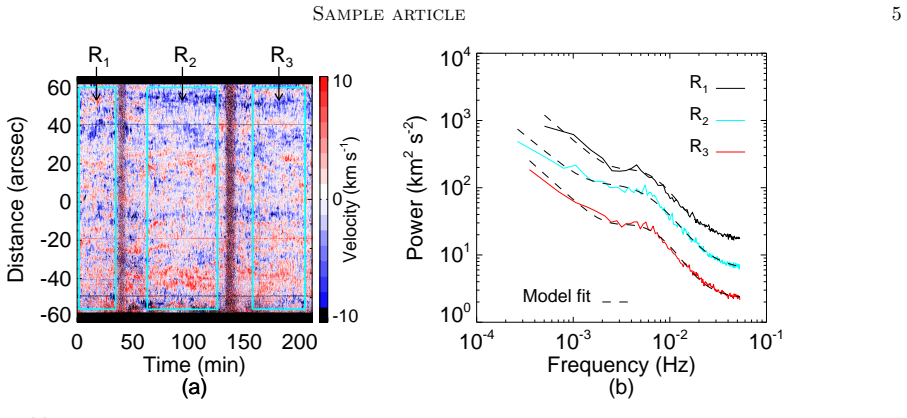
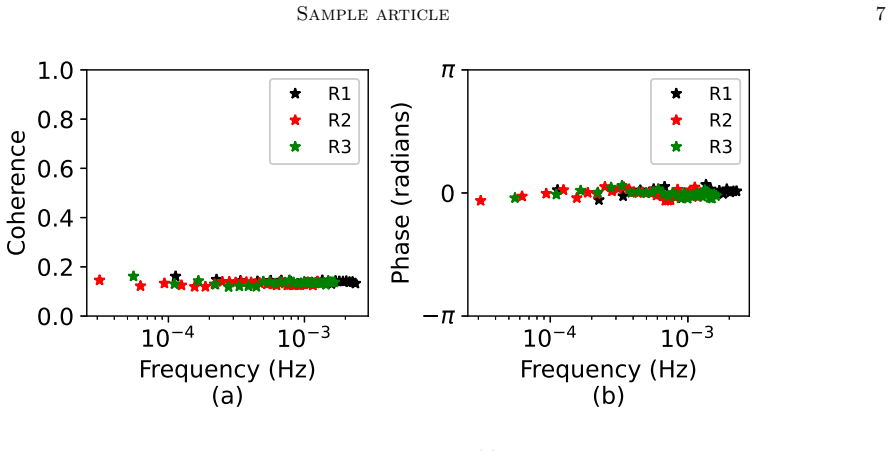
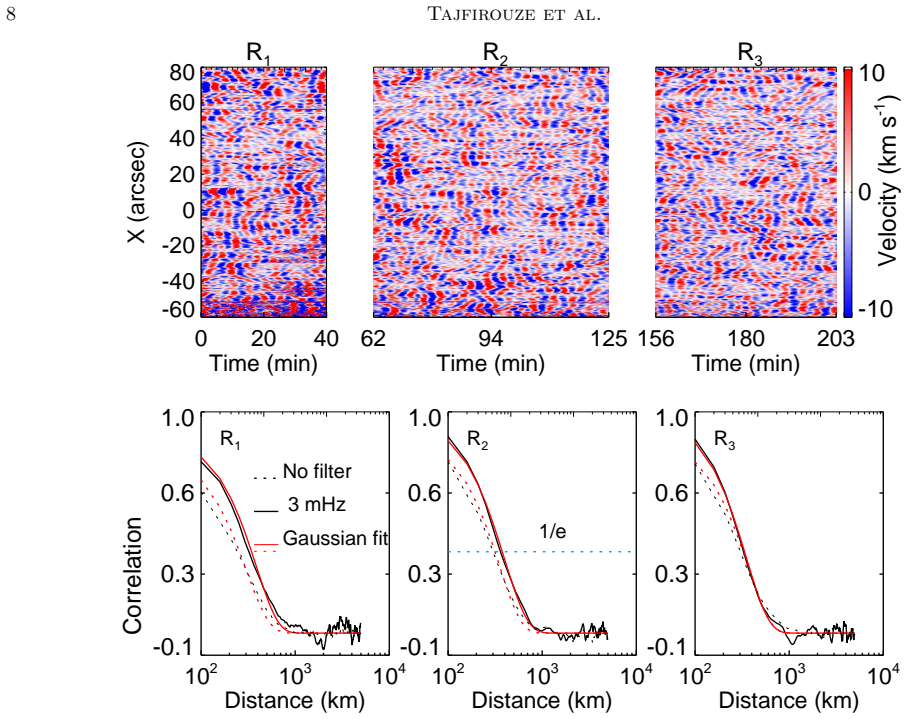
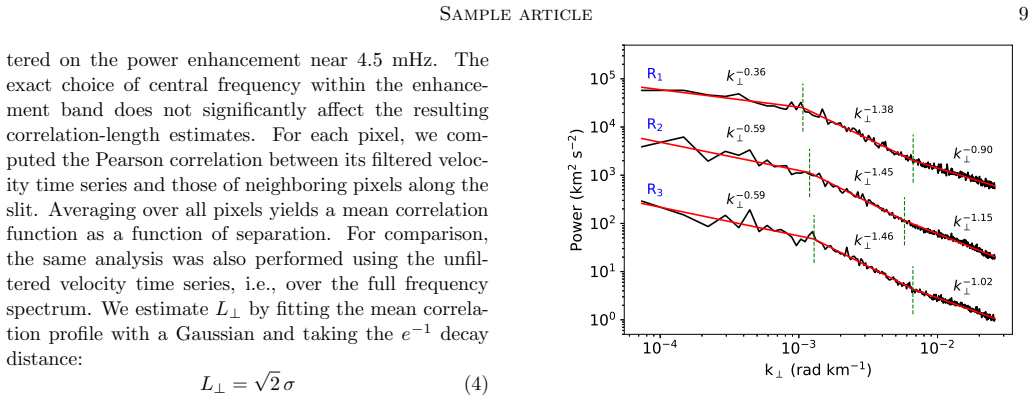
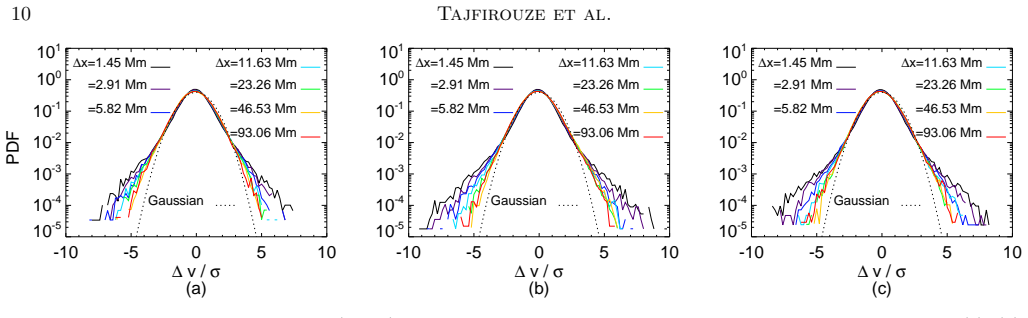
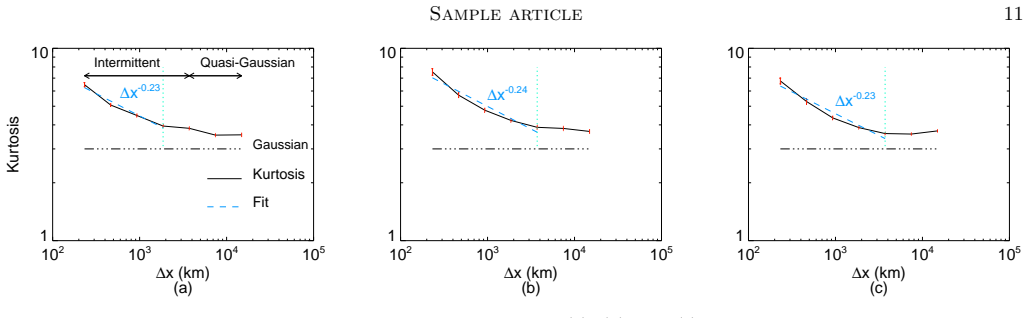
Observations of the Si IV 1394 Å line in quiet-Sun polar spicules show transverse and Doppler velocity fluctuations with temporal power spectra exhibiting enhanced power between 3-7 mHz and a peak near 4-6 mHz, a perpendicular spatial power spectrum scaling as approximately k_perp^{-1.43}, non-Gaussian velocity-increment PDFs whose kurtosis increases toward smaller scales, and an outer spatial-coherence scale of a few hundred to roughly one thousand kilometers. The authors interpret the combination of spectral slopes, intermittency, and coherence as observational evidence that polar spicules host multiscale Alfvénic fluctuations consistent with a developing turbulent cascade and intermittenc
What carries the argument
Fourier power spectra of temporal and spatial velocity fluctuations, probability distribution functions of velocity increments, and cross-correlation diagnostics for spatial coherence.
If this is right
- Spicules function as conduits that carry Alfvénic energy from the lower atmosphere into the corona.
- The observed spectral index is consistent with reflection-driven turbulence simulations.
- Intermittency at small scales implies localized dissipation within the spicules themselves.
- The measured outer coherence scale sets a lower bound on the driving scale of the fluctuations.
Where Pith is reading between the lines
- If the cascade continues into the corona, the measured fluctuation amplitudes could supply a non-negligible fraction of the energy required to heat the quiet corona.
- Repeating the same analysis on spicules in active regions would test whether the spectral slope and intermittency depend on the background magnetic field strength.
- Higher-cadence observations that resolve scales below the current outer scale could reveal whether the power law steepens further, as expected in a fully developed cascade.
Load-bearing premise
The observed transverse and Doppler velocity fluctuations are dominantly Alfvénic and the measured power-law scaling together with rising kurtosis directly trace the start of a turbulent energy cascade.
What would settle it
Independent high-resolution spectra showing that the velocity fluctuations contain substantial non-Alfvénic contributions or that kurtosis stays constant across scales would falsify the turbulent-cascade interpretation.
Figures
read the original abstract
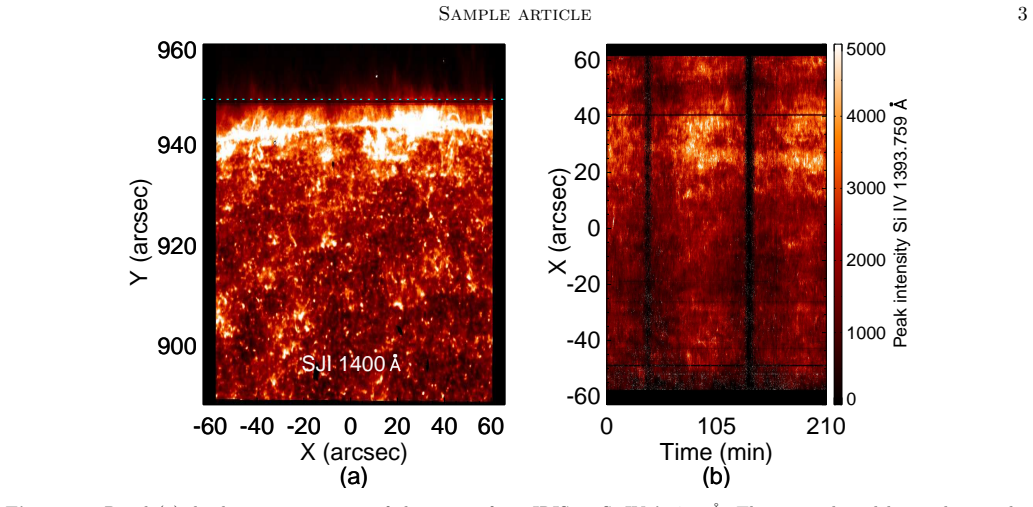
Alfv\'enic fluctuations are considered a key mechanism for transporting energy from the lower solar atmosphere into the corona, with spicules acting as dynamic conduits for this transfer. We investigate transverse and Doppler velocity fluctuations in quiet-Sun polar spicules observed in the Si IV 1394\,\AA\ line by the Interface Region Imaging Spectrograph. Fourier analysis in time and space is used to characterize power across frequency and spatial scales. The temporal power spectra show broadband fluctuations with enhanced power in the 3--7~mHz range and a peak near 4--6~mHz. Spatial Fourier analysis of Doppler velocities reveals a perpendicular power spectrum scaling as $\sim k_{\perp}^{-1.43}$, slightly shallower than the canonical $-5/3$ and $-3/2$ slopes of strong MHD turbulence, but consistent with reflection-driven turbulence simulations. Velocity increment PDFs show non-Gaussian behavior, with kurtosis increasing toward smaller scales, consistent with intermittency. Spatial coherence analysis using cross-correlation and spectral diagnostics indicates an outer scale of a few hundred to about a thousand kilometres, with cross-correlation yielding smaller values. These results provide observational evidence that polar spicules host multiscale Alfv\'enic fluctuations consistent with a developing turbulent cascade and intermittency, suggesting a role in energy transport into the solar corona.
Editorial analysis
A structured set of objections, weighed in public.
Referee Report
Summary. The paper analyzes transverse and Doppler velocity fluctuations in quiet-Sun polar spicules observed in the Si IV 1394 Å line with IRIS. Temporal Fourier spectra show broadband power with a peak near 4–6 mHz; spatial Fourier analysis yields a perpendicular spectrum scaling as ∼k⊥^{-1.43}; velocity-increment PDFs are non-Gaussian with kurtosis rising at smaller scales; cross-correlation and spectral diagnostics indicate spatial coherence on scales of a few hundred to ∼1000 km. The authors interpret these statistics as evidence that polar spicules host multiscale Alfvénic fluctuations consistent with a developing turbulent cascade and intermittency, thereby contributing to energy transport into the corona.
Significance. If the fluctuations can be shown to be dominantly Alfvénic and the power-law and kurtosis results can be robustly linked to a turbulent cascade, the work would supply useful observational constraints on wave-mediated energy transport in the chromosphere–corona interface, a topic of direct relevance to coronal heating models.
major comments (3)
- [Abstract] Abstract (final sentence) and the interpretive discussion: the central claim equates the observed transverse/Doppler fluctuations with multiscale Alfvénic turbulence on the basis of the k⊥^{-1.43} spectrum and rising kurtosis. No polarization, magnetic-field, or forward-modeling diagnostics are supplied to isolate the Alfvénic component from possible fast/slow-mode contamination, line-of-sight superposition, or instrumental artifacts; this assumption is load-bearing for the link to a turbulent cascade and coronal energy transport.
- [Spatial Fourier analysis] Spatial Fourier analysis section: the reported ∼k⊥^{-1.43} scaling is stated to be consistent with reflection-driven turbulence simulations, yet the manuscript provides neither formal uncertainties on the index, robustness tests against Fourier windowing or spatial binning choices, nor quantitative comparison to the cited simulation slopes; without these the claimed consistency cannot be evaluated and the result remains difficult to use as a constraint.
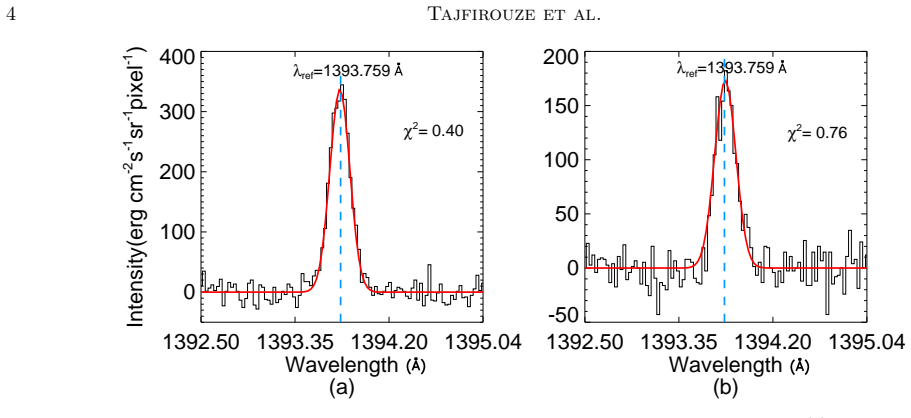
- [Methods / Data analysis] Data selection and error propagation: the manuscript does not detail the criteria used to select spicules or pixels, nor how uncertainties from line fitting, background subtraction, or finite signal-to-noise are propagated into the power spectra and kurtosis values; these omissions prevent assessment of whether the reported scalings and non-Gaussianity are robust.
minor comments (2)
- [Spatial analysis] Notation: the symbol k⊥ is introduced without an explicit definition of the perpendicular direction relative to the local magnetic field or line of sight.
- [Figures] Figure captions: several panels lack explicit labels for the frequency or wavenumber ranges over which the power-law fits were performed.
Simulated Author's Rebuttal
We thank the referee for their constructive and detailed review. We address each major comment below with point-by-point responses. Where the manuscript was lacking in detail or robustness, we have revised accordingly; in cases where new observational diagnostics are unavailable, we have added explicit discussion of assumptions and limitations.
read point-by-point responses
-
Referee: [Abstract] Abstract (final sentence) and the interpretive discussion: the central claim equates the observed transverse/Doppler fluctuations with multiscale Alfvénic turbulence on the basis of the k⊥^{-1.43} spectrum and rising kurtosis. No polarization, magnetic-field, or forward-modeling diagnostics are supplied to isolate the Alfvénic component from possible fast/slow-mode contamination, line-of-sight superposition, or instrumental artifacts; this assumption is load-bearing for the link to a turbulent cascade and coronal energy transport.
Authors: We acknowledge that the dataset does not include polarization or vector magnetic field measurements that would allow direct mode separation. Our interpretation follows the standard association in the literature of transverse spicule motions observed in transition-region lines with Alfvénic fluctuations. In revision we have added explicit caveats to the abstract and discussion sections stating the assumptions, possible fast/slow-mode contributions, and line-of-sight effects. We also cite supporting forward-modeling work that validates the Alfvénic interpretation for comparable IRIS observations. These changes clarify the evidential basis without overstating the diagnostics. revision: partial
-
Referee: [Spatial Fourier analysis] Spatial Fourier analysis section: the reported ∼k⊥^{-1.43} scaling is stated to be consistent with reflection-driven turbulence simulations, yet the manuscript provides neither formal uncertainties on the index, robustness tests against Fourier windowing or spatial binning choices, nor quantitative comparison to the cited simulation slopes; without these the claimed consistency cannot be evaluated and the result remains difficult to use as a constraint.
Authors: We agree that the spectral analysis requires greater rigor. The revised manuscript now reports the index with formal uncertainties from least-squares fitting and bootstrap resampling. Additional tests using Hanning and Blackman windows and varied spatial binning confirm stability within ±0.1. We also provide a direct quantitative comparison, noting that -1.43 ± 0.08 lies within the range reported by the cited reflection-driven turbulence simulations. These results are presented in an expanded analysis subsection. revision: yes
-
Referee: [Methods / Data analysis] Data selection and error propagation: the manuscript does not detail the criteria used to select spicules or pixels, nor how uncertainties from line fitting, background subtraction, or finite signal-to-noise are propagated into the power spectra and kurtosis values; these omissions prevent assessment of whether the reported scalings and non-Gaussianity are robust.
Authors: We have expanded the Methods section with the requested details: spicule selection uses intensity thresholds (>3σ above background) plus manual verification; pixels are retained only if line-core SNR >5; velocity uncertainties from Gaussian fitting are propagated via 1000-iteration Monte Carlo simulations to derive errors on spectra and kurtosis. A brief discussion of background-subtraction sensitivity is also included. These additions allow direct evaluation of robustness. revision: yes
Circularity Check
No circularity: purely observational reporting of spectra and statistics
full rationale
The paper performs Fourier analysis on observed Si IV Doppler and transverse velocities in polar spicules, reports measured power spectra (~k⊥^{-1.43}), kurtosis trends, and cross-correlation scales, then states consistency with Alfvénic turbulence. No equations define a quantity in terms of itself, no fitted parameters are relabeled as predictions, and no load-bearing claims rest on self-citations or uniqueness theorems imported from the authors' prior work. All central results are direct outputs of the data reduction; the interpretive link to energy transport is an external assumption, not a reduction internal to the derivation chain.
Axiom & Free-Parameter Ledger
Reference graph
Works this paper leans on
-
[1]
R., Duvall, Thomas L., J., & Jefferies, S
Anderson, E. R., Duvall, Thomas L., J., & Jefferies, S. M. 1990, ApJ, 364, 699, doi: 10.1086/169452
-
[2]
J., Winebarger, A., Tsiklauri, D., & Peter, H
Aschwanden, M. J., Winebarger, A., Tsiklauri, D., & Peter, H. 2007, ApJ, 659, 1673, doi: 10.1086/513070 Sample article13
-
[3]
Athay, R. G., & Holzer, T. E. 1982, ApJ, 255, 743, doi: 10.1086/159873
-
[4]
2025, ApJL, 980, L20, doi: 10.3847/2041-8213/ada363
Bailey, Z., Bandyopadhyay, R., Habbal, S., & Druckm¨ uller, M. 2025, ApJL, 980, L20, doi: 10.3847/2041-8213/ada363
-
[5]
Bate, W., Jess, D. B., Nakariakov, V. M., et al. 2022, ApJ, 930, 129, doi: 10.3847/1538-4357/ac5c53
-
[6]
A Global Survey of EUV Corona Power Spectra
Battams, K., Gallagher, B. M., & Weigel, R. S. 2017, arXiv e-prints, arXiv:1707.02448, doi: 10.48550/arXiv.1707.02448
work page internal anchor Pith review Pith/arXiv arXiv doi:10.48550/arxiv.1707.02448 2017
-
[7]
Beckers, J. M. 1968, SoPh, 3, 367, doi: 10.1007/BF00171614
-
[8]
2013, Living Reviews in Solar Physics, 10, 2, doi: 10.12942/lrsp-2013-2
Bruno, R., & Carbone, V. 2013, Living Reviews in Solar Physics, 10, 2, doi: 10.12942/lrsp-2013-2
-
[9]
Cally, P. S., & Goossens, M. 2008, SoPh, 251, 251, doi: 10.1007/s11207-007-9086-3
-
[10]
Chandran, B. D. G., & Perez, J. C. 2019, Journal of Plasma Physics, 85, 905850409, doi: 10.1017/S0022377819000540
-
[11]
Chandran, B. D. G., Sioulas, N., Bale, S., et al. 2025, Journal of Plasma Physics, 91, E57, doi: 10.1017/S0022377825000194
-
[12]
Chen, C. H. K. 2016, Journal of Plasma Physics, 82, 535820602, doi: 10.1017/S0022377816001124
-
[13]
Chen, C. H. K., Sorriso-Valvo, L., ˇSafr´ ankov´ a, J., & Nˇ emeˇ cek, Z. 2014, ApJL, 789, L8, doi: 10.1088/2041-8205/789/1/L8
-
[14]
Cranmer, S. R., & van Ballegooijen, A. A. 2005, ApJS, 156, 265, doi: 10.1086/426507 De Moortel, I., & Pascoe, D. J. 2012a, ApJ, 746, 31, doi: 10.1088/0004-637X/746/1/31 —. 2012b, ApJ, 746, 31, doi: 10.1088/0004-637X/746/1/31 —. 2012c, ApJ, 746, 31, doi: 10.1088/0004-637X/746/1/31 De Pontieu, B., Erd´ elyi, R., & De Moortel, I. 2005, The Astrophysical Jour...
-
[15]
Schrijver, C. J. 2009, ApJL, 701, L1, doi: 10.1088/0004-637X/701/1/L1 De Pontieu, B., McIntosh, S. W., Carlsson, M., et al. 2007, Science, 318, 1574, doi: 10.1126/science.1151747 de Pontieu, B., McIntosh, S., Hansteen, V. H., et al. 2007, PASJ, 59, S655, doi: 10.1093/pasj/59.sp3.S655 De Pontieu, B., Title, A. M., Lemen, J. R., et al. 2014, SoPh, 289, 2733...
-
[16]
Didkovsky, L., Judge, D., Kosovichev, A. G., Wieman, S., & Woods, T. 2011, ApJL, 738, L7, doi: 10.1088/2041-8205/738/1/L7
-
[17]
Dmitruk, P., Matthaeus, W. H., Milano, L. J., & Oughton, S. 2001, Physics of Plasmas, 8, 2377, doi: 10.1063/1.1344563
-
[18]
Frisch, U. 1995, Turbulence. The legacy of A.N. Kolmogorov, doi: 10.1017/CBO9781139170666
-
[19]
1995, ApJ, 438, 763, doi: 10.1086/175121
Goldreich, P., & Sridhar, S. 1995, ApJ, 438, 763, doi: 10.1086/175121
-
[20]
2012, ApJ, 753, 111, doi: 10.1088/0004-637X/753/2/111
Goossens, M., Andries, J., Soler, R., et al. 2012, ApJ, 753, 111, doi: 10.1088/0004-637X/753/2/111
-
[21]
2015, SoPh, 290, 3023, doi: 10.1007/s11207-015-0772-2
Guglielmi, A., Potapov, A., & Dovbnya, B. 2015, SoPh, 290, 3023, doi: 10.1007/s11207-015-0772-2
-
[22]
Hahn, M., Fu, X., Hofmeister, S. J., et al. 2025a, ApJ, 984, 69, doi: 10.3847/1538-4357/adc1c0
-
[23]
Hahn, M., Hofmeister, S. J., Koukras, A., & Savin, D. W. 2025b, ApJ, 991, 97, doi: 10.3847/1538-4357/ae017f
-
[24]
2014, Science, 346, 1255757, doi: 10.1126/science.1255757
Hansteen, V., De Pontieu, B., Carlsson, M., et al. 2014, Science, 346, 1255757, doi: 10.1126/science.1255757
-
[25]
H., de Pontieu, B., Carlsson, M., et al
Hansteen, V. H., de Pontieu, B., Carlsson, M., et al. 2007, PASJ, 59, S699, doi: 10.1093/pasj/59.sp3.S699
-
[26]
He, J. S., Tu, C. Y., Marsch, E., et al. 2009, A&A, 497, 525, doi: 10.1051/0004-6361/200810777
-
[27]
2025, arXiv e-prints, arXiv:2511.10906, doi: 10.48550/arXiv.2511.10906
Huang, Z., Velli, M., Panasenco, O., et al. 2025, arXiv e-prints, arXiv:2511.10906, doi: 10.48550/arXiv.2511.10906
-
[28]
Iroshnikov, P. S. 1964, Soviet Ast., 7, 566
1964
-
[29]
Isaacs, J. J., Tessein, J. A., & Matthaeus, W. H. 2015, Journal of Geophysical Research (Space Physics), 120, 868, doi: 10.1002/2014JA020661
-
[30]
B., Mathioudakis, M., Erd´ elyi, R., et al
Jess, D. B., Mathioudakis, M., Erd´ elyi, R., et al. 2009, Science, 323, 1582, doi: 10.1126/science.1168680
-
[31]
Kayshap, P., & Young, P. R. 2023, MNRAS, 526, 383, doi: 10.1093/mnras/stad2761
-
[32]
A., & L´ opez Fuentes, M
Klimchuk, J. A., & L´ opez Fuentes, M. C. 2006, in American Institute of Physics Conference Series, Vol. 848, Recent Advances in Astronomy and Astrophysics, ed. N. Solomos (AIP), 55–63
2006
-
[33]
Kraichnan, R. H. 1965, Physics of Fluids, 8, 1385, doi: 10.1063/1.1761412
-
[34]
2019, ApJ, 882, 50, doi: 10.3847/1538-4357/ab357c
Magyar, N., Van Doorsselaere, T., & Goossens, M. 2019, ApJ, 882, 50, doi: 10.3847/1538-4357/ab357c
-
[35]
Matthaeus, W. H., Mullan, D. J., Dmitruk, P., Milano, L., & Oughton, S. 2003, Nonlinear Processes in Geophysics, 10, 93, doi: 10.5194/npg-10-93-2003
-
[36]
Matthaeus, W. H., Zank, G. P., Oughton, S., Mullan, D. J., & Dmitruk, P. 1999, ApJL, 523, L93, doi: 10.1086/312259
-
[37]
McIntosh, S. W., & De Pontieu, B. 2012, ApJ, 761, 138, doi: 10.1088/0004-637X/761/2/138
-
[38]
W., de Pontieu, B., Carlsson, M., et al
McIntosh, S. W., de Pontieu, B., Carlsson, M., et al. 2011, Nature, 475, 477, doi: 10.1038/nature10235
-
[39]
2025, ApJ, 982, 199, doi: 10.3847/1538-4357/adba54
Mondal, S., Banerjee, S., & Sorriso-Valvo, L. 2025, ApJ, 982, 199, doi: 10.3847/1538-4357/adba54
-
[40]
Morton, R. J., Molnar, M., Cranmer, S. R., & Schad, T. A. 2025, ApJ, 982, 104, doi: 10.3847/1538-4357/adb8df
-
[41]
Morton, R. J., & Soler, R. 2025a, ApJL, 986, L6, doi: 10.3847/2041-8213/add7da 14Tajfirouze et al. —. 2025b, ApJL, 986, L6, doi: 10.3847/2041-8213/add7da
-
[42]
Morton, R. J., Tomczyk, S., & Pinto, R. 2015, Nature Communications, 6, 7813, doi: 10.1038/ncomms8813
-
[43]
Morton, R. J., Tomczyk, S., & Pinto, R. F. 2016, ApJ, 828, 89, doi: 10.3847/0004-637X/828/2/89
-
[44]
J., Verth, G., Fedun, V., Shelyag, S., & Erd´ elyi, R
Morton, R. J., Verth, G., Fedun, V., Shelyag, S., & Erd´ elyi, R. 2013, ApJ, 768, 17, doi: 10.1088/0004-637X/768/1/17
-
[45]
Morton, R. J., Weberg, M. J., & McLaughlin, J. A. 2019, Nature Astronomy, 3, 223, doi: 10.1038/s41550-018-0668-9
-
[46]
Okamoto, T. J., & De Pontieu, B. 2011a, ApJL, 736, L24, doi: 10.1088/2041-8205/736/2/L24 —. 2011b, ApJL, 736, L24, doi: 10.1088/2041-8205/736/2/L24
-
[47]
Osman, K. T., Matthaeus, W. H., Greco, A., & Servidio, S. 2011, ApJL, 727, L11, doi: 10.1088/2041-8205/727/1/L11
-
[48]
Pant, V., Magyar, N., Van Doorsselaere, T., & Morton, R. J. 2019, ApJ, 881, 95, doi: 10.3847/1538-4357/ab2da3
-
[49]
C., & Chandran, B
Perez, J. C., & Chandran, B. D. 2013a, in AGU Fall Meeting Abstracts, Vol. 2013, AGU Fall Meeting
2013
-
[50]
C., & Chandran, B
Perez, J. C., & Chandran, B. D. 2013b, in AGU Fall Meeting Abstracts, Vol. 2013, AGU Fall Meeting
2013
-
[51]
Perez, J. C., & Chandran, B. D. G. 2013c, ApJ, 776, 124, doi: 10.1088/0004-637X/776/2/124
-
[52]
Pneuman, G. W., & Kopp, R. A. 1978, SoPh, 57, 49, doi: 10.1007/BF00152043
-
[53]
2026, ApJ, 1001, 173, doi: 10.3847/1538-4357/ae5792
Qi, Y., Guo, M., Huang, Z., et al. 2026, ApJ, 1001, 173, doi: 10.3847/1538-4357/ae5792
-
[54]
Rao, Y. K., Del Zanna, G., & Mason, H. E. 2022, MNRAS, 511, 1383, doi: 10.1093/mnras/stac128
-
[55]
1981, SoPh, 69, 27, doi: 10.1007/BF00151253
Roberts, B. 1981, SoPh, 69, 27, doi: 10.1007/BF00151253
-
[56]
Salem, C., Mangeney, A., Bale, S. D., & Veltri, P. 2009, ApJ, 702, 537, doi: 10.1088/0004-637X/702/1/537
-
[57]
2019, Science, 366, 890, doi: 10.1126/science.aaw2796
Samanta, T., Tian, H., Yurchyshyn, V., et al. 2019, Science, 366, 890, doi: 10.1126/science.aaw2796
-
[58]
Schekochihin, A. A. 2022, Journal of Plasma Physics, 88, 155880501, doi: 10.1017/S0022377822000721
-
[59]
Sharma, R., & Morton, R. J. 2023, Nature Astronomy, 7, 1301, doi: 10.1038/s41550-023-02070-1
-
[60]
Shetye, J., Verwichte, E., Stangalini, M., & Doyle, J. G. 2021, ApJ, 921, 30, doi: 10.3847/1538-4357/ac1a12
-
[61]
Soler, R., Terradas, J., Oliver, R., & Ballester, J. L. 2019, ApJ, 871, 3, doi: 10.3847/1538-4357/aaf64c
-
[62]
Sorriso-Valvo, L., Carbone, V., Giuliani, P., et al. 2001, Planet. Space Sci., 49, 1193, doi: 10.1016/S0032-0633(01)00060-5
-
[63]
Tajfirouze, E., Morton, R., & Young, P. R. 2025, ApJ, 982, 59, doi: 10.3847/1538-4357/adb9e5
-
[64]
Tavabi, E., Koutchmy, S., Ajabshirizadeh, A., Ahangarzadeh Maralani, A. R., & Zeighami, S. 2015, A&A, 573, A4, doi: 10.1051/0004-6361/201423385
-
[65]
Thurgood, J. O., Morton, R. J., & McLaughlin, J. A. 2014, ApJL, 790, L2, doi: 10.1088/2041-8205/790/1/L2
-
[66]
Tian, H., McIntosh, S. W., Wang, T., et al. 2012, ApJ, 759, 144, doi: 10.1088/0004-637X/759/2/144
-
[67]
Tian, H., DeLuca, E. E., Cranmer, S. R., et al. 2014, Science, 346, 1255711, doi: 10.1126/science.1255711
-
[68]
Tomczyk, S., McIntosh, S. W., Keil, S. L., et al. 2007, Science, 317, 1192, doi: 10.1126/science.1143304 van Ballegooijen, A. A., Asgari-Targhi, M., Cranmer, S. R., & DeLuca, E. E. 2011, ApJ, 736, 3, doi: 10.1088/0004-637X/736/1/3 van der Holst, B., Sokolov, I. V., Meng, X., et al. 2014, ApJ, 782, 81, doi: 10.1088/0004-637X/782/2/81 Van Doorsselaere, T., ...
-
[69]
Vernazza, J. E., Avrett, E. H., & Loeser, R. 1981, ApJS, 45, 635, doi: 10.1086/190731
-
[70]
Verscharen, D., Klein, K. G., & Maruca, B. A. 2019, Living Reviews in Solar Physics, 16, 5, doi: 10.1007/s41116-019-0021-0
-
[71]
1967, IEEE Transactions on Audio and Electroacoustics, 15, 70, doi: 10.1109/TAU.1967.1161901
Welch, P. 1967, IEEE Transactions on Audio and Electroacoustics, 15, 70, doi: 10.1109/TAU.1967.1161901
-
[72]
Wentzel, D. G. 1979, ApJ, 227, 319, doi: 10.1086/156732
-
[73]
Withbroe, G. L., & Noyes, R. W. 1977, ARA&A, 15, 363, doi: 10.1146/annurev.aa.15.090177.002051
discussion (0)
Sign in with ORCID, Apple, or X to comment. Anyone can read and Pith papers without signing in.