Experimental Tests of Radio-Frequency Heating Saturation in Ultracold Neutral Plasmas
Pith reviewed 2026-06-28 11:52 UTC · model grok-4.3
The pith
Experiments find no saturation of radio-frequency electron heating in ultracold plasmas even when quiver velocity matches thermal velocity.
A machine-rendered reading of the paper's core claim, the machinery that carries it, and where it could break.
Core claim
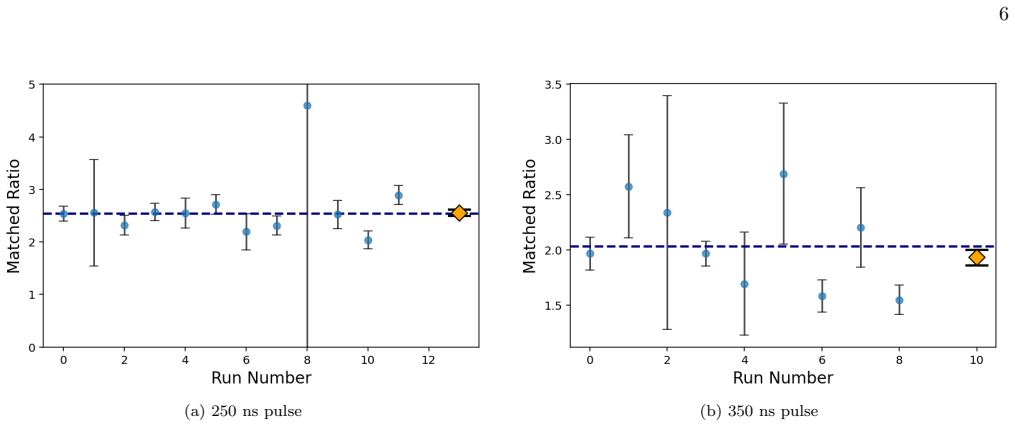
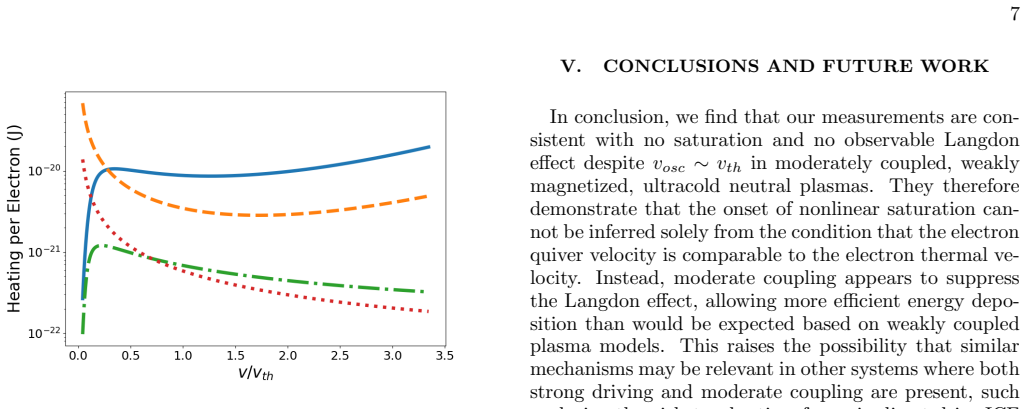
Despite v_osc being comparable to v_th, no observable saturation of RF heating is measured. The results match linear response theory and binary collision theory much better when quiver-velocity-dependent cutoffs are used. Under the experimental conditions of moderate coupling and magnetization, RF heating produces no detectable distortion of the electron velocity distribution away from Maxwell-Boltzmann form, showing that saturation from the Langdon effect is suppressed.
What carries the argument
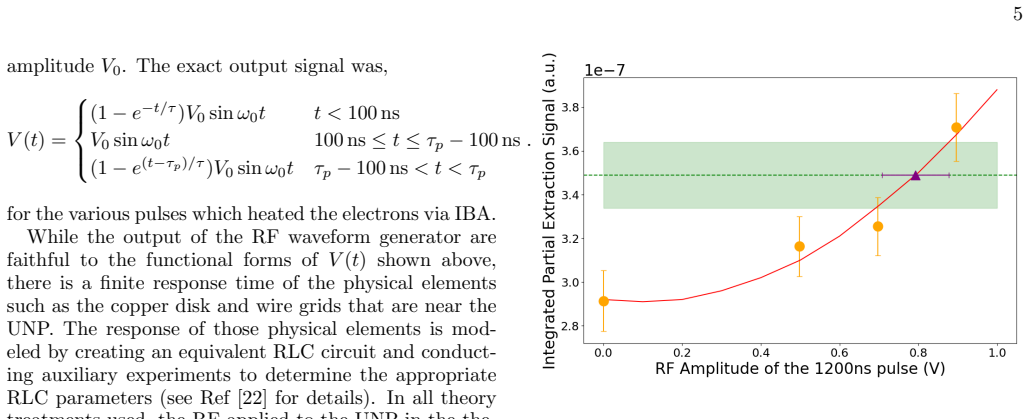
The experimental isolation of saturation behavior by comparing electron heating from RF pulses of different amplitude and duration that are predicted to deliver equal energy input if the response remains linear.
If this is right
- Heating rate scales linearly with RF power even when quiver velocity reaches thermal velocity.
- Linear response theory and binary collision theory require quiver-velocity-dependent cutoffs to match the measured heating.
- No distortion of the electron velocity distribution from Maxwell-Boltzmann form occurs, suppressing Langdon-effect saturation.
- Moderate coupling and magnetization do not introduce additional saturation mechanisms under these conditions.
Where Pith is reading between the lines
- The results imply that saturation thresholds in inverse bremsstrahlung models may be higher than commonly assumed when velocity-dependent cutoffs are included.
- Similar RF heating protocols could be applied to other collisional plasma systems without expecting nonlinear corrections at comparable velocity ratios.
- The lack of observed distribution distortion suggests that Langdon saturation requires stronger coupling or different magnetization to appear.
- Further measurements at higher RF frequencies or lower densities could test whether the linear regime persists outside the present parameter range.
Load-bearing premise
The plasmas remain sufficiently collisional for inverse bremsstrahlung to dominate heating and the chosen RF pulse pairs isolate saturation without confounding effects from magnetization or coupling.
What would settle it
A systematic difference in final electron temperature between RF pulse pairs of different amplitude but equal nominal energy input would demonstrate saturation.
Figures

read the original abstract
For non-resonant radio-frequency (RF) fields, electron heating in sufficiently collisional plasmas can be driven primarily by inverse bremsstrahlung absorption. When the quiver velocity v_osc approaches the electron thermal velocity v_th, theory often predicts sublinear scaling of the heating rate with RF power, indicating saturation. We experimentally test this prediction in ultracold neutral plasmas by finding RF pulses of different amplitude and duration that produce the same electron heating. Despite v_osc being comparable to v_th, we measured no observable saturation. We compare our results to linear response theory (LRT) and a binary collision theory (BCT). The predicted saturation in both theories is sensitive to how common assumptions about cutoff parameters are applied, and agreement with experimental results is much better if quiver-velocity-dependent cutoffs in LRT and BCT are used. Additionally, under our conditions of moderate coupling and magnetization, we find no evidence that RF heating distorts the electron velocity distribution from Maxwell-Boltzmann, indicating saturation from the Langdon effect is suppressed.
Editorial analysis
A structured set of objections, weighed in public.
Referee Report
Summary. The manuscript reports an experimental test of saturation in non-resonant RF heating of ultracold neutral plasmas via inverse bremsstrahlung. By identifying pairs of RF pulses with differing amplitude and duration that produce identical electron heating, the authors find no observable saturation even when v_osc is comparable to v_th. Results are compared to linear response theory (LRT) and binary collision theory (BCT); agreement improves when velocity-dependent cutoffs are adopted. Under the reported conditions of moderate coupling and magnetization, no distortion of the electron velocity distribution from Maxwell-Boltzmann is observed, indicating suppression of Langdon-effect saturation.
Significance. If the central null result on saturation holds, the work supplies a direct experimental benchmark for the regime v_osc ~ v_th in moderately coupled, magnetized ultracold plasmas. The equal-heating pulse-pair design isolates the scaling behavior without relying on absolute power calibration. The finding that velocity-dependent cutoffs improve theory-experiment agreement, together with the absence of distribution distortion, provides concrete guidance for choosing cutoff prescriptions in LRT/BCT modeling of RF heating.
major comments (2)
- [Abstract and §4] Abstract and §4 (results): the central claim of 'no observable saturation' is presented without explicit quantitative heating values, error bars on the temperature change, or the precise criterion used to declare two pulses 'equal' in heating. While the full manuscript supplies these details in the methods, the abstract alone leaves the sensitivity of the null result difficult to assess.
- [§5] §5 (theory comparison): the statement that agreement is 'much better' with velocity-dependent cutoffs would be strengthened by an explicit side-by-side comparison (on the identical dataset) of the fixed-cutoff LRT/BCT predictions versus the velocity-dependent versions, including the resulting χ^{2} or residual values.
minor comments (2)
- [Figures] Figure captions should state the number of independent experimental runs and the typical uncertainty on each data point.
- [§2] Notation for the cutoff parameters (e.g., k_max, v_cut) should be defined once in a dedicated subsection rather than introduced piecemeal in the theory discussion.
Simulated Author's Rebuttal
We thank the referee for the supportive review and recommendation of minor revision. The comments identify useful opportunities to strengthen the presentation of our null result and the theory comparison. We address both points with revisions to the manuscript.
read point-by-point responses
-
Referee: [Abstract and §4] Abstract and §4 (results): the central claim of 'no observable saturation' is presented without explicit quantitative heating values, error bars on the temperature change, or the precise criterion used to declare two pulses 'equal' in heating. While the full manuscript supplies these details in the methods, the abstract alone leaves the sensitivity of the null result difficult to assess.
Authors: We agree that the abstract would benefit from explicit quantitative details to allow readers to assess the sensitivity of the null result. In the revised manuscript we have added representative heating values (with error bars) and the precise matching criterion used to identify equal-heating pulse pairs directly into the abstract, using the values already reported in the methods section. revision: yes
-
Referee: [§5] §5 (theory comparison): the statement that agreement is 'much better' with velocity-dependent cutoffs would be strengthened by an explicit side-by-side comparison (on the identical dataset) of the fixed-cutoff LRT/BCT predictions versus the velocity-dependent versions, including the resulting χ^{2} or residual values.
Authors: We concur that a quantitative side-by-side comparison on the same dataset would make the improvement more transparent. We have added to §5 an explicit comparison of the fixed-cutoff and velocity-dependent-cutoff versions of both LRT and BCT applied to the identical experimental data, including the resulting χ² values to document the better agreement obtained with the velocity-dependent cutoffs. revision: yes
Circularity Check
No significant circularity; experimental test of external theories
full rationale
The paper reports direct experimental measurements of electron heating under RF pulses in ultracold plasmas, comparing observed heating to predictions from existing linear response theory (LRT) and binary collision theory (BCT). No derivation chain is presented that reduces a claimed prediction or first-principles result to a fitted parameter or self-citation by construction. The central result (absence of observable saturation despite v_osc ~ v_th) is a measurement outcome, not a derived quantity. Sensitivity to cutoff choices in the cited theories is noted as improving agreement, but this does not constitute circularity within the paper itself. The work is self-contained against external benchmarks.
Axiom & Free-Parameter Ledger
axioms (2)
- domain assumption Electron heating for non-resonant RF fields in sufficiently collisional plasmas is driven primarily by inverse bremsstrahlung absorption.
- domain assumption The electron velocity distribution remains Maxwell-Boltzmann under the experimental conditions of moderate coupling and magnetization.
Reference graph
Works this paper leans on
-
[1]
This is the dielectric function associated with a collisionless, magnetized plasma [35, 38, 39]
is the plasma dispersion func- tion [37]. This is the dielectric function associated with a collisionless, magnetized plasma [35, 38, 39]. For our con- ditions, collisions are not expected to have a significant effect on the LRT predictions for heating rates Ref. [36] and even less of an effect on the predicted saturation of those rates. kmax is a cutoff ...
-
[2]
plasma region
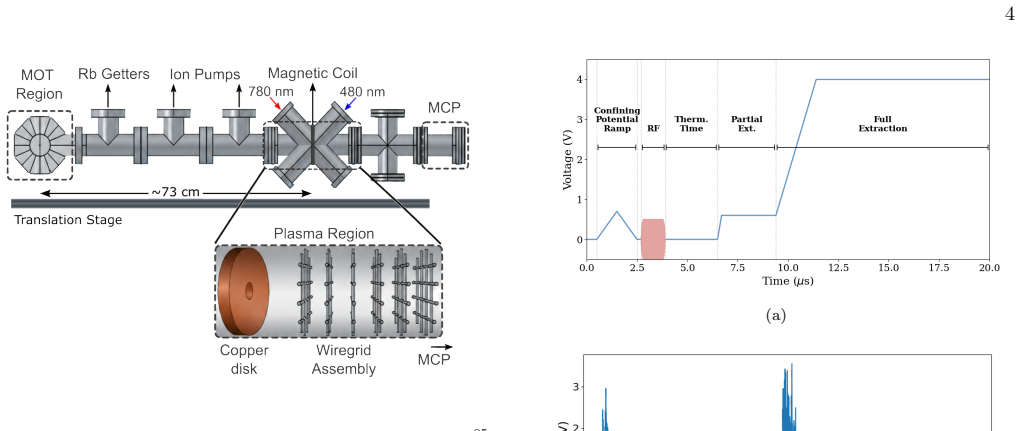
To compare the amount of heating from pulses of different lengths and different values of E0, the instantaneous value of the RF electric fieldE(t) is squared and then integrated for each pulse to obtain a quantity proportional to the amount of heating which can then be used for the basis of comparison. III. EXPERIMENTAL APPARATUS AND METHODS Having descri...
-
[3]
DAWSON and C
J. DAWSON and C. OBERMAN, PHYSICS OF FLUIDS 5, 517 (1962)
1962
-
[4]
DECKER, W
C. DECKER, W. MORI, J. DAWSON, and T. KAT- SOULEAS, Phys. Plasmas1, 4043 (1994)
1994
-
[5]
D. L. Wiggins, C. T. Raynor, and J. A. Johnson, III, PHYSICS OF PLASMAS17, 10.1063/1.3501995 (2010)
-
[6]
A. L. Milder, J. Katz, R. Boni, J. P. Palastro, M. Sher- lock, W. Rozmus, and D. H. Froula, Phys. Rev. Lett. 127, 10.1103/PhysRevLett.127.015001 (2021)
-
[7]
Falk, HIGH POWER LASER SCIENCE AND ENGI- NEERING6, 10.1017/hpl.2018.53 (2018)
K. Falk, HIGH POWER LASER SCIENCE AND ENGI- NEERING6, 10.1017/hpl.2018.53 (2018)
-
[8]
O. A. Hurricane, P. K. Patel, R. Betti, D. H. Froula, S. P. Regan, S. A. Slutz, M. R. Gomez, and M. A. Sweeney, REVIEWS OF MODERN PHYSICS95, 10.1103/RevModPhys.95.025005 (2023)
-
[9]
Turnbull, J
D. Turnbull, J. Katz, M. Sherlock, L. Divol, N. R. Shaf- fer, D. J. Strozzi, A. Cola¨ ıtis, D. H. Edgell, R. K. Fol- lett, K. R. McMillen, P. Michel, A. L. Milder, and D. H. Froula, Phys. Rev. Lett.130, 145103 (2023)
2023
-
[10]
Firouzi Farrashbandi and M
N. Firouzi Farrashbandi and M. Eslami-Kalantari, JOURNAL OF THEORETICAL AND APPLIED PHYSICS14, 261 (2020)
2020
-
[11]
B. Oussama, G. Abdenasser, and A. Sid, EPL133, 10.1209/0295-5075/133/55001 (2021)
-
[12]
Zhang, F
Y. Zhang, F. Wang, J. Liu, and J. Sun, Chemical Physics Letters793, 139434 (2022)
2022
-
[13]
B. Gustavsson, M. T. Rietveld, N. V. Ivchenko, and M. J. Kosch, JOURNAL OF GEOPHYSICAL RESEARCH- SPACE PHYSICS115, 10.1029/2010JA015873 (2010)
-
[14]
P. W. Smorenburg, L. P. J. Kamp, and O. J. Luiten, Phys. Rev. A85, 10.1103/PhysRevA.85.063413 (2012)
-
[15]
LANGDON, Phys
A. LANGDON, Phys. Rev. Lett.44, 575 (1980)
1980
-
[16]
Mulser, F
P. Mulser, F. Cornolti, E. B´ esuelle, and R. Schneider, Phys. Rev. E63, 016406 (2000)
2000
-
[17]
Geltman, J
S. Geltman, J. Res. Natl. Bur. Stand.82, 173 (1977)
1977
-
[18]
JONES and K
R. JONES and K. LEE, PHYSICS OF FLUIDS25, 2307 (1982)
1982
-
[19]
J. Daligault and G. Dimonte, PHYSICAL REVIEW E 79, 10.1103/PhysRevE.79.056403 (2009)
-
[20]
D. Gericke, M. Murillo, and M. Schlanges, PHYSICAL REVIEW E65, 10.1103/PhysRevE.65.036418 (2002)
-
[21]
Killian, S
T. Killian, S. Kulin, S. Bergeson, L. Orozco, C. Orzel, and S. Rolston, PHYSICAL REVIEW LETTERS83, 4776 (1999)
1999
-
[22]
T. C. Killian and S. L. Rolston, PHYSICS TODAY63, 46 (2010)
2010
-
[23]
M. Lyon and S. L. Rolston, REPORTS ON PROGRESS IN PHYSICS80, 10.1088/0034-4885/80/1/017001 (2017)
-
[24]
J. M. Guthrie, P. Jiang, and J. L. Roberts, JOURNAL OF PLASMA PHYSICS90, 10.1017/S0022377824000114 (2024)
-
[25]
Wei-Ting, C
C. Wei-Ting, C. Witte, and J. L. Roberts, Phys. Rev. E 96, 013203 (2017)
2017
-
[26]
Ichimaru, Rev
S. Ichimaru, Rev. Mod. Phys.54, 1017 (1982)
1982
-
[27]
S. D. Baalrud and J. Daligault, Phys. Rev. E96, 043202 (2017)
2017
-
[28]
Dimonte and J
G. Dimonte and J. Daligault, Phys. Rev. Lett.101, 135001 (2008)
2008
-
[29]
CAUBLE and W
R. CAUBLE and W. ROZMUS, PHYSICS OF FLUIDS 28, 3387 (1985)
1985
-
[30]
KROOK and T
M. KROOK and T. WU, PHYSICAL REVIEW LET- TERS36, 1107 (1976)
1976
-
[31]
P. E. Grabowski, M. P. Surh, D. F. Richards, F. R. Graziani, and M. S. Murillo, Phys. Rev. Lett.111, 215002 (2013)
2013
-
[32]
Devriendt and O
R. Devriendt and O. Poujade, Physics of Plasmas29, 073301 (2022)
2022
-
[33]
PETER and J
T. PETER and J. MEYERTERVEHN, PHYSICAL RE- VIEW A43, 1998 (1991)
1998
-
[34]
Maynard and C
G. Maynard and C. Deutsch, Phys. Rev. A26, 665 (1982)
1982
-
[35]
Bekefi,Radiation Processes in Plasmas, Wiley Series in Plasma Physics (John Wiley and Sons, Inc., New York, 1966)
G. Bekefi,Radiation Processes in Plasmas, Wiley Series in Plasma Physics (John Wiley and Sons, Inc., New York, 1966)
1966
-
[36]
Fitzpatrick,The Physics of Plasmas(Institute for Fu- sion Studies, The University of Texas at Austin, Austin, TX, 2014)
R. Fitzpatrick,The Physics of Plasmas(Institute for Fu- sion Studies, The University of Texas at Austin, Austin, TX, 2014)
2014
-
[37]
Nersisyan, C
H. Nersisyan, C. Toepffer, and G. Zwicknagel,Interac- tions Between Charged Particles in a Magnetic Field, 1st ed. (Springer Berlin, Heidelberg, 2007) pp. XI + 187
2007
-
[38]
J. M. Guthrie and J. L. Roberts, PHYSICS OF PLAS- MAS28, 10.1063/5.0047640 (2021)
-
[39]
B. D. Fried and S. D. Conte,The Plasma Dispersion Function: The Hilbert Transform of the Gaussian(Aca- demic Press, New York and London, 1961)
1961
-
[40]
T. Lafleur and S. D. Baalrud, Plasma Phys. Control. Fu- sion62, 10.1088/1361-6587/ab9bea (2020)
-
[41]
Krall and D
N. Krall and D. Book, Phys. Fluids12, 347 (1969)
1969
-
[42]
Rutherford, The London, Edinburgh, and Dublin Philosophical Magazine and Journal of Science21, 669 (1911)
E. Rutherford, The London, Edinburgh, and Dublin Philosophical Magazine and Journal of Science21, 669 (1911)
1911
-
[43]
S. D. Baalrud, Phys. Plasmas19, 10.1063/1.3690093 (2012)
-
[44]
T. M. Wilson, W.-T. Chen, and J. L. Roberts, Phys. Rev. A87, 10.1103/PhysRevA.87.013410 (2013)
-
[45]
Oster, Rev
L. Oster, Rev. Mod. Phys.33, 525 (1961)
1961
-
[46]
B. Hu, W. Horton, and T. Petrosky, PHYSICAL RE- VIEW E65, 10.1103/PhysRevE.65.056212 (2002)
-
[47]
B. Hu, W. Horton, C. Chiu, and T. Petrosky, PHYSICS OF PLASMAS9, 1116 (2002)
2002
-
[48]
D. J. Bernstein, T. Lafleur, J. Daligault, and S. D. Baalrud, PHYSICAL REVIEW E102, 10.1103/Phys- RevE.102.041201 (2020)
-
[49]
L. Jose and S. D. Baalrud, Phys. Plasmas27, 10.1063/5.0025158 (2020)
-
[50]
R. S. Craxton, K. S. Anderson, T. R. Boehly, V. N. Goncharov, D. R. Harding, J. P. Knauer, R. L. Mc- Crory, P. W. McKenty, D. D. Meyerhofer, J. F. Myatt, A. J. Schmitt, J. D. Sethian, R. W. Short, S. Skup- sky, W. Theobald, W. L. Kruer, K. Tanaka, R. Betti, T. J. B. Collins, J. A. Delettrez, S. X. Hu, J. A. Marozas, A. V. Maximov, D. T. Michel, P. B. Radh...
-
[51]
Gopalaswamy, R
V. Gopalaswamy, R. Betti, J. P. Knauer, N. Luciani, D. Patel, K. M. Woo, A. Bose, I. V. Igumenshchev, E. M. Campbell, K. S. Anderson, K. A. Bauer, M. J. Bonino, D. Cao, A. R. Christopherson, G. W. Collins, T. J. B. Collins, J. R. Davies, J. A. Delettrez, D. H. Edgell, R. Epstein, C. J. Forrest, D. H. Froula, V. Y. 9 Glebov, V. N. Goncharov, D. R. Harding,...
2019
-
[52]
B. O’Mara, R. C. Baker, and J. L. Roberts, Data as- sociated with the manuscript ”experimental tests of radio-frequency heating saturation in ultracold neutral plasmas”,https://doi.org/10.5061/dryad.kd51c5bnf (2026)
discussion (0)
Sign in with ORCID, Apple, or X to comment. Anyone can read and Pith papers without signing in.