REVIEW 3 major objections 5 minor 23 references
Thermal conductivity of the Kondo semiconductor CeRu$_4$Sn$_6$
T0 review · 3 major / 5 minor · reviewed 2026-08-14 · deepseek-v4-flash
Pith's one-line read The thermal conductivity of CeRu4Sn6 is essentially isotropic and phonon-dominated, with a low-temperature T-squared law pointing to an isotropic carrier concentration.
desk verdict New isotropic thermal conductivity data for CeRu4Sn6, but the Callaway analysis as reported cannot produce the claimed power laws—worth refereeing with major revisions. read the letter →
The pith
A machine-rendered reading of the paper's core claim, the machinery that carries it, and where it could break.
The reading
What carries the argument
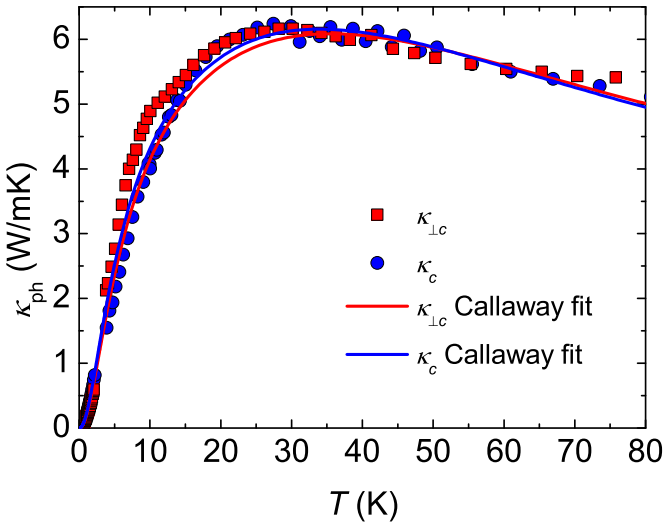
The central object is the Callaway model for phonon thermal conductivity, in which the total phonon relaxation rate is the sum of independent scattering channels: boundary scattering with constant rate $B$, phonon-electron scattering with rate $A\omega^2$, point-defect scattering with rate $C\omega^4$, and Umklapp scattering with rate $D\omega^2 T \exp(-\theta_D/(3T))$. The decisive channel is the phonon-electron term: a standard theory of phonon-electron scattering connects its prefactor $A$ to the charge carrier concentration $n$, so the near-equality of $A$ for heat flow along and across the c-axis is what turns an isotropic thermal conductivity into evidence for an isotropic carrier density. The low-temperature $T^2$ dependence of $\kappa_{\mathrm{ph}}$ is the observable signature of that $A\omega^2$ channel.
What would settle it
Remeasure $\kappa$ below 2 K on crystals with different smallest dimensions: if the $T^2$ regime is true phonon-electron scattering, its prefactor should stay fixed while the $T^3$ boundary-scattering tail moves to lower temperatures in larger crystals, whereas a geometry-dependent $T^2$ term would expose an additional scattering channel. Alternatively, tune the carrier concentration by doping or pressure and check whether the fitted phonon-electron prefactor $A$ tracks the Hall carrier density as that theory requires.
Extended reading notes
Core claim
On its own terms, the paper establishes that the thermal conductivity $\kappa$ of CeRu4Sn6 is phonon-dominated over the whole measured range and is essentially isotropic: $\kappa$ measured along the c-axis and perpendicular to it agree closely, even though resistivity, thermopower, and optical conductivity are strongly direction-dependent. The phononic part $\kappa_{\mathrm{ph}} = \kappa - \kappa_{\mathrm{WF}}$ behaves as $T^2$ from roughly 200 mK to 2 K, identified as scattering of phonons by electrons, and as $T^3$ below that, identified as boundary scattering with a mean free path near 0.8 mm, matching the sample dimensions. A Callaway fit that combines phonon-electron, boundary, point-defect, and Umklapp scattering reproduces the data over the full range. The near-equality of the fitted phonon-electron scattering prefactors in the two directions, combined with Hall-effect results showing an isotropic carrier concentration, is used to conclude that the strongly anisotropic resistivity of CeRu4Sn6 is mainly a mobility anisotropy.
Load-bearing premise
The argument depends on assuming that the low-temperature $T^2$ rise in thermal conductivity is caused by phonons scattering off electrons with a rate proportional to frequency squared; if some other scattering channel, such as magnetic excitations, disorder, or two-level systems, also produces a $T^2$ law, then the inference of an isotropic carrier concentration loses its footing.
Editorial extensions
If this is right
- If the paper is right, the strongly anisotropic resistivity of CeRu4Sn6 is a mobility anisotropy: the carrier concentration is essentially the same in the tetragonal plane and along the c-axis.
- The small enhancement of $\kappa_{\perp c}$ near 10 K becomes a direct fingerprint of the anisotropic Kondo gap: electrons in the plane freeze out sooner, removing phonon scattering partners.
- Below roughly 200 mK, thermal conductivity is set by the sample boundaries, with a mean free path of about 0.8 mm matching the smallest crystal dimension.
- In the 0.2-2 K window, the $T^2$ law gives a quantitative measure of the phonon-electron scattering prefactor $A$, which can be compared across directions and with Hall carrier densities.
- Thermal conductivity is not a useful probe of the electronic anisotropy in this material, because the phonon background dominates at all measured temperatures.
Reading between the lines
- A direct test of the paper's central attribution would be to measure $\kappa$ at low temperatures on the same compound with the carrier concentration tuned by doping or pressure: if the fitted $T^2$ prefactor follows the Hall density, the phonon-electron assignment is confirmed, and if not, another $T^2$ channel is present.
- The same logic suggests that in other Kondo semiconductors the low-temperature $T^2$ phonon conductivity could serve as a contact-free probe of mobile carrier density, useful where Hall contacts are difficult to make.
- Because the bulk heat flow is phonon-dominated, future searches for topological surface transport in CeRu4Sn6 should expect thermal conductivity to remain insensitive to surface carriers; electrical transport on thin or surface-dominated samples would be the relevant probe.
Signed reviews
Editorial analysis
A structured set of objections, weighed in public.
Referee Report
Summary. The manuscript reports thermal conductivity measurements on single crystals of the Kondo semiconductor CeRu4Sn6 along the c axis and perpendicular to it, covering 80 mK to 80 K. The authors find that the thermal conductivity is essentially isotropic, that the electronic contribution estimated via the Wiedemann-Franz law is small, and that the phononic part dominates over the whole range. Below 2 K the data are reported to follow a T^2 law, which is attributed to phonon-electron scattering, with a T^3 boundary-scattering regime at the lowest temperatures. The data are fitted to a Callaway model including phonon-electron, boundary, defect, and Umklapp scattering. The conclusion is that the strongly anisotropic electrical resistivity is due to anisotropic charge-carrier mobility rather than anisotropic carrier concentration.
Significance. If the conclusions hold, the work provides a useful transport characterization of a non-centrosymmetric Kondo insulator and supports a scenario in which carrier concentration is isotropic while mobility is strongly anisotropic, with implications for the interpretation of resistivity, thermopower, and optical conductivity in CeRu4Sn6. The experimental strengths are the wide temperature range, the single-crystal measurements along two crystallographic directions, and the direct visibility of phonon dominance and approximate isotropy in the raw data. However, the specific mechanism identification—the T^2 law attributed to phonon-electron scattering—rests on a Callaway fit whose stated parameters are internally inconsistent, as detailed in the major comments. Because this attribution is the load-bearing link to the isotropic-carrier-concentration conclusion, the central interpretive claim is not yet secured.
major comments (3)
- [Eq. (2), Table I, and paragraph after Fig. 3] The Callaway model as specified cannot yield the claimed low-temperature T^2 law. With τ_pe^-1 = A ω^2 substituted into Eq. (1), the phonon-electron-dominated conductivity is κ_ph ∝ T^3 ∫ x^4 e^x/(e^x-1)^2 dx / [A(k_B T/ħ)^2 x^2] ∝ T, not T^2. A T^2 asymptote requires τ_pe^-1 ∝ ω rather than ω^2. Therefore the attribution of the 0.2–2 K T^2 range to phonon-electron scattering is not supported by the model as written; the fit must be redone with the correct frequency dependence (or the table corrected) before this conclusion can be drawn.
- [Table I and paragraph after Fig. 3] The returned parameters are mutually inconsistent with the claimed boundary-scattering T^3 regime. Taking A ≈ 2.2×10^7 s and B ≈ 2.8×10^6 s^-1, at T = 80 mK, ω ≈ k_B T/ħ ≈ 10^10 s^-1, so Aω^2 ≈ 10^27 s^-1, which exceeds B by more than 20 orders of magnitude. Thus the boundary term never dominates in the measured range, and the T^3 behavior below ~0.2 K and the extracted mean free paths 0.77–0.83 mm cannot be reproduced from the stated parameters.
- [Physical properties, after Fig. 3] The identification of the T^2 range as phonon-electron scattering is not tested against alternatives with the same temperature dependence, such as scattering by structural disorder or two-level systems, or by magnetic excitations. Because the isotropic-carrier-concentration conclusion in the Conclusion depends directly on this identification, the authors should provide a quantitative comparison with at least one alternative scattering channel or otherwise justify its neglect.
minor comments (5)
- [Figures 1–3] The figures do not show error bars; please state the measurement uncertainty and the number of samples measured.
- [Figure 3 caption and text] The text refers to 'solid red and blue lines' in Fig. 3, but the caption and main text should be made consistent with the line styles used in Fig. 2; ensure that color and line labels match.
- [Reference [19]] Reference [19] is a PhD thesis; please cite the published Hall-effect data if available and give numerical values for the carrier concentration at high and low temperatures.
- [Isotropy claim, around 10 K] Around 10 K the data show a hump in κ⊥c; the claim that κ is 'essentially isotropic' should be quantified with the maximum relative difference between κc and κ⊥c.
- [General presentation] There are several typographical and formatting issues, such as 'cryst allographic' in the Experimental section and inconsistent spacing in Table I; please check against the journal style.
Circularity Check
No circular derivation: the thermal conductivity is directly measured and the Callaway fit is a parametrization of those data, not an input reused as an output; a same-group Hall citation is ancillary, not load-bearing.
full rationale
The paper's core quantities are raw measurements: kappa(T) along c and perpendicular to c is measured from 80 mK to 80 K, kappa_ph is computed by subtracting the Wiedemann-Franz estimate kappa_WF = L0 T / rho using measured resistivity [13], and the Callaway expression (Eq. 1) with the rates in Eq. (2) is fitted to kappa_ph. The fit parameters in Table I (A, B, C, D) are extracted from the measured data, and the T^3, T^2, and linear guides in Fig. 3 are labels for the observed slopes, not outputs of the model. No equation in the paper has an output equal to its input, and no fitted parameter is renamed as a prediction. The only self-citation that enters the interpretive chain is the Hall-effect result [19] (H. Winkler's PhD thesis from the same Vienna group), used to state that the carrier concentration n is isotropic and hence consistent with the isotropic phonon-electron scattering rates in Table I. This citation is ancillary: the main claims that kappa is phonon-dominated and essentially isotropic are supported by the measured kappa and the tiny kappa_WF, and the near-isotropy of the fitted A values already indicates isotropic phonon-electron scattering; so [19] is not load-bearing for the central result. One should note, as a correctness caveat rather than a circularity, that the stated tau_pe^-1 = A omega^2 with Table I appears inconsistent with the claimed kappa proportional to T^2 asymptote (the Callaway integral with this rate yields kappa proportional to T, and A omega^2 would dominate B even at the lowest temperatures, precluding the claimed T^3 boundary regime); that issue concerns consistency of the model parameters, not a logical tautology. Thus the circularity score is low.
Assumptions & free parameters
free parameters (8)
- A, phonon-electron scattering prefactor (c direction) =
2.2 × 10^7 s
- A, phonon-electron scattering prefactor (perp-c direction) =
2.5 × 10^7 s
- B, boundary scattering rate (c direction) =
2.8 × 10^6 s^-1
- B, boundary scattering rate (perp-c direction) =
3.0 × 10^6 s^-1
- C, defect scattering prefactor (c direction) =
7250 s^3
- C, defect scattering prefactor (perp-c direction) =
6878 s^3
- D, Umklapp scattering prefactor (c direction) =
9.16 × 10^4 s K^-1
- D, Umklapp scattering prefactor (perp-c direction) =
9.06 × 10^4 s K^-1
assumptions (6)
- domain assumption Callaway model with Debye spectrum and no Normal-process correction term
- standard math Matthiessen's rule sums independent scattering rates
- domain assumption Wiedemann-Franz law with the free-electron Lorenz number L0 gives the electronic thermal conductivity
- domain assumption Phonon-electron scattering rate is proportional to omega^2 and, via Pippard theory, proportional to carrier concentration n
- domain assumption Hall-effect carrier concentration is isotropic in CeRu4Sn6
- domain assumption Debye temperature theta_D = 250 K from reference [11] is valid for this crystal
Cite this review
Pith. "Pith review of Thermal conductivity of the Kondo semiconductor CeRu$_4$Sn$_6$." pith.science (2026). https://pith.science/paper/ANJD5DJU
@misc{pith2026190800803,
  author       = {Pith},
  title        = {Pith review of: Thermal conductivity of the Kondo semiconductor CeRu$_4$Sn$_6$},
  year         = {2026},
  howpublished = {\url{https://pith.science/paper/ANJD5DJU}},
  note         = {Machine review of arXiv:1908.00803}
}
abstract
We report measurements of the thermal conductivity $\kappa$ on single crystalline CeRu$_4$Sn$_6$ in the temperature range between 80mK and 80K, along the main crystallographic directions. $\kappa$ is phonon-dominated in the whole temperature range and is found to be essentially isotropic. At low temperatures the data are well approximated by $\kappa \propto T^2$, which is attributed to a predominant scattering of phonons on electrons. We describe the data with a Callaway fit in the whole temperature range giving good agreement at low and high temperatures.
Figures


Reference graph
Works this paper leans on
- [1]
-
[2]
Riseborough P S 2000 Adv. Phys. 49 257
work page 2000
-
[3]
Dzero M, Sun K, Galitski V and Coleman P 2010 Phys. Rev. Lett. 104 106408
work page 2010
-
[4]
Dzero M, Sun K, Coleman P and Galitski V 2012 Phys. Rev. B 85 045130
work page 2012
-
[5]
Alexandrov V, Dzero M and Coleman P 2013 Phys. Rev. Lett. 111 226403
work page 2013
- [6]
-
[7]
Kim D J, Xia J and Fisk Z 2014 Nat. Mater. 13 466
work page 2014
-
[8]
P¨ ottgen R, Hoffmann R D, Sampathkumaran E V, Das I, Mosel B D and M¨ ullmann R 1997 J. Solid State Chem. 134 326
work page 1997
Show all 23 references
-
[9]
Das I and Sampathkumaran E V 1992 Phys. Rev. B 46 4250
1992
-
[10]
Matter 359-361 293 7
Strydom A M, Guo Z, Paschen S, Viennois R and Steglich F 20 05 Physica B: Condens. Matter 359-361 293 7
-
[11]
Br¨ uning E M, Brando M, Baenitz M, Bentien A, Strydom A M, Walstedt R E and Steglich F 2010 Phys. Rev. B 82 125115
2010
-
[12]
Paschen S, Winkler H, Nezu T, Kriegisch M, Hilscher G, Cu sters J, Prokofiev A and Strydom A 2010 J. Phys. Conf. Ser. 200 012156
2010
-
[13]
Winkler H, Lorenzer K A, Prokofiev A and Paschen S 2012 J. Phys. Conf. Ser. 391 012077
2012
-
[14]
Electron
H¨ anel J, Winkler H, Ikeda M, Larrea J J, Martelli V, Prok ofiev A, Bauer E and Paschen S 2014 J. Electron. Mater. 43 2440
2014
-
[15]
Guritanu V, Wissgott P, Weig T, Winkler H, Sichelschmid t J, Scheffler M, Prokofiev A, Kimura S, Iizuka T, Strydom A M, Dressel M, Steglich F, Held K and Pasc hen S 2013 Phys. Rev. B 87 115129
2013
-
[16]
Prokofiev A and Paschen S 2012 Crystal Growth and Stoichiometry of Strongly Correlated Intermetallic Cerium Compounds (InTech) chap 11, pp 263–284 Modern Aspects of Bulk Crystal and Thin Film Preparation
2012
-
[17]
Callaway J 1959 Phys. Rev. 113 1046
1959
-
[18]
Pippard A B 1955 Phil. Mag. 46 1104
1955
-
[19]
thesis Technische Universit¨ at Wien
Winkler H 2013 Physical properties of the anisotropic Kondo insulator CeRu 4Sn6 Ph.D. thesis Technische Universit¨ at Wien
2013
-
[20]
Paschen S, Wand B, Sparn G, Steglich F, Echizen Y and Taka batake T 2000 Phys. Rev. B 62 14912
2000
-
[21]
Sera M, Kobayashi N, Yoshino T, Kobayashi K, Takabatake T, Nakamoto G and Fujii H 1997 Phys. Rev. B 55 6421
1997
-
[22]
Isikawa Y, Mori K, Ogiso Y, Oyabe K and Sato K 1991 J. Phys. Soc. Jpn. 60 2514
1991
-
[23]
Yan X, Bauer E, Rogl P and Paschen S 2013 Phys. Rev. B 87 115206 8
2013
Reviewed August 14, 2026 · model on record in the stance chip above.
Discussion (0). Continue with ORCID to comment.