REVIEW 2 major objections 5 minor 42 references
Slowing YbF molecules using radiation pressure
T0 review · 2 major / 5 minor · reviewed 2026-08-05 · deepseek-v4-flash
Pith's one-line read Microwaves close YbF's optical-cycle leak, enabling laser slowing.
desk verdict Genuine advance for YbF cooling: microwave recycling of the 4f-hole leak is the key new result; the paper is solid and deserves referees. read the letter →
The pith
A machine-rendered reading of the paper's core claim, the machinery that carries it, and where it could break.
The reading
What carries the argument
The machinery is the A^2Π1/2 ← X^2Σ+ optical cycle at 552 nm, driven by four lasers (L0-L3) that cover the main cycling transition and the vibrational repumps v=1,2,3. The new element is a set of microwave couplings |X; v; 1; F> ↔ |X; v; 0; F'> for v=0,1,2, generated by a 14.36 GHz local oscillator with frequency modulation, which bring population that decayed through the 4f hole states into N=0 back into the cycle. Dark states are destabilized by polarization modulation at 4.4-6.5 MHz plus a magnetic field, and the scattering rate is inferred from exponential decay of the |X; 0; 1> population as each repump is added.
What would settle it
Probe the populations in |X; v; 0> for v=1 and v=2 during the slowing cycle using laser-induced fluorescence on the corresponding Q(0) transitions; if the microwave couplings do not return those populations to |X; v; 1>, the reported closure of the leak is overestimated. Alternatively, count molecules captured in a magneto-optical trap loaded from the slowed beam—a rate below the prediction based on the 1.3% sub-20-m/s fraction would indicate loss not captured by the current detection volume.
Extended reading notes
Core claim
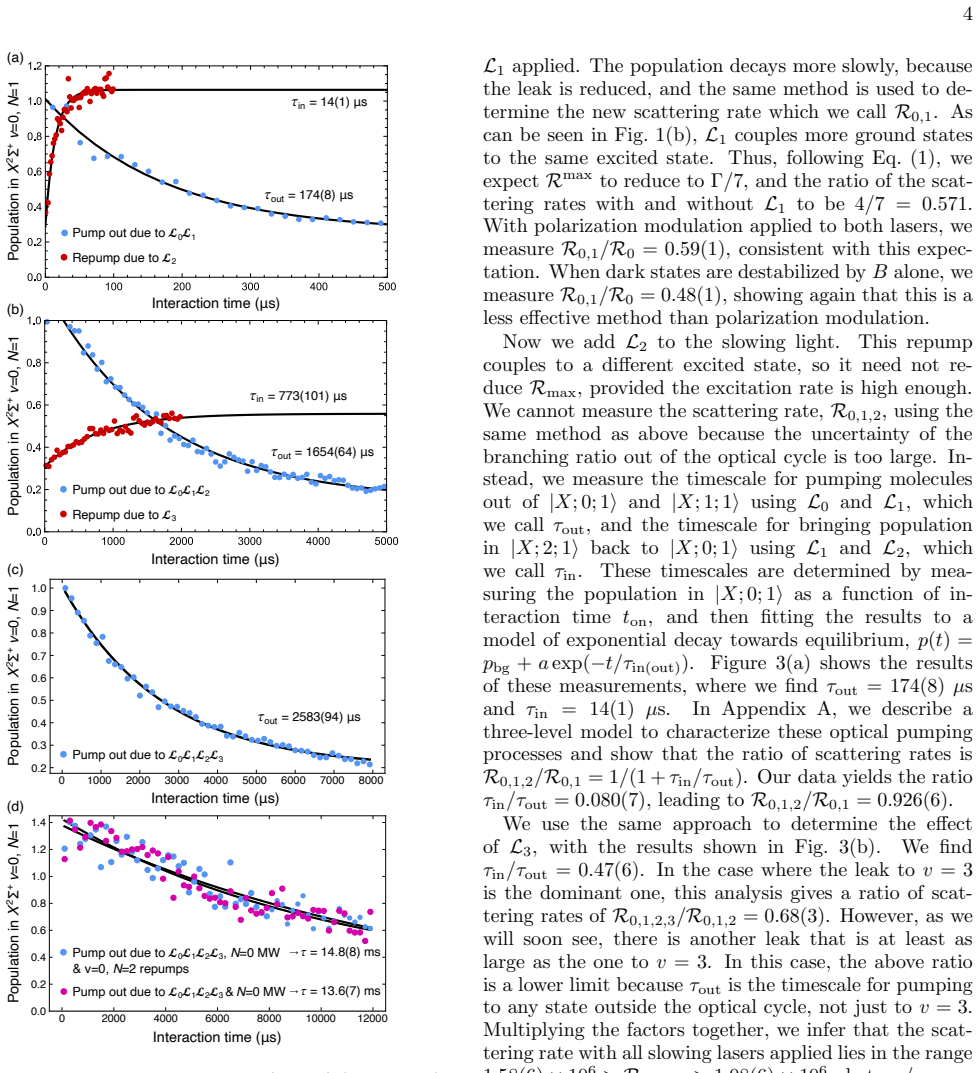
The central claim is that the 4f-hole leak can be closed after the population decays to the electronic ground state, using microwaves to drive |X; v; 1> ↔ |X; v; 0> for v=0,1,2. This recovers essentially all leaked population and brings the scattering rate back into the range needed for radiation-pressure slowing. With all repumps and the microwave remix, the beam's peak velocity falls linearly during the 10-12 ms scattering window, corresponding to a constant acceleration of -1143(8) m/s^2 and an effective scattering rate of 3.06(2)×10^5 photons/s. The measured fractions with forward speed below 40, 30, and 20 m/s after 12 ms are 7.0(2)%, 3.2(1)%, and 1.3(1)%, respectively, up from 0.4(1)%
Load-bearing premise
The scheme assumes that molecules leaking through the 4f hole states decay mostly to N=0 and N=2 of the first three vibrational levels of the ground state, so the microwaves and off-resonant excitation recover them; if a comparable fraction lands in v>=3 or N>2, the slow flux would be smaller than reported.
Editorial extensions
If this is right
- With the demonstrated acceleration, YbF could be decelerated from 64 m/s to rest over the 1.8 m between source and trap, making MOT capture (predicted capture velocity ~10.5 m/s) feasible.
- The microwave-repump strategy turns a leak to metastable states into a recoverable path, so the technique transfers to other molecules whose cooling cycles suffer from similar inner-shell leaks.
- Closing the remaining leak to |X; v>0; 2>, which the authors are working on, should raise the low-velocity flux further.
- Slow YbF at this flux is a practical input for optical-lattice eEDM searches, where spin coherence times of several seconds are expected.
Reading between the lines
- The null result of the 1038-nm repump search implies the 4f-hole lifetime is well below the predicted 8 ms; if so, the same fast decay may also feed vibrational states above v=2, whose contribution was not measured directly and could set a floor on the residual loss.
- A natural test is to load the slowed beam directly into a magneto-optical trap: the paper's estimate that the MOT capture region is much larger than the 2.5-mm probe volume implies a measurable MOT population should appear, which would confirm the low-velocity tail.
- Because the recovery works after decay to X, the microwave remix may also be applicable to the odd isotopologues 171YbF and 173YbF, whose hyperfine structure is richer; the required frequencies would need remapping.
Signed reviews
Editorial analysis
A structured set of objections, weighed in public.
Referee Report
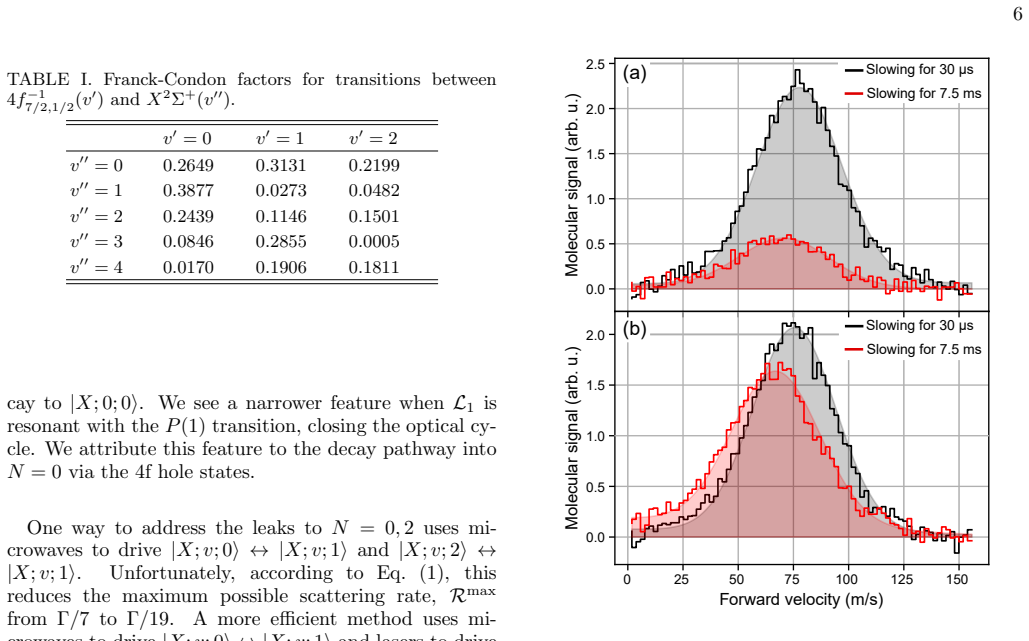
Summary. The paper reports radiation-pressure slowing of a cryogenic buffer-gas beam of YbF molecules using frequency-broadened light on the A^2Π_{1/2}–X^2Σ^+ transition. The central difficulty is the leak out of the optical cycle through low-lying 4f-hole states; the authors show that this population can be recovered after it decays to the ground electronic state by using microwaves to couple X(v,N=0) to X(v,N=1) for v=0,1,2. They measure photon scattering rates as repumps are added, characterize dark-state destabilization by magnetic field and polarization modulation, and demonstrate a constant acceleration of −1143(8) m/s². The headline quantitative claims are that slowing increases the fraction of molecules below 40 m/s from 0.4(1)% to 7.0(2)% and produces 3.2(1)% below 30 m/s and 1.3(1)% below 20 m/s, corresponding to 9(5)×10² molecules/shot below 20 m/s. These fractions are obtained by fitting velocity spectra to a skewed Gaussian and deconvolving the 35 m/s instrumental profile.
Significance. If the quantitative claims hold, this is a substantial experimental milestone: it is the first demonstration that YbF, a key molecule for eEDM searches, can be radiatively slowed to velocities approaching the capture velocity of a MOT. The microwave remixing scheme for the 4f-hole leak is a new and generally useful technique for molecules with metastable intermediate states. The paper is strong in using complementary diagnostics: time-of-flight profiles, velocity-resolved LIF, deconvolved velocity distributions, and a constant-acceleration scaling with slowing duration. It also compares the inferred leak branching ratio to independent quantum-chemistry calculations and clearly self-identifies the remaining leaks. The main weakness is that the headline low-velocity fractions rest on parametric deconvolution of a sub-resolution tail, and the related assumption about the rovibrational distribution of the recovered population is only partially verified.
major comments (2)
- [§IV, Eq. (2), Fig. 7(c,d)] The headline fractions below 40, 30, and 20 m/s are computed from fits of a single skewed Gaussian to velocity spectra, then deconvolved with a 35 m/s FWHM instrumental profile. The thresholds are comparable to or smaller than the instrumental resolution, so these tail fractions are model extrapolations rather than directly measured quantities. The quoted uncertainties (e.g., 7.0(2)%) propagate only fit-parameter errors and do not include model error. The TOF data in Fig. 7(e) provide an independent constraint that is not quantitatively combined with the velocity spectra. I request a forward model that simultaneously describes the TOF and velocity-spectrum data with a physically motivated slowed distribution (e.g., including the sharp low-velocity edge expected from frequency-broadened slowing), or a stated conservative systematic uncertainty on the extracted fractions. This is load-bear
- [§III, Fig. 4, Table I] The recovery scheme assumes that the 4f-hole leak decays predominantly to N=0 and N=2 levels of X(v=0,1,2), with the Franck-Condon factors computed at the harmonic-oscillator level. Direct evidence for population reaching the N=0 manifold is shown only for X(0,0) in Fig. 5; the recovery of the v=1 and v=2 N=0 branches is not directly measured, and branches to v≥3 or to N>2 are not addressed. An unmeasured comparable branch would reduce the recovered low-velocity flux below the reported values. Please provide a direct measurement or an upper bound for the v=1,2 N=0 recovery, and quantify the sensitivity of the reported fractions to the assumed branching. The paper's own closing statement that leaks to X(v>0,N=2) are still being closed indicates that this is a recognized gap.
minor comments (5)
- [Abstract] Typo: 'destabilzation' should be 'destabilization'.
- [Introduction] Typo: 'vibrational repuming' should be 'vibrational repumping'.
- [§IV, Eq. (2)] The choice of a single skewed Gaussian as the fitting function is not justified. A brief justification or a test against an alternative shape would help assess the model dependence.
- [§III, Fig. 3(d)] The fits in Fig. 3(d) set the background to zero (p_bg=0). This choice should be stated in the main text or figure caption, since it affects the extracted decay times.
- [§IV, Fig. 8] The definition of r(v_upper) uses the total unslowed distribution in the denominator, so the values are not the fraction of the slowed distribution but the fraction of the original beam. This is clear from the text, but the wording 'fraction in the slowed distribution' is misleading.
Circularity Check
No significant circularity: central claims rest on direct measurements; prior self-citations are inputs, not derivational crutches.
full rationale
The paper's central claims are supported by direct experimental measurements rather than by construction or by a self-citation chain. The velocity fractions below 40, 30, and 20 m/s are obtained by fitting a skewed Gaussian (Eq. 2) to measured laser-induced fluorescence spectra and then deconvolving the fitted profile with a measured 35 m/s instrumental profile; the reported fractions are integrals of those deconvolved fits, not parameters fed back into the fit. The scattering-rate analysis (Appendix A) derives R'/R = 1/(1 + tau_in/tau_out) from a three-level rate model, and the tau_in and tau_out values are independently measured time constants from population decay/recovery data (Fig. 3). The initial R0 measurement does use a previously measured branching ratio from Ref. [35], but that is an external spectroscopic input, not a value produced by this paper, and it is used only to calibrate the scattering rate. The inferred 4f-hole branching ratio is obtained from the measured decay time and the measured scattering rate, then compared with a theoretical prediction from Ref. [30]; the comparison is confirmatory, not definitional. The microwave repumping scheme is designed using prior level-structure assignments (Refs. [30,31]) and is validated by the measured increase in decay time from 2.6 ms to 13.6 ms (Fig. 3d), so the scheme's effectiveness is empirically demonstrated rather than assumed. The paper explicitly acknowledges remaining leaks to |X; v>0; 2> and that the low-velocity tail underestimates the slow-molecule flux due to gravity and divergence; these are stated limitations, not circular steps. Although several cited works share authors with the present paper (Refs. [30-32,34,35]), those citations provide prior spectroscopic data, beam-source characterization, and molecular constants that are externally falsifiable and independent of the present data; they are not invoked as a uniqueness theorem or as the sole justification for the paper's new claims. The slow-molecule fraction is model-dependent in the sense that it relies on the skewed-Gaussian shape and deconvolution, but that is a statistical/modeling risk, not a circularity: the fit parameters are constrained by the measured spectra, and the claim is not equivalent to the fit input by construction. Therefore the derivation chain is self-contained, and there is no circular step to report.
Assumptions & free parameters
free parameters (1)
- Skewed-Gaussian line-shape parameters (A, v0, sigma, gamma) for slowed and control velocity distributions =
v0 shifts, e.g., -8.6(4) m/s with microwaves; individual A, sigma, gamma not tabulated
assumptions (6)
- standard math Multi-level optical Bloch/rate-equation model with steady-state solutions (Appendix A, Eq. A1) describes photon cycling.
- domain assumption Molecular constants, hyperfine splittings, branching ratios, and electronic assignments from Refs [30,31,34,35] are correct.
- domain assumption Franck-Condon factors for 4f-hole to X decays are adequately given by a harmonic-oscillator model using bond lengths and vibrational constants from Ref [30] (Table I).
- domain assumption Parity and angular-momentum selection rules restrict decay from 4f-hole states to X to N=0 and N=2 only (Ref [31] level structure).
- domain assumption The instrument velocity response is a Gaussian with FWHM 35 m/s, stable across the measurement, and the true distributions are well described by the skewed Gaussian of Eq. (2).
- domain assumption Off-resonant excitation by the intense L0 beam sufficiently addresses N=2 population without a dedicated repump laser.
Cite this review
Pith. "Pith review of Slowing YbF molecules using radiation pressure." pith.science (2026). https://pith.science/paper/AO37UXAM
@misc{pith2026250815994,
  author       = {Pith},
  title        = {Pith review of: Slowing YbF molecules using radiation pressure},
  year         = {2026},
  howpublished = {\url{https://pith.science/paper/AO37UXAM}},
  note         = {Machine review of arXiv:2508.15994}
}
read the original abstract
We report radiation pressure slowing of YbF molecules to low velocity. In YbF, laser slowing is hindered by leaks out of the optical cycle attributed to low-lying metastable electronic states arising from inner-shell excitation. We bring this population back into the optical cycle once it has decayed to the electronic ground state using microwaves to couple the relevant rotational levels. We measure the scattering rate and closure of the optical cycle as repumps are added, and study the destabilzation of dark states by a magnetic field and by polarization modulation, finding that both are helpful for maximizing the scattering rate. Starting from a beam with a mean speed of 80 m/s, and using frequency broadened slowing light, we reduce the mean speed of the beam and produce a substantial flux in the low velocity tail of the distribution. Slowing increases the fraction of molecules below 40 m/s from 0.4(1)% to 7.0(2)%, and the fraction below 30 m/s from zero to 3.2(1)%. The establishment of a nearly-closed optical cycle and the production of molecules at low velocity are important steps towards trapping YbF molecules for future measurements of the electron's electric dipole moment.
Figures


Figures from the paper (7 more)



Reference graph
Works this paper leans on
-
[1]
S. L. Cornish, M. R. Tarbutt, and K. R. A. Hazzard, Quantum computation and quantum simulation with ul- tracold molecules, Nat. Phys. 20, 730 (2024)
2024
-
[2]
L. D. Carr, D. DeMille, R. V. Krems, and J. Ye, Cold and ultracold molecules: science, technology and applica- tions, New J. Phys. 11, 10.1088/1367-2630/11/5/055049 (2009)
-
[3]
C. M. Holland, Y. Lu, and L. W. Cheuk, On-demand 11 68000 70000 72000 74000 76000 78000 −10 0 10 J'=3/2 + ←J"=3/2 − J'=1/2 + ←J"=3/2 − 20 30(d) (c) (b)(a) −1000 0 1000 2000 3000 4000 5000 6000 Laser frequency − 288,730,100 (MHz) −10 0 10 20 30 Background-normalized number of photons Background-normalized number of photons J'=1/2 + ←J"=1/2 − J'=3/2 + ←J"=1...
work page 2000
-
[4]
Y. Bao, S. S. Yu, L. Anderegg, E. Chae, W. Ketterle, K.-K. Ni, and J. M. Doyle, Dipolar spin-exchange and entanglement between molecules in an optical tweezer ar- ray, Science 382, 1138 (2023)
2023
- [5]
-
[6]
M. S. Safronova, D. Budker, D. DeMille, D. F. J. Kimball, A. Derevianko, and C. W. Clark, Search for new physics with atoms and molecules, Rev. Mod. Phys. 90, 025008 (2018)
work page 2018
-
[7]
J. J. Hudson, D. M. Kara, I. J. Smallman, B. E. Sauer, M. R. Tarbutt, and E. A. Hinds, Improved measurement of the shape of the electron, Nature 473, 493 (2011)
work page 2011
-
[8]
V. Andreev, D. G. Ang, D. DeMille, J. M. Doyle, G. Gabrielse, J. Haefner, N. R. Hutzler, Z. Lasner, C. Meisenhelder, B. R. O’Leary, C. D. Panda, A. D. West, E. P. West, and X. Wu, Improved limit on the electric dipole moment of the electron, Nature 562, 355 (2018)
work page 2018
Show all 42 references
-
[9]
T. S. Roussy, L. Caldwell, T. Wright, W. B. Cairncross, Y. Shagam, K. B. Ng, N. Schlossberger, S. Y. Park, A. Wang, J. Ye, and E. A. Cornell, An improved bound on the electron’s electric dipole moment, Science 381, 46 (2023)
2023
-
[10]
W. B. Cairncross and J. Ye, Atoms and molecules in 12 the search for time-reversal symmetry violation, Nature Reviews Physics 1, 510 (2019)
2019
-
[11]
Arrowsmith-Kron, M
G. Arrowsmith-Kron, M. Athanasakis-Kaklamanakis, M. Au, J. Ballof, R. Berger, A. Borschevsky, A. A. Breier, F. Buchinger, D. Budker, L. Caldwell, C. Charles, N. Dattani, R. P. de Groote, D. DeMille, T. Dickel, J. Dobaczewski, C. E. D¨ ullmann, E. Eliav, J. Engel, M. Fan, V. Fl...
2024
-
[12]
T. E. Chupp, P. Fierlinger, M. J. Ramsey-Musolf, and J. T. Singh, Electric dipole moments of atoms, molecules, nuclei, and particles, Rev. Mod. Phys. 91, 015001 (2019)
2019
-
[13]
A. D. Sakharov, Violation of CP invariance, C asym- metry, and baryon asymmetry of the universe, Phys.- Uspekhi 34, 392 (1991)
1991
-
[14]
Dine and A
M. Dine and A. Kusenko, Origin of the matter-antimatter asymmetry, Reviews of Modern Physics 76, 1 (2003), publisher: American Physical Society
2003
-
[15]
N. J. Fitch, J. Lim, E. A. Hinds, B. E. Sauer, and M. R. Tarbutt, Methods for measuring the electron’s electric dipole moment using ultracold YbF molecules, Quantum Sci. Technol. 6, 014006 (2021)
2021
-
[16]
Anderegg, N
L. Anderegg, N. B. Vilas, C. Hallas, P. Robichaud, A. Jadbabaie, J. M. Doyle, and N. R. Hutzler, Quan- tum Control of Trapped Polyatomic Molecules for eEDM Searches, Science 382, 665 (2023)
2023
-
[17]
Bause, N
R. Bause, N. Balasubramanian, T. Fikkers, E. H. Prin- sen, K. Steinebach, A. Jadbabaie, N. R. Hutzler, I. A. Aucar, L. F. Paˇ steka, A. Borschevsky, and S. Hoekstra, Prospects for measuring the electron’s electric dipole mo- ment with polyatomic molecules in an optical lattice...
2024 arXiv
-
[18]
Z. Zeng, S. Deng, S. Yang, and B. Yan, Three- dimensional magneto-optical trapping of barium monofluoride, Phys. Rev. Lett. 133, 143404 (2024)
2024
-
[19]
M. G. Kozlov, Enhancement of the electric dipole mo- ment of the electron in the YbF molecule, J. Phys. B 30, L607 (1997)
1997
-
[20]
J. J. Hudson, B. E. Sauer, M. R. Tarbutt, and E. A. Hinds, Measurement of the electron electric dipole mo- ment using YbF molecules, Phys. Rev. Lett. 89, 023003 (2002)
2002
-
[21]
M. R. Tarbutt, B. E. Sauer, J. J. Hudson, and E. A. Hinds, Design for a fountain of YbF molecules to measure the electron’s electric dipole moment, New J. Phys. 15, 053034 (2013)
2013
-
[22]
C. J. Ho, J. Lim, B. E. Sauer, and M. R. Tarbutt, Mea- suring the nuclear magnetic quadrupole moment in heavy polar molecules, Front. Phys. 11, 1086980 (2023)
2023
-
[23]
T. A. Zheng, Y. A. Yang, S.-Z. Wang, J. T. Singh, Z.-X. Xiong, T. Xia, and Z.-T. Lu, Measurement of the electric dipole moment of 171Yb atoms in an optical dipole trap, Phys. Rev. Lett. 129, 083001 (2022)
2022
-
[24]
J. Lim, J. R. Almond, M. A. Trigatzis, J. A. Devlin, N. J. Fitch, B. E. Sauer, M. R. Tarbutt, and E. A. Hinds, Laser cooled YbF molecules for measuring the electron’s elec- tric dipole moment, Phys. Rev. Lett. 120, 123201 (2018)
2018
-
[25]
Alauze, J
X. Alauze, J. Lim, M. A. Trigatzis, S. Swarbrick, F. J. Collings, N. J. Fitch, B. E. Sauer, and M. R. Tarbutt, An ultracold molecular beam for testing fundamental physics, Quantum Sci. Technol. 6, 044005 (2021)
2021
-
[26]
J. F. Barry, E. S. Shuman, E. B. Norrgard, and D. De- Mille, Laser radiation pressure slowing of a molecular beam, Phys. Rev. Lett. 108, 103002 (2012)
2012
-
[27]
Zhelyazkova, A
V. Zhelyazkova, A. Cournol, T. E. Wall, A. Matsushima, J. J. Hudson, E. A. Hinds, M. R. Tarbutt, and B. E. Sauer, Laser cooling and slowing of CaF molecules, Phys. Rev. A 89, 053416 (2014)
2014
-
[28]
Truppe, H
S. Truppe, H. J. Williams, N. J. Fitch, M. Hambach, T. E. Wall, E. A. Hinds, B. E. Sauer, and M. R. Tarbutt, An intense, cold, velocity-controlled molecular beam by frequency-chirped laser slowing, New J. Phys. 19, 022001 (2017)
2017
-
[29]
Hemmerling, E
B. Hemmerling, E. Chae, A. Ravi, L. Anderegg, G. K. Drayna, N. R. Hutzler, A. L. Collopy, J. Ye, W. Ketterle, and J. M. Doyle, Laser slowing of CaF molecules to near the capture velocity of a molecular MOT, J. Phys. B 49, 174001 (2016)
2016
-
[30]
Zhang, C
C. Zhang, C. Zhang, L. Cheng, T. C. Steimle, and M. R. Tarbutt, Inner-shell excitation in the YbF molecule and its impact on laser cooling, J. Mol. Spectrosc. 386, 111625 (2022)
2022
-
[31]
S. Popa, S. Schaller, A. Fielicke, J. Lim, B. G. Sartakov, M. R. Tarbutt, and G. Meijer, Understanding Inner-Shell Excitations in Molecules through Spectroscopy of the 4f Hole States of YbF, Phys. Rev. X 14, 021035 (2024)
2024
-
[32]
A. D. White, S. Popa, J. Mellado-Mu˜ noz, N. J. Fitch, B. E. Sauer, J. Lim, and M. R. Tarbutt, Slow molecular beams from a cryogenic buffer gas source, Phys. Rev. Res. 6, 043232 (2024)
2024
-
[33]
The same states are sometimes also called [18.58] and [18.71] [31] where the label is the energy in thousands of cm−1
These labels specify the energy above the ground state, in THz. The same states are sometimes also called [18.58] and [18.71] [31] where the label is the energy in thousands of cm−1
-
[34]
J. Lim, J. R. Almond, M. R. Tarbutt, D. T. Nguyen, and T. C. Steimle, The [557]-X 2Σ+ and [561]-X2Σ+ bands of ytterbium fluoride, 174YbF, J. Mol. Spectrosc. 338, 81 (2017)
2017
-
[35]
Zhuang, A
X. Zhuang, A. Le, T. C. Steimle, N. E. Bulleid, I. J. Smallman, R. J. Hendricks, S. M. Skoff, J. J. Hudson, B. E. Sauer, E. A. Hinds, and M. R. Tarbutt, Franck- Condon factors and radiative lifetime of the A 2Π1/2- X2Σ+ transition of ytterbium monofluoride, YbF, Phys. Chem. Ch...
2011
-
[36]
D. J. Berkeland and M. G. Boshier, Destabilization of dark states and optical spectroscopy in Zeeman- degenerate atomic systems, Phys. Rev. A 65, 033413 (2002)
2002
-
[37]
N. J. Fitch and M. R. Tarbutt, Laser-cooled molecules, in Adv. At. Mol. Opt. Phys., Vol. 70 (Elsevier, 2021) pp. 157–262
2021
-
[38]
A. L. Collopy, S. Ding, Y. Wu, I. A. Finneran, L. An- deregg, B. L. Augenbraun, J. M. Doyle, and J. Ye, 3D magneto-optical trap of yttrium monoxide, Phys. Rev. Lett. 121, 213201 (2018)
2018
-
[39]
T. K. Langin and D. DeMille, Toward improved loading, 13 cooling, and trapping of molecules in magneto-optical traps, New J. Phys. 25, 043005 (2023)
2023
-
[40]
Petzold, P
M. Petzold, P. Kaebert, P. Gersema, M. Siercke, and S. Ospelkaus, A Zeeman slower for diatomic molecules, New J. Phys. 20, 042001 (2013)
2013
-
[41]
Kaebert, M
P. Kaebert, M. Stepanova, T. Poll, M. Petzold, S. Xu, M. Siercke, and S. Ospelkaus, Characterizing the zeeman slowing force for 40ca19f molecules, New J. Phys. 23, 093013 (2021)
2021
-
[557]
=3, N"=1−) 𝓛0 𝓛1𝓛2 𝓛0𝓛1𝓛2 YAG Detect X 2Σ+←A2Π1/2 decay 7/2,1/2Excite A2Π1/2 ← 4f −1 YbF v
(J'=1/2+) ← X 2Σ+ (v"=3, N"=1−) 𝓛0 𝓛1𝓛2 𝓛0𝓛1𝓛2 YAG Detect X 2Σ+←A2Π1/2 decay 7/2,1/2Excite A2Π1/2 ← 4f −1 YbF v"=3 probe 585 nm, 18 mW Removable beam block for 4f −1 probe Slowing Photon detection f = 25.4 mm f = 300 mm 7/2,1/2 7/2,1/24f −1 probe 1038 nm, ~20 W −200 FIG. 10. S...
2023
Reviewed August 5, 2026 · model on record in the stance chip above.
Discussion (0). Continue with ORCID to comment.