A Family of Quantile Functions Useful in Clinical Studies
Pith reviewed 2026-06-28 04:47 UTC · model grok-4.3
The pith
A rational specification of the tail-mean-to-quantile ratio reduces under boundary conditions to a two-parameter family of nonnegative distributions.
A machine-rendered reading of the paper's core claim, the machinery that carries it, and where it could break.
Core claim
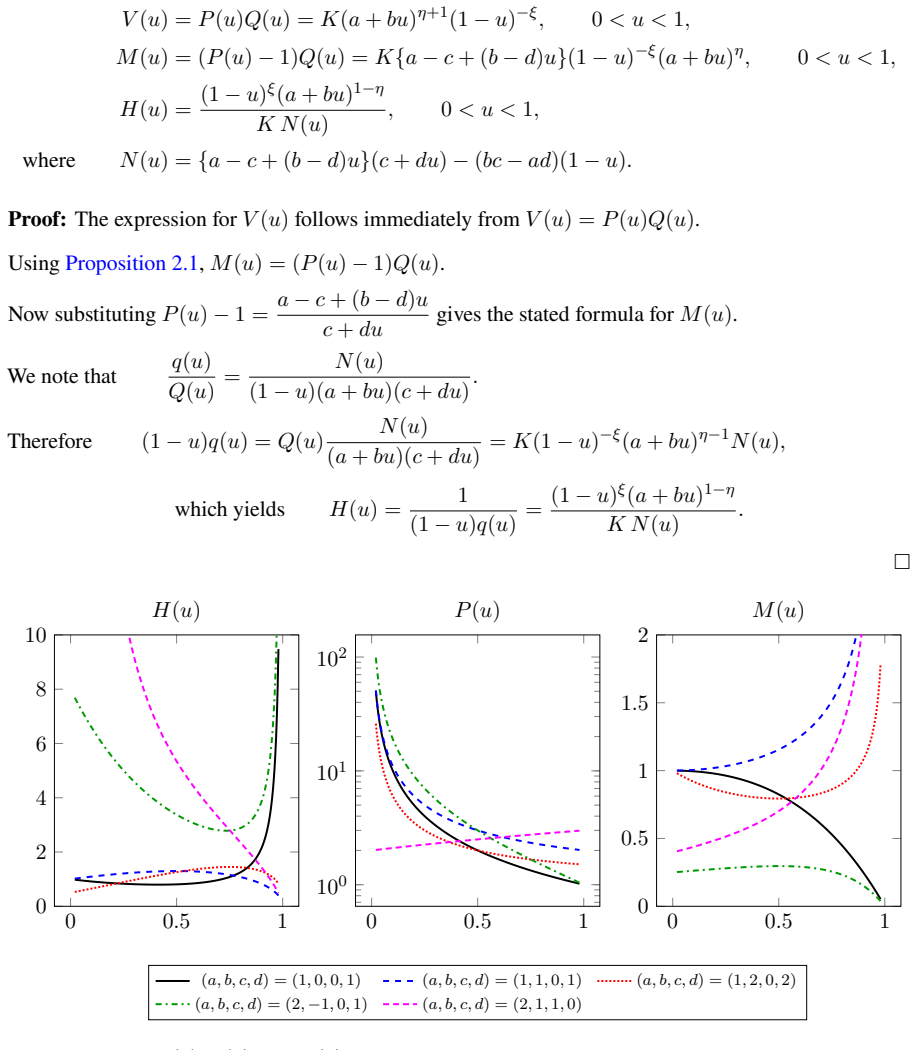
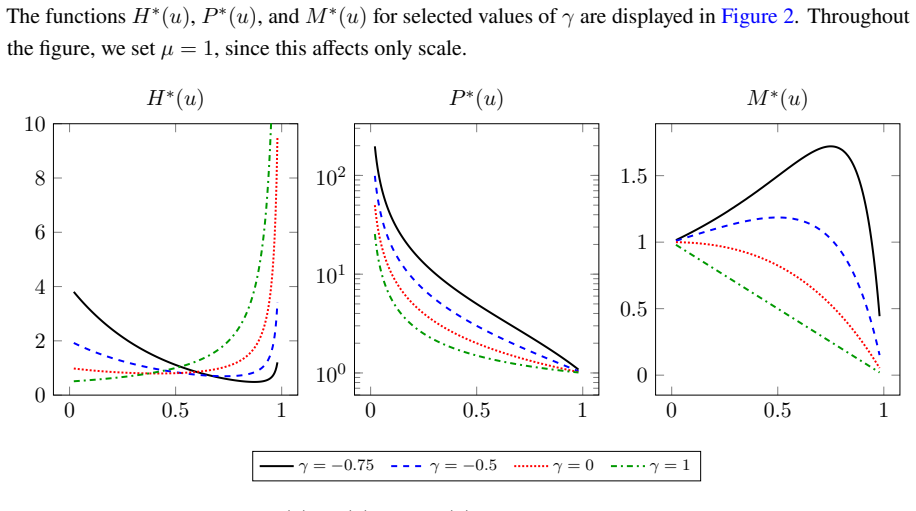
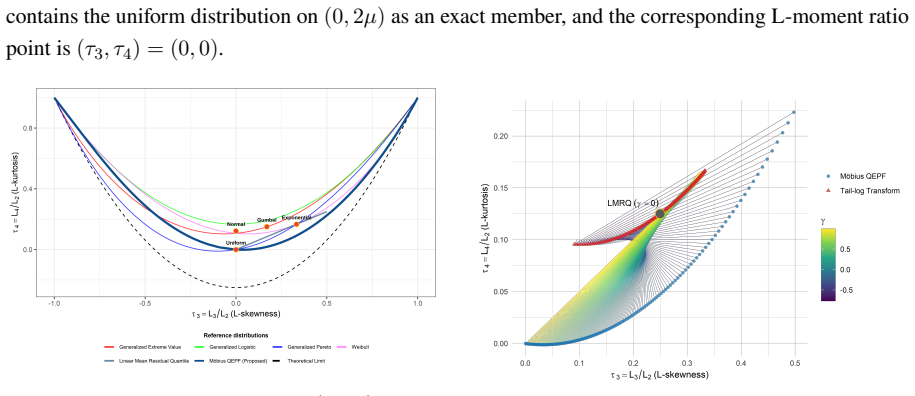
Under natural boundary conditions the Möbius specification of the quantile-based effectiveness persistence function collapses to a canonical form whose inverse supplies the quantile function of a two-parameter family of nonnegative distributions; the family admits closed-form expressions for L-moments and quantile reliability measures and supports direct maximum-likelihood estimation.
What carries the argument
The quantile-based effectiveness persistence function (ratio of tail mean to quantile), specialized to a rational Möbius form that reduces canonically under boundary conditions.
If this is right
- Explicit L-moment and quantile-reliability formulas become available for the entire class.
- Maximum-likelihood estimation of the two parameters is feasible directly from the quantile function.
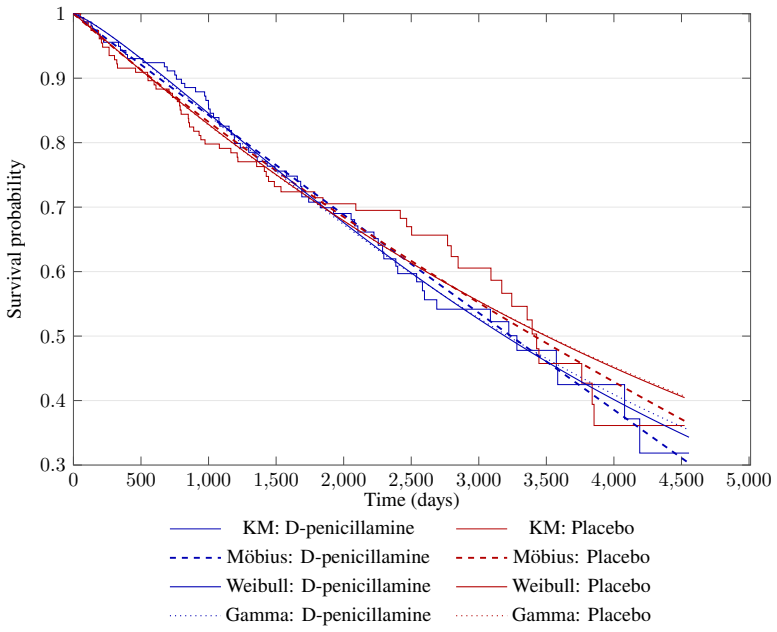
- The family supplies a parametric model for upper-tail behavior in clinical survival data.
- Descriptive measures such as mean, variance, and skewness follow immediately from the quantile expression.
Where Pith is reading between the lines
- The construction may be especially convenient when only upper-tail summaries are reliably observed.
- Because the family is defined through its quantile function, order statistics and trimmed moments are straightforward to obtain.
- The same boundary-condition device could be applied to other ratio-based persistence functions to generate additional families.
Load-bearing premise
The rational Möbius specification of the effectiveness persistence function, together with the chosen boundary conditions, is the right functional form for generating a useful and flexible family of quantile functions.
What would settle it
Maximum-likelihood fits of the two-parameter family to a survival dataset either fail to reproduce the observed upper-tail quantiles or are dominated in likelihood by standard alternatives such as Weibull or log-logistic.
Figures
read the original abstract
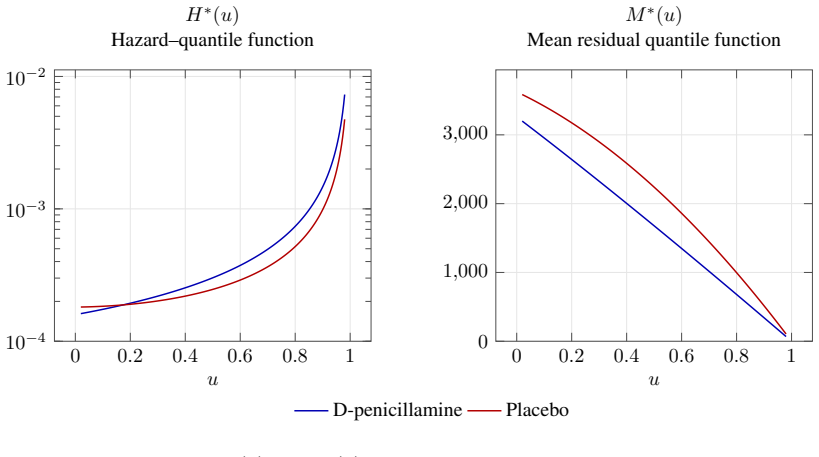
Motivated by upper-tail quantile-domain summaries, we study the quantile-based effectiveness persistence function defined as the ratio between the tail mean and the quantile function. We derive statistical properties of this measure and consider a rational (M\"obius) specification of the quantilebased effectiveness persistence function. Under natural boundary conditions, this specification reduces to a canonical form. The resulting canonical family defines a two-parameter class of nonnegative distributions through its quantile function. Various properties, including descriptive measures, L-moments, and quantile-based reliability concepts, are derived for this class. Estimation of the model parameters using maximum likelihood is also developed. The proposed family is illustrated using a real survival dataset.
Editorial analysis
A structured set of objections, weighed in public.
Referee Report
Summary. The manuscript defines a quantile-based effectiveness persistence function as the ratio of tail mean to the quantile function. It specifies this via a rational Möbius form and shows that natural boundary conditions reduce it to a canonical form, yielding a two-parameter family of nonnegative distributions defined by its quantile function. Statistical properties, L-moments, quantile-based reliability concepts, and maximum likelihood estimation are derived for the family, which is then illustrated on a real survival dataset.
Significance. If the boundary-condition reduction holds and the resulting family is flexible for upper-tail modeling, the work supplies a new quantile-defined class of distributions suited to clinical survival data. Explicit derivations of L-moments and reliability concepts, together with MLE, strengthen its potential utility for practitioners focused on quantile summaries.
major comments (1)
- [§3] §3 (canonical reduction): the algebraic steps from the general Möbius effectiveness persistence function to the claimed canonical quantile function under the stated boundary conditions must be shown in full detail; without explicit verification that the resulting expression is strictly increasing and satisfies the required limits, the central claim that a two-parameter family is obtained cannot be confirmed.
minor comments (3)
- [Introduction] The motivation for choosing the Möbius (rational) form over other possible specifications of the effectiveness persistence function is stated only briefly; a short comparison with alternative functional forms would clarify the modeling choice.
- [Table 1] Table 1 (parameter estimates on the survival data): the reported standard errors and confidence intervals should be accompanied by the observed information matrix or Hessian to allow direct assessment of numerical stability of the MLE.
- [§2] Notation for the effectiveness persistence function is introduced without an explicit symbol; consistent use of a single symbol (e.g., E_p(u)) throughout would improve readability.
Simulated Author's Rebuttal
We thank the referee for their thorough review and for identifying the need for greater detail in the canonical reduction. We address the single major comment below and will revise the manuscript to incorporate the requested algebraic verification.
read point-by-point responses
-
Referee: [§3] §3 (canonical reduction): the algebraic steps from the general Möbius effectiveness persistence function to the claimed canonical quantile function under the stated boundary conditions must be shown in full detail; without explicit verification that the resulting expression is strictly increasing and satisfies the required limits, the central claim that a two-parameter family is obtained cannot be confirmed.
Authors: We agree that the manuscript does not display the intermediate algebraic steps in sufficient detail. In the revised version we will expand §3 to present the complete derivation: starting from the general rational Möbius form of the effectiveness persistence function, applying the three natural boundary conditions (limits at the lower and upper quantiles together with the normalization at the median), solving for the two free parameters, and obtaining the explicit canonical quantile function. We will then verify directly that the resulting expression is strictly increasing on (0,1) and satisfies the required limits at 0 and 1, thereby confirming that a well-defined two-parameter family is obtained. revision: yes
Circularity Check
No significant circularity
full rationale
The derivation begins with the definition of the quantile-based effectiveness persistence function (ratio of tail mean to quantile function), adopts a Möbius rational form for it, and imposes natural boundary conditions to obtain a canonical quantile function that parametrizes a two-parameter family. All subsequent properties (L-moments, reliability measures, MLE) are then derived from this quantile function. No step reduces a claimed prediction or result to a prior fit, self-citation, or definitional tautology; the construction is a standard functional-form choice satisfying boundary constraints and is therefore self-contained.
Axiom & Free-Parameter Ledger
free parameters (1)
- two model parameters
axioms (1)
- domain assumption Natural boundary conditions applied to the Möbius specification of the effectiveness persistence function
Reference graph
Works this paper leans on
-
[1]
2026 , note =
Quantile-Based Effectiveness Persistence Function: A Tail-Focused Metric with Theory, Estimation, and Application to Biosimilar Evaluation , author =. 2026 , note =
2026
-
[2]
2026 , eprint=
Quantile-Based Effectiveness Persistence Function: A Tail-Focused Metric with Theory, Estimation, and Application to Biosimilar Evaluation , author =. 2026 , eprint=
2026
-
[3]
Midhu, N. N. and Sankaran, P. G. and Nair, N. Unnikrishnan , title =. Statistical Methodology , year =
-
[4]
Midhu, N. N. and Sankaran, P. G. and Unnikrishnan Nair, N. , title =. Communications in Statistics -- Theory and Methods , volume =. 2014 , doi =
2014
-
[5]
Sankaran, P. G. and Thomas, Bijamma and Midhu, N. N. , title =. Metron , year =
-
[6]
Aswin, I. C. and Sankaran, P. G. and Sunoj, S. M. , title =. Journal of the Indian Society for Probability and Statistics , year =
-
[7]
Sankaran, P. G. and Kumar, Dileep M. , title =. Journal of Statistical Theory and Practice , year =
-
[8]
2000 , doi =
Gilchrist, Warren , title =. 2000 , doi =
2000
-
[9]
Hosking, J. R. M. , title =. Journal of the Royal Statistical Society: Series B (Methodological) , year =
-
[10]
Journal of the American Statistical Association , year =
Parzen, Emanuel , title =. Journal of the American Statistical Association , year =
-
[11]
Unnikrishnan and Sankaran, P
Nair, N. Unnikrishnan and Sankaran, P. G. , title =. Communications in Statistics -- Theory and Methods , year =
-
[12]
Hankin, Robin K. S. and Lee, Alan , title =. Australian & New Zealand Journal of Statistics , year =
-
[13]
N. Unnikrishnan Nair and P. G. Sankaran and N. Balakrishnan , title =. 2013 , series =. doi:10.1007/978-0-8176-8361-0 , isbn =
-
[14]
Habibi, M. and Asgharzadeh, A. , title =. Communications in Statistics - Simulation and Computation , year =. doi:10.1080/03610918.2017.1367807 , url =
-
[15]
2015 , journal =
Scientific Considerations in Demonstrating Biosimilarity to a Reference Product , author =. 2015 , journal =
2015
-
[16]
2014 , journal =
Guideline on Similar Biological Medicinal Products , author =. 2014 , journal =
2014
-
[17]
2004 , journal =
Comparability of Biotechnological/Biological Products Subject to Changes in Their Manufacturing Process , author =. 2004 , journal =
2004
-
[18]
David, H. A. and Nagaraja, H. N. , title =
-
[19]
Statistical Methodology , volume =
A class of distributions with the linear mean residual quantile function and its generalizations , author =. Statistical Methodology , volume =. 2013 , doi =
2013
-
[20]
Lang, Serge , title =
-
[21]
Kaplan, E. L. and Meier, Paul , title =. Journal of the American Statistical Association , volume =. 1958 , doi =
1958
-
[22]
Cox, D. R. , title =
-
[23]
Hall, W. J. and Wellner, J. A. , title =. Annals of Probability , year =
-
[24]
Kotz, Samuel and Shanbhag, D. N. , title =
-
[25]
and Proschan, F
Guess, F. and Proschan, F. , title =. Handbook of Statistics , year =
-
[26]
Schmittlein, D. C. and Morrison, D. G. , title =. Operations Research , year =
-
[27]
Jones, M. C. , title =. Journal of the Royal Statistical Society, Series B (Methodological) , volume =
-
[28]
Statistical Science , volume =
Parzen, Emanuel , title =. Statistical Science , volume =
-
[29]
IMS Lecture Notes--Monograph Series , volume =
Stute, Winfried , title =. IMS Lecture Notes--Monograph Series , volume =
-
[30]
2023 , url =
Cirrhosis Patient Survival Prediction Data Set , author =. 2023 , url =
2023
-
[31]
Rolland and Grambsch, Patricia M
Dickson, E. Rolland and Grambsch, Patricia M. and Fleming, Thomas R. and Fisher, Lloyd D. and Langworthy, Alice , title =. Hepatology , year =. doi:10.1002/hep.1840100102 , url =
-
[32]
Journal of Statistical Software , year =
Jackson, Christopher , title =. Journal of Statistical Software , year =. doi:10.18637/jss.v070.i08 , url =
-
[33]
2024 , note =
flexsurv: Flexible Parametric Survival and Multi-State Models , author =. 2024 , note =
2024
-
[34]
2026 , note =
survreg: Regression for a Parametric Survival Model , author =. 2026 , note =
2026
-
[35]
Therneau, T. M. and Grambsch, P. M. , title =. 2000 , edition =
2000
-
[36]
, title =
Akaike, H. , title =. IEEE Transactions on Automatic Control , volume =
-
[37]
, title =
Schwarz, G. , title =. Annals of Statistics , volume =
-
[38]
Kalbfleisch, J. D. and Prentice, R. L. , title =
-
[39]
Kleinbaum, D. G. and Klein, M. , title =
-
[40]
, title =
Oakes, D. , title =. International Statistical Review , volume =
-
[41]
and Berger, R
Casella, G. and Berger, R. L. , title =
-
[42]
Journal of Statistical Software , year =
Delignette-Muller, Marie-Laure and Dutang, Christophe , title =. Journal of Statistical Software , year =
-
[43]
2025 , url =
R: A Language and Environment for Statistical Computing , organization =. 2025 , url =
2025
-
[44]
Primary Biliary Cirrhosis (PBC) Trial Data , year =
-
[45]
and Chesneau, Christophe and Jamal, Farrukh and Elgarhy, Mohammed and Tahir, Muhammad H
Bantan, Rashad A. and Chesneau, Christophe and Jamal, Farrukh and Elgarhy, Mohammed and Tahir, Muhammad H. and Ali, Aqib and Zubair, Muhammad and Anam, Sania , title =. Mathematics , volume =. 2020 , doi =
2020
-
[46]
Journal of the Egyptian Mathematical Society , volume =
The Kumaraswamy Marshal--Olkin Family of Distributions , author =. Journal of the Egyptian Mathematical Society , volume =. 2015 , publisher =
2015
-
[47]
Computation , volume =
A New Extension of the Kumaraswamy Generated Family of Distributions with Applications to Real Data , author =. Computation , volume =. 2023 , publisher =
2023
-
[48]
Journal of Statistics Applications and Probability , volume =
The Odd Burr-III Family of Distributions , author =. Journal of Statistics Applications and Probability , volume =. 2017 , publisher =
2017
-
[49]
Geometry by Its Transformations , publisher =
Baltus, Christopher , title =. Geometry by Its Transformations , publisher =. 2025 , doi =
2025
-
[50]
Marshall, Albert W. and Olkin, Ingram , title =. 2007 , publisher =. doi:10.1007/978-0-387-68477-2 , url =
-
[51]
, title =
Beardon, Alan F. , title =. 1983 , doi =
1983
-
[52]
2006 , doi =
de Haan, Laurens and Ferreira, Ana , title =. 2006 , doi =
2006
-
[53]
Modelling Extremal Events for Insurance and Finance , publisher =
Embrechts, Paul and Kl. Modelling Extremal Events for Insurance and Finance , publisher =. 1997 , address =
1997
-
[54]
, title =
Arnold, Barry C. , title =. 2015 , address =
2015
-
[55]
Borgman, L. E. , title =. Journal of Applied Probability , volume =
-
[56]
and Moeschberger, Melvin L
Klein, John P. and Moeschberger, Melvin L. , title =. 2003 , series =
2003
-
[57]
Unnikrishnan and Sankaran, P
Nair, N. Unnikrishnan and Sankaran, P. G. and Sunoj, S. M. , title =. REVSTAT -- Statistical Journal , volume =. 2019 , doi =
2019
-
[58]
Journal of Banking & Finance , volume =
Acerbi, Carlo and Tasche, Dirk , title =. Journal of Banking & Finance , volume =. 2002 , doi =
2002
-
[59]
Hosking, J. R. M. and Wallis, J. R. , title =
-
[60]
Hosking, J. R. M. , title =. IBM Journal of Research and Development , volume =
-
[61]
and Resnick, S
Ghosh, S. and Resnick, S. , title =. Journal of Applied Probability , volume =
-
[62]
On the tails of extreme event distributions in hydrology , journal =
El Adlouni, Salah-Eddine and Bob. On the tails of extreme event distributions in hydrology , journal =. 2008 , volume =
2008
-
[63]
and Koutsoyiannis, Demetris and Makropoulos, Christos , title =
Papalexiou, Simon M. and Koutsoyiannis, Demetris and Makropoulos, Christos , title =. Hydrology and Earth System Sciences , year =
-
[64]
, title =
Malamud, Bruce D. , title =. Physics World , year =
-
[65]
, title =
Lorenz, Max O. , title =. Publications of the American Statistical Association , year =
-
[66]
, title =
Arnold, Barry C. , title =. 1987 , publisher =
1987
-
[67]
Midhu, N. N. and Sankaran, P. G. , title =. Calcutta Statistical Association Bulletin , volume =. 2014 , doi =
2014
-
[68]
Sankaran, P. G. and Midhu, N. N. , title =. Journal of Applied Statistics , volume =. 2017 , doi =
2017
discussion (0)
Sign in with ORCID, Apple, or X to comment. Anyone can read and Pith papers without signing in.