Precision luminosity measurement in proton-proton collisions at a center-of-mass energy of 13 TeV with the CMS detector at the Large Hadron Collider
Pith reviewed 2026-06-26 01:58 UTC · model grok-4.3
The pith
CMS measures integrated luminosity to 0.73% precision for the full 13 TeV proton data set
A machine-rendered reading of the paper's core claim, the machinery that carries it, and where it could break.
Core claim
Calibration of several luminosity monitors via beam-separation techniques, followed by validation of their stability against Z boson rates, produces a total integrated luminosity uncertainty of 0.73% for the complete 13 TeV data set, representing the most precise such measurement at a bunched-beam hadron collider.
What carries the argument
Multiple independent luminosity monitors whose calibrations are obtained from beam-separation scans and whose stability is cross-checked with Z boson production rates.
If this is right
- Cross-section measurements for standard model processes carry a smaller systematic uncertainty from luminosity.
- Searches for new physics gain sensitivity because the expected event rates are known more precisely.
- The full 13 TeV data set can be reanalyzed with reduced luminosity-related errors.
- A documented sub-percent precision baseline now exists for planning luminosity measurements in the high-luminosity LHC phase.
Where Pith is reading between the lines
- The same combination of beam-separation calibration and Z validation could be tested at other hadron colliders to reach comparable relative precision.
- Future detector upgrades might target still lower uncertainties by refining the same reference processes rather than introducing entirely new monitors.
- Analyses that combine multiple data-taking years will now be limited by other systematics sooner than by luminosity.
Load-bearing premise
Z boson production rates act as an independent, luminosity-independent reference that can confirm the monitors remain stable over time.
What would settle it
A statistically significant mismatch between the luminosity values reported by the monitors and the luminosity inferred directly from the observed Z boson event yield would show the claimed 0.73% precision cannot be maintained.
Figures
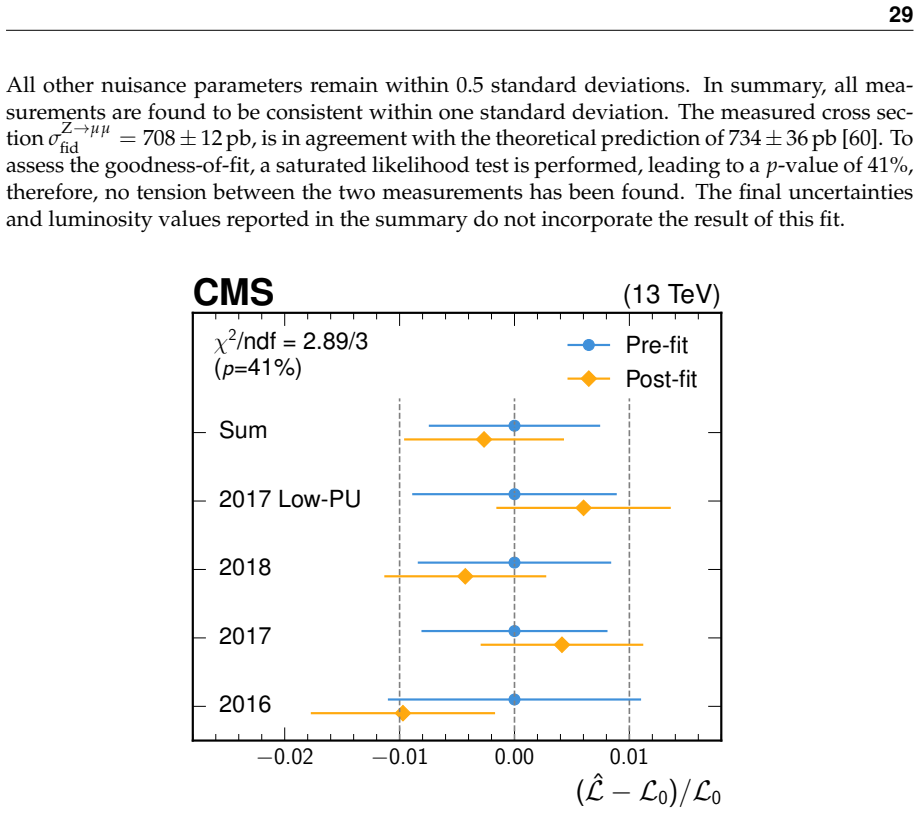
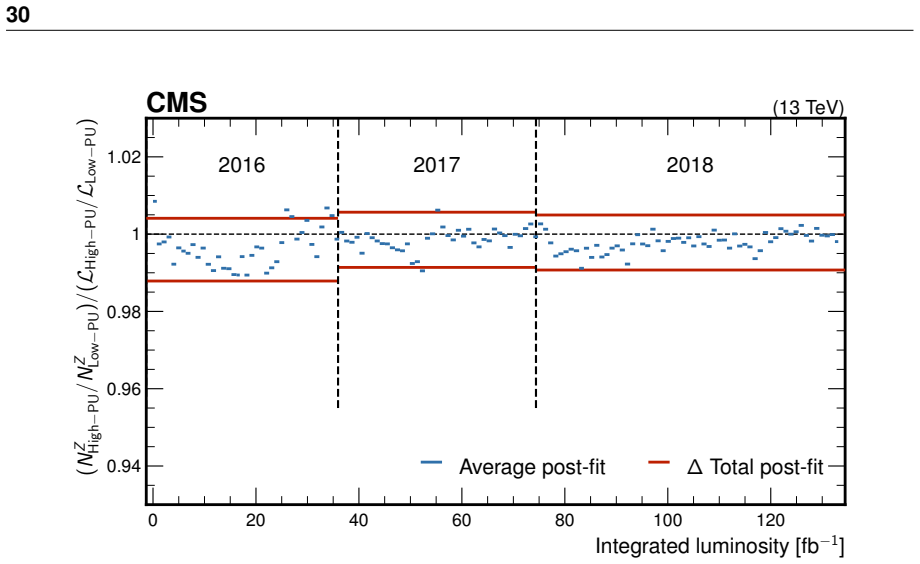
read the original abstract
Discovering new fundamental physics requires spotting subtle deviations between theoretical predictions and experimental data. This delicate comparison hinges on the precise knowledge of the integrated luminosity, the measure of how many particle interactions were actually delivered by the collider. Here, we report a landmark measurement of the integrated luminosity by the Compact Muon Solenoid (CMS) experiment for proton-proton collisions at a center-of-mass energy of 13 TeV at the CERN Large Hadron Collider (LHC). By calibrating multiple independent monitors through specialized beam-separation techniques and rigorously validating their long-term stability against well-understood Z boson production rates, we comprehensively map and minimize systematic uncertainties. Combining the findings yields a total integrated luminosity precision of 0.73% for the entire data set. This marks the most precise luminosity measurement ever achieved at a bunched-beam hadron collider. Crossing the sub-percent precision threshold per data taking year fundamentally sharpens our ability to test the standard model and establishes a vital baseline for the upcoming High-Luminosity LHC era.
Editorial analysis
A structured set of objections, weighed in public.
Referee Report
Summary. The manuscript reports a precision determination of the integrated luminosity for CMS proton-proton collisions at 13 TeV, obtained by calibrating multiple luminosity monitors via beam-separation (van der Meer) scans and validating their long-term stability using Z boson production rates. The combined result is quoted as 0.73% total uncertainty for the full dataset, presented as the most precise such measurement at a bunched-beam hadron collider.
Significance. If the quoted uncertainty is shown to be free of circular dependence, the result would be a benchmark for precision LHC physics, sharpening Standard Model tests and providing a reference for HL-LHC luminosity calibration. The multi-monitor calibration strategy and systematic mapping are positive features when independence of the validation sample is demonstrated.
major comments (1)
- [Abstract] Abstract: the 0.73% precision claim rests on Z-boson-rate validation of long-term stability after van-der-Meer calibration. The text states only that the rates are 'well-understood' and supplies no explicit statement that the reference Z sample (acceptance-corrected rate or cross section) is normalized with a luminosity source independent of the monitors under test. This independence is load-bearing for whether the stability check can bound the dominant systematic; without it the combined uncertainty may be underestimated.
Simulated Author's Rebuttal
We thank the referee for the careful reading of the manuscript and for highlighting the need for explicit clarification on the independence of the Z-boson validation sample. We address the single major comment below.
read point-by-point responses
-
Referee: [Abstract] Abstract: the 0.73% precision claim rests on Z-boson-rate validation of long-term stability after van-der-Meer calibration. The text states only that the rates are 'well-understood' and supplies no explicit statement that the reference Z sample (acceptance-corrected rate or cross section) is normalized with a luminosity source independent of the monitors under test. This independence is load-bearing for whether the stability check can bound the dominant systematic; without it the combined uncertainty may be underestimated.
Authors: We agree that the abstract does not contain an explicit statement regarding the independence of the Z-sample normalization. The full manuscript describes the Z rates as well-understood from a combination of theoretical predictions and prior measurements performed with luminosity determinations independent of the 13 TeV monitors under test. However, because this independence is not stated in the abstract, we will revise the abstract to include a concise clause making the independence explicit. This change will directly address the concern that the stability validation could otherwise appear circular. revision: yes
Circularity Check
No circularity in derivation chain
full rationale
The provided abstract describes absolute calibration of luminosity monitors via beam-separation scans followed by stability validation against independently well-understood Z boson production rates. No equations, fitted parameters, or self-citations are exhibited that reduce the final 0.73% precision result to the inputs by construction. The Z reference is presented as external and theory-driven, rendering the chain self-contained against external benchmarks with no load-bearing reduction to self-defined quantities.
Axiom & Free-Parameter Ledger
axioms (2)
- domain assumption Z boson production rates are well-understood and independent of the luminosity measurement being validated
- domain assumption Beam-separation techniques yield accurate absolute calibration of the monitors
Reference graph
Works this paper leans on
-
[1]
Motivations and precision targets for an accurate luminosity determination at the LHC
M. L. Mangano, “Motivations and precision targets for an accurate luminosity determination at the LHC”, inProc. LHC Lumi Days: Geneva, Switzerland, January 13–14, 2011, p. 1. 2021. [CERN-Proceedings-2011-001]
2011
-
[2]
CMS Collaboration, “Stairway to discovery: a report on the CMS program of cross section measurements from millibarns to femtobarns”,Phys. Rep.1115(2024) 3, doi:10.1016/j.physrep.2024.11.005,arXiv:2405.18661
-
[3]
CMS Collaboration, “Measurement of the t t production cross section, the top quark mass, and the strong coupling constant using dilepton events in pp collisions at√s=13 TeV”,Eur. Phys. J. C79(2019) 368, doi:10.1140/epjc/s10052-019-6863-8,arXiv:1812.10505
work page internal anchor Pith review Pith/arXiv arXiv doi:10.1140/epjc/s10052-019-6863-8 2019
-
[4]
CMS Collaboration, “Measurements of differential Z boson production cross sections in proton-proton collisions at √s=13 TeV”,JHEP12(2019) 061, doi:10.1007/JHEP12(2019)061,arXiv:1909.04133
-
[5]
CMS Collaboration, “Measurements of the W boson rapidity, helicity, double-differential cross sections, and charge asymmetry in pp collisions at 13 TeV”,Phys. Rev. D102(2020) 092012,doi:10.1103/PhysRevD.102.092012,arXiv:2008.04174
-
[6]
CMS Collaboration, “First measurement of the top quark pair production cross section in proton-proton collisions at √s=13.6 TeV”,JHEP08(2023) 204, doi:10.1007/JHEP08(2023)204,arXiv:2303.10680
-
[7]
CMS Collaboration, “Measurement of the inclusive cross sections for W and Z boson production in proton-proton collisions at √s=5.02 and 13 TeV”,JHEP04(2025) 162, doi:10.1007/JHEP04(2025)162,arXiv:2408.03744
-
[8]
CMS Physics: Technical design report volume 1: Detector performance and software
CMS Collaboration, “CMS Physics: Technical design report volume 1: Detector performance and software”, Technical Report CERN/LHCC-2006-001, CMS-TDR-08-1, 2006
2006
-
[9]
Report on the Physics at the HL-LHC and Perspectives for the HE-LHC
ATLAS and CMS Collaborations, “Report on the physics at the HL-LHC and perspectives for the HE-LHC”, Technical Report CERN-LPCC-2019-01, 2019. doi:10.23731/CYRM-2019-007[.Addendum],arXiv:1902.10229
work page internal anchor Pith review Pith/arXiv arXiv doi:10.23731/cyrm-2019-007 2019
-
[10]
The Phase-2 upgrade of the CMS beam radiation, instrumentation, and luminosity detectors
CMS Collaboration, “The Phase-2 upgrade of the CMS beam radiation, instrumentation, and luminosity detectors”, CMS Technical Proposal CERN-LHCC-2021-008, CMS-TDR-023, 2021
2021
-
[11]
The Phase-2 upgrade of the CMS beam radiation, instrumentation, and luminosity detectors: conceptual design
CMS Collaboration, “The Phase-2 upgrade of the CMS beam radiation, instrumentation, and luminosity detectors: conceptual design”, CMS Technical Proposal CMS-TDR-19-003, 2019
2019
-
[12]
Precision luminosity measurements at LHCb
LHCb Collaboration, “Precision luminosity measurements at LHCb”,JINST9(2014) P12005,doi:10.1088/1748-0221/9/12/P12005,arXiv:1410.0149
work page internal anchor Pith review Pith/arXiv arXiv doi:10.1088/1748-0221/9/12/p12005 2014
-
[13]
Precision luminosity measurement in proton-proton collisions at√s=13 TeV in 2015 and 2016 at CMS
CMS Collaboration, “Precision luminosity measurement in proton-proton collisions at√s=13 TeV in 2015 and 2016 at CMS”,Eur. Phys. J. C81(2021) 800, doi:10.1140/epjc/s10052-021-09538-2,arXiv:2104.01927. References 35
-
[14]
ALICE luminosity determination for PbPb collisions at√sNN =5.02 TeV
ALICE Collaboration, “ALICE luminosity determination for PbPb collisions at√sNN =5.02 TeV”,JINST19(2024) P02039, doi:10.1088/1748-0221/19/02/P02039,arXiv:2204.10148
-
[15]
Luminosity determination in $pp$ collisions at $\sqrt{s}=13$ TeV using the ATLAS detector at the LHC
ATLAS Collaboration, “Luminosity determination in pp collisions at √s=13 TeV using the ATLAS detector at the LHC”,Eur. Phys. J. C83(2023) 982, doi:10.1140/epjc/s10052-023-11747-w,arXiv:2212.09379
work page internal anchor Pith review Pith/arXiv arXiv doi:10.1140/epjc/s10052-023-11747-w 2023
-
[16]
Luminosity determination at proton colliders
P . Grafstr¨om and W. Kozanecki, “Luminosity determination at proton colliders”,Prog. Part. Nucl. Phys.81(2015) 97,doi:10.1016/j.ppnp.2014.11.002
-
[17]
Calibration of the effective beam height in the ISR
S. van der Meer, “Calibration of the effective beam height in the ISR”, ISR Report CERN-ISR-PO-68-31, 1968
1968
-
[18]
CMS Collaboration, “Instrumentation for beam radiation and luminosity measurement in the CMS experiment using novel detector technologies”,Nucl. Instrum. Meth. A845 (2017) 565,doi:10.1016/j.nima.2016.06.028
-
[19]
Development of the CMS detector for the CERN LHC Run 3
CMS Collaboration, “Development of the CMS detector for the CERN LHC Run 3”, JINST19(2024) P05064,doi:10.1088/1748-0221/19/05/P05064, arXiv:2309.05466
-
[20]
Data-Driven Precision Luminosity Measurements with Z Bosons at the LHC and HL-LHC
J. Salfeld-Nebgen and D. Marlow, “Data-driven precision luminosity measurements with Z bosons at the LHC and HL-LHC”,JINST13(2018) P12016, doi:10.1088/1748-0221/13/12/P12016,arXiv:1806.02184
work page internal anchor Pith review Pith/arXiv arXiv doi:10.1088/1748-0221/13/12/p12016 2018
-
[21]
Luminosity determination using Z boson production at the CMS experiment
CMS Collaboration, “Luminosity determination using Z boson production at the CMS experiment”,Eur. Phys. J. C84(2024) 26, doi:10.1140/epjc/s10052-023-12268-2,arXiv:2309.01008
-
[22]
Luminosity measurement for lead-lead collisions at√sNN =5.02 TeV in 2015 and 2018 at CMS
CMS Collaboration, “Luminosity measurement for lead-lead collisions at√sNN =5.02 TeV in 2015 and 2018 at CMS”, 2025.arXiv:2503.03946. Submitted to Eur. Phys. J. C
arXiv 2015
-
[23]
CMS luminosity measurement for the 2017 data-taking period at√s=13 TeV
CMS Collaboration, “CMS luminosity measurement for the 2017 data-taking period at√s=13 TeV”, CMS Physics Analysis Summary CMS-PAS-LUM-17-004, 2018
2017
-
[24]
CMS luminosity measurement for the 2018 data-taking period at√s=13 TeV
CMS Collaboration, “CMS luminosity measurement for the 2018 data-taking period at√s=13 TeV”, CMS Physics Analysis Summary CMS-PAS-LUM-18-002, 2019
2018
-
[25]
The CMS experiment at the CERN LHC
CMS Collaboration, “The CMS experiment at the CERN LHC”,JINST3(2008) S08004, doi:10.1088/1748-0221/3/08/S08004
-
[26]
Performance of the CMS Level-1 trigger in proton-proton collisions at √s=13 TeV
CMS Collaboration, “Performance of the CMS Level-1 trigger in proton-proton collisions at √s=13 TeV”,JINST15(2020) P10017,doi:10.1088/1748-0221/15/10/P10017, arXiv:2006.10165
-
[27]
CMS Collaboration, “The CMS trigger system”,JINST12(2017) P01020, doi:10.1088/1748-0221/12/01/P01020,arXiv:1609.02366
work page internal anchor Pith review Pith/arXiv arXiv doi:10.1088/1748-0221/12/01/p01020 2017
-
[28]
Performance of the CMS high-level trigger during LHC Run 2
CMS Collaboration, “Performance of the CMS high-level trigger during LHC Run 2”, JINST19(2024) P11021,doi:10.1088/1748-0221/19/11/P11021, arXiv:2410.17038. 36
-
[29]
Electron and photon reconstruction and identification with the CMS experiment at the CERN LHC
CMS Collaboration, “Electron and photon reconstruction and identification with the CMS experiment at the CERN LHC”,JINST16(2021) P05014, doi:10.1088/1748-0221/16/05/P05014,arXiv:2012.06888
-
[30]
CMS Collaboration, “Performance of the CMS muon detector and muon reconstruction with proton-proton collisions at √s=13 TeV”,JINST13(2018) P06015, doi:10.1088/1748-0221/13/06/P06015,arXiv:1804.04528
work page internal anchor Pith review Pith/arXiv arXiv doi:10.1088/1748-0221/13/06/p06015 2018
-
[31]
Description and performance of track and primary-vertex reconstruction with the CMS tracker
CMS Collaboration, “Description and performance of track and primary-vertex reconstruction with the CMS tracker”,JINST9(2014) P10009, doi:10.1088/1748-0221/9/10/P10009,arXiv:1405.6569
work page internal anchor Pith review Pith/arXiv arXiv doi:10.1088/1748-0221/9/10/p10009 2014
-
[32]
Design, performance, and calibration of CMS forward calorimeter wedges
CMS HCAL Collaboration, “Design, performance, and calibration of CMS forward calorimeter wedges”,Eur. Phys. J. C53(2008) 139, doi:10.1140/epjc/s10052-007-0459-4
-
[33]
CMS technical design report for the Level-1 trigger upgrade
CMS Collaboration, “CMS technical design report for the Level-1 trigger upgrade”, CMS Technical Proposal CERN-LHCC-2013-011, CMS-TDR-012, 2013
2013
-
[34]
CMS BRIL Collaboration, “The pixel luminosity telescope: a detector for luminosity measurement at CMS using silicon pixel sensors”,Eur. Phys. J. C83(2023) 673, doi:10.1140/epjc/s10052-023-11713-6,arXiv:2206.08870
-
[35]
CMS Collaboration, “The new fast beam condition monitor using poly-crystalline diamond sensors for luminosity measurement at CMS”,Nucl. Instrum. Meth. A936 (2019) 717,doi:10.1016/j.nima.2018.11.071
-
[36]
RAMSES: the LHC radiation monitoring system for the environment and safety
G. Segura Millan, D. Perrin, and L. Scibile, “RAMSES: the LHC radiation monitoring system for the environment and safety”, inProc. 10th Int. Conf. on Accelerator and Large Experimental Physics Control Systems (ICALEPCS 2005): Geneva, Switzerland. 2005. [Conf. Proc. C 051010 (2005) TH3B.1-3O]
2005
-
[37]
CERN supervision, control and data acquisition system for radiation and environmental protection
A. Ledeul et al., “CERN supervision, control and data acquisition system for radiation and environmental protection”, inProc. 12th Workshop on Emerging Technologies and Scientific Facilities Controls (PCaP AC2018): Hsinchu, Taiwan. 2018. [JACoW (PCaPAC2018) 248].doi:10.18429/JACoW-PCaPAC2018-FRCC3
-
[38]
First operational experience with the LHC diode orbit and oscillation (DOROS) system
M. Ga ¸sior, G. Baud, J. Olexa, and G. Valentino, “First operational experience with the LHC diode orbit and oscillation (DOROS) system”, inProc. 5th International Beam Instrumentation Conference (IBIC 2016): Barcelona, Spain. 2016. [JACoW (IBIC2016) 43]. doi:10.18429/JACoW-IBIC2016-MOPG07
-
[39]
BPM electronics based on compensated diode detectors—results from development systems
M. Ga ¸sior, J. Olexa, and R. Steinhagen, “BPM electronics based on compensated diode detectors—results from development systems”, inProc. 15th Beam Instrumentation Workshop (BIW12): Newport News, USA. 2012. [Conf. Proc. C 1204151 (2012) 4]
2012
-
[40]
Design and optimization of the beam orbit and oscillation measurement system for the Large Hadron Collider
J. Olexa, “Design and optimization of the beam orbit and oscillation measurement system for the Large Hadron Collider”. PhD thesis, Slovensk ´a technick´a univerzita v Bratislave,
-
[41]
CERN-THESIS-2018-185
2018
-
[42]
Observation of beam-beam deflections with LHC orbit data
W. Kozanecki, T. Pieloni, and J. Wenninger, “Observation of beam-beam deflections with LHC orbit data”, CERN Report CERN-ACC-NOTE-2013-0006, 2013
2013
-
[43]
The LHC fast BCT system: A comparison of design parameters with initial performance
D. Belohrad et al., “The LHC fast BCT system: A comparison of design parameters with initial performance”, CERN Report CERN-BE-2010-010, 2010. References 37
2010
-
[44]
Upgrade of the LHC bunch by bunch intensity measurement acquisition system
D. Belohrad, D. Esperante Pereira, J. Kral, and S. Pedersen, “Upgrade of the LHC bunch by bunch intensity measurement acquisition system”, inProc. 5th International Beam Instrumentation Conference (IBIC 2016): Barcelona, Spain. 2016. [JACoW (IBIC2016) 135]. doi:10.18429/JACoW-IBIC2016-MOPG39
-
[45]
M. Krupa and M. Ga ¸sior, “The wall current transformer—a new sensor for precise bunch-by-bunch intensity measurements in the LHC”, inProc. 5th International Beam Instrumentation Conference (IBIC 2016): Barcelona, Spain, September 11–15, 2016. 2017. [JACoW (IBIC2016) 568].doi:10.18429/JACoW-IBIC2016-WEAL02
-
[46]
Results of the LHC DCCT calibration studies
C. Barschel et al., “Results of the LHC DCCT calibration studies”, CERN Report CERN-ATS-Note-2012-026 PERF, 2012
2012
-
[47]
Longitudinal density monitor for the LHC
A. Jeff et al., “Longitudinal density monitor for the LHC”,Phys. Rev. ST Accel. Beams15 (2012) 032803,doi:10.1103/PhysRevSTAB.15.032803
-
[48]
A longitudinal density monitor for the LHC
A. Jeff, “A longitudinal density monitor for the LHC”. PhD thesis, University of Liverpool, 2012. CERN-THESIS-2012-240
2012
-
[49]
Precision luminosity measurement at LHCb with beam-gas imaging
C. Barschel, “Precision luminosity measurement at LHCb with beam-gas imaging”. PhD thesis, RWTH Aachen University, 2014. CERN-THESIS-2013-301
2014
-
[50]
Beam-gas imaging measurements at LHCb
G. Coombs, M. Ferro-Luzzi, and R. Matev, “Beam-gas imaging measurements at LHCb”, inProc. 7th International Beam Instrumentation Conference (IBIC 2018): Shanghai, China
2018
-
[51]
[JACoW (IBIC2018) 459].doi:10.18429/JACoW-IBIC2018-WEPB13
-
[52]
Impact of beam-beam effects on absolute luminosity calibrations at the CERN Large Hadron Collider
A. Babaev et al., “Impact of beam-beam effects on absolute luminosity calibrations at the CERN Large Hadron Collider”,Eur. Phys. J. C84(2024) 17, doi:10.1140/epjc/s10052-023-12192-5,arXiv:2306.10394
-
[53]
Closed expression for the electrical field of a two-dimensional Gaussian charge
M. Bassetti and G. A. Erskine, “Closed expression for the electrical field of a two-dimensional Gaussian charge”, ISR Report CERN-ISR-TH-80-06, 1980
1980
-
[54]
Coherent deflection of elliptic bunches colliding at crossing angle
A. Babaev, “Coherent deflection of elliptic bunches colliding at crossing angle”, 2021. arXiv:2104.02595
arXiv 2021
-
[55]
Operation and configuration of the LHC in Run 2
J. Wenninger, “Operation and configuration of the LHC in Run 2”, CERN Report CERN-ACC-NOTE-2019-0007, 2019
2019
-
[56]
Van der Meer scan luminosity measurement and beam-beam correction
V . Balagura, “Van der Meer scan luminosity measurement and beam-beam correction”, Eur. Phys. J. C81(2021) 26,doi:10.1140/epjc/s10052-021-08837-y, arXiv:2012.07752
-
[57]
Parallel high-performance multi-beam multi-bunch simulations
S. V . Furuseth and X. Buffat, “Parallel high-performance multi-beam multi-bunch simulations”,Comput. Phys. Commun.244(2019) 180, doi:10.1016/j.cpc.2019.06.006
-
[58]
Magnetic measurements of MCBC and MCBY orbit correctors under special cycling conditions
A. Chmieli ´nska, L. Fiscarelli, W. Kozanecki, and E. Todesco, “Magnetic measurements of MCBC and MCBY orbit correctors under special cycling conditions”, CERN Report CERN-ACC-NOTE-2022-0013, 2022
2022
-
[59]
Production of single Gaussian bunches for Van der Meer scans in the LHC injector chain
H. Bartosik and G. Rumolo, “Production of single Gaussian bunches for Van der Meer scans in the LHC injector chain”, CERN Report CERN-ACC-NOTE-2013-0008, 2013. 38
2013
-
[60]
Factorisation of beams in van der Meer scans and measurements of theϕ ∗ η distribution of Z→e +e− events in pp collisions at √s=8 TeV with the ATLAS detector
S. N. Webb, “Factorisation of beams in van der Meer scans and measurements of theϕ ∗ η distribution of Z→e +e− events in pp collisions at √s=8 TeV with the ATLAS detector”. PhD thesis, University of Manchester, 2015. CERN-THESIS-2015-054
2015
-
[61]
Probing New Physics: Search for supersymmetry with Higgs particles and high-precision luminosity determination at the CMS experiment
P . Major, “Probing New Physics: Search for supersymmetry with Higgs particles and high-precision luminosity determination at the CMS experiment”. PhD thesis, ELTE E¨otv¨os Lor´and University, 2024. CMS TS-2026/002
2024
-
[62]
Fiducialq t resummation of color-singlet processes at N3LL+NNLO
T. Becher and T. Neumann, “Fiducialq t resummation of color-singlet processes at N3LL+NNLO”,JHEP03(2021) 199,doi:10.1007/JHEP03(2021)199, arXiv:2009.11437. 39 A The CMS Collaboration Yerevan Physics Institute, Yerevan, Armenia A. Gevorgyan , A. Hayrapetyan, V . Makarenko , A. Tumasyan1 Marietta Blau Institute for Particle Physics, Vienna, Austria W. Adam ...
discussion (0)
Sign in with ORCID, Apple, or X to comment. Anyone can read and Pith papers without signing in.