REVIEW 4 major objections 6 minor 23 references
A distributed system perspective on Backscatter systems: A review
T0 review · 4 major / 6 minor · reviewed 2026-08-07 · deepseek-v4-flash
Pith's one-line read This review argues that reliable backscatter communication, indoor localization, battery-free networking, and SWIPT all hinge on distributed architectures and intelligent resource allocation.
desk verdict A useful but unfinished survey: accurate summaries of key backscatter systems, marred by template leftovers and one clear misclassification that weakens the central claim. read the letter →
The pith
A machine-rendered reading of the paper's core claim, the machinery that carries it, and where it could break.
The reading
What carries the argument
The review's central object is the interplay between distributed architecture and resource allocation across four application domains. Its load-bearing mechanisms are the concrete coordination schemes it highlights: Relacks's closed-loop sharing of link settings between two transceivers, HitchHike's channel-shifted WiFi backscatter with XOR decoding at a secondary access point, B2Loc's confidence-aware fusion of distributed Angle-of-Arrival estimates, Find's geometrically distributed random wake-up delays with runtime adaptation, Flync's external flicker-based synchronization, and Trident's frequency-space division for multi-reader interference avoidance. The most consequential mechanism is the distinction between linear and nonlinear energy harvester (EH) models in multi-user SWIPT: under a saturation model, the beamforming direction that maximizes total received RF power does not maximize total harvested DC power, and under a diode model, optimal input distributions may deviate from Gaussian and interference may be shaped to be more harvestable. These mechanisms collectively carry the argument that distributed, adaptive, diversity-exploiting designs outperform centralized ones.
What would settle it
Run a controlled comparison in a 60 $m^{2}$ indoor space between the Relacks closed-loop bistatic system and a centralized single-transceiver baseline that cannot share link metrics or adapt frequency and antenna settings; if the baseline achieves comparable per-location success rates, the claim that distributed coordination is pivotal for reliable backscatter would be weakened.
Extended reading notes
Core claim
The paper's central claim is that distributed coordination and intelligent resource allocation are not optional refinements but decisive factors for making backscatter, localization, battery-free networking, and SWIPT robust and scalable. The review supports this by walking through Relacks (closed-loop bistatic backscatter where two transceivers share link metrics to avoid bad frequencies and antennas), HitchHike and Inter-Technology Backscatter (repurposing commodity WiFi and Bluetooth hardware as distributed infrastructure), B2Loc (combining Angle-of-Arrival estimates from multiple BLE receivers with confidence-aware weighting), Find and Flync (randomized wake-up delays and powerline-flicker synchronization for intermittently powered nodes), and the WIPT framework in [13] (where linear versus nonlinear energy harvester models lead to qualitatively different beamforming and signal design). A key result is that maximizing total received RF power does not maximize harvested DC power under nonlinear energy harvester models, so resource allocation must change. The review also surveys reliability mechanisms—macro-level co-design, collision detection and avoidance, coding, and physical-layer innovations—and highlights five recurring themes: coordination, adaptivity, diversity, realistic modeling, and reuse of commodity infrastructure.
Load-bearing premise
The review assumes that the handful of summarized systems is representative of the field and that the descriptions of these systems faithfully match the original papers; if any summary is inaccurate or cherry-picked, the synthesis could mislead readers.
Editorial extensions
If this is right
- Backscatter system designers should implement closed-loop coordination that shares link-quality information between separated transceivers, as Relacks does, to avoid low-quality links and improve indoor success rates.
- Deployments should reuse existing commodity WiFi and BLE infrastructure where possible, since HitchHike, Inter-Technology Backscatter, and B2Loc show that this lowers cost and enables practical localization and connectivity.
- Battery-free networks should use randomized wake-up delays and external synchronization signals such as powerline-induced flicker to bootstrap device-to-device communication efficiently under intermittency.
- Multi-user SWIPT resource allocation should be based on nonlinear energy harvester models; strategies derived from linear models can be suboptimal or qualitatively wrong, especially for saturation and diode rectifier behaviors.
- Reliability techniques such as Trident's frequency-space division and the joint carrier-tag coding for interference cancellation should be considered alongside protocol-level approaches to support dense, mission-critical backscatter deployments.
Reading between the lines
- This review's synthesis suggests a general design principle beyond the surveyed systems: as IoT scales, pushing adaptivity to edge devices that share local metrics may beat any central controller that tries to track all channels.
- The nonlinear energy harvester insights imply that interference could be deliberately shaped to be more harvestable, turning a traditional obstacle into a resource; this idea, extended to backscatter tags, is a testable next step the review only gestures at.
- The review's emphasis on commodity infrastructure implies a research direction: defining open interfaces so multiple vendors' radios can be coordinated by software, which neither the surveyed systems nor the review fully articulate.
- One could test the review's core claim by re-running the Relacks experiment with a centralized baseline that uses a single fixed transceiver pair; the review would predict a meaningful success-rate gap across the coverage area.
Editorial analysis
A structured set of objections, weighed in public.
Referee Report
Summary. This review paper synthesizes recent work on distributed architectures and resource allocation across four related areas: backscatter communication (Relacks, HitchHike, Inter-Technology Backscatter), BLE-backscatter indoor localization (B2Loc), battery-free networking (Find, Flync), and SWIPT resource allocation (Clerckx et al.). It also devotes Section II to reliability in backscatter networks, discussing macro-level co-design, collision avoidance, coding, and physical-layer approaches. The paper makes no new experimental or theoretical contributions; its thesis is that coordination, adaptivity, diversity, and realistic energy-harvester modeling are pivotal for reliable and scalable low-power wireless systems.
Significance. The paper could serve as a readable introductory survey for practitioners entering backscatter and battery-free networking, and several capsule descriptions are accurate: the summaries of Relacks, HitchHike, B2Loc, Find/Flync, and the Clerckx SWIPT survey match the essential contributions of those papers. The explicit attention to nonlinear energy harvester models in the WIPT section is a useful corrective to linear-model thinking. However, the review's contribution is purely synthetic, and the absence of a stated methodology, combined with at least one clear misclassification in Section II, means the central claim is not yet established at the claimed level of comprehensiveness. The paper does not fabricate data and does not rely on self-citation, so the factual summary layer is largely trustworthy where it has been checked.
major comments (4)
- [Section II] [21] is presented as a reliability enhancement for backscatter networks, but the paragraph's own description concerns orbital angular momentum (OAM) vortex beams generated by ultra-large metasurfaces for high-capacity communication, with no backscatter component. This is a category error in the evidence base for the reliability synthesis; either remove [21] or provide an explicit argument for how OAM metasurface work informs backscatter reliability.
- [Section I] The review does not state a search protocol, inclusion/exclusion criteria, or a rationale for why the roughly fifteen discussed systems are representative. The abstract and introduction promise a 'comprehensive overview,' but without a methodology the reader cannot distinguish a curated selection from an arbitrary one. Add a methods paragraph or substantially qualify the scope claim.
- [Section I] The term 'distributed' is used so broadly that the thesis risks becoming definitional: any bistatic backscatter system, by having separate RF source and receiver, qualifies as distributed. For example, Relacks is described as distributed mainly because the excitation and receiver TRX units are separate entities. The review should define distributedness in terms of coordination, information sharing, decentralized decision-making, or similar properties, and then evaluate each system against that definition; otherwise the conclusion that distributed architectures are pivotal is not empirically informative.
- [Section II] The reliability section mixes levels of analysis without an organizing framework: macro-level co-design, rate adaptation for effective nodes, interference cancellation, frequency-space division, and OAM metasurface scaling are presented as parallel 'perspectives' with no synthesis of how they jointly support the paper's central claim. At least one paragraph ([20]) ends mid-sentence with 'This paper' and does not connect the interference-cancellation scheme to distributed architecture or resource allocation. The section needs a unifying analytic thread.
minor comments (6)
- [References] References [1] through [7] are IEEE template placeholders (Eason, Maxwell, Jacobs, Elissa, Nicole, Yorozu, Young) and are not cited in the text; they should be removed.
- [Acknowledgment] The Acknowledgment section contains template boilerplate ('The preferred spelling of the word "acknowledgment"...') rather than a real acknowledgment; replace it with an actual acknowledgment or delete the section.
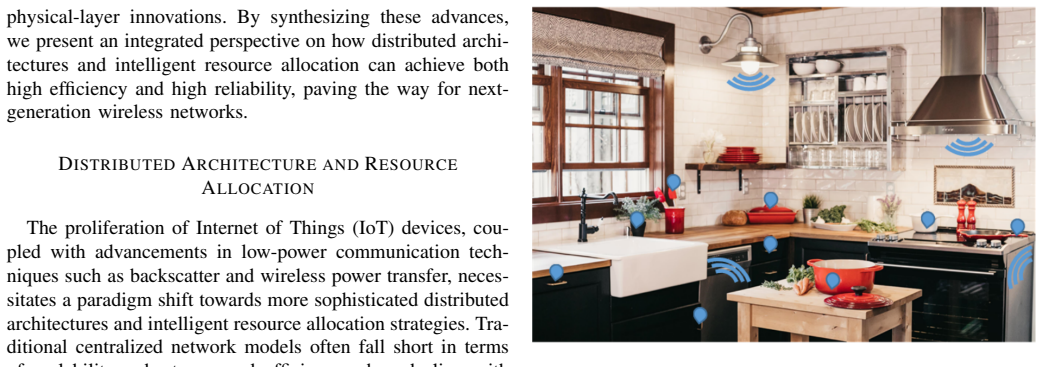
- [Figures] Figure captions such as 'Fig. 1. indoor communication' are insufficiently descriptive; each figure needs a caption that states what is shown and why it matters to the surrounding argument.
- [Section II] In Section II, the phrase 'Firstly ,we discuss' contains a spacing typo that should be corrected.
- [WIPT section] In the linear energy harvester model, the notation e_3 for the rectifier efficiency constant is confusing; use a conventional symbol such as eta throughout.
- [References] The reference list mixes citation styles, with some entries giving full author lists and others using 'et al.'; normalize all entries to the journal house style.
Circularity Check
No circular derivation: the paper is a literature review whose claims are restatements of externally published results, with no fitted quantities, predictions, or load-bearing self-citations.
full rationale
This manuscript is an expository review (arXiv:2506.04873) of previously published systems (Relacks, HitchHike, Inter-Technology Backscatter, B2Loc, Find/Flync, Clerckx et al., RAEN, Trident, etc.). It contains no mathematical derivation that maps an input to an output, no fitted parameter renamed as a prediction, and no self-citation on which a load-bearing premise depends: the reference list contains none of the authors' own prior works. The closest thing to a circularity concern is the synthesis frame itself—systems are selected because they exhibit distributed architectures and then cited as evidence that distributed architectures are pivotal—but that is the standard inductive structure of a review, not a derivation that reduces to its inputs. The apparent misclassification of reference [21] (an OAM metasurface paper with no backscatter component) as a backscatter physical-layer reliability enhancement is a factual and categorization weakness and a threat to the review's representativeness, not a circularity of the kind defined here; per the rubric, accuracy doubts belong to correctness risk rather than circularity analysis. Therefore no step satisfies the requirement of quoting the paper and exhibiting a specific reduction of a claimed result to its own inputs, and the circularity score is 0.
Assumptions & free parameters
assumptions (2)
- domain assumption The summaries of cited systems (Relacks, HitchHike, etc.) accurately reflect the original papers.
- domain assumption The handful of selected works is representative of the broader backscatter and distributed systems literature.
Cite this review
Pith. "Pith review of A distributed system perspective on Backscatter systems: A review." pith.science (2026). https://pith.science/paper/AQMLXKT3
@misc{pith2026250604873,
  author       = {Pith},
  title        = {Pith review of: A distributed system perspective on Backscatter systems: A review},
  year         = {2026},
  howpublished = {\url{https://pith.science/paper/AQMLXKT3}},
  note         = {Machine review of arXiv:2506.04873}
}
read the original abstract
This review investigates the pivotal role of distributed architectures and intelligent resource allocation in enabling robust and scalable wireless systems, with a particular emphasis on backscatter communication, indoor localization, battery-free networks, and Simultaneous Wireless Information and Power Transfer (SWIPT).
Figures


Figures from the paper (5 more)


Reference graph
Works this paper leans on
-
[1]
On certain integrals of Lipschitz-Hankel type involving products of Bessel functions,
G. Eason, B. Noble, and I. N. Sneddon, “On certain integrals of Lipschitz-Hankel type involving products of Bessel functions,” Phil. Trans. Roy. Soc. London, vol. A247, pp. 529–551, April 1955
1955
-
[7]
Electron spectroscopy studies on magneto-optical media and plastic substrate interface,
Y . Yorozu, M. Hirano, K. Oka, and Y . Tagawa, “Electron spectroscopy studies on magneto-optical media and plastic substrate interface,” IEEE Transl. J. Magn. Japan, vol. 2, pp. 740–741, August 1987 [Digests 9th Annual Conf. Magnetics Japan, p. 301, 1982]
1987
-
[21]
A novel interference cancellation scheme for bistatic backscatter communication systems[J]
Tao Q, Li Y , Zhong C, et al. A novel interference cancellation scheme for bistatic backscatter communication systems[J]. IEEE Communications Letters, 2021, 25(6): 2014-2018
work page 2021
-
[20]
RAEN: Rate Adaptation for Effective Nodes in Backscatter Networks[J]
Zhao J, Liu Q, Li D, et al. RAEN: Rate Adaptation for Effective Nodes in Backscatter Networks[J]. Sensors, 2022, 22(12): 4322
work page 2022
-
[2]
Clerk Maxwell, A Treatise on Electricity and Magnetism, 3rd ed., vol
J. Clerk Maxwell, A Treatise on Electricity and Magnetism, 3rd ed., vol
-
[3]
Oxford: Clarendon, 1892, pp.68–73
-
[4]
Fine particles, thin films and exchange anisotropy,
I. S. Jacobs and C. P. Bean, “Fine particles, thin films and exchange anisotropy,” in Magnetism, vol. III, G. T. Rado and H. Suhl, Eds. New York: Academic, 1963, pp. 271–350
1963
-
[5]
Title of paper if known,
K. Elissa, “Title of paper if known,” unpublished
Show all 23 references
-
[6]
Title of paper with only first word capitalized,
R. Nicole, “Title of paper with only first word capitalized,” J. Name Stand. Abbrev., in press
-
[8]
Young, The Technical Writer’s Handbook
M. Young, The Technical Writer’s Handbook. Mill Valley, CA: Univer- sity Science, 1989
1989
-
[9]
Katanbaf, Mohamad, Vivek Jain, and Joshua R. Smith. ”Relacks: Reli- able backscatter communication in indoor environments.” Proceedings of the ACM on Interactive, Mobile, Wearable and Ubiquitous Technologies 4.2 (2020): 1-24
2020
-
[10]
”Hitchhike: Practical backscatter using commodity wifi.” Proceedings of the 14th ACM conference on embedded network sensor systems CD-ROM
Zhang, Pengyu, et al. ”Hitchhike: Practical backscatter using commodity wifi.” Proceedings of the 14th ACM conference on embedded network sensor systems CD-ROM. 2016
2016
-
[11]
”Inter-technology backscatter: Towards internet connectivity for implanted devices.” Proceedings of the 2016 ACM SIGCOMM Conference
Iyer, Vikram, et al. ”Inter-technology backscatter: Towards internet connectivity for implanted devices.” Proceedings of the 2016 ACM SIGCOMM Conference. 2016
2016
-
[12]
”Accurate Indoor Localization for Bluetooth Low Energy Backscatter.” IEEE Internet of Things Journal (2024)
Luo, Zhiqing, et al. ”Accurate Indoor Localization for Bluetooth Low Energy Backscatter.” IEEE Internet of Things Journal (2024)
2024
-
[13]
Geissdoerfer, Kai, and Marco Zimmerling. ”Bootstrapping battery-free wireless networks: Efficient neighbor discovery and synchronization in the face of intermittency.” 18th USENIX Symposium on Networked Systems Design and Implementation (NSDI 21). 2021
2021
-
[14]
Clerckx, Bruno, et al. ”Fundamentals of wireless information and power transfer: From RF energy harvester models to signal and system designs.” IEEE Journal on Selected Areas in Communications 37.1 (2018): 4-33
2018
-
[15]
V . Liu, A. Parks, V . Talla, S. Gollakota, D. Wetherall, and J. R. Smith, ”Ambient Backscatter: Wireless Communication Out of Thin Air,” ACM SIGCOMM, 2013
2013
-
[16]
Kellogg, A
B. Kellogg, A. Parks, S. Gollakota, J. R. Smith, and D. Wetherall, ”Wi- Fi Backscatter: Internet Connectivity for RF-Powered Devices,” ACM SIGCOMM, 2014
2014
-
[17]
Roy and B
S. Roy and B. Karthik, ”Backscatter Communication: Fundamentals and Applications,” IEEE Access, vol. 7, pp. 85343–85362, 2019
2019
-
[18]
Y . Liu, M. Ma, and Y . Zhang, ”Networked Backscatter Communication: Challenges and Solutions,” IEEE Internet of Things Journal, vol. 5, no. 6, pp. 4358–4368, 2018
2018
-
[19]
Eco-Friendly 0G Networks: Unlocking the Power of Backscatter Communications for a Greener Future[J]
Javaid S, Fahim H, He B, et al. Eco-Friendly 0G Networks: Unlocking the Power of Backscatter Communications for a Greener Future[J]. arXiv preprint arXiv:2411.13440, 2024
2024 arXiv
-
[22]
Enhancing the Anti-Interference Capability of Orbital Angular Momentum Beams Generated by an Ultra-Large-Scale Metasurface[J]
Su B, Guan K, Qian A. Enhancing the Anti-Interference Capability of Orbital Angular Momentum Beams Generated by an Ultra-Large-Scale Metasurface[J]. Applied Sciences, 2025, 15(7): 3900
2025
-
[23]
TRIDENT: Interference avoidance in multi- reader backscatter network via frequency-space division[J]
Zou Y , Na X, Sun Y , et al. TRIDENT: Interference avoidance in multi- reader backscatter network via frequency-space division[J]. IEEE/ACM Transactions on Networking, 2024
2024
Reviewed August 7, 2026 · model on record in the stance chip above.
Discussion (0). Sign in to comment.