REVIEW 5 major objections 4 minor 62 references
Magnetic Field Induced Band Deformation in a Lieb Lattice:Aharonov-Bohm Caging and Zeeman Splitting
T0 review · 5 major / 4 minor · reviewed 2026-08-05 · deepseek-v4-flash
Pith's one-line read Adding a Zeeman field to a pi-flux Lieb lattice splits its flat band into two spin-resolved bands.
desk verdict The paper's own Hamiltonian makes the advertised 'competition' impossible: spin blocks are decoupled, so Zeeman splitting is just a rigid shift of the known AB-caged spectrum, and the headline result is a restatement of the model. read the letter →
The pith
A machine-rendered reading of the paper's core claim, the machinery that carries it, and where it could break.
The reading
What carries the argument
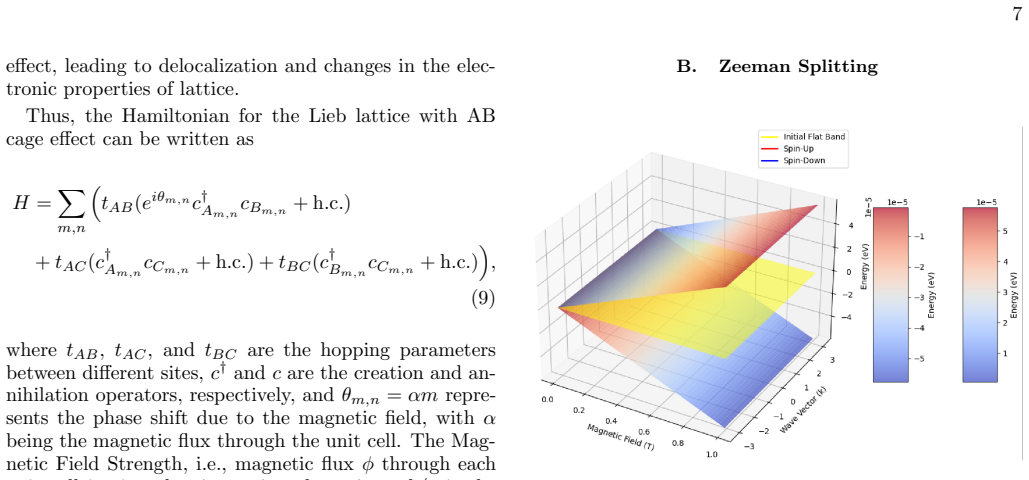
The load-bearing object is the spin-block-diagonal Hamiltonian H_total = diag(H0 + Bz I, H0 − Bz I), where H0 is the spinless tight-binding Lieb Hamiltonian with Peierls phases and Bz is the out-of-plane Zeeman energy. This identity carries the argument: it reduces the combined problem to a single spinless spectrum H0, computed once, with the Zeeman field providing only a rigid shift per spin sector. The second essential ingredient is Aharonov-Bohm caging at flux pi, which makes the eigenstates of H0 strictly localized plaquette states and therefore makes the shifted flat bands in each spin sector exactly dispersionless. The density-of-states calculation, using Gaussian-broadened eigenvalue
What would settle it
At pi flux with a chosen Zeeman field (say Bz = 0.5), measure the spin-resolved density of states or band structure: the model predicts two identical, dispersionless bands at exactly E = ±Bz with equal peak heights and widths. If the two spin bands show different bandwidths, peak heights, or avoided crossings (indicating spin mixing), or if the peaks are not centered exactly at ±Bz, the block-diagonal picture is wrong.
Extended reading notes
Core claim
The paper studies a tight-binding model of the Lieb lattice with a perpendicular magnetic flux, introduced through Peierls phases on the hopping terms, plus an out-of-plane Zeeman field acting as an on-site spin-dependent shift. Because the orbital part is spin-independent, the full Hamiltonian is spin-block-diagonal, with spin-up and spin-down sectors governed by H0+Bz and H0−Bz respectively. At flux pi, H0 exhibits Aharonov-Bohm caging, so its spectrum is entirely flat; the Zeeman field then simply moves the spin-up and spin-down copies of that caged spectrum apart. The authors verify this by numerically diagonalizing a 10x10 lattice and plotting the density of states: the sharp zero-energ
Load-bearing premise
The whole picture assumes the two spin directions see exactly the same hopping paths, with no spin-orbit coupling, so the Zeeman field only shifts two identical copies of the spectrum apart.
Editorial extensions
If this is right
- At pi flux, the flat-band peak in the density of states splits into two sharp peaks at plus and minus Bz, turning one spin-degenerate flat band into two spin-resolved flat bands.
- The splitting is linear in Bz for small fields; beyond a crossover field the peaks broaden and merge with the dispersive bands, so field strength controls how long spin-selective localization survives.
- At zero flux, Zeeman splitting shifts the dispersive spectrum symmetrically without generating flat bands, so the flux is what creates the localized spin-resolved structure.
- The spectrum is 2π-periodic in flux and symmetric about pi under flux reversal, so the half-flux point is the special point where caging and spin splitting combine.
- In a cold-atom implementation with two spin states and laser-assisted tunneling, the predicted spin-resolved density-of-state peaks can be measured directly, giving a clean signature of combined orbital and spin magnetic response.
Reading between the lines
- The abstract's 'competition' is not a true competition within this model: the Hamiltonian is block-diagonal, so the Zeeman shift and the Peierls flux act independently on separate sectors. A genuine interplay would require spin-orbit coupling or spin-dependent hopping, which would break the block structure—an extension the paper does not make.
- Adding interactions to the two spin-split flat bands at plus and minus Bz would create a platform for spin-selective Hubbard physics, where spin-up and spin-down atoms occupy different energy windows and can be doped or filled independently; this is a natural next step the paper only gestures toward.
- The block-diagonal structure suggests a clean probe: any observed deviation from identical spin-up and spin-down spectra—different peak widths, heights, or positions—would directly signal spin-mixing terms such as spin-orbit coupling.
- A natural follow-up calculation is the inverse participation ratio versus system size at pi flux with finite Bz; infinite-size scaling would confirm that the split bands are genuinely caged rather than finite-size artifacts.
Signed reviews
Editorial analysis
A structured set of objections, weighed in public.
Referee Report
Summary. The manuscript studies a tight-binding Lieb lattice under a perpendicular magnetic flux, introduced via Peierls phases, and a Zeeman field that adds a spin-dependent on-site energy. The authors diagonalize a 300×300 Hamiltonian on a 10×10 lattice with periodic boundary conditions and Gaussian broadening, plotting DOS and band structures for fluxes ϕ=0, π/2, π, 3π/2, 2π and for Zeeman fields Bz=0 to 1.0. The central claim is that Aharonov–Bohm caging at ϕ=π and Zeeman splitting 'compete' to produce rich band restructuring and tunable spin-selective flat-band phenomena. The numerical DOS computations appear internally consistent, but the paper's own Hamiltonian in Eq. (6) is spin-block-diagonal, so the Zeeman effect is a rigid shift of the spinless spectrum and no genuine competition or interplay is present.
Significance. If the claimed spin-selective band restructuring were real, the paper could be relevant for flat-band engineering in cold-atom and photonic platforms. However, the central physical claim is undermined by the model itself: Eq. (6) makes the spin sectors independent up to a constant energy shift, so the full spectrum is exactly {E_n^(0)±B_z}. No spin-orbital coupling or spin-dependent hopping is introduced, and no spin-resolved transport, localization, or dynamical quantity is computed. The numerical exact diagonalization is straightforward and the 2π periodicity check in Fig. 3(c) is a reasonable sanity check, but the advertised physics reduces to a trivial spectral shift. The paper also contains internal inconsistencies in the analytic section, and the experimental proposal in Sec. II is not faithfully reflected in the numerical model.
major comments (5)
- [Eq. (6), Sec. IV] Equation (6) defines H_total = diag(H0+BzI, H0−BzI). Because the two spin blocks are identical up to a constant shift, the spectrum is exactly {E_n^(0)±B_z}, where E_n^(0) are the spinless eigenvalues. There is no term coupling spin to orbital motion, so [H_total, σ_z]=0 and every eigenstate is a spin-labeled copy of a spinless eigenstate. The ϕ=π flat band at E=0 therefore becomes two flat bands at ±B_z with unchanged wavefunctions and flatness. The 'competition between AB caging and Zeeman splitting' advertised in the abstract and conclusion is not derived but is simply a restatement of the block-diagonal model. This is the load-bearing problem with the central claim.
- [Secs. V and VII] The abstract and introduction promise spin-selective transport and tunable spin-selective flat-band phenomena, but the manuscript only presents DOS and band structures (Figs. 3–6). No spin-resolved current, velocity, localization length, inverse participation ratio, or time-evolution quantity is computed. The transport claims are therefore unsupported by the calculations shown.
- [Sec. VI A, Eq. (10)] Equation (10) writes the Bloch Hamiltonian using 2×2 Pauli matrices σx, σy, σz, but the Lieb lattice has three sublattices and the tight-binding model in Eq. (9) has three site species. The Bloch Hamiltonian must be 3×3. As written, Eq. (10) cannot describe the AB caging spectrum of the Lieb lattice and is internally inconsistent with the model introduced in Sec. III.
- [Sec. II and Fig. 2 vs. Eq. (6)] The experimental proposal in Sec. II and Fig. 2 describes a setup where the two spin states experience opposite or different fluxes: the text states 'This realizes an effective flux ϕ=π/2 for |↑⟩ atoms and −ϕ for |↓⟩ atoms.' However, the numerical model in Eq. (6) uses the same H0 for both spin blocks. The calculations therefore do not implement the experimentally described spin-dependent flux, and the connection between the experimental scheme and the simulated model is missing.
- [Sec. VI A] The text contains a direct contradiction: it first states 'The flat band becomes completely flat' and then, two paragraphs later, states 'the AB effect can lead to a dispersion of the flat band, meaning that the originally flat band can acquire a non-zero bandwidth.' These statements cannot both be true for the same model and need to be reconciled.
minor comments (4)
- [Eqs. (5) and (7)] The normalization in Eq. (5) is written as 1/(N√(2πσ^2)) but Eq. (7) omits the factor 1/N. The DOS normalization should be consistent, especially since both are used to compare spectra.
- [Fig. 2 caption and Sec. II text] The caption says the scheme realizes flux ϕ=π/2 for |↑⟩ and ϕ for |↓⟩, while the main text says '−ϕ for |↓⟩'. This sign discrepancy should be corrected.
- [Sec. VI B] The sentence 'Zeeman effect increases the spin degeneracy of the flat band' should presumably read 'lifts' the spin degeneracy. As written it is the opposite of what is meant.
- [Sec. III, Eq. (4)] The dispersion relation in Eq. (4) is written as 't^2 e^{ikxa} e^{-ikxa}(E−ϵ0)' rather than the standard 2t^2 cos(k_x a)(E−ϵ0). This is confusing notation and should be rewritten for clarity.
Circularity Check
The claimed AB–Zeeman 'competition' is absent by construction: Eq. (6) makes the spin sectors block-diagonal, so spin-resolved bands are just rigidly shifted copies of the spinless spectrum.
-
self definitional
[Eq. (6), Sec. IV]
"Including Zeeman effect as a spin-dependent onsite energy shift, the total Hamiltonian becomes spin-block-diagonal, i.e., Htotal = ( H0 + BzI 0; 0 H0 − BzI )"
Both spin blocks contain the same H0, so the full spectrum is exactly spec(H0) shifted by ±Bz. Every eigenstate of H0 produces two spin-labeled eigenstates with energies E_n^0 ± Bz, and the flat band at E=0 becomes two flat bands at ±Bz. No term couples spin to the orbital motion; there is no competition, only superposition. The advertised 'spin-selective flat-band phenomena' are therefore the literal content of the Hamiltonian, and the DOS plots in Figs. 4 and 6(d) read off the model input rather than derive a consequence.
-
renaming known result
[Eq. (12), Sec. VI.B]
"Espin-up = E0 + 1/2 gµBB, Espin-down = E0 − 1/2 gµBB"
This is the textbook Zeeman shift written as if it were a result of the Lieb-lattice band structure and its 'competition' with AB caging. Given Eq. (6), it is an identity for every eigenvalue and contains no information about the flux ϕ, the localization length, or the flatness of the bands. Calling this 'spin-selective flat-band engineering' renames the input Zeeman term as an emergent prediction. The spin splitting would occur identically for any dispersive band in this model, so the claimed competition is not supported by the calculation.
full rationale
The paper's central new claim is that AB caging and Zeeman splitting 'compete' to produce rich band restructuring and tunable spin-selective flat-band phenomena. The paper's own Eq. (6) makes the two spin sectors block-diagonal with the same H0 and opposite constant shifts. Consequently, every spin-resolved band is a rigidly shifted copy of the spinless band, the flat band at ϕ=π simply splits into two copies at ±Bz, and there is no coupling between spin and orbital motion to generate any genuine competition. This is a 'prediction reduces by construction' situation: the numerical DOS and band plots with Bz>0 display the model input. The AB-caging part at ϕ=π is standard, externally known physics and is not circular; the paper's self-citations are not load-bearing for the main claim. The internal inconsistency in Sec. VI A (stating the flat band becomes 'completely flat' and later 'can acquire a non-zero bandwidth') is a correctness concern, not a circularity. Overall, the spin-selective result is forced by the definition of the Hamiltonian.
Assumptions & free parameters
free parameters (5)
- Zeeman field Bz =
0, 0.1, 0.3, 0.5, 0.8, 1.0 (in units of hop t)
- Magnetic flux per plaquette phi =
0, pi/2, pi, 3pi/2, 2pi
- Gaussian broadening sigma =
0.05
- Hopping amplitude t =
1
- Lattice size Lx x Ly =
10 x 10 unit cells (300 sites)
assumptions (5)
- domain assumption Tight-binding model with nearest-neighbor hopping only (Eq. 2)
- domain assumption Peierls substitution with a uniform perpendicular flux (Eq. 8)
- domain assumption Spin-sector decoupling: H_total = diag(H0 + Bz I, H0 - Bz I) (Eq. 6)
- domain assumption Periodic boundary conditions on a finite 10x10 lattice
- standard math Gaussian broadening of the DOS (Eqs. 5 and 7)
Cite this review
Pith. "Pith review of Magnetic Field Induced Band Deformation in a Lieb Lattice:Aharonov-Bohm Caging and Zeeman Splitting." pith.science (2026). https://pith.science/paper/AS5XC3ZX
@misc{pith2026250820451,
  author       = {Pith},
  title        = {Pith review of: Magnetic Field Induced Band Deformation in a Lieb Lattice:Aharonov-Bohm Caging and Zeeman Splitting},
  year         = {2026},
  howpublished = {\url{https://pith.science/paper/AS5XC3ZX}},
  note         = {Machine review of arXiv:2508.20451}
}
read the original abstract
Flat-band systems are highly sensitive to external perturbations, providing a route to study unconventional localization, transport, and spin physics. Lieb lattice, a two-dimensional geometry with an inherent flat band, exemplifies this behavior and is experimentally realizable in ultracold atoms, photonic arrays, and superconducting circuits. In this work, we present a comprehensive study of magnetic field induced band deformation in the Lieb lattice by jointly considering orbital Peierls phases and Zeeman spin splitting. A perpendicular magnetic flux generates Aharonov Bohm caging, confining particles into localized flat-band states, while Zeeman coupling lifts spin degeneracy and induces spin-resolved energy shifts. The competition between these two mechanisms gives rise to rich band restructuring and tunable spin-selective flat-band phenomena. These results establish the Lieb lattice as a controllable setting for spin-selective transport and magneticfield engineering in synthetic quantum platforms such as ultracold atoms, photonic lattices, and superconducting circuits, offering guiding principles for quantum simulation and the corresponding experiments, which opens the avenue for controlled engineering of spin-resolved localization and flat-band physics in synthetic quantum matter.
Figures


Figures from the paper (3 more)


Reference graph
Works this paper leans on
-
[1]
Y. Chen, J. Huang, K. Jiang, and J. Hu, Science Bulletin 68, 3165 (2023)
work page 2023
-
[2]
T. Neupert, L. Santos, C. Chamon, and C. Mudry, Phys- ical Review Letters 106, 236804 (2011)
work page 2011
- [3]
-
[4]
Leykam, A
D. Leykam, A. Andreanov, and S. Flach, Advances in Physics: X 3, 1473052 (2018)
2018
- [5]
- [6]
-
[7]
A. Mallick, N. Chang, A. Andreanov, and S. Flach, Phys- ical Review A 105, L021305 (2022)
work page 2022
-
[8]
A. Mallick, N. Chang, W. Maimaiti, S. Flach, and A. An- dreanov, Physical Review Research 3, 013174 (2021)
work page 2021
Show all 62 references
-
[9]
S. Taie, H. Ozawa, T. Ichinose, T. Nishio, S. Nakajima, and Y. Takahashi, Science Advances 1, e1500854 (2015)
2015
-
[10]
Ozawa, H
T. Ozawa, H. M. Price, A. Amo, N. Goldman, M. Hafezi, L. Lu, M. C. Rechtsman, D. Schuster, J. Simon, O. Zil- berberg, and I. Carusotto, Reviews of Modern Physics 91, 015006 (2019)
2019
-
[11]
R. A. Vicencio, C. Cantillano, L. Morales-Inostroza, B. Real, C. Mej ´ ıa-Cort´ es, S. Weimann, A. Szameit, and M. I. Molina, Physical Review Letters 114, 245503 (2015)
2015
-
[12]
C. E. Whittaker, D. R. Gulevich, D. Biega´ nska, B. Roy- all, E. Clarke, M. S. Skolnick, I. A. Shelykh, and D. N. Krizhanovskii, Physical Review A 104, 063505 (2021)
2021
-
[13]
Bello, S
M. Bello, S. Arze, and S. Greschner, New Journal of Physics 21, 033050 (2019)
2019
-
[14]
Tang, J.-W
E. Tang, J.-W. Mei, and X.-G. Wen, Physical Review Letters 106, 236802 (2011)
2011
-
[15]
Mukherjee and M
S. Mukherjee and M. C. Rechtsman, Science 368, 856 (2020)
2020
-
[16]
Chen and Others, Nat
T. Chen and Others, Nat. Phys. 20, 456 (2024)
2024
-
[17]
Yin, C.-K
G. Yin, C.-K. Lai, N. Chang, Y. Liang, D. Mao, and X. Zhou, Frontiers of Physics 19, 62201 (2024)
2024
-
[18]
Li and Others, Nat
L. Li and Others, Nat. Phys. 18, 1124 (2022)
2022
-
[19]
Parto, S
M. Parto, S. Mukherjee, M. Plasencia, K. Piper, D. Leykam, C. Mej ´ ıa-Cort´ es, D. Guzm´ an-Silva, R. R. Thomson, A. Szameit, and N. Goldman, Nat. Phys. 15, 1100 (2019)
2019
-
[20]
Vidal, B
J. Vidal, B. Dou¸ cot, R. Mosseri, and P. Butaud, Phys. Rev. Lett. 85, 3906 (2000)
2000
-
[21]
Mukherjee, M
S. Mukherjee, M. Parto, and N. Goldman, Nature Phys. 16, 818 (2020)
2020
-
[22]
Vidal, R
J. Vidal, R. Mosseri, and B. Dou¸ cot, Phys. Rev. Lett. 81, 5888 (1998)
1998
-
[23]
Nicolau, A
E. Nicolau, A. M. Marques, R. G. Dias, J. Mompart, and V. Ahufinger, Phys. Rev. A 107, 023305 (2023)
2023
-
[24]
Mukherjee et al., Phys
S. Mukherjee et al., Phys. Rev. Lett. 121, 075502 (2018)
2018
-
[25]
Mukherjee, A
S. Mukherjee, A. Spracklen, D. Choudhury, N. Goldman, P. ¨Ohberg, E. Andersson, and R. R. Thomson, Physical Review Letters 114, 245504 (2015)
2015
-
[26]
Guzm´ an-Silva, C
D. Guzm´ an-Silva, C. Mej ´ ıa-Cort´ es, M. A. Bandres, M. C. Rechtsman, S. Weimann, S. Nolte, M. Segev, A. Szameit, and R. A. Vicencio, New Journal of Physics 16, 063061 (2014)
2014
-
[27]
Roushan, C
P. Roushan, C. Neill, A. Megrant, Y. Chen, R. Bab- bush, R. Barends, B. Campbell, Z. Chen, B. Chiaro, A. Dunsworth, et al., Nature Phys. 13, 146 (2017)
2017
-
[28]
H. A. Lorentz, Attempt of a theory of electrical and op- tical phenomena in moving bodies (1897)
-
[29]
Demtr¨ oder, Atoms, Molecules and Photons (Springer, Berlin, 2014) Link to publisher
W. Demtr¨ oder, Atoms, Molecules and Photons (Springer, Berlin, 2014) Link to publisher
2014
-
[30]
Zeeman, Philosophical Magazine 43, 226 (1897)
P. Zeeman, Philosophical Magazine 43, 226 (1897)
-
[31]
Born and E
M. Born and E. Wolf, Principles of Optics, 7th ed. (Cam- bridge University Press, Cambridge, 1999)
1999
-
[32]
J. J. Sakurai and J. Napolitano, Modern Quantum Mechanics, 2nd ed. (Pearson, San Francisco, 2017)
2017
-
[33]
D. J. Griffiths, Introduction to Quantum Mechanics, 3rd ed. (Cambridge University Press, Cambridge, 2017)
2017
-
[34]
C. J. Foot, Atomic Physics (Oxford University Press, Ox- ford, 2005)
2005
-
[35]
R. P. Feynman, R. B. Leighton, and M. Sands, The Feynman Lectures on Physics, Vol. III (Addison- Wesley, Reading, MA, 1963)
1963
-
[36]
R. Shen, L. Shao, B. Wang, and D. Xing, Physical Review B—Condensed Matter and Materials Physics 81, 041410 (2010)
2010
-
[37]
Wirth, M
G. Wirth, M. ¨Olschl¨ ager, and A. Hemmerich, Nature Physics 7, 147 (2011)
2011
-
[38]
Julku, S
A. Julku, S. Peotta, T. I. Vanhala, D.-H. Kim, and P. T¨ orm¨ a, Physical Review Letters117, 045303 (2016)
2016
-
[39]
C´ aceres-Aravena, D
G. C´ aceres-Aravena, D. Guzm´ an-Silva, I. Salinas, and R. A. Vicencio, Physical Review Letters 128, 256602 (2022)
2022
-
[40]
Zeng, Y.-R
C. Zeng, Y.-R. Shi, Y.-Y. Mao, F.-F. Wu, Y.-J. Xie, T. Yuan, W. Zhang, H.-N. Dai, Y.-A. Chen, and J.-W. Pan, Physical Review Letters 132, 063401 (2024)
2024
-
[41]
Leung, M
T.-H. Leung, M. N. Schwarz, S.-W. Chang, C. D. Brown, G. Unnikrishnan, and D. Stamper-Kurn, Physical Review Letters 125, 133001 (2020)
2020
-
[42]
L. Li, C. Zhou, W. Xiong, M. Huang, S. Fang, X. Xu, J. Ji, M. Gao, T. Song, Y. Hong, Z. Liang, D. Chen, X. Hou, X. Zhou, X. Chen, W. Chen, B. Wang, T. Li, and L. Liu, Applied Optics 62, 7844 (2023)
2023
-
[43]
S. Taie, T. Ichinose, H. Ozawa, and Y. Takahashi, Nature Communications 11, 257 (2020)
2020
-
[44]
G.-B. Jo, J. Guzman, C. K. Thomas, P. Hosur, A. Vish- wanath, and D. M. Stamper-Kurn, Physical Review Let- ters 108, 045305 (2012)
2012
- [45]
-
[46]
Nandy, Physica B: Condensed Matter 699, 416855 (2025)
A. Nandy, Physica B: Condensed Matter 699, 416855 (2025)
2025
-
[47]
Mukherjee, M
S. Mukherjee, M. Di Liberto, P. ¨Ohberg, R. R. Thomson, and N. Goldman, Phys. Rev. Lett. 121, 075502 (2018)
2018
-
[48]
Aidelsburger, M
M. Aidelsburger, M. Atala, M. Lohse, J. T. Barreiro, B. Paredes, and I. Bloch, Phys. Rev. Lett. 111, 185301 (2013)
2013
-
[49]
Miyake, G
H. Miyake, G. A. Siviloglou, C. J. Kennedy, W. C. Bur- ton, and W. Ketterle, Phys. Rev. Lett. 111, 185302 (2013)
2013
-
[50]
Jotzu, M
G. Jotzu, M. Messer, R. Desbuquois, M. Lebrat, T. Uehlinger, D. Greif, and T. Esslinger, Nature 515, 237 (2014)
2014
-
[51]
Goldman, G
N. Goldman, G. Juzeli¯ unas, P. ”Ohberg, and I. B. Spielman, Reports on Progress in Physics 77, 126401 (2016)
2016
-
[52]
Goldman and J
N. Goldman and J. Dalibard, Physical Review X 4, 031027 (2014)
2014
-
[53]
M. R. Slot, T. S. Gardenier, P. H. Jacobse, G. C. P. Van Miert, S. N. Kempkes, S. J. M. Zevenhuizen, C. M. Smith, D. Vanmaekelbergh, and I. Swart, Nature Physics 13, 672 (2017)
2017
-
[54]
Drost, T
R. Drost, T. Ojanen, A. Harju, and P. Liljeroth, Nature Physics 13, 668 (2017)
2017
-
[55]
S. Wu, C. Xu, X. Wang, H.-Q. Lin, C. Cao, and G.-H. Cao, Nature Communications 16, 1375 (2025)
2025
-
[56]
J. Yang, Y. Li, Y. Yang, X. Xie, Z. Zhang, J. Yuan, H. Cai, D.-W. Wang, and F. Gao, Nature Communica- tions 15, 1484 (2024). 11
2024
-
[57]
Zohuri, Journal of Energy and Power Engineering 18, 79 (2024)
B. Zohuri, Journal of Energy and Power Engineering 18, 79 (2024)
2024
-
[58]
Shui, C.-K
H. Shui, C.-K. Lai, Z. Yu, J. Tian, C. Wu, X. Chen, and X. Zhou, Optics Express 31, 26599 (2023)
2023
-
[59]
Y. Chen, Z. Zhang, C.-K. Lai, Y. Liang, H. Shui, H. Fu, F. Wei, and X. Zhou, Physical Review A 111, 043303 (2025)
2025
-
[60]
Wei, C.-K
F. Wei, C.-K. Lai, Y. Chen, Z. Zhang, Y. Liang, H. Shui, C. Li, and X. Zhou, Phys. Rev. Res. 7, 023030 (2025)
2025
- [61]
-
[62]
J. Tian, Z. Yu, J. Liu, C.-K. Lai, L. Pizzino, C. Wu, H. Shui, T. Giamarchi, H. Yao, and X. Zhou, Probing universal phase diagram of dimensional crossover with an atomic quantum simulator (2025), arXiv:2506.18464 [cond-mat.quant-gas]
2025 arXiv
Reviewed August 5, 2026 · model on record in the stance chip above.
Discussion (0). Continue with ORCID to comment.