REVIEW 2 major objections 4 minor 68 references
Kinematic Evidence for Bipolar Ejecta Flows in the Galactic SNR W49B
T0 review · 2 major / 4 minor · reviewed 2026-08-07 · deepseek-v4-flash
Pith's one-line read The first high-resolution X-ray velocity map of the supernova remnant W49B shows its ejecta flowing in bipolar streams rather than expanding as an equatorial disk, pointing to a bipolar explosion or a bipolar circumstellar cavity.
desk verdict First kinematic map of W49B's ejecta from XRISM/Resolve is a genuinely new result; the bipolar-flow conclusion is plausible but the 'clearly rejects' disk language overshoots the data. read the letter →
The pith
A machine-rendered reading of the paper's core claim, the machinery that carries it, and where it could break.
The reading
What carries the argument
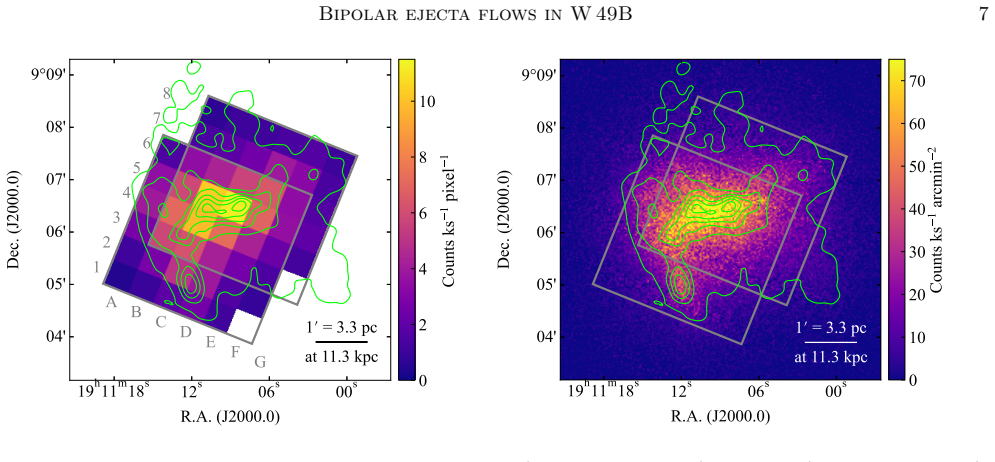
The load-bearing new capability is the XRISM/Resolve microcalorimeter, an X-ray spectrometer that resolves the iron Heα line at about 4.5 eV FWHM, letting the authors measure line-of-sight velocities at the roughly 100 km/s level in individual detector pixels. The argument then rests on two observable signatures: the smooth east-west gradient in the line centroid (up to ±300 km/s) and the uniform, single-peaked line broadening of about 5 eV across the center. The paper contrasts these signatures with the predictions of the two competing kinematic models, an equatorially expanding disk versus bipolar flows, and derives the outflow inclination angle from the homologous expansion relation θ ≈ 6° × (V_LOS/100 km/s) × (r/1 pc)^−1 × (t_age/$10^{3}$ yr).
What would settle it
A future observation of W49B's center with a sharper point-spread function (better than roughly 30 arcseconds) and spectral resolution better than 2 eV at 6.7 keV that splits the central Fe Heα line into two peaks separated by more than about 3 eV would overturn the no-disk conclusion, as would the appearance of such a double peak in any other Fe-group line such as Cr or Mn.
Extended reading notes
Core claim
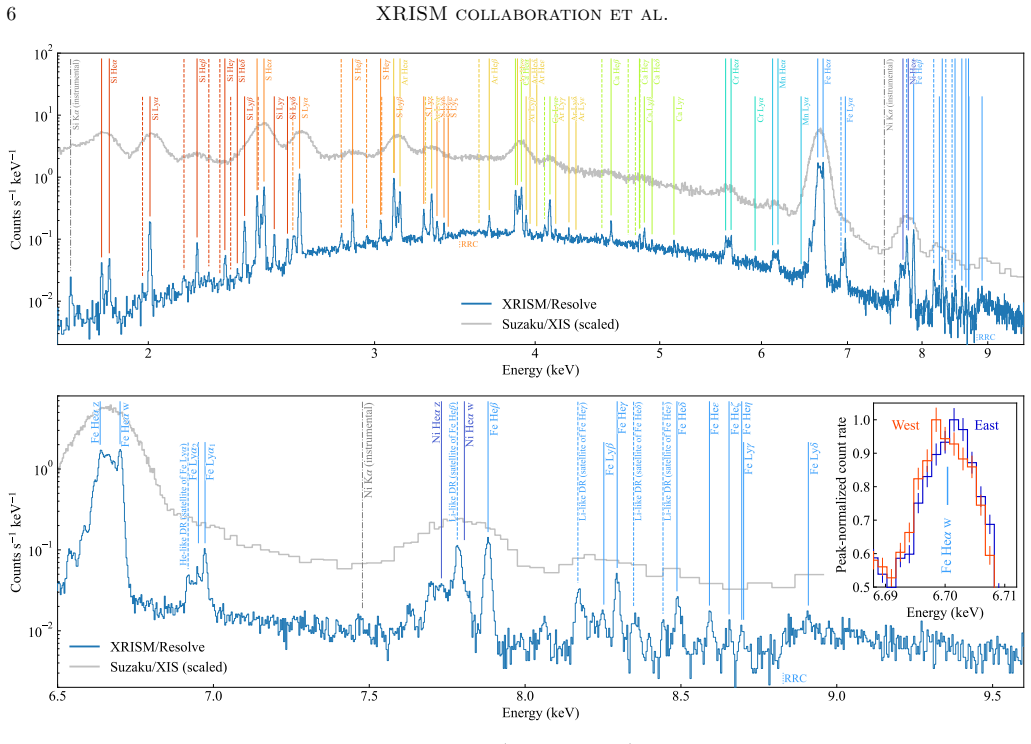
The central claim is that the Fe Heα line-of-sight velocity in W49B varies by up to ±300 km/s with a smooth east-west gradient along the major axis, and that this gradient, together with the absence of a twin-peaked line profile or enhanced broadening in the central region, clearly rejects the equatorially expanding disk model. The authors measured this gradient pixel-by-pixel with the XRISM Resolve microcalorimeter at about 4.5 eV FWHM resolution, and also found similar velocity trends in Cr, Mn, Si, S, Ar, and Ca lines. They argue that a homologous bipolar flow inclined at roughly 8–19 degrees to the line of sight reproduces the observations, with the exact value depending on the assumed distance of 11.3 kpc and age of about 5 kyr.
Load-bearing premise
The argument's load-bearing premise is that the telescope's spectral resolution of 4.5 eV at the iron line and the 1.3-arcmin mirror blur cannot hide two counter-moving components in the center of the remnant, since a two-component structure with a separation near 3 eV would masquerade as the single slightly broadened line that is actually seen.
Editorial extensions
If this is right
- The equatorial-disk kinematic model is rejected for W49B, eliminating several proposed scenarios that assumed a spherical explosion interacting with a disk-like or torus-like circumstellar medium.
- The velocity gradient points to bipolar ejecta flows, consistent with either a bipolar core-collapse explosion or collimation by a bipolar circumstellar cavity, such as a bipolar planetary nebula.
- The flow inclination is small, roughly 8–19 degrees from the line of sight, under the assumed distance of 11.3 kpc and age of about 5 kyr.
- The same east-west velocity structure appears in Fe, Cr, Mn, Si, S, Ar, and Ca, indicating that the bipolar pattern extends across a wide range of ejecta masses and elements.
Reading between the lines
- If the bipolar-cavity interpretation is right, W49B might be a Type Ia or low-mass progenitor that exploded inside a planetary nebula, implying a binary companion formed that nebula; a search for a surviving companion star would test this idea.
- The asymmetry in the velocity gradient, which is about twice as steep on the west as on the east, could directly probe the ambient density distribution or an intrinsic asymmetry in the explosion; comparing the gradient slope with radio and infrared cavity morphology would distinguish environmental from intrinsic causes.
- A future X-ray observation of W49B separated by several years could measure proper motion of the ejecta bar, breaking the distance–age degeneracy that currently sets the inclination angle and testing the bipolar-flow geometry directly.
Editorial analysis
A structured set of objections, weighed in public.
Referee Report
Summary. Using XRISM/Resolve observations of the Galactic SNR W49B, the paper measures the line centroid and broadening of the Fe Heα line in individual detector pixels and in coadded regions for Cr, Mn, Si, S, Ar, and Ca. It reports a smooth, monotonic east-west line-of-sight velocity gradient of about ±300 km/s along the Fe-bar major axis, similar trends in the other elements, and no significant east-west gradient in line broadening. The authors interpret these findings as kinematic evidence for bipolar ejecta flows and argue that they clearly reject an equatorially expanding disk model, discussing implications for bipolar core-collapse explosions and for ejecta collimation by a bipolar circumstellar medium.
Significance. The measurement is potentially important: it is the first high-resolution X-ray spectroscopic velocity map of a mixed-morphology SNR, and the reported gradient is statistically robust. The calibration treatment is thorough (energy-scale residuals of 0.3–0.5 eV, per-pixel RMFs, cross-checks between AtomDB and SPEX), and the consistency of the gradient across Fe-group and intermediate-mass elements is a genuine strength. The significance of the paper, however, rests on the kinematic discrimination between disk-like and bipolar geometries, and that discrimination is currently supported by plausibility arguments rather than by a forward model. If the discrimination can be placed on a quantitative footing, the result would be a valuable constraint on the explosion geometry of W49B and on the relation between ejecta morphology and kinematics in SNRs.
major comments (2)
- [§4.1 and Abstract] The central conclusion that the data 'clearly reject' the equatorially expanding disk model is stated more strongly than the analysis supports. The pixel-by-pixel fits in §3.2 use a single redshift and a single Gaussian σ_V, so by construction they cannot distinguish a single-component line from a two-component (approaching plus receding) line whose components are blended. A disk-like two-component velocity field with unequal component brightness and a smoothly varying flux ratio along the bar could in principle reproduce the observed smooth centroid gradient while leaving the profile single-peaked and the broadening nearly uniform. The authors themselves defer a quantitative spatial-spectral mixing (SSM) treatment to a future paper (§4.1). I request a response- and PSF-forwarded two-component disk model, or an explicit scan over disk parameters, to demonstrate which disk configurations are actually excluded. Until such a model is shown, the abstract and §4.1 should use more cautious language.
- [§4.1 and Fig. 4] The broadening argument used to reject the disk model is not yet quantified. The authors state that the observed σ_E ≈ 5 eV includes a large non-kinematic contribution and that the kinematic variation across the 1.3′ HPD PSF is only 100–200 km/s (§4.1). At the Fe Heα energy, 100–200 km/s corresponds to a line-centroid variation of 2.2–4.5 eV, comparable to the 4.5 eV FWHM resolution and smaller than the fitted σ_E = 5 eV. Given the ~3 eV east-west peak separation in the integrated spectrum (Fig. 1 inset), a disk-induced separation at the center would be of this order and could be masked by the intrinsic width; the near-constant σ_E map in Fig. 4 does not by itself rule out such a variation. The paper should provide a quantitative upper limit on an additional kinematic broadening component (e.g., by fitting a two-component model to the central pixels) before using the uniformity of broadening as evidence against the disk model. The same masking applies to the §4.1 statement that SSM of two distinct velocity groups would necessarily produce an observable central broadening enhancement.
minor comments (4)
- [§3.2] The exclusion of pixels A1, B8, and C8 as outliers is based on local deviations of 220–250 km/s, but the exact selection threshold is not stated; please make the criterion explicit or show the fits with and without these pixels.
- [§4.2.2] The statement that the east-west asymmetry may be caused by momentum taken away by an undiscovered central compact object is a speculation that is not testable with the present data; it should be clearly labeled as such or removed from the discussion.
- [§4.1, Eq. (1)] The inclination estimate θ ≈ 8–19° depends linearly on the assumed age (5 kyr) and distance (11.3 kpc), both of which carry systematic uncertainties; please state that this is illustrative rather than a measurement and, where θ is used in §4.2.2, propagate these uncertainties.
- [§3.3, Fig. 5] The Mn Heα point for region N is shown with a 68% error because the 90% error is not defined; please clarify in the caption how this point enters the comparison and whether the lack of a 90% constraint affects the conclusion that Mn follows the Fe trend.
Circularity Check
No circularity found: the velocity gradient is a direct observable, and the inclination and disk-model arguments do not reduce to fitted inputs.
full rationale
The paper's central quantity is measured, not derived from an assumed model: each pixel's Fe Heα spectrum is fitted with a free redshift z, and the map of V_LOS = cz is a direct observable used to establish the east-west gradient. The inclination estimate in Eq. (1), θ ≈ 6 (V_LOS/100 km/s)(r/1 pc)^-1 (t_age/10^3 yr), combines measured velocities with assumed age and distance as a consistency check; it is not a fitted parameter that is later renamed as a prediction. The rejection of the equatorial disk model in §4.1 is an inference from the observed single-peaked line profiles and the near-uniform broadening; although this inference would be stronger with a PSF- and response-forwarded two-component disk model, the argument does not reduce to its own inputs by construction. Self-citations in the paper are mostly to instrument calibration and to companion abundance studies (e.g., Sawada et al. 2025), and the kinematic claim does not depend on those citations as unique support. The authors explicitly flag the remaining modeling limitation: 'Distinguishing the origin of the broadening requires further analysis considering the SSM effect and will be reported elsewhere' (§4.1); this is a robustness caveat, not evidence of circularity. No derivation step is equivalent to its input by definition or by fitted-parameter renaming.
Assumptions & free parameters
free parameters (2)
- Fe abundance in per-pixel fits =
5 x solar (fixed)
- Initial plasma temperature (kT_init) =
4 keV (fixed)
assumptions (5)
- domain assumption W49B is at a distance of 11.3 kpc.
- domain assumption The remnant age is about 5 kyr.
- standard math The Fe He-alpha line rest energy is 6700.42 eV and the line centroid shift is purely Doppler.
- domain assumption The brnei/AtomDB recombining plasma model with kT_init = 4 keV and Fe abundance fixed to 5 solar describes the Fe He-alpha complex in the 6.53-6.80 keV band well enough that a single fitted centroid is unbiased.
- domain assumption X-ray PSF spatial-spectral mixing does not create or erase the observed velocity gradient and broadening pattern.
invented entities (1)
-
Undiscovered central compact object
Cite this review
Pith. "Pith review of Kinematic Evidence for Bipolar Ejecta Flows in the Galactic SNR W49B." pith.science (2026). https://pith.science/paper/AT2DZQCG
@misc{pith2026250605455,
  author       = {Pith},
  title        = {Pith review of: Kinematic Evidence for Bipolar Ejecta Flows in the Galactic SNR W49B},
  year         = {2026},
  howpublished = {\url{https://pith.science/paper/AT2DZQCG}},
  note         = {Machine review of arXiv:2506.05455}
}
abstract
W49B is a unique Galactic supernova remnant with centrally peaked, "bar"-like ejecta distribution, which was once considered evidence for a hypernova origin that resulted in a bipolar ejection of the stellar core. However, chemical abundance measurements contradict this interpretation. Closely connected to the morphology of the ejecta is its velocity distribution, which provides critical details for understanding the explosion mechanism. We report the first-ever observational constraint on the kinematics of the ejecta in W49B using the Resolve microcalorimeter spectrometer on the X-ray Imaging and Spectroscopy Mission (XRISM). Using XRISM/Resolve, we measured the line-of-sight velocity traced by the Fe He$\alpha$ emission, which is the brightest feature in the Resolve spectrum, to vary by $\pm$300 km s$^{-1}$ with a smooth east-to-west gradient of a few tens of km s$^{-1}$ pc$^{-1}$ along the major axis. Similar trends in the line-of-sight velocity structure were found for other Fe-group elements Cr and Mn, traced by the He$\alpha$ emission, and also for intermediate-mass elements Si, S, Ar, and Ca, traced by the Ly$\alpha$ emission. The discovery of the east-west gradient in the line-of-sight velocity, together with the absence of a twin-peaked line profile or enhanced broadening in the central region, clearly rejects the equatorially expanding disk model. In contrast, the observed velocity structure suggests bipolar flows reminiscent of a bipolar explosion scenario. An alternative scenario would be a collimation of the ejecta by an elongated cavity sculpted by bipolar stellar winds.
Figures

Figures from the paper (3 more)


Reference graph
Works this paper leans on
-
[1]
Arnaud, K. A. 1996, in Astronomical Society of the Pacific Conference Series, Vol. 101, Astronomical Data Analysis Software and Systems V, ed. G. H. Jacoby & J. Barnes, 17
1996
-
[2]
2009, A&A, 498, 139, doi: 10.1051/0004-6361/200810742
Bocchino, F., Miceli, M., & Troja, E. 2009, A&A, 498, 139, doi: 10.1051/0004-6361/200810742
-
[3]
Brogan, C. L., & Troland, T. H. 2001, ApJ, 550, 799, doi: 10.1086/319787
doi:10.1086/319787 2001
-
[4]
Chiotellis, A., Zapartas, E., & Meyer, D. M. A. 2024, MNRAS, 531, 5109, doi: 10.1093/mnras/stae947
-
[5]
2024, ApJ, 962, 63, doi: 10.3847/1538-4357/ad165f De Marco, O
Court, T., Badenes, C., Lee, S.-H., et al. 2024, ApJ, 962, 63, doi: 10.3847/1538-4357/ad165f De Marco, O. 2009, PASP, 121, 316, doi: 10.1086/597765
-
[6]
Eckart, M. E., Brown, G. V., Chiao, M. P., et al. 2024, in Society of Photo-Optical Instrumentation Engineers (SPIE) Conference Series, Vol. 13093, Space Telescopes and Instrumentation 2024: Ultraviolet to Gamma Ray, ed. J.-W. A. den Herder, S. Nikzad, & K. Nakazawa, 130931P, doi: 10.1117/12.3019276
-
[7]
2018, A&A, 618, A124, doi: 10.1051/0004-6361/201833475
Fink, M., Kromer, M., Hillebrandt, W., et al. 2018, A&A, 618, A124, doi: 10.1051/0004-6361/201833475
-
[8]
Foster, A. R. 2020, Astronomische Nachrichten, 341, 191, doi: 10.1002/asna.202023777
Show all 68 references
-
[9]
R., Ji, L., Smith, R
Foster, A. R., Ji, L., Smith, R. K., & Brickhouse, N. S. 2012, ApJ, 756, 128, doi: 10.1088/0004-637X/756/2/128
2012 doi
-
[10]
1995, PASJ, 47, L31 Gonz´ alez-Casanova, D
Fujimoto, R., Tanaka, Y., Inoue, H., et al. 1995, PASJ, 47, L31 Gonz´ alez-Casanova, D. F., De Colle, F., Ramirez-Ruiz, E., & Lopez, L. A. 2014, ApJL, 781, L26, doi: 10.1088/2041-8205/781/2/L26
1995 doi
-
[11]
2023, MNRAS, 523, 6041, doi: 10.1093/mnras/stad1872
Grichener, A., & Soker, N. 2023, MNRAS, 523, 6041, doi: 10.1093/mnras/stad1872
2023 doi
-
[12]
2024, in Society of Photo-Optical Instrumentation Engineers (SPIE) Conference Series, Vol
Hayashi, T., Boissay-Malaquin, R., Tamura, K., et al. 2024, in Society of Photo-Optical Instrumentation Engineers (SPIE) Conference Series, Vol. 13093, Space Telescopes and Instrumentation 2024: Ultraviolet to Gamma Ray, ed. J.-W. A. den Herder, S. Nikzad, & K. Nakazawa, 13093...
2024 doi
-
[13]
2010, ApJ, 725, 894, doi: 10.1088/0004-637X/725/1/894
Hayato, A., Yamaguchi, H., Tamagawa, T., et al. 2010, ApJ, 725, 894, doi: 10.1088/0004-637X/725/1/894
2010 doi
-
[14]
A., & Auchettl, K
Holland-Ashford, T., Lopez, L. A., & Auchettl, K. 2020, ApJ, 903, 108, doi: 10.3847/1538-4357/abb808
2020 doi
-
[15]
Hwang, U., Petre, R., & Hughes, J. P. 2000, ApJ, 532, 970, doi: 10.1086/308614
2000 doi
-
[16]
2018, Journal of Astronomical Telescopes, Instruments, and Systems, 4, 011217, doi: 10.1117/1.JATIS.4.1.011217
Ishisaki, Y., Yamada, S., Seta, H., et al. 2018, Journal of Astronomical Telescopes, Instruments, and Systems, 4, 011217, doi: 10.1117/1.JATIS.4.1.011217
2018 doi
-
[17]
L., Awaki, H., et al
Ishisaki, Y., Kelley, R. L., Awaki, H., et al. 2022, in Society of Photo-Optical Instrumentation Engineers (SPIE) Conference Series, Vol. 12181, Space Telescopes and Instrumentation 2022: Ultraviolet to Gamma Ray, ed. J.-W. A. den Herder, S. Nikzad, & K. Nakazawa, 121811S, doi...
2022 doi
-
[18]
1989, MNRAS, 236, 885, doi: 10.1093/mnras/236.4.885
Itoh, H., & Masai, K. 1989, MNRAS, 236, 885, doi: 10.1093/mnras/236.4.885
1989 doi
-
[19]
Jones, D., & Boffin, H. M. J. 2017, Nature Astronomy, 1, 0117, doi: 10.1038/s41550-017-0117
2017 doi
-
[20]
C., Fisher, R
Jordan, IV, G. C., Fisher, R. T., Townsley, D. M., et al. 2008, ApJ, 681, 1448, doi: 10.1086/588269
2008 doi
-
[21]
S., Mewe, R., & Nieuwenhuijzen, H
Kaastra, J. S., Mewe, R., & Nieuwenhuijzen, H. 1996, in UV and X-ray Spectroscopy of Astrophysical and Laboratory Plasmas, 411–414
1996
-
[22]
2008, SSRv, 134, 155, doi: 10.1007/s11214-008-9310-y
Richter, P. 2008, SSRv, 134, 155, doi: 10.1007/s11214-008-9310-y
2008 doi
-
[23]
S., Raassen, A
Kaastra, J. S., Raassen, A. J. J., de Plaa, J., & Gu, L. 2024,, 3.08.01 Zenodo, doi: 10.5281/zenodo.12771915
2024 doi
-
[24]
W., Reach, W
Keohane, J. W., Reach, W. T., Rho, J., & Jarrett, T. H. 2007, ApJ, 654, 938, doi: 10.1086/509311
2007 doi
-
[25]
A., Sawada, M., Tsujimoto, M., et al
Kilbourne, C. A., Sawada, M., Tsujimoto, M., et al. 2018, PASJ, 70, 18, doi: 10.1093/pasj/psx139
2018 doi
-
[26]
K., Lazio, T
Lacey, C. K., Lazio, T. J. W., Kassim, N. E., et al. 2001, ApJ, 559, 954, doi: 10.1086/322372
2001 doi
-
[27]
Lodders, K., Palme, H., & Gail, H. P. 2009, Landolt B¨ ornstein, 4B, 712, doi: 10.1007/978-3-540-88055-434
2009 doi
-
[28]
A., Ramirez-Ruiz, E., Castro, D., & Pearson, S
Lopez, L. A., Ramirez-Ruiz, E., Castro, D., & Pearson, S. 2013, ApJ, 764, 50, doi: 10.1088/0004-637X/764/1/50
2013 doi
-
[29]
2003, ApJ, 598, 1163, doi: 10.1086/378948
Maeda, K., & Nomoto, K. 2003, ApJ, 598, 1163, doi: 10.1086/378948
2003 doi
-
[30]
Meyer, D. M. A. 2021, MNRAS, 507, 4697, doi: 10.1093/mnras/stab2426
2021 doi
-
[31]
G., Schraml, J., & Terzian, Y
Mezger, P. G., Schraml, J., & Terzian, Y. 1967, ApJ, 150, 807, doi: 10.1086/149384
1967 doi
-
[32]
2008, Advances in Space Research, 41, 390, doi: 10.1016/j.asr.2007.01.030
Miceli, M., Decourchelle, A., Ballet, J., et al. 2008, Advances in Space Research, 41, 390, doi: 10.1016/j.asr.2007.01.030
2008 doi
-
[33]
2006, A&A, 453, 567, doi: 10.1051/0004-6361:20054290 16XRISM collaboration et al
Miceli, M., Decourchelle, A., Ballet, J., et al. 2006, A&A, 453, 567, doi: 10.1051/0004-6361:20054290 16XRISM collaboration et al
2006 doi
-
[34]
A., et al
Mochizuki, Y., Tsujimoto, M., Kilbourne, C. A., et al. 2024, in Society of Photo-Optical Instrumentation Engineers (SPIE) Conference Series, Vol. 13093, Space Telescopes and Instrumentation 2024: Ultraviolet to Gamma Ray, ed. J.-W. A. den Herder, S. Nikzad, & K. Nakazawa, 1309...
2024 doi
-
[35]
A., & Reynolds, S
Moffett, D. A., & Reynolds, S. P. 1994, ApJ, 437, 705, doi: 10.1086/175033
1994 doi
-
[36]
2022, in Society of Photo-Optical Instrumentation Engineers (SPIE) Conference Series, Vol
Mori, K., Tomida, H., Nakajima, H., et al. 2022, in Society of Photo-Optical Instrumentation Engineers (SPIE) Conference Series, Vol. 12181, Space Telescopes and Instrumentation 2022: Ultraviolet to Gamma Ray, ed. J.-W. A. den Herder, S. Nikzad, & K. Nakazawa, 121811T, doi: 10...
2022 doi
-
[37]
2024, A&A, 687, L17, doi: 10.1051/0004-6361/202450191
Nagao, T., Maeda, K., Mattila, S., et al. 2024, A&A, 687, L17, doi: 10.1051/0004-6361/202450191
2024 doi
- [38]
-
[39]
2009, ApJL, 706, L71, doi: 10.1088/0004-637X/706/1/L71
Tamagawa, T. 2009, ApJL, 706, L71, doi: 10.1088/0004-637X/706/1/L71
2009 doi
-
[40]
C., & Lamb, D
Plewa, T., Calder, A. C., & Lamb, D. Q. 2004, ApJL, 612, L37, doi: 10.1086/424036
2004 doi
-
[41]
S., Kilbourne, C
Porter, F. S., Kilbourne, C. A., Chiao, M., et al. 2024, in Society of Photo-Optical Instrumentation Engineers (SPIE) Conference Series, Vol. 13093, Space Telescopes and Instrumentation 2024: Ultraviolet to Gamma Ray, ed. J.-W. A. den Herder, S. Nikzad, & K. Nakazawa, 130931K,...
2024 doi
-
[42]
P., Becker, R
Pye, J. P., Becker, R. H., Seward, F. D., & Thomas, N. 1984, MNRAS, 207, 649, doi: 10.1093/mnras/207.3.649
1984 doi
-
[43]
T., Rho, J., Tappe, A., et al
Reach, W. T., Rho, J., Tappe, A., et al. 2006, AJ, 131, 1479, doi: 10.1086/499306
2006 doi
-
[44]
1998, ApJL, 503, L167, doi: 10.1086/311538
Rho, J., & Petre, R. 1998, ApJL, 503, L167, doi: 10.1086/311538
1998 doi
-
[45]
2021, ApJ, 919, 123, doi: 10.3847/1538-4357/ac0dba
Sano, H., Yoshiike, S., Yamane, Y., et al. 2021, ApJ, 919, 123, doi: 10.3847/1538-4357/ac0dba
2021 doi
-
[46]
Sato, T., & Hughes, J. P. 2017, ApJ, 840, 112, doi: 10.3847/1538-4357/aa6f60
2017 doi
-
[47]
Williams, B. J. 2025, ApJ, accepted, doi: 10.3847/1538-4357/add932
2025 doi
-
[48]
2025, PASJ, 77, 446, doi: 10.1093/pasj/psaf012
Sawada, M., Sato, T., Maeda, K., & Itonaga, K. 2025, PASJ, 77, 446, doi: 10.1093/pasj/psaf012
2025 doi
-
[49]
Shelton, R. L. 1999, ApJ, 521, 217, doi: 10.1086/307553
1999 doi
-
[50]
2012, PASJ, 64, 24, doi: 10.1093/pasj/64.2.24
Shimizu, T., Masai, K., & Koyama, K. 2012, PASJ, 64, 24, doi: 10.1093/pasj/64.2.24
2012 doi
-
[51]
V., Frank, K
Siegel, J., Dwarkadas, V. V., Frank, K. A., & Burrows, D. N. 2020, ApJ, 904, 175, doi: 10.3847/1538-4357/abbfa9
2020 doi
-
[52]
Raymond, J. C. 2001, ApJL, 556, L91, doi: 10.1086/322992
2001 doi
-
[53]
2020, ApJ, 893, 90, doi: 10.3847/1538-4357/ab8001
Sun, L., & Chen, Y. 2020, ApJ, 893, 90, doi: 10.3847/1538-4357/ab8001
2020 doi
-
[54]
R., et al
Tanaka, T., Yamaguchi, H., Wik, D. R., et al. 2018, ApJL, 866, L26, doi: 10.3847/2041-8213/aae709
2018 doi
-
[55]
Tashiro, M. S. 2022, International Journal of Modern Physics D, 31, 2230001, doi: 10.1142/S0218271822300014
2022 doi
-
[56]
M., Calder, A
Townsley, D. M., Calder, A. C., Asida, S. M., et al. 2007, ApJ, 668, 1118, doi: 10.1086/521013
2007 doi
-
[57]
2021, A&A, 654, A167, doi: 10.1051/0004-6361/202141569
Ustamujic, S., Orlando, S., Miceli, M., et al. 2021, A&A, 654, A167, doi: 10.1051/0004-6361/202141569
2021 doi
-
[58]
1958, BAN, 14, 215
Westerhout, G. 1958, BAN, 14, 215
1958
- [59]
-
[60]
J., Blair, W
Williams, B. J., Blair, W. P., Borkowski, K. J., et al. 2018, ApJL, 865, L13, doi: 10.3847/2041-8213/aae08d
2018 doi
-
[61]
Wynn-Williams, C. G. 1969, MNRAS, 142, 453, doi: 10.1093/mnras/142.4.453
1969 doi
-
[62]
2021, ApJL, 910, L24, doi: 10.3847/2041-8213/abee8a
Yamaguchi, H., Acero, F., Li, C.-J., & Chu, Y.-H. 2021, ApJL, 910, L24, doi: 10.3847/2041-8213/abee8a
2021 doi
-
[63]
2014, ApJL, 785, L27, doi: 10.1088/2041-8205/785/2/L27
Yamaguchi, H., Badenes, C., Petre, R., et al. 2014, ApJL, 785, L27, doi: 10.1088/2041-8205/785/2/L27
2014 doi
-
[64]
R., et al
Yamaguchi, H., Tanaka, T., Wik, D. R., et al. 2018, ApJL, 868, L35, doi: 10.3847/2041-8213/aaf055
2018 doi
-
[65]
D., Foster, A., et al
Zhang, G.-Y., Slavin, J. D., Foster, A., et al. 2019, ApJ, 875, 81, doi: 10.3847/1538-4357/ab0f9a
2019 doi
-
[66]
2018, A&A, 615, A150, doi: 10.1051/0004-6361/201731583
Zhou, P., & Vink, J. 2018, A&A, 615, A150, doi: 10.1051/0004-6361/201731583
2018 doi
-
[67]
2022, ApJ, 931, 144, doi: 10.3847/1538-4357/ac63b5
Zhou, P., Zhang, G.-Y., Zhou, X., et al. 2022, ApJ, 931, 144, doi: 10.3847/1538-4357/ac63b5
2022 doi
-
[68]
2011, MNRAS, 415, 244, doi: 10.1111/j.1365-2966.2011.18695.x
Zhou, X., Miceli, M., Bocchino, F., Orlando, S., & Chen, Y. 2011, MNRAS, 415, 244, doi: 10.1111/j.1365-2966.2011.18695.x
2011
Reviewed August 7, 2026 · model on record in the stance chip above.
Discussion (0). Sign in to comment.