REVIEW 5 major objections 6 minor 56 references
Emerging Paradigms in the Energy Sector: Forecasting and System Control Optimisation
T0 review · 5 major / 6 minor · reviewed 2026-08-06 · deepseek-v4-flash
Pith's one-line read The paper claims a single digital-twin-plus-optimiser workflow, applied to forecasting, building HVAC, CHP heat networks, and a school microgrid, delivers cost and carbon savings of 3–39 percent in UK field deployments.
desk verdict A solid applied case study with credible building and EMS validation, but the headline CHP savings are model-vs-model and the forecasting section lacks numbers. read the letter →
The pith
A machine-rendered reading of the paper's core claim, the machinery that carries it, and where it could break.
The reading
What carries the argument
The carrying mechanism is a rolling-horizon optimisation loop: a fitted digital twin predicts the physical response of the asset, and an optimiser replans as forecasts refresh. For buildings the twin is a discretised resistance-capacitance ODE calibrated to historical sensor data, with a Kalman filter estimating latent states; for CHP and EMS sites the twins are white-box energy-balance models with state variables such as battery state of charge and thermal storage state of energy. The optimisers are model predictive control for the building and mixed-integer linear programming for the heat network and EMS, with binary variables capturing plant on/off and restart decisions. The forecasting pillar supplies the loop's inputs through a weighted ensemble orchestrator whose non-negative weights sum to one and update from recent error, letting heterogeneous models share the forecast. This combination—physical model, optimiser, and refreshed forecasts—is what the paper claims can be cloned from one building to a district scheme and a microgrid.
What would settle it
Run a randomised crossover trial at a live CHP site: for alternating weeks use the optimised schedule or the legacy rule-based schedule, meter gas and electricity imports and exports, and compare actual net cost; the central claim would be settled by whether metered savings approach the modelled 19–39% (or at least the 10–21% already claimed as realised).
Extended reading notes
Core claim
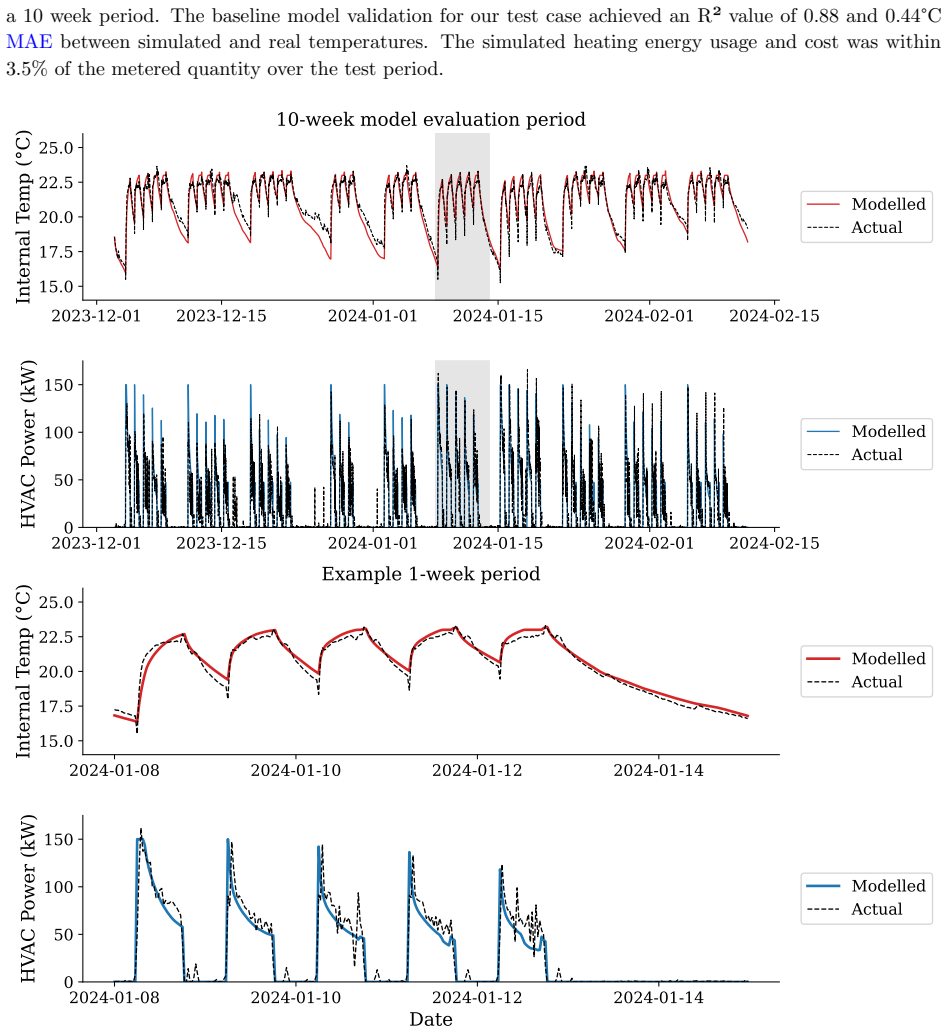
The paper's central claim, stated in its conclusion, is that next-generation forecasting and optimisation can deliver sizeable efficiency, carbon-reduction, and resilience gains across four linked arenas: high-resolution weather-enhanced demand forecasting, grey-box-plus-MPC building optimisation, CHP-centred heat-network dispatch, and whole-site EMS optimisation within a system-of-systems architecture. The forecasting pillar contributes a weighted ensemble orchestrator that blends XGBoost, LightGBM, and an exponential moving average, with weights updated from rolling errors, and reports improved week-ahead and year-ahead accuracy over single models at contract, sector, district, and portfolio scales. The building pillar fits a discretised resistance-capacitance thermal model to BMS data, embeds it as a digital twin in an MPC that minimises cost, carbon, and comfort deviation, and validates it to an R² of 0.88 with simulated heating energy within 3.5% of metered use. The heat-network pillar builds white-box models of CHP engines, boilers, chillers, and thermal storage and dispatches them with MILP against import/export prices, restart limits, and storage constraints; Table 1 reports baseline-to-optimised reductions of 22%, 19%, and 39% on three sites, with 96%, 53%, and 38% of that modelled value reported as realised. The EMS pillar reports battery, solar, and whole-EMS digital twins with day-ahead sMAPE of 2%, 4%, and 5%, and cost-optimised control beating rule-based self-consumption by 8–12% under time-of-use tariffs.
Load-bearing premise
The load-bearing premise is that the computer models of the CHP sites faithfully mirror the real plant, because the headline 19–39 percent savings are computed by comparing a simulated legacy schedule with a simulated 'theoretical minimum' schedule, not by metering both schedules on the real system.
Editorial extensions
If this is right
- If the claim holds, building-portfolio optimisation does not require a physical survey of every site: grey-box RC models fitted to meter data plus MPC can be deployed with minimal bespoke engineering.
- CHP operators can move from fixed time-window schedules to price- and carbon-aware weekly dispatch while still respecting daily restart caps and storage limits, and the paper reports most of the modelled value is already being captured.
- Cost-optimised EMS control with grid-charging arbitrage is worth materially more than self-consumption-only rules under time-of-use tariffs (8–12% vs 3–5%), so tariff structure, not just battery size, determines storage value.
- Forecast horizon matters operationally: day-ahead digital-twin predictions carry roughly 2–5% cost uncertainty, while week-ahead predictions carry 3–10%, supporting a shift from week-ahead to day-ahead optimisation.
- The same asset-by-asset digital-twin and MILP structure can be cloned or linked to manage multiple sites as one system-of-systems, since each site's generation, storage, and load models feed the same rolling optimiser.
Reading between the lines
- The headline CHP savings are model-versus-model: baseline and optimised costs both come from the digital twin, so a metered A/B trial is the natural next check; if it confirms even half the 19–39% gap, automated dispatch is clearly worth deploying.
- The system-of-systems scaling claim is architectural rather than empirically demonstrated—one school microgrid is shown, while multi-site federation is argued by construction; testing it would require running linked optimisers across two or more sites with shared constraints.
- The building results (3–8%) are for an already well-optimised building, whereas the 25% proof-of-concept savings appear in poorly controlled buildings; this implies the value is concentrated where legacy control is weak, which is testable by ranking sites by current set-point compliance before rollout.
- Flat tariffs squeeze EMS savings to 3–5%, so the economic case for battery arbitrage is contingent on market structure; the same optimiser would need carbon-price or flexibility-service signals to retain value as time-of-use spreads narrow.
Editorial analysis
A structured set of objections, weighed in public.
Referee Report
Summary. The paper describes four connected industrial deployments in the UK energy sector: an ensemble demand-forecasting pipeline (XGBoost, LightGBM, EMA with learned weights and MLOps), a grey-box RC thermal model combined with MPC for building HVAC control, a white-box MILP for CHP-based heat-network dispatch, and a white-box MILP EMS for PV and battery operation. It reports results on real case studies, claiming improved forecast accuracy, building energy savings, 19–39% baseline-to-optimised CHP cost savings, and 8–12% EMS cost savings, and argues that these demonstrate a common digital-twin-plus-optimiser workflow scaling from a single building to a district heat network and a school microgrid. The building and EMS digital-twin validations are presented with quantitative metrics; the forecasting and CHP sections are largely qualitative or model-to-model, which weakens the umbrella claims.
Significance. If substantiated, the paper would provide a useful industrial demonstration that a single digital-twin-plus-optimiser approach can be reused across four energy-management problems. The strongest part is Section 4.2, where the building digital twin reproduces metered temperatures with R²=0.88 and 0.44°C MAE and simulated heating energy within 3.5% of metered energy. Section 6.2 also reports credible digital-twin evaluation for battery, solar, and EMS models, with R² between 0.90 and 0.97 and clear normalised-error and cost-impact uncertainty metrics. The MLOps and ETL descriptions are detailed and reflect real deployment experience. However, the headline quantitative claims in Section 7, including the implicit 8–39% savings range, currently rest on unsupported forecasting claims, an unvalidated CHP baseline, and simulated EMS comparisons; as a result, the paper's central claim is not yet established.
major comments (5)
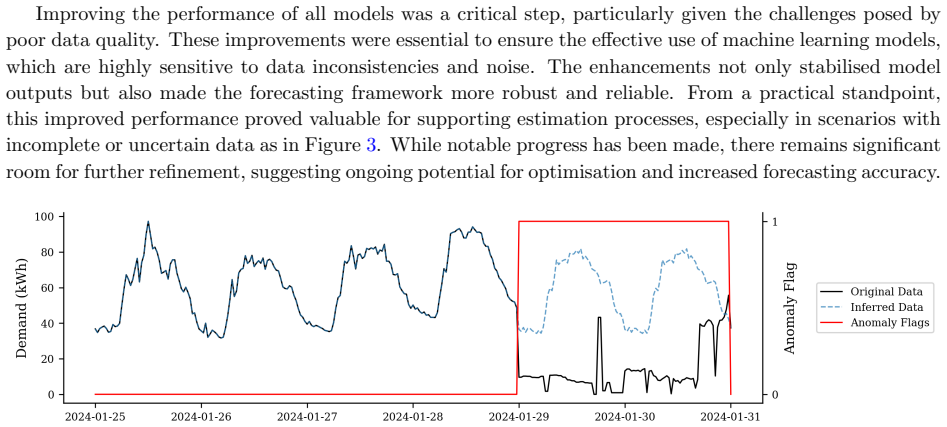
- [§3.2, Figures 1–3] The forecasting pillar reports no numerical error metrics. The text claims that the ensemble reduced MAE, MAPE, and RMSE across all scales compared with single-model baselines, but Section 3.2 gives only qualitative descriptions of Figures 1–3, whose axes and legends are not legible in the text, and no baseline table, confidence interval, or statistical test is provided. Section 7's statement that 'ensemble learning markedly sharpened forecast accuracy' is therefore unsupported as written. Please add actual MAE/MAPE/RMSE values, the single-model baselines, and the forecast horizons evaluated.
- [§5.2, Tables 1–2] The headline CHP savings are model-versus-model. The baseline is defined as 'estimated costs ... derived from the digital twin model' and the optimised costs as 'theoretical minimum costs' assuming perfect forecast accuracy, so the 22%, 19%, and 39% baseline-to-optimised gaps compare one simulation to another. No validation of the CHP white-box models against metered operation is reported, unlike the building model in Section 4.2. The largest figure, 39% at Site 3, is the site Table 2 marks with 'Confidence: L' and high model complexity. The umbrella '8–39%' claim therefore needs either metered validation of the CHP baselines or explicit reframing as modelled potential rather than realised savings.
- [§5.2, Table 1] The 'Baseline → Actual' savings of 21%, 10%, and 15% are also measured against the estimated digital-twin baseline, not against metered costs under the legacy schedule. The text says actual costs are based on metered operational data, but the percentage reduction is relative to the simulated baseline; if that baseline overstates legacy-schedule cost, the realised savings are inflated. The paper should report the metered legacy-schedule cost, or validate the baseline schedule against metered operation, before presenting these as realised savings.
- [§4 and §4.2] The claim that building optimisation can reduce energy costs by 'up to 25%' is not supported by the presented deployment. The real trial building achieved 3–8% cost saving while maintaining comfort, and the 25% figure is attributed to proof-of-concept experiments on open-source data with no details of building type, control strategy, or validation. This overstates the contribution; please either report the proof-of-concept evidence or remove the 25% claim from the opening of Section 4 and soften the corresponding language elsewhere.
- [§6.2] The EMS savings are reported without stating whether they are metered outcomes. The sentence 'At the pilot school site in London, cost reductions ranged from 3–5% under simple tariffs to 8–12% with aggressive time-of-use structures' follows a description of comparing a Digital Twin Baseline with a Cost-Based optimiser, so the savings appear to be simulation-based. Please clarify whether these figures come from live operation or from backcasting, and if they are simulated, validate the baseline and optimiser against metered data or label the figures as modelled potential.
minor comments (6)
- [§2.1] Section 2.1 contains several typographical errors, including 'These been effective models' and 'due to their due to their simplicity', and the acronym 'HV AC' is inconsistently spaced; these should be corrected.
- [§3.2, Figures 1–3] Figure 1 is not referenced in the text, Figure 2's sub-captions do not state the units or error definition, and Figure 3 is described only vaguely; the figure captions and in-text references need to be made complete.
- [§5.2, Table 2] The column heading 'Baseline → Optimised' with values 96%, 53%, and 38% is ambiguous; if these are percentages of potential savings actually realised, the heading and caption should say so explicitly.
- [§6.2] The phrase 'symmetric Mean Absolute Percentage Error symmetric Mean Absolute Percentage Error' is duplicated and should be reduced to one instance.
- [List of Variables] The List of Variables includes Qthermal(t) and GPV(t), which are not defined or used in the main text; inconsistent notation should be reconciled.
- [§6, ¦7] The claim that the EMS 'can simply be cloned or linked together' and that the workflow 'proved transferable' is not backed by any multi-site or system-of-systems experiment; as written it is an architectural assertion rather than a demonstrated result.
Circularity Check
No significant circularity found: the CHP baseline-vs-optimised comparison is a model-based estimate and the paper labels it as such; this is an external-validation limitation, not an equivalence-by-construction circularity.
full rationale
I walked each pillar of the claimed derivation chain. The forecasting ensemble (Section 3) is a weighted average whose weights are updated from rolling forecast errors; the reported MAE/MAPE/RMSE improvements are standard forecast-error comparisons, and no equation in the paper defines the reported accuracy gain as the fitted weight or the optimisation criterion itself. The building optimisation (Section 4) validates its grey-box digital twin against metered data (R^2=0.88, 0.44 deg C MAE, and simulated heating energy within 3.5% of metered quantity) before reporting MPC-based savings, so the claimed savings are not self-definitional; the Optuna hyper-parameter search explores the cost-carbon-comfort trade-off surface rather than manufacturing a fitted prediction. The CHP section (Section 5) is the weakest evidential link: Table 1's baseline-to-optimised figures are both produced by the same white-box digital twin. The paper states that the baseline costs are 'derived from the digital twin model that simulates system behaviour under those traditional schedules' and that the optimised costs are 'the theoretical minimum costs' under 'perfect forecast accuracy'. Table 2 also flags Site 3, the source of the headline 39% figure, with 'Confidence: L'. This is a genuine threat to external validity because a biased model could inflate both the simulated baseline cost and the simulated optimised saving, but it is not circular in the sense defined here: the saving is not defined to be equal to a fitted parameter, nor does any equation reduce the claimed saving to the model's input by construction. The EMS section (Section 6) validates the solar, battery, and EMS digital twins against measured data (day-ahead R^2 of 0.97, 0.95, and 0.93 respectively) before comparing rule-based and cost-optimised strategies. The only author self-citation I identified is [DMSA22] in the related-work section, and it is not load-bearing for any derivation in this paper. Overall, no step reduces by construction to its own inputs; the appropriate concern for the CHP results is model calibration and external validation, not circularity.
Assumptions & free parameters
free parameters (5)
- MPC objective weights (w_cost, w_carbon, w_comfort) =
Not reported (Pareto front over 100 Optuna iterations)
- Ensemble weights w_m for forecasting =
Not reported
- RC grey-box parameters (R, C, solar coupling p) =
Not reported
- CHP MILP artificial cost penalties (C_import_pref, C_CHP_pref, C_boiler_pref, C_restart) =
Not reported
- PV digital-twin calibration adjustments (efficiency, temperature derating, tilt/orientation/cloud factors) =
Not reported
assumptions (4)
- domain assumption The white-box digital-twin models used in CHP and EMS optimisation are accurate enough to compare schedules.
- domain assumption Meter, weather, and BMS data used for fitting and validation are sufficiently clean after anomaly detection.
- domain assumption The linear discretised RC model structure captures building thermal dynamics for MPC.
- standard math Solver optimality for the MILP formulations is assumed.
Cite this review
Pith. "Pith review of Emerging Paradigms in the Energy Sector: Forecasting and System Control Optimisation." pith.science (2026). https://pith.science/paper/ATDQR3SY
@misc{pith2026250712373,
  author       = {Pith},
  title        = {Pith review of: Emerging Paradigms in the Energy Sector: Forecasting and System Control Optimisation},
  year         = {2026},
  howpublished = {\url{https://pith.science/paper/ATDQR3SY}},
  note         = {Machine review of arXiv:2507.12373}
}
read the original abstract
The energy sector is experiencing rapid transformation due to increasing renewable energy integration, decentralisation of power systems, and a heightened focus on efficiency and sustainability. With energy demand becoming increasingly dynamic and generation sources more variable, advanced forecasting and optimisation strategies are crucial for maintaining grid stability, cost-effectiveness, and environmental sustainability. This paper explores emerging paradigms in energy forecasting and management, emphasizing four critical domains: Energy Demand Forecasting integrated with Weather Data, Building Energy Optimisation, Heat Network Optimisation, and Energy Management System (EMS) Optimisation within a System of Systems (SoS) framework. Leveraging machine learning techniques and Model Predictive Control (MPC), the study demonstrates substantial enhancements in energy efficiency across scales -- from individual buildings to complex interconnected energy networks. Weather-informed demand forecasting significantly improves grid resilience and resource allocation strategies. Smart building optimisation integrates predictive analytics to substantially reduce energy consumption without compromising occupant comfort. Optimising CHP-based heat networks achieves cost and carbon savings while adhering to operational and asset constraints. At the systems level, sophisticated EMS optimisation ensures coordinated control of distributed resources, storage solutions, and demand-side flexibility. Through real-world case studies we highlight the potential of AI-driven automation and integrated control solutions in facilitating a resilient, efficient, and sustainable energy future.
Figures


Figures from the paper (8 more)



Reference graph
Works this paper leans on
-
[1]
A comprehensive review on energy management strategy of microgrids
Rona George Allwyn, Amer Al-Hinai, and Vijaya Margaret. A comprehensive review on energy management strategy of microgrids. Energy Reports , 9:5565--5591, 2023
work page 2023
-
[2]
Bottom-up forecasting: Applications and limitations in load forecasting using smart-meter data
Harsh Anand, Roshanak Nateghi, and Negin Alemazkoor. Bottom-up forecasting: Applications and limitations in load forecasting using smart-meter data. Data-Centric Engineering , 4:e14, 2023
work page 2023
-
[3]
Digital twins for reducing energy consumption in buildings: A review
Buddhika Arsecularatne, Navodana Rodrigo, and Ruidong Chang. Digital twins for reducing energy consumption in buildings: A review. Sustainability , 16(21):9275, 2024
work page 2024
-
[4]
Comparison of optimal control techniques for building energy management
Javier Arroyo, Fred Spiessens, and Lieve Helsen. Comparison of optimal control techniques for building energy management. Frontiers in Built Environment , 8:849754, 2022
work page 2022
-
[5]
Review of machine learning techniques for power electronics control and optimization, 2023
Maryam Bahrami and Zeyad Khashroum. Review of machine learning techniques for power electronics control and optimization, 2023
work page 2023
-
[6]
Identifying suitable models for the heat dynamics of buildings
Peder Bacher and Henrik Madsen. Identifying suitable models for the heat dynamics of buildings. Energy and buildings , 43(7):1511--1522, 2011
work page 2011
-
[7]
A. Ben-Tal, L.E. Ghaoui, and A. Nemirovski. Robust Optimization . Princeton Series in Applied Mathematics. Princeton University Press, 2009
work page 2009
-
[8]
Energy simulation in building design
Joseph Clarke. Energy simulation in building design . Routledge, 2007
work page 2007
Show all 56 references
-
[9]
Vrabie, and Lieve Helsen
Ján Drgoňa, Javier Arroyo, Iago Cupeiro Figueroa , David Blum, Krzysztof Arendt, Donghun Kim, Enric Perarnau Ollé, Juraj Oravec, Michael Wetter, Draguna L. Vrabie, and Lieve Helsen. All you need to know about model predictive control for buildings. Annual Reviews in Control , ...
2020
-
[10]
Dhaigude and R
R. Dhaigude and R. Chanda. Real-time data and analytics on building management system to control energy consumption. In M.S. Kaiser, J. Xie, and V.S. Rathore, editors, Intelligent Strategies for ICT , volume 941 of Lecture Notes in Networks and Systems . Springer, Singapore, 2024
2024
-
[11]
Machine learning for smart and energy-efficient buildings
HP Das, Y-W Lin, U Agwan, et al. Machine learning for smart and energy-efficient buildings. Environmental Data Science , 3:e1, 2024
2024
-
[12]
Cntrlda: A building energy management control system with real-time adjustments
Alex Dmitrewski, Miguel Molina-Solana, and Rossella Arcucci. Cntrlda: A building energy management control system with real-time adjustments. application to indoor temperature. Building and Environment , 215:108938, 2022
2022
-
[13]
Dagdougui, A
Y. Dagdougui, A. Ouammi, and R. Benchrifa. Energy management-based predictive controller for a smart building powered by renewable energy. Sustainability , 12:4264, 2020
2020
-
[14]
A review on the basics of building energy estimation
Nelson Fumo. A review on the basics of building energy estimation. Renewable and sustainable energy reviews , 31:53--60, 2014
2014
-
[15]
Grey-box method for urban building energy modelling: Advancements and potentials
Yucheng Guo, Jie Shi, Tong Guo, Fei Guo, Feng Lu, and Lingqi Su. Grey-box method for urban building energy modelling: Advancements and potentials. Energies (19961073) , 17(21), 2024
2024
-
[16]
Forecasting: principles and practice
Rob J Hyndman and George Athanasopoulos. Forecasting: principles and practice . OTexts, 2018
2018
-
[17]
Optimal combination forecasts for hierarchical time series
Rob J Hyndman, Roman A Ahmed, George Athanasopoulos, and Han Lin Shang. Optimal combination forecasts for hierarchical time series. Computational statistics & data analysis , 55(9):2579--2589, 2011
2011
-
[18]
Density forecasting for long-term peak electricity demand
Rob J Hyndman and Shu Fan. Density forecasting for long-term peak electricity demand. IEEE Transactions on Power Systems , 25(2):1142--1153, 2009
2009
-
[19]
Probabilistic electric load forecasting: A tutorial review
Tao Hong and Shu Fan. Probabilistic electric load forecasting: A tutorial review. International Journal of Forecasting , 32(3):914--938, 2016
2016
-
[20]
An enhanced microgrid load demand sharing strategy
Jinwei He and Yun Wei Li. An enhanced microgrid load demand sharing strategy. IEEE Transactions on Power Electronics , 27(9):3984--3995, 2012
2012
-
[21]
Global energy forecasting competition 2012, 2014
Tao Hong, Pierre Pinson, and Shu Fan. Global energy forecasting competition 2012, 2014
2012
-
[22]
Microgrids with model predictive control: a critical review
Karan Singh Joshal and Neeraj Gupta. Microgrids with model predictive control: a critical review. Energies , 16(13):4851, 2023
2023
-
[23]
Economic dispatch of combined heat and power plant units within energy network integrated with wind power plant
Paramjeet Kaur, Krishna Teerth Chaturvedi, and Mohan Lal Kolhe. Economic dispatch of combined heat and power plant units within energy network integrated with wind power plant. Processes , 11(4):1232, 2023
2023
-
[24]
Energy forecasting in smart grid systems: A review of the state-of-the-art techniques
Devinder Kaur, Shama Naz Islam, Md Apel Mahmud, Md Enamul Haque, and ZhaoYang Dong. Energy forecasting in smart grid systems: A review of the state-of-the-art techniques. arXiv preprint arXiv:2011.12598 , 2020
2011 arXiv
-
[25]
The role of district heating in future renewable energy systems
Henrik Lund, Bernd M \"o ller, Brian Vad Mathiesen, and A Dyrelund. The role of district heating in future renewable energy systems. Energy , 35(3):1381--1390, 2010
2010
-
[26]
A hybrid forecasting model with parameter optimization for short-term load forecasting of micro-grids
Nian Liu, Qingfeng Tang, Jianhua Zhang, Wei Fan, and Jie Liu. A hybrid forecasting model with parameter optimization for short-term load forecasting of micro-grids. Applied Energy , 129:336--345, 2014
2014
-
[27]
Architecting principles for systems-of-systems
Mark W Maier. Architecting principles for systems-of-systems. Systems Engineering: The Journal of the International Council on Systems Engineering , 1(4):267--284, 1998
1998
-
[28]
Building energy load forecasting using deep neural networks
Daniel L Marino, Kasun Amarasinghe, and Milos Manic. Building energy load forecasting using deep neural networks. In IECON 2016-42nd annual conference of the IEEE industrial electronics society , pages 7046--7051. IEEE, 2016
2016
-
[29]
Machine learning for modern power distribution systems: Progress and perspectives
Marija Markovi \'c , Matthew Bossart, and Bri-Mathias Hodge. Machine learning for modern power distribution systems: Progress and perspectives. Journal of Renewable and Sustainable Energy , 15(3), 2023
2023
-
[30]
Machine learning for modern power distribution systems: Progress and perspectives
Marija Marković, Matthew Bossart, and Bri-Mathias Hodge. Machine learning for modern power distribution systems: Progress and perspectives. Journal of Renewable and Sustainable Energy , 15(3):032301, 2023
2023
-
[31]
Enhanced reinforcement learning-model predictive control for distributed energy systems: Overcoming local and global optimization limitations
Hua Meng, Huaijiang Bin, Fanyue Qian, Tingting Xu, Chaoliang Wang, Wei Liu, Yuting Yao, and Yingjun Ruan. Enhanced reinforcement learning-model predictive control for distributed energy systems: Overcoming local and global optimization limitations. In Building Simulation , pag...
2025
-
[32]
Energy forecasting: a comprehensive review of techniques and technologies
Aristeidis Mystakidis, Paraskevas Koukaras, Nikolaos Tsalikidis, Dimosthenis Ioannidis, and Christos Tjortjis. Energy forecasting: a comprehensive review of techniques and technologies. Energies , 17(7):1662, 2024
2024
-
[33]
Smart grid: fundamentals of design and analysis , volume 33
James A Momoh. Smart grid: fundamentals of design and analysis , volume 33. John Wiley & Sons, 2012
2012
-
[34]
The m4 competition: Results, findings, conclusion and way forward
Spyros Makridakis, Evangelos Spiliotis, and Vassilios Assimakopoulos. The m4 competition: Results, findings, conclusion and way forward. International Journal of forecasting , 34(4):802--808, 2018
2018
-
[35]
Building modeling as a crucial part for building predictive control
Samuel Privara, Ji r \' Cigler, Zden e k V \'a n a, Frauke Oldewurtel, Carina Sagerschnig, and Eva Z \'a c ekov \'a . Building modeling as a crucial part for building predictive control. Energy and Buildings , 56:8--22, 2013
2013
-
[36]
Model predictive control: theory, computation, and design , volume 2
James Blake Rawlings, David Q Mayne, Moritz Diehl, et al. Model predictive control: theory, computation, and design , volume 2. Nob Hill Publishing Madison, WI, 2017
2017
-
[37]
Stop explaining black box machine learning models for high stakes decisions and use interpretable models instead
Cynthia Rudin. Stop explaining black box machine learning models for high stakes decisions and use interpretable models instead. Nature machine intelligence , 1(5):206--215, 2019
2019
-
[38]
A review of deep learning techniques for forecasting energy use in buildings
Jason Runge and Radu Zmeureanu. A review of deep learning techniques for forecasting energy use in buildings. Energies , 14(3):608, 2021
2021
-
[39]
A bcs-gde multi-objective optimization algorithm for combined cooling, heating and power model with decision strategies
Jiaze Sun, Jiahui Deng, Yang Li, and Nan Han. A bcs-gde multi-objective optimization algorithm for combined cooling, heating and power model with decision strategies. Applied Thermal Engineering , 213:118685, 2022
2022
-
[40]
Energy demand forecasting: industry practices and challenges
Mathieu Sinn. Energy demand forecasting: industry practices and challenges. In e-Energy , page 121, 2014
2014
-
[41]
Experimental analysis of model predictive control for an energy efficient building heating system
Jan S irok \`y , Frauke Oldewurtel, Ji r \' Cigler, and Samuel Pr \' vara. Experimental analysis of model predictive control for an energy efficient building heating system. Applied energy , 88(9):3079--3087, 2011
2011
-
[42]
Short-term electricity demand forecasting using double seasonal exponential smoothing
James W Taylor. Short-term electricity demand forecasting using double seasonal exponential smoothing. Journal of the Operational Research Society , 54(8):799--805, 2003
2003
-
[43]
Digitalization and energy
Dave Turk, Laura Cozzi, et al. Digitalization and energy. Organization for Economic Co-Operation and Development International Energy Agency (OECD/IEA) , 2017
2017
-
[44]
A gradient boosting approach to the kaggle load forecasting competition
Souhaib Ben Taieb and Rob J Hyndman. A gradient boosting approach to the kaggle load forecasting competition. International journal of forecasting , 30(2):382--394, 2014
2014
-
[45]
Y. Tian, Z. Lian, P. Wang, et al. Application of a long short-term memory neural network algorithm fused with kalman filter in uwb indoor positioning. Scientific Reports , 14:1925, 2024
1925
-
[46]
2022 global status report for buildings and construction: towards a zero-emission, efficient and resilient buildings and construction sector
U UNEP. 2022 global status report for buildings and construction: towards a zero-emission, efficient and resilient buildings and construction sector. Renewables global status report , 2020
2022
-
[47]
Global status report for buildings and construction
UNEP. Global status report for buildings and construction. United Nations environment programme , 2022
2022
-
[48]
Villano, G.M
F. Villano, G.M. Mauro, and A. Pedace. A review on machine/deep learning techniques applied to building energy simulation, optimization and management. Thermo , 4:100--139, 2024
2024
-
[49]
Informed machine learning--a taxonomy and survey of integrating prior knowledge into learning systems
Laura Von Rueden, Sebastian Mayer, Katharina Beckh, Bogdan Georgiev, Sven Giesselbach, Raoul Heese, Birgit Kirsch, Julius Pfrommer, Annika Pick, Rajkumar Ramamurthy, et al. Informed machine learning--a taxonomy and survey of integrating prior knowledge into learning systems. I...
2021
-
[50]
Spatial electric load forecasting
H Lee Willis. Spatial electric load forecasting . CRC Press, 2002
2002
-
[51]
No free lunch theorems for optimization
David H Wolpert and William G Macready. No free lunch theorems for optimization. IEEE transactions on evolutionary computation , 1(1):67--82, 1997
1997
-
[52]
Deep reinforcement learning for building hvac control
Tianshu Wei, Yanzhi Wang, and Qi Zhu. Deep reinforcement learning for building hvac control. In Proceedings of the 54th annual design automation conference 2017 , pages 1--6, 2017
2017
-
[53]
Flexible operation of a chp-vpp considering the coordination of supply and demand based on a strengthened distributionally robust optimization
Songyuan Yu, Fang Fang, and Jizhen Liu. Flexible operation of a chp-vpp considering the coordination of supply and demand based on a strengthened distributionally robust optimization. IET Control Theory & Applications , 17(16):2146--2161, 2023
2023
-
[54]
Auto-evaluation model for the prediction of building energy consumption that combines modified kalman filtering and long short-term memory
Fan Yang and Qian Mao. Auto-evaluation model for the prediction of building energy consumption that combines modified kalman filtering and long short-term memory. Sustainability , 15(22):15749, 2023
2023
-
[55]
Time series classification using multi-channels deep convolutional neural networks
Yi Zheng, Qi Liu, Enhong Chen, Yong Ge, and J Leon Zhao. Time series classification using multi-channels deep convolutional neural networks. In International conference on web-age information management , pages 298--310. Springer, 2014
-
[56]
A multi-agent deep-reinforcement-learning-based strategy for safe distributed energy resource scheduling in energy hubs
Xi Zhang, Qiong Wang, Jie Yu, Qinghe Sun, Heng Hu, and Ximu Liu. A multi-agent deep-reinforcement-learning-based strategy for safe distributed energy resource scheduling in energy hubs. Electronics , 12(23):4763, 2023
2023
Reviewed August 6, 2026 · model on record in the stance chip above.
Discussion (0). Sign in to comment.