REVIEW 3 major objections 4 minor 34 references
A Gaia-Enceladus Analog in the EAGLE Simulation: Insights into the Early Evolution of the Milky Way
T0 review · 3 major / 4 minor · reviewed 2026-08-14 · deepseek-v4-flash
Pith's one-line read A simulated Milky Way analog with a Gaia-Enceladus-like merger shows the merger heated the young disk into a thick disk and triggered a burst of star formation.
desk verdict A single-object EAGLE case study with an honest but partly self-fulfilling selection: useful proof-of-concept for Gaia-Enceladus disk heating, though the 84% thick-disk growth rests on bins the paper itself calls fiducial. read the letter →
The pith
A machine-rendered reading of the paper's core claim, the machinery that carries it, and where it could break.
The reading
What carries the argument
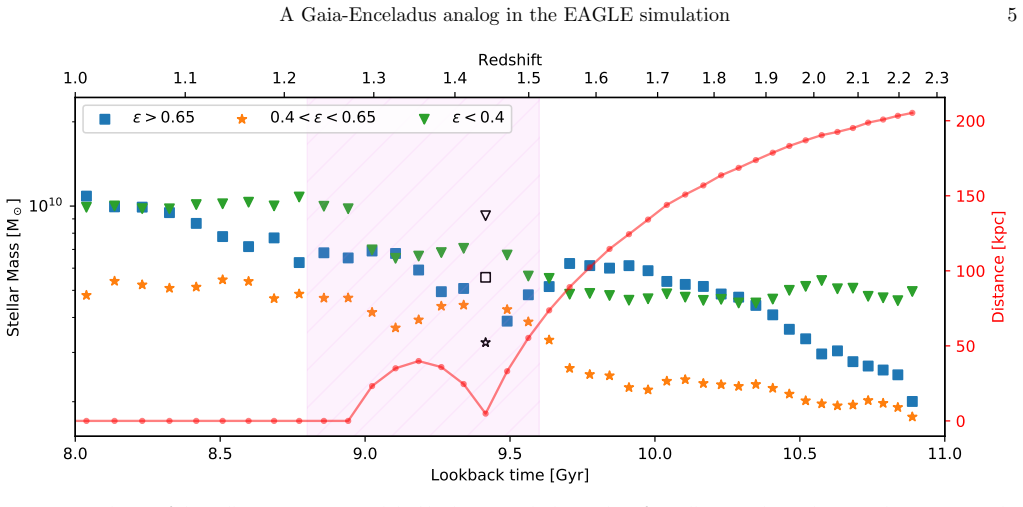
The central object is the circularity parameter, defined as epsilon = L_z / L_z_max(E), the ratio of a star's angular momentum around the disk axis to the maximum possible angular momentum at its binding energy. Stars are split into three fiducial components: epsilon greater than 0.65 (thin disk), between 0.4 and 0.65 (thick disk), and below 0.4 (spheroid). The argument works by tracking how particles move between these bins across the merger: the thick disk's growth is attributed to a decrease in circularity of pre-existing thin-disk stars during the first passage, rather than to direct accretion of satellite stars, which identifies dynamical heating as the physical mechanism building the thick disk.
What would settle it
Re-simulate the same galaxy at much higher resolution and track the circularity of individual star particles across the merger: if the 84 percent growth of the intermediate-circularity component is not recovered, or if the transferred stars cannot be identified as originally thin-disk particles, the dynamical-heating claim would be refuted.
Extended reading notes
Core claim
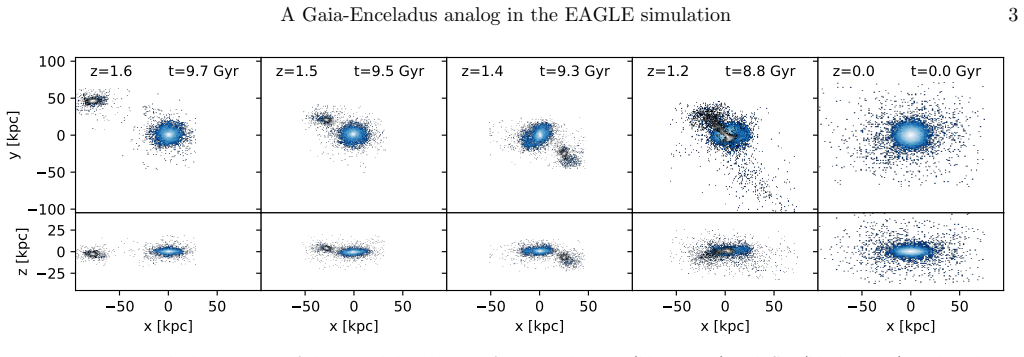
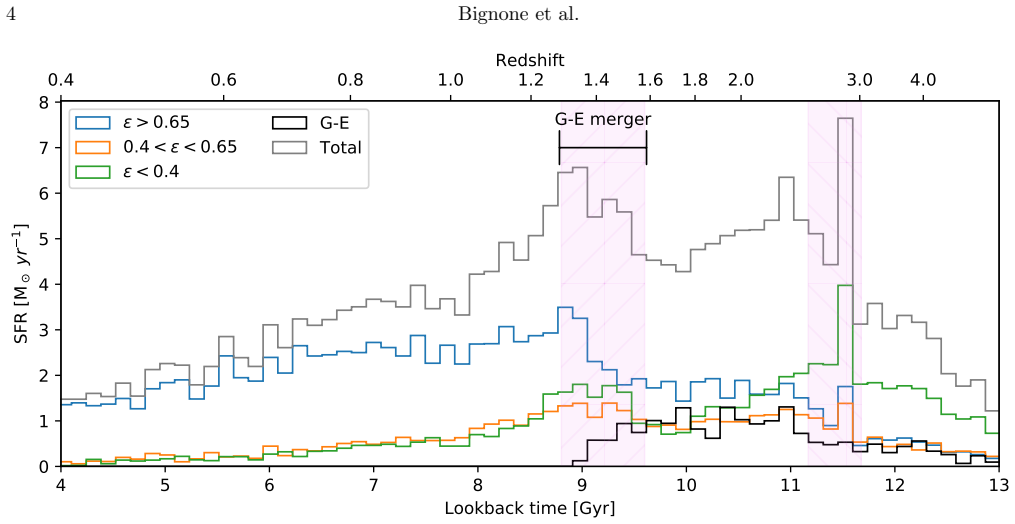
The paper's central claim is that a Gaia-Enceladus-like merger can simultaneously build a thick disk and boost star formation in a Milky Way-mass galaxy. In the selected analog, the merger occurred between lookback times of roughly 8.8 and 9.6 Gyr, with the satellite reaching closest approach at about 4.9 kpc. By following star particles across the merger, the authors show that the intermediate-circularity component, identified as a fiducial thick disk, grows by 84 percent, almost entirely because stars originally in the thin disk lose circularity and are dynamically heated, not because satellite stars are directly deposited there (only 3.5 percent of the satellite's stars end up in this component). The same interaction raises the star formation rate, converting about 2.9 billion solar masses of gas into thin-disk stars over the course of the merger. The debris of the satellite ends up predominantly in the spheroid, and at large heights above the disk plane, 38 percent of stars within 30 kpc come from the accreted galaxy, matching the observational picture of the inner stellar halo.
Load-bearing premise
The central claim rests on the assumption that the three circularity bins applied to the low-resolution simulation genuinely separate thin disk, thick disk, and spheroid stars, rather than mixing populations or producing numerical artifacts.
Editorial extensions
If this is right
- The Milky Way's thick disk can be explained by a single Gaia-Enceladus-like merger that heats the pre-existing thin disk without destroying it.
- The same merger naturally produces an inner halo dominated at large heights by accreted debris, consistent with the observed retrograde, radially anisotropic stellar halo.
- The merger-triggered starburst contributes a significant fraction of the present thin disk, about 13 percent of its stellar mass, linking the event to the Milky Way's star formation history.
- The identified galaxy is a prime target for high-resolution zoom-in re-simulation, which could constrain the dark matter distribution near the Sun and the formation of the bulge and bar.
- The kinematic signatures of the simulated debris, including the sausage-like velocity distribution and slight retrograde rotation, validate the use of such analogs for interpreting Gaia data.
Reading between the lines
- If this scenario is correct, the thick disk should show an age-metallicity break at the merger epoch: stars heated from the old thin disk should be older and more metal-poor than stars formed in the post-merger starburst, a prediction testable with current spectroscopic surveys.
- The nearly coplanar, retrograde encounter imprints a specific mean rotation on the thick disk; measuring a net retrograde rotation component in the Milky Way's thick disk would distinguish this heating mechanism from alternatives such as internal instabilities or multiple minor mergers.
- Since 96 percent of the satellite's stars end up in the spheroid, the inner halo's phase-space structure should be dominated by one coherent debris stream; mapping its action-space distribution could directly constrain the mass and orbit of Gaia-Enceladus.
- The selection method used here, requiring both global Milky Way properties and a Gaia-Enceladus-like merger, could be applied to other simulations to estimate how common such events are and what fraction of Milky Way analogs would have thick disks built this way.
Signed reviews
Editorial analysis
A structured set of objections, weighed in public.
Referee Report
Summary. The paper identifies a single Milky Way analog in the EAGLE Ref-L100N1504 cosmological simulation whose merger history resembles the proposed Gaia-Enceladus event, with a satellite of stellar mass ~3.1e9 Msun merging with a host of ~1.5e10 Msun at z~1.2-1.7. The authors analyze the merger's orbital configuration, star formation history, and the evolution of stellar mass in three circularity bins meant to represent thin disk, thick disk, and spheroid. They report that the merger produced a starburst and increased the mass of the intermediate-circularity 'fiducial thick disk' by 84%, primarily by lowering the circularity of pre-existing thin-disk stars rather than by direct accretion. They conclude that the simulated system supports the scenario in which Gaia-Enceladus contributed to the Milky Way's thick disk and inner halo.
Significance. If the result holds, the paper provides a concrete demonstration in a cosmological simulation that a G-E-like merger can heat an early disk and trigger star formation, lending support to the interpretation of the observed Gaia-Enceladus debris and thick disk. The paper is valuable for selecting a strong candidate for future zoom-in re-simulation. Strengths: the analysis is based on public EAGLE data; the selection procedure is explicit; the authors track particle histories to distinguish accretion from in-situ heating; they acknowledge resolution limits by calling the components 'fiducial'; and they exclude timesteps contaminated by close passage. The main limitation is that the quantitative thick-disk growth depends on uncalibrated circularity thresholds in a simulation whose resolution cannot resolve the thin/thick disk vertical structure, and the selection of the analog itself guarantees some similarity to G-E debris.
major comments (3)
- [Section 2 and Section 3.3/Figure 4] The central quantitative claim that the merger built the thick disk rests on the 0.4<epsilon<0.65 circularity bin, yet Section 2 states that 'the numerical resolution of the simulation prevents us from obtaining a detailed definition of thin and thick disks.' The thresholds epsilon>0.65, 0.4-0.65, and <0.4 are not calibrated against a resolved simulation, a scale-height criterion, or an observational definition. At z=1.7 the intermediate bin already contains ~27% of the stellar mass, so the reported 84% growth could in part reflect mixing with spheroid/halo particles or artificial lowering of circularity by the 0.7 kpc softening and the poorly defined disk plane during the encounter. To support the abstract's claim, the authors should either validate that the intermediate bin traces a bona fide thick disk (e.g., by showing a distinct vertical scale height and kinematic structure, or by testing convergence at higher resolution) or rephrase the abstract and conclusions to refer to the 'fiducial thick disk' and present the 84% as a resolution-dependent indicator rather than a direct measurement.
- [Section 2 and Section 4] The analog was deliberately selected to have a G-E-like mass ratio, merger time, and high halo anisotropy; therefore, the qualitative similarity of the simulated debris (eccentric, slightly retrograde orbits) to observed Gaia-Enceladus is partly by construction and should not be presented as independent validation. The genuinely new results are the dynamical heating of the pre-existing disk and the starburst, which were not part of the selection criteria. The discussion should clearly separate selection outcomes from predictions, and ideally quantify how much of the reported agreement follows from the selection.
- [Section 3.2 and Section 4] There is a numerical inconsistency in the gas mass contributed by the satellite to the thin disk: Section 3.2 gives ~4.5e9 Msun of gas and ~2.9e9 Msun converted into thin-disk stars, while Section 4 states that G-E 'contributes a significant amount of gas (~2.9e10 Msun) to the thin disk.' These numbers differ by an order of magnitude; the text should be corrected and the actual value stated consistently.
minor comments (4)
- [Throughout] Typos and formatting: 'diskovery' should be 'discovery', 'diskard' should be 'discard', 'Diskussion' should be 'Discussion', 'right pnale' should be 'right panel', and 'eagle' should be consistently capitalized as 'EAGLE'.
- [Section 1] The phrase 'eagle suit' should be 'EAGLE suite'.
- [Section 3.2] The sentence 'G-E thus contributes a significant amount to the subsequent growth of the MW, but does not accounts for all of it' contains a grammatical error ('does not accounts') and should be reworded.
- [Figure 3 caption] The caption refers to 'The shaded region on the left' for the previous major merger, but the text does not specify the redshift or lookback time of that event in the caption; adding a brief description would improve readability.
Circularity Check
Selection criteria restated as agreement; central dynamical claims are emergent.
-
fitted input called prediction
[Section 2 (G-E analog identification) and Section 4 (Discussion and Conclusions)]
"We analyzed their assembly histories, searching for the accreted satellite galaxies that contributed more significantly to the anisotropic distribution and had a stellar mass ratio that is comparable to the value estimated for G-E by Helmi et al. (2018) and occurred around the estimated time by Helmi et al. (2018); Hawkins et al. (2014). Only one of the selected halos satisfies these constraints and also has a value of β∼ 0.73, which is comparable to that found for the dynamical structure commonly referred to as the Gaia Sausage. ..."
The concluding 'agreement' is not an independent test: the galaxy was selected specifically because its halo had β>0.68 (the anisotropic Gaia-Sausage-like signature) and because it had a satellite with a G-E-like mass ratio and merger time. The statement 'evidence can be found in the present-day kinematic properties of halo stars' refers to the same anisotropy criterion used to choose the object, so that particular claim reduces by construction to the selection input. This circularity is minor because the paper's central dynamical results — the 84% growth of the fiducial thick-disk bin and the merger-induced star formation enhancement — are measured from the simulation after selection and are not part of the selection criteria.
full rationale
The paper openly states that the simulated galaxy was selected to resemble the Milky Way's assembly history, including a Gaia-Enceladus-like merger, so the subsequent detection of such a merger and an anisotropic halo is by construction rather than an independent prediction. The one explicitly circular sentence appears in the conclusions, where the selection criteria are restated as 'agreement' with the Gaia-Enceladus scenario. The main claim, however — that the merger heated the pre-existing disk and triggered star formation — is an emergent outcome of the EAGLE simulation, quantified via circularity-bin mass evolution and star-formation histories. The circularity bins are acknowledged as 'fiducial' and limited by resolution, but that is a resolution/proxy concern, not a self-referential reduction. Self-citations to Helmi et al. (2018) are used for observational context and for interpreting the simulation, not as the load-bearing justification of the dynamical results. Overall, the central derivation is self-contained against the simulation; the identified circularity is confined to one concluding restatement and does not undermine the independent content.
Assumptions & free parameters
free parameters (9)
- Virial mass window =
M200 = [1, 1.5]e12 solar masses
- Stellar mass threshold =
greater than 1e10 solar masses within 30 kpc
- Star formation rate window =
0.1 to 3 solar masses per year
- Disk-to-total ratio threshold =
D/T greater than 0.4
- Recent merger exclusion =
exclude mergers with stellar mass ratio greater than 0.15 at z below 1
- Circularity boundaries =
epsilon = 0.65 and 0.4
- Halo star selection =
epsilon below 0.4, |Z| greater than 5 kpc, R between 5 and 12 kpc
- Anisotropy threshold =
beta greater than 0.68, which is the median plus two sigma
- Gaia-Enceladus matching criteria =
stellar mass ratio around 0.2 and merger time around 10 Gyr ago
assumptions (5)
- domain assumption EAGLE subgrid physics produces a realistic population of Milky Way-mass galaxies.
- domain assumption High radial anisotropy, beta greater than 0.68, in old halo stars marks accreted Gaia-Enceladus-like debris.
- domain assumption Circularity bins correspond to the thin disk, thick disk, and spheroid at all times.
- domain assumption The star formation rate increase coincident with the merger is caused by the merger.
- domain assumption Particle assignment near closest approach is reliable enough after exclusions.
Cite this review
Pith. "Pith review of A Gaia-Enceladus Analog in the EAGLE Simulation: Insights into the Early Evolution of the Milky Way." pith.science (2026). https://pith.science/paper/ATNMOIOL
@misc{pith2026190807080,
  author       = {Pith},
  title        = {Pith review of: A Gaia-Enceladus Analog in the EAGLE Simulation: Insights into the Early Evolution of the Milky Way},
  year         = {2026},
  howpublished = {\url{https://pith.science/paper/ATNMOIOL}},
  note         = {Machine review of arXiv:1908.07080}
}
abstract
We identify a simulated Milky Way analog in the EAGLE suite of cosmological hydrodynamical simulations. This galaxy not only shares similar global properties as the Milky Way, but was specifically selected because its merger history resembles that currently known for the Milky Way. In particular we find that this Milky Way analog has experienced its last significant merger (with a stellar mass ratio $\sim 0.2$) at $z\sim 1.2$. We show that this merger affected both the dynamical properties of the stars present at the time, contributing to the formation of a thick disk, and also leading to a significant increase in the star formation rate of the host. This object is thus particularly suitable for understanding the early evolutionary history of the Milky Way. It is also an ideal candidate for re-simulation with much higher resolution as this would allow addressing a plethora of interesting questions such as, for example, the specific distribution of dark matter near the Sun.
Figures

Figures from the paper (1 more)
Reference graph
Works this paper leans on
-
[1]
Abolfathi, B., Aguado, D. S., Aguilar, G., et al. 2018, ApJS, 235, 42, doi: 10.3847/1538-4365/aa9e8a
-
[2]
Barnes, J. E. 2004, MNRAS, 350, 798, doi: 10.1111/j.1365-2966.2004.07725.x
arXiv 2004
-
[3]
Deason, A. J. 2018, MNRAS, 478, 611, doi: 10.1093/mnras/sty982
-
[4]
2018, MNRAS, 478, 4513, doi: 10.1093/mnras/sty1281
Buder, S., Asplund, M., Duong, L., et al. 2018, MNRAS, 478, 4513, doi: 10.1093/mnras/sty1281
-
[5]
Carollo, D., Tissera, P. B., Beers, T. C., et al. 2018, ApJ, 859, L7, doi: 10.3847/2041-8213/aac2dc
-
[6]
Evidence for the Third Stellar Population in the Milky Way's Disk
Carollo, D., Chiba, M., Ishigaki, M., et al. 2019, arXiv e-prints, arXiv:1904.04881
work page Pith review arXiv 2019
-
[7]
Crain, R. A., Schaye, J., Bower, R. G., et al. 2015, MNRAS, 450, 1937, doi: 10.1093/mnras/stv725
-
[8]
2012, Research in Astronomy and Astrophysics, 12, 1197, doi: 10.1088/1674-4527/12/9/003
Cui, X.-Q., Zhao, Y.-H., Chu, Y.-Q., et al. 2012, Research in Astronomy and Astrophysics, 12, 1197, doi: 10.1088/1674-4527/12/9/003
Show all 34 references
-
[9]
J., et al
Fattahi, A., Belokurov, V., Deason, A. J., et al. 2019, MNRAS, 484, 4471, doi: 10.1093/mnras/stz159 Fern´ andez-Alvar, E., Tissera, P. B., Carigi, L., et al. 2019, MNRAS, 485, 1745, doi: 10.1093/mnras/stz443 Gaia Collaboration, Brown, A. G. A., Vallenari, A., et al. 2018, A&A,...
2019 doi
-
[10]
J., Brook, C
Gallart, C., Bernard, E. J., Brook, C. B., et al. 2019, Nat Astron, 407, doi: 10.1038/s41550-019-0829-5 G´ omez, F. A., Grand, R. J. J., Monachesi, A., et al. 2017, MNRAS, 472, 3722, doi: 10.1093/mnras/stx2149
2019 doi
-
[11]
2014, MNRAS, 445, 2575, doi: 10.1093/mnras/stu1910
Hawkins, K., Jofr´ e, P., Gilmore, G., & Masseron, T. 2014, MNRAS, 445, 2575, doi: 10.1093/mnras/stu1910
2014 doi
-
[12]
D., et al
Haywood, M., Di Matteo, P., Lehnert, M. D., et al. 2018, ApJ, 863, 113, doi: 10.3847/1538-4357/aad235
2018 doi
-
[13]
H., et al
Helmi, A., Babusiaux, C., Koppelman, H. H., et al. 2018, Nature, 563, 85, doi: 10.1038/s41586-018-0625-x
2018 doi
-
[14]
2018, Phys
Herzog-Arbeitman, J., Lisanti, M., Madau, P., & Necib, L. 2018, Phys. Rev. Lett., 120, 041102, doi: 10.1103/PhysRevLett.120.041102
2018 doi
-
[15]
A., Gilmore, G., & Irwin, M
Ibata, R. A., Gilmore, G., & Irwin, M. J. 1994, Nature, 370, 194, doi: 10.1038/370194a0
1994 doi
-
[16]
Katz, N., Quinn, T., Bertschinger, E., & Gelb, J. M. 1994, MNRAS, 270, L71, doi: 10.1093/mnras/270.1.L71
1994 doi
-
[17]
2018, ApJ, 860, L11, doi: 10.3847/2041-8213/aac882
Koppelman, H., Helmi, A., & Veljanoski, J. 2018, ApJ, 860, L11, doi: 10.3847/2041-8213/aac882
2018 doi
-
[18]
2017, AJ, 153, 75, doi: 10.3847/1538-3881/153/2/75
Kunder, A., Kordopatis, G., Steinmetz, M., et al. 2017, AJ, 153, 75, doi: 10.3847/1538-3881/153/2/75
2017 doi
-
[19]
G., Tissera, P
Lambas, D. G., Tissera, P. B., Alonso, M. S., & Coldwell, G. 2003, MNRAS, 346, 1189, doi: 10.1111/j.1365-2966.2003.07179.x
2003
-
[20]
B., & Tinsley, B
Larson, R. B., & Tinsley, B. M. 1978, Astrophys. J., 219, 46, doi: 10.1086/155753
1978 doi
-
[21]
T., Schiavon, R
Mackereth, J. T., Schiavon, R. P., Pfeffer, J., et al. 2019, MNRAS, 482, 3426, doi: 10.1093/mnras/sty2955
2019 doi
-
[22]
C., Schaller, M., et al
McAlpine, S., Helly, J. C., Schaller, M., et al. 2016, A&C, 15, 72, doi: 10.1016/j.ascom.2016.02.004
2016 doi
-
[23]
C., & Hernquist, L
Mihos, J. C., & Hernquist, L. 1996, The Astrophysical Journal, 464, 641, doi: 10.1086/177353
1996 doi
-
[24]
Koposov, S. E. 2018, ApJ, 856, L26, doi: 10.3847/2041-8213/aab613
2018 doi
-
[25]
F., & White, S
Navarro, J. F., & White, S. D. M. 1994, MNRAS, 267, 401, doi: 10.1093/mnras/267.2.401
1994 doi
-
[26]
2018, arXiv e-prints, arXiv:1810.12301
Necib, L., Lisanti, M., Garrison-Kimmel, S., et al. 2018, arXiv e-prints, arXiv:1810.12301
2018 arXiv
-
[27]
2019, A&A, 621, A56, doi: 10.1051/0004-6361/201833355
Posti, L., & Helmi, A. 2019, A&A, 621, A56, doi: 10.1051/0004-6361/201833355
2019 doi
-
[28]
A., Bower, R
Schaye, J., Crain, R. A., Bower, R. G., et al. 2015, MNRAS, 446, 521, doi: 10.1093/mnras/stu2058
2015 doi
-
[29]
B., Lambas, D
Sillero, E., Tissera, P. B., Lambas, D. G., & Michel-Dansac, L. 2017, MNRAS, 472, 4404, doi: 10.1093/mnras/stx2265
2017 doi
-
[30]
2019, A&A, 623, A60, doi: 10.1051/0004-6361/201834188
Grisoni, V. 2019, A&A, 623, A60, doi: 10.1051/0004-6361/201834188
2019 doi
-
[31]
B., White, S
Tissera, P. B., White, S. D. M., & Scannapieco, C. 2012, MNRAS, 420, 255, doi: 10.1111/j.1365-2966.2011.20028.x Villalobos, ´A., & Helmi, A. 2008, MNRAS, 391, 1806, doi: 10.1111/j.1365-2966.2008.13979.x
2012
-
[32]
2019, MNRAS, 487, L47, doi: 10.1093/mnrasl/slz070
Vincenzo, F., Spitoni, E., Calura, F., et al. 2019, MNRAS, 487, L47, doi: 10.1093/mnrasl/slz070
2019 doi
-
[33]
L., van der Marel, R
Watkins, L. L., van der Marel, R. P., Sohn, S. T., & Evans, N. W. 2019, ApJ, 873, 118, doi: 10.3847/1538-4357/ab089f
2019 doi
-
[34]
2012, Research in Astronomy and Astrophysics, 12, 723, doi: 10.1088/1674-4527/12/7/002
Zhao, G., Zhao, Y.-H., Chu, Y.-Q., Jing, Y.-P., & Deng, L.-C. 2012, Research in Astronomy and Astrophysics, 12, 723, doi: 10.1088/1674-4527/12/7/002
2012 doi
Reviewed August 14, 2026 · model on record in the stance chip above.
Discussion (0). Continue with ORCID to comment.