REVIEW 3 major objections 5 minor
Different Jet Dissipation Mechanisms Underlying the Variability in Blazars
T0 review · 3 major / 5 minor · reviewed 2026-07-12 · grok-4.5
Pith's one-line read Mrk 501’s radio core-shift and low-state SED fit a single conical jet, but its multiwavelength variability requires different radiating-blob populations inside and outside ~0.1 pc.
desk verdict Solid multi-messenger constraint that a single radial blob distribution fails for Mrk 501 PSDs; the title over-reaches on “different dissipation mechanisms,” but the observational result itself is real and useful. read the letter →
The pith
A machine-rendered reading of the paper's core claim, the machinery that carries it, and where it could break.
The reading
What carries the argument
The multi-blob stochastic dissipation model on a conical jet with conserved magnetic power (B' ∝ r^−1). Analytic expressions for the radio spectral index, core-shift index kr, and fractional-rms PSD amplitude (P ∝ 1/Ṅ) convert core-shift, SED, and variability data into radial profiles of blob generation rate, size, and electron luminosity; an inner-jet “blob-merging” reparameterization then reduces the effective radiating-blob number while preserving mean flux.
What would settle it
Millimeter/sub-millimeter VLBI core-shift measurements (roughly 0.1–1 THz) that map the inner-jet opacity surface; if the measured kr or rcore(ν) deviate from the outer-jet extrapolation in the sense predicted by the modified αL and ακ, the scale-dependent picture is supported; if they follow the single-distribution power law, it is not.
Extended reading notes
Core claim
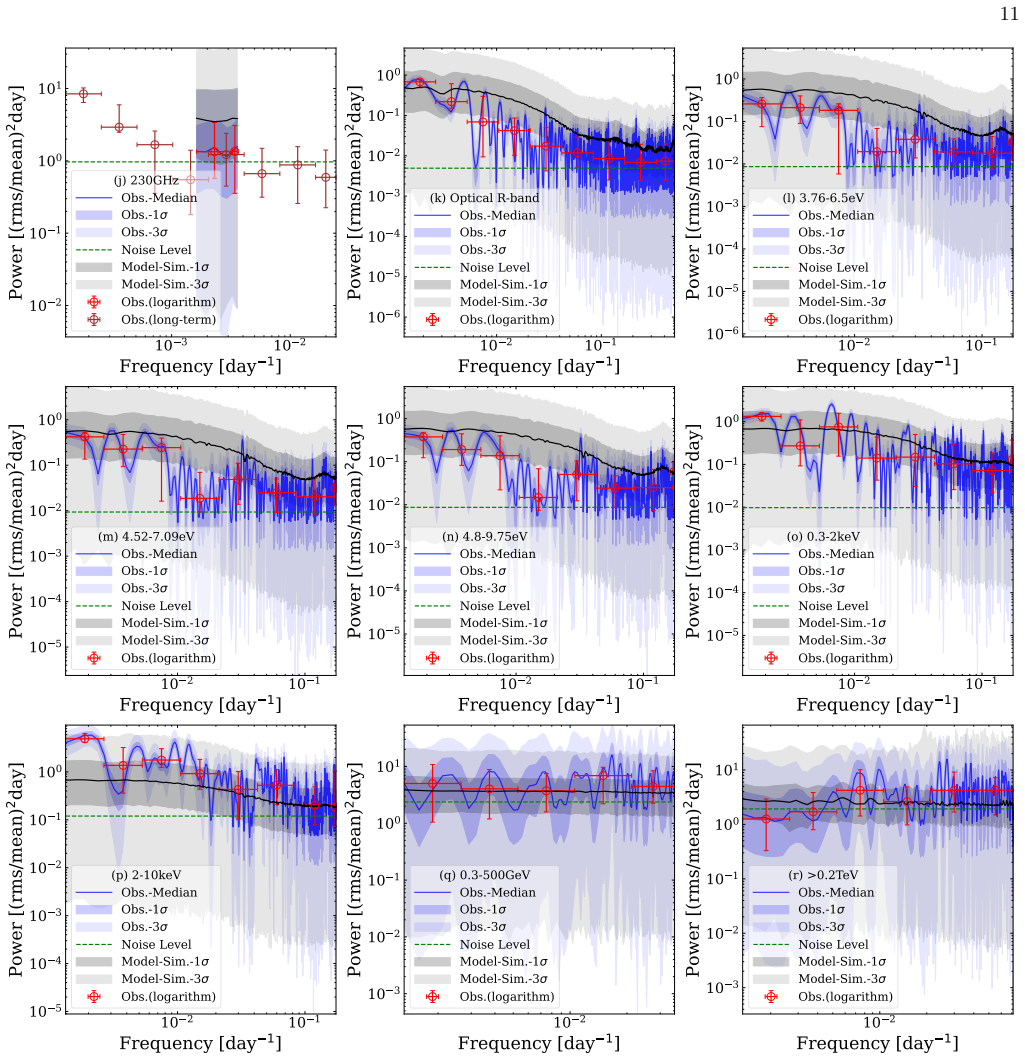
A single radial distribution of jet parameters that conserves magnetic power fits Mrk 501’s radio core-shift relation and low-state SED, but underpredicts the observed power spectral densities above ~15 GHz and in the optical-to-gamma-ray bands. Introducing different effective blob distributions—fewer, larger, longer-lived blobs inside ~0.1 pc and the baseline population outside—brings the simulated multiwavelength PSDs into agreement with the 2017–2019 low-state data while leaving the time-averaged SED essentially unchanged.
Load-bearing premise
The phenomenological blob-merging rule that lowers the number of radiating blobs inside 0.1 pc while keeping the time-averaged synchrotron and SSC fluxes fixed; the authors themselves call the chosen parameters a non-unique illustration.
Editorial extensions
If this is right
- Effective jet dissipation changes character across a transition near 0.1 pc (~10^3 gravitational radii for a 10^9 solar-mass black hole).
- High-frequency radio and optical-to-gamma-ray variability are produced by a sparser population of larger, longer-lived structures than the outer radio jet.
- Spectro-timing-astrometric modeling of other blazars can locate analogous scale-dependent transitions.
- Future sub-mm core-shift and high-precision radio spectra will distinguish among alternative inner-jet parameter sets that preserve the SED but alter kr.
Reading between the lines
- If the inner-jet population is produced by efficient plasmoid coalescence, the transition radius should scale with jet magnetization and therefore with black-hole mass or accretion rate across the blazar population.
- The same framework applied to flaring states could test whether flares are simply temporary increases in the inner-jet blob rate or a qualitative change in the dissipation channel.
- Simultaneous dense radio-to-TeV sampling of additional HSP BL Lacs would reveal whether the 0.1-pc transition is universal or source-dependent.
Editorial analysis
A structured set of objections, weighed in public.
Referee Report
Summary. The paper applies a multi-blob stochastic dissipation model to Mrk 501, combining radio core-shift measurements, the low-state SED, and multiwavelength PSDs. Analytic relations for the radio spectral index (Eq. 8), core-shift index (Eq. 11), and fractional PSD amplitude (Eq. 18) are derived for a conical jet with conserved magnetic power. A single radial distribution of parameters reproduces the core-shift relation and SED but underpredicts the observed PSDs above ~15 GHz and in the optical-to-γ-ray bands. The authors then introduce different effective blob distributions for the inner (≲0.1 pc) and outer (≳0.1 pc) jet, using a phenomenological blob-merging prescription (Section 3.3, Eq. 19) that reduces the effective number of radiating blobs while approximately preserving the time-averaged fluxes. With this modification the simulated PSDs match the 2017–2019 low-state data within the reported Monte-Carlo uncertainties, which the authors interpret as evidence for scale-dependent dissipation.
Significance. If the inference holds, the work provides a concrete spectro-timing-astrometric framework that links core-shift, SED, and multiwavelength PSD data to radial jet stratification and scale-dependent dissipation. The analytic scalings (especially P ∝ Ṅ^{-1} under fractional-rms normalization) are clean and useful beyond this single source, and the paper makes a falsifiable prediction: mm/sub-mm core-shift measurements should distinguish among the inner-jet parameter families shown in Figure 5. The explicit demonstration that a single radial distribution fails the high-frequency PSDs while still fitting the SED and core-shift is a genuine advance over purely spectral multi-zone models. The result is therefore of interest for blazar jet physics even if the particular merging picture is only one of several viable realizations.
major comments (3)
- Section 3.3 and Eq. (19): the central claim of different inner/outer dissipation rests on a non-unique, flux-preserving blob-merging construction (τ̃_inj = 10^3, κ̃(r) ∝ r^{-1/6}, α̃_blob = 1.5, abrupt transition fixed at 0.1 pc). The paper itself states that this “should not be regarded as a unique solution” and is only “a phenomenological example.” Because Eq. (18) already implies that any reduction in effective radiating-blob number raises the PSD amplitude, the data require only “fewer independent radiators inside ~0.1 pc,” not the specific merging picture or the title/abstract language of distinct dissipation mechanisms. The manuscript should either (i) reframe the claim more cautiously around the robust inference (reduced effective Ṅ in the inner jet) or (ii) supply an independent constraint (e.g., continuous transition, mm/sub-mm core-shift prior) that selects among the families o
- Section 3.2 and Figures 2/4: the 230 GHz IRAM PSD is an outlier (higher than X-ray/γ-ray PSDs) based on only 11 low-state points, while the simultaneous and long-term SMA 230 GHz PSDs are an order of magnitude lower and better matched by the model. The paper notes the large uncertainty but still treats the IRAM result as within 3σ. Given that the high-frequency radio discrepancy is a primary driver for modifying the inner jet, the authors should quantify how much the required Ṅ reduction changes if the IRAM points are down-weighted or excluded, and whether the optical-to-γ-ray PSDs alone still force the same transition radius.
- Section 4.2: the physical interpretation in terms of magnetic reconnection and efficient plasmoid coalescence in the inner jet versus shocks farther out is presented as a natural reading of the modified model. Because the modified parameters are phenomenological and non-unique, this interpretation is under-constrained. The discussion should more clearly separate the robust observational requirement (scale-dependent effective blob number) from the speculative microphysical scenario, and note which future observables (e.g., the core-shift families of Figure 5) would actually discriminate reconnection-dominated from shock-dominated regimes.
minor comments (5)
- Table 1: the modified-model column lists only inner-jet quantities; a short note clarifying that outer-jet parameters remain identical to the baseline would improve readability.
- Figure 3: the vertical scales for local dissipation rate and injection luminosity span several orders of magnitude; a logarithmic inset or explicit annotation of the transition radius would make the break at 0.1 pc clearer.
- Appendix B, Eq. (B4): the generalized expressions for α_r and k_r when κ(r) and τ_inj(r) are power laws are useful; they should be cross-referenced earlier when the modified model is introduced in Section 3.3.
- Throughout: the notation mixes primed (comoving) and unprimed quantities; a brief glossary or consistent use of primes for all comoving quantities would reduce ambiguity.
- Section 2.3: the derivation of E[P_seg] assumes statistically independent blobs and neglects cross-correlations; a short remark on when this approximation fails (e.g., if successive blobs share a common driver) would be helpful.
Circularity Check
PSD-driven claim of scale-dependent dissipation rests on a non-unique flux-preserving blob-merging ansatz (Eq. 19) tuned to keep the SED fixed while raising PSD amplitudes via P ∝ Ṅ^{-1}.
-
fitted input called prediction
[Section 3.3, Eq. (19) and surrounding text]
"one simple way to keep both the synchrotron and SSC fluxes approximately unchanged is [Eq. 19] … This prescription keeps the time-averaged SED close to the baseline fit while changing the variability amplitude. It is only one possible way … This modified model should not be regarded as a unique solution. It is a phenomenological example showing what kind of change is required by the variability data."
The inner-jet parameters ( aũ_inj, κ̃(r), L̃_e(r), Ṅ̃_r) are deliberately chosen so that the time-averaged synchrotron and SSC luminosities of every radial segment remain identical to the baseline while the effective blob number is reduced. Because the fractional-rms PSD scales as P ∝ 1/Ṅ (Eq. 18), the reduction automatically raises the PSD amplitude to the observed level. The subsequent statement that the modified model “reproduces” both the SED and the multiwavelength PSDs is therefore partly by construction for the SED and a direct fit for the PSDs; the particular merging picture is not independently constrained.
-
other
[Section 3.3 (transition radius) and Fig. 3]
"Guided by the PSD comparison, we place the transition at 0.1 pc, inside the region corresponding to the 15 GHz core. … In the inner jet, we set aũ_inj = 10^3 … We also let κ̃(r) and L̃_e(r) increase toward smaller radii as r^{-1/6} relative to the baseline model."
The location of the break (0.1 pc) and the specific power-law indices that implement the “blob-merging” picture are selected after inspecting where the baseline PSD discrepancy appears, then adjusted until the simulated PSDs fall inside the 1σ observational bands. No independent observable (e.g., mm/sub-mm core-shift) fixes these values; they are free parameters of the phenomenological extension.
full rationale
The baseline single-distribution model is independently constrained by core-shift (k_r,obs = 0.91) and the flat radio spectrum via the inverted analytic relations (Eqs. 8, 11), which fix α_blob ≈ 2.0 and α_L ≈ 0.3; the remaining normalizations are then set by the low-state SED. The analytic PSD scaling P_seg ∝ 1/N_blob^T (Eq. 18) is a genuine derivation from the multi-blob construction and correctly predicts that the baseline (more blobs inward) under-predicts high-frequency PSDs. The subsequent step that introduces different inner/outer distributions is not forced by construction: the data require only fewer independent radiators inside ~0.1 pc. However, the concrete realization (Section 3.3) chooses aũ_inj = 10^3, κ̃(r) ∝ r^{-1/6}, α̃_blob = 1.5 and the exact scalings of Eq. 19 expressly so that both L_syn and L_SSC of every segment remain unchanged while Ṅ is lowered. The paper itself labels this “a phenomenological example” that “should not be regarded as a unique solution.” Thus the post-modification SED consistency is by construction and the PSD match is a fit; the stronger claim of “different dissipation mechanisms” therefore inherits residual circularity from the non-unique, flux-preserving ansatz. Self-citations to the authors’ SDM framework (Liu et al. 2023; Tan et al. 2024) supply the computational machinery but are not load-bearing for uniqueness or for the scale-dependent conclusion. Overall circularity is therefore moderate (score 4), not fatal.
Assumptions & free parameters
free parameters (10)
- r0 (jet-base distance) =
0.006 pc
- B'_0 (magnetic field at r0) =
0.53 G
- L'_e,0 (electron injection luminosity at r0) =
7.6e40 / 8.2e40 erg s^-1
- κ (blob-to-jet radius ratio) =
0.16 (baseline); 0.31 r^{-1/6} (inner)
- Ṅ (total dissipation rate) =
0.025 / 1.4e-3 s^-1
- α_blob (radial index of blob generation) =
2.0 (outer); 1.5 (inner)
- α_L (radial index of electron luminosity) =
0.3 / 0.13
- τ_inj (injection-time multiplier) =
10^3 (inner); 1 (outer)
- transition radius =
0.1 pc
- δ_D, s, γ'_min, γ'_max,1/2, α_γ, α_B =
δ_D=15, s=2.1, α_B=1, etc.
assumptions (5)
- domain assumption Conical jet with magnetic power conserved (α_B = 1)
- domain assumption Blobs are statistically independent and triggered stochastically; cross-correlations neglected
- domain assumption Adiabatic losses dominate electron cooling (t'_cool ≈ R'/c)
- ad hoc to paper Total blob volume and particle density conserved under merging
- domain assumption Viewing angle θ_obs ≈ 15° and jet half-opening angle 5°
invented entities (2)
-
Effective merged-blob population in the inner jet
-
Abrupt inner/outer transition at 0.1 pc
Cite this review
Pith. "Pith review of Different Jet Dissipation Mechanisms Underlying the Variability in Blazars." pith.science (2026). https://pith.science/paper/ATQ6DHEA
@misc{pith2026260703689,
  author       = {Pith},
  title        = {Pith review of: Different Jet Dissipation Mechanisms Underlying the Variability in Blazars},
  year         = {2026},
  howpublished = {\url{https://pith.science/paper/ATQ6DHEA}},
  note         = {Machine review of arXiv:2607.03689}
}
abstract
Blazars are among the most extreme classes of active galactic nuclei. They are powered by relativistic jets, but the way in which the jet energy is dissipated is still unclear. The flat radio spectrum and the core-shift effect trace the distributions of magnetic fields and relativistic particles along the jet, while variability carries information about time-dependent dissipation. However, a unified framework connecting these observables to the underlying jet physics has been lacking. Here we present a multi-frequency analysis of the prototypical blazar Mrk~501. We model its core-shift measurements, spectral energy distributions (SEDs), and power spectral densities (PSDs) with a conical jet model that conserves magnetic power. The core-shift data localize the radio emitting regions and constrain the electron-density and dissipation-rate profiles along the jet. With a single radial distribution of jet parameters, the model reproduces the core-shift relation and SED, but it underpredicts the observed variability at high radio frequencies and in the optical to $\gamma$-ray bands. We therefore introduce different blob distributions for the inner ($\lesssim$~0.1\,pc) and outer ($\gtrsim$~0.1\,pc) jet regions. With this extended model, the simulated PSDs are consistent with the multiwavelength observations of Mrk~501 during its 2017--2019 low state. This result points to different dissipation behavior in the inner and outer jet. Our study demonstrates that spectro--timing--astrometric jet modeling, which combines SEDs, multiwavelength PSDs, and radio core-shift measurements, can constrain jet stratification and scale-dependent dissipation in blazars.
Figures


Figures from the paper (4 more)



Reviewed July 12, 2026 · model on record in the stance chip above.
Discussion (0). Continue with ORCID to comment.