REVIEW 5 major objections 5 minor 2 cited by
Combinatorial Cycle Classes in the Intersection Cohomology of Projective Toric Varieties
T0 review · 5 major / 5 minor · reviewed 2026-08-03 · deepseek-v4-flash
Pith's one-line read Combinatorial Hodge Conjecture for projective toric varieties: the classes of torus-invariant subvarieties span every even-degree rational intersection cohomology group, verified up to dimension three and for simplicial fans.
desk verdict A well-framed conjecture paper that is honest about its main assumption, but the central combinatorial cycle-class construction is not rigorous and the n=3 verification is conditional on an unproven compatibility. read the letter →
The pith
A machine-rendered reading of the paper's core claim, the machinery that carries it, and where it could break.
The reading
What carries the argument
The central object is the combinatorial cycle class [V(tau)]_comb := (i_tau)_*([Star(tau)]), the image of the fundamental class of the star of a cone under a combinatorial Gysin pushforward inside the minimal-extension sheaf complex. The argument also relies on the combinatorial Hard Lefschetz operator, which plays the role of intersecting with an ample divisor, and, in the simplicial case, on the description of rational cohomology as a quotient of the ring generated by rays. The paper's algorithm computes local intersection cohomology, assembles the global sheaf, forms the matrix of candidate cycle classes, and checks whether the rank matches the target dimension.
What would settle it
Run the paper's rank check (Algorithm, Step 5) on a non-simplicial projective 4-dimensional fan with no smooth maximal cone—for instance, a fan whose maximal cones are all singular—and compare the rank of the candidate cycle-class matrix with the computed dimension of IH^{2k}_comb for each even degree; a shortfall in any degree would refute the spanning conjecture. For the compatibility premise, compute phi([V(tau)]_comb) on a singular weighted projective 3-fold and compare it with the geometric cycle class of V(tau); any nonzero difference would invalidate the stated compatibility.
Extended reading notes
Core claim
The paper's central claim is Conjecture 4.1: the canonical isomorphism between combinatorial and geometric intersection cohomology maps the span of combinatorial cycle classes [V(tau)]_comb onto the geometric Hodge classes. Since projective toric intersection cohomology is Hodge-Tate, this is equivalent to asserting that the classes [V(tau)]_comb span IH^{2k}_comb(Sigma, Q) for every k. The paper proves this for all projective toric varieties of dimension n <= 3, assuming the stated BBFK-BL compatibility, and unconditionally for simplicial fans. In the simplicial case the proof uses the presentation of rational cohomology as a quotient of the ring generated by ray variables, so the combinato
Load-bearing premise
The conjecture collapses if the combinatorial class assigned to a cone does not match, via the canonical isomorphism, the geometric class of the corresponding invariant subvariety; the low-dimensional proof further assumes this compatibility and, for top-degree classes, the presence of a smooth maximal cone.
Editorial extensions
If this is right
- For every projective toric 3-fold, every rational class in even-degree intersection cohomology is a Q-linear combination of classes of torus-invariant subvarieties.
- For simplicial projective toric varieties (toric orbifolds), the same spanning statement holds unconditionally, recovering the known fact that cohomology is generated by invariant divisors.
- The conjecture becomes a finite computational problem: a rank check on a matrix of combinatorial cycle classes attached to the fan.
- If the conjecture holds in general, the Intersection Hodge Conjecture for projective toric varieties follows, since the combinatorial spanning statement is equivalent to the geometric one under the compatibility assumption.
- The framework suggests a path to verifying the conjecture in higher dimensions by algorithmic rank computations rather than by geometric construction of cycles.
Reading between the lines
- The paper's low-dimensional proof is only as strong as the compatibility it assumes; a mismatch between [V(tau)]_comb and the geometric class of V(tau) would sever the link between the combinatorial theorem and the geometric Hodge conjecture.
- The rank-check formulation means the conjecture for a given fan is decidable in principle; testing non-simplicial 4-dimensional fans, especially those lacking smooth maximal cones, is the natural next experiment.
- If the combinatorial Gysin map is constructed explicitly rather than assumed, the same framework would likely prove the conjecture for all rational polytopal fans, not just low dimensions.
- The reliance on smooth maximal cones in the top-degree argument suggests that a cleaner proof may come from local-to-global sheaf theory on fans, avoiding the need for smooth points.
Editorial analysis
A structured set of objections, weighed in public.
Referee Report
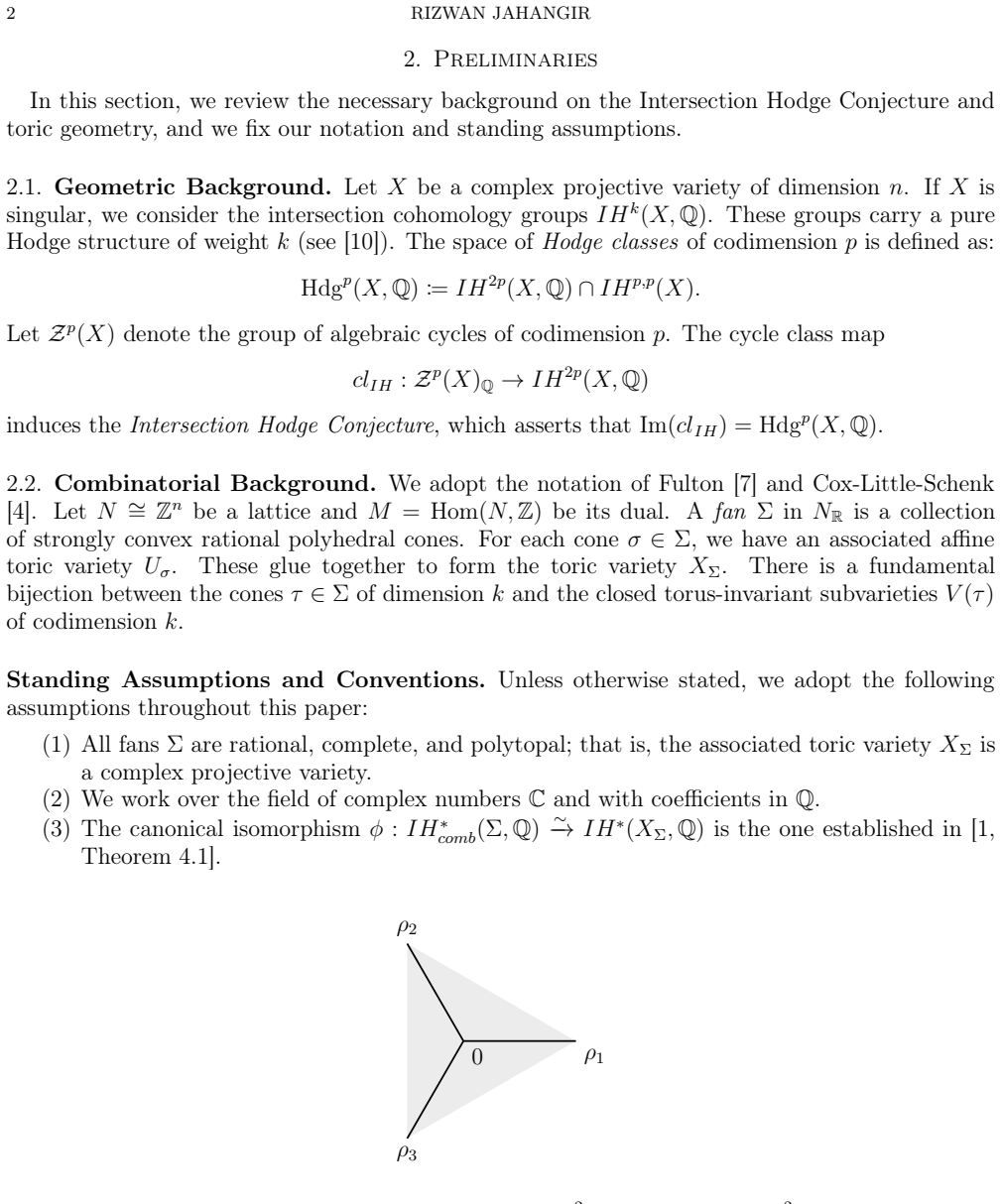
Summary. The paper introduces a combinatorial analogue of the intersection Hodge conjecture for projective toric varieties. It defines, within the BBFK combinatorial intersection cohomology IH^*_comb(Σ), a combinatorial cycle class [V(τ)]_comb for each cone τ (Definition 3.2) and lets Hdg^k_comb(Σ) be their span (Definition 3.3). Conjecture 4.1 asserts that the canonical isomorphism φ: IH^*_comb(Σ,ℚ) ≅ IH^*(X_Σ,ℚ) carries Hdg^k_comb onto the geometric Hodge classes, which for projective toric varieties amounts to asking that the classes [V(τ)]_comb span IH^{2k}_comb. The paper claims to verify the conjecture for n≤2 (Theorem 5.1), n=3 (Theorem 5.2), and for simplicial fans (Theorem 5.3), and it outlines an algorithm for checking the spanning property. The abstract conditions the n≤3 verification on a 'BBFK–BL compatibility' statement, and the proofs are labeled sketches.
Significance. If the combinatorial Gysin maps and the BBFK–BL compatibility were actually established, the paper would provide a clean reduction of the toric intersection Hodge conjecture to a concrete linear-algebraic rank computation, and the low-dimensional checks would be valuable. The author correctly identifies Karu's Hard Lefschetz as the key input and separates the simplicial case. However, the manuscript does not deliver these prerequisites: the central objects are not well-defined, and the main theorem statements overclaim relative to the abstract. The strengths are the formulation of the question and the honest disclosure of the compatibility assumption in the abstract.
major comments (5)
- [Def. 3.2, Rem. 3.2] The combinatorial Gysin map (i_τ)_* is never constructed. The stated origin (functoriality of minimal extension sheaves for open embeddings of fans) does not yield a degree-shifting pushforward on intersection cohomology; open embeddings induce restriction maps in the opposite direction, and no properness or duality argument is supplied. Likewise 'the fundamental class of Star(τ)' is not defined. Consequently [V(τ)]_comb and Hdg^k_comb are not well-defined, and Conjecture 4.1 and Theorems 5.1–5.3 have no precise content as stated. This is load-bearing because every 'spanned by combinatorial cycle classes' statement depends on this definition.
- [Thm 5.2, degree-4 paragraph] Theorem 5.2 asserts Conjecture 4.1 holds unqualifiedly for n=3, but the proof silently uses the BBFK–BL compatibility that the abstract discloses as an assumption. The sentence 'Since the intersection of algebraic cycles (divisors) with an ample divisor yields algebraic cycles (invariant curves)' is a geometric assertion about ordinary cycle classes; it does not prove that φ maps [V(τ)]_comb onto those classes. The theorem statement must include the compatibility hypothesis, and the proof must spell out the transfer through φ.
- [Thm 5.1(3)] The degree-4 step for surfaces assumes the existence of a smooth maximal cone ('Since X is projective, it contains smooth points'). This is not guaranteed for an arbitrary complete fan: the 2D fan with rays (±1,±1) has no smooth maximal cone. The argument needs a replacement using a singular cone or a different proof that a nonzero class exists. As written, the proof of Theorem 5.1(3) is incomplete.
- [Thm 5.3] For simplicial fans the proof asserts that '[V(τ)]_comb correspond to monomials in these divisor classes' without proof. The isomorphism IH^*_comb ≅ H^*(X) identifies the vector spaces, but identifying the specifically defined combinatorial cycle classes with torus-invariant subvariety classes is exactly the compatibility that has not been established. Thus Theorem 5.3 is also conditional on the unproved identification.
- [Conj. 4.1, equivalence paragraph] The claim that Conjecture 4.1 is equivalent to the combinatorial cycle classes spanning IH^{2k}_comb is only valid if the BBFK–BL compatibility holds. Since that compatibility is unproved, the equivalence is not established. Moreover, Hdg^k_comb was defined as the span of those classes, so 'spanning' is definitional; the substantive assertion is the compatibility φ([V(τ)]_comb)=[V(τ)]. The paper's low-dimensional arguments verify only the geometric generation statement and leave the combinatorial statement untouched.
minor comments (5)
- [Abstract] The term 'BBFK–BL compatibility' is used without a formal definition; it should be stated precisely in the introduction and clearly referenced in the statements of the main theorems.
- [§5.3] The Danilov–Jurkiewicz theorem is attributed to [3] (Cox), but the standard citation is Danilov's paper [5] or Fulton's book [7]. The current citation is misleading.
- [Example 3.1] The assertion that the combinatorial classes [V(ρ_i)]_comb are non-zero is not justified by any computation; an explicit description of the maps involved would be needed for the example to be illustrative.
- [§6.1, Step 4] The algorithm presumes the existence of the very sheaf map and Gysin pushforward that are not defined in Section 3. The algorithm cannot be executed without resolving Definition 3.2.
- [General] Several minor typographical issues: spacing in 'IH ∗', the '2010 Mathematics Subject Classification' should be '2020', and the phrase 'Key words and phrases' is not standard for this journal format.
Circularity Check
The n<=3 verification is conditional on the unproved BBFK-BL compatibility, and part of Conjecture 4.1 is true by definition of Hdg_comb; the cycle-class Gysin map is asserted, not constructed.
-
self definitional
[Definition 3.3; Conjecture 4.1]
"Definition 3.3: Hdg^k_comb(Σ) := span_Q {[V(τ)]_comb | τ∈Σ, dim(τ)=k}. Conjecture 4.1: "this is equivalent to asserting that the combinatorial cycle classes [V(τ)]_comb span the intersection cohomology group IH^{2k}_comb(Σ,Q).""
Hdg_comb is defined as the span of the combinatorial cycle classes, so the statement 'combinatorial Hodge classes are generated by combinatorial cycle classes' is true by construction. The paper then reduces Conjecture 4.1 to the statement that these classes span all of IH_comb. The first half of the claimed equivalence carries no independent information; the only nontrivial content is the spanning equality, which the proofs try to establish using geometric input.
-
other
[Theorem 5.2, degree 4 paragraph]
"Under the canonical isomorphism ϕ, the combinatorial Lefschetz operator corresponds to the cup product with the Chern class of the ample line bundle (see [9, Section 5]). Since the intersection of algebraic cycles (divisors) with an ample divisor yields algebraic cycles (invariant curves), the image L(IH2(X)) consists of classes generated by algebraic cycles. Thus, IH4(X) is spanned by combinatorial cycle classes."
The conclusion 'IH4(X) is spanned by combinatorial cycle classes' is inferred from the geometric fact that L(IH2(X)) consists of classes of algebraic cycles. The bridge from geometric algebraic-cycle classes to the paper's combinatorial classes [V(τ)]_comb under ϕ is precisely the 'BBFK–BL compatibility' that the abstract says is assumed but that is never proved. Without that bridge, the degree-4 case of Theorem 5.2 does not verify the combinatorial spanning statement; it imports the compatibility as the load-bearing input.
1 more flagged steps
-
other
[Definition 3.2 and Remark 3.2]
"[V(τ)]_comb := (i_τ)_*([Star(τ)]) where [Star(τ)] is the fundamental class in the local intersection cohomology of the sub-fan Star(τ). ... Remark 3.2: The map (i_τ)_* : IH^m_comb(Star(τ)) → IH^{m+2k}_comb(Σ) is the combinatorial analogue of the proper pushforward map ... It arises from the functoriality of the minimal extension sheaf with respect to open embeddings of fans, as formalized in [1, Section 4] and [2]."
The paper's central objects are defined through a Gysin map that is asserted but never constructed: the 'fundamental class' of Star(τ) is not specified, and the required degree shift and pushforward properties are not proved. Every later statement about [V(τ)]_comb—including the claimed correspondence with geometric cycle classes and the algorithmic Step 4 ('computing the image of the generator ... under the sheaf map')—therefore depends on the assumed functoriality rather than on a defined combinatorial object. This is the point where the BBFK-BL compatibility is smuggled in as a definition, making the n≤3 verification conditional.
full rationale
The formal statement of Conjecture 4.1 is not merely a renaming: after using Hodge-Tate to identify geometric Hodge classes with all even intersection cohomology, it becomes the nontrivial spanning question span{[V(τ)]_comb}=IH^{2k}_comb. However, the paper's own definition makes Hdg_comb the span of those classes, so the 'generated by cycles' wording is tautological. More seriously, the proofs of Theorems 5.1 and 5.2 do not construct the combinatorial Gysin map; Definition 3.2 depends on an asserted pushforward, and the degree-2 and degree-4 arguments identify geometric T-invariant subvariety classes with combinatorial classes without proof. The abstract honestly says the verification is 'assuming the stated BBFK--BL compatibility,' but Theorem 5.2 is stated unconditionally and its degree-4 'Thus' step silently uses that compatibility. This is not a case of self-citation; all cited results are external and the simplicial case is an independent known argument. Still, the low-dimensional central claim is conditional on an unproved identification that is close to the conclusion it is used to prove, so partial circularity is present.
Assumptions & free parameters
assumptions (9)
- standard math BBFK construction: IH*_comb(Sigma) and canonical isomorphism phi: IH*_comb(Sigma) ~ IH*(X_Sigma) ([1, Thm 4.1])
- standard math IH of projective toric varieties is Hodge-Tate: odd IH vanishes and rational Hodge classes equal full even IH ([6, Cor 1.3])
- standard math IH^2(X) ~ H^2(X) for normal surfaces and 3-folds with isolated / codimension>=2 singularities (Goresky-MacPherson [8])
- standard math H^2 of a complete toric variety is generated by classes of T-invariant divisors ([7, Section 3.4])
- standard math Karu's combinatorial Hard Lefschetz for complete projective fans ([9])
- ad hoc to paper Existence of combinatorial Gysin pushforwards (i_tau)_*: IH^m_comb(Star(tau)) -> IH^{m+2k}_comb(Sigma)
- ad hoc to paper BBFK-BL compatibility: phi carries [V(tau)]_comb to the geometric cycle class [V(tau)] in IH^{2k}(X_Sigma), and L_comb to cup product with an ample class
- domain assumption Existence of a smooth maximal cone in a complete polytopal fan
- standard math For simplicial fans, IH*(X,Q) ~ H*(X,Q) and H* is the Stanley-Reisner quotient modulo linear forms (Danilov-Jurkiewicz; [6, Cor 1.2], [3])
invented entities (2)
-
Combinatorial cycle class [V(tau)]_comb
-
Combinatorial Hodge classes Hdg^k_comb(Sigma)
Cite this review
Pith. "Pith review of Combinatorial Cycle Classes in the Intersection Cohomology of Projective Toric Varieties." pith.science (2026). https://pith.science/paper/ATVIPJLM
@misc{pith2026251206755,
  author       = {Pith},
  title        = {Pith review of: Combinatorial Cycle Classes in the Intersection Cohomology of Projective Toric Varieties},
  year         = {2026},
  howpublished = {\url{https://pith.science/paper/ATVIPJLM}},
  note         = {Machine review of arXiv:2512.06755}
}
abstract
We investigate cycle-class realizations inside the combinatorial intersection cohomology for fans developed by Barthel, Brasselet, Fieseler, and Kaup (BBFK). For projective toric varieties, the intersection cohomology is Hodge-Tate, and thus the space of rational Hodge classes coincides with the full rational even-degree intersection cohomology. We formulate a compatibility statement between combinatorial and geometric cycle classes and explore it in the torus-invariant setting under standard functoriality assumptions. The central question we address is whether these invariant combinatorial cycle classes span the even-degree combinatorial intersection cohomology $IH^{2k}_{\mathrm{comb}}(\Sigma, \mathbb{Q})$. Assuming the stated BBFK--BL compatibility, we verify this linear-generation statement for projective toric varieties of dimension at most $3$; the simplicial case follows unconditionally from standard rational cohomology descriptions. We illustrate the framework with a non-simplicial example in dimension $3$ for which the Betti numbers and spanning property are derived directly from Stanley's toric $h$-vector formula and Fieseler's surjectivity theorem.
Figures

Forward citations
Cited by 2 Pith papers
-
Document-Level Numerical Reasoning across Single and Multiple Tables in Financial Reports
FinLongDocQA targets single- and cross-table numerical QA in long financial reports; FinLongDocAgent uses multi-round multi-agent RAG with intermediate calculation and verification.
-
Canonical Lattices of Integer Relations Associated to Rational Fans: Wall Generation and a Two-Step Support Filtration
The claimed one-step generation of a fan's relation lattice by wall-star relations is not proven by the paper's argument, and the paper's own P^2×P^1 example misplaces a relation in the filtration.
Reference graph
Works this paper leans on
-
[1]
Barthel, J.-P
G. Barthel, J.-P. Brasselet, K.-H. Fieseler, and L. Kaup,Combinatorial intersection cohomology for fans, Tohoku Math. J. (2) 54 (2002), no. 1, 1–41
2002
-
[2]
Bressler and V
P. Bressler and V. A. Lunts,Intersection cohomology on nonrational polytopes, Compositio Math. 135 (2003), no. 3, 245–278
2003
-
[3]
D. A. Cox,The homogeneous coordinate ring of a toric variety, J. Algebraic Geom. 4 (1995), no. 1, 17–50
1995
-
[4]
D. A. Cox, J. B. Little, and H. K. Schenck,Toric Varieties, Graduate Studies in Mathematics, 124. American Mathematical Society, Providence, RI, 2011
2011
-
[5]
V. I. Danilov,The geometry of toric varieties, Russian Math. Surveys 33 (1978), no. 2, 97–154
1978
-
[6]
Fieseler,Rational intersection cohomology of projective toric varieties, J
K.-H. Fieseler,Rational intersection cohomology of projective toric varieties, J. Reine Angew. Math. 413 (1991), 88–98
1991
-
[7]
Fulton,Introduction to Toric Varieties, Annals of Mathematics Studies, 131
W. Fulton,Introduction to Toric Varieties, Annals of Mathematics Studies, 131. Princeton University Press, Princeton, NJ, 1993
1993
-
[8]
Goresky and R
M. Goresky and R. MacPherson,Intersection homology theory, Topology 19 (1980), no. 2, 135–162
1980
Show all 10 references
-
[9]
Karu,Hard Lefschetz theorem for nonrational polytopes, Invent
K. Karu,Hard Lefschetz theorem for nonrational polytopes, Invent. Math. 157 (2004), no. 2, 419–447
2004
-
[10]
Saito,Mixed Hodge Modules, Publ
M. Saito,Mixed Hodge Modules, Publ. Res. Inst. Math. Sci. 26 (1990), no. 2, 221–333. Kiara Inc. Tokyo, Japan, and NUST Business School, NUST H-12 Campus, Off Srinagar High- w ay, Islamabad 44000, Pakistan Email address:rizwan@kiara.team, rizwan.jahangir@nbs.nust.edu.pk
1990
Reviewed August 3, 2026 · model on record in the stance chip above.
Discussion (0). Continue with ORCID to comment.