REVIEW 5 major objections 3 minor 19 references
Detection of White Dwarf Companions to Blue Straggler Stars from UVIT Observations of M67
T0 review · 5 major / 3 minor · reviewed 2026-08-14 · deepseek-v4-flash
Pith's one-line read Five bright blue straggler stars in the open cluster M67 show far-UV excess consistent with low-mass white dwarf companions, the first such detections in this cluster.
desk verdict Plausible and important if true, but this proceedings paper overclaims 'detection' relative to what it shows. read the letter →
The pith
A machine-rendered reading of the paper's core claim, the machinery that carries it, and where it could break.
The reading
What carries the argument
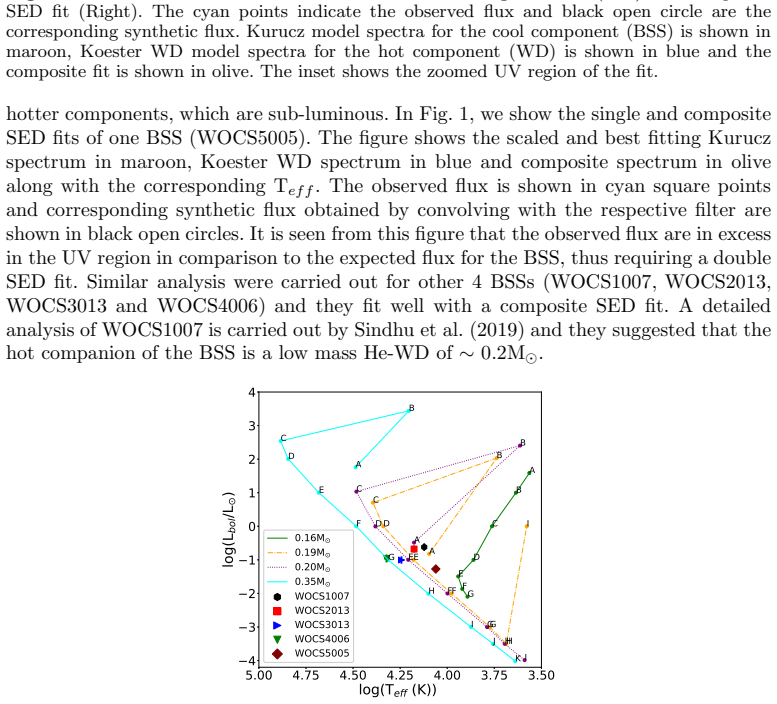
The load-bearing tool is composite spectral energy distribution (SED) fitting. A stellar-atmosphere model represents the cool blue straggler, a white-dwarf model represents the hot companion, and the two are scaled and summed so the combined synthetic fluxes match photometry from 0.12 to 11.5 $\mu$m. The single-star fit acts as the null hypothesis, and the residual ultraviolet excess is what motivates adding the second component, so the whole detection hinges on this comparison. A second piece of machinery, the placement of the hot components on a luminosity–temperature diagram against low-mass helium white dwarf evolutionary tracks, converts each fitted temperature and luminosity into a companion mass and an evolutionary interpretation.
What would settle it
Take an ultraviolet spectrum of one of the five systems, for instance WOCS 5005, with enough resolution to separate the companion's lines from the blue straggler's. If the hot component is not comoving with the blue straggler, or if its spectrum shows a main-sequence star, hot subdwarf, or background object rather than a white dwarf, the claimed detection for that system fails.
Extended reading notes
Core claim
On its own terms, the paper's central discovery is the detection of white dwarf companions to five blue stragglers in M67: WOCS 5005, 1007, 2013, 3013, and 4006. A single stellar-atmosphere model cannot account for the far-ultraviolet flux in these five; adding a white-dwarf model spectrum removes the residual and fits the full 0.12–11.5 $\mu$m spectral energy distribution. The fitted companions have effective temperatures of about 11,000–24,000 K and masses of 0.2–0.35 $M_\odot$, and they sit where low-mass helium white dwarf evolutionary tracks predict on a luminosity–temperature diagram. The paper therefore identifies them as low-mass helium white dwarfs formed by Roche-lobe overflow mass transfer.
Load-bearing premise
The ultraviolet excess in each of the five stars must come from a physically associated hot white dwarf, rather than from an unrelated hotter star, chromospheric activity, an underestimated dust extinction, or a background ultraviolet source along the same line of sight.
Editorial extensions
If this is right
- If the detections hold, M67 becomes a cluster with empirically identified blue straggler plus white dwarf systems, giving binary evolution models a concrete local testbed.
- The low companion masses (0.2–0.35 $M_\odot$) indicate helium white dwarfs, objects that ordinary single-star evolution cannot produce; their presence ties these blue stragglers to Roche-lobe overflow in close binaries.
- Because the companions are overwhelmed by the blue straggler in optical light and only appear in the ultraviolet, similar systems in other clusters will require UV photometry or spectroscopy to be found.
- The companion temperatures (11,000–24,000 K) fall in the range expected for post-mass-transfer remnants, supporting the interpretation that these are cooling white dwarfs left behind after mass transfer.
Reading between the lines
- A natural extension would be to search the same UV-excess signature in archived ultraviolet images of other open clusters; if similar detection fractions appear, mass transfer would look like a common rather than exceptional blue straggler formation route.
- Existing radial-velocity data for these five systems could test the interpretation: the orbital motion implied by a 0.2–0.35 $M_\odot$ companion should be measurable and should match the fitted companion masses.
- The white-dwarf cooling ages implied by the fitted temperatures could be combined with the cluster age to estimate when each mass-transfer event happened, potentially separating recent from ancient formation episodes.
Signed reviews
Editorial analysis
A structured set of objections, weighed in public.
Referee Report
Summary. This proceedings paper reports FUV observations of the old open cluster M67 taken with the UVIT instrument on ASTROSAT, and constructs multiwavelength SEDs (0.12-11.5 micron) for five blue straggler stars. The authors find that these five BSSs show excess UV flux in single-star SED fits and that composite Kurucz-plus-Koester fits are required. They interpret the hot components as low-mass helium white dwarfs with Teff ~ 11,000-24,000 K and masses ~0.2-0.35 solar masses, formed through mass transfer in close binaries. The detailed fitting procedure and most quantitative results are deferred to the authors' earlier papers (Sindhu et al. 2018, 2019).
Significance. If the detections hold, this would be a valuable contribution: direct UV evidence for white-dwarf companions to BSSs in M67, supporting the mass-transfer formation channel. The use of UVIT FUV photometry and composite SED fitting is well motivated, and comparison to Panei et al. (2007) tracks for low-mass He-WDs provides a physically grounded interpretation. However, the evidence presented in this manuscript is largely qualitative: only one SED fit is shown, no fit statistics or error bars are given, and no alternative hot-component models are tested. The abstract's 'detection' phrasing is stronger than the evidence presented and even stronger than the conclusions' 'possible WD companions.' The central claim is thus plausible but not established by the material in this paper alone.
major comments (5)
- [Section 3] The five BSSs are selected because they 'show significant excess UV flux in the residual single SED fit,' but no significance threshold, photometric uncertainty budget, or residual plot is provided for any star other than WOCS5005 (Fig. 1). Because the sample selection is the foundation of the central claim, the paper should either report quantitative excess significance for all five stars (e.g., UV excess in sigma or the fit chi2/dof for single versus composite fits) or explicitly label these as candidate systems whose selection is fully described in the companion papers.
- [Section 3, Fig. 1] The composite fits use only a Kurucz model for the BSS and a Koester WD model for the hot component; no alternative hot-component models (main-sequence companion, hot subdwarf, chromospheric continuum, or unrelated background UV source) are tested. Without fit statistics (chi2, degrees of freedom, residuals) or an argument for why these alternatives are excluded, the identification of the hot component as a white dwarf is not established by this manuscript.
- [Section 3, Fig. 2] The masses of 0.2-0.35 solar masses are read off Panei et al. (2007) He-WD tracks by placing the fitted Teff and luminosity on the H-R diagram. No error bars are given for these quantities, and the tracks presuppose that the companion is a helium-core white dwarf formed in binary evolution; this is a model-dependent step that is partly circular with respect to the WD identification. The paper should show the uncertainties and justify the adopted evolutionary tracks against other possible interpretations of the hot component.
- [Abstract vs. Section 4] The abstract states 'we present the detection of WD companions to 5 bright BSSs,' while the conclusions state 'the detection of possible WD companions.' This wording difference is material: the evidence shown in this paper supports candidate or possible detections, not confirmed detections. The abstract should be aligned with the more cautious conclusion unless additional confirmatory evidence (e.g., radial-velocity or proper-motion association, X-ray exclusion of active companions) is provided.
- [Sections 2 and 3] The details of the VOSA fitting and the composite SED construction are deferred to Sindhu et al. (2018) and Sindhu et al. (2019), and the present paper does not include fit-quality diagnostics or parameter uncertainties for the five systems. For a claim of detection, the manuscript should either summarize the essential fit statistics and error estimates for all five stars or explicitly frame this as a proceedings report of results published elsewhere.
minor comments (3)
- [Figure 1] The axis labels in Fig. 1 contain typographical errors ('erg −1', 'e g s−1') and the residual-panel axis label appears truncated; please correct these and verify the figure rendering.
- [Throughout] The object naming is inconsistent: 'WOCS 1007' appears in the Introduction while 'WOCS1007' is used elsewhere; please standardize the naming convention.
- [Figure 2] The legend text contains rendering artifacts such as '0⊙16M /uni2299' instead of proper solar-mass symbols; please ensure the astronomical symbols are typeset correctly.
Circularity Check
WD companions are effectively fit into existence: the hot component is modeled as a Koester WD and then reported as a detected WD.
-
fitted input called prediction
[Section 3 (Analysis), composite SED fitting; Section 4 (Conclusions)]
"We have used Kurucz model (Castelli et al. 1997) to fit the BSSs and Koester WD model (Koester 2010) to fit the hotter components, which are sub-luminous. ... The parameters (Luminosity, Teff and Mass) of the hot companion suggest them to be low mass WDs"
The hot component is fitted with a Koester WD atmosphere model, so its derived Teff and L are WD-model quantities; placing them on Panei et al. (2007) WD tracks to obtain masses presupposes the WD interpretation. The abstract's 'detection of WD companions' is therefore a restatement of the model chosen to represent the UV excess rather than an independent inference. Because the five targets were preselected for 'significant excess UV flux' in the single-SED residual, the composite fit with any hot component is guaranteed to improve; the only hot-component model tried is a WD, so the conclusion 'suggest them to be low mass WDs' reduces, by construction, to the input model assumption. The empirical UV excess is real, but the WD label is not independently established.
full rationale
The paper's derivation is a standard SED-fitting exercise on observed photometry, so the UV excess itself is not defined into existence. However, the central claim that the companions are white dwarfs is not independently derived: the hot component is parameterized with a Koester WD model, and the inferred masses come from WD evolutionary tracks, so the 'WD' conclusion is an assumed input rather than a tested output. No alternative hot-component models (e.g., main-sequence companions, hot subdwarfs, chromospheric emission) are fit, and no fit statistics or error bars are presented, which would be needed to show that the WD model is uniquely required. The deferral of fitting details to prior papers by overlapping authors (Sindhu et al. 2018, 2019) is a self-citation concern but not the main issue. The abstract's 'detection' is stronger than the conclusions' 'possible WD companions,' and the identification reduces to the adopted model, giving partial circularity.
Assumptions & free parameters
free parameters (5)
- Hot component effective temperature (per BSS) =
11,000-24,000 K
- Hot component luminosity scaling =
log L values shown in Fig. 2
- Cool BSS component Teff and scaling =
e.g., 6500 K for WOCS5005
- Extinction (E(B-V)) =
not stated
- WD mass =
0.2-0.35 M_sun
assumptions (5)
- domain assumption The five targets are genuine cluster members and are blue stragglers (Geller et al. 2015 membership and RV study).
- domain assumption UVIT photometry is correctly calibrated and corrected for aperture and saturation effects (Tandon et al. 2017).
- domain assumption Kurucz model atmospheres and Koester WD models provide adequate SEDs for the BSS and the hot companion.
- domain assumption The hot component is physically associated with the BSS and not a foreground or background object.
- domain assumption The Panei et al. (2007) evolutionary tracks, which assume binary evolution, are applicable for inferring companion masses.
Cite this review
Pith. "Pith review of Detection of White Dwarf Companions to Blue Straggler Stars from UVIT Observations of M67." pith.science (2026). https://pith.science/paper/AU4H5FPA
@misc{pith2026190801573,
  author       = {Pith},
  title        = {Pith review of: Detection of White Dwarf Companions to Blue Straggler Stars from UVIT Observations of M67},
  year         = {2026},
  howpublished = {\url{https://pith.science/paper/AU4H5FPA}},
  note         = {Machine review of arXiv:1908.01573}
}
abstract
We investigate the old open cluster M67 using ultraviolet photometric data of Ultra-Violet Imaging Telescope in multi-filter far-UV bands. M67, well known for the presence of several blue straggler stars (BSS), has been put to detailed tests to understand their formation pathways. Currently, there are three accepted formation channels: mass transfer due to Roche-lobe overflow in binary systems, stellar mergers either due to dynamical collisions or through coalescence of close binaries. So far, there had not been any confirmed detection of a white dwarf (WD) companion to any of the BSSs in this cluster. Here, we present the detection of WD companions to 5 bright BSSs in M67. The multiwavelength spectral energy distributions covering 0.12 -11.5 $\mu$m range, were found to require binary spectral fits for 5 BSSs, consisting of a cool (BSS) and a hot companion. The parameters (Luminosity, Temperature, Radius and Mass) of the hot companions suggest them to be WDs with mass in the range 0.2 - 0.35 M$_{\odot}$ with T$_{eff}$ $\sim$ 11000 - 24000 K.
Figures

Reference graph
Works this paper leans on
-
[1]
G., & Kurucz, R
Castelli, F., Gratton, R. G., & Kurucz, R. L. 1997, A&A, 318, 841
1997
-
[2]
M., Latham, D
Geller, A. M., Latham, D. W., & Mathieu, R. D. 2015, AJ, 150, 97
2015
-
[3]
Gosnell, N. M., Mathieu, R. D., Geller, A. M., Sills, A., Leig h, N., & Knigge, C. 2015, ApJ, 814, 163
work page 2015
- [4]
- [5]
-
[6]
Knigge, C., Dieball, A., Ma ´ ız Apell´ aniz, J., Long, K. S., Zurek, D. R., & Shara, M. M., 2008, ApJ, 683, 1006
work page 2008
-
[7]
2009, Nature, 457, 288
Knigge, C., Leigh, N., & Sills, A. 2009, Nature, 457, 288
2009
-
[8]
2011, MNRAS, 410, 2370
Leigh, N., & Sills, A. 2011, MNRAS, 410, 2370
2011
Show all 19 references
-
[9]
D., & Geller, A
Mathieu, R. D., & Geller, A. M. 2009, Nature, 462, 1032
2009
-
[10]
McCrea, W. H. 1964, MNRAS, 128, 147
1964
-
[11]
Milone, A. A. E., & Latham, D. W. 1992, IAU, 151, 475
1992
-
[12]
Naoz, S., & Fabrycky, D. C. 2014, ApJ, 793, 137
2014
-
[13]
A., Althaus, L
Panei, J. A., Althaus, L. G., Chen, X., & Han, Z. 2007, MNRAS, 382, 779
2007
-
[14]
B., & Fabrycky, D
Perets, H. B., & Fabrycky, D. C. 2009, ApJ, 697, 1048
2009
-
[15]
M., Leigh, N., Shara, M., Puzia, T
Sahu, S., Subramaniam, A., Simunovic, M., Postma, J., Cˆ ot´ e, P., Kameswera Rao, N., Geller, A. M., Leigh, N., Shara, M., Puzia, T. H., & Stetson, P. B. 2019 , ApJ, 876, 34
2019
-
[16]
D., & Sandquist, E
Shetrone, M. D., & Sandquist, E. L. 2000, AJ, 120, 1913
2000
-
[17]
Sindhu, N., Subramaniam, A., & Radha, C. A. 2018, MNRAS, 481, 226
2018
- [18]
-
[19]
2017, AJ, 154, 128
Sreekumar, P. 2017, AJ, 154, 128
2017
Reviewed August 14, 2026 · model on record in the stance chip above.
Discussion (0). Continue with ORCID to comment.