REVIEW 3 major objections 5 minor 12 references
How Perfect are Perfect Vortex Beams?
T0 review · 3 major / 5 minor · reviewed 2026-08-14 · deepseek-v4-flash
Pith's one-line read The paper proves that experimentally realizable 'perfect' vortex beams have a width that grows with orbital angular momentum, scaling as the square root of the topological charge in the best case.
desk verdict The exact width formula is useful and likely correct, but the paper's advertised sqrt(l) scaling in the R/T >> 1 limit rests on an invalid asymptotic simplification. read the letter →
The pith
A machine-rendered reading of the paper's core claim, the machinery that carries it, and where it could break.
The reading
What carries the argument
The load-bearing object is the quasi-perfect vortex field, a finite-thickness ring beam described by a modified Bessel function: $PV(r,\phi)\propto \exp[-(r^2+R^2)/T^2]I_\ell(2Rr/T^2)e^{i\ell\phi}$, where $R$ sets the nominal ring radius and $T$ the ring thickness. Its width is quantified by the standard second-moment definition, and the analytic integration of that definition produces the ratio $I_{\ell+1}(R^2/T^2)/I_\ell(R^2/T^2)$, which is the mechanism that makes the width depend on $\ell$. The combined parameter $R/T$ (set by the Bessel product $k_r w_0$) controls how visible the growth is: for $R/T\gg1$ the Bessel-function ratio approaches 1 and the width grows slowly as $\sqrt{\ell}$, while for small $R/T$ the growth is much stronger. The same ratio appears in the inversion condition used for compensation, and the paper connects the cutoff of that inversion to the OAM density limit $|\ell|/R\le k\,\mathrm{NA}$, which states that a helical phase cannot be compressed beyond a wavelength-scale area.
What would settle it
Measure the second-moment width of quasi-perfect vortices generated by Fourier-transforming an independently characterized Bessel-Gaussian beam, with $k_r$ and $w_0$ measured from the input beam and the lens focal length calibrated separately, over $\ell=0$ to at least 50 for several values of $R/T$; if the data deviate from Eq. (6) beyond experimental error, the analytic width is wrong. A second test targets the unattainability claim: any propagating helical beam whose measured second-moment width stays constant while $\ell$ varies over a wide range would contradict the conclusion.
Extended reading notes
Core claim
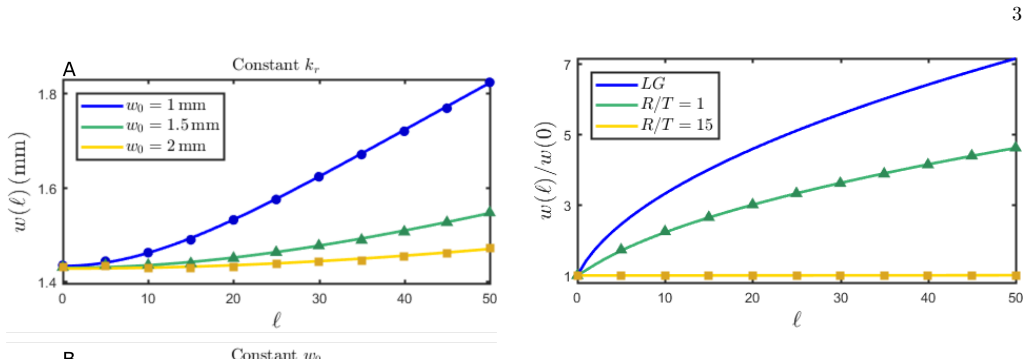
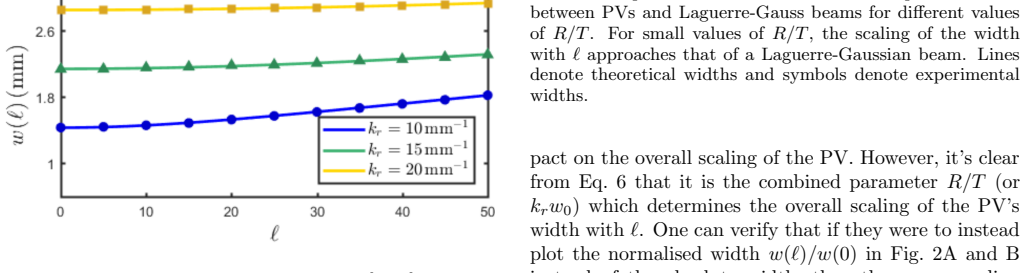
The paper's central claim is Eq. (6): for the quasi-perfect vortex field $PV(r,\phi)\propto \exp[-(r^2+R^2)/T^2]I_\ell(2Rr/T^2)e^{i\ell\phi}$, the second-moment width is exactly $w^2(\ell)=T^2(\ell+1)+R^2(1+I_{\ell+1}(R^2/T^2)/I_\ell(R^2/T^2))$. Evaluating the second-moment integrals analytically gives this closed form, and in the limit $R/T\gg1$ it reduces to $w^2(\ell)\approx T^2(\ell+1)+2R^2$, so the width scales as $\sqrt{\ell}$ even for the best-approximated perfect vortex. The paper confirms the formula by generating quasi-PVs with a spatial light modulator over $\ell\in[0,50]$, computing widths from camera images, and finding agreement for several values of the product $k_r w_0$ (equivalently $R/T$). It also shows that the combined parameter $R/T$, not $R$ or $T$ alone, sets the degree of 'perfectness', and it demonstrates a numerical compensation procedure that fixes the width by choosing $R(\ell)$, but only up to a cutoff where the required radius reaches zero. That cutoff is argued to be consistent with the optical OAM density limit $|\ell|/R\le k\,\mathrm{NA}$, and the paper concludes that no truly OAM-independent beam exists.
Load-bearing premise
The argument assumes the generated beam really is the finite-energy Bessel-Gaussian-derived ring field whose radius and thickness are set by the stated lens and beam parameters; if the hologram or Fourier lens distorts that field, the agreement between theory and measurement could be coincidental.
Editorial extensions
If this is right
- In the best-case regime $R/T\gg1$, the width of a quasi-perfect vortex grows as $\ell^{1/2}$, so applications that need a fixed ring size must either operate at low topological charge or actively compensate.
- The ratio $R/T$ (equivalently the Bessel product $k_r w_0$) is the figure of merit for 'perfectness'; experiments should report it, because small values make the beam behave much like a Laguerre-Gaussian mode and erase the advantage.
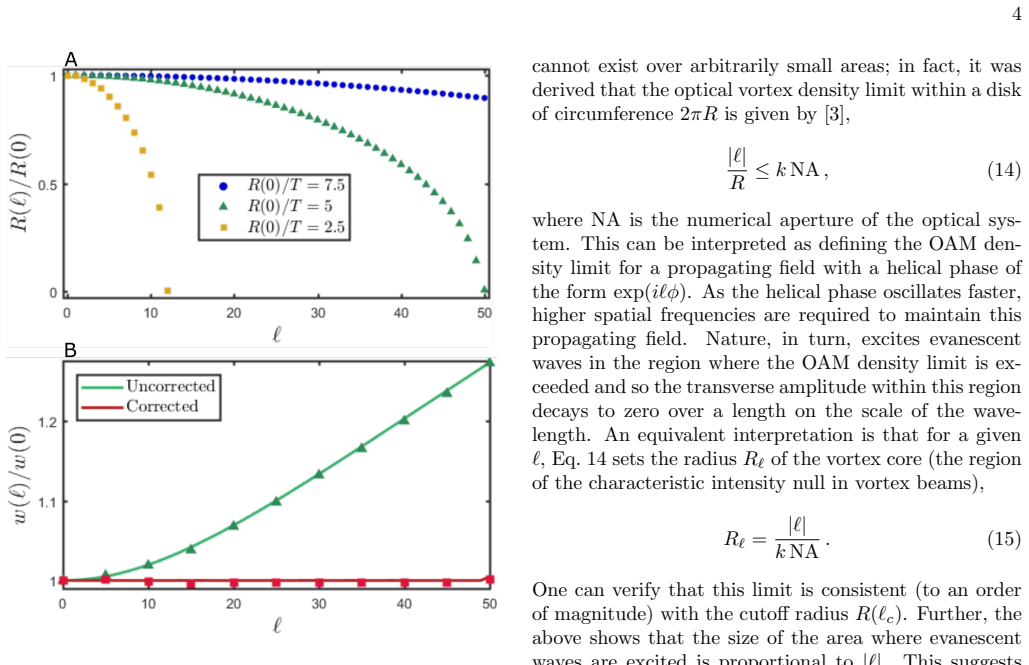
- The compensation scheme based on numerically inverting Eq. (13) can hold the width fixed for a range of $\ell$, but it fails above a cutoff $\ell_c$; past that point no realizable quasi-PV can maintain the $\ell=0$ width.
- The OAM density limit $|\ell|/R\le k\,\mathrm{NA}$ implies that any propagating beam with a helical phase has a vortex core whose radius grows with $\ell$, so a truly OAM-independent beam is unattainable.
- Prior reports of a small width increase over narrow ranges of $\ell$, sometimes attributed to systematic error, are consistent with Eq. (6); the effect is real and predictable.
Reading between the lines
- A testable extension is to generate quasi-PVs by the other standard route, creating the Bessel-Gaussian beam with an axicon and Fourier-transforming it with a lens, rather than using complex-amplitude modulation; if Eq. (6) holds across both routes, the formula is tied to the field itself, not to the encoding.
- The compensation procedure in the paper holds $T$ fixed while adjusting $R$; an untested extension is to dynamically adjust both parameters, which may push the usable cutoff to higher $\ell$.
- The same second-moment approach could be applied to other finite-energy approximations of ideal vortices, such as aperture-truncated or higher-order Bessel beams, to see whether the $\sqrt{\ell}$ scaling is universal or specific to the Bessel-Gaussian route.
Signed reviews
Editorial analysis
A structured set of objections, weighed in public.
Referee Report
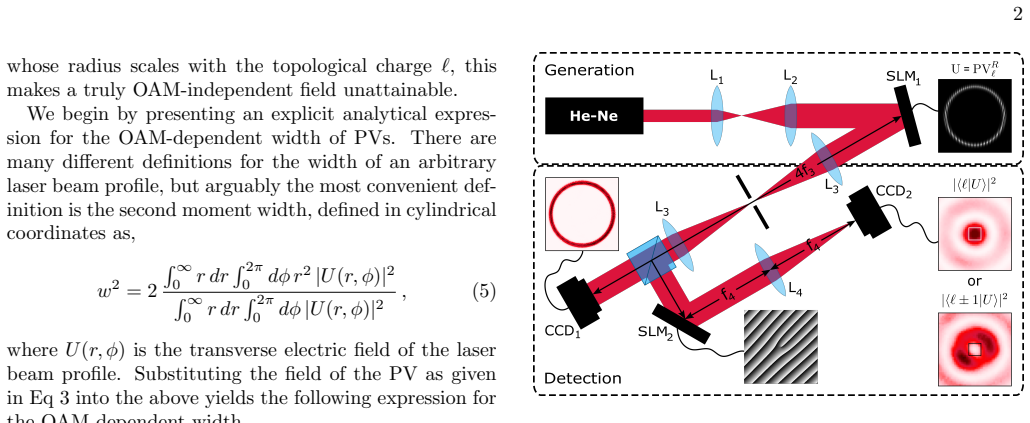
Summary. The paper derives an analytic expression for the second-moment width of quasi-perfect vortex (PV) beams described by Eq. (3), namely w2(l) = T^2(l+1) + R^2(1 + I_{l+1}(R^2/T^2)/I_l(R^2/T^2)). It reports agreement between this formula and CCD-measured widths for l in [0,50], proposes Eq. (7) as the large-R/T asymptotic simplification, and uses Eq. (7) to argue that even in the best case the PV width scales as sqrt(l). The paper also proposes a compensation scheme based on numerically inverting Eq. (13) to adjust the ring radius, associates a cutoff in that inversion with an OAM density limit, and concludes that a truly OAM-independent propagating beam is unattainable.
Significance. The exact result in Eq. (6) is a useful analytic contribution: it is derived from the stated field model without free parameters, and it correctly recovers the ideal-Bessel limit w2 = 2R^2 in Eq. (8). If the paper is revised, the precise width formula and the correct scaling regimes will be of practical value to groups generating quasi-PVs for trapping, tweezing, and communications. However, the current headline claims rest on Eq. (7), which is not a valid R/T >> 1 simplification, and on Eq. (13), which does not correctly implement the proposed compensation. These issues are load-bearing for the abstract and for the correction demonstration, so the manuscript needs substantial revision.
major comments (3)
- [Eq. (7)] Eq. (7) is not the R/T >> 1 limit of Eq. (6). For z = R^2/T^2, I_{l+1}(z)/I_l(z) = 1 - (l+1/2)/z + O(l^2/z^2). Substitution into Eq. (6) gives w2(l) = 2R^2 + T^2/2 + O(T^4 l^2/R^2), not T^2(l+1) + 2R^2; the T^2(l+1) term is cancelled by the correction from the Bessel-function ratio. Consequently the width is almost OAM-independent for l << R/T, and the claimed sqrt(l) scaling in the abstract and conclusion does not follow in the 'best' R/T >> 1 regime. In addition, the statement that Eq. (7) shows the asymptotic PV field of Eq. (4) has an OAM-dependent width is internally inconsistent, because the radial amplitude in Eq. (4) is independent of l.
- [Eq. (13) and Fig. 4] The stated compensation condition w2(l) = w2(0), with T held fixed, leads to x^2(1 + I_{l+1}(x^2)/I_l(x^2)) = x0^2(1 + I_1(x0^2)/I_0(x0^2)) - l, with x = R(l)/T and x0 = R(0)/T. Eq. (13) contains no x0 and is therefore independent of the initial radius, yet the text says it is inverted for different initial radii. Moreover, in the R/T >> 1 limit the left-hand side of Eq. (13) tends to l for every large x, so the equation is asymptotically degenerate and cannot select a unique correction radius. The authors should derive the correct inversion, repeat the numerical examples in Fig. 4A, and verify whether the corrected-width result in Fig. 4B remains valid.
- [Fig. 2 and experimental method] The experimental validation does not independently determine R and T. The theory curves use R = k_r f/k and T = 2f/(k w_0) from the nominal Bessel-Gaussian parameters, and the same parameters are used to encode the Eq. (3) field on the SLM. Agreement between Eq. (6) and the measured widths therefore tests the encoding plus the formula, but not the mapping from these parameters to the physical field. This does not affect the analytic derivation of Eq. (6), but it does weaken the claim that the expression is 'experimentally confirmed'; an independent measurement of R and T, or an explicit statement that the comparison is a consistency check, would be needed.
minor comments (5)
- [Page 1] The phrase 'it's finite-energy approximation' should read 'its finite-energy approximation'.
- [Pages 3-4] 'psuedo-gradient' should be 'pseudo-gradient', and 'the the ring thickness' contains a duplicated article.
- [After Eq. (6)] The sentence 'It should be noted that R and T are constants... As l changes, so too do these ring attributes' is confusing, since R and T were just called constants; please clarify that the actual ring radius and thickness of the quasi-PV differ from the l = 0 parameters R and T.
- [Fig. 3] The LG comparison curve is not defined; please state which LG mode and which width definition are used for the comparison.
- [Eq. (5)] The prefactor 2 in the second-moment definition should be stated explicitly, for example by noting that for an azimuthally symmetric field w2 = 2<r^2>, to avoid ambiguity with other common second-moment conventions.
Circularity Check
No significant circularity: Eq. 6 is derived from the stated quasi-PV field model and validated against independent CCD intensity measurements, with no width parameter fitted to the data.
full rationale
The paper's central result, Eq. 6, is obtained by substituting the model field of Eq. 3 into the standard second-moment width definition Eq. 5 and evaluating the integrals analytically. The parameters R and T entering Eq. 6 are fixed by the Bessel-Gaussian beam parameters according to R = kr f/k and T = 2f/(k w0); they are not fitted to the measured widths. Experimental widths are computed directly from CCD images via Eq. 9 and compared with Eq. 6, so the width formula is not an input to the measurement. The correction procedure in Eq. 13 is an inversion of the same derived formula, which is expected use of the result rather than circular reasoning. The only self-citation, Ref. [12] by the same authors, is used to justify that the modal decomposition setup quantitatively determines OAM content of PVs; this is not load-bearing for the width derivation, and it is independently supported by the cited method's prior use. The final argument invoking an OAM density limit relies on Ref. [3], an external source, not on the authors' own prior work. A separate mathematical concern exists: the claimed R/T >> 1 simplification to Eq. 7 appears to drop the leading I_{l+1}/I_l correction, which cancels the T^2(l+1) term to that order; however, this is an asymptotic-expansion correctness issue, not circularity, because it does not involve fitting, self-citation, or definitional equivalence. Therefore the derivation is self-contained against an external measurement and receives a circularity score of 0.
Assumptions & free parameters
assumptions (4)
- domain assumption The field of a quasi-perfect vortex obtained from a Bessel-Gaussian beam is given by Eq. 3: exp(-(r^2+R^2)/T^2) I_l(2Rr/T^2) exp(i l phi).
- domain assumption The standard second-moment width definition, Eq. 5, is the appropriate measure of beam width for vortex rings.
- standard math Modified Bessel function integral identities and asymptotic forms used to simplify Eq. 6 are valid.
- domain assumption The OAM density limit |l|/R <= k NA, Eq. 14 from Roux (2003), applies to these fields and supports the final no-go claim.
Cite this review
Pith. "Pith review of How Perfect are Perfect Vortex Beams?." pith.science (2026). https://pith.science/paper/AU4IXY3M
@misc{pith2026190804428,
  author       = {Pith},
  title        = {Pith review of: How Perfect are Perfect Vortex Beams?},
  year         = {2026},
  howpublished = {\url{https://pith.science/paper/AU4IXY3M}},
  note         = {Machine review of arXiv:1908.04428}
}
abstract
Perfect (optical) vortex (PV) beams are fields which are mooted to be independent of the orbital angular momentum (OAM) they carry. To date, the best experimental approximation of these modes is obtained from passing Bessel-Gaussian beams through a Fourier lens. However, the OAM-dependent width of these quasi-PVs is not precisely known and is often understated. We address this here by deriving and experimentally confirming an explicit analytic expression for the second moment width of quasi-PVs. We show that the width scales in proportion to $\sqrt{\ell}$ in the best case, the same as most "regular" vortex modes albeit with a much smaller proportionality constant. Our work will be of interest to the large community who seek to use such structured light fields in various applications, including optical trapping, tweezing and communications.
Figures
Figures from the paper (1 more)
Reference graph
Works this paper leans on
- [1]
-
[2]
M. J. Padgett, Optics Express 25, 11265 (2017)
work page 2017
-
[3]
F. S. Roux, Optics Communications 223, 31 (2003)
work page 2003
-
[4]
A. S. Ostrovsky, C. Rickenstorff-Parrao, and V. Arriz´ on, Optics letters 38, 534 (2013)
work page 2013
-
[5]
F. Gori, G. Guattari, and C. Padovani, Opt. Commun. 64, 491 (1987)
work page 1987
- [6]
-
[7]
A. Sabatyan and Z. Behjat, Optical and Quantum Elec- tronics 49 (2017), https://doi.org/10.1007/s11082-017- 1211-4. 5
- [8]
Show all 12 references
-
[9]
Garc´ ıa-Garc´ ıa, C
J. Garc´ ıa-Garc´ ıa, C. Rickenstorff-Parrao, R. Ramos- Garc´ ıa, V. Arriz´ on, and A. S. Ostrovsky, Opt. Lett.39, 5305 (2014)
2014
-
[10]
Arrizon, U
V. Arrizon, U. Ruiz, R. Carrada, and L. A. Gonzalez, J. Opt. Soc. Am. 24, 3500 (2007)
2007
-
[11]
Forbes, A
A. Forbes, A. Dudley, and M. McLaren, Advances in Optics and Photonics 8, 200 (2016)
2016
-
[12]
Pinnell, V
J. Pinnell, V. Rodr´ ıguez-Fajardo, and A. Forbes, Opt. Lett. 44, 2736 (2019)
2019
Reviewed August 14, 2026 · model on record in the stance chip above.
Discussion (0). Continue with ORCID to comment.