An SKA-Low RM Grid for constraining the origin of cosmic magnetism
Pith reviewed 2026-06-25 22:48 UTC · model grok-4.3
The pith
SKA-Low will produce more than 50,000 rotation measures at 0.05 rad/m² precision across 10,000 square degrees.
A machine-rendered reading of the paper's core claim, the machinery that carries it, and where it could break.
Core claim
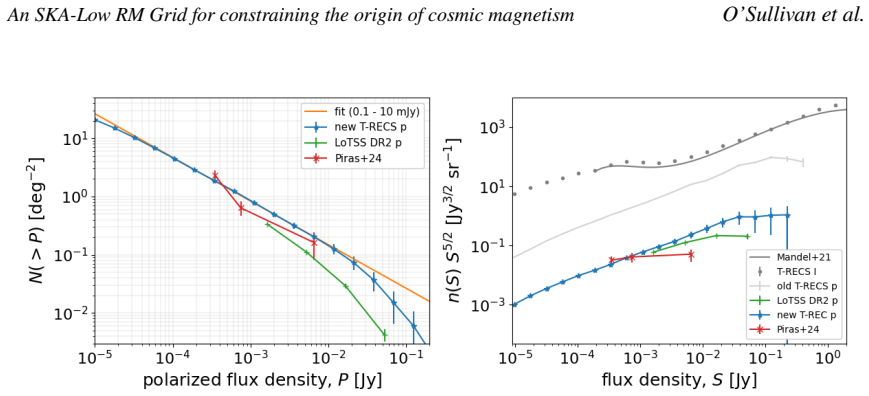
Modeling the polarized source counts as N(>P) ∼ 5 (P/100 μJy)^{-0.75} deg^{-2} shows that SKA-Low can generate the leading RM grid of the SKA era, delivering more than 50,000 RMs at ∼0.05 rad/m² precision for a 10,000 deg² survey in ∼3,200 hours and up to 100,000 RMs when wide-area and all-sky data are combined.
What carries the argument
The power-law extrapolation of metre-wavelength polarized source counts that sets the expected RM grid density at SKA-Low flux thresholds.
If this is right
- At least tenfold increase in RM grid density relative to the current best metre-wavelength surveys.
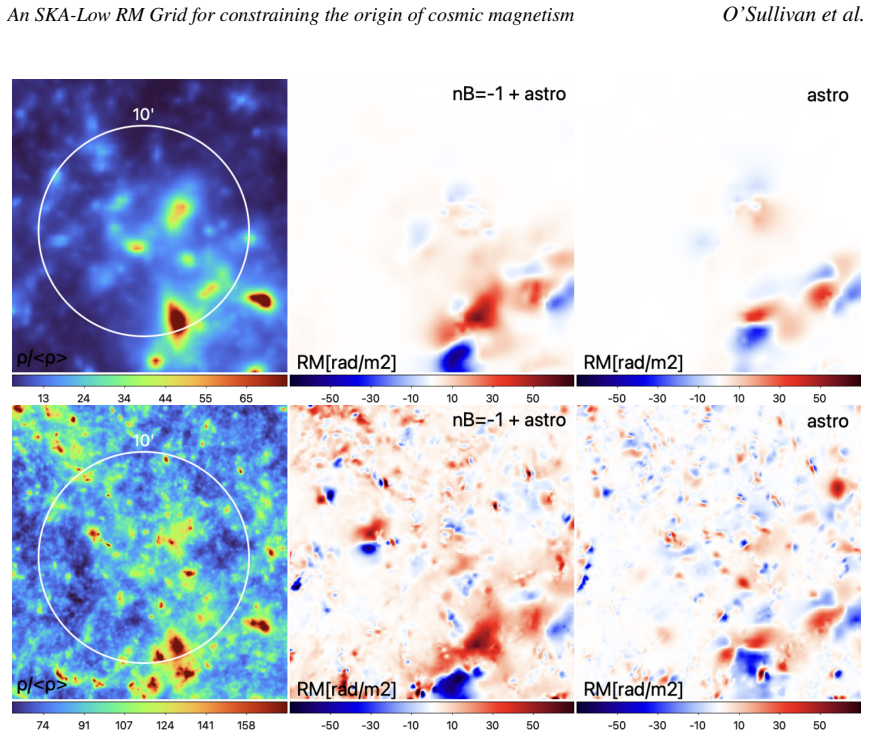
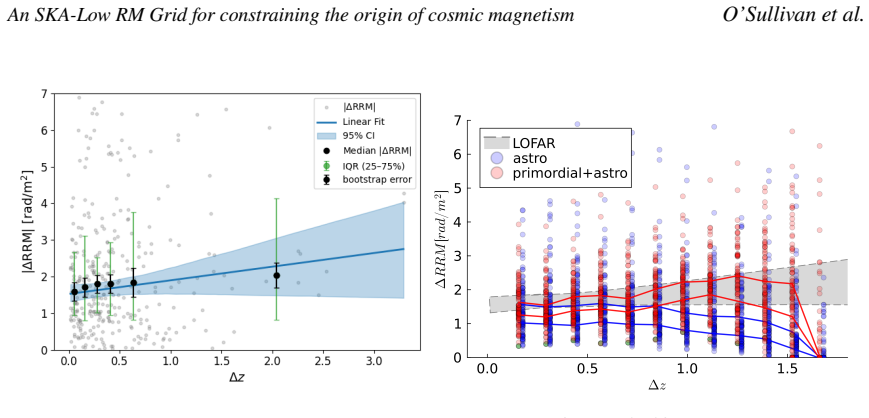
- Direct comparison of observed RMs with cosmological MHD simulations to constrain magnetic-field seeding and amplification mechanisms.
- Up to 100,000 m-λ RMs detectable across the full observable sky when wide-area and all-sky data sets are merged.
- Early verification possible with AA* data yielding ∼2.6 RMs per square degree at a 240 μJy threshold.
Where Pith is reading between the lines
- A grid of this size and precision could separate primordial-seeding from astrophysical-amplification scenarios by mapping field strength on the largest cosmic scales.
- Repeated observations over time could track the redshift evolution of magnetized structures in the circumgalactic and intergalactic media.
- The same data would furnish a dense foreground screen for correcting Faraday rotation in future 21-cm intensity-mapping experiments.
Load-bearing premise
The adopted power-law form and normalization of polarized source counts continue to hold at the faint polarized intensities reached by SKA-Low.
What would settle it
A direct measurement of the surface density of polarized sources at 10–50 μJy that lies more than a factor of two away from the extrapolated power law.
Figures
read the original abstract
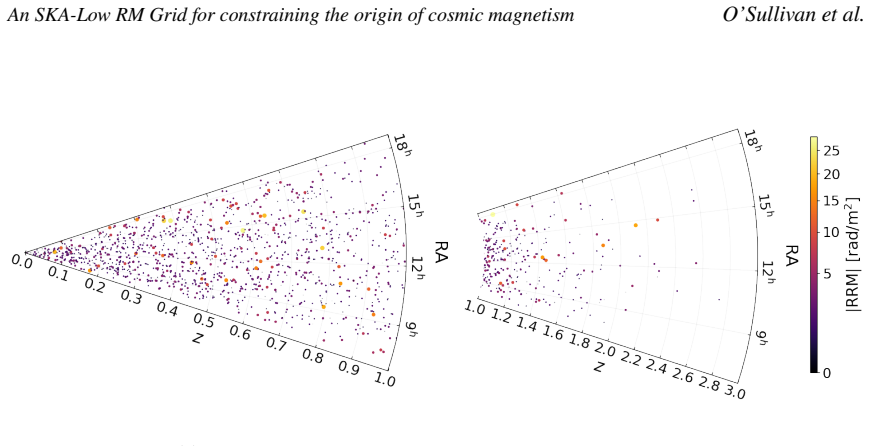
Understanding the origin and evolution of cosmic magnetic fields is a key science goal for the SKAO. Recent advances in metre-wavelength (m-$\lambda$) Faraday rotation measure (RM) grids are enabling precision probes of cosmic magnetism, with implications extending to early-Universe physics, AGN feedback, and the magnetized circumgalactic medium. Here we model the m-$\lambda$ polarized source counts to predict an RM Grid density with SKA-Low of $N(>P) \sim 5 ({P}/{100{\rm \mu Jy}})^{-0.75}\,\, {\rm deg}^{-2} $, where $P$ is the polarized intensity detection threshold. This represents at least an order of magnitude improvement over the current state-of-the-art. For a representative wide-area SKA-Low AA4 survey covering 10,000 deg$^2$ in $\sim$3,200 hours, we predict more than 50,000 RMs. Coupled with an expected RM precision of $\sim$0.05 rad/m$^2$, SKA-Low promises to produce the leading RM Grid survey for constraining the origin of cosmic magnetism in the SKA era. These predictions can be partially tested during the Science Verification phase using the AA* Sky Model data. For example, at a nominal detection threshold of 240~$\mu$Jy/beam (8 times the noise in Stokes $Q$ and $U$), we expect $\sim$2.6 RMs/deg$^2$ (5x the current best m-$\lambda$ RM Grid density). Combining both wide-area and all-sky data, SKA-Low could detect up to 100,000 m-$\lambda$ RMs across its observable sky. Finally, we demonstrate new constraints on the origin of cosmic magnetism by comparing cosmological MHD simulations with the LOFAR m-$\lambda$ RMs, and highlight the transformative advances an SKA-Low RM Grid will enable for precision studies of cosmic magnetism.
Editorial analysis
A structured set of objections, weighed in public.
Referee Report
Summary. The manuscript models meter-wavelength polarized source counts to predict an SKA-Low RM grid density of N(>P) ~ 5 (P/100 μJy)^{-0.75} deg^{-2}. For a 10,000 deg² AA4 survey it forecasts >50,000 RMs at ~0.05 rad/m² precision (an order-of-magnitude gain), illustrates partial tests with AA* data, and demonstrates current constraints on cosmic magnetism by comparing LOFAR RMs with cosmological MHD simulations.
Significance. If the source-count model holds, the predicted RM grid would materially advance precision studies of cosmic magnetism, enabling tighter constraints on early-Universe fields, AGN feedback, and the magnetized CGM. The LOFAR–MHD comparison already supplies a concrete, falsifiable demonstration of the method.
major comments (2)
- [Abstract] Abstract: the headline prediction (>50,000 RMs over 10,000 deg²) is obtained by integrating the quoted power-law N(>P) ~ 5 (P/100 μJy)^{-0.75} deg^{-2} down to the survey threshold. The functional form and normalization are stated to come from 'modeling' but the abstract (and, on the information supplied, the methods) supplies neither the input catalogs, fitting procedure, nor any cross-check against existing deep m-λ polarized catalogs at P ≲ 100 μJy. Without these, the integrated density and the 'order of magnitude improvement' claim cannot be assessed.
- [Abstract] Abstract: no error bars, sensitivity tests, or alternative slope/normalization scenarios are reported for the source-count integral. A plausible flattening or change in normalization below current detection limits would shift the predicted RM count by a factor of several, directly affecting the central quantitative claim.
minor comments (1)
- [Abstract] The statement that predictions 'can be partially tested during the Science Verification phase using the AA* Sky Model data' is left at a high level; a short quantitative example (e.g., expected number of sources at the quoted 240 μJy threshold) would strengthen the claim.
Simulated Author's Rebuttal
We thank the referee for their careful and constructive review. We address each major comment below and commit to revisions that will strengthen the presentation of the source-count model.
read point-by-point responses
-
Referee: [Abstract] Abstract: the headline prediction (>50,000 RMs over 10,000 deg²) is obtained by integrating the quoted power-law N(>P) ~ 5 (P/100 μJy)^{-0.75} deg^{-2} down to the survey threshold. The functional form and normalization are stated to come from 'modeling' but the abstract (and, on the information supplied, the methods) supplies neither the input catalogs, fitting procedure, nor any cross-check against existing deep m-λ polarized catalogs at P ≲ 100 μJy. Without these, the integrated density and the 'order of magnitude improvement' claim cannot be assessed.
Authors: We agree that the abstract is too concise and that the methods section would benefit from greater explicitness on this point. In revision we will (i) expand the abstract to state the principal input catalogs and the fitting approach used to obtain the quoted power-law parameters, (ii) add a short methods subsection that tabulates the catalogs, describes the fitting procedure, and reports the cross-checks performed against existing deep m-λ polarized fields, and (iii) note that the AA* Sky Model data provide a partial validation at 240 μJy. These changes will allow readers to assess the integrated density and the order-of-magnitude claim directly. revision: yes
-
Referee: [Abstract] Abstract: no error bars, sensitivity tests, or alternative slope/normalization scenarios are reported for the source-count integral. A plausible flattening or change in normalization below current detection limits would shift the predicted RM count by a factor of several, directly affecting the central quantitative claim.
Authors: We accept this criticism. The revised manuscript will include (i) formal uncertainties on the fitted slope and normalization propagated through the integral, (ii) a sensitivity analysis showing the range of predicted RM counts when the slope is varied by ±0.1 and the normalization by ±30 %, and (iii) an explicit discussion of the possible impact of a flattening below ~100 μJy. These results will be added both to the abstract (as a parenthetical range) and to a new paragraph in the main text. revision: yes
Circularity Check
No significant circularity in the derivation chain
full rationale
The paper states it models the m-λ polarized source counts to obtain the density formula N(>P) ~ 5 (P/100 μJy)^{-0.75} deg^{-2} and then integrates that model to forecast RM counts for SKA-Low. This is a forward-model prediction rather than a fitted parameter or self-referential definition. No load-bearing self-citations, uniqueness theorems, or reductions of the headline prediction (>50,000 RMs) to the input data by construction appear in the abstract or quoted sections. The extrapolation assumption is an external modeling choice, not a circular step.
Axiom & Free-Parameter Ledger
free parameters (2)
- normalization constant 5
- power-law index -0.75
axioms (1)
- domain assumption Polarized source counts follow a single unbroken power law down to SKA-Low thresholds
Reference graph
Works this paper leans on
-
[1]
T. M. C. Abbott et al. , 239 0 (2): 0 18, Dec. 2018. doi:10.3847/1538-4365/aae9f0
-
[2]
M. Abitbol et al. , 2025 0 (8): 0 034, Aug. 2025. doi:10.1088/1475-7516/2025/08/034
-
[3]
P. Ade et al. Journal of Cosmology and Astroparticle Physics, 2019 0 (2): 0 056, Feb. 2019. doi:10.1088/1475-7516/2019/02/056
-
[4]
G. Agazie et al. The Astrophysical Journal Letters, 951 0 (1): 0 L8, June 2023. ISSN 2041-8205. doi:10.3847/2041-8213/acdac6. URL https://dx.doi.org/10.3847/2041-8213/acdac6. Publisher: The American Astronomical Society
-
[5]
D. Alonso-L \'o pez et al. , 705: 0 A143, Jan. 2026. doi:10.1051/0004-6361/202556287
-
[6]
A. Amaral, T. Vernstrom, and B. M. Gaensler. Monthly Notices of the Royal Astronomical Society, 503 0 (2): 0 2913, 2021. doi:10.1093/mnras/stab564. URL http://arxiv.org/abs/2102.11312v2. Publisher: Cornell University Library
-
[7]
C. S. Anderson et al. Monthly Notices of the Royal Astronomical Society, 533 0 (4): 0 4068--4080, Oct. 2024. doi:10.1093/mnras/stae1954
-
[8]
R. Beck and B. M. Gaensler . New Astron. Rev., 48: 0 1289--1304, Dec. 2004. doi:10.1016/j.newar.2004.09.013
-
[9]
P. N. Best et al. , 523 0 (2): 0 1729--1755, Aug. 2023. doi:10.1093/mnras/stad1308
-
[10]
J. Blunier and A. Neronov. Astronomy and Astrophysics, 691: 0 A34, March 2024. doi:10.1051/0004-6361/202450138. URL http://arxiv.org/abs/2403.13418. arXiv: 2403.13418
-
[11]
K. B \"o ckmann et al. Astronomy and Astrophysics, 678: 0 A56, August 2023. doi:10.1051/0004-6361/202346777. URL http://arxiv.org/abs/2308.11391. arXiv: 2308.11391
-
[12]
A. Bonaldi et al. Monthly Notices of the Royal Astronomical Society, 482 0 (1): 0 2--19, January 2019. ISSN 0035-8711, 1365-2966. doi:10.1093/mnras/sty2603. URL http://arxiv.org/abs/1805.05222. arXiv:1805.05222 [astro-ph]
-
[13]
A. Bonaldi et al. Monthly Notices of the Royal Astronomical Society, 524 0 (1): 0 993--1007, July 2023. ISSN 0035-8711, 1365-2966. doi:10.1093/mnras/stad1913. URL http://arxiv.org/abs/2305.10175. arXiv:2305.10175 [astro-ph]
-
[14]
K. Bondarenko, A. Boyarsky, A. Sokolenko, and I. Vovk. arXiv e-prints, page arXiv:2404.17402, April 2024. doi:10.48550/arXiv.2404.17402. URL http://arxiv.org/abs/2404.17402. arXiv: 2404.17402
-
[15]
M. Booth et al. arXiv e-prints, art. arXiv:2407.01413, July 2024. doi:10.48550/arXiv.2407.01413
-
[16]
A. Botteon et al. , 499 0 (1): 0 L11--L15, Dec. 2020. doi:10.1093/mnrasl/slaa142
-
[17]
A. Brandenburg, O. Iarygina, E. I. Sfakianakis, and R. Sharma. Journal of Cosmology and Astroparticle Physics, 2024 0 (12): 0 057, August 2024. doi:10.1088/1475-7516/2024/12/057. URL https://doi.org/10.1088/1475-7516/2024/12/057. Publication Title: arXiv e-prints ADS Bibcode: 2024arXiv240817413B
-
[18]
E. Carretti and F. Vazza . Universe, 11 0 (5): 0 164, May 2025. doi:10.3390/universe11050164
-
[19]
E. Carretti et al. Monthly Notices of the Royal Astronomical Society, 512 0 (1): 0 945, 2022. doi:10.1093/mnras/stac384. URL http://arxiv.org/abs/2202.04607v1. Publisher: Cornell University Library
-
[21]
E. Carretti et al. , 518 0 (2): 0 2273--2286, Jan. 2023. doi:10.1093/mnras/stac2966
-
[22]
E. Carretti et al. Astronomy and Astrophysics, 693: 0 A208, Jan. 2025. doi:10.1051/0004-6361/202451333
-
[23]
J. Dietl et al. Astronomy and Astrophysics, 691: 0 A286, January 2024. doi:10.1051/0004-6361/202449354. URL http://arxiv.org/abs/2401.17281. arXiv: 2401.17281
-
[24]
Euclid Collaboration et al. , 662: 0 A112, June 2022. doi:10.1051/0004-6361/202141938
-
[25]
B. M. Gaensler et al. The polarisation sky survey of the universe's magnetism (possum): Science goals and survey description, May 2025. URL http://arxiv.org/abs/2505.08272. arXiv:2505.08272 [astro-ph]
arXiv 2025
-
[26]
J. E. Geach et al. Nature, 621 0 (7979): 0 483--486, September 2023. ISSN 1476-4687. doi:10.1038/s41586-023-06346-4. URL https://www.nature.com/articles/s41586-023-06346-4. Publisher: Nature Publishing Group
-
[27]
Y. A. Gordon et al. The Astrophysical Journal Supplement Series, 267 0 (2): 0 37, 2023. doi:10.3847/1538-4365/acda30. URL http://arxiv.org/abs/2303.12830v1. Publisher: Cornell University Library
-
[28]
F. Govoni et al. Science, 364 0 (6444): 0 981--984, June 2019. doi:10.1126/science.aat7500
-
[29]
N. Gupta et al. Publications of the Astronomical Society of Australia, 41: 0 e027, March 2024. doi:10.1017/pasa.2024.25. URL http://arxiv.org/abs/2403.14235. arXiv: 2403.14235
-
[30]
S. Hackstein et al. Monthly Notices of the Royal Astronomical Society, 475 0 (2): 0 2519, 2018. doi:10.1093/mnras/stx3354. URL http://arxiv.org/abs/1710.01353v2. Publisher: Cornell University Library
-
[31]
M. J. Hardcastle et al. Astronomy and Astrophysics, 678, October 2023. ISSN 14320746. doi:10.1051/0004-6361/202347333. arXiv: 2309.00102 Publisher: EDP Sciences
-
[32]
M. J. Hardcastle et al. , 539 0 (2): 0 1856--1878, May 2025. doi:10.1093/mnras/staf622
-
[33]
G. Heald et al. Galaxies, 8 0 (3): 0 53, 2020. doi:10.3390/galaxies8030053. URL http://arxiv.org/abs/2006.03172v1. Publisher: Cornell University Library
-
[34]
V. Heesen et al. Astronomy & Astrophysics, 670: 0 L23, Feb. 2023. ISSN 0004-6361, 1432-0746. doi:10.1051/0004-6361/202346008. URL https://www.aanda.org/10.1051/0004-6361/202346008
-
[35]
M. Hoeft et al. , 654: 0 A68, Oct. 2021. doi:10.1051/0004-6361/202039725
-
[36]
S. Hutschenreuter et al. Astronomy and Astrophysics, 657: 0 A43, 2022. doi:10.1051/0004-6361/202140486. URL http://arxiv.org/abs/2102.01709v1. Publisher: Cornell University Library
-
[37]
Z . Ivezi \'c et al. , 873 0 (2): 0 111, Mar. 2019. doi:10.3847/1538-4357/ab042c
-
[38]
K. Jedamzik and L. Pogosian. Physical Review Letters, 125 0 (18): 0 181302, 2020. doi:10.1103/PhysRevLett.125.181302. URL http://arxiv.org/abs/2004.09487v2. Publisher: Cornell University Library
-
[39]
M. Johnston-Hollitt et al. Advancing Astrophysics with the Square Kilometre Array (AASKA14), astro-ph.CO: 0 92, 2015. doi:10.22323/1.215.0092. URL http://arxiv.org/abs/1506.00808v1. Publisher: Cornell University Library
-
[40]
J. P. Leahy. Monthly Notices of the Royal Astronomical Society, 226 0 (2): 0 433--446, 1987. doi:10.1093/mnras/226.2.433. URL https://doi.org/10.1093/mnras/226.2.433
-
[41]
J. Lin et al. RAS Techniques and Instruments, 3 0 (1): 0 737--747, November 2024. doi:10.1093/rasti/rzae051. URL https://doi.org/10.1093/rasti/rzae051. Publication Title: arXiv e-prints ADS Bibcode: 2024arXiv241103931L
-
[42]
F. Loi et al. , 485 0 (4): 0 5285--5293, June 2019. doi:10.1093/mnras/stz350
-
[43]
Loi et al
F. Loi et al. In Advancing Astrophysics with the SKA -- II (AASKAII). 2026. arXiv search: Report number AASKAII/Loi01
2026
-
[44]
V. H. Mahatma et al. Monthly Notices of the Royal Astronomical Society, 502 0 (1): 0 273, 2021. doi:10.1093/mnras/staa3980. URL http://arxiv.org/abs/2012.11990v1. Publisher: Cornell University Library
-
[45]
S. Mandal et al. Astronomy and Astrophysics, 648: 0 A5, April 2021. ISSN 0004-6361. doi:10.1051/0004-6361/202039998. URL https://ui.adsabs.harvard.edu/abs/2021A&A...648A...5M. ADS Bibcode: 2021A&A...648A...5M
-
[46]
M. Mevius . RMextract: Ionospheric Faraday Rotation calculator . Astrophysics Source Code Library, record ascl:1806.024, June 2018
2018
-
[47]
K. Migkas, F. Pacaud, T. Tuominen, and N. Aghanim. Astronomy & Astrophysics, 698: 0 A270, June 2025. ISSN 0004-6361, 1432-0746. doi:10.1051/0004-6361/202554944. URL https://www.aanda.org/10.1051/0004-6361/202554944
-
[49]
S. Mtchedlidze et al. The Astrophysical Journal, 977 0 (1): 0 128, June 2024. doi:10.3847/1538-4357/ad8dc5. URL http://arxiv.org/abs/2406.16230. arXiv: 2406.16230
-
[50]
F. Naokawa. Universal profile for cosmic birefringence tomography with radio galaxies, April 2025. URL http://arxiv.org/abs/2504.06709. arXiv:2504.06709 [astro-ph]
arXiv 2025
-
[51]
A. Neronov and I. Vovk. Science, 328 0 (5974): 0 73, 2010. doi:10.1126/science.1184192. URL http://arxiv.org/abs/1006.3504v1. Publisher: Cornell University Library
-
[52]
A. Neronov, A. R. Pol, C. Caprini, and D. Semikoz. Physical Review D, 103 0 (4), February 2021. ISSN 24700029. doi:10.1103/PhysRevD.103.L041302. Publisher: American Physical Society
-
[53]
A. Neronov, F. Vazza, S. Mtchedlidze, and E. Carretti. Revision of upper bound on volume-filling intergalactic magnetic fields with lofar, December 2024. URL http://arxiv.org/abs/2412.14825. arXiv:2412.14825 [astro-ph]
arXiv 2024
-
[54]
N. Oppermann et al. Astronomy and Astrophysics, 575: 0 1--25, March 2015. ISSN 14320746. doi:10.1051/0004-6361/201423995. arXiv: 1404.3701 Publisher: EDP Sciences
-
[55]
S. P. O'Sullivan et al. Monthly Notices of the Royal Astronomical Society, 475 0 (3): 0 4263--4277, April 2018. ISSN 13652966. doi:10.1093/MNRAS/STY171. arXiv: 1801.02452 Publisher: Oxford University Press
-
[57]
S. P. O'Sullivan et al. , 495 0 (3): 0 2607--2619, May 2020. doi:10.1093/mnras/staa1395
-
[58]
S. P. O'Sullivan et al. Monthly Notices of the Royal Astronomical Society, 519 0 (4): 0 5723--5742, 2023. doi:10.1093/mnras/stac3820. URL https://doi.org/10.1093/mnras/stac3820. arXiv: 2301.07697v1
-
[59]
D. Paoletti and F. Finelli . JCAP, 2019 0 (11): 0 028, Nov. 2019. doi:10.1088/1475-7516/2019/11/028
-
[60]
M. Pavi c evi \'c et al. Physical Review Letters, January 2025. doi:10.1103/77rd-vkpz. URL https://doi.org/10.1103/77rd-vkpz. Publication Title: arXiv e-prints ADS Bibcode: 2025arXiv250106299P
-
[61]
R. Pell \'o et al. In J. J. Bryant, K. Motohara, and J. R. D. Vernet, editors, Ground-based and Airborne Instrumentation for Astronomy X, volume 13096, page 1309615. International Society for Optics and Photonics, SPIE, 2024. doi:10.1117/12.3019047. URL https://doi.org/10.1117/12.3019047
-
[62]
G. V. Pignataro et al. Astronomy & Astrophysics, 682: 0 A105, February 2024. ISSN 0004-6361, 1432-0746. doi:10.1051/0004-6361/202346243. URL https://www.aanda.org/10.1051/0004-6361/202346243
-
[63]
G. V. Pignataro et al. Detection of magnetic fields in superclusters of galaxies, March 2025. URL http://arxiv.org/abs/2503.08765. arXiv:2503.08765 [astro-ph]
arXiv 2025
-
[64]
S. Piras et al. Astronomy and Astrophysics, 687: 0 A267, June 2024. doi:10.1051/0004-6361/202349085. URL http://arxiv.org/abs/2406.08346. arXiv: 2406.08346
-
[65]
Planck Collaboration et al. , 594: 0 A19, Sept. 2016. doi:10.1051/0004-6361/201525821
-
[66]
V. P. Pomakov et al. Monthly Notices of the Royal Astronomical Society, 515 0 (1): 0 256--270, September 2022. ISSN 13652966. doi:10.1093/mnras/stac1805. arXiv: 2208.01336 Publisher: Oxford University Press
-
[67]
R. Ramesh, D. Nelson, V. Heesen, and M. Br \"u ggen. Monthly Notices of the Royal Astronomical Society, 526 0 (4): 0 5483, May 2023. doi:10.1093/mnras/stad3104. URL http://arxiv.org/abs/2305.11214. arXiv: 2305.11214
-
[68]
C. J. Riseley et al. Publications of the Astronomical Society of Australia, 37: 0 e029, 2020. doi:10.1017/pasa.2020.20. URL http://arxiv.org/abs/2005.09266v1. Publisher: Cornell University Library
-
[69]
M. Sanati et al. Astronomy and Astrophysics, 690: 0 A59, October 2024. ISSN 0004-6361. doi:10.1051/0004-6361/202449822. URL https://ui.adsabs.harvard.edu/abs/2024A&A...690A..59S. Publisher: EDP ADS Bibcode: 2024A&A...690A..59S
-
[70]
D. H. Schnitzeler. Monthly Notices of the Royal Astronomical Society: Letters, 409 0 (1), November 2010. ISSN 17453933. doi:10.1111/j.1745-3933.2010.00957.x
-
[71]
C. Sobey et al. , 661: 0 A87, May 2022. doi:10.1051/0004-6361/202142636
-
[72]
J. M. Stil, M. Krause, R. Beck, and A. R. Taylor. The Astrophysical Journal, 693 0 (2): 0 1392, 2009. doi:10.1088/0004-637X/693/2/1392. URL http://arxiv.org/abs/0810.2303v1
-
[73]
J. M. Stil , A. R. Taylor , and C. Sunstrum . ApJ, 726: 0 4, Jan. 2011. doi:10.1088/0004-637X/726/1/4
-
[74]
C. Stuardi et al. Astronomy and Astrophysics, 638: 0 A48, 2020. doi:10.1051/0004-6361/202037635. URL http://arxiv.org/abs/2004.05169v1. Publisher: Cornell University Library
-
[75]
H. Tanimura et al. Astronomy and Astrophysics, 637: 0 A41, 2020 a . doi:10.1051/0004-6361/201937158. URL http://arxiv.org/abs/1911.09706v1. Publisher: Cornell University Library
-
[76]
H. Tanimura et al. Astronomy and Astrophysics, 643, November 2020 b . ISSN 14320746. doi:10.1051/0004-6361/202038521. arXiv: 2011.05343 Publisher: EDP Sciences
-
[77]
A. R. Taylor, J. M. Stil, and C. Sunstrum. Astrophysical Journal, 702 0 (2): 0 1230--1236, 2009. ISSN 15384357. doi:10.1088/0004-637X/702/2/1230. Publisher: Institute of Physics Publishing
-
[78]
M. Unger and G. R. Farrar . , 970 0 (1): 0 95, July 2024. doi:10.3847/1538-4357/ad4a54
-
[79]
V. Vacca et al. , 691: 0 A334, Nov. 2024. doi:10.1051/0004-6361/202349095
-
[80]
Vacca et al
V. Vacca et al. In Advancing Astrophysics with the SKA -- II (AASKAII). 2026. arXiv search: Report number AASKAII/Vacca02
2026
-
[81]
C. L. Van Eck et al. Astronomy and Astrophysics, 613, May 2018. ISSN 14320746. doi:10.1051/0004-6361/201732228. arXiv: 1801.04467 Publisher: EDP Sciences
-
[82]
C. L. Van Eck et al. The Astrophysical Journal Supplement Series, 267 0 (2): 0 28, May 2023. doi:10.3847/1538-4365/acda24. URL http://arxiv.org/abs/2305.16607. arXiv: 2305.16607
-
[83]
R. J. van Weeren et al. , 215 0 (1): 0 16, Feb. 2019. doi:10.1007/s11214-019-0584-z
discussion (0)
Sign in with ORCID, Apple, or X to comment. Anyone can read and Pith papers without signing in.