Evidence for candidate X-ray pulsations from the ultraluminous X-ray source NGC 7456 ULX-1
Pith reviewed 2026-06-26 16:09 UTC · model grok-4.3
The pith
Candidate 0.22 Hz X-ray pulsation detected from NGC 7456 ULX-1.
A machine-rendered reading of the paper's core claim, the machinery that carries it, and where it could break.
Core claim
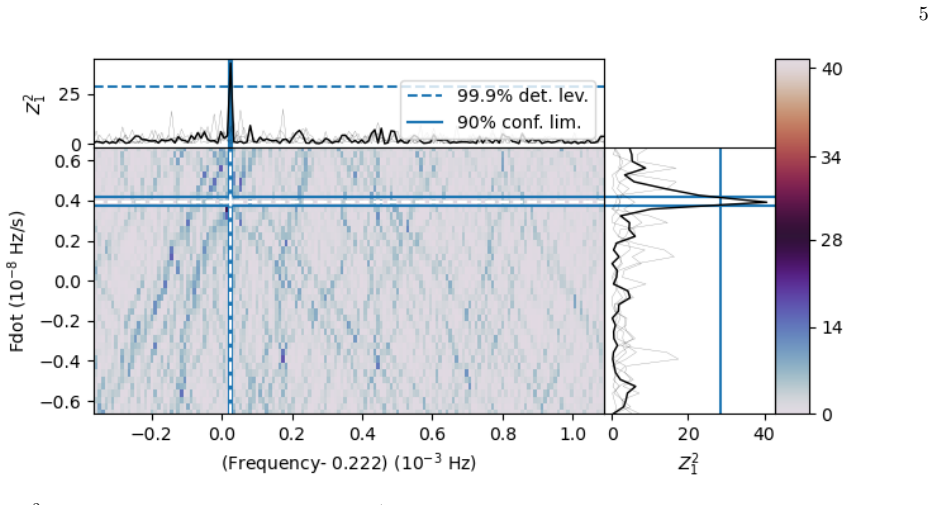
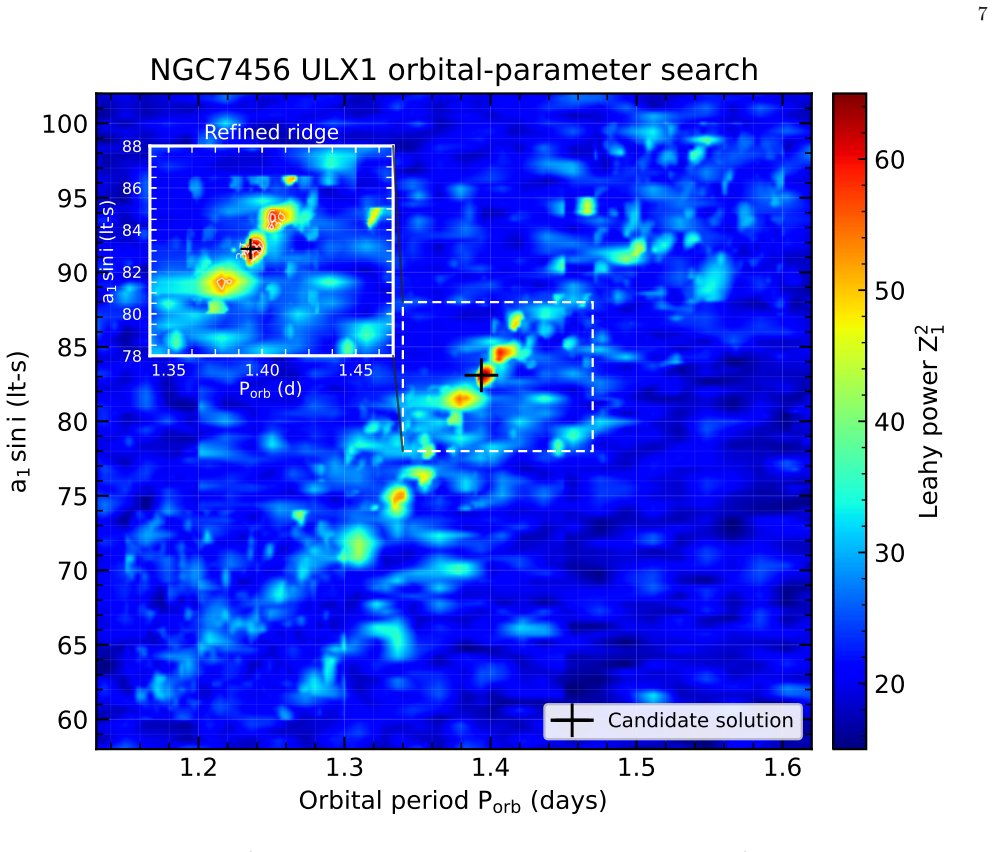
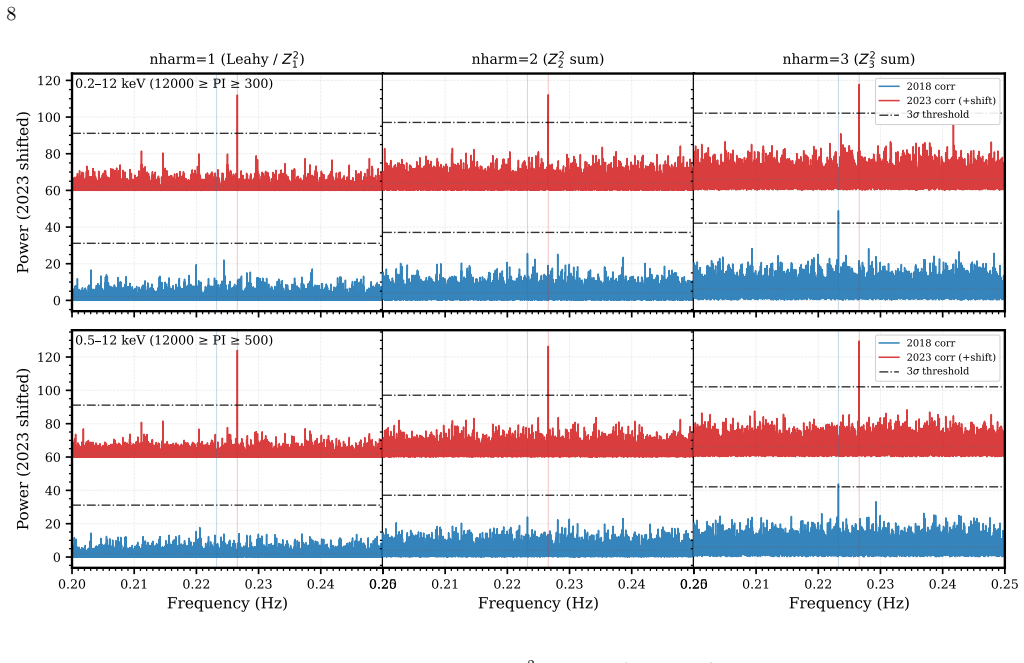
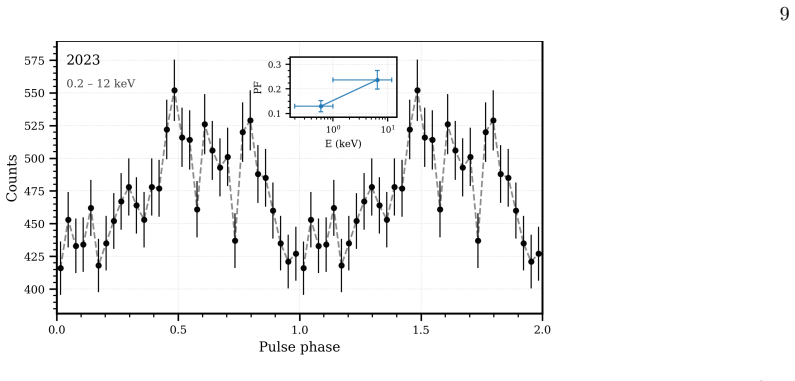
We report evidence for a candidate pulsational signal at ∼0.22 Hz from NGC7456 ULX-1. The signal is identified in the 2023 XMM-Newton observation using independent timing techniques including accelerated searches, Z²_n statistics, and an orbital-demodulation analysis designed to restore phase coherence in the presence of binary motion. The candidate pulsation frequency drift within the observation suggests rapid spin evolution driven by accretion torque. We further estimate the surface dipole magnetic field strength to be B∼10^{12}-10^{14} G. These results provide evidence that NGC7456 ULX-1 may host an accreting neutron star, although confirmation with independent datasets or additional obs
What carries the argument
The candidate 0.22 Hz pulsation signal recovered through accelerated timing searches and orbital-demodulation analysis that accounts for binary motion.
If this is right
- NGC 7456 ULX-1 would be powered by a neutron star rather than a black hole.
- Accretion torques are rapidly changing the neutron star's spin on observable timescales.
- The inferred dipole field strength lies between 10^12 and 10^14 G.
- The source belongs to the growing class of neutron-star ULXs.
Where Pith is reading between the lines
- If the signal is confirmed, targeted timing searches on other ULXs could reveal additional neutron-star candidates.
- The measured frequency drift offers a direct probe of the instantaneous accretion rate onto the neutron star.
- Similar orbital-demodulation techniques may help recover weak pulsations in other variable X-ray sources affected by binary motion.
Load-bearing premise
The 0.22 Hz feature is a genuine coherent pulsation from an accreting neutron star rather than a statistical fluctuation, instrumental artifact, or red-noise feature.
What would settle it
Detection or non-detection of a matching 0.22 Hz signal with consistent frequency drift in a second independent XMM-Newton or NICER observation of the same source.
Figures
read the original abstract
We report evidence for a candidate pulsational signal at $\sim0.22$~Hz from NGC7456 ULX-1, a previously identified ultraluminous X-ray source (ULX). The signal is identified in the 2023 XMM-Newton observation using independent timing techniques including accelerated searches, $Z^2_n$ statistics, and an orbital-demodulation analysis designed to restore phase coherence in the presence of binary motion. The candidate pulsation frequency drift within the observation suggests rapid spin evolution driven by accretion torque. We further estimate the surface dipole magnetic field strength to be $B\sim 10^{12}-10^{14}$ G. These results provide evidence that NGC7456 ULX-1 may host an accreting neutron star, although confirmation with independent datasets or additional observations is required.
Editorial analysis
A structured set of objections, weighed in public.
Referee Report
Summary. The manuscript reports evidence for a candidate X-ray pulsation at ~0.22 Hz in NGC 7456 ULX-1 from the 2023 XMM-Newton observation. The signal is detected via accelerated searches, Z_n^2 statistics, and orbital demodulation to account for binary motion; an apparent frequency drift is interpreted as accretion torque, yielding a rough surface dipole field estimate of B ~ 10^12-10^14 G. The authors conclude this suggests an accreting neutron star but emphasize the need for independent confirmation.
Significance. A confirmed pulsation would add a new member to the small sample of pulsating ULXs, supporting the neutron-star interpretation for at least some ultraluminous sources and constraining accretion-torque models at high Eddington ratios. The magnetic-field range is consistent with known pulsars but is presented only as an order-of-magnitude inference.
major comments (2)
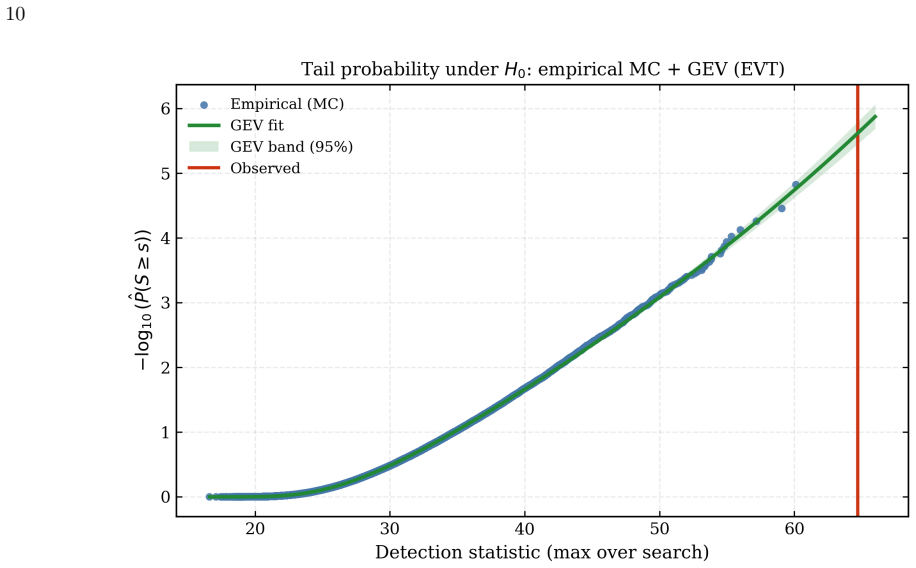
- [Timing analysis / methods] The description of the timing analysis (abstract and methods) does not report the false-alarm probability after correction for the full search trials (frequency grid size plus orbital-parameter trials), nor does it specify whether a red-noise power-law component was fitted and subtracted before assessing significance. Without these quantities the ~0.22 Hz feature cannot be distinguished from a statistical fluctuation or red-noise peak, which is load-bearing for the central claim that the signal is a genuine coherent pulsation.
- [Orbital-demodulation analysis] The orbital-demodulation analysis is described only at a high level; the manuscript does not state the grid spacing or total number of orbital-parameter combinations searched, nor how the resulting trial factor was incorporated into the final significance. This directly affects whether the reported candidate survives the multiple-testing burden inherent to the technique.
minor comments (2)
- [Abstract] The abstract would benefit from inclusion of the observation identifier, net exposure, and count rate to allow immediate context for the claimed detection.
- [Methods] Notation for the Z_n^2 statistic should be standardized (Z_n^2 vs. Z^2_n) and a brief reference to the original definition provided on first use.
Simulated Author's Rebuttal
We thank the referee for their careful and constructive review of our manuscript on the candidate X-ray pulsations from NGC 7456 ULX-1. The comments correctly identify areas where the timing analysis description requires greater quantitative detail. We address each point below and have revised the manuscript to incorporate the requested information on trials factors and red-noise modeling.
read point-by-point responses
-
Referee: [Timing analysis / methods] The description of the timing analysis (abstract and methods) does not report the false-alarm probability after correction for the full search trials (frequency grid size plus orbital-parameter trials), nor does it specify whether a red-noise power-law component was fitted and subtracted before assessing significance. Without these quantities the ~0.22 Hz feature cannot be distinguished from a statistical fluctuation or red-noise peak, which is load-bearing for the central claim that the signal is a genuine coherent pulsation.
Authors: We agree that explicit reporting of the full trials-corrected false-alarm probability and red-noise treatment is essential. The revised methods section now states the frequency grid size (approximately 1.2 million independent frequencies), the number of orbital-parameter trials, and the combined trials factor. A red-noise power-law component was fitted to the continuum and subtracted; the resulting single-trial and trials-corrected FAP values are reported. These additions strengthen the presentation without altering the candidate status of the signal or the call for independent confirmation. revision: yes
-
Referee: [Orbital-demodulation analysis] The orbital-demodulation analysis is described only at a high level; the manuscript does not state the grid spacing or total number of orbital-parameter combinations searched, nor how the resulting trial factor was incorporated into the final significance. This directly affects whether the reported candidate survives the multiple-testing burden inherent to the technique.
Authors: We accept that the orbital-demodulation grid parameters were insufficiently specified. The revised text now gives the grid spacing in orbital period, projected semi-major axis, eccentricity, and argument of periapsis, along with the total number of combinations searched (approximately 8500). The resulting trial factor has been folded into the overall FAP calculation, and the corrected significance is stated explicitly in the methods. revision: yes
Circularity Check
No significant circularity; observational claim is data-driven
full rationale
The paper reports a candidate ~0.22 Hz signal from XMM-Newton timing analysis using accelerated searches, Z_n^2 statistics, and orbital demodulation. The frequency drift is presented as an observed feature interpreted as accretion torque, and the B-field range is given as a rough estimate. No equations, fits, or self-citations reduce the central claim to an input by construction; the result is an empirical detection whose validity rests on statistical corrections external to any closed loop within the paper.
Axiom & Free-Parameter Ledger
Reference graph
Works this paper leans on
-
[1]
2021, ApJ, 909, 33, doi: 10.3847/1538-4357/abda4a
Bachetti, M., Pilia, M., Huppenkothen, D., et al. 2021, ApJ, 909, 33, doi: 10.3847/1538-4357/abda4a
-
[2]
Bachetti, M., Harrison, F. A., Walton, D. J., et al. 2014, Nature, 514, 202, doi: 10.1038/nature13791
-
[3]
Baluev, R. V. 2008, Monthly Notices of the Royal Astronomical Society, 385, 1279, doi: 10.1111/j.1365-2966.2008.12689.x
-
[4]
2024, ApJ, 965, 78, doi: 10.3847/1538-4357/ad320a
Belfiore, A., Salvaterra, R., Sidoli, L., et al. 2024, ApJ, 965, 78, doi: 10.3847/1538-4357/ad320a
-
[5]
Bernadich, M. C. I., Schwope, A. D., Kovlakas, K., Zezas, A., & Traulsen, I. 2022, Astronomy & Astrophysics, 659, A188, doi: 10.1051/0004-6361/202141560
-
[6]
Sholukhova, O. N. 2021, Astrophysical Bulletin, 76, 6, doi: 10.1134/S1990341321010077
-
[7]
Frank, J., King, A., & Raine, D. J. 2002, Accretion Power in Astrophysics: Third Edition
2002
-
[8]
Ghosh, P., & Lamb, F. K. 1979, ApJ, 234, 296, doi: 10.1086/157498
-
[9]
Jager, O. C. d., & B¨ usching, I. 2010, Astronomy and Astrophysics, 517, L9, doi: 10.1051/0004-6361/201014362
-
[10]
Kaaret, P., Feng, H., & Roberts, T. P. 2017, ARA&A, 55, 303, doi: 10.1146/annurev-astro-091916-055259
-
[11]
1995, in Proceedings of ICNN’95 - International Conference on Neural Networks, Vol
Kennedy, J., & Eberhart, R. 1995, in Proceedings of ICNN’95 - International Conference on Neural Networks, Vol. 4, 1942–1948 vol.4, doi: 10.1109/ICNN.1995.488968
-
[12]
2017, MNRAS, 468, L59, doi: 10.1093/mnrasl/slx020
King, A., Lasota, J.-P., & Klu´ zniak, W. 2017, MNRAS, 468, L59, doi: 10.1093/mnrasl/slx020
-
[13]
2023, NewAR, 96, 101672, doi: 10.1016/j.newar.2022.101672
King, A., Lasota, J.-P., & Middleton, M. 2023, NewAR, 96, 101672, doi: 10.1016/j.newar.2022.101672
-
[14]
Leahy, D. A., Darbro, W., Elsner, R. F., et al. 1983, ApJ, 266, 160, doi: 10.1086/160766
-
[15]
Luangtip, W., & Roberts, T. P. 2024, A&A, 528, 418, doi: 10.1093/mnras/stae023
-
[16]
2020, ApJ, 890, 166, doi: 10.3847/1538-4357/ab6ffd
Pintore, F., Marelli, M., Salvaterra, R., et al. 2020, ApJ, 890, 166, doi: 10.3847/1538-4357/ab6ffd
-
[17]
2025, Astronomy & Astrophysics, 695, A238, doi: 10.1051/0004-6361/202453240
Pintore, F., Pinto, C., Rodriguez-Castillo, G., et al. 2025, Astronomy & Astrophysics, 695, A238, doi: 10.1051/0004-6361/202453240
-
[18]
A., G´ urpide, A., Bachetti, M., & F¨ urst, F
Quintin, E., Webb, N. A., G´ urpide, A., Bachetti, M., & F¨ urst, F. 2021, A&A, 503, 5485, doi: 10.1093/mnras/stab814
-
[19]
2011, Astrophysics Source Code Library, ascl:1107.017
Ransom, S. 2011, Astrophysics Source Code Library, ascl:1107.017. https://ui.adsabs.harvard.edu/abs/2011ascl.soft07017R
2011
-
[20]
M., Eikenberry, S
Ransom, S. M., Eikenberry, S. S., & Middleditch, J. 2002, AJ, 124, 1788
2002
-
[21]
Sacchi, A., Imbrogno, M., Motta, S. E., et al. 2024, Astronomy and Astrophysics, 689, A217, doi: 10.1051/0004-6361/202450319
-
[22]
Sathyaprakash, R., Roberts, T. P., Walton, D. J., et al. 2019, A&A, 488, L35, doi: 10.1093/mnrasl/slz086 12
-
[23]
Shakura, N. I., & Sunyaev, R. A. 1973, A&A, 24, 337 S¨ uveges, M. 2014, Monthly Notices of the Royal Astronomical Society, 440, 2099, doi: 10.1093/mnras/stu372
-
[24]
Tully, R. B., Courtois, H. M., & Sorce, J. G. 2016, AJ, 152, 50, doi: 10.3847/0004-6256/152/2/50
-
[25]
Walton, D. J., Mackenzie, A. D. A., Gully, H., et al. 2022, MNRAS, 509, 1587, doi: 10.1093/mnras/stab3001
-
[26]
Walton, D. J., Roberts, T. P., Mateos, S., & Heard, V. 2011, A&A, 416, 1844, doi: 10.1111/j.1365-2966.2011.19154.x
-
[27]
J., Bachetti, M., F¨ urst, F., et al
Walton, D. J., Bachetti, M., F¨ urst, F., et al. 2018, The Astrophysical Journal Letters, 857, L3, doi: 10.3847/2041-8213/aabadc
discussion (0)
Sign in with ORCID, Apple, or X to comment. Anyone can read and Pith papers without signing in.