REVIEW 3 major objections 4 minor
Search for long-lived charginos and $\tau$-sleptons using final states with a disappearing track in $pp$ collisions at $\sqrt{s} = 13$ TeV with the ATLAS detector
T0 review · 3 major / 4 minor · reviewed 2026-08-03 · deepseek-v4-flash
Pith's one-line read A search for long-lived charginos and tau-sleptons in 137 fb^-1 of 13 TeV proton-proton collisions finds no significant excess and sets new 95% CL mass limits, excluding higgsino-like charginos up to 225 GeV at lifetimes below 0.03 ns.
desk verdict Solid, incremental ATLAS search with genuinely useful new techniques and one extrapolation concern worth asking about. read the letter →
The pith
A machine-rendered reading of the paper's core claim, the machinery that carries it, and where it could break.
The reading
What carries the argument
The carrying mechanism is the disappearing-track signature: a short charged track left by a heavy charged particle, such as a chargino (the charged supersymmetric partner of the electroweak and Higgs states) or a tau-slepton (the partner of the tau lepton), that decays after crossing three or four of ATLAS's innermost pixel layers, leaving no hits in the outer silicon tracker. A dedicated tracklet reconstruction allows tracks as short as three pixel hits, and for three-hit tracklets a boosted decision tree identifies the low-energy charged pion from chargino decay. Backgrounds are estimated data-drivenly from template regions, transfer factors, and control regions; the fake-tracklet componen
What would settle it
Take the three observed SR4High events (tracklet pT near 139, 142, and 152 GeV, expected background 0.68 ± 0.14) and re-analyze the next ~140 fb^-1 of Run-3 data with the same selection: if the yield grows to several events while the scaled background stays near one, the null result is contradicted; if the events disappear or match the scaled background, the central limit claim survives.
Extended reading notes
Core claim
On the paper's own terms, the central result is the absence of an excess and the setting of 95% CL exclusion limits in the 0.01–10 ns lifetime window. Observed (expected) limits reach 225 GeV (250 GeV) for pure-higgsino charginos at lifetimes below 0.03 ns, 720 GeV (840 GeV) for the same particles at around 1 ns, 880 GeV (1020 GeV) for wino-like charginos near 1 ns, and 320/300 GeV (390/380 GeV) for tau-sleptons in CMSSM/GMSB-inspired scenarios. The largest local excess, in the high missing-energy four-hit region, has a significance of 1.9σ, which the paper treats as consistent with background.
Load-bearing premise
The estimate of the dominant fake-tracklet background assumes that the tracklet transverse-momentum shape and the ratio of 'pure' to 'hybrid' fakes measured in low missing-transverse-momentum regions and simulated V+jets events correctly describe the high missing-transverse-momentum signal regions.
Editorial extensions
If this is right
- Wino-like charginos with masses up to 880 GeV and lifetimes around 1 ns are excluded at 95% CL.
- Higgsino-like charginos below 225 GeV are excluded for lifetimes below 0.03 ns, covering the loop-induced mass-splitting region.
- Long-lived tau-sleptons with lifetimes around 1 ns are excluded up to about 320 GeV (CMSSM) and 300 GeV (GMSB).
- No signal region shows more than a 1.9σ local excess, so the Standard Model background prediction is consistent with data in these final states.
- The improved tracklet and pion reconstruction extends the expected mass reach by about 100 GeV compared with the earlier Run-2 analysis.
Reading between the lines
- One thing the paper leaves open is the fate of the 1.9σ excess in SR4High: if the three events around 140–150 GeV tracklet pT persist in more data, they could become a real signal or expose an underestimated fake background.
- The same three-hit tracklet plus pion-tagging technique could be applied to Run-3 data at 13.6 TeV, where the larger dataset should push the higgsino limit to higher masses.
- Because the signal regions are defined model-independently around tracklet kinematics, other new physics with a decaying charged track and missing energy could be reinterpreted with the same results.
- The reliance on V+jets simulation for the pure-to-hybrid fake ratio suggests that a dedicated high missing-energy fake-enriched control sample would directly test the extrapolation that carries the main background uncertainty.
Signed reviews
Editorial analysis
A structured set of objections, weighed in public.
Referee Report
Summary. The paper reports a search for long-lived charginos and tau-sleptons using the disappearing-track signature in 137 fb^-1 of 13 TeV pp collisions recorded by ATLAS. Four signal regions are defined: two requiring four-pixel-layer tracklets and two requiring three-pixel-layer tracklets, with the latter further split by a BDT-based low-energy pion tag. The background is estimated with a data-driven strategy using template regions, transfer factors, and control-region normalizations; the dominant fake-tracklet component is modeled from a low-EmissT, high-|z0 sin theta| template with MC-derived transfer factors. No significant excess is found (largest local significance 1.9 sigma in SR4High), and 95% CL exclusion limits are set on wino and higgsino charginos and on tau-sleptons in CMSSM- and GMSB-inspired scenarios. The observed (expected) limits reach 880 GeV (1020 GeV) for wino production and 720 GeV (840 GeV) for higgsino production at ~1 ns lifetime, and 320 GeV (390 GeV) for CMSSM staus.
Significance. If the background estimate is unbiased, the paper presents a solid experimental result with improved sensitivity over the previous ATLAS disappearing-track search, particularly for short lifetimes due to the use of three-pixel-layer tracklets and the dedicated pion tag. The paper is unusually transparent: detailed selection tables, control and validation regions, post-fit distributions, and an explicit discussion of the local excess are provided. The systematic treatment is thorough for the electron, muon, and hadron backgrounds, with data-driven tag-and-probe methods where possible. However, the central exclusion limits rely sensitively on the fake-tracklet background in the four-layer regions, and the manuscript itself states that no dedicated uncertainty is associated with the overall background estimation methodology. Because the validation regions do not cover the high-pT, high-EmissT, calo-veto phase space of SR4High, this omission is load-bearing for the central claim.
major comments (3)
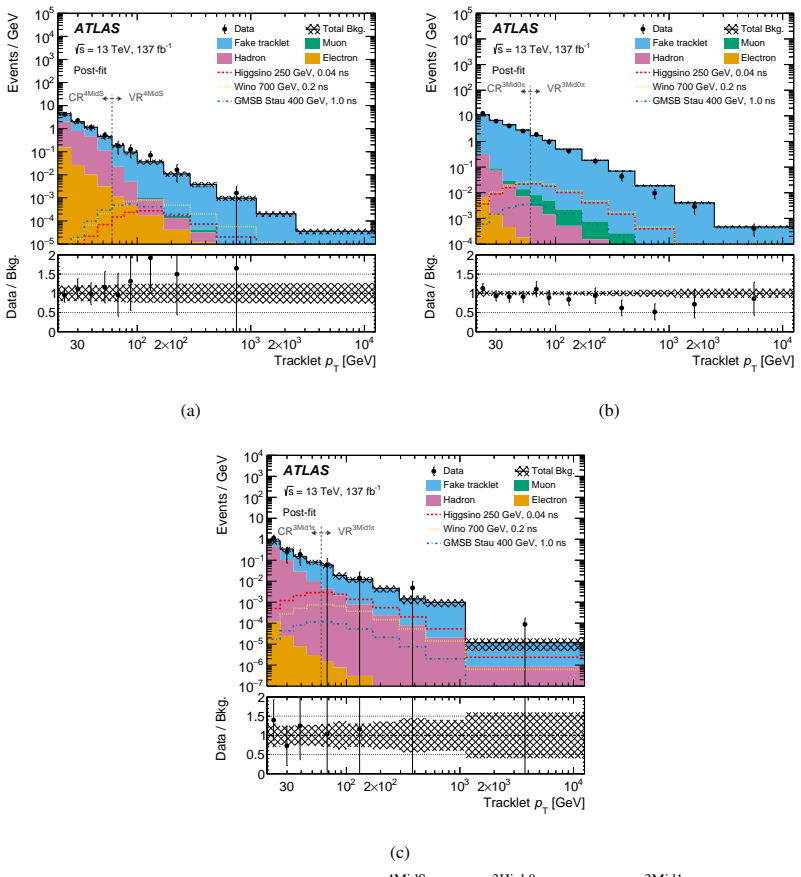
- [Section 6, Eq. (1) and Table 1] The fake-tracklet pT template N_TR^fake(pT) is explicitly taken from tracklets with hits in three layers ('All three TRs select tracklets reconstructed from hits in three layers to ensure a high-statistics pT template'), while SR4High and SR4Mid require four-layer tracklets. No transfer factor or shape correction is applied for the layer multiplicity. The four-layer SRs dominate the sensitivity and drive the strongest limits. The validation regions do not test the extrapolation: VR4Mid has pT<60 GeV, and VR4MidS requires E_clus>5 GeV (hadron-dominated), so neither probes the high-pT, calo-veto, high-EmissT region relevant to SR4High. If the 3-hit and 4-hit fake tracklet pT spectra differ at pT>60 GeV, the SR4High background of 0.68 +/- 0.14 and the resulting mass limits would be biased. Please either introduce a layer-count transfer factor, validate the 4-layer fake shape in a dedicated
- [Section 7] The manuscript states: 'No dedicated uncertainty is associated with the overall background estimation methodology as, within other sources of uncertainties including the statistics of the data, the predicted post-fit tracklet pT distributions in the VRs are consistent with the data.' This is not sufficient because the MC-derived terms in the fake background, TF^fake_hybrid(pT) and SF^fake_EmissT, are based on V+jets simulation and a fitted exponential-plus-constant function, and the validation regions (VR4Mid, VR4MidS, VR3Mid1pi, VR3High0pi) do not cover the SR4High phase space. The quoted background uncertainties in SR4High and the derived limits therefore may undercover the extrapolation uncertainty. A quantitative methodology uncertainty, or an additional validation specifically in the high-pT, low-E_clus, high-EmissT region, should be provided.
- [Section 6, CR4Low/CR4High (Table 2)] The scale factor SF^fake_EmissT is derived from the ratio of events in CR4Low (EmissT<150 GeV) to CR4High (EmissT>300 GeV). Both regions require the EmissT trigger to pass. The text justifies the low-Emiss TR by saying the trigger efficiency 'does not need to be well understood' because the TR is not used for the overall yield, but the CR ratio is used for the normalization and is therefore directly affected by any trigger inefficiency in CR4Low. Since CR4Low is below the 230 GeV online trigger threshold quoted in Section 3, the trigger efficiency is not on the plateau. Please demonstrate that the trigger efficiency cancels in the ratio or apply a correction; otherwise the SF is biased.
minor comments (4)
- [Section 3] Typo: 'in both the CSSM and GMSB models' should be 'CMSSM'.
- [Section 9] Typo: 'The data obervations' should be 'observations'.
- [Section 8] The text says 'the previous analyses used five-layer tracking', but Section 2 describes four pixel layers and Ref. [43] is described as requiring at least four pixel hits. Please clarify what 'five-layer tracking' refers to (perhaps it includes SCT hits).
- [General] The reproduction of the text contains numerous formatting artifacts (missing spaces, stray characters such as 'Tτ-sleptons' in the contents). These should be corrected in the final published version.
Circularity Check
No significant circularity: the exclusion limits come from a direct experimental search with data-driven backgrounds derived from control regions orthogonal to the signal regions; the 3-layer-to-4-layer tracklet template extrapolation is a modelling assumption, not a circular reduction.
full rationale
The paper's central claim is an experimental null result: observed yields in four signal regions are compared with background estimates and signal Monte Carlo, leading to 95% CL exclusion limits. Walking the derivation chain, the background is genuinely predicted rather than fitted from the SRs: fake-tracklet templates are taken from template regions with `E_missT < 150 GeV` and `|z0 sinθ| > 2.5 mm`, electron/muon templates from single-lepton-enriched regions, and hadron templates from TRT/SCT/calorimeter-matched samples; the transfer and scale factors are derived from MC or from control regions, and the fit uses "only the CRs, and not the SRs, ... to constrain the SM background" (Section 8). No SR bin itself enters the background construction, so the observed `p0 = 0.033 (1.9σ)` in SR4High and the consequent limits (e.g., 880 GeV wino, 720 GeV higgsino) are not forced by construction. The skeptic's 3-layer-versus-4-layer template issue is a legitimate extrapolation assumption -- the text states "All three TRs select tracklets reconstructed from hits in three layers to ensure a high-statistics pT template" while SR4High/SR4Mid require four layers -- but it is a potential mis-modelling (a correctness/systematics concern, especially given the paper's own admission that "No dedicated uncertainty is associated with the overall background estimation methodology"), not a circular reduction: the prediction is not equal to its input by definition. Self-references (Refs. [43-45]) are prior ATLAS disappearing-track analyses used for comparison and as the source of Figure 3; they are not load-bearing for the null result or the limits. No uniqueness theorem, no fitted parameter renamed as a prediction, and no ansatz smuggled via self-citation were found.
Assumptions & free parameters
free parameters (3)
- Tracklet pT threshold =
60 GeV
- BDT score threshold for pion tag =
0.8
- EmissT thresholds in SRs =
>300, 150-300, >240, >280 GeV
assumptions (4)
- domain assumption Signal models (wino, higgsino, CMSSM stau, GMSB stau with gravitino LSP) are valid simplified SUSY scenarios with the stated decay chains and cross-sections.
- domain assumption The mass-splitting calculations for winos/higgsinos from Refs. [14,15,21,22] correctly predict the chargino lifetime as a function of mass.
- domain assumption MC simulation (Geant4, Pythia) accurately models tracklet reconstruction efficiency and the detector response for the signal and background templates.
- domain assumption Data-driven background estimation assumes that the template regions and transfer factors/scale factors correctly extrapolate to the signal regions, with closure tested in validation regions.
Cite this review
Pith. "Pith review of Search for long-lived charginos and $\tau$-sleptons using final states with a disappearing track in $pp$ collisions at $\sqrt{s} = 13$ TeV with the ATLAS detector." pith.science (2026). https://pith.science/paper/AUVZX7YG
@misc{pith2026260308315,
  author       = {Pith},
  title        = {Pith review of: Search for long-lived charginos and $\tau$-sleptons using final states with a disappearing track in $pp$ collisions at $\sqrts = 13$ TeV with the ATLAS detector},
  year         = {2026},
  howpublished = {\url{https://pith.science/paper/AUVZX7YG}},
  note         = {Machine review of arXiv:2603.08315}
}
abstract
This paper reports a search for decays of long-lived charginos or $\tau$-sleptons to final states containing a short disappearing track, a single high-energy jet, and missing transverse momentum. The search uses 137 fb$^{-1}$ of data from 13 TeV proton-proton collisions recorded by the ATLAS detector during Run 2 of the LHC. Multiple search regions are defined, all requiring the presence of a track reconstructed from either three or four measurements in the innermost layers of the ATLAS detector. Regions with tracks having only three measurements are further characterised by the absence or presence of a low-energy charged pion reconstructed using a dedicated algorithm, leveraging machine learning. Data-driven methods are used to estimate the background contributions in the search regions. No significant excesses are found and 95% CL lower limits are placed on the masses of charginos and $\tau$-sleptons in the lifetime range $0.01{-}10$ ns. Observed (expected) mass limits of up to 225 GeV (250 GeV) are set for pure-higgsino charginos in scenarios with lifetimes below 0.03 ns, where the electroweakino mass splitting is entirely due to loop corrections involving the Standard Model bosons, and up to 720 GeV (840 GeV) for charginos with a lifetime of around 1 ns. For wino production, charginos with masses up to 880 GeV (1020 GeV) are excluded for lifetimes of around 1 ns. For $\tau$-sleptons with lifetimes of around 1 ns, masses are excluded up to 320 GeV (390 GeV) in Constrained Minimal Supersymmetric Standard Model scenarios and 300 GeV (380 GeV) in Gauge-Mediated Supersymmetry-Breaking scenarios.
Figures


Figures from the paper (11 more)




Reviewed August 3, 2026 · model on record in the stance chip above.
Discussion (0). Continue with ORCID to comment.