REVIEW 4 major objections 5 minor 25 references
Regular genus of $\mathbb{S}^2 \times \mathbb{S}^1 \times \mathbb{S}^1$, $4$-torus, and small covers over $\Delta^2 \times \Delta^2$
T0 review · 4 major / 5 minor · reviewed 2026-08-07 · deepseek-v4-flash
Pith's one-line read This paper proves exact regular genera for three families of 4-manifolds: $G(\mathbb{S}^2 \times \mathbb{S}^1 \times \mathbb{S}^1)=6$, $G(\mathbb{S}^1 \times \mathbb{S}^1 \times \mathbb{S}^1 \times \mathbb{S}^1)=16$, and $G=8$ for each of…
desk verdict Solid new results on regular genus with a load-bearing unproved move; worth refereeing after the Observation in §2.2 is proved. read the letter →
The pith
A machine-rendered reading of the paper's core claim, the machinery that carries it, and where it could break.
The reading
What carries the argument
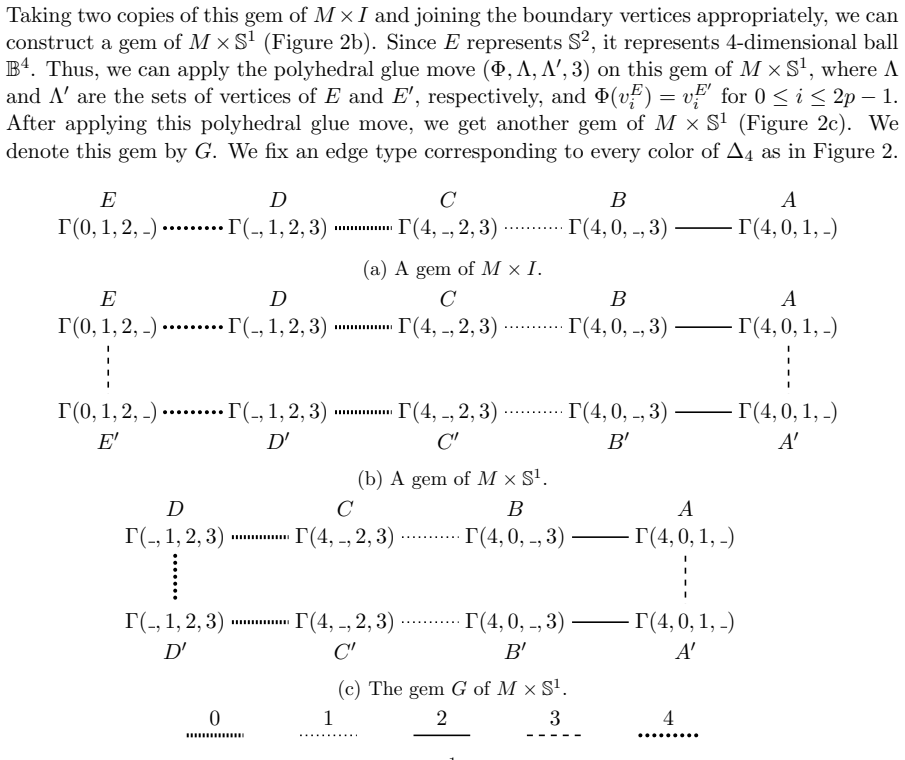
The central objects are crystallizations: 5-regular edge-colored graphs on the color set $\{0,1,2,3,4\}$ dual to contracted triangulations of a 4-manifold. The regular genus of a crystallization is computed from the bi-colored cycle counts $g_{ij}$ through the formula $\rho_\varepsilon(\Gamma) = 1 - \tfrac{1}{2}\big(-\tfrac{3}{2}|V(\Gamma)| + \sum_i g_{\varepsilon_i\varepsilon_{i+1}}\big)$ for a cyclic permutation $\varepsilon$ of the five colors; minimizing over all $\varepsilon$ and all crystallizations gives $G(M)$. The upper bounds come from explicit graphs, built from gems of $M\times \mathbb{S}^1$ using polyhedral glue moves and a two-stage dipole cancellation stated as an Observation in Section 2.2; the lower bound is the inequality $G(M) \ge 2\chi(M)+5m-4$, where $m = \mathrm{rk}(\pi_1(M))$.
What would settle it
Take the intermediate graph produced after the first reduction in the 4-torus construction (the claimed 156-vertex gem) and compute its fundamental group; if it is not the free abelian group of rank 4, the unproved Observation fails and the 120-vertex graph would not be certified. Similarly, checking the 80-vertex and 64-vertex intermediate gems for each small cover against the known $\mathbb{RP}^2$-bundle structure would settle whether the reduction to 52 vertices is valid.
Extended reading notes
Core claim
The paper's central claim is that the regular genus, a PL invariant measuring the minimal genus of a surface in which a manifold's crystallization embeds regularly, takes the values $G(\mathbb{S}^2 \times \mathbb{S}^1 \times \mathbb{S}^1)=6$, $G(\mathbb{S}^1 \times \mathbb{S}^1 \times \mathbb{S}^1 \times \mathbb{S}^1)=16$, and $G(M)=8$ for each of the seven small covers over $\Delta^2 \times \Delta^2$. For each manifold it constructs a crystallization attaining the lower bound $2\chi + 5m - 4$ of Proposition 1, where $m$ is the rank of the fundamental group, and then computes the regular genus of that crystallization by counting bi-colored cycles with respect to a chosen cyclic permutation of the five colors. The 40-vertex and 120-vertex graphs settle the previously open cases of $\mathbb{S}^2 \times \mathbb{S}^1 \times \mathbb{S}^1$ and the 4-torus; the small-cover analysis classifies all $\mathbb{Z}_2$-characteristic functions on $\Delta^2 \times \Delta^2$ up to D-J equivalence, identifies one of the seven as $\mathbb{RP}^2 \times \mathbb{RP}^2$ and the other six as $\mathbb{RP}^2$-bundles over $\mathbb{RP}^2$, and supplies a 52-vertex crystallization for each. Along the way the paper records that the seven covers collapse to at most four distinct PL homeomorphism types, with pairwise identical isomorphism signatures, and that all crystallizations constructed are weak semi-simple, a property equivalent to attaining the lower bound.
Load-bearing premise
The argument rests on an unproved technical claim, stated as an Observation in Section 2.2, that certain graph-surgery moves used to shrink the crystallizations always preserve the underlying 4-manifold; if any of those moves goes wrong, the vertex reductions in the main theorems could produce graphs of the wrong manifold.
Editorial extensions
If this is right
- The previously open conjecture that $\mathbb{S}^2 \times \mathbb{S}^1 \times \mathbb{S}^1$ has regular genus 6 is settled, so this manifold joins the known orientable prime PL 4-manifolds of genus 6 alongside the mapping tori constructed in the literature.
- The regular genus of the 4-torus is exactly 16, closing the interval between the earlier bounds of 4 and 28 and providing an explicit 120-vertex crystallization.
- Every small cover over $\Delta^2 \times \Delta^2$ has regular genus 8 and admits a 52-vertex genus-minimal crystallization; in particular $G(\mathbb{RP}^2 \times \mathbb{RP}^2)=8$.
- The seven D-J equivalence classes of small covers over $\Delta^2 \times \Delta^2$ are at most four distinct PL homeomorphism types, with three pairs identified by identical isomorphism signatures.
- All crystallizations constructed in the paper are weak semi-simple, so the class of closed PL 4-manifolds with known regular genus now includes these manifolds together with all of their connected sums.
- The paper proposes that the regular genus of the $n$-torus is $1+\frac{(n+1)!(n-3)}{8}$ for $n \ge 5$, supported by the observed cycle structure of a candidate crystallization with $(n+1)!$ vertices.
Reading between the lines
- If the unproved Observation in Section 2.2 holds generally, the two-stage 2-dipole/3-dipole reduction is a reusable tool: other products $M \times \mathbb{S}^1$ with a matching base crystallization could receive the same vertex reduction, potentially yielding genus-minimal crystallizations for further 4-manifolds.
- The pairwise agreement of isomorphism signatures shows that D-J equivalence is strictly finer than PL homeomorphism in dimension four; a natural next question, not answered here, is whether the four remaining classes are pairwise non-homeomorphic.
- The $n$-torus conjecture is already testable at $n=5$: the candidate graph has 720 vertices and would have regular genus 361, so the bottleneck is finding a matching lower bound for manifolds whose fundamental group has rank greater than two.
- Because weak semi-simplicity is equivalent to attaining the regular-genus lower bound and is closed under connected sum, every new weak semi-simple example enlarges a class whose additivity over connected sums would resolve the 4-dimensional smooth Poincar\'e conjecture if it ever covered all simply-connected PL 4-manifolds.
Editorial analysis
A structured set of objections, weighed in public.
Referee Report
Summary. The paper constructs explicit edge-colored graphs (crystallizations) for S^2×S^1×S^1 (40 vertices), for S^1×S^1×S^1×S^1 (120 vertices), and for each of the seven Davis-Januszkiewicz equivalence classes of small covers over Δ^2×Δ^2 (52 vertices each). For each constructed graph the authors compute the regular genus and combine it with the external lower bound G(M) ≥ 2χ(M)+5m−4 from Proposition 1 (Basak–Casali) to conclude G(S^2×S^1×S^1)=6, G(S^1×S^1×S^1×S^1)=16, and that each of the seven small covers, including RP^2×RP^2, has regular genus 8. The paper also proposes a conjectural formula for the regular genus of the n-torus, verifies the n=4 case by an independent cube-based construction, and reports Regina isomorphism signatures for the principal crystallizations.
Significance. If the constructions are correct, the paper settles a conjecture from Basak's 2019 mapping-torus paper and the previously open value for the 4-dimensional torus, and it gives the first regular-genus computations for small covers over Δ^2×Δ^2. The main strengths are the fully explicit graph constructions, the absence of free parameters in the upper-bound constructions, and the provision of machine-readable Regina isomorphism signatures that allow independent combinatorial verification of the final graphs. These are concrete, checkable contributions to crystallization theory and to the classification of PL 4-manifolds by regular genus.
major comments (4)
- [Subsection 2.2 (Observation)] The Observation is load-bearing and is not proved. After canceling the 2-dipole {v1, v1′}, the cancellation joins, for every color c not in {i, j}, the former c-neighbor of v1 to the former c-neighbor of v1′. This can create new paths between v2 and v2′ in the color set Δ4\{i,j,k}; the hypothesis that v1, v2, v1′, v2′ lie in distinct components of Γ_{Δ4\{i,j,k}} does not by itself imply the required distinct-component condition for v2 and v2′ in (Γ1)_{Δ4\{i,j,k}}. The assertion that v2 and v2′ form a 3-dipole after the first cancellation therefore needs a proof. The move is used repeatedly in Theorem 2 (moves Φ4, Φ5, Φ6) and Theorem 4 (moves Φ4 through Φ12); if the condition fails in any of these configurations, the reduced graphs may no longer be crystallizations of the claimed manifolds. Please supply a proof of the Observation or, failing that, a certified computational check of the dipole hypotheses after each intermediate step in Theorems 2 and 4.
- [Theorems 2 and 4] The Regina isomorphism signatures identify the final edge-colored graphs combinatorially, but an isomorphism signature alone does not certify which 4-manifold a graph represents; it certifies only that two graphs with the same signature are isomorphic. For Theorem 4, the later cube-based construction of Γ′ gives independent evidence that the 120-vertex graph represents the 4-torus, but for Theorem 2 (and for the identification of the small covers in Theorem 7) there is no independent recognition of the represented manifold. The manifold identification therefore rests entirely on the composition of moves in Sections 3 and 4, which is why the gap in the Observation is central. Please provide an independent recognition certificate for the 40-vertex graph of Theorem 2, for example by verifying that its associated colored triangulation is isomorphic to a known triangulation of S^2×S^1×S^1, or by constructing the final graph directly from a known gem.
- [Theorem 7] The proof of Theorem 7 is a long case analysis whose verification is delegated to Figure 9, with the sentence 'any statement whose justification is not explicitly provided can be understood to follow from Figure 9.' The final cycle counts—g{0,3}=g{0,4}=g{1,4}=g{2,3}=13 and g{1,2}=12 for the relevant permutations—are asserted after four polyhedral glue moves, but the reader cannot reconstruct all seven characteristic functions and all intermediate graphs from the figure without effectively repeating the whole computation. Since these numbers enter directly into the genus computation, please provide a systematic derivation or a machine-readable certificate (edge lists of all Γ′i, i=1,...,7, together with a script that computes the bi-colored cycle counts).
- [Theorem 7 and Lemma 6] The lower bound G(M(λ)) ≥ 8 uses Proposition 1 with m=2, the rank of the fundamental group. The statement 'it is easy to verify that the rank of the fundamental group of M^4(λ) is 2' is not backed by an argument or a reference. For the product RP^2×RP^2 the rank is 2, but for the six non-trivial RP^2-bundles the fundamental group should be computed explicitly or cited from a verifiable source. If any of these manifolds had rank 1, the lower bound would drop below 8 and the minimality conclusion would not follow. Please add the computation of π1 for each of the seven small covers.
minor comments (5)
- [Section 1] There are typos: 'dimesional' should be 'dimensional' and the journal name in reference [20] is 'Aequationes', not 'Acquationes'.
- [Theorem 2] In the sentence introducing the sets for the second reduction, the last set is written as 'Λ′4 = {vA′6, vA′7}' but it should be 'Λ′5'; as written, Λ′4 is defined twice.
- [Theorem 4] The cycle count for G′2 is stated as 'all the cycles colored by {i,j} are of length 4 and thus g{i,j}=30' for five color pairs, but the counting argument from Figure 8 is not shown. Adding the explicit count of 4-cycles for each pair would make the computation reproducible.
- [Theorem 7] The sentence about {2,3}-colored cycles in Γ′i is initially confusing: it says there are 13 four-cycles for i∈{1,2,5} and then 9 four-cycles, 2 six-cycles, and 2 two-cycles for i∈{3,4,6,7}. Both statements give total g=13, but the wording suggests a contradiction; please rephrase to make the totals explicit.
- [Figures 5–8 and 10–15] The figures are dense and use many labels; providing the edge lists of the final crystallizations in a supplementary file would make the Regina signatures and the cycle counts independently checkable without transcription from the figures.
Circularity Check
No circularity found: the regular genus values are established by explicit crystallizations plus the external lower bound of Proposition 1; the unproved Observation in §2.2 is a proof gap, not a circular step.
full rationale
The central claims are not circular. Upper bounds are obtained by explicit edge-colored graph constructions: for S²×S¹×S¹ the paper starts from the standard 8-vertex crystallization of S²×S¹, builds a 64-vertex gem of S²×S¹×S¹, applies polyhedral glue moves and the §2.2 Observation to reach a 40-vertex crystallization, and then computes the regular genus directly from the bi-colored cycle counts g{i,j}. For the 4-torus it similarly starts from a 24-vertex crystallization of S¹×S¹×S¹, builds a 192-vertex gem, reduces it to 120 vertices, and computes ρε = 16 from the displayed cycle counts. For the small covers, the 96-vertex gems are constructed from the explicit colored triangulations in Figure 9 and then reduced to 52-vertex crystallizations; the genus 8 is computed from the listed cycle counts. In each case the lower bound comes from Proposition 1, an external published result (Basak–Casali, Forum Math. 2017), not from the paper's own constructions or fitted values. The equality between the upper bound and the lower bound is therefore a genuine match, not a prediction forced by construction. The paper does use the authors' prior work [1] for the small-cover gem construction, but the construction itself is reproduced in Figures 9–15, so the citation is not doing unverified load-bearing work. The main weakness is the unproved Observation in Subsection 2.2: it asserts that a 2-dipole removal followed by the induced 3-dipole removal yields a crystallization of the same 4-manifold, and this move is used repeatedly in Theorems 4 and 7. The preservation of the 3-dipole condition after the first cancellation is not proved, and the Regina signatures certify the final graphs combinatorially rather than the intermediate moves. This is a genuine correctness/verification gap, but it is not circularity: the Observation is not defined in terms of the target genera, nor does it fit any parameter to the desired answers, nor does it reduce the theorems to the assumptions of the theorems. Under the circularity criteria, no specific step qualifies as self-definitional, fitted-input-called-prediction, load-bearing self-citation, imported uniqueness, ansatz-smuggling, or renaming of a known result. The appropriate finding is therefore no significant circularity, with the proof-gap concern recorded as a correctness risk rather than as circularity.
Assumptions & free parameters
assumptions (4)
- standard math Proposition 1: for a closed connected PL 4-manifold M with rk(π1(M))=m, G(M) ≥ 2χ(M)+5m−4.
- ad hoc to paper The Observation in Subsection 2.2: under the stated hypotheses, removing a 2-dipole and then the induced 3-dipole yields a crystallization of the same manifold.
- standard math The construction of gems of small covers from [1] correctly yields colored triangulations dual to the small covers M⁴(λ_i).
- domain assumption For n=1,2,3,4 the graph Γ′ constructed in Section 3 represents the n-dimensional torus.
Cite this review
Pith. "Pith review of Regular genus of $\mathbb{S}^2 \times \mathbb{S}^1 \times \mathbb{S}^1$, $4$-torus, and small covers over $\Delta^2 \times \Delta^2$." pith.science (2026). https://pith.science/paper/AUXQBHHN
@misc{pith2026250601315,
  author       = {Pith},
  title        = {Pith review of: Regular genus of $\mathbbS^2 \times \mathbbS^1 \times \mathbbS^1$, $4$-torus, and small covers over $\Delta^2 \times \Delta^2$},
  year         = {2026},
  howpublished = {\url{https://pith.science/paper/AUXQBHHN}},
  note         = {Machine review of arXiv:2506.01315}
}
abstract
A crystallization of a PL manifold is an edge-colored graph encoding a contracted triangulation of the manifold. The concept of regular genus generalizes the notions of surface genus and Heegaard genus for 3-manifolds to higher-dimensional closed PL manifolds. The regular genus of a PL manifold is a PL invariant. Determining the regular genus of a closed PL $n$-manifold remains a fundamental challenge in combinatorial topology. In this article, we first resolve a conjecture by proving that the regular genus of $\mathbb{S}^2 \times \mathbb{S}^1 \times \mathbb{S}^1$ is 6. Additionally, we determine that the regular genus of $\mathbb{S}^1 \times \mathbb{S}^1 \times \mathbb{S}^1 \times \mathbb{S}^1$ is 16. We also present some observations related to the regular genus of the $n$-dimensional torus and conjecture that the regular genus of $\mathbb{S}^1 \times \mathbb{S}^1 \times \cdots \times \mathbb{S}^1$ ($n$ times) is $1+\frac{(n+1)! \ (n-3)}{8}$, for $n\ge 5$. Then, we investigate the regular genus of small covers. Small covers are closed $n$-manifolds admitting a locally standard $\mathbb{Z}_2^n$-action with orbit space homeomorphic to a simple convex polytope $P^n$. For the polytope $P = \Delta^2 \times \Delta^2$, we classify all the small covers up to Davis-Januszkiewicz (D-J) equivalence and show that there are exactly seven such covers. Among these, one is $\mathbb{RP}^2 \times \mathbb{RP}^2$, while the others are $\mathbb{RP}^2$-bundles over $\mathbb{RP}^2$. Remarkably, each of these seven small covers has the regular genus 8. Results in this article provide explicit regular genus values for several important 4-manifolds, offering new insights and tools for future work in combinatorial topology.
Figures


Figures from the paper (12 more)


Reference graph
Works this paper leans on
-
[1]
A. Agarwal and B. Basak, Crystallizations of small covers over the n-simplex ∆n and the prism ∆n−1 × I, (2025), 14 pages, arXiv:2408.05922. (under review)
-
[2]
Basak, Regular genus and gem-complexity of some mapping tori, Rev
B. Basak, Regular genus and gem-complexity of some mapping tori, Rev. R. Acad. Cienc. Exactas F ´ ıs. Nat. Ser. A Mat. RACSAM 113 (3) (2019), 2479–2493
work page 2019
-
[3]
Basak, Genus-minimal crystallizations of PL 4-manifolds, Beitr
B. Basak, Genus-minimal crystallizations of PL 4-manifolds, Beitr. Algebra Geom. 59 (2018), 101–111
work page 2018
-
[4]
B. Basak and M. Binjola, Lower bounds for regular genus and gem-complexity of PL 4-manifolds with boundary, Forum Math. 33 (2) (2021), 289–304
work page 2021
-
[5]
B. Basak and M. R. Casali, Lower bounds for regular genus and gem-complexity of PL 4-manifolds, Forum Math. 29 (4) (2017), 761–773
work page 2017
-
[6]
B. Basak and J. Spreer, Simple crystallizations of 4-manifolds, Adv. Geom. 16 (1) (2016), 111–130
work page 2016
-
[7]
Bj¨ orner, Posets, regular CW complexes and Bruhat order, European J
A. Bj¨ orner, Posets, regular CW complexes and Bruhat order, European J. Combin. 5 (1984), 7–16
work page 1984
-
[8]
J. A. Bondy and U. S. R. Murty, Graph Theory, Springer, New York, 2008
work page 2008
Show all 25 references
-
[9]
V. M. Buchstaber and T. E. Panov, Torus actions and their applications in topology and combinatorics, University Lecture Series, American Mathematical Society, Providence, RI, 24 (2002)
2002
-
[10]
M. Cai, X. Chen and Z. L¨ u, Small cover over prisms, Topology Appl. 154 (2007), 2228–2234
2007
-
[11]
Cavicchioli, On the genus of smooth 4-manifolds, Trans
A. Cavicchioli, On the genus of smooth 4-manifolds, Trans. Am. Math. Soc. 31 (1999), 203–214
1999
-
[12]
Cavicchioli, A combinatorial characterization of S3 × S1 among closed 4–manifolds, Proc
A. Cavicchioli, A combinatorial characterization of S3 × S1 among closed 4–manifolds, Proc. Amer. Math. Soc. 105 (4) (1989), 1008–1014
1989
-
[13]
Cavicchioli and F
A. Cavicchioli and F. Hegenbarth, On the determination of PL–manifolds by handles of lower dimension, Topology Appl. 53 (1993), 111–118
1993
-
[14]
Cavicchioli and F
A. Cavicchioli and F. Spaggiari, On the genus of real projective spaces, Arch. Math. (Basel) 89 (2007), 570–576
2007
-
[15]
Choi, The number of small covers over cubes, Algebr
S. Choi, The number of small covers over cubes, Algebr. Geom. Topol. 8 (2008), 2391–2399
2008
-
[16]
Davis and T
M.W. Davis and T. Januszkiewicz, Convex polytopes, coxeter orbifolds and torus actions, Duke Math. J. 62 (2) (1991), 417–451
1991
-
[17]
Ferri and C
M. Ferri and C. Gagliardi, On the genus of 4–dimensional products of manifolds, Geom. Dedicata 13 (1982), 331–345
1982
-
[18]
Ferri and C
M. Ferri and C. Gagliardi, Crystallisation moves, Pacific J. Math. 100 (1) (1982), 85–103
1982
-
[19]
Ferri and C
M. Ferri and C. Gagliardi, The only genus zero n-manifold is Sn, Proc. Amer. Math. Soc. 85 (1982), 638–642. 24
1982
-
[20]
Ferri, C
M. Ferri, C. Gagliardi and L. Grasselli, A graph-theoretic representation of PL-manifolds – A survey on crystallizations, Acquationes Math. 31 (1986), 121–141
1986
-
[21]
Gagliardi, On the genus of the complex projective plane, Aequationes Math
C. Gagliardi, On the genus of the complex projective plane, Aequationes Math. 37 (1989), 130–140
1989
-
[22]
Gagliardi, Extending the concept of genus to dimension n, Proc
C. Gagliardi, Extending the concept of genus to dimension n, Proc. Amer. Math. Soc. 81 (1981), 473–481
1981
-
[23]
Gagliardi and L
C. Gagliardi and L. Grasselli, Representing products of polyhedra by products of edge-colored graphs, J. Graph Theory 17 (1993), 549–579
1993
-
[24]
C. P. Rourke and B. J. Sanderson, Introduction to piecewise-linear topology, Springer Verlag, New York - Heidelberg (1972)
1972
-
[25]
Spaggiari, On the genus of RP3 × S1, Collect
F. Spaggiari, On the genus of RP3 × S1, Collect. Math. 50 (3) (1999), 229–241. 25
1999
Reviewed August 7, 2026 · model on record in the stance chip above.
Discussion (0). Sign in to comment.