Sharper Ramsey lower bounds from refined Gaussian estimates
Pith reviewed 2026-06-29 21:33 UTC · model grok-4.3
The pith
A sharp cumulant generating function bound for truncated Gaussians raises the exponent in lower bounds for every off-diagonal Ramsey number R(ℓ, Cℓ) with fixed C > 1.
A machine-rendered reading of the paper's core claim, the machinery that carries it, and where it could break.
Core claim
Substituting the sharp cumulant generating function bound for truncated Gaussians into the existing Gaussian random-graph construction increases the exponent appearing in the lower bound for R(ℓ, Cℓ) by a strictly positive amount for every fixed C > 1; the gain is asymptotically Θ(p_C^{-1/2}/log C) as C tends to infinity.
What carries the argument
The sharp cumulant generating function bound for truncated Gaussians, inserted in place of the earlier subgaussian estimate inside the Hunter-Milojević-Sudakov Gaussian random graph model.
If this is right
- The lower-bound exponent improves by a positive constant for each fixed ratio C.
- The asymptotic size of the improvement is Θ(p_C^{-1/2}/log C) as C grows.
- The same random-graph framework remains valid after the substitution of the tighter tail bound.
- Quantitative lower bounds for R(ℓ, Cℓ) are strictly larger than those obtained by the prior Gaussian method.
Where Pith is reading between the lines
- The same refinement technique may apply to other Ramsey-type problems that rely on Gaussian embeddings or similar concentration bounds.
- Numerical checks for moderate values of C could show whether the predicted gain is visible before the asymptotic regime.
- The approach might combine with non-Gaussian constructions to produce still larger exponent improvements.
- The refined tail bound could be tested directly on the probability calculations to isolate where the gain originates.
Load-bearing premise
The new cumulant bound can be substituted into the Gaussian random-graph construction without destroying the independence of the relevant edge indicators or the accuracy of the clique-probability calculations that deliver the lower bound.
What would settle it
An explicit calculation for some fixed C > 1 showing that the clique probability under the refined bound either exceeds the threshold needed for the random graph to be valid or fails to produce any increase in the exponent over the previous Gaussian construction.
Figures
read the original abstract
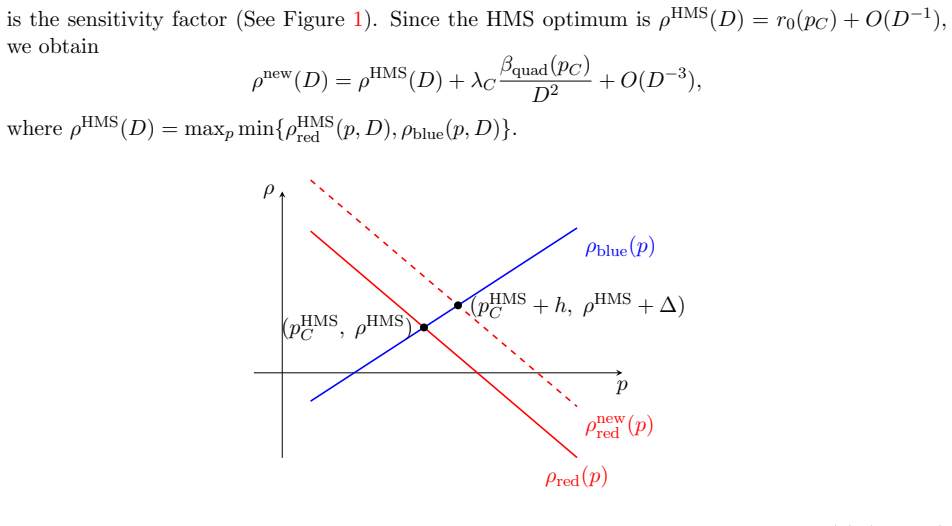
Recently, Ma, Shen and Xie broke the Erd\H{o}s barrier for off-diagonal Ramsey numbers $R(\ell,C\ell)$, achieving the first exponential improvement over the classical lower bound for every $C>1$ and sufficiently large $\ell$. Hunter, Milojevi\'{c}, and Sudakov later gave a simplified proof using Gaussian random graphs and obtained better quantitative bounds. In this paper we prove a further improvement, and show that the exponent in the Ramsey lower bound can be increased by a strictly positive amount for every fixed $C>1$; as $C\to\infty$, the gain is asymptotically $\Theta(p_C^{-1/2}/\log C)$. The improvement is achieved by replacing the subgaussian estimate for truncated Gaussians with a sharp cumulant generating function bound.
Editorial analysis
A structured set of objections, weighed in public.
Referee Report
Summary. The paper claims a quantitative improvement to lower bounds on the off-diagonal Ramsey numbers R(ℓ, Cℓ) for fixed C > 1. Building on the Gaussian random-graph construction of Hunter-Milojević-Sudakov (itself simplifying Ma-Shen-Xie), it replaces the sub-Gaussian tail bound for truncated Gaussians by a sharp cumulant-generating-function estimate. This substitution is asserted to increase the exponent in the resulting lower bound by a strictly positive amount for each fixed C > 1; the gain is stated to be asymptotically Θ(p_C^{-1/2}/log C) as C → ∞.
Significance. The work supplies a modest but explicit strengthening of the best currently known exponential lower bounds for R(ℓ, Cℓ). The central technical step—explicit substitution of a sharper analytic estimate together with verification that the first-moment calculation and independence properties of the bad events remain intact—is a standard and reproducible technique in probabilistic combinatorics. If the re-derived tail and moment estimates are correct, the result is a clean, parameter-free improvement that can be checked by direct comparison with the preceding Hunter-Milojević-Sudakov exponent.
minor comments (3)
- The introduction should state the precise form of the Hunter-Milojević-Sudakov exponent (including the dependence on C) so that the claimed gain can be compared term-by-term.
- The definition of the auxiliary quantity p_C appearing in the asymptotic statement should be given explicitly before the main theorem, rather than deferred to a later section.
- A short remark clarifying that the new cumulant bound introduces no additional dependence on the truncation threshold would help readers verify that the independence properties used in the deletion step are unaffected.
Simulated Author's Rebuttal
We thank the referee for their positive summary, significance assessment, and recommendation of minor revision. The report accurately captures the contribution: a clean, parameter-free improvement to the Hunter-Milojević-Sudakov exponent via the sharp cumulant-generating-function bound for truncated Gaussians. No specific major comments or requested changes were listed.
Circularity Check
No significant circularity; derivation self-contained via external analytic bound
full rationale
The paper's central improvement consists of substituting a sharper cumulant-generating-function bound for truncated Gaussians (an independent analytic estimate) into the pre-existing Hunter-Milojević-Sudakov Gaussian random-graph construction. The manuscript explicitly performs the substitution, re-derives the tail and moment estimates for clique indicators, and confirms that the independence of bad events and the first-moment calculation remain unchanged. No parameter is fitted inside the Ramsey construction itself, no self-citation is load-bearing for the exponent gain, and the claimed positive improvement for each fixed C>1 follows directly from the stricter external bound without reducing to a redefinition or renaming of the input construction. The derivation is therefore self-contained against external benchmarks.
Axiom & Free-Parameter Ledger
axioms (1)
- domain assumption Properties of the cumulant generating function for truncated Gaussians hold and can be applied to the edge indicators in the random graph model.
Forward citations
Cited by 1 Pith paper
-
New Tower-Type Lower Bounds for Hypergraph Ramsey Numbers
Improves r_k(k+1,k+1) > s_3(⌊k/2⌋-2) for k≥6 and proves s_3(k) ≥ (twr_{k-2}(2))^2 for k≥5, yielding r_k(k+1,k+1) > (twr_{⌊k/2⌋-4}(2))^2 for k≥14.
Reference graph
Works this paper leans on
-
[1]
Ajtai, J
M. Ajtai, J. Koml´ os and E. Szemer´ edi, A note on Ramsey numbers,J. Combin. Theory Ser. A29 (1980), 354–360
1980
-
[2]
Balister, B
P. Balister, B. Bollob´ as, M. Campos, S. Griffiths, E. Hurley, R. Morris, J. Sahasrabudhe and M. Tiba, Upper bounds for multicolour Ramsey numbers,J. Amer. Math. Soc.39(3) (2026), 765–780
2026
-
[3]
M. Barreto, O. Marchal, and J. Arbel, Optimal sub-Gaussian variance proxy for truncated Gaussian and exponential random variables,arXiv preprint arXiv:2403.08628, 2024
-
[4]
Bohman and P
T. Bohman and P. Keevash, The early evolution of theH-free process,Invent. Math.181(2) (2010), 291–336
2010
-
[5]
Bohman and P
T. Bohman and P. Keevash, Dynamic concentration of the triangle-free process,Random Struct. Algor.58(2) (2021), 221–293
2021
-
[6]
Campos, S
M. Campos, S. Griffiths, R. Morris and J. Sahasrabudhe, An exponential improvement for diagonal Ramsey,Ann. of Math., to appear
- [7]
-
[8]
F. R. K. Chung and R. L. Graham, Erd˝ os on Graphs: His Legacy of Unsolved Problems, A. K. Peters Ltd., Wellesley, MA, 1998
1998
-
[9]
Conlon, A new upper bound for diagonal Ramsey numbers,Ann
D. Conlon, A new upper bound for diagonal Ramsey numbers,Ann. of Math.170(2) (2009), 941–960
2009
-
[10]
Conlon, J
D. Conlon, J. Fox and B. Sudakov, Recent developments in graph Ramsey theory,Surveys in Combinatorics424 (2015), 49–118. 17
2015
-
[11]
Erd˝ os, Some remarks on the theory of graphs,Bull
P. Erd˝ os, Some remarks on the theory of graphs,Bull. Amer. Math. Soc.53 (1947), 292–294
1947
-
[12]
Erd˝ os, Graph theory and probability, 11,Canad
P. Erd˝ os, Graph theory and probability, 11,Canad. J. Math.13 (1961), 346–352
1961
-
[13]
Erd˝ os and G
P. Erd˝ os and G. Szekeres, A combinatorial problem in geometry,Compos. Math.2 (1935), 463–470
1935
-
[14]
Gordon, Values of Mills’ ratio of area to bounding ordinate and of the normal probability integral for large values of the argument,Ann
R.D. Gordon, Values of Mills’ ratio of area to bounding ordinate and of the normal probability integral for large values of the argument,Ann. Math. Statist.12 (1941), 364–366
1941
-
[15]
R. L. Graham and V. R¨ odl, Numbers in Ramsey theory, inSurveys in Combinatorics 1987(New Cross, 1987), London Math. Soc. Lecture Note Ser. 123, Cambridge Univ. Press, Cambridge, 1987, pp. 111–153
1987
- [16]
- [17]
-
[18]
Gaussian random graphs and Ramsey numbers
Z. Hunter, A. Milojevi´ c and B. Sudakov, Gaussian random graphs and Ramsey numbers, arXiv:2512.17718v2, 2026
work page internal anchor Pith review Pith/arXiv arXiv 2026
-
[19]
J. H. Kim, The Ramsey numberR(3, t) has order of magnitudet 2/logt,Random Struct. Algor. 7(3) (1995), 173–207
1995
-
[20]
Y. Li, C. C. Rousseau, and W. Zang, Asymptotic upper bounds for Ramsey functions,Graphs Combin.17 (2001), 123–128
2001
-
[21]
J. Ma, W. Shen, and S. Xie, An exponential improvement for Ramsey lower bounds,Invent. Math., to appear
-
[22]
Mattheus and J
S. Mattheus and J. Verstra¨ ete, The asymptotics ofr(4, t),Ann. of Math.199 (2024), 919–941
2024
-
[23]
Morris, Some recent results in Ramsey theory, arXiv:2601.05221, 2026
R. Morris, Some recent results in Ramsey theory, arXiv:2601.05221, 2026
-
[24]
Fiz Pontiveros, S
G. Fiz Pontiveros, S. Griffiths and R. Morris, The triangle-free process and the Ramsey number R(3, k),Mem. Amer. Math. Soc.263(1274) (2020), v+125
2020
-
[25]
F. P. Ramsey, On a problem of formal logic,Proc. London Math. Soc.30 (1929), 264–286
1929
-
[26]
Sah, Diagonal Ramsey via effective quasirandomness,Duke Math
A. Sah, Diagonal Ramsey via effective quasirandomness,Duke Math. J.172 (2023), 545–567
2023
-
[27]
Spencer, Ramsey’s theorem–a new lower bound,J
J. Spencer, Ramsey’s theorem–a new lower bound,J. Combin. Theory Ser. A18 (1975), 108– 115
1975
-
[28]
Spencer, Asymptotic lower bounds for Ramsey functions,Discrete Math.20 (1977), 69–76
J. Spencer, Asymptotic lower bounds for Ramsey functions,Discrete Math.20 (1977), 69–76
1977
-
[29]
Thomason, An upper bound for some Ramsey numbers,J
A. Thomason, An upper bound for some Ramsey numbers,J. Graph Theory12 (1988), 509– 517. 18
1988
discussion (0)
Sign in with ORCID, Apple, or X to comment. Anyone can read and Pith papers without signing in.