Dynamics of fast magnetosonic wave turbulence
Pith reviewed 2026-05-22 03:25 UTC · model grok-4.3
The pith
Fast magnetosonic wave turbulence mixes stronger forward cascades for counter-propagating waves with weaker backward cascades for co-propagating waves, yielding a radial k to the minus 3/2 spectrum.
A machine-rendered reading of the paper's core claim, the machinery that carries it, and where it could break.
Core claim
The cascade in fast magnetosonic wave turbulence is in fact a mixture of a forward cascade for counter-propagating waves and a backward cascade for co-propagating waves, with the former stronger than the latter. The Kolmogorov-Zakharov energy spectrum proportional to k to the power of minus 3/2 appears in the radial direction together with an anisotropy whose amplitude depends on the angle relative to the strong mean magnetic field. The analytical expression for the Kolmogorov-Zakharov constant is supplied and verified in the high-Reynolds-number limit.
What carries the argument
The wave turbulence kinetic equation for three-wave interactions of fast magnetosonic waves that governs the time evolution of the wave energy spectrum.
If this is right
- Energy and integral length scale follow specific power-law decay laws in free-decay turbulence consistent with Kolmogorov phenomenology.
- The Kolmogorov-Zakharov constant possesses a closed analytical form that matches direct numerical evaluation at high Reynolds number.
- The mixed forward-backward cascade accounts for the weak-turbulence regime of fast magnetosonic waves identified alongside strong Alfvénic turbulence in solar-wind observations.
Where Pith is reading between the lines
- The relative strength of forward versus backward transfer may be controlled by the population imbalance between co- and counter-propagating waves, offering a diagnostic for mean-field alignment in observations.
- Analogous mixed-cascade behavior could appear in any three-wave resonant system where propagation direction relative to a background field selects the sign of energy transfer.
- Relaxing the small-amplitude assumption in future simulations would map the transition from this weak-turbulence regime to strong turbulence.
Load-bearing premise
Wave amplitudes remain small enough relative to the mean magnetic field that the weak-turbulence kinetic equation stays valid for the entire evolution.
What would settle it
A solar-wind measurement that finds either no radial k to the minus 3/2 spectrum for fast magnetosonic waves or equal cascade strengths for co-propagating and counter-propagating populations would contradict the simulated dynamics.
Figures


read the original abstract
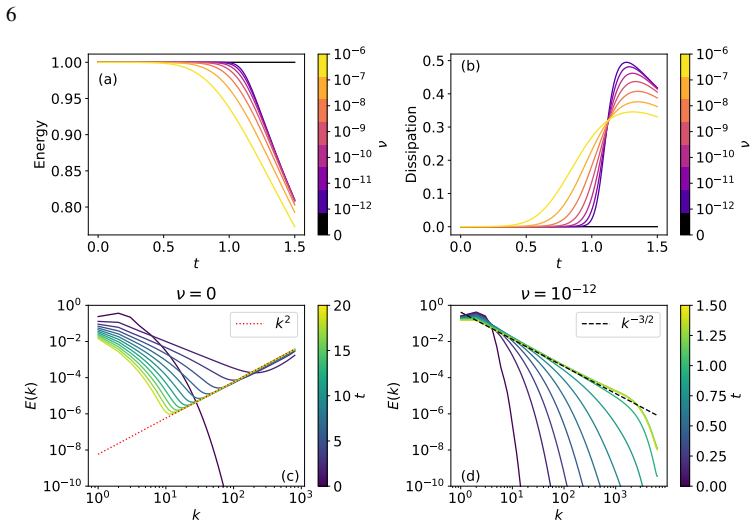
Fast magnetosonic waves are among the fundamental oscillation modes of astrophysical plasmas. To study their dynamics, we carry out numerical simulations of the wave turbulence kinetic equation, which describes the evolution of the energy spectrum of a set of weakly nonlinear fast magnetosonic waves. This kinetic equation, which involves three-wave interactions, has recently been derived from compressible magnetohydrodynamics in the low-$\beta$ limit (Galtier 2023). It has an exact stationary solution, the Kolmogorov-Zakharov spectrum, corresponding to a direct energy cascade. Here we perform free decay simulations of the kinetic equation for which we propose a Kolmogorov-type phenomenology to explain the temporal decay laws of energy and integral length scale. In the forced simulations, we show that the cascade is in fact composed of a mixture of a forward cascade for counter-propagating waves, and a backward cascade for co-propagating waves, with the former being stronger than the latter. The Kolmogorov-Zakharov energy spectrum in $k^{-3/2}$ is found in the radial direction with an anisotropy due to the amplitude that depends on the angle relative to the strong mean magnetic field. We give the analytical expression of the Kolmogorov-Zakharov constant, which is numerically verified in the high Reynolds number limit. Our study provides a theoretical explanation for certain observations in the solar wind plasma (Zhao et al. 2022), where a regime of weak turbulence has been identified for fast magnetosonic waves, alongside a critical balance regime for strong Alfv\'en wave turbulence.
Editorial analysis
A structured set of objections, weighed in public.
Referee Report
Summary. The manuscript numerically integrates the three-wave kinetic equation for fast magnetosonic waves derived from low-β compressible MHD (Galtier 2023). It analyzes free-decay runs with a proposed Kolmogorov phenomenology for the temporal decay of energy and integral scale, and forced runs that reveal a dominant forward cascade of counter-propagating waves together with a weaker backward cascade of co-propagating waves. The radial spectrum is reported to follow the Kolmogorov-Zakharov form k^{-3/2} with amplitude-dependent anisotropy relative to the mean field; an analytical expression for the KZ constant is derived and verified numerically at high Reynolds number. The results are offered as a theoretical explanation for weak-turbulence signatures observed in the solar wind.
Significance. If the weak-turbulence ordering remains valid, the work supplies a concrete link between the exact KZ solution of the kinetic equation and both free-decay scaling and forced-cascade directionality, together with a numerically confirmed analytical constant. This constitutes a useful step toward interpreting fast-magnetosonic signatures in astrophysical plasmas and complements existing strong-turbulence descriptions of Alfvén waves.
major comments (1)
- [Forced simulations section] The central claim that the forced cascade consists of a stronger forward component for counter-propagating waves and a weaker backward component for co-propagating waves rests on the continued applicability of the Galtier 2023 kinetic equation. No quantitative check (e.g., time series of max |δB|/B0 or equivalent amplitude parameter) is described to confirm that the small-amplitude ordering is preserved under continuous large-scale forcing; violation of this ordering would alter the resonance conditions and the reported directionality of the transfers.
minor comments (1)
- [Abstract] The abstract states that the KZ constant is 'numerically verified in the high Reynolds number limit' but does not specify the diagnostic used to establish convergence (e.g., variation of the measured constant with Reynolds number or with resolution).
Simulated Author's Rebuttal
We thank the referee for the positive evaluation of our work and for the constructive comment on the forced simulations. We address the point below and describe the revision we will implement.
read point-by-point responses
-
Referee: [Forced simulations section] The central claim that the forced cascade consists of a stronger forward component for counter-propagating waves and a weaker backward component for co-propagating waves rests on the continued applicability of the Galtier 2023 kinetic equation. No quantitative check (e.g., time series of max |δB|/B0 or equivalent amplitude parameter) is described to confirm that the small-amplitude ordering is preserved under continuous large-scale forcing; violation of this ordering would alter the resonance conditions and the reported directionality of the transfers.
Authors: We agree that an explicit verification of the small-amplitude ordering is necessary to confirm the applicability of the kinetic equation throughout the forced runs. Our simulations integrate the three-wave kinetic equation, which is derived under the weak-turbulence assumption of Galtier (2023), and the forcing strength is selected so that wave amplitudes remain small relative to the mean field. Nevertheless, we acknowledge that a direct time series of an amplitude diagnostic such as max |δB|/B0 was not included. In the revised manuscript we will add this diagnostic (a time series or running maximum of the amplitude parameter) for the forced cases, thereby confirming that the ordering is preserved and supporting the reported mixed forward-backward cascade directionality. revision: yes
Circularity Check
Central cascade results inherit kinetic equation and KZ spectrum from prior self-citation
specific steps
-
self citation load bearing
[Abstract]
"This kinetic equation, which involves three-wave interactions, has recently been derived from compressible magnetohydrodynamics in the low-β limit (Galtier 2023). It has an exact stationary solution, the Kolmogorov-Zakharov spectrum, corresponding to a direct energy cascade."
The forced-simulation claims (mixture of stronger forward cascade for counter-propagating waves and weaker backward cascade for co-propagating waves, plus radial k^{-3/2} spectrum with amplitude-dependent anisotropy) are obtained by solving this equation. The equation form, its three-wave resonance conditions, and the exact KZ stationary solution are imported wholesale from the same author group's earlier paper, so the central results reduce to that self-cited premise.
full rationale
The paper numerically integrates the three-wave kinetic equation and its stationary Kolmogorov-Zakharov solution to obtain the reported mixture of forward/backward cascades and the radial k^{-3/2} spectrum. Both the equation and the exact stationary solution are taken directly from Galtier 2023 (same lead author). While the numerical verification of the KZ constant adds independent content and the simulations themselves are new, the load-bearing framework and applicability assumptions remain those of the self-cited prior derivation without re-establishment here. No other circular reductions (self-definitional, fitted-input, ansatz smuggling, or renaming) appear in the provided text.
Axiom & Free-Parameter Ledger
axioms (1)
- domain assumption Weak nonlinearity and low-beta limit of compressible MHD allow closure to a three-wave kinetic equation
Lean theorems connected to this paper
-
IndisputableMonolith/Cost/FunctionalEquation.leanwashburn_uniqueness_aczel unclear?
unclearRelation between the paper passage and the cited Recognition theorem.
numerical simulations of the wave turbulence kinetic equation... three-wave interactions... Kolmogorov-Zakharov spectrum... k^{-3/2}... anisotropy due to the amplitude that depends on the angle relative to the strong mean magnetic field
-
IndisputableMonolith/Foundation/DimensionForcing.leanalexander_duality_circle_linking unclear?
unclearRelation between the paper passage and the cited Recognition theorem.
exact stationary solution... Kolmogorov-Zakharov spectrum... direct energy cascade
What do these tags mean?
- matches
- The paper's claim is directly supported by a theorem in the formal canon.
- supports
- The theorem supports part of the paper's argument, but the paper may add assumptions or extra steps.
- extends
- The paper goes beyond the formal theorem; the theorem is a base layer rather than the whole result.
- uses
- The paper appears to rely on the theorem as machinery.
- contradicts
- The paper's claim conflicts with a theorem or certificate in the canon.
- unclear
- Pith found a possible connection, but the passage is too broad, indirect, or ambiguous to say the theorem truly supports the claim.
Reference graph
Works this paper leans on
-
[1]
Andr \'e s, N. , Clark Di Leoni, P. , Mininni, P. D. , Dmitruk, P. , Sahraoui, F. & Matthaeus, W. H. 2017 Interplay between Alfv\'en and magnetosonic waves in compressible magnetohydrodynamics turbulence . Physics of Plasmas 24 (10), 102314
work page 2017
-
[2]
Batchelor , G. K. & Proudman , I. 1956 The Large-Scale Structure of Homogeneous Turbulence . Phil. Trans. Royal Soc. London Series A 248 (949), 369--405
work page 1956
-
[3]
Benney, D.J. & Newell, A.C. 1967 Sequential time closures for interacting random waves . J. Math. Phys. 46 ( 4 ), 363--392
work page 1967
-
[4]
Benney , D.J. & Saffman , P.G. 1966 Nonlinear Interactions of Random Waves in a Dispersive Medium . Proc. R. Soc. Lond. A 289 (1418), 301--320
work page 1966
-
[5]
Bigot , B. , Galtier , S. & Politano , H. 2008 Energy Decay Laws in Strongly Anisotropic Magnetohydrodynamic Turbulence . Phys. Rev. Lett. 100 (7), 074502
work page 2008
-
[6]
Biskamp , D. & M \"u ller , W.-C. 1999 Decay Laws for Three-Dimensional Magnetohydrodynamic Turbulence . Phys. Rev. Lett. 83 (11), 2195--2198
work page 1999
-
[7]
Biskamp , D. & Welter , H. 1989 Dynamics of decaying two-dimensional magnetohydrodynamic turbulence . Phys. Fluids B 1 (10), 1964--1979
work page 1989
-
[8]
Briard , A. & Gomez , T. 2018 The decay of isotropic magnetohydrodynamics turbulence and the effects of cross-helicity . J. Plasma Phys. 84 (1), 905840110
work page 2018
-
[9]
Brunetti , G. & Lazarian , A. 2007 Compressible turbulence in galaxy clusters: physics and stochastic particle re-acceleration . MNRAS 378 (1), 245--275
work page 2007
-
[10]
Chandran, Benjamin D. G. 2008 Strong Anisotropic MHD Turbulence with Cross Helicity . The Astrophysical Journal 685 (1), 646--658
work page 2008
-
[11]
Cho, J. & Lazarian, A. 2002 Compressible Sub-Alfv\'enic MHD Turbulence in Low- Plasmas . Phys. Rev. Lett. 88 (24), 245001
work page 2002
-
[12]
Cho , J. & Vishniac , E.T. 2000 The Anisotropy of Magnetohydrodynamic Alfv \'e nic Turbulence . Astrophys. J. 539 (1), 273--282
work page 2000
-
[13]
Clark di Leoni , P. & Mininni , P.D. 2016 Quantifying resonant and near-resonant interactions in rotating turbulence . J. Fluid Mech. 809 , 821--842
work page 2016
-
[14]
Physical Review E 113 (2), 024205
Costa, Guillaume , Krstulovic, Giorgio & Nazarenko, Sergey 2026 Stability of stationary solutions in acoustic wave turbulence . Physical Review E 113 (2), 024205
work page 2026
-
[15]
David , V. & Galtier , S. 2022 Wave turbulence in inertial electron magnetohydrodynamics . J. Plasma Phys. 88 (5), 905880509
work page 2022
-
[16]
David , V. , Galtier , S. & Meyrand , R. 2024 Monofractality in the Solar Wind at Electron Scales: Insights from Kinetic Alfv \'e n Waves Turbulence . Phys. Rev. Lett. 132 (8), 085201
work page 2024
-
[17]
Dematteis , G. & Lvov , Y.V. 2023 The structure of energy fluxes in wave turbulence . J. Fluid Mech. 954 , A30
work page 2023
-
[18]
D \"u ring , G. , Josserand , C. & Rica , S. 2017 Wave turbulence theory of elastic plates . Physica D Nonlinear Phenomena 347 , 42--73
work page 2017
-
[19]
Falcon, E. & Mordant, N. 2022 Experiments in surface gravity–capillary wave turbulence . Ann. Rev. Fluid Mech. 54 (1), 1--25
work page 2022
-
[20]
Ferraro , M. , Baudin , K. , Gervaziev , M. , Fusaro , A. , Picozzi , A. , Garnier , J. , Millot , G. , Kharenko , D. , Podivilov , E. , Babin , S. , Mangini , F. & Wabnitz , S. 2025 Wave turbulence, thermalization and multimode locking in optical fibers . Physica D Nonlinear Phenomena 481 , 134758
work page 2025
-
[21]
2003 Weak inertial-wave turbulence theory
Galtier , S. 2003 Weak inertial-wave turbulence theory . Phys. Rev. E 68 (1), 015301
work page 2003
-
[22]
2016 Introduction to Modern Magnetohydrodynamics \/ , 1st edn
Galtier, S. 2016 Introduction to Modern Magnetohydrodynamics \/ , 1st edn. Cambridge University Press
work page 2016
-
[23]
2022 Physics of Wave Turbulence \/ , 1st edn
Galtier, S. 2022 Physics of Wave Turbulence \/ , 1st edn. Cambridge University Press
work page 2022
-
[24]
2023 A multiple time scale approach for anisotropic inertial wave turbulence
Galtier , S. 2023 A multiple time scale approach for anisotropic inertial wave turbulence . J. Fluid Mech. 974 , A24
work page 2023
-
[25]
2023 Fast magneto-acoustic wave turbulence and the Iroshnikov -- Kraichnan spectrum
Galtier, S. 2023 Fast magneto-acoustic wave turbulence and the Iroshnikov -- Kraichnan spectrum . Journal of Plasma Physics 89 (2), 905890205
work page 2023
-
[26]
2024 Wave turbulence: A solvable problem applied to the Navier -- Stokes equations
Galtier, S. 2024 Wave turbulence: A solvable problem applied to the Navier -- Stokes equations . Comptes Rendus. Physique 25 (G1), 433--455
work page 2024
-
[27]
Galtier , S. & Chandran , B. D. G. 2006 Extended spectral scaling laws for shear-Alfv \'e n wave turbulence . Phys. Plasmas 13 (11), 114505
work page 2006
-
[28]
Galtier , S. & Nazarenko , S.V. 2017 Turbulence of Weak Gravitational Waves in the Early Universe . Phys. Rev. Lett. 119 (22), 221101
work page 2017
-
[29]
Galtier, S. , Nazarenko, S. V. , Newell, A. C. & Pouquet, A. 2000 A weak turbulence theory for incompressible magnetohydrodynamics . Journal of Plasma Physics 63 (5), 447--488
work page 2000
-
[30]
Galtier , S. , Politano , H. & Pouquet , A. 1997 Self-Similar Energy Decay in Magnetohydrodynamic Turbulence . Phys. Rev. Lett. 79 (15), 2807--2810
work page 1997
-
[31]
Gay , B. & Galtier , S. 2024 Gravitational wave turbulence: A multiple time scale approach for quartic wave interactions . Phys. Rev. D 109 (8), 083531
work page 2024
-
[32]
Goldreich, P. & Sridhar, S. 1995 Toward a theory of interstellar turbulence. 2: Strong alfvenic turbulence . Astrophys. J. 438 , 763
work page 1995
-
[33]
Grappin , R. , Frisch , U. , Pouquet , A. & Leorat , J. 1982 Alfvenic fluctuations as asymptotic states of MHD turbulence . Astron. Astrophys. 105 (1), 6--14
work page 1982
-
[34]
& Nazarenko, Sergey 2022 Energy Spectrum of Two-Dimensional Acoustic Turbulence
Griffin, Adam , Krstulovic, Giorgio , L'vov, Victor S. & Nazarenko, Sergey 2022 Energy Spectrum of Two-Dimensional Acoustic Turbulence . Physical Review Letters 128 (22), 224501
work page 2022
-
[35]
Hassaini , R. , Mordant , N. , Miquel , B. , Krstulovic , G. & D \"u ring , G. 2019 Elastic weak turbulence: From the vibrating plate to the drum . Phys. Rev. E 99 (3), 033002
work page 2019
-
[36]
Horbury , T.S. , Forman , M. & Oughton , S. 2008 Anisotropic Scaling of Magnetohydrodynamic Turbulence . Phys. Rev. Lett. 101 (17), 175005
work page 2008
- [37]
- [38]
-
[39]
1964 Turbulence of a conducting fluid in a strong magnetic field
Iroshnikov , P.S. 1964 Turbulence of a conducting fluid in a strong magnetic field . Soviet Astron. 7 , 566--571
work page 1964
-
[40]
Kochurin, E. A. & Kuznetsov, E. A. 2024 Three- Dimensional Acoustic Turbulence : Weak Versus Strong . Physical Review Letters 133 (20), 207201
work page 2024
-
[41]
1941 On degeneration of isotropic turbulence in an incompressible viscous fluid
Kolmogorov, A.N. 1941 On degeneration of isotropic turbulence in an incompressible viscous fluid . Doklady Akademii Nauk 31 , 538--540
work page 1941
-
[42]
1965 Inertial-Range Spectrum of Hydromagnetic Turbulence
Kraichnan , R.H. 1965 Inertial-Range Spectrum of Hydromagnetic Turbulence . Phys. Fluids 8 , 1385--1387
work page 1965
-
[43]
Kuznetsov, E. A. 2001 Weak magnetohydrodynamic turbulence of a magnetized plasma . Journal of Experimental and Theoretical Physics 93 (5), 1052--1064
work page 2001
-
[44]
Labarre , V. , Krstulovic , G. & Nazarenko , S. 2025 Wave-Kinetic Dynamics of Forced-Dissipated Turbulent Internal Gravity Waves . Phys. Rev. Lett. 135 (1), 014101
work page 2025
-
[45]
Labarre , V. , Lanchon , N. , Cortet , P.-P. , Krstulovic , G. & Nazarenko , S. 2024 On the kinetics of internal gravity waves beyond the hydrostatic regime . J. Fluid Mech. 998 , A17
work page 2024
-
[46]
Lanchon , N. , Boury , S. & Cortet , P.-P. 2025 Laboratory observation of internal gravity wave turbulence in a three-dimensional large-scale facility . Phys. Rev. Fluids 10 (8), 084804
work page 2025
-
[47]
Lanchon , N. , Mora , D.O. , Monsalve , E. & Cortet , P.-P. 2023 Internal wave turbulence in a stratified fluid with and without eigenmodes of the experimental domain . Phys. Rev. Fluids 8 (5), 054802
work page 2023
-
[48]
Le Reun , T. , Favier , B. , Barker , A.J. & Le Bars , M. 2017 Inertial Wave Turbulence Driven by Elliptical Instability . Phys. Rev. Lett. 119 (3), 034502
work page 2017
-
[49]
2021 Particle acceleration in strong MHD turbulence
Lemoine , M. 2021 Particle acceleration in strong MHD turbulence . Phys. Rev. D 104 (6), 063020
work page 2021
-
[50]
Meyrand, R. , Galtier, S. & Kiyani, K.H. 2016 Direct Evidence of the Transition from Weak to Strong Magnetohydrodynamic Turbulence . Physical Review Letters 116 (10), 105002
work page 2016
-
[51]
Meyrand, R. , Kiyani, K.H. , G \"u rcan, O.D. & Galtier, S. 2018 Coexistence of Weak and Strong Wave Turbulence in Incompressible Hall Magnetohydrodynamics . Physical Review X 8 (3), 031066
work page 2018
-
[52]
Monsalve, E. , Brunet, M. , Gallet, B. & Cortet, P.-P. 2020 Quantitative experimental observation of weak inertial-wave turbulence . Phys. Rev. Lett. 125 , 254502
work page 2020
-
[53]
M \"u ller, N.P. & Krstulovic, G. 2020 Kolmogorov and Kelvin wave cascades in a generalized model for quantum turbulence . Physical Review B 102 (13), 134513
work page 2020
-
[54]
Newell , A. C. & Aucoin , P. J. 1971 Semidispersive wave systems . J. Fluid Mech. 49 , 593--609
work page 1971
-
[55]
Onorato , M. , Dematteis , G. , Proment , D. , Pezzi , A. , Ballarin , M. & Rondoni , L. 2022 Equilibrium and nonequilibrium description of negative temperature states in a one-dimensional lattice using a wave kinetic approach . Phys. Rev. E 105 (1), 014206
work page 2022
-
[56]
Pan , Y. & Yue , D.K. P. 2017 Understanding discrete capillary-wave turbulence using a quasi-resonant kinetic equation . J. Fluid Mech. 816 , R1
work page 2017
-
[57]
Pongkitiwanichakul , P. & Chandran , B.D. G. 2014 Stochastic Acceleration of Electrons by Fast Magnetosonic Waves in Solar Flares: The Effects of Anisotropy in Velocity and Wavenumber Space . Astrophys. J. 796 (1), 45
work page 2014
-
[58]
Ricard , G. & Falcon , E. 2021 Experimental quasi-1D capillary-wave turbulence . EPL (Europhysics Letters) 135 (6), 64001
work page 2021
-
[59]
Saffman , P. G. 1967 Note on Decay of Homogeneous Turbulence . Phys. Fluids 10 (6), 1349--1349
work page 1967
-
[60]
Savaro , C. , Campagne , A. , Linares , M.C. , Augier , P. , Sommeria , J. , Valran , T. , Viboud , S. & Mordant , N. 2020 Generation of weakly nonlinear turbulence of internal gravity waves in the Coriolis facility . Phys. Rev. Fluids 5 (7), 073801
work page 2020
-
[61]
Shavit , M. , B \"u hler , O. & Shatah , J. 2025 Turbulent Spectrum of 2D Internal Gravity Waves . Phys. Rev. Lett. 134 (5), 054101
work page 2025
-
[62]
Fast Magnetosonic Turbulence in Two-Dimensional Relativistic Plasmas
Ugarov , P. , Zhdankin , V. & Arr \`o , G. 2026 Fast Magnetosonic Turbulence in Two-Dimensional Relativistic Plasmas . arXiv e-prints p. arXiv:2604.04276 , arXiv:arXiv: 2604.04276
work page internal anchor Pith review Pith/arXiv arXiv 2026
-
[63]
Yan , H. , Lazarian , A. & Petrosian , V. 2008 Particle Acceleration by Fast Modes in Solar Flares . Astrophys. J. 684 (2), 1461--1468
work page 2008
-
[64]
Yarom , E. , Salhov , A. & Sharon , E. 2017 Experimental quantification of nonlinear time scales in inertial wave rotating turbulence . Phys. Rev. Fluids 2 (12), 122601
work page 2017
-
[65]
Zakharov , V.E. & Filonenko , N.N. 1967 Weak turbulence of capillary waves . J. Applied Mech. Tech. Phys. 8 (5), 37--40
work page 1967
-
[66]
Zakharov, V. E. & Sagdeev, R. Z. 1970 Spectrum of Acoustic Turbulence . Soviet Physics Doklady 15 , 439
work page 1970
- [67]
- [68]
- [69]
- [70]
-
[71]
Zhao, S. Q. , Yan, Huirong , Liu, Terry Z. , Liu, Mingzhe & Wang, Huizi 2022 Multispacecraft Analysis of the Properties of Magnetohydrodynamic Fluctuations in Sub-Alfv\'enic Solar Wind Turbulence at 1 au . Astrophys. J. 937 (2), 102
work page 2022
discussion (0)
Sign in with ORCID, Apple, or X to comment. Anyone can read and Pith papers without signing in.