Large Language Model-Driven Cooperative Operator Ensemble Evolution for Permutation Flow Shop Scheduling
Pith reviewed 2026-06-27 04:36 UTC · model grok-4.3
The pith
An LLM-assisted framework evolves a set of destruction operators that lets iterated greedy switch among them on stagnation and outperform a leading variant on large flow shop instances.
A machine-rendered reading of the paper's core claim, the machinery that carries it, and where it could break.
Core claim
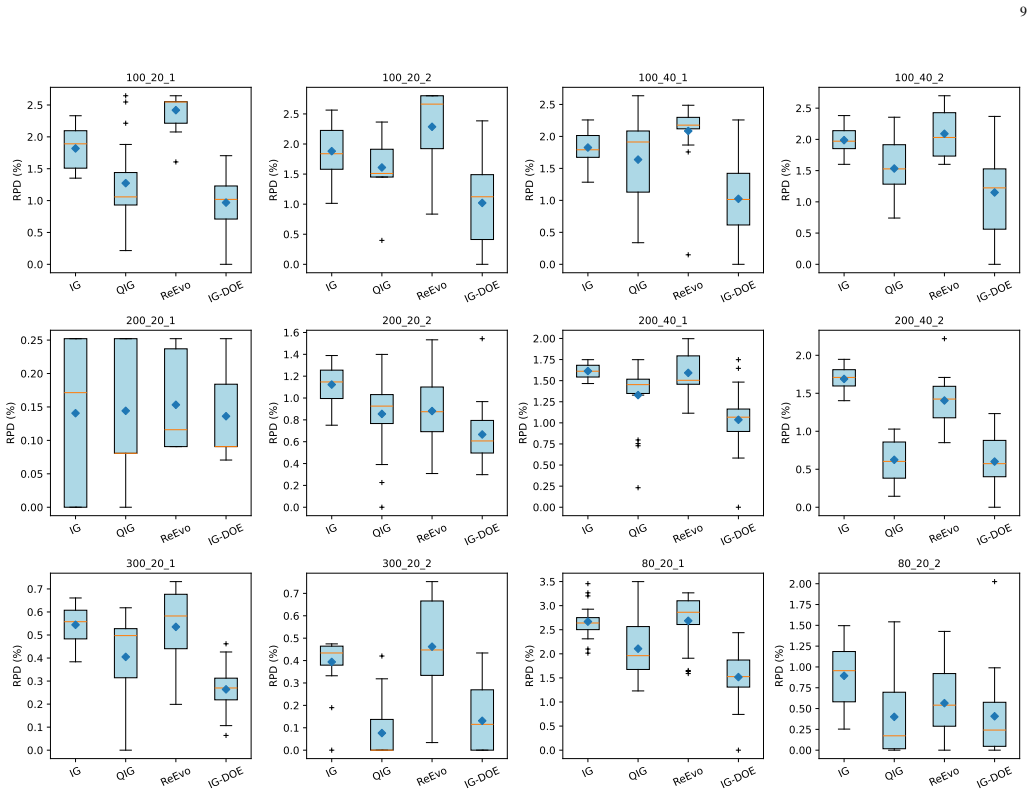
The paper claims that the SCOE framework produces a destruction operator ensemble whose integration into IG-DOE via stagnation-triggered sequential switching yields measurably better average performance than QIG on the VRF-hard-large set under identical CPU-time limits, and that this ensemble generalizes from the smaller instances used for evolution to both larger synthetic instances and real-world industrial instances without further adaptation.
What carries the argument
Stagnation-triggered sequential switching inside an ordered destruction operator ensemble (DOE), where detection of stagnation activates the next operator in the sequence to change the perturbation applied to the current solution.
If this is right
- An ensemble evolved on smaller instances transfers directly to larger instances without retraining.
- IG-DOE produces higher average solution quality than QIG when both run under identical CPU-time budgets.
- The same ensemble retains effectiveness on real-world industrial instances whose data distribution differs from the benchmark set.
Where Pith is reading between the lines
- LLM-driven cooperative evolution may be usable to generate operator sets for other metaheuristics that currently depend on manually chosen perturbation operators.
- The stagewise, state-aware construction process could be tested on routing or packing problems that also suffer from operator stagnation.
- If the switching rule proves robust, similar trigger-based ensembles might replace fixed single-operator designs in many local-search algorithms.
Load-bearing premise
The assumption that a destruction operator ensemble evolved solely on smaller problem instances will generalize without retraining or adaptation to larger unseen instances and to real-world data with different distributions.
What would settle it
Apply both IG-DOE and QIG to a fresh collection of large PFSP instances under the same CPU-time limit and check whether the average performance gap disappears or reverses; or test the evolved DOE on additional industrial datasets drawn from distributions farther from the training data.
Figures
read the original abstract
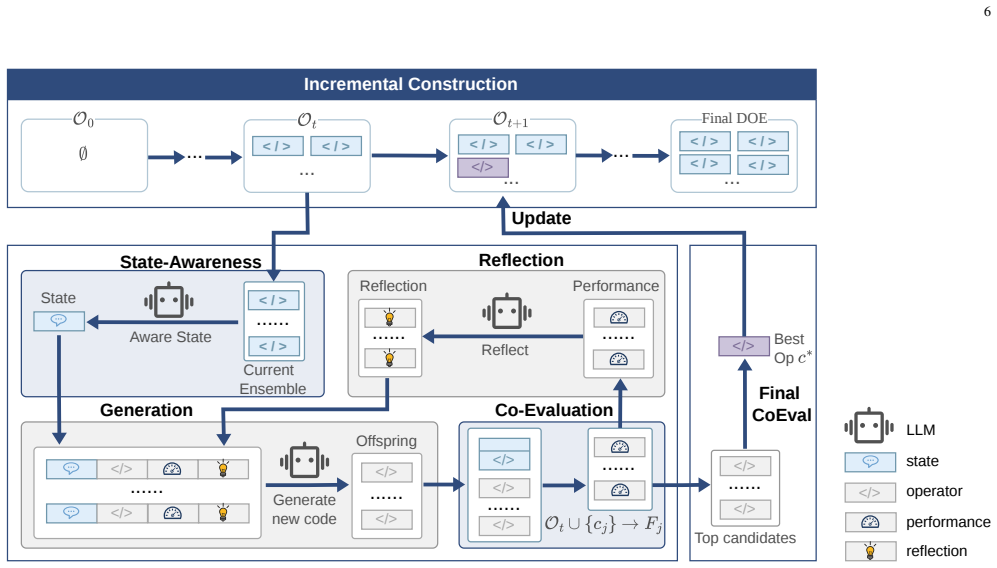
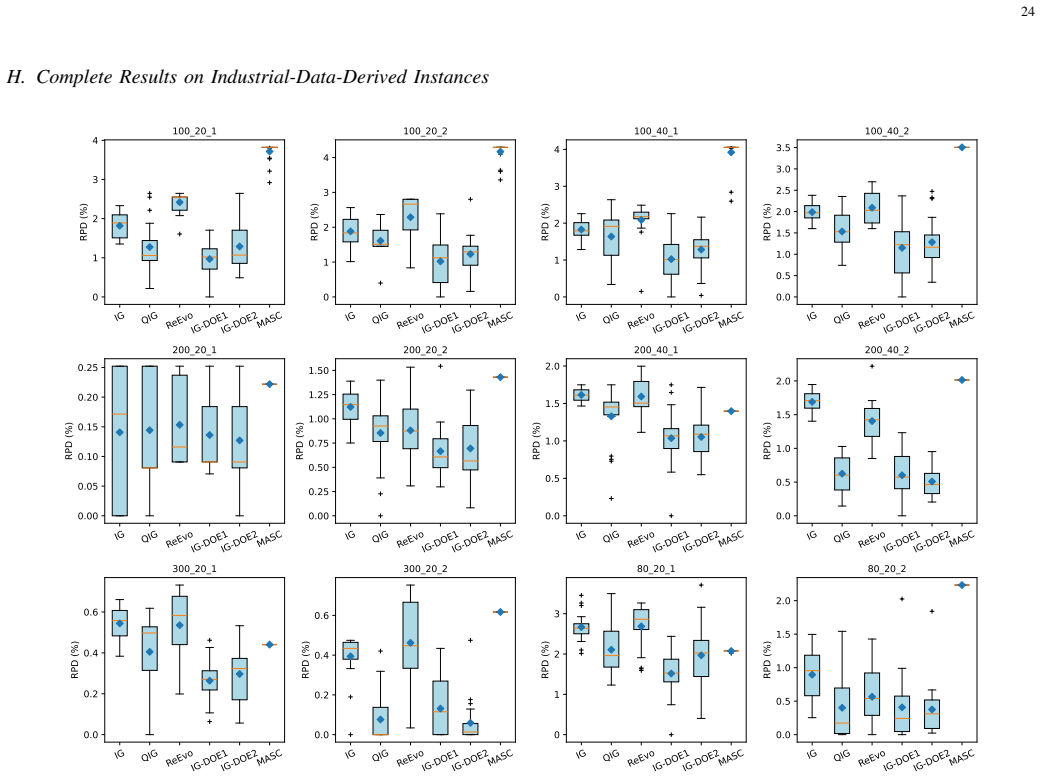
The permutation flow shop scheduling problem (PFSP) is a classical NP-hard combinatorial optimization problem in intelligent manufacturing. In practice, PFSP is commonly addressed using metaheuristic algorithms, among which the iterated greedy (IG) algorithm is widely adopted due to its simplicity and strong empirical performance. However, classical IG relies on a single fixed destruction operator, which often limits exploration and leads to search stagnation on large and complex problem instances. To address this issue, this work proposes a multi-operator IG algorithm, termed IG-DOE, which enhances exploration by switching among heterogeneous destruction operators along a single search trajectory. The core mechanism, called stagnation-triggered sequential switching, activates the next destruction operator in an ordered destruction operator ensemble (DOE) when stagnation is detected, thereby enriching the perturbation behavior of classical IG. Moreover, to reduce reliance on expert-crafted operators, a large language model (LLM)-assisted framework, termed SCOE, is introduced to automatically construct a high-quality DOE through stagewise evolution, state-awareness, and cooperative evaluation. Experiments on the challenging VRF-hard-large benchmark show that the DOE evolved from smaller problem instances generalizes well to larger unseen instances. Under the same CPU-time limit, IG-DOE obtained much better average performance than QIG, a state-of-the-art IG algorithm. Additional experiments on real-world industrial-data-derived instances further show that the evolved DOE can generalize effectively to different data distributions without additional adaptation.
Editorial analysis
A structured set of objections, weighed in public.
Referee Report
Summary. The manuscript proposes IG-DOE, a multi-operator iterated greedy algorithm for the permutation flow shop scheduling problem that switches among a destruction operator ensemble (DOE) upon stagnation detection. The DOE is automatically constructed via the SCOE framework, which uses large language models for stagewise evolution, state-awareness, and cooperative evaluation to reduce reliance on expert-crafted operators. The central claims are that a DOE evolved solely on smaller VRF instances generalizes to VRF-hard-large benchmarks and yields better average performance than the state-of-the-art QIG under identical CPU-time limits, with further generalization shown on real-world industrial-data-derived instances without adaptation.
Significance. If the empirical claims are substantiated, the work would advance LLM-assisted metaheuristic design in evolutionary computation by demonstrating automated construction of operator ensembles that improve exploration on large PFSP instances. The cooperative evaluation mechanism and focus on fixed computational budgets represent strengths that could influence practical applications in intelligent manufacturing. The reported cross-distribution generalization, if robust, would support broader adoption of such evolutionary frameworks.
major comments (3)
- [Abstract] Abstract and experimental results: the claim of superior average performance versus QIG on VRF-hard-large provides no information on the number of independent runs, standard deviations, or statistical significance tests, leaving the central empirical comparison only moderately supported.
- [Generalization experiments] Generalization experiments: the assertion that a DOE evolved exclusively on smaller instances transfers to VRF-hard-large and to industrial instances with shifted processing-time distributions lacks any invariance argument, scaling relation, or ablation study on distribution shift; nothing in the SCOE construction supplies such a guarantee, making this the least-secured step in the headline result.
- [SCOE framework description] SCOE framework: the stagewise evolution and cooperative evaluation are presented without analysis of why the resulting stagnation-triggered switching behavior remains effective across instance sizes, undermining the no-retraining transfer claim.
minor comments (1)
- [Method description] A pseudocode listing or diagram for the stagnation-triggered sequential switching logic would clarify the IG-DOE search trajectory.
Simulated Author's Rebuttal
We thank the referee for the constructive comments. We address each major point below, indicating planned revisions where appropriate.
read point-by-point responses
-
Referee: [Abstract] Abstract and experimental results: the claim of superior average performance versus QIG on VRF-hard-large provides no information on the number of independent runs, standard deviations, or statistical significance tests, leaving the central empirical comparison only moderately supported.
Authors: We agree that the abstract and results would be strengthened by reporting the number of independent runs, standard deviations, and statistical tests. The revised manuscript will include these details (e.g., averages over 10 runs with standard deviations and Wilcoxon signed-rank test p-values) in both the abstract and experimental section. revision: yes
-
Referee: [Generalization experiments] Generalization experiments: the assertion that a DOE evolved exclusively on smaller instances transfers to VRF-hard-large and to industrial instances with shifted processing-time distributions lacks any invariance argument, scaling relation, or ablation study on distribution shift; nothing in the SCOE construction supplies such a guarantee, making this the least-secured step in the headline result.
Authors: The transfer is supported by direct empirical evaluation on the target distributions. While the manuscript does not contain a formal invariance proof, the SCOE mechanisms (state-awareness and cooperative evaluation) are designed to favor generally useful perturbation strategies. We will add a discussion subsection with further analysis of the observed robustness and, where data permit, an ablation on distribution shift. revision: partial
-
Referee: [SCOE framework description] SCOE framework: the stagewise evolution and cooperative evaluation are presented without analysis of why the resulting stagnation-triggered switching behavior remains effective across instance sizes, undermining the no-retraining transfer claim.
Authors: We accept that an explicit analysis of cross-size effectiveness would reinforce the no-retraining claim. The revised version will expand the SCOE description with additional discussion and supporting experiments on why the evolved switching behavior transfers across instance sizes. revision: yes
Circularity Check
No circularity: empirical framework with direct experimental validation
full rationale
The paper introduces an algorithmic framework (SCOE for evolving DOE, then IG-DOE with stagnation-triggered switching) and supports its claims exclusively through benchmark experiments (VRF-hard-large, industrial instances) and comparisons to QIG under fixed CPU time. No mathematical derivation, uniqueness theorem, or parameter-fitting step is claimed whose output reduces by construction to the inputs; generalization is asserted only as an observed experimental outcome, not as a predicted quantity forced by the method's own definitions or self-citations. The central result therefore remains independent of any self-referential reduction.
Axiom & Free-Parameter Ledger
Reference graph
Works this paper leans on
-
[1]
A new vision of approximate methods for the permutation flowshop to minimise makespan: State-of-the-art and computational evaluation,
V . Fernandez-Viagas, R. Ruiz, and J. M. Frami ˜nan, “A new vision of approximate methods for the permutation flowshop to minimise makespan: State-of-the-art and computational evaluation,”Eur. J. Oper. Res., vol. 257, no. 3, pp. 707–721, 2017
2017
-
[3]
A balance-oriented iterative greedy algorithm for the distributed heterogeneous hybrid flow-shop scheduling problem with blocking constraints,
X. Wu and Y . Zhao, “A balance-oriented iterative greedy algorithm for the distributed heterogeneous hybrid flow-shop scheduling problem with blocking constraints,”Swarm Evol. Comput., vol. 96, p. 102015, 2025
2025
-
[4]
A self-adaptive two stage iterative greedy algorithm based job scales for energy-efficient distributed permutation flowshop scheduling problem,
Y . Yu, Q. Zhong, L. Sun, Y . Han, Q. Zhang, X. Jing, and Z. Wang, “A self-adaptive two stage iterative greedy algorithm based job scales for energy-efficient distributed permutation flowshop scheduling problem,” Swarm Evol. Comput., vol. 92, p. 101777, 2025
2025
-
[5]
Optimal two- and three-stage production schedules with setup times included,
S. M. Johnson, “Optimal two- and three-stage production schedules with setup times included,”Naval Research Logistics Quarterly, vol. 1, no. 1, pp. 61–68, 1954
1954
-
[6]
A. H. G. R. Kan,Machine Scheduling Problems: Classification, Com- plexity and Computations. H. E. Stenfert Kroese, 1976
1976
-
[7]
A simple and effective iterated greedy algorithm for the permutation flowshop scheduling problem,
R. Ruiz and T. St ¨utzle, “A simple and effective iterated greedy algorithm for the permutation flowshop scheduling problem,”Eur. J. Oper. Res., vol. 177, no. 3, pp. 2033–2049, 2007
2033
-
[8]
A memetic algorithm with novel semi-constructive evolution operators for permutation flowshop scheduling problem,
M. Kurdi, “A memetic algorithm with novel semi-constructive evolution operators for permutation flowshop scheduling problem,”Applied Soft Computing, vol. 94, p. 106458, 2020
2020
-
[9]
A best-of-breed iterated greedy for the permutation flowshop scheduling problem with makespan objective,
V . Fernandez-Viagas and J. M. Frami ˜nan, “A best-of-breed iterated greedy for the permutation flowshop scheduling problem with makespan objective,”Comput. Oper. Res., vol. 112, 2019
2019
-
[10]
Learning to select operators in meta-heuristics: An integration of q- learning into the iterated greedy algorithm for the permutation flowshop scheduling problem,
M. Karimi-Mamaghan, M. Mohammadi, B. Pasdeloup, and P. Meyer, “Learning to select operators in meta-heuristics: An integration of q- learning into the iterated greedy algorithm for the permutation flowshop scheduling problem,”Eur. J. Oper. Res., vol. 304, no. 3, pp. 1296–1330, 2023
2023
-
[11]
Adaptive operator selection for meta-heuristics: A survey,
J. Pei, Y . Mei, J. Liu, M. Zhang, and X. Yao, “Adaptive operator selection for meta-heuristics: A survey,”IEEE Transactions on Artificial Intelligence, vol. 6, no. 8, pp. 1991–2012, 2025
1991
-
[12]
Hybrid memetic search for electric vehicle routing with time windows, simultaneous pickup-delivery, and partial recharges,
Z. Zheng, S. Liu, and Y . Ong, “Hybrid memetic search for electric vehicle routing with time windows, simultaneous pickup-delivery, and partial recharges,”IEEE Trans. Emerg. Top. Comput. Intell., vol. 9, no. 6, pp. 3773–3787, 2025
2025
-
[13]
Learning-aided neighborhood search for vehicle routing problems,
T. Guo, Y . Mei, M. Zhang, H. Zhao, K. Cai, and W. Du, “Learning-aided neighborhood search for vehicle routing problems,”IEEE Transactions on Pattern Analysis and Machine Intelligence, vol. 47, no. 7, pp. 5930– 5944, 2025
2025
-
[14]
A reduced variable neighborhood search for the just in time job shop scheduling problem with sequence depen- dent setup times,
P. Brandimarte and E. Fadda, “A reduced variable neighborhood search for the just in time job shop scheduling problem with sequence depen- dent setup times,”Comput. Oper. Res., vol. 167, p. 106634, 2024
2024
-
[15]
Variable neighborhood search algorithms for the permutation flowshop scheduling problem with the preventive maintenance,
W. Jomaa, M. Eddaly, and B. Jarboui, “Variable neighborhood search algorithms for the permutation flowshop scheduling problem with the preventive maintenance,”Oper. Res., vol. 21, no. 4, pp. 2525–2542, 2021
2021
-
[16]
Hybrid quantum particle swarm optimization and variable neighborhood search for flexible job- shop scheduling problem,
Y . Xu, M. Zhang, M. Yang, and D. Wang, “Hybrid quantum particle swarm optimization and variable neighborhood search for flexible job- shop scheduling problem,”Journal of Manufacturing Systems, vol. 73, pp. 334–348, 2024
2024
-
[17]
New hard benchmark for flowshop scheduling problems minimising makespan,
E. Vallada, R. Ruiz, and J. M. Framinan, “New hard benchmark for flowshop scheduling problems minimising makespan,”Eur. J. Oper. Res., vol. 240, no. 3, pp. 666–677, 2015
2015
-
[18]
A review of metrics on permutations for search landscape analysis,
T. Schiavinotto and T. St ¨utzle, “A review of metrics on permutations for search landscape analysis,”Comput. Oper. Res., vol. 34, no. 10, pp. 3143–3153, 2007
2007
-
[19]
Variable neighborhood search,
N. Mladenovi ´c and P. Hansen, “Variable neighborhood search,”Comput. Oper. Res., vol. 24, no. 11, pp. 1097–1100, 1997
1997
-
[20]
Mathematical discoveries from program search with large language models,
B. Romera-Paredes, M. Barekatain, A. Novikov, M. Balog, M. P. Kumar, E. Dupont, F. J. Ruiz, J. S. Ellenberg, P. Wang, O. Fawziet al., “Mathematical discoveries from program search with large language models,”Nature, vol. 625, no. 7995, pp. 468–475, 2024
2024
-
[21]
Reevo: Large language models as hyper-heuristics with reflective evolution,
H. Ye, J. Wang, Z. Cao, F. Berto, C. Hua, H. Kim, J. Park, and G. Song, “Reevo: Large language models as hyper-heuristics with reflective evolution,” inProceedings of NeurIPS 2024, Austria, 2024
2024
-
[22]
Evolution of heuristics: towards efficient automatic algorithm design using large language model,
F. Liu, X. Tong, M. Yuan, X. Lin, F. Luo, Z. Wang, Z. Lu, and Q. Zhang, “Evolution of heuristics: towards efficient automatic algorithm design using large language model,” inProceedings of ICML 2024, Austria, 2024. 13
2024
-
[23]
A systematic review of permutation flow shop scheduling with due-date- related objectives,
B. de Athayde Prata, L. R. de Abreu, and V . Fernandez-Viagas, “A systematic review of permutation flow shop scheduling with due-date- related objectives,”Comput. Oper. Res., vol. 177, p. 106989, 2025
2025
-
[24]
Q-learning guided algorithms for bi-criteria minimization of total flow time and makespan in no-wait permutation flowshops,
D. Y ¨uksel, L. Kandiller, and M. F. Tasgetiren, “Q-learning guided algorithms for bi-criteria minimization of total flow time and makespan in no-wait permutation flowshops,”Swarm Evol. Comput., vol. 89, p. 101617, 2024
2024
-
[25]
Variable neighborhood search algorithms for the permutation flowshop scheduling problem with the preventive maintenance,
W. Jomaa, M. Eddaly, and B. Jarboui, “Variable neighborhood search algorithms for the permutation flowshop scheduling problem with the preventive maintenance,”Operational Research, vol. 21, no. 4, pp. 2525– 2542, 2021
2021
-
[26]
Solving the permutation flow shop scheduling problem with sequence-dependent setup time via iterative greedy algorithm and imitation learning,
Z. Du, J. Li, H. Song, K. Gao, Y . Xu, J. Li, and Z. Zheng, “Solving the permutation flow shop scheduling problem with sequence-dependent setup time via iterative greedy algorithm and imitation learning,”Math- ematics and Computers in Simulation, vol. 234, pp. 169–193, 2025
2025
-
[27]
A heuristic algorithm for the m- machine, n-job flow-shop sequencing problem,
M. Nawaz, E. E. Enscore, and I. Ham, “A heuristic algorithm for the m- machine, n-job flow-shop sequencing problem,”Omega, vol. 11, no. 1, pp. 91–95, 1983
1983
-
[28]
Simulated annealing for permutation flow-shop scheduling,
I. Osman and C. Potts, “Simulated annealing for permutation flow-shop scheduling,”Omega, vol. 17, no. 6, pp. 551–557, 1989
1989
-
[29]
A comprehensive review and evaluation of permutation flowshop heuristics,
R. Ruiz and C. Maroto, “A comprehensive review and evaluation of permutation flowshop heuristics,”Eur. J. Oper. Res., vol. 165, no. 2, pp. 479–494, 2005, project Management and Scheduling
2005
-
[30]
Learning to optimize permutation flow shop scheduling via graph-based imitation learning,
L. Li, S. Liang, Z. Zhu, C. Ding, H. Zha, and B. Wu, “Learning to optimize permutation flow shop scheduling via graph-based imitation learning,” inProceedings of the AAAI Conference on Artificial Intelli- gence, Canada, Mar. 2024, pp. 20 185–20 193
2024
-
[31]
An improved artificial bee colony algorithm with q-learning for solving permutation flow-shop scheduling problems,
H. Li, K. Gao, P.-Y . Duan, J.-Q. Li, and L. Zhang, “An improved artificial bee colony algorithm with q-learning for solving permutation flow-shop scheduling problems,”IEEE Transactions on Systems, Man, and Cybernetics: Systems, vol. 53, no. 5, pp. 2684–2693, 2023
2023
-
[32]
Some efficient heuristic methods for the flow shop sequenc- ing problem,
E. Taillard, “Some efficient heuristic methods for the flow shop sequenc- ing problem,”Eur. J. Oper. Res., vol. 47, no. 1, pp. 65–74, 1990
1990
-
[33]
An iterated greedy algorithm with optimization of partial solutions for the makespan permutation flowshop problem,
J. Dubois-Lacoste, F. Pagnozzi, and T. St ¨utzle, “An iterated greedy algorithm with optimization of partial solutions for the makespan permutation flowshop problem,”Comput. Oper. Res., vol. 81, pp. 160– 166, 2017
2017
-
[34]
Survey on genetic programming and machine learning techniques for heuristic design in job shop scheduling,
F. Zhang, Y . Mei, S. Nguyen, and M. Zhang, “Survey on genetic programming and machine learning techniques for heuristic design in job shop scheduling,”IEEE Trans. Evol. Comput., vol. 28, no. 1, pp. 147–167, 2024
2024
-
[35]
Recent advances in selection hyper-heuristics,
J. H. Drake, A. Kheiri, E. ¨Ozcan, and E. K. Burke, “Recent advances in selection hyper-heuristics,”Eur. J. Oper. Res., vol. 285, no. 2, pp. 405–428, 2020
2020
-
[36]
Genetic programming for dynamic flexible job shop scheduling: Evolution with single individuals and ensembles,
M. Xu, Y . Mei, F. Zhang, and M. Zhang, “Genetic programming for dynamic flexible job shop scheduling: Evolution with single individuals and ensembles,”IEEE Trans. Evol. Comput., vol. 28, no. 6, pp. 1761– 1775, 2024
2024
-
[37]
Toward evolving dispatch- ing rules with flow control operations by grammar-guided linear genetic programming,
Z. Huang, Y . Mei, F. Zhang, and M. Zhang, “Toward evolving dispatch- ing rules with flow control operations by grammar-guided linear genetic programming,”IEEE Trans. Evol. Comput., vol. 29, no. 1, pp. 217–231, 2025
2025
-
[38]
A systematic survey on large language models for algorithm design,
F. Liu, Y . Yao, P. Guo, Z. Yang, X. Lin, Z. Zhao, X. Tong, K. Mao, Z. Lu, Z. Wang, M. Yuan, and Q. Zhang, “A systematic survey on large language models for algorithm design,”ACM Comput. Surv., vol. 58, no. 8, 2026
2026
-
[39]
Evolutionary computation in the era of large language model: Survey and roadmap,
X. Wu, S. Wu, J. Wu, L. Feng, and K. C. Tan, “Evolutionary computation in the era of large language model: Survey and roadmap,”IEEE Trans. Evol. Comput., vol. 29, no. 2, pp. 534–554, 2025
2025
-
[40]
Llm-driven instance-specific heuristic generation and selection,
S. Zhang, S. Liu, N. Lu, J. Wu, J. Liu, Y .-S. Ong, and K. Tang, “Llm-driven instance-specific heuristic generation and selection,”arXiv preprint arXiv:2506.00490, 2026
arXiv 2026
-
[41]
AHD Agent: Agentic re- inforcement learning for automatic heuristic design,
H. Lv, N. Lu, Z. Zhou, and S. Liu, “AHD Agent: Agentic re- inforcement learning for automatic heuristic design,”arXiv preprint arXiv:2605.08756, 2026
Pith/arXiv arXiv 2026
-
[42]
FunBO: Discovering acquisition functions for bayesian optimization with funsearch,
V . Aglietti, I. Ktena, J. Schrouff, E. Sgouritsa, F. Ruiz, A. Malek, A. Bellot, and S. Chiappa, “FunBO: Discovering acquisition functions for bayesian optimization with funsearch,” inProceedings of ICML 2025, Canada, 2025
2025
-
[43]
Llamea: A large language model evolutionary algorithm for automatically generating metaheuristics,
N. van Stein and T. B ¨ack, “Llamea: A large language model evolutionary algorithm for automatically generating metaheuristics,”IEEE Trans. Evol. Comput., vol. 29, no. 2, pp. 331–345, 2025
2025
-
[44]
R. Li, L. Wang, H. Sang, L. Yao, and L. Pan, “Llm-assisted automatic memetic algorithm for lot-streaming hybrid job shop scheduling with variable sublots,”IEEE Trans. Evol. Comput., 2025, early Access, DOI:10.1109/TEVC.2025.3556186
-
[45]
Au- tonomous multi-objective optimization using large language model,
Y . Huang, S. Wu, W. Zhang, J. Wu, L. Feng, and K. C. Tan, “Autonomous multi-objective optimization using large lan- guage model,”IEEE Trans. Evol. Comput., 2025, early Access, DOI:10.1109/TEVC.2025.3561001
-
[46]
Multi-objective evolution of heuristic using large language model,
S. Yao, F. Liu, X. Lin, Z. Lu, Z. Wang, and Q. Zhang, “Multi-objective evolution of heuristic using large language model,” inProceedings of AAAI 2025, PA, 2025
2025
-
[47]
Monte carlo tree search for comprehensive exploration in LLM-based automatic heuristic design,
Z. Zheng, Z. Xie, Z. Wang, and B. Hooi, “Monte carlo tree search for comprehensive exploration in LLM-based automatic heuristic design,” inProceedings of ICML 2025, Canada, 2025
2025
-
[48]
Alphaevolve: A coding agent for scientific and algorithmic discovery,
A. Novikov, N. V ˜u, M. Eisenberger, E. Dupont, P.-S. Huang, A. Z. Wagner, S. Shirobokov, B. Kozlovskii, F. J. Ruiz, A. Mehrabianet al., “Alphaevolve: A coding agent for scientific and algorithmic discovery,” arXiv preprint arXiv:2506.13131, 2025
Pith/arXiv arXiv 2025
-
[49]
EoH-S: Evolution of heuristic set using llms for automated heuristic design,
F. Liu, Y . Liu, Q. Zhang, T. Xialiang, and M. Yuan, “EoH-S: Evolution of heuristic set using llms for automated heuristic design,” inProceedings of AAAI 2026, Singapore, 2026
2026
-
[50]
Generalised accelerations for insertion-based heuristics in permutation flowshop scheduling,
V . Fernandez-Viagas, J. M. Molina-Pariente, and J. M. Framinan, “Generalised accelerations for insertion-based heuristics in permutation flowshop scheduling,”Eur. J. Oper. Res., vol. 282, no. 3, pp. 858–872, 2020
2020
-
[51]
Equation of state calculations by fast computing machines,
N. Metropolis, A. W. Rosenbluth, M. N. Rosenbluth, A. H. Teller, and E. Teller, “Equation of state calculations by fast computing machines,” The Journal of Chemical Physics, vol. 21, no. 6, pp. 1087–1092, 1953
1953
-
[52]
Cascaded large-scale tsp solving with unified neural guidance: Bridging local and population- based search,
H. Lv, Z. Wang, W. Chen, and S. Liu, “Cascaded large-scale tsp solving with unified neural guidance: Bridging local and population- based search,” inProceedings of ECAI, Bologna, Italy, 2025
2025
-
[53]
Local optima correlation assisted adaptive operator selection,
J. Pei, H. Tong, J. Liu, Y . Mei, and X. Yao, “Local optima correlation assisted adaptive operator selection,” inProceedings of the Genetic and Evolutionary Computation Conference. ACM, 2023, pp. 339–347. 14 Supplementary for the paper “Large Language Model-Driven Cooperative Operator Ensemble Evolution for Permutation Flow Shop Scheduling” A. The Iterate...
2023
-
[54]
```python ... ```
System Prompt System Generator You are an expert in the domain of optimization heuristics. Your task is to design heuristics that can effectively solve optimization problems. Your response outputs Python code and nothing else. Format your code as a Python codestring: "```python ... ```". Prompt 1: System prompt for generator LLM System Reflector You are a...
-
[55]
Be very creative and give `{func_name}_v2`
Generation Prompt User Generator Write a {func_name} function for {problem_desc} {func_desc} Prompt 3: User prompt for target function generation 17 Seed {seed_func} Refer to the format of a trivial design above. Be very creative and give `{func_name}_v2`. Output code only and enclose your code with Python code block:```python ... ```. Prompt 4: Seed form...
-
[56]
[Worse code] {worse_code} [Better code] {better_code} You respond with some hints for designing better heuristics, based on the two code versions and using less than 50 words
Reflection Prompt User prompt for short-term reflection Below are two {func_name} functions for {problem_desc}{func_desc} You are provided with two code versions below, where the second version performs better than the first one. [Worse code] {worse_code} [Better code] {better_code} You respond with some hints for designing better heuristics, based on the...
-
[57]
Focus on:
Operator Ensemble State-Awareness Prompt Operator ensemble state-awarenes Please analyze the following destruction-operator code and extract its key features. Focus on:
-
[58]
Destruction size (how many jobs are removed): specific values or how it is computed
-
[59]
The description should be clear enough for others to understand the core design of the operator
Destruction strategy (which jobs are removed): rules used to select jobs Describe these features in concise text. The description should be clear enough for others to understand the core design of the operator. [Code] {operator_code} [Feature description] Prompt 9: User prompt for state-aware
-
[60]
Its purpose is to selectively remove some jobs from the current solution based on the current solution and problem characteristics
Task-Specific Prompts Function signature def destroy_v{version}(sequence: list, processing_times: list) -> tuple[list, list]: Prompt 10: Operator signature 19 Seed function def destroy_v1(sequence: list, processing_times: list) -> tuple[list, list]: import random d_max = 2 d = min(d_max, len(sequence)) positions = random.sample(range(len(sequence)), d) re...
discussion (0)
Sign in with ORCID, Apple, or X to comment. Anyone can read and Pith papers without signing in.