Revolutionizing Wireless Communications with Space Data Centers: Applications and Open Challenges
Pith reviewed 2026-06-27 05:33 UTC · model grok-4.3
The pith
Space data centers integrate communication, computing, storage, and control in orbit to support task-oriented space services.
A machine-rendered reading of the paper's core claim, the machinery that carries it, and where it could break.
Core claim
Space data centers integrate communication, computing, storage, and control capabilities in orbit, enabling persistent service support for data-intensive and intelligence-driven space applications and transforming space communication paradigms from connectivity-oriented data transmission toward task-oriented and service-centric information exchange.
What carries the argument
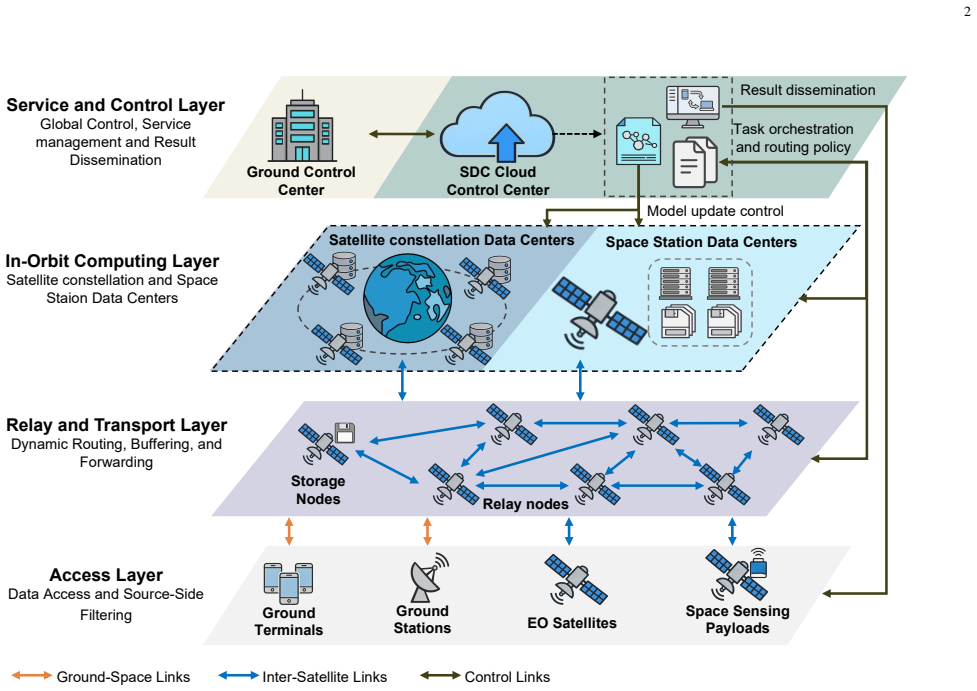
The hierarchical SDC network architecture consisting of access, relay, computing, and control layers that structures deployment and service delivery.
If this is right
- Future space applications gain support with specific communication traits and open research challenges identified.
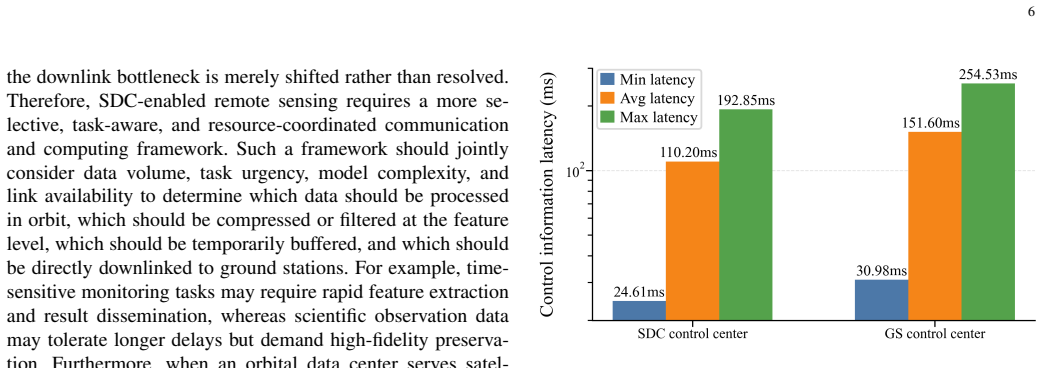
- Simulations confirm measurable reduction in control-layer latency within the layered space network.
- Practical deployment paths are outlined through identified research directions.
- Space networks shift from connectivity focus to service-centric operation for intelligence tasks.
Where Pith is reading between the lines
- Orbital compute resources could directly feed AI model training and inference for space systems.
- Hybrid ground-space networks might form if the architecture scales across layers.
- Standardization efforts for service-centric protocols would likely follow architecture adoption.
Load-bearing premise
Hierarchical SDC networks with integrated multi-layer capabilities can be practically deployed and operated in orbit.
What would settle it
An orbital simulation or prototype that includes power budgets, radiation effects, and orbital mechanics and shows the integrated layers cannot sustain operation.
Figures
read the original abstract
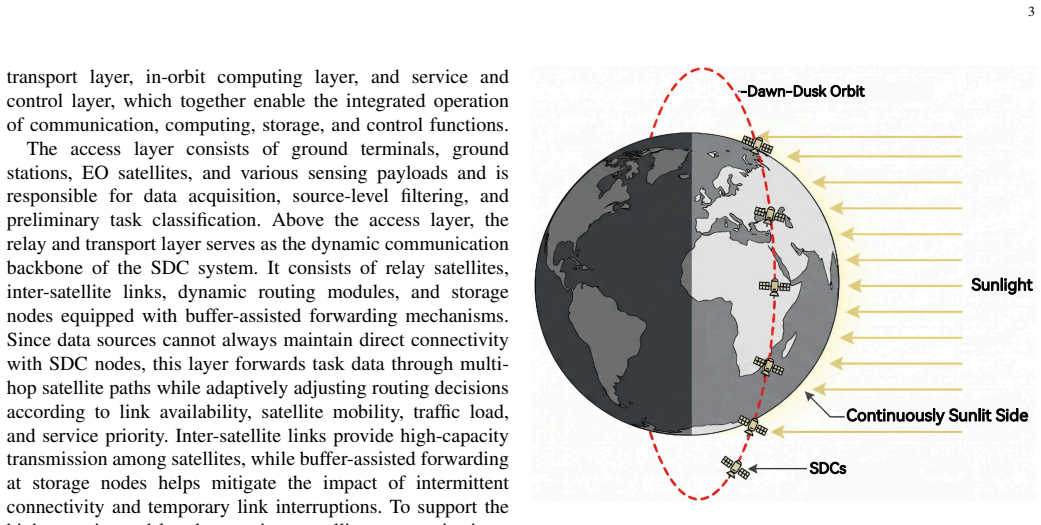
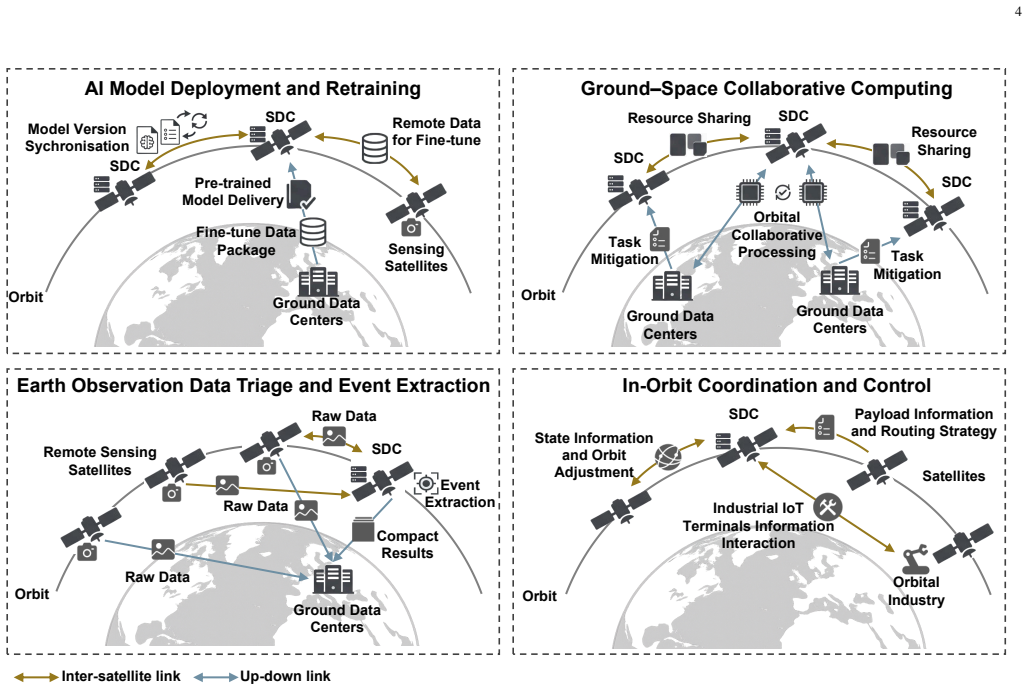
Space data centers (SDCs) are emerging as a promising orbital computing infrastructure for the future AI industry. Unlike conventional satellites that mainly serve as relay nodes or lightweight onboard processors, SDCs integrate communication, computing, storage, and control capabilities in orbit, enabling persistent service support for data-intensive and intelligence-driven space applications. In this article, we investigate how SDCs may transform space communication paradigms from connectivity-oriented data transmission toward task-oriented and service-centric information exchange. We first present a hierarchical SDC network architecture consisting of access, relay, computing, and control layers, and outline possible deployment strategies. We then explore representative future application scenarios enabled by SDCs, highlighting their communication characteristics and associated research challenges. Simulation results further demonstrate the effectiveness of SDCs in reducing control-layer latency in hierarchical space networks. Finally, we identify key research directions toward the practical deployment of SDCs.
Editorial analysis
A structured set of objections, weighed in public.
Referee Report
Summary. The paper claims that Space Data Centers (SDCs) integrate communication, computing, storage, and control in orbit to enable persistent services for data-intensive space applications and shift space communications from connectivity-oriented to task-oriented paradigms. It presents a hierarchical architecture with access, relay, computing, and control layers plus deployment strategies, explores representative application scenarios and their communication challenges, reports simulation results demonstrating latency reduction in the control layer, and identifies open research directions for practical SDC deployment.
Significance. If the feasibility concerns can be resolved, the work offers a forward-looking vision that could guide integration of edge computing into space networks, with explicit credit for mapping application scenarios and enumerating concrete research challenges. The single mentioned simulation of latency reduction, if expanded with methods and data, would strengthen the case for the proposed paradigm shift.
major comments (2)
- [Simulation results] Simulation results paragraph: the effectiveness demonstration for control-layer latency reduction is stated without any description of the simulation setup, network topology, traffic models, baseline comparisons, or quantitative outcomes, leaving the central claim of SDC-enabled improvement unsupported.
- [Hierarchical architecture and deployment] Hierarchical SDC network architecture and deployment strategies sections: the assumption that multi-layer SDCs can be practically operated rests on unaddressed constraints such as power budgets for continuous compute/storage, radiation effects on integrated electronics, thermal management, and orbital mechanics for inter-layer connectivity; these are load-bearing for the asserted paradigm transformation.
minor comments (1)
- [Abstract] The abstract and introduction use the term 'persistent service support' without defining its quantitative meaning in the context of orbital operations.
Simulated Author's Rebuttal
We thank the referee for the constructive comments on our manuscript. We agree that the simulation requires more detail and that practical constraints merit explicit discussion. We respond to each major comment below.
read point-by-point responses
-
Referee: [Simulation results] Simulation results paragraph: the effectiveness demonstration for control-layer latency reduction is stated without any description of the simulation setup, network topology, traffic models, baseline comparisons, or quantitative outcomes, leaving the central claim of SDC-enabled improvement unsupported.
Authors: We agree that the simulation paragraph lacks necessary detail. In the revised manuscript we will expand this section with a complete description of the simulation setup, network topology (layer-specific orbital parameters), traffic models (task-oriented AI workloads), baseline comparisons (conventional relay satellites), and quantitative latency outcomes with specific reduction metrics. revision: yes
-
Referee: [Hierarchical architecture and deployment] Hierarchical SDC network architecture and deployment strategies sections: the assumption that multi-layer SDCs can be practically operated rests on unaddressed constraints such as power budgets for continuous compute/storage, radiation effects on integrated electronics, thermal management, and orbital mechanics for inter-layer connectivity; these are load-bearing for the asserted paradigm transformation.
Authors: The manuscript is a vision paper that already lists power, radiation, thermal, and orbital-mechanics issues among the open research challenges in its final section. To address the concern directly, we will add explicit discussion of these constraints within the architecture and deployment sections, clarifying that the proposed paradigm shift is contingent on resolving them. This revision will make the load-bearing nature of the constraints transparent without altering the paper's scope. revision: partial
Circularity Check
No circularity: purely descriptive architecture proposal without derivations or reductions
full rationale
The paper contains no equations, fitted parameters, predictions derived from inputs, or mathematical derivations of any kind. It describes a hierarchical SDC architecture, deployment strategies, application scenarios, and mentions simulation results for latency reduction at a high level, but these are not shown to reduce to self-defined quantities or self-citations. No self-citation load-bearing steps, uniqueness theorems, or ansatzes appear in the provided text. The work is self-contained as a forward-looking survey and position piece.
Axiom & Free-Parameter Ledger
axioms (1)
- domain assumption Space data centers can integrate communication, computing, storage, and control in orbit to enable new service paradigms
invented entities (1)
-
Space Data Center (SDC)
no independent evidence
Reference graph
Works this paper leans on
-
[2]
Why we should train ai in space,
E. Feilden, A. Oltean, and P. Johnston, “Why we should train ai in space,” StarCloud, White Paper, 2024
2024
-
[3]
L. Kuang, J. Sun, J. Zhang, H. Cui, and K. Liu, “Towards space- based computing infrastructure network: Development trends, network architecture, challenges analysis, and key technologies,”arXiv preprint arXiv:2503.06521, 2025
-
[4]
Starcloud-1: The First Satellite with an NVIDIA H100 GPU in Orbit,
Starcloud, “Starcloud-1: The First Satellite with an NVIDIA H100 GPU in Orbit,” https://www.starcloud.com/starcloud-1, 2025, accessed: May 19, 2026
2025
-
[5]
On-orbit servicing: Inspection repair refuel upgrade and assembly of satellites in space,
J. P. Davis, J. P. Mayberry, and J. P. Penn, “On-orbit servicing: Inspection repair refuel upgrade and assembly of satellites in space,”The Aerospace Corporation, report, vol. 25, 2019
2019
-
[6]
Space cloud networks: Technologies, architectures, and key enablers,
W. Ge, J. A. Fraire, X. Shen, and K. Zhao, “Space cloud networks: Technologies, architectures, and key enablers,”IEEE Communications Magazine, Mar. 2026
2026
-
[7]
Compressed robust transmission for remote sensing services in space information networks,
H. Lu, Y . Gui, X. Jiang, F. Wu, and C. W. Chen, “Compressed robust transmission for remote sensing services in space information networks,” IEEE Wireless Communications, vol. 26, no. 2, pp. 46–54, May 2019
2019
-
[8]
Advancing earth observation: a survey on ai-powered image processing in satellites,
A. Duggan, B. Andrade, and H. Afli, “Advancing earth observation: a survey on ai-powered image processing in satellites,”European Journal of Remote Sensing, vol. 58, no. 1, p. 2567921, Oct. 2025
2025
-
[9]
Y . Qiu, T. Liao, X. Jin, Q. Zhang, and S. Wu, “Twinning for space- air-ground-sea integrated networks: Beyond conventional digital twin towards goal-oriented semantic twin,”arXiv preprint arXiv:2512.16058, 2025
-
[10]
China makes high-speed laser links in orbit,
A. Jones, “China makes high-speed laser links in orbit,” https://spectrum. ieee.org/satellite-internet-china-crosslink, may 2025, IEEE Spectrum, accessed Apr. 8, 2026
2025
-
[11]
2024 united states data center energy usage report,
A. Shehabi, A. Newkirk, S. J. Smith, A. Hubbard, N. Lei, M. A. B. Siddik, B. Holecek, J. Koomey, E. Masanet, and D. Sartor, “2024 united states data center energy usage report,” Lawrence Berkeley National Laboratory, Dec. 2024
2024
-
[12]
Toward Communication-Efficient Space Data Centers: Bottlenecks, Architectures, and New Paradigms
M. Sun, Z. Chen, J. Hou, K. Wang, and X. Chu, “Toward communication-efficient space data centers: Bottlenecks, architectures, and new paradigms,”arXiv preprint arXiv:2605.12681, 2026
work page internal anchor Pith review Pith/arXiv arXiv 2026
-
[13]
Towards a future space-based, highly scalable AI infrastructure system design
B. A. y Arcas, T. Beals, M. Biggs, J. V . Bloom, T. Fischbacher, K. Gromov, U. K ¨oster, R. Pravahan, and J. Manyika, “Towards a future space-based, highly scalable ai infrastructure system design,”arXiv preprint arXiv:2511.19468, vol. 4, 2025
work page internal anchor Pith review Pith/arXiv arXiv 2025
-
[14]
Link topology and multi-objective mission flow optimization for remote sensing satellites with inter-layer links and satellite-ground links,
X. Zhong, N. Guo, A. Li, Y . Gong, Y . Wang, N. Wang, and L. Liu, “Link topology and multi-objective mission flow optimization for remote sensing satellites with inter-layer links and satellite-ground links,”IEEE Transactions on V ehicular Technology, vol. 73, no. 10, pp. 15 621– 15 635, Jun. 2024
2024
-
[15]
Rendezvous, Proxim- ity Operations & Docking Subsystems,
National Aeronautics and Space Administration, “Rendezvous, Proxim- ity Operations & Docking Subsystems,” https://www.nasa.gov/reference/ jsc-rendezvous-prox-ops-docking-subsystems/, 2026, accessed: 2026- 05-18
2026
discussion (0)
Sign in with ORCID, Apple, or X to comment. Anyone can read and Pith papers without signing in.