REVIEW 4 major objections 4 minor 53 references
Controlling quantum phases with electric fields in one-dimensional Hubbard systems
T0 review · 4 major / 4 minor · reviewed 2026-08-07 · deepseek-v4-flash
Pith's one-line read The paper claims that a step electric potential in a half-filled one-dimensional Hubbard chain produces three phases—Mott insulator, metal, and band insulator—with a metallic window that narrows as spin polarization increases.
desk verdict Useful DMRG map of the step-potential Hubbard chain, but the low-U metallic region contradicts the exact V=0 limit and needs fixing before the quantitative phase diagram can stand. read the letter →
The pith
A machine-rendered reading of the paper's core claim, the machinery that carries it, and where it could break.
The reading
What carries the argument
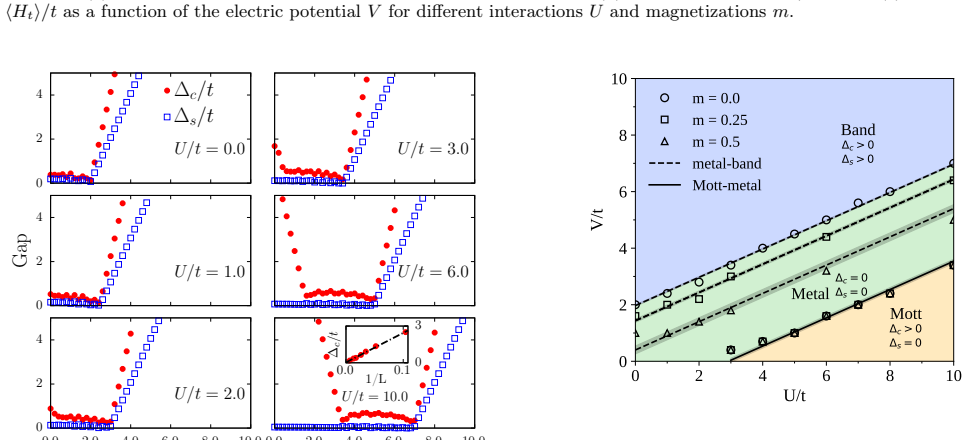
The machinery is the half-filled one-dimensional Hubbard Hamiltonian with a step potential, $$H=-t\sum_{j,\$\sigma$}(c^\dagger_{j\$\sigma$}c_{j+1\$\sigma$}+\mathrm{h.c.})+U\sum_j n_{j\uparrow}n_{j\downarrow}+V\sum_{j=1}^{L/2}(n_j-n_{j+L/2}),$$ which raises one half of the chain by $+V$ and lowers the other by $-V$. The argument runs on three diagnostics: the charge gap $\Delta_c$ and spin gap $\Delta_s$ extracted from ground-state energies with electron-number and spin-flip changes; the pairing response $\partial\bar{w}_2/\partial V$ and kinetic energy $\langle H_t\rangle$; and the entanglement entropy $S$ across the half-chain cut. Density matrix renormalization group (DMRG) ground states with bond dimension up to $2^{11}$ and energy convergence to $10^{-7}$ supply the numbers that place the phase boundaries.
What would settle it
Compute the charge gap at $V=0$ for $U/t=1$ and $U/t=2$ on chains of length $L=20,40,80,160$ and extrapolate to the thermodynamic limit; if the extrapolated gap is positive, the boundary $V_c=U/2-1.46t$ cannot cross $V=0$ at small $U$ and the low-$U$ metallic region is a finite-size artifact.
Extended reading notes
Core claim
On a half-filled one-dimensional Hubbard chain, applying a potential difference $V$ between the two halves of the chain produces three distinct ground-state phases. At small $V$ and large $U$ the system is a Mott insulator with a finite charge gap and no spin gap; at intermediate $V$ both charge and spin gaps vanish, the kinetic energy responds strongly to the field, and pairing response and half-chain entanglement oscillate quasi-periodically; at large $V$ the system becomes a band-like insulator with both gaps open and entanglement tending to zero. The phase boundaries are approximately linear in $U$, with $V_c^{\mathrm{Mott}\rightarrow\mathrm{metal}} = U/2 - 1.46t$ independent of magnetization and $V_c^{\mathrm{metal}\rightarrow\mathrm{band}} = U/2 + b(m)t$ with $b = 1.97, 1.43, 0.40$ for $m = 0, 0.25, 0.5$, so the metallic window shrinks as spin polarization increases.
Load-bearing premise
The load-bearing premise is that finite-size DMRG data on chains up to 25 sites, together with a linear extrapolation of the Mott-to-metal boundary, correctly locate the phase boundaries for all interaction strengths and voltages, including the claim that the metal reaches down to $V=0$ for small $U$.
Editorial extensions
If this is right
- For a fixed interaction $U$, sweeping the voltage $V$ drives the system through insulator-metal-insulator transitions at the two predicted boundaries, so $V$ acts as a continuous external switch.
- The onset voltage for metallicity, $V_c^{\mathrm{Mott}\rightarrow\mathrm{metal}} = U/2 - 1.46t$, does not depend on magnetization, so the $U$-versus-$V$ competition alone sets the Mott-to-metal threshold.
- Higher spin polarization lowers $V_c^{\mathrm{metal}\rightarrow\mathrm{band}}$ and reduces the maximum transferred density, meaning fewer available opposite-spin pairs narrow the metallic window.
- Inside the metallic phase both charge and spin excitations are gapless, which distinguishes it from the surrounding insulators and implies the phase is a conductor rather than a gapless spin-only state.
- For very large $V$ the entanglement between halves tends to zero, so the band-insulator phase is characterized by effectively decoupled halves.
Reading between the lines
- Beyond the paper's claims, if the linear Mott-to-metal boundary is trusted below the smallest computed $U$, the model becomes metallic at $V=0$ for $U \lesssim 2.92t$; this conflicts with the known exponentially small but nonzero Mott gap of the half-filled Hubbard chain at $V=0$, so the low-$U$ portion of the phase diagram likely requires either a re-entrant insulating sliver or a soft crossover
- The quasi-periodic oscillations in pairing and entanglement suggest the metallic phase has a field-induced modulated charge structure; computing the Drude weight or the single-particle spectral function across $V$ would test whether this phase is a conventional conductor or a fluctuating charge-density-wave-like state.
- The same step-potential construction could be realized in optical lattices with a superlattice potential or in one-dimensional materials with a gate-defined junction, and the predicted shrinking of the metallic window with polarization could be tested by measuring conductance as a function of spin imbalance.
Editorial analysis
A structured set of objections, weighed in public.
Referee Report
Summary. The manuscript studies the half-filled one-dimensional Hubbard chain with a step-like electrostatic potential of magnitude V between the two halves, using DMRG for chains up to L=25. It computes the charge density on the low-potential half, the pairing response ∂w̄2/∂V, the charge and spin gaps, kinetic energy, and half-chain entanglement for U/t up to 10 and magnetizations m=0, 0.25, 0.5. The authors identify three phases — Mott insulator, metal, and band-like insulator — and propose linear phase boundaries V_c^{Mott→metal}=U/2−1.46t and V_c^{metal→band}=U/2+b(m)t with b={1.97,1.43,0.40} for m={0,0.25,0.5}. The metallic phase is characterized by vanishing charge and spin gaps and by quasi-periodic oscillations in the pairing response and entanglement.
Significance. If the phase diagram were established, the paper would provide a simple quantitative description of electric-field-driven quantum phase transitions in a strongly correlated 1D system, with testable predictions for cold-atom or 1D-material realizations. The work combines several complementary diagnostics (density, pairing response, gaps, kinetic energy, entanglement) and reports careful DMRG convergence (bond dimension up to 2^11, energy convergence to 10^-7), which strengthens confidence in the numerical data themselves. However, the central quantitative claim is not yet secure: the low-U portion of the phase diagram rests on an extrapolation that contradicts the exact V=0 Hubbard result, and the finite-size scaling underlying the metallic gap closure is documented only for one parameter point.
major comments (4)
- [Results, Fig. 3] The low-U part of the phase diagram is in direct conflict with an exact result. At V=0 the Hamiltonian (1) reduces to the standard half-filled 1D Hubbard model, for which the Lieb-Wu solution gives a positive charge gap for every U>0 (exponentially small as U→0). The fitted line V_c^{Mott→metal}=U/2−1.46t crosses V_c=0 at U=2.92t, so the paper's phase diagram predicts a metallic state at V=0 for U<2.92t. This is likely a finite-size artifact: with L≤25 the exponentially small gap is below the DMRG energy resolution, and the linear decay in 1/L shown in the inset of Fig. 2 is demonstrated only at U=10t, V=4t, not at V=0 for small U. The authors should either remove the extrapolation to V≤0, restrict the phase diagram to U values where the V=0 gap is resolved, or provide a finite-size scaling of Δc at V=0 for small U that is consistent with the exact result.
- [Results, Figs. 2 and 3] The metallic-gap claim and the fitted phase boundaries are not supported by a documented finite-size extrapolation. The inset of Fig. 2 reports a linear decay in L, but no system sizes or extrapolated intercept are given, and the fit range, number of points, and uncertainties for the linear boundaries in Fig. 3 are not reported. In particular, the line V_c^{Mott→metal}=U/2−1.46t is drawn for U≲3t where no data are shown; this is the extrapolation that creates the V=0 metallic region. The authors should provide the DMRG data points, the fit intervals, and confidence intervals for all fitted parameters, and restrict the lines to the fitted U range.
- [Model and Methods; footnote [54]] For m>0 the charge gap is undefined, and the phase boundaries are inferred from the observables in Fig. 1. The paper does not state a quantitative criterion for locating V_c from n(−V) or ∂w2/∂V, nor does it give the associated uncertainty. Since the narrowing of the metallic window with m is a main result, the criterion should be explicit (e.g., threshold derivative, peak position) and its robustness to the choice of criterion should be demonstrated.
- [Results, Figs. 1(b), 1(c), and 4] The quasi-periodic oscillations claimed to accompany the metallic phase are not quantified. No period, amplitude, or system-size dependence is reported, so it is unclear whether the oscillations are intrinsic or finite-size effects of the abrupt potential step on short chains. A finite-size analysis of the oscillation period would be needed before presenting this as a characteristic of the metallic regime.
minor comments (4)
- [Abstract] In the abstract, 'analyzingi)' should read 'analyzing (i)'.
- [Fig. 2 caption] The caption text 'e V/t=4' should read 'V/t=4'.
- [Footnote [51]] Footnote [51] introduces ferromagnetic insulating states inside the band-like regime, but the main text and Fig. 3 label the phase simply as 'band'; the terminology should be harmonized.
- [Model and Methods] The paper says 'system sizes of up to 25 sites' but never states which L values are used for each figure; please list them, since the finite-size claims depend on this.
Circularity Check
No significant circularity: the phase diagram is a transparent fit to the paper's own DMRG gap and density data, not an independent prediction derived from its inputs.
full rationale
The paper reports finite-size DMRG results and explicitly presents the phase boundaries as fits to its own data: 'Symbols are numerical data, while lines represent their linear fits.' The phases are classified by computed observables — charge and spin gaps, n(−V), pairing response, and entanglement — and the phase diagram is a summary of those computations, not a derived prediction that could reduce to its inputs by construction. The formula V_c(Mott→metal)=U/2−1.46t is a linear fit to the computed critical points, and the paper does not dress this fit as a first-principles derivation. The footnote that for m>0 the charge gap is undefined and boundaries are inferred from Fig. 1 is an operational proxy, not a circular redefinition: it extrapolates the same observed charge-transfer/pairing criterion across magnetizations. Self-citations (refs. 3–8, 36, 43–44) provide background on Hubbard physics and entanglement diagnostics; none is load-bearing for the central computation, and no uniqueness theorem or ansatz is imported from the authors' prior work. A genuine concern is the low-U extrapolation of the Mott–metal line to values where V_c<0, which would imply a metallic state at V=0 for U≲2.92t, in tension with the exact Lieb–Wu result of a finite Mott gap for every U>0; this is a correctness or finite-size extrapolation risk, not circularity.
Assumptions & free parameters
free parameters (5)
- Mott-metal boundary intercept =
-1.46t
- Metal-band boundary intercept b(0) =
1.97t
- Metal-band boundary intercept b(0.25) =
1.43t
- Metal-band boundary intercept b(0.5) =
0.40t
- Phase boundary slope =
1/2 (units of t)
assumptions (5)
- domain assumption DMRG converges to exact ground states for L <= 25 with bond dimension up to 2^11 and energy convergence to 10^-7
- domain assumption Charge and spin gaps defined via ground-state energy differences correctly classify phases
- ad hoc to paper The metallic phase at V=0 for U < 2.92t exists despite the known finite Mott gap of the half-filled Hubbard model
- ad hoc to paper Phase boundaries for m > 0 can be inferred from charge density and pairing response because the charge gap is undefined for Sz > 0
- ad hoc to paper The quasi-periodic oscillations in pairing response and entanglement are physical and not finite-size artifacts
Cite this review
Pith. "Pith review of Controlling quantum phases with electric fields in one-dimensional Hubbard systems." pith.science (2026). https://pith.science/paper/AX62WNVD
@misc{pith2026250515449,
  author       = {Pith},
  title        = {Pith review of: Controlling quantum phases with electric fields in one-dimensional Hubbard systems},
  year         = {2026},
  howpublished = {\url{https://pith.science/paper/AX62WNVD}},
  note         = {Machine review of arXiv:2505.15449}
}
read the original abstract
Quantum systems under electric fields provide a powerful framework for uncovering and controlling novel quantum phases, especially in low-dimensional systems with strong correlations. In this work, we investigate quantum phase transitions induced by an electric potential difference in a one-dimensional half-filled Hubbard chain. By analyzing (i) tunneling and pairing mechanisms, (ii) charge and spin gaps, and (iii) entanglement between the chain halves, we identify three distinct phases: Mott insulator, metal and band-like insulator. The metallic regime, characterized by the closing of both charge and spin gaps, is accompanied by a field-dependent kinetic energy and a quasi-periodic oscillatory behavior of pairing response and entanglement. Although the metallic phase persists for different magnetizations, its extent in the phase diagram shrinks as spin polarization increases.
Figures


Reference graph
Works this paper leans on
-
[1]
I. Goychuk and P. Hänggi, Quantum dynamics in strong fluctuating fields, Advances in Physics 54, 525 (2005), https://doi.org/10.1080/00018730500429701
-
[2]
Campisi, P
M. Campisi, P. Hänggi, and P. Talkner, Colloquium: Quantum fluctuation relations: Foundations and appli- cations, Rev. Mod. Phys.83, 771 (2011)
2011
-
[3]
V. V. França, D. Hörndlein, and A. Buchleitner, Fulde- ferrell-larkin-ovchinnikov critical polarization in one- dimensional fermionic optical lattices, Phys. Rev. A86, 033622 (2012)
work page 2012
-
[4]
G. A. Canella and V. V. França, Superfluid-insulator transition unambiguously detected by entanglement in one-dimensional disordered superfluids, Scientific Re- ports 9, 10.1038/s41598-019-51986-0 (2019)
-
[5]
G. A. Canella and V. V. França, Entanglement in disor- dered superfluids: The impact of density, interaction and harmonic confinement on the superconductor–insulator transition, Physica A: Statistical Mechanics and its Ap- plications 545, 123646 (2020)
work page 2020
-
[6]
D.ArisaandV.V.França,Linearmappingbetweenmag- netic susceptibility and entanglement in conventional and exotic one-dimensional superfluids, Physical Review B 101, 10.1103/physrevb.101.214522 (2020)
-
[7]
G. A. Canella, K. Zawadzki, and V. V. França, Effects of temperature and magnetization on the mott–anderson physics in one-dimensional disordered systems, Scientific Reports 12, 10.1038/s41598-022-12561-2 (2022). 5
-
[8]
G. A. Canella and V. V. França, Mott-anderson metal- insulator transitions from entanglement, Phys. Rev. B 104, 134201 (2021)
work page 2021
Show all 53 references
-
[9]
Zheng, Exact solution ofu → ∞1d hubbard model in electric field, Physics Letters A394, 127112 (2021)
Y. Zheng, Exact solution ofu → ∞1d hubbard model in electric field, Physics Letters A394, 127112 (2021)
2021
-
[10]
A. V. Joura, J. K. Freericks, and A. I. Lichtenstein, Long- lived nonequilibrium states in the hubbard model with an electric field, Phys. Rev. B91, 245153 (2015)
2015
-
[11]
J. Li, C. Aron, G. Kotliar, and J. E. Han, Electric- field-driven resistive switching in the dissipative hubbard model, Phys. Rev. Lett.114, 226403 (2015)
2015
-
[12]
Bellomia, C
G. Bellomia, C. Mejuto-Zaera, M. Capone, and A. Amar- icci, Quasilocal entanglement across the mott-hubbard transition, Phys. Rev. B109, 115104 (2024)
2024
-
[13]
Giamarchi, Quantum physics in one dimension, Vol
T. Giamarchi, Quantum physics in one dimension, Vol. 121 (Clarendon Press, Oxford, 2003)
2003
-
[14]
Giamarchi, One-dimensional physics in the 21st cen- tury, Comptes Rendus
T. Giamarchi, One-dimensional physics in the 21st cen- tury, Comptes Rendus. Physique17, 322 (2016)
2016
-
[15]
Jardine, J
M. Jardine, J. Stenger, Y. Jiang, E. J. de Jong, W. Wang, A. C. Bleszynski Jayich, and S. Frolov, Integrating mi- cromagnets and hybrid nanowires for topological quan- tum computing, SciPost Physics 11, 10.21468/scipost- phys.11.5.090 (2021)
2021 doi
-
[16]
Baydin, F
A. Baydin, F. Tay, J. Fan, M. Manjappa, W. Gao, and J. Kono, Carbon nanotube devices for quantum technol- ogy, Materials15, 1535 (2022)
2022
-
[17]
E. A. Laird, F. Kuemmeth, G. A. Steele, K. Grove- Rasmussen, J. Nygård, K. Flensberg, and L. P. Kouwen- hoven, Quantum transport in carbon nanotubes, Reviews of Modern Physics87, 703–764 (2015)
2015
-
[18]
Qu, B.-B
D.-W. Qu, B.-B. Chen, H.-C. Jiang, Y. Wang, and W. Li, Spin-triplet pairing induced by near-neighbor attraction in the extended hubbard model for cuprate chain, Com- munications Physics 5, 257 (2022)
2022
-
[19]
T. Tang, B. Moritz, C. Peng, Z.-X. Shen, and T. P. Devereaux, Traces of electron-phonon coupling in one- dimensional cuprates, Nature Communications14, 3129 (2023)
2023
-
[21]
Xie, A.-P
H.Wang, H.S.Wang, C.Ma, L.Chen, C.Jiang, C.Chen, X. Xie, A.-P. Li, and X. Wang, Graphene nanoribbons for quantum electronics, Nature Reviews Physics3, 791–802 (2021)
2021
-
[22]
Li, X.-Y
Y. Li, X.-Y. Yang, Y. Feng, Z.-Y. Yuan, and B.-L. Su, One-dimensional metal oxide nanotubes, nanowires, nanoribbons, andnanorods: Synthesis, characterizations, properties and applications, Critical Reviews in Solid State and Materials Sciences37, 1–74 (2012)
2012
-
[23]
Alfieri, S
A. Alfieri, S. B. Anantharaman, H. Zhang, and D. Jariwala, Nanomaterials for quantum informa- tion science and engineering, Advanced Materials 35, 10.1002/adma.202109621 (2022)
2022 doi
-
[24]
Balcerzak and K
T. Balcerzak and K. Szałowski, Hubbard pair cluster in the external fields. studies of the chemical potential, Physica A: Statistical Mechanics and its Applications 468, 252 (2017)
2017
-
[25]
Balcerzak and K
T. Balcerzak and K. Szałowski, Hubbard pair cluster in the external fields. studies of the polarization and sus- ceptibility, Physica A: Statistical Mechanics and its Ap- plications 512, 1069 (2018)
2018
-
[26]
V. P. Villegas and C. D. Villagonzalo, Optimal polariza- tion and susceptibility profiles of a half-filled open mag- netoelectric fermi-hubbard optical dimer, Physics Letters A 525, 129898 (2024)
2024
-
[27]
Hasegawa, Nonextensive thermodynamics of the two- sitehubbardmodel,PhysicaA:StatisticalMechanicsand its Applications 351, 273 (2005)
H. Hasegawa, Nonextensive thermodynamics of the two- sitehubbardmodel,PhysicaA:StatisticalMechanicsand its Applications 351, 273 (2005)
2005
-
[28]
Hasegawa, Thermal entanglement of hubbard dimers in the nonextensive statistics, Physica A: Statistical Me- chanics and its Applications390, 1486 (2011)
H. Hasegawa, Thermal entanglement of hubbard dimers in the nonextensive statistics, Physica A: Statistical Me- chanics and its Applications390, 1486 (2011)
2011
-
[29]
S. R. Manmana, V. Meden, R. M. Noack, and K. Schönhammer, Quantum critical behavior of the one- dimensional ionic hubbard model, Physical Review B70, 10.1103/physrevb.70.155115 (2004)
2004 doi
-
[30]
Gerster, M
M. Gerster, M. Rizzi, F. Tschirsich, P. Silvi, R. Fazio, and S. Montangero, Superfluid density and quasi-long-range order in the one-dimensional disordered bose–hubbard model, New Journal of Physics18, 015015 (2016)
2016
-
[31]
A. J. Millis and H. Monien, Pseudogaps in one- dimensional models with quasi-long-range order, Phys. Rev. B 61, 12496 (2000)
2000
-
[32]
Kuklov, N
A. Kuklov, N. Prokof’ev, L. Radzihovsky, and B. Svis- tunov, Transverse quantum fluids, Phys. Rev. B 109, L100502 (2024)
2024
-
[33]
I. M. Carvalho, H. Bragança, W. H. Brito, and M. C. O. Aguiar, Formation of spin and charge ordering in the extended hubbard model during a finite-time quantum quench, Phys. Rev. B106, 195405 (2022)
2022
-
[34]
A. L. S. Ribeiro, P. McClarty, P. Ribeiro, and M. We- ber, Dissipation-induced long-range order in the one- dimensional bose-hubbard model, Phys. Rev. B 110, 115145 (2024)
2024
-
[35]
Grüner, The dynamics of charge-density waves, Rev
G. Grüner, The dynamics of charge-density waves, Rev. Mod. Phys. 60, 1129 (1988)
1988
-
[36]
Sanino, I
M. Sanino, I. M. Carvalho, and V. V. França, Entangle- ment as a topological marker in harmonically confined attractivefermi-hubbardchains(2024),arXiv:2412.20515 [cond-mat.quant-gas]
2024 arXiv
-
[37]
F. H. Essler, H. Frahm, F. Göhmann, A. Klümper, and V. E. Korepin,The one-dimensional Hubbard model (Cambridge University Press, 2005)
2005
-
[38]
A. E. Feiguin and F. Heidrich-Meisner, Pairing states of a polarized fermi gas trapped in a one-dimensional optical lattice, Phys. Rev. B76, 220508 (2007)
2007
-
[39]
Hohenadler and H
M. Hohenadler and H. Fehske, Density waves in strongly correlated quantum chains, The European Physical Jour- nal B 91, 204 (2018)
2018
-
[40]
Ejima and S
S. Ejima and S. Nishimoto, Phase diagram of the one- dimensional half-filled extended hubbard model, Phys. Rev. Lett. 99, 216403 (2007)
2007
-
[41]
Ejima, F
S. Ejima, F. Gebhard, and S. Nishimoto, Tomonaga- luttinger parameters and spin excitations in the dimer- ized extended hubbard model, Phys. Rev. B74, 245110 (2006)
2006
-
[42]
Islam, R
R. Islam, R. Ma, P. M. Preiss, M. Eric Tai, A. Lukin, M. Rispoli, and M. Greiner, Measuring entanglement en- tropy in a quantum many-body system, Nature 528, 77–83 (2015)
2015
-
[43]
Pauletti, M
T. Pauletti, M. Silva, G. Canella, and V. França, Lin- ear entropy fails to predict entanglement behavior in low-density fermionic systems, Physica A: Statistical Me- chanics and its Applications644, 129824 (2024)
2024
-
[44]
V. V. França, Entanglement and exotic superfluidity in spin-imbalanced lattices, Physica A: Statistical Mechan- 6 ics and its Applications475, 82 (2017)
2017
-
[45]
Laflorencie, Quantum entanglement in condensed matter systems, Physics Reports646, 1 (2016), quantum entanglement in condensed matter systems
N. Laflorencie, Quantum entanglement in condensed matter systems, Physics Reports646, 1 (2016), quantum entanglement in condensed matter systems
2016
-
[46]
Laurell, A
P. Laurell, A. Scheie, E. Dagotto, and D. A. Tennant, Witnessing entanglement and quantum correlations in condensed matter: A review, Ad- vanced Quantum Technologies n/a, 2400196 (2024), https://onlinelibrary.wiley.com/doi/pdf/10.1002/qute.202400196
2024 doi
-
[47]
Amico, R
L. Amico, R. Fazio, A. Osterloh, and V. Vedral, Entan- glement in many-body systems, Rev. Mod. Phys.80, 517 (2008)
2008
-
[48]
S. R. White, Density matrix formulation for quantum renormalizationgroups,Phys.Rev.Lett. 69,2863(1992)
1992
-
[49]
Phys.326, 96 (2011)
U.Schollwöck,Thedensity-matrixrenormalizationgroup in the age of matrix product states, Ann. Phys.326, 96 (2011)
2011
-
[50]
Fishman, S
M. Fishman, S. R. White, and E. M. Stoudenmire, The ITensor software library for tensor network calculations (2020), arXiv:2007.14822
2020 arXiv
-
[51]
Notice that form ̸= 0, the band-like regime actually con- tains both band-like and ferromagnetic insulating states, due to the spin-imbalanced populations
-
[52]
Rigol and A
M. Rigol and A. Muramatsu, Ground-state properties of hard-core bosons confined on one-dimensional optical lat- tices, Phys. Rev. A72, 013604 (2005)
2005
-
[53]
Rigol and A
M. Rigol and A. Muramatsu, Universal properties of hard-core bosons confined on one-dimensional lattices, Phys. Rev. A70, 031603 (2004)
2004
-
[54]
1, which are also consistent with them = 0 case
Since the charge gap is undefined form >0, the metal- lic boundaries are inferred from Fig. 1, which are also consistent with them = 0 case
Reviewed August 7, 2026 · model on record in the stance chip above.
Discussion (0). Continue with ORCID to comment.