Population synthesis of Galactic middle-aged pulsar wind nebulae I. Detection prospects for current and future instruments
Pith reviewed 2026-07-02 23:42 UTC · model grok-4.3
The pith
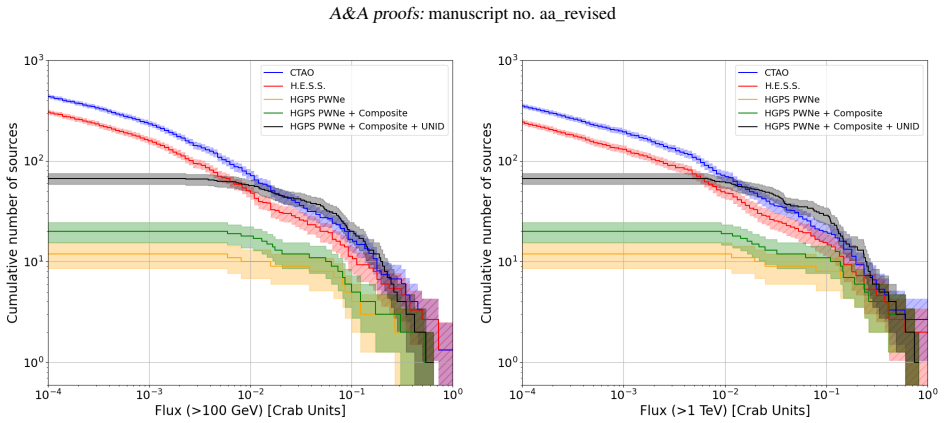
A model of middle-aged pulsar wind nebulae that includes the reverberation phase predicts the Cherenkov Telescope Array Observatory will detect roughly ten times more TeV sources than are currently known.
A machine-rendered reading of the paper's core claim, the machinery that carries it, and where it could break.
Core claim
By combining a thin-shell dynamical model with a Lagrangian description of the supernova remnant during reverberation inside the TIDE+L framework, the calculation shows that realistic compression and re-expansion change both the magnetic field and particle spectrum enough to raise the predicted number of detectable TeV PWNe by a factor of about ten once the Cherenkov Telescope Array Observatory begins operations.
What carries the argument
The hybrid TIDE+L framework, which couples thin-shell nebula dynamics to a Lagrangian treatment of the supernova remnant structure during the reverberation phase.
If this is right
- The Cherenkov Telescope Array Observatory will supply the large majority of the future TeV PWNe census.
- Current TeV catalogs miss most middle-aged PWNe because they lack the sensitivity to reach the fainter fluxes produced after reverberation.
- Detailed reverberation modeling changes both the predicted flux distribution and the fraction of sources that remain above detection thresholds at late times.
- Population predictions that omit reverberation will systematically underestimate the total number of Galactic TeV PWNe.
Where Pith is reading between the lines
- Many of the still-unidentified TeV sources in existing surveys may turn out to be middle-aged PWNe once their spectra are re-examined with reverberation effects included.
- The same modeling approach could be used to predict the radio and X-ray detectability of the same population for cross-matching with other all-sky surveys.
- Refining the assumed distributions with the first CTAO detections would tighten constraints on the birth properties of the underlying pulsar population.
Load-bearing premise
The input distributions of pulsar spin-down power, supernova remnant properties, and interstellar medium conditions correctly describe the real Galactic population of middle-aged pulsar wind nebulae.
What would settle it
An actual CTAO survey that detects far fewer or far more than ten times the present number of firmly identified TeV PWNe would show whether the modeled population size or the reverberation-induced flux changes are accurate.
Figures



read the original abstract
Pulsar wind nebulae (PWNe) constitute the largest population of Galactic very-high-energy (VHE; $E > 100$ GeV) $\gamma$-ray sources and are key laboratories for studying particle acceleration and pulsar--supernova remnant (SNR) interactions. However, realistic population-level predictions have so far lacked any detailed treatment of the reverberation phase, when the nebula is compressed by the SNR reverse shock, significantly altering its dynamics and radiative spectrum. We employ the hybrid \texttt{TIDE+L} framework, which combines a thin-shell dynamical model with a Lagrangian treatment of the SNR structure during reverberation, allowing self-consistent evolution of thousands of PWNe across all stages up to $10^5$ yr. Each source is evolved under distributions of pulsar spin-down, SNR, and environmental properties, and the resulting $\gamma$-ray fluxes are used to estimate the detectability by current and next-generation $\gamma$-ray observatories while accounting for their sensitivity and sky coverage. The model predicts that the upcoming Cherenkov Telescope Array Observatory (CTAO) will detect an order of magnitude more PWNe than those firmly detected in the TeV range, confirming its dominant contribution to the forthcoming TeV population census. Our results demonstrate that realistic modeling of reverberation is important for predicting the Galactic TeV PWNe population.
Editorial analysis
A structured set of objections, weighed in public.
Referee Report
Summary. The paper presents a population synthesis study of Galactic middle-aged pulsar wind nebulae using the hybrid TIDE+L framework, which combines thin-shell dynamics with Lagrangian SNR treatment during reverberation. Sources are evolved from assumed distributions of pulsar spin-down, SNR, and environmental properties up to 10^5 yr, with resulting gamma-ray fluxes folded through instrument sensitivities to predict detectability. The central claim is that CTAO will detect an order of magnitude more PWNe than those currently firmly detected in the TeV band.
Significance. If the central prediction holds after validation, the work would be significant for forecasting the TeV source population and for demonstrating the impact of reverberation modeling on population statistics. The framework's self-consistent treatment of reverberation is a technical advance over prior studies that omit this phase.
major comments (1)
- [Abstract] Abstract: the order-of-magnitude CTAO detection prediction is obtained by evolving sources drawn from fixed input distributions of pulsar spin-down, SNR, and environmental properties, yet no calibration to the observed middle-aged TeV PWN sample, no systematic variation of those priors, and no uncertainty quantification on the yield are described. Because the predicted count scales directly with the normalization and shape of the inputs, this omission is load-bearing for the claim.
Simulated Author's Rebuttal
We thank the referee for the constructive report and for recognizing the technical advance of the reverberation treatment. We address the single major comment below.
read point-by-point responses
-
Referee: [Abstract] Abstract: the order-of-magnitude CTAO detection prediction is obtained by evolving sources drawn from fixed input distributions of pulsar spin-down, SNR, and environmental properties, yet no calibration to the observed middle-aged TeV PWN sample, no systematic variation of those priors, and no uncertainty quantification on the yield are described. Because the predicted count scales directly with the normalization and shape of the inputs, this omission is load-bearing for the claim.
Authors: We agree that the abstract (and, more broadly, the current manuscript) does not present an explicit calibration to the observed middle-aged TeV PWN sample, a systematic variation of the input priors, or uncertainty quantification on the predicted yields. The input distributions are taken from the literature on pulsar spin-down and SNR properties, but we acknowledge that this choice makes the absolute number sensitive to those choices. In the revised manuscript we will add (i) a calibration step that normalizes the model output to the currently known middle-aged TeV PWNe, (ii) a sensitivity study in which key parameters (birth rate, spin-down distribution, ambient density) are varied within their observational ranges, and (iii) resulting uncertainty bands on the CTAO detection forecast. These additions will be placed in a new subsection of the results and referenced in the abstract. revision: yes
Circularity Check
No significant circularity; forward modeling from literature distributions
full rationale
The paper evolves thousands of PWNe drawn from assumed distributions of pulsar spin-down, SNR, and environmental properties, then folds the resulting fluxes through instrument sensitivity curves to predict CTAO detections. No equations or text in the provided material show these input distributions being fitted to the observed middle-aged TeV PWN sample, nor any reduction of the predicted count to those inputs by construction. The reverberation treatment (TIDE+L) is an independent dynamical module. This is standard population synthesis whose central prediction remains falsifiable against future observations and is not forced by self-definition or self-citation chains.
Axiom & Free-Parameter Ledger
Forward citations
Cited by 2 Pith papers
-
EMU discovery of Thunder: a bow-shock PWN powered by PSR J1631-4722 escaping Nimbus SNR (G336.7+0.5)
Discovery of Thunder, a bow-shock PWN powered by PSR J1631-4722 in SNR G336.7+0.5 (Nimbus), characterized with radio, X-ray, and polarization data at assumed 7 kpc distance with age ~30-45 kyr.
-
Population synthesis of Galactic middle-aged pulsar wind nebulae II. Observational signatures of superefficiency
Population synthesis predicts superefficiency is common in PWNe, especially in far-infrared, and substantially more prevalent than thin-shell models suggest across multiple bands.
Reference graph
Works this paper leans on
-
[1]
Abe, S., Abhir, J., Abhishek, A., et al. 2024, J. Cosmology Astropart. Phys., 2024, 081
2024
-
[2]
Abeysekara, A. U. et al. 2013, Astroparticle Physics, 50, 26
2013
-
[3]
Abeysekara, A. U. et al. 2017, ApJ, 843, 39
2017
-
[4]
2013, ApJ, 773, 77
Acero, F., Ackermann, M., Ajello, M., et al. 2013, ApJ, 773, 77
2013
-
[5]
2024, A&A, 686, A308
Aharonian, F., Ait Benkhali, F., Aschersleben, J., et al. 2024, A&A, 686, A308
2024
-
[6]
G., Bazer-Bachi, A
Aharonian, F., Akhperjanian, A. G., Bazer-Bachi, A. R., et al. 2006, A&A, 457, 899
2006
-
[7]
2020, ApJ, 905, 76 Aleksi´c, J., Ansoldi, S., Antonelli, L
Albert, A., Alfaro, R., Alvarez, C., et al. 2020, ApJ, 905, 76 Aleksi´c, J., Ansoldi, S., Antonelli, L. A., et al. 2015, Journal of High Energy Astrophysics, 5, 30
2020
-
[8]
2013, ApJ, 764, 38
Aliu, E., Archambault, S., Arlen, T., et al. 2013, ApJ, 764, 38
2013
-
[9]
2014, ApJ, 787, 166
Aliu, E., Archambault, S., Aune, T., et al. 2014, ApJ, 787, 166
2014
-
[10]
A., Antoranz, P., et al
Anderhub, H., Antonelli, L. A., Antoranz, P., et al. 2010, ApJ, 710, 828 Angüner, E. O. & Ergin, T. 2024, Astroparticle Physics, 158, 102936
2010
-
[11]
Bandiera, R., Bucciantini, N., Martín, J., Olmi, B., & Torres, D. F. 2020, MN- RAS, 499, 2051
2020
-
[12]
Bandiera, R., Bucciantini, N., Martín, J., Olmi, B., & Torres, D. F. 2021, MN- RAS, 508, 3194
2021
-
[13]
Batzofin, R., Cristofari, P., Egberts, K., Steppa, C., & Meyer, D. M. A. 2024, Astronomy & Astrophysics, 687, A279
2024
-
[14]
M.-A., & Steppa, C
Batzofin, R., Egberts, K., Meyer, D. M.-A., & Steppa, C. 2025, A&A, 701, L4
2025
-
[15]
& Huang, H
Becker, W. & Huang, H. H. 2007, 363rd WE-Heraeus Seminar on Neutron Stars and Pulsars: 40 Years after the Discovery. Posters and Contributed Talks
2007
-
[16]
M., Chevalier, R
Blondin, J. M., Chevalier, R. A., & Frierson, D. M. 2001, ApJ, 563, 806
2001
-
[17]
2011, MNRAS, 410, 381
Bucciantini, N., Arons, J., & Amato, E. 2011, MNRAS, 410, 381
2011
-
[18]
M., Del Zanna, L., & Amato, E
Bucciantini, N., Blondin, J. M., Del Zanna, L., & Amato, E. 2003, A&A, 405, 617
2003
-
[19]
2024, ApJS, 271, 25 Cherenkov Telescope Array Consortium
Cao, Z., Aharonian, F., An, Q., et al. 2024, ApJS, 271, 25 Cherenkov Telescope Array Consortium. 2019, Science with the Cherenkov Telescope Array Conceição, R. 2023, arXiv e-prints, arXiv:2309.04577
-
[20]
B., et al
Cristofari, P., Gabici, S., Humensky, T. B., et al. 2017, MNRAS, 471, 201 de Oña-Wilhelmi, E., Rudak, B., Barrio, J. A., et al. 2013, Astroparticle Physics, 43, 287 De Sarkar, A., Zhang, W., Martín, J., et al. 2022, A&A, 668, A23 Del Zanna, L., V olpi, D., Amato, E., & Bucciantini, N. 2006, A&A, 453, 621
2017
-
[21]
1986, Non-Uniform Random Variate Generation(originally pub- lished with (Springer-Verlag)
Devroye, L. 1986, Non-Uniform Random Variate Generation(originally pub- lished with (Springer-Verlag)
1986
-
[22]
2008, Ap&SS, 316, 43 Ekström, S., Georgy, C., Eggenberger, P., et al
Eggenberger, P., Meynet, G., Maeder, A., et al. 2008, Ap&SS, 316, 43 Ekström, S., Georgy, C., Eggenberger, P., et al. 2012, Astronomy & Astro- physics, 537, A146
2008
-
[23]
& Zhang, L
Fang, J. & Zhang, L. 2010, A&A, 515, A20 Faucher-Giguère, C.-A. & Kaspi, V . M. 2006, ApJ, 643, 332 Fermi-LAT Collaboration, Acharyya, A., Adelfio, A., et al. 2025, ApJ, 989, 110
2010
-
[24]
Ferreira, S. E. S. & de Jager, O. C. 2008, A&A, 478, 17 Article number, page 15 A&A proofs:manuscript no. aa_revised
2008
-
[25]
2022, Monthly Notices of the Royal Astro- nomical Society, 511, 1439
Fiori, M., Olmi, B., Amato, E., et al. 2022, Monthly Notices of the Royal Astro- nomical Society, 511, 1439
2022
-
[26]
2020, MNRAS, 499, 3494
Fiori, M., Zampieri, L., Burtovoi, A., Caraveo, P., & Tibaldo, L. 2020, MNRAS, 499, 3494
2020
-
[27]
Gaensler, B. M. & Slane, P. O. 2006, ARA&A, 44, 17
2006
-
[28]
D., Slane, P
Gelfand, J. D., Slane, P. O., & Zhang, W. 2009, ApJ, 703, 2051
2009
-
[29]
2010, PhD thesis, University of Geneva, Switzerland Gullón, M., Pons, J
Georgy, C. 2010, PhD thesis, University of Geneva, Switzerland Gullón, M., Pons, J. A., Miralles, J. A., et al. 2015, MNRAS, 454, 615 H. E. S. S. Collaboration, Abdalla, H., Abramowski, A., et al. 2018a, A&A, 612, A2 H. E. S. S. Collaboration, Abdalla, H., Abramowski, A., et al. 2018b, A&A, 612, A1
2010
-
[30]
Review on the Observed and Physical Properties of Core Collapse Supernovae
Hamuy, M. 2003, arXiv e-prints [arXiv:astro-ph/0301006]
work page internal anchor Pith review Pith/arXiv arXiv 2003
-
[31]
Horvath, J. E. 2019, MNRAS, 484, 1983
2019
-
[32]
Hurt, R. et al. 2025, mw_plot documentation,https://milkyway-plot. readthedocs.io/en/stable/, accessed: 2026-03-28
2025
-
[33]
A., Karastergiou, A., & Kramer, M
Johnston, S., Smith, D. A., Karastergiou, A., & Kramer, M. 2020, MNRAS, 497, 1957
2020
-
[34]
2013, in The Universe Evolution: As- trophysical and Nuclear Aspects
Kargaltsev, O., Rangelov, B., & Pavlov, G. 2013, in The Universe Evolution: As- trophysical and Nuclear Aspects. Edited by I. Strakovsky and L. Blokhintsev. Nova Science Publishers, 359–406
2013
-
[35]
2017, ApJ, 844, 1
Kolb, C., Blondin, J., Slane, P., & Temim, T. 2017, ApJ, 844, 1
2017
-
[36]
Komissarov, S. S. & Lyubarsky, Y . E. 2004, MNRAS, 349, 779
2004
-
[37]
2008, in International Cosmic Ray Conference, V ol
Konopelko, A. 2008, in International Cosmic Ray Conference, V ol. 2, Interna- tional Cosmic Ray Conference, 767–770
2008
-
[38]
G., Jordan, C
Lyne, A. G., Jordan, C. A., Graham-Smith, F., et al. 2015, MNRAS, 446, 857
2015
-
[39]
& Torres, D
Martin, J. & Torres, D. F. 2022, Journal of High Energy Astrophysics, 36, 128 Martín, J., Torres, D. F., & Pedaletti, G. 2016, MNRAS, 459, 3868 Martín, J., Torres, D. F., & Rea, N. 2012, MNRAS, 427, 415
2022
-
[40]
2024, A&A, 690, A116
Martin, P., de Guillebon, L., Collard, E., et al. 2024, A&A, 690, A116
2024
-
[41]
2025, arXiv e-prints, arXiv:2507.06627
Martin, P., Mertz, I., Kempf, J., et al. 2025, arXiv e-prints, arXiv:2507.06627
-
[42]
2022, A&A, 666, A7
Martin, P., Tibaldo, L., Marcowith, A., & Abdollahi, S. 2022, A&A, 666, A7
2022
-
[43]
P., Bersten, M
Martinez, L., Anderson, J. P., Bersten, M. C., et al. 2022, Astronomy & Astro- physics, 660, A42
2022
-
[44]
Meyer, D. M.-A. & Meliani, Z. 2022, MNRAS, 515, L29
2022
-
[45]
M.-A., Meliani, Z., & Torres, D
Meyer, D. M.-A., Meliani, Z., & Torres, D. F. 2024, A&A, 692, A207
2024
-
[46]
Meyer, D. M.-A. & Torres, D. F. 2025, MNRAS, 537, 186
2025
-
[47]
M.-A., Torres, D
Meyer, D. M.-A., Torres, D. F., & Meliani, Z. 2025, A&A, 696, L9
2025
-
[48]
2016, Nuclear and Particle Physics Proceedings, 273-275, 367, 37th International Conference on High Energy Physics (ICHEP) Müller, B., Melson, T., Heger, A., & Janka, H.-T
Mukherjee, R. 2016, Nuclear and Particle Physics Proceedings, 273-275, 367, 37th International Conference on High Energy Physics (ICHEP) Müller, B., Melson, T., Heger, A., & Janka, H.-T. 2017, MNRAS, 472, 491
2016
-
[49]
Nadyozhin, D. K. 2003, MNRAS, 346, 97
2003
-
[50]
& Bucciantini, N
Olmi, B. & Bucciantini, N. 2023, PASA, 40, e007
2023
-
[51]
2016, Jour- nal of Plasma Physics, 82, 635820601
Olmi, B., Del Zanna, L., Amato, E., Bucciantini, N., & Mignone, A. 2016, Jour- nal of Plasma Physics, 82, 635820601
2016
-
[52]
& Torres, D
Olmi, B. & Torres, D. F. 2020, MNRAS, 494, 4357
2020
-
[53]
& Salvati, M
Pacini, F. & Salvati, M. 1973, ApJ, 186, 249
1973
-
[54]
A., Moskalenko, I
Porter, T. A., Moskalenko, I. V ., & Strong, A. W. 2006, The Astrophysical Jour- nal, 648, L29
2006
-
[55]
S., & Keppens, R
Porth, O., Komissarov, S. S., & Keppens, R. 2014, MNRAS, 443, 547
2014
-
[56]
2009, Research in Astronomy and Astro- physics, 9, 449
Qiao, W.-F., Zhang, L., & Fang, J. 2009, Research in Astronomy and Astro- physics, 9, 449
2009
-
[57]
L., Wright, N
Quintana, A. L., Wright, N. J., & Martínez García, J. 2025, MNRAS, 538, 1367
2025
-
[58]
D., Shore, S
Renzo, M., Ott, C. D., Shore, S. N., & de Mink, S. E. 2017, A&A, 603, A118
2017
-
[59]
Reynolds, S. P. & Chevalier, R. A. 1984, ApJ, 278, 630
1984
-
[60]
2016, Nuclear and Particle Physics Proceedings, 273-275, 328, 37th In- ternational Conference on High Energy Physics (ICHEP)
Rico, J. 2016, Nuclear and Particle Physics Proceedings, 273-275, 328, 37th In- ternational Conference on High Energy Physics (ICHEP)
2016
-
[61]
2021, New Astronomy, 83, 101498
Rozwadowska, K., Vissani, F., & Cappellaro, E. 2021, New Astronomy, 83, 101498
2021
-
[62]
T., Joshi, V ., & Mitchell, A
Scharrer, N., Spencer, S. T., Joshi, V ., & Mitchell, A. M. W. 2025, J. Cosmology Astropart. Phys., 2025, 096
2025
-
[63]
2017, in Handbook of Supernovae, ed
Slane, P. 2017, in Handbook of Supernovae, ed. A. W. Alsabti & P. Murdin, 2159
2017
-
[64]
Sukhbold, T., Ertl, T., Woosley, S. E., Brown, J. M., & Janka, H. T. 2016, ApJ, 821, 38 SWGO Collaboration et al. 2025, arXiv e-prints, arXiv:2506.01786
-
[65]
Tanaka, S. J. & Takahara, F. 2010, The Astrophysical Journal, 715, 1248
2010
-
[66]
Tanaka, S. J. & Takahara, F. 2011, ApJ, 741, 40
2011
-
[67]
2015, ApJ, 808, 100
Temim, T., Slane, P., Kolb, C., et al. 2015, ApJ, 808, 100
2015
-
[68]
F., Cillis, A., Martín, J., & de Oña Wilhelmi, E
Torres, D. F., Cillis, A., Martín, J., & de Oña Wilhelmi, E. 2014, Journal of High Energy Astrophysics, 1, 31
2014
-
[69]
Torres, D. F. & Lin, T. 2018, ApJ, 864, L2
2018
-
[70]
F., Lin, T., & Coti Zelati, F
Torres, D. F., Lin, T., & Coti Zelati, F. 2019, MNRAS, 486, 1019
2019
-
[71]
F., Martín, J., de Oña Wilhelmi, E., & Cillis, A
Torres, D. F., Martín, J., de Oña Wilhelmi, E., & Cillis, A. 2013, MNRAS, 436, 3112
2013
-
[72]
Truelove, J. K. & McKee, C. F. 1999, ApJS, 120, 299 van der Swaluw, E., Achterberg, A., Gallant, Y . A., & Tóth, G. 2001, A&A, 380, 309 van Rensburg, C., Krüger, P. P., & Venter, C. 2018, MNRAS, 477, 3853 V orster, M. J., Tibolla, O., Ferreira, S. E. S., & Kaufmann, S. 2013, ApJ, 773, 139
1999
-
[73]
Watters, K. P. & Romani, R. W. 2011, ApJ, 727, 123
2011
-
[74]
2003, MNRAS, 338, 711
Zampieri, L., Pastorello, A., Turatto, M., et al. 2003, MNRAS, 338, 711
2003
-
[75]
B., & Fang, J
Zhang, L., Chen, S. B., & Fang, J. 2008, ApJ, 676, 1210
2008
-
[76]
Zhu, B.-T., Zhang, L., & Fang, J. 2018, A&A, 609, A110 Article number, page 16 De Sarkar et al.: Population synthesis of middle-aged PWNe - I 10 20 30 40 50 Zero-age main-sequence mass M (M ) 0.000 0.025 0.050 0.075 0.100 0.125 0.150 0.175Probability Density Inverse transform sampled Theoretical IMF M 2.35 20 40 60 80 100 120 Zero-age main-sequence mass M...
2018
discussion (0)
Sign in with ORCID, Apple, or X to comment. Anyone can read and Pith papers without signing in.