REVIEW 2 major objections 4 minor 100 references
An "inside-out" approach to modeling supermassive black hole binary inspiral
T0 review · 2 major / 4 minor · reviewed 2026-08-07 · deepseek-v4-flash
Pith's one-line read The nanohertz gravitational-wave background is set by the radius where astrophysical hardening gives way to gravitational-wave emission.
desk verdict A practical, clearly written method paper that reframes PTA GWB modeling around the transition radius a_GW; the central sensitivity claim holds up, with a fair caveat about the single-power-law inner hardening ansatz. read the letter →
The pith
A machine-rendered reading of the paper's core claim, the machinery that carries it, and where it could break.
The reading
What carries the argument
The central object is $a_{\rm GW}\equiv a_{\rm GW,9} M_9^{\alpha_{\rm GW}}(4\eta)^{\beta_{\rm GW}}$, the semi-major axis, in gravitational units, at which the astrophysical hardening timescale equals the gravitational-wave timescale for a circular binary. It carries the argument because $t_{\rm hard,GW}\propto a^4$ makes the transition radius the point where the binary's residence time in the PTA band and its emitted gravitational-wave energy per frequency are set. Around it the paper places a single-power-law inner hardening phase with index $\nu_{\rm in}$, a mass-scaled outer boundary $r_{\rm char}$, and an outer delay $\tau_{\rm out}$; the "inside-out" move is to make $a_{\rm GW}$ the free anchor and push all outer evolution into $\tau_{\rm out}$.
What would settle it
A future PTA spectrum with a clearly broken power-law shape or a strong high-frequency excess from eccentric binaries cannot be reproduced by any single $\nu_{\rm in}$ and $a_{\rm GW,9}$ pair that also satisfies the subluminal hardening-rate limit, which would falsify the paper's reduction of the background to one transition radius.
Extended reading notes
Core claim
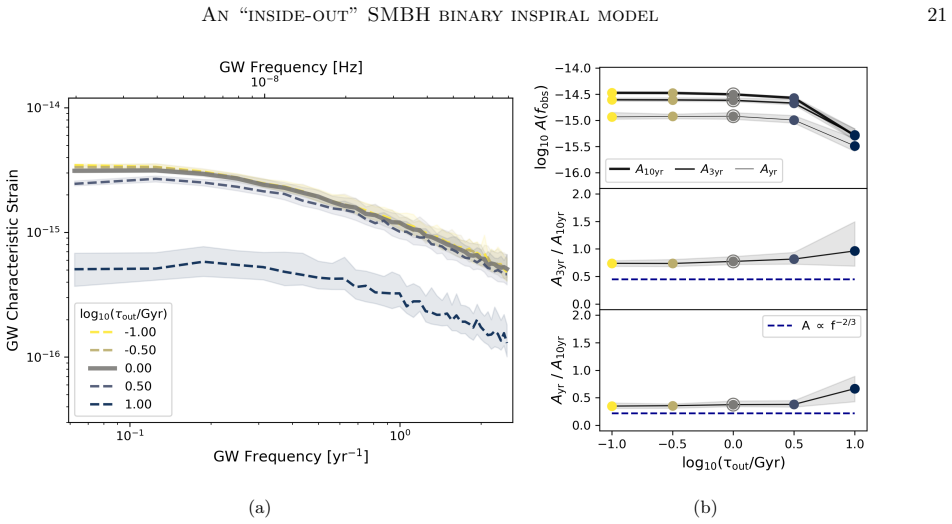
The central discovery is that the spectral shape and amplitude of the GWB are dominated by $a_{\rm GW}$, not by the details of how binaries harden before or after the PTA band. Working backwards from the GW regime, modeling $\dot a\propto a^{1-\nu_{\rm in}}$ just outside $a_{\rm GW}$ and absorbing everything at larger radii into a delay time $\tau_{\rm out}$, the paper finds that varying $a_{\rm GW,9}$ across roughly two orders of magnitude changes the low-frequency amplitude by factors up to $\sim10^3$, whereas varying $\nu_{\rm in}$, $\tau_{\rm out}$, $r_{\rm char}$, or the mass-ratio scaling of $a_{\rm GW}$ leaves the spectrum nearly unchanged. Requiring sub-relativistic hardening rates and a detectable background restricts $a_{\rm GW,9}$ to roughly $20$--$6000\,R_g$, with the peak, near-power-law spectrum at $a_{\rm GW,9}\sim500$--$2000\,R_g$ corresponding to efficient astrophysical transport to the edge of the PTA band followed by a GW-driven sweep through it. The paper therefore proposes that $a_{\rm GW}$ be treated as a free parameter in PTA analyses rather than implicitly fixed by outer inspiral assumptions.
Load-bearing premise
The model assumes every binary's astrophysical hardening, from the start of the PTA regime down to the GW transition, follows one fixed power law in separation, with no eccentricity, so one averaged index represents all environments.
Editorial extensions
If this is right
- PTA analyses should fit $a_{\rm GW,9}$ as a free parameter rather than absorbing it into a fixed total inspiral timescale, since the GWB amplitude and slope vary by orders of magnitude across the allowed range.
- A measured turnover or slope of the GWB can be translated into an allowed window for $a_{\rm GW,9}$, directly tying the background to the binary separation where astrophysics loses to gravity.
- Because the GWB is largely blind to $\beta_{\rm GW}$ and only weakly sensitive to $\alpha_{\rm GW}$, those scalings must be constrained through other observables, chiefly SMBHB merger rates and LISA event rates.
- The range of viable $a_{\rm GW,9}$ shrinks as PTA observation time grows; a 100-year dataset cannot be modeled self-consistently with GW-only inspiral for binaries below a few times $10^9\,M_\odot$, strengthening the case for astrophysical hardening in the band.
- If future data favor gas-like $\nu_{\rm in}$ or stellar-like $\nu_{\rm in}$, that would indicate the dominant hardening channel in the nHz regime and inform whether mergers are likely to have electromagnetic counterparts.
Reading between the lines
- If the paper is right, the next round of PTA parameter estimation should see $a_{\rm GW,9}$ and $\nu_{\rm in}$ as nearly orthogonal axes, with $a_{\rm GW,9}$ controlling overall amplitude and turnover while $\nu_{\rm in}$ controls spectral steepness only at the high-$a_{\rm GW,9}$ or low-$a_{\rm GW,9}$ extremes.
- A testable extension would be to repeat the exercise with a two-slope inner hardening law, such as gas at small radii and stars at larger radii; the paper's own sensitivity ranking could shift toward $\nu_{\rm in}$ if real hardening is not a single power law.
- The paper's mass-threshold result implies that as PTAs accumulate decades of data, any claimed GWB from low-mass SMBHBs will require either direct evidence of astrophysical hardening or an exotic explanation, since GW-only inspiral cannot bring them through the band in time.
- Because LISA event rates are claimed to be more sensitive to $\alpha_{\rm GW}$ and $\beta_{\rm GW}$ than the GWB is, combining PTA and LISA data would be the cleanest way to pin down the mass scaling of $a_{\rm GW}$.
Editorial analysis
A structured set of objections, weighed in public.
Referee Report
Summary. The paper proposes an 'inside-out' analytic model for supermassive-black-hole binary inspiral, in which the astrophysical hardening rate in the inner regime is a single power law anchored to the transition radius a_GW where the astrophysical and GW-driven hardening timescales are equal; the outer evolution is compressed into a delay time tau_out. Using the holodeck population code, the author computes GWB spectra for a set of fiducial models and parameter sweeps. The main claims are that the nHz GWB shape and amplitude are most sensitive to a_GW,9, that only a_GW,9 ~20-6000 R_g are consistent with an observable SMBHB background, and that a_GW should therefore be a free parameter in PTA analyses. The paper also derives a minimum-mass self-consistency criterion for GW-only hardening models and compares the framework with stellar- and gas-driven hardening expectations.
Significance. The paper's central idea is useful and timely: it provides a minimal, computationally cheap parameterization that isolates the PTA-relevant portion of binary evolution and makes a falsifiable prediction (the allowed a_GW,9 window). The analysis is transparent, uses standard Peters (1964) equations, and explicitly checks physicality via |dot a| <= c. The author is candid about limitations (eccentricity, single power law, no orbital softening, and the alternative parameterization in Appendix A). If the sensitivity ranking survives a parameterization-robust test, the paper would strengthen the case for treating a_GW as a key PTA-inference parameter and would be a useful reference for future PTA analyses.
major comments (2)
- [§2.3, Eq. (8); Appendix A] The sensitivity analysis for a_GW,9 conflates the transition radius with the overall normalization of the inner astrophysical hardening rate. In Eq. (8), dot a_in(a) = dot a_GW(a_GW) (a/a_GW)^{1-nu_in}, and since dot a_GW(a_GW) ∝ M^3 a_GW^{-3}, for fixed a and nu_in the inner hardening rate scales as a_GW^{-(4-nu_in)}. Thus varying a_GW,9 changes both the location of the astrophysical-to-GW transition and the hardening rate at every separation in the inner regime. Appendix A outlines an alternative parameterization in which dot a(r_char) is an independent input and nu_in is derived, which would decouple these effects, but no GWB calculations are presented for that parameterization. Because the central claim that a_GW is the dominant parameter, and the inferred allowed range a_GW,9 ~20-6000 R_g, depend on the chosen normalization, the author should either implement the Appendix A parameterization and show whether the strong sensitivity persists, or explicitly restrict the claim to the Eq. (8) normalization.
- [§3.5; §2.3] The sensitivity ranking of a_GW versus nu_in rests on the assumption that the inner astrophysical hardening rate is a single power law from r_char to a_GW for all binaries. Figures 9 and 10 show that nu_in can strongly modulate the GWB in the gas-like and stellar-like regimes, so a broken power law or a mixture of hardening channels could plausibly alter the ranking. The paper acknowledges this possibility in §3.7 and §4.1 but does not quantify its impact on the allowed a_GW window. A robustness test with, for example, a two-slope inner hardening law, or with the Appendix A parameterization, would make the central claim substantially more robust.
minor comments (4)
- [Abstract and Section 5] The statement that a_GW,9 ~20-6000 R_g are consistent with an observable GWB 'across a wide range in other model parameters' should be qualified as the union over the models considered, since no single model admits the entire range; for example, Bstar requires a_GW,9 >= 10^3.25 R_g and the gas-like models show no observable GWB above roughly 10^3 R_g.
- [Section 1] The quoted value H0 = 0.6933 km s^-1 Mpc^-1 appears to be a factor-of-100 typo; the intended WMAP9 value is 69.33 km s^-1 Mpc^-1.
- [Figure 2 caption] The schematic labels such as 'f_em 10^9 M_sun = 1/(20yr)' are ambiguous; clarifying the axes and annotations would improve readability.
- [References] The DOI given for Sato-Polito et al. (2025), '10.1103/1br7-s1rc', looks malformed and should be checked.
Circularity Check
No significant circularity; the a_GW sensitivity is a computed forward-model result, and self-citations are limited to non-load-bearing infrastructure.
full rationale
The paper is a forward parameter study, not a fit to GWB data: it specifies the inside-out hardening law (Eqs. 8–12), feeds it into the holodeck population synthesis code, and computes GWB spectra for chosen parameter values. The central claim that the GWB is most sensitive to a_GW is a computed sensitivity result: with other parameters at fiducial values, varying a_GW moves the transition radius and, via Eq. (8), also changes the normalization of the inner astrophysical hardening rate, but the paper independently varies ν_in, τ_out, α_GW, β_GW, and r_char and finds weaker or negligible effects. That ranking is not an identity; it is a model output. The allowed range a_GW,9 ~ 20–6000 R_g follows from the imposed physical criteria (|ẏ| < c and τ_in+gw < t_H) together with the requirement of a detectable GWB, not from fitting the GWB. The alternative parameterization in Appendix A (ẏ(r_char) as input, ν_in derived) is only outlined; the absence of GWB calculations for that parameterization is a robustness/completeness gap regarding whether the normalization coupling in Eq. (8) inflates a_GW sensitivity, but it is not a circular reduction of the paper's result to its input. Self-citations (Kelley et al. 2017a,b; holodeck/NG15Astro; Harris et al. 2026) support the computational infrastructure and comparison values; none is load-bearing for the main claim, and no uniqueness theorem or forced choice is imported. Thus there is no circular step, and the score is 2 only because the paper leans on prior work by the same group for the holodeck framework and the 2PL ansatz, which are normal, non-circular dependencies.
Assumptions & free parameters
free parameters (7)
- a_GW,9 =
10^2.5 R_g
- α_GW =
-1/4
- β_GW =
+1/4
- ν_in =
0
- r_char,9 =
1 pc
- α_char =
-2/3
- τ_out =
1 Gyr
assumptions (7)
- standard math Gravitational radiation from circular binaries follows Peters (1964) formulae.
- domain assumption All binaries are circular with zero eccentricity.
- ad hoc to paper The inner astrophysical hardening rate follows a single power law from r_char down to a_GW.
- domain assumption The outer astrophysical inspiral is modeled only as a constant delay time τ_out for all binaries.
- domain assumption A single set of hardening parameters applies to all binaries across the full mass and redshift range.
- domain assumption The galaxy population inputs (GSMF, merger rate, M_BH-M_bulge) are taken from literature and held fixed.
- ad hoc to paper The maximum hardening rate |a_dot| is capped at the speed of light c.
Cite this review
Pith. "Pith review of An "inside-out" approach to modeling supermassive black hole binary inspiral." pith.science (2026). https://pith.science/paper/AYGTEMU3
@misc{pith2026260806269,
  author       = {Pith},
  title        = {Pith review of: An "inside-out" approach to modeling supermassive black hole binary inspiral},
  year         = {2026},
  howpublished = {\url{https://pith.science/paper/AYGTEMU3}},
  note         = {Machine review of arXiv:2608.06269}
}
abstract
The inspiral and merger of two supermassive black holes (SMBHs) releases immense energy in low-frequency gravitational waves (GWs). Recent pulsar timing array (PTA) observations of the stochastic nHz GW background (GWB) are consistent with a SMBH binary origin. GW data from PTAs and from the upcoming Laser Interferometer Space Antenna (LISA) can probe late-stage binary evolution where electromagnetic constraints are scarce. However, the complexity of the relevant astrophysics necessitates a well optimized approach. I argue that a key physical quantity to constrain with PTAs is the orbital semi-major axis at which binary inspiral transitions from the astrophysical to the GW-dominated regime ($a_{\rm GW}$). This quantity should be treated as a free parameter in analysis of the GWB. Using this premise, I present a simple analytic framework for modeling SMBH binary inspiral in an "inside-out" fashion. At orbital separations slightly larger than $a_{\rm GW}$, a power-law scaling for the astrophysical inspiral timescale is assumed, while the outermost phase (prior to the PTA regime) is simply modeled via a delay time. I show that the GWB spectral shape and amplitude are most sensitive to $a_{\rm GW}$ (normalized to $10^9 M_{\odot}$, equal-mass binaries and expressed in gravitational units), with weaker dependence on the inner power-law index and the outer delay time. The GWB is largely insensitive to the mass and mass-ratio scaling of $a_{\rm GW}$ and to the boundary between the inner and outer astrophysical inspiral regimes. I compare with models for gas- and stellar-driven binary inspiral and discuss implications for LISA and for GW source parameter inference.
Figures


Figures from the paper (8 more)



Reference graph
Works this paper leans on
-
[1]
2023, ApJL, 951, L11, doi: 10.3847/2041-8213/acdc91
Afzal, A., Agazie, G., Anumarlapudi, A., et al. 2023, ApJL, 951, L11, doi: 10.3847/2041-8213/acdc91
-
[2]
Agarwal, N., Agazie, G., Anumarlapudi, A., et al. 2026, ApJL, 998, L11, doi: 10.3847/2041-8213/ae3719 An “inside-out” SMBH binary inspiral model27
-
[3]
Agazie, G., Anumarlapudi, A., Archibald, A. M., et al. 2023a, ApJL, 951, L8, doi: 10.3847/2041-8213/acdac6
-
[4]
Agazie, G., Anumarlapudi, A., Archibald, A. M., et al. 2023b, ApJL, 952, L37, doi: 10.3847/2041-8213/ace18b
-
[5]
Agazie, G., Anumarlapudi, A., Archibald, A. M., et al. 2023c, ApJL, 951, L50, doi: 10.3847/2041-8213/ace18a
-
[6]
2017, arXiv e-prints, arXiv:1702.00786
Amaro-Seoane, P., Audley, H., Babak, S., et al. 2017, arXiv e-prints, arXiv:1702.00786. https://arxiv.org/abs/1702.00786
arXiv 2017
-
[7]
2023, Living Reviews in Relativity, 26, 2, doi: 10.1007/s41114-022-00041-y
Amaro-Seoane, P., Andrews, J., Arca Sedda, M., et al. 2023, Living Reviews in Relativity, 26, 2, doi: 10.1007/s41114-022-00041-y
-
[8]
Armitage, P. J., & Natarajan, P. 2002, ApJL, 567, L9, doi: 10.1086/339770
doi:10.1086/339770 2002
Show all 100 references
-
[9]
2012, MNRAS, 423, 2533, doi: 10.1111/j.1365-2966.2012.21057.x
Barausse, E. 2012, MNRAS, 423, 2533, doi: 10.1111/j.1365-2966.2012.21057.x
2012
-
[10]
C., Blandford, R
Begelman, M. C., Blandford, R. D., & Rees, M. J. 1980, Nature, 287, 307, doi: 10.1038/287307a0
1980 doi
-
[11]
2006, ApJL, 642, L21, doi: 10.1086/504426
Berczik, P., Merritt, D., Spurzem, R., & Bischof, H.-P. 2006, ApJL, 642, L21, doi: 10.1086/504426
2006 doi
-
[13]
2010, ApJ, 715, 1117, doi: 10.1088/0004-637X/715/2/1117 Bogdanovi´ c, T., Miller, M
Shoemaker, D. 2010, ApJ, 715, 1117, doi: 10.1088/0004-637X/715/2/1117 Bogdanovi´ c, T., Miller, M. C., & Blecha, L. 2022, Living Reviews in Relativity, 25, 3, doi: 10.1007/s41114-022-00037-8
2010 doi
-
[14]
2016, MNRAS, 461, 4419, doi: 10.1093/mnras/stw1590
Bonetti, M., Haardt, F., Sesana, A., & Barausse, E. 2016, MNRAS, 461, 4419, doi: 10.1093/mnras/stw1590
2016 doi
-
[15]
2018a, MNRAS, 477, 3910, doi: 10.1093/mnras/sty896
Bonetti, M., Haardt, F., Sesana, A., & Barausse, E. 2018a, MNRAS, 477, 3910, doi: 10.1093/mnras/sty896
-
[16]
2018b, MNRAS, 477, 2599, doi: 10.1093/mnras/sty874
Bonetti, M., Sesana, A., Barausse, E., & Haardt, F. 2018b, MNRAS, 477, 2599, doi: 10.1093/mnras/sty874
-
[17]
2019, MNRAS, 486, 4044, doi: 10.1093/mnras/stz903
Bonetti, M., Sesana, A., Haardt, F., Barausse, E., & Colpi, M. 2019, MNRAS, 486, 4044, doi: 10.1093/mnras/stz903
2019 doi
-
[18]
2025, arXiv e-prints, arXiv:2509.12325, doi: 10.48550/arXiv.2509.12325
Bonoli, S., Izquierdo-Villalba, D., Spinoso, D., et al. 2025, arXiv e-prints, arXiv:2509.12325, doi: 10.48550/arXiv.2509.12325
2025 doi
-
[19]
Noble, S. C. 2017, ApJ, 838, 42, doi: 10.3847/1538-4357/aa63f3
2017 doi
-
[21]
2016, MNRAS, 463, 2145, doi: 10.1093/mnras/stw1838
Charisi, M., Bartos, I., Haiman, Z., et al. 2016, MNRAS, 463, 2145, doi: 10.1093/mnras/stw1838
2016 doi
-
[22]
2014, SSRv, 183, 189, doi: 10.1007/s11214-014-0067-1
Colpi, M. 2014, SSRv, 183, 189, doi: 10.1007/s11214-014-0067-1
2014 doi
-
[23]
M., & Simon, J
Comerford, J. M., & Simon, J. 2025, ApJ, 994, 168, doi: 10.3847/1538-4357/ae1133 D’Orazio, D. J., & Duffell, P. C. 2021, ApJL, 914, L21, doi: 10.3847/2041-8213/ac0621 D’Orazio, D. J., Haiman, Z., & Schiminovich, D. 2015, Nature, 525, 351, doi: 10.1038/nature15262
2025 doi
-
[24]
C., D’Orazio, D., Derdzinski, A., et al
Duffell, P. C., D’Orazio, D., Derdzinski, A., et al. 2020, ApJ, 901, 25, doi: 10.3847/1538-4357/abab95 EPTA Collaboration, InPTA Collaboration, Antoniadis, J., et al. 2023, A&A, 678, A50, doi: 10.1051/0004-6361/202346844 EPTA Collaboration, InPTA Collaboration, Antoniadis, J.,...
2020 doi
-
[25]
A., Halpern, J
Eracleous, M., Boroson, T. A., Halpern, J. P., & Liu, J. 2012, ApJS, 201, 23, doi: 10.1088/0067-0049/201/2/23
2012 doi
-
[26]
B., Coppi, P
Escala, A., Larson, R. B., Coppi, P. S., & Mardones, D. 2005, ApJ, 630, 152, doi: 10.1086/431747
2005 doi
-
[27]
D., Duffell, P., MacFadyen, A
Farris, B. D., Duffell, P., MacFadyen, A. I., & Haiman, Z. 2014, ApJ, 783, 134, doi: 10.1088/0004-637X/783/2/134
2014 doi
-
[28]
D., Duffell, P., MacFadyen, A
Farris, B. D., Duffell, P., MacFadyen, A. I., & Haiman, Z. 2015, MNRAS, 447, L80, doi: 10.1093/mnrasl/slu184
2015 doi
-
[29]
D., Liu, Y
Farris, B. D., Liu, Y. T., & Shapiro, S. L. 2010, PhRvD, 81, 084008, doi: 10.1103/PhysRevD.81.084008
2010 doi
-
[30]
Gardiner, E. C. 2026, in preparation
2026
-
[31]
C., B´ ecsy, B., Kelley, L
Gardiner, E. C., B´ ecsy, B., Kelley, L. Z., & Cornish, N. J. 2025, ApJ, 988, 222, doi: 10.3847/1538-4357/ade4c2
2025 doi
-
[32]
C., Kelley, L
Gardiner, E. C., Kelley, L. Z., Lemke, A.-M., & Mitridate, A. 2024, ApJ, 965, 164, doi: 10.3847/1538-4357/ad2be8
2024 doi
-
[33]
Pfeiffer, H. P. 2014, PhRvD, 89, 064060, doi: 10.1103/PhysRevD.89.064060
2014 doi
-
[34]
I., Dehnen, W., & Bortolas, E
Gualandris, A., Read, J. I., Dehnen, W., & Bortolas, E. 2017, Monthly Notices of the Royal Astronomical Society, 464, 2301, doi: 10.1093/mnras/stw2528
2017 doi
-
[35]
2009, ApJ, 700, 1952, doi: 10.1088/0004-637X/700/2/1952
Haiman, Z., Kocsis, B., & Menou, K. 2009, ApJ, 700, 1952, doi: 10.1088/0004-637X/700/2/1952
2009 doi
-
[36]
J., G¨ ultekin, K., & Blecha, L
Harris, C. J., G¨ ultekin, K., & Blecha, L. 2026, arXiv e-prints, arXiv:2601.07762, doi: 10.48550/arXiv.2601.07762
2026 doi
-
[37]
2007, MNRAS, 377, 957, doi: 10.1111/j.1365-2966.2007.11694.x
Hoffman, L., & Loeb, A. 2007, MNRAS, 377, 957, doi: 10.1111/j.1365-2966.2007.11694.x
2007
-
[38]
2008, ApJ, 686, 829, doi: 10.1086/591218
Yunes, N. 2008, ApJ, 686, 829, doi: 10.1086/591218
2008 doi
-
[39]
Holley-Bockelmann, K., & Khan, F. M. 2015, ApJ, 810, 139, doi: 10.1088/0004-637X/810/2/139
2015 doi
-
[40]
2006, arXiv e-prints, astro
Holley-Bockelmann, K., & Sigurdsson, S. 2006, arXiv e-prints, astro. https://arxiv.org/abs/astro-ph/0601520
2006 arXiv
-
[41]
M., Williams, I., et al
Holley-Bockelmann, K., Khan, F. M., Williams, I., et al. 2025, ApJL, 995, L32, doi: 10.3847/2041-8213/ae1ccd 28L. Blecha
2025 doi
-
[42]
2022, MNRAS, 509, 3488, doi: 10.1093/mnras/stab3239
Izquierdo-Villalba, D., Sesana, A., Bonoli, S., & Colpi, M. 2022, MNRAS, 509, 3488, doi: 10.1093/mnras/stab3239
2022 doi
-
[43]
L., Kelley, L
Katz, M. L., Kelley, L. Z., Dosopoulou, F., et al. 2020, MNRAS, 491, 2301, doi: 10.1093/mnras/stz3102
2020 doi
-
[44]
Z., Blecha, L., & Hernquist, L
Kelley, L. Z., Blecha, L., & Hernquist, L. 2017a, MNRAS, 464, 3131, doi: 10.1093/mnras/stw2452
-
[45]
Taylor, S. R. 2017b, MNRAS, 471, 4508, doi: 10.1093/mnras/stx1638
-
[46]
Taylor, S. R. 2018, MNRAS, 477, 964, doi: 10.1093/mnras/sty689
2018 doi
-
[47]
Z., Gardiner, E
Kelley, L. Z., Gardiner, E. C., Wright, D., et al. 2024, nanograv/holodeck: v1.5.2, v1.5.2 Zenodo, doi: 10.5281/zenodo.10966412
2024 doi
-
[48]
M., Berczik, P., & Just, A
Khan, F. M., Berczik, P., & Just, A. 2018, A&A, 615, A71, doi: 10.1051/0004-6361/201730489
2018 doi
-
[49]
M., Holley-Bockelmann, K., Berczik, P., & Just, A
Khan, F. M., Holley-Bockelmann, K., Berczik, P., & Just, A. 2013, ApJ, 773, 100, doi: 10.1088/0004-637X/773/2/100
2013 doi
-
[50]
M., Just, A., & Merritt, D
Khan, F. M., Just, A., & Merritt, D. 2011, ApJ, 732, 89, doi: 10.1088/0004-637X/732/2/89
2011 doi
-
[51]
M., Preto, M., Berczik, P., et al
Khan, F. M., Preto, M., Berczik, P., et al. 2012, ApJ, 749, 147, doi: 10.1088/0004-637X/749/2/147
2012 doi
-
[52]
2011, MNRAS, 411, 1467, doi: 10.1111/j.1365-2966.2010.17782.x
Kocsis, B., & Sesana, A. 2011, MNRAS, 411, 1467, doi: 10.1111/j.1365-2966.2010.17782.x
2011
-
[53]
Kormendy, J., & Ho, L. C. 2013, ARA&A, 51, 511, doi: 10.1146/annurev-astro-082708-101811
2013 doi
-
[54]
R., Matt, C., & G¨ ultekin, K
Laal, N., Taylor, S. R., Matt, C., & G¨ ultekin, K. 2026, The Astrophysical Journal, 1004, 90, doi: 10.3847/1538-4357/ae6cea
2026 doi
-
[55]
R., Kelley, L
Laal, N., Taylor, S. R., Kelley, L. Z., et al. 2025, ApJ, 982, 55, doi: 10.3847/1538-4357/adb4ef
2025 doi
-
[56]
Lai, D., & Mu˜ noz, D. J. 2023, ARA&A, 61, 517, doi: 10.1146/annurev-astro-052622-022933
2023 doi
-
[57]
S., Johnson, B
Leja, J., Speagle, J. S., Johnson, B. D., et al. 2020, ApJ, 893, 111, doi: 10.3847/1538-4357/ab7e27
2020 doi
-
[58]
R., & Bonetti, M
Li, K., Bogdanovi´ c, T., Ballantyne, D. R., & Bonetti, M. 2023, ApJ, 959, 3, doi: 10.3847/1538-4357/ad04d2
2023 doi
-
[59]
R., & Ma, C.-P
Liepold, E. R., & Ma, C.-P. 2024, ApJL, 971, L29, doi: 10.3847/2041-8213/ad66b8
2024 doi
-
[60]
I., & Milosavljevi´ c, M
MacFadyen, A. I., & Milosavljevi´ c, M. 2008, ApJ, 672, 83, doi: 10.1086/523869
2008 doi
-
[61]
Z., et al
Matt, C., G¨ ultekin, K., Kelley, L. Z., et al. 2026a, ApJ, 997, 188, doi: 10.3847/1538-4357/ae2480
- [62]
-
[63]
2007, Science, 316, 1874, doi: 10.1126/science.1141858
Mayer, L., Kazantzidis, S., Madau, P., et al. 2007, Science, 316, 1874, doi: 10.1126/science.1141858
2007 doi
-
[64]
2005, Living Reviews in Relativity, 8, 8, doi: 10.12942/lrr-2005-8 Milosavljevi´ c, M., & Phinney, E
Merritt, D., & Milosavljevi´ c, M. 2005, Living Reviews in Relativity, 8, 8, doi: 10.12942/lrr-2005-8 Milosavljevi´ c, M., & Phinney, E. S. 2005, ApJL, 622, L93, doi: 10.1086/429618
2005 doi
-
[65]
Moody, M. S. L., Shi, J.-M., & Stone, J. M. 2019, ApJ, 875, 66, doi: 10.3847/1538-4357/ab09ee Mu˜ noz, D. J., Lai, D., Kratter, K., & Mirand a, R. 2020, ApJ, 889, 114, doi: 10.3847/1538-4357/ab5d33 Mu˜ noz, D. J., Miranda, R., & Lai, D. 2019, ApJ, 871, 84, doi: 10.3847/1538-43...
2019 doi
-
[66]
2015, Astronomy and Computing, 13, 12, doi: 10.1016/j.ascom.2015.09.003
Nelson, D., Pillepich, A., Genel, S., et al. 2015, Astronomy and Computing, 13, 12, doi: 10.1016/j.ascom.2015.09.003
2015 doi
-
[67]
C., Mundim, B
Noble, S. C., Mundim, B. C., Nakano, H., et al. 2012, ApJ, 755, 51, doi: 10.1088/0004-637X/755/1/51
2012 doi
-
[68]
2021, ApJL, 910, L26, doi: 10.3847/2041-8213/abee21
Paschalidis, V., Bright, J., Ruiz, M., & Gold, R. 2021, ApJL, 910, L26, doi: 10.3847/2041-8213/abee21
2021 doi
-
[69]
Peters, P. C. 1964, Physical Review, 136, 1224, doi: 10.1103/PhysRev.136.B1224
1964 doi
- [70]
- [71]
-
[72]
Quinlan, G. D. 1996, NewA, 1, 35, doi: 10.1016/S1384-1076(96)00003-6
1996 doi
-
[73]
D., & Hernquist, L
Quinlan, G. D., & Hernquist, L. 1997, NewA, 2, 533, doi: 10.1016/S1384-1076(97)00039-0
1997 doi
-
[74]
Ravi, V., Wyithe, J. S. B., Hobbs, G., et al. 2012, ApJ, 761, 84, doi: 10.1088/0004-637X/761/2/84
2012 doi
-
[75]
J., Zic, A., Shannon, R
Reardon, D. J., Zic, A., Shannon, R. M., et al. 2023, ApJL, 951, L6, doi: 10.3847/2041-8213/acdd02
2023 doi
-
[76]
2018, MNRAS, 481, 3278, doi: 10.1093/mnras/sty2448
Ricarte, A., & Natarajan, P. 2018, MNRAS, 481, 3278, doi: 10.1093/mnras/sty2448
2018 doi
-
[77]
B., Zavala, R
Rodriguez, C., Taylor, G. B., Zavala, R. T., et al. 2006, ApJ, 646, 49, doi: 10.1086/504825
2006 doi
-
[78]
2015, MNRAS, 449, 49, doi: 10.1093/mnras/stv264
Rodriguez-Gomez, V., Genel, S., Vogelsberger, M., et al. 2015, MNRAS, 449, 49, doi: 10.1093/mnras/stv264
2015 doi
-
[79]
E., & Warren, M
Roebber, E., Holder, G., Holz, D. E., & Warren, M. 2016, ApJ, 819, 163, doi: 10.3847/0004-637X/819/2/163
2016 doi
-
[80]
2011, MNRAS, 415, 3033, doi: 10.1111/j.1365-2966.2011.18927.x
Roedig, C., Dotti, M., Sesana, A., Cuadra, J., & Colpi, M. 2011, MNRAS, 415, 3033, doi: 10.1111/j.1365-2966.2011.18927.x
2011
-
[81]
Satheesh, P., Blecha, L., & Kelley, L. Z. 2025, ApJ, 993, 222, doi: 10.3847/1538-4357/ae0a48
2025 doi
- [82]
- [83]
-
[84]
2025, PhRvD, 112, 123018, doi: 10.1103/1br7-s1rc
Sato-Polito, G., Zaldarriaga, M., & Quataert, E. 2025, PhRvD, 112, 123018, doi: 10.1103/1br7-s1rc
2025 doi
-
[85]
2010, ApJ, 719, 851, doi: 10.1088/0004-637X/719/1/851
Sesana, A. 2010, ApJ, 719, 851, doi: 10.1088/0004-637X/719/1/851
2010 doi
-
[86]
2006, ApJ, 651, 392, doi: 10.1086/507596
Sesana, A., Haardt, F., & Madau, P. 2006, ApJ, 651, 392, doi: 10.1086/507596
2006 doi
-
[87]
Sesana, A., Haiman, Z., Kocsis, B., & Kelley, L. Z. 2018, ApJ, 856, 42, doi: 10.3847/1538-4357/aaad0f
2018 doi
-
[88]
Sesana, A., & Khan, F. M. 2015, MNRAS, 454, L66, doi: 10.1093/mnrasl/slv131
2015 doi
-
[89]
Sesana, A., Vecchio, A., & Colacino, C. N. 2008, MNRAS, 390, 192, doi: 10.1111/j.1365-2966.2008.13682.x
2008
-
[90]
2009, Classical and Quantum Gravity, 26, 094033, doi: 10.1088/0264-9381/26/9/094033
Sesana, A., Volonteri, M., & Haardt, F. 2009, Classical and Quantum Gravity, 26, 094033, doi: 10.1088/0264-9381/26/9/094033
2009 doi
-
[91]
H., Lubow, S
Shi, J.-M., Krolik, J. H., Lubow, S. H., & Hawley, J. F. 2012, ApJ, 749, 118, doi: 10.1088/0004-637X/749/2/118
2012 doi
-
[92]
Z., & Hernquist, L
Siwek, M., Kelley, L. Z., & Hernquist, L. 2024, MNRAS, 534, 2609, doi: 10.1093/mnras/stae2251
2024 doi
-
[93]
2023a, MNRAS, 522, 2707, doi: 10.1093/mnras/stad1131
Siwek, M., Weinberger, R., & Hernquist, L. 2023a, MNRAS, 522, 2707, doi: 10.1093/mnras/stad1131
-
[94]
J., & Hernquist, L
Siwek, M., Weinberger, R., Mu˜ noz, D. J., & Hernquist, L. 2023b, MNRAS, 518, 5059, doi: 10.1093/mnras/stac3263
-
[95]
2018, MNRAS, 476, 2249, doi: 10.1093/mnras/sty423
Tang, Y., Haiman, Z., & MacFadyen, A. 2018, MNRAS, 476, 2249, doi: 10.1093/mnras/sty423
2018 doi
-
[96]
2020, ApJ, 900, 43, doi: 10.3847/1538-4357/aba432
Tiede, C., Zrake, J., MacFadyen, A., & Haiman, Z. 2020, ApJ, 900, 43, doi: 10.3847/1538-4357/aba432
2020 doi
-
[97]
2007, ApJL, 663, L5, doi: 10.1086/519525
Volonteri, M. 2007, ApJL, 663, L5, doi: 10.1086/519525
2007 doi
-
[98]
2003, ApJ, 582, 559, doi: 10.1086/344675
Volonteri, M., Haardt, F., & Madau, P. 2003, ApJ, 582, 559, doi: 10.1086/344675
2003 doi
-
[99]
Wyithe, J. S. B., & Loeb, A. 2003, ApJ, 590, 691, doi: 10.1086/375187
2003 doi
-
[100]
2023, Research in Astronomy and Astrophysics, 23, 075024, doi: 10.1088/1674-4527/acdfa5
Xu, H., Chen, S., Guo, Y., et al. 2023, Research in Astronomy and Astrophysics, 23, 075024, doi: 10.1088/1674-4527/acdfa5
2023 doi
-
[101]
2002, MNRAS, 331, 935, doi: 10.1046/j.1365-8711.2002.05242.x
Yu, Q. 2002, MNRAS, 331, 935, doi: 10.1046/j.1365-8711.2002.05242.x
2002
-
[102]
2021, ApJL, 909, L13, doi: 10.3847/2041-8213/abdd1c
Zrake, J., Tiede, C., MacFadyen, A., & Haiman, Z. 2021, ApJL, 909, L13, doi: 10.3847/2041-8213/abdd1c
2021 doi
Reviewed August 7, 2026 · model on record in the stance chip above.
Discussion (0). Sign in to comment.